15.1 C
London
Wednesday, July 22, 2026
Home Blog

How Australia resisted PRC economic coercion: lessons for others

0
how-australia-resisted-prc-economic-coercion:-lessons-for-others
How Australia resisted PRC economic coercion: lessons for others

The People’s Republic of China has used its statecraft to weaponize its trade with other countries on several occasions in recent years. Such behavior usually arises when the PRC interprets another country’s actions as hostile to its political interests and resorts to nonofficial sanctions, tariffs, regulations, and consumer boycotts that damage a host nation’s economy.

These actions don’t follow market sentiments and can be revoked without a change in any underlying economic concerns the PRC initially used to justify its imposition. Many targeted countries use terms such as economic coercion to refer to trade decisions intended to alter a nation’s policies, behaviors or decisions.

Among the many advanced economies experiencing trade deficits with the PRC, Australia is a unique case. Australia possesses abundant natural resources, from iron ore to coking coal to barley and fisheries. Many of these products became major trading commodities between Australia and the PRC.  However, during the 2010s, concerns arose due to foreign political influence, university funding dependence and Chinese state-linked investment with national security concerns.

Subsequent suspicion of the PRC grew, eventually culminating in Canberra’s call for an investigation into the origin of the Covid-19 virus in the PRC. Beijing responded with retaliatory tariffs against Australia’s exports. However, the PRC has failed to coerce Australia into changing its policies toward China. This, along with Australia’s economic resiliency, has policy implications.

Deteriorating relations

Beginning in 2015, suspicion spiked regarding Chinese state-linked campaigns to influence Australian elites and shape their perceptions of the PRC’s human rights issues, the US-Australia security alliance and the South China Sea. The Australian Security Intelligence Organization reportedly warned various elites and politicians of this issue in 2015.

The suspicion became public in 2016 with the Sam Dastyari case in which Dastyari, a Labor Party politician, made comments in opposition to the Labor Party’s support for Freedom of Navigation Operations (FONOP) in the South China Sea in exchange for donations from the PRC through a donor by the name of Huang Xiangmo. Dastyari reportedly helped Huang avoid the security intelligence apparatus of Australia.

This proved indicative of Chinese espionage tactics, since the United Front Work Department of the PRC prefers to blur the line between legitimate influence and illegal interference, taking advantage of legal gray zones in democratic states to advance Chinese state activities.       

This led Australia to react with stricter legislation and a tougher stance on Chinese interference. Most important was the legal distinction between influence – which includes lobbying, diplomacy and advocacy – and interference, including covert, deceptive, coercive and other actions directed by a foreign state/proxy.

Australia later imposed anti-interference laws and investment screening on Chinese companies to enhance national security, followed by banning Chinese companies such as 5G telecommunication providers Huawei and ZTE from involvement in critical national infrastructures as well as becoming more vocal via diplomatic channels on issues regarding Xinjiang, Hong Kong, Taiwan and the South China Sea.

Origin of the clash

All of the abovementioned culminated in the announcement of an investigation into the origins of Covid-19 by the Australian government, focused on the PRC. In April 2020, Marise Payne, the foreign minister of Australia, called for an independent international investigation into the origin and the global handling of Covid. The call was backed by then-Prime Minister Scott Morrison of the Liberal Party.

Australia partially got what it wanted in May 2020, when the World Health Organization agreed to convene an investigation committee of more than 100 countries, including the PRC, to look into the global response efforts regarding Covid, rather than looking into the virus’s origin.

Despite claiming victory (with no origin inquiry, the findings were less substantial than expected), the PRC then retaliated by imposing and encouraging restrictions on numerous Australian imports, including barley, wine and coal. It also simultaneously claimed that Australia was no longer a suitable education and tourism destination.

In November 2020, the Chinese ambassador in Canberra provided journalists with 14 points of grievance against Australia, including blocking Chinese investments on national security grounds, banning Huawei and ZTE from Australia’s 5G network and issuing the calls for Covid origin investigation

The 14 points became significant because this was one of the rare occasions in which the PRC explicitly claimed political grievances tied to economic coercion. This essentially became the PRC’s “ask” of Australia. Saying trade relations had deteriorated because their policy was not to the PRC’s liking fits a textbook definition of economic coercion.

Australia’s response

Under Morrison, Australia found alternative destinations for its exports. The nominal damage to Australia’s GDP between 2020 and 2023 was less than 1%, though the toll was concentrated in specific sectors.

The Department of Agriculture, Fisheries and Forestry reported a 416% growth (A$251.6 million, or US$173.4 million) in barley exports to Latin American countries between 2022 and 2023, while overall barley exports rose to A$3.3 billion in 2023 despite exports to the PRC dropping to 0%. Australia’s agricultural and fisheries exports in general have also diversified to ASEAN countries, with ASEAN surpassing the PRC as the largest agricultural and fisheries importer during FY 2021-22(21% vs the PRC’s 20%).

Studies have also found that Japan was able to surpass the PRC as the largest importer of Australian coal, taking up 35% (vs the PRC’s 9%) of Australia’s coal export by 2023.

It is important to note that lobster fisheries and wineries weren’t able to diversify as successfully as other targeted industries, with wine exports falling by 30% and lobster exports by 64% between 2020 and 2023.

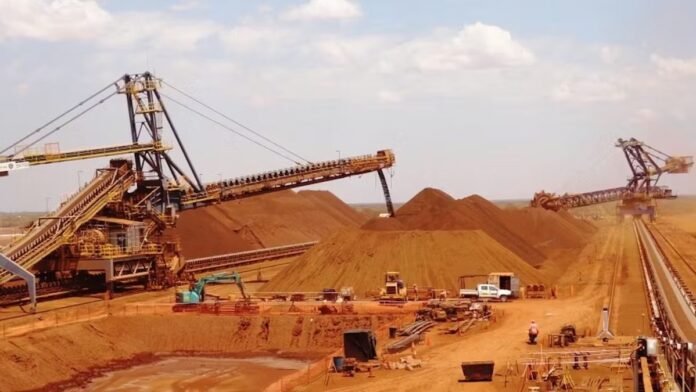
But it’s also noteworthy that the PRC couldn’t get around Australia’s iron ore export. So, despite restricting agricultural products, the PRC did not put an import restriction on Australian iron ore, which continued to generate significant income for Australia. In fact, one can argue that Australia weathered the storm despite massive tariffs from the PRC because of its rich iron ore export industry.

The economic resiliency of Australia paved the road for its political resiliency. Despite warmer diplomatic exchanges under Anthony Albanese, the current prime minister who has governed since his Labor Party’s victory over Morrison’s Liberal Party in 2022, Australia has not changed its strategy. It continued to supply other countries with the stated goods and at higher volume prior to Chinese sanctions.

Australia still doesn’t allow Huawei or ZTE to participate in its 5G network, similar to most developed countries; Australia didn’t revoke the foreign interference law, neither did it pause reviews of existing cases; Australia didn’t change its stance on Hong Kong, Taiwan or the South China Sea; nor did it further distance itself from the US – instead becoming part of the landmark AUKUS (Australia, UK, and US) alliance, whose main goal is to provide Australia with nuclear submarines as well as advanced deterrence capabilities in the Indo-Pacific.

Other actions from Australia include blocking a state agreement to the Belt and Road Initiative and increasing cybersecurity surveillance in cooperation with allies, something the Chinese ambassador explicitly mentioned in his 14 points and urged Australia not to do.

This is highlighted by how the PRC resumed imports and began gradually removing restrictions after Albanese’s meeting with President Xi Jinping of the PRC during the G20 summit. Despite rhetoric on expanding cooperation, the truth is that the PRC removed its import restrictions without Australia changing its political stance or economic model.

Even during the warming-up period between Australia and the PRC, Australia has pursued actions that are against Chinese interests such as promoting rugby league funding to Pacific Island neighbors contingent on their not having security or policy ties to the PRC, as well as criticizing the PRC for conducting military exercises in international waters between Australia and New Zealand.

Australia is a telling case because, unlike those countries that have to worry about whether their dependence on the PRC is mostly upstream or downstream, Australia is itself the upstream producer that exports raw materials to the PRC. This means that Australia’s economic methods during coercion are hard to replicate, since not many developed countries have trade surpluses with the PRC.

What can be learned from this case, and should act as a policy model, is the advantage of pursuing a de-risking strategy, aimed at diversifying a country’s supply chain to rely less on the PRC.

In the case of Australia, the PRC took great offense at being targeted internationally, and sought to punish Australia economically to extract political concessions. Yet, once there was no Australian concession, either economically or politically, the PRC was quick to realize the economic necessity of continued trade, so the meeting between Albanese and Xi became a staircase for the PRC to dial back on its coercion despite fundamentally changing nothing.

In order to reduce the economic damage of coercion, it is important to understand which part of the supply chain one stands upon instead of assuming, by looking at the PRC’s size, that it is indispensable. View economic leverage as inevitable in extrapolating political concessions. With the PRC’s economic coercion methods becoming more sophisticated, it’s imperative for countries to pursue de-risking strategies if they wish to avoid constant and random trade restrictions from the PRC.

Henry Xuan (henry@pacforum.org) is a research intern at the Pacific Forum and a master’s student in Asian Studies at Georgetown University. His area of research is international business and economics – in particular, in the Indo-Pacific, supply chain resiliency, economic policies and geopolitical risks’ impact on businesses.

Let Tom Hiddleston be your guide to Pompeii’s final day

0
let-tom-hiddleston-be-your-guide-to-pompeii’s-final-day
Let Tom Hiddleston be your guide to Pompeii’s final day

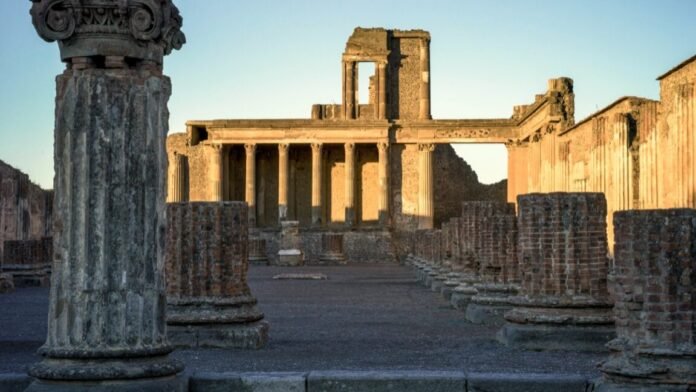
When Mount Vesuvius erupted in 79 CE, it spewed molten rock, pumice, and hot ash over the cities of Pompeii and Herculaneum, killing thousands of people. It’s one of the most famous natural disasters in human history, so naturally there have been countless documentaries about Pompeii (and at least one popular song). But only one features actor Tom Hiddleston taking on the role of a “time detective” to bring the people of Pompeii to vivid life. That would be National Geographic’s new three-part docuseries, Pompeii: Out of Time.

The Marvel connection made Out of Time happen. Executive producer Kevin Wright was also a producer on the Disney+ series Loki, which included a scene where Hiddleston’s Loki travels through time to visit Pompeii. Hiddleston also studied classics at Cambridge University and had visited the Pompeii archaeological site as a teenager, which the Marvel star attributes to indirectly influencing his career path into acting.

“There is just a passion to the way Tom tells stories that’s infectious,” Wright told Ars. “We knew that if we could capture that and put it into [the series], it might interest people who wouldn’t normally want to watch a documentary about Pompeii. “

The docuseries combines the usual historical and scientific facts with Hiddleston’s personal journey of discovery. He homes in on three people in particular and follows them over the city’s final 24 hours to discover whether or not they survived: a teenage boy, a local businesswoman, and a Praetorian guard. Stilted re-enactments are replaced with scripted dramatic scenes and high production values to make it all feel more cinematic. It’s an unusual approach, if only because we’re so conditioned to what a documentary “should” be. But the blended approach makes for a powerful experience.

“We felt we could use the imagination to make a more human story. This isn’t just ancient history; these were real people, and their lives were not dramatically different than ours even though they lived 2,000 years ago,” said Wright. “One of the most freeing moments was when we came to this idea of ‘historia,’ the merging of imagination and historical fact, and that ‘storytelling’ and ‘history’ in Latin are the same word. It was Hiddleston who put us onto that. When we went to our historians, our experts, with that word, we were met with nothing but enthusiasm. There seems to be a real movement in archaeology of, ‘This is how you have to approach it now.’”

A time detective

Tom Hiddleston examines an inscription at the Gatehouse ruins in Pompeii.

Tom Hiddleston examines an inscription at the Gatehouse ruins in Pompeii.

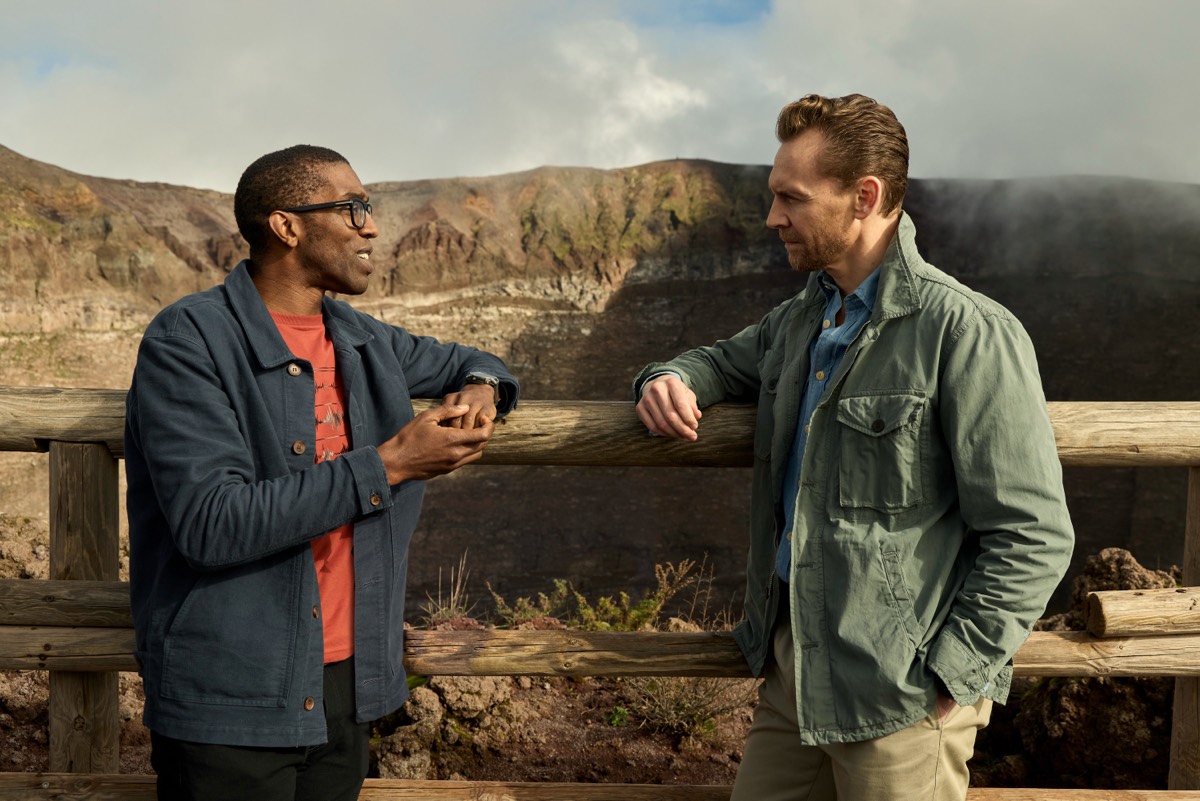
Chris Jackson and Tom Hiddleston discuss the events at Pompeii from atop Mt. Vesuvius.

Geologist Chris Jackson and Hiddleston discuss the events at Pompeii from atop Mt. Vesuvius.

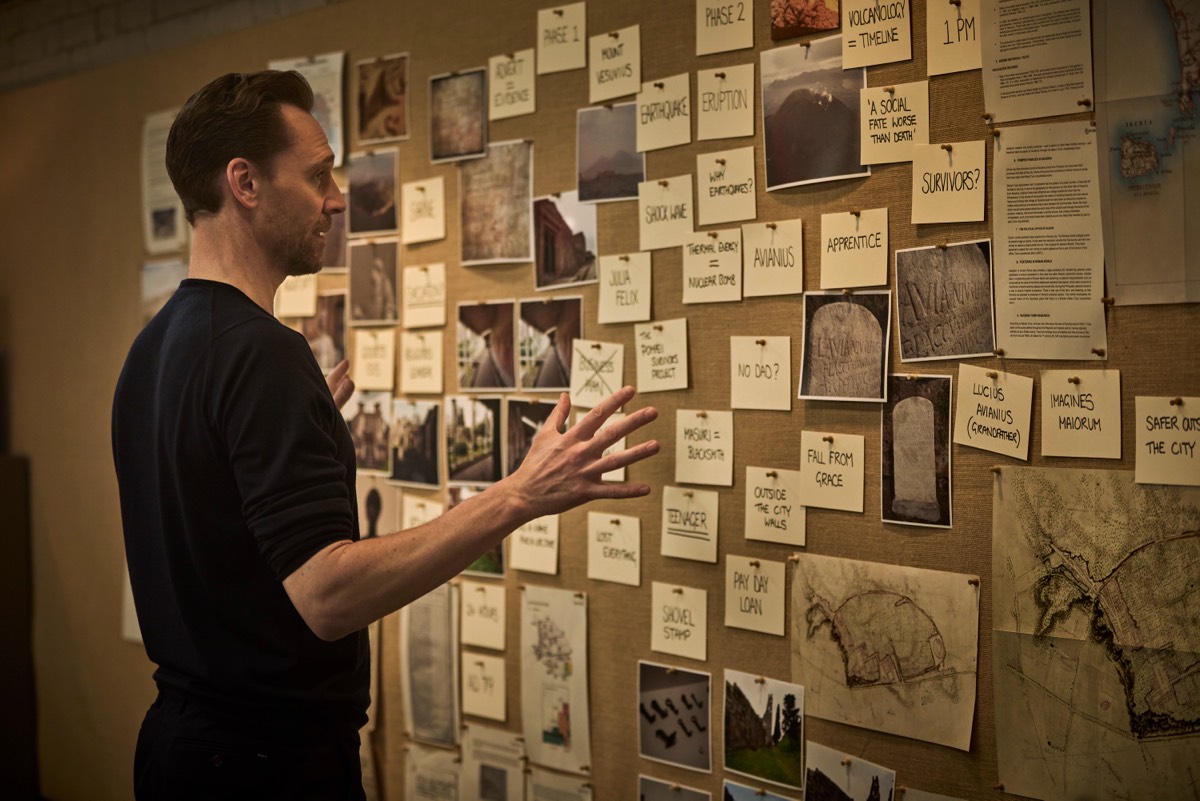
Hiddleston examines a pinboard with clues as to how the events at Pompeii unfolded after the eruption of Mt. Vesuvius.

Hiddleston examines a pinboard with clues as to how the events at Pompeii unfolded after the eruption of Mt. Vesuvius.

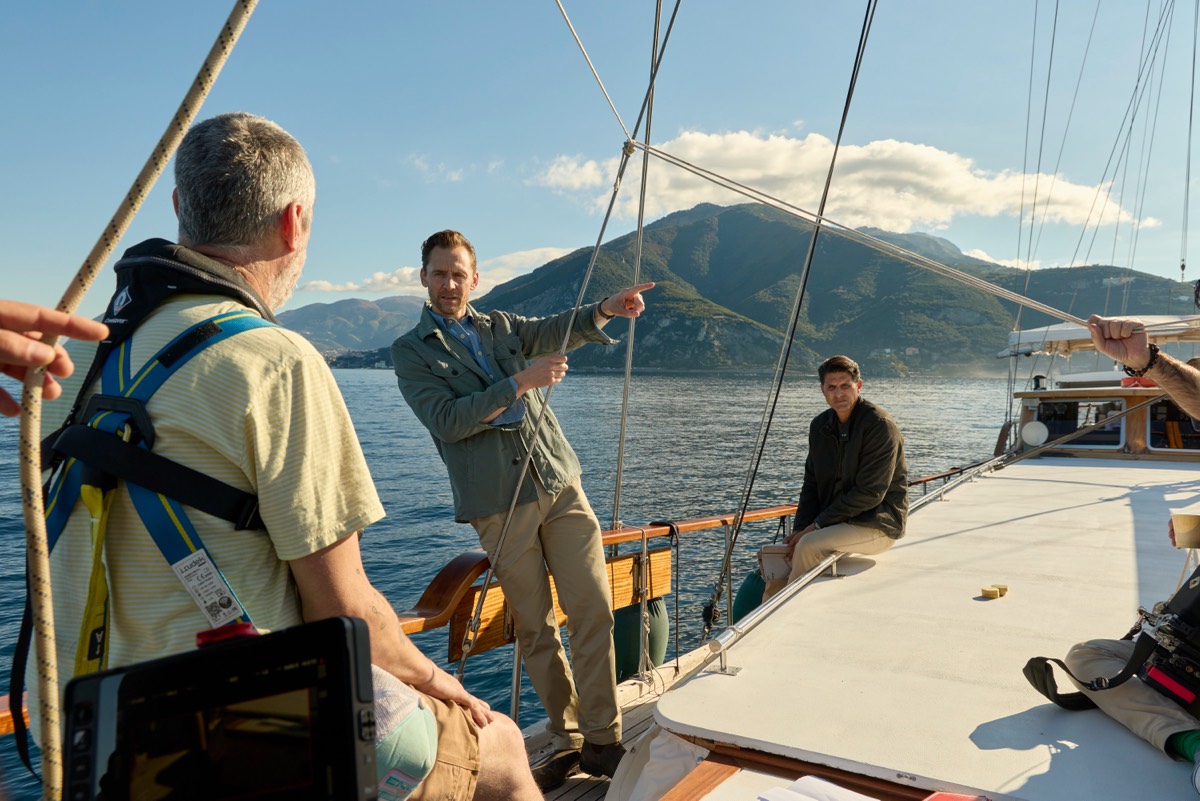
Hiddleston with Dr. Darius Arya in the Gulf of Naples, behind-the-scenes

Hiddleston with Darius Arya in the Gulf of Naples.

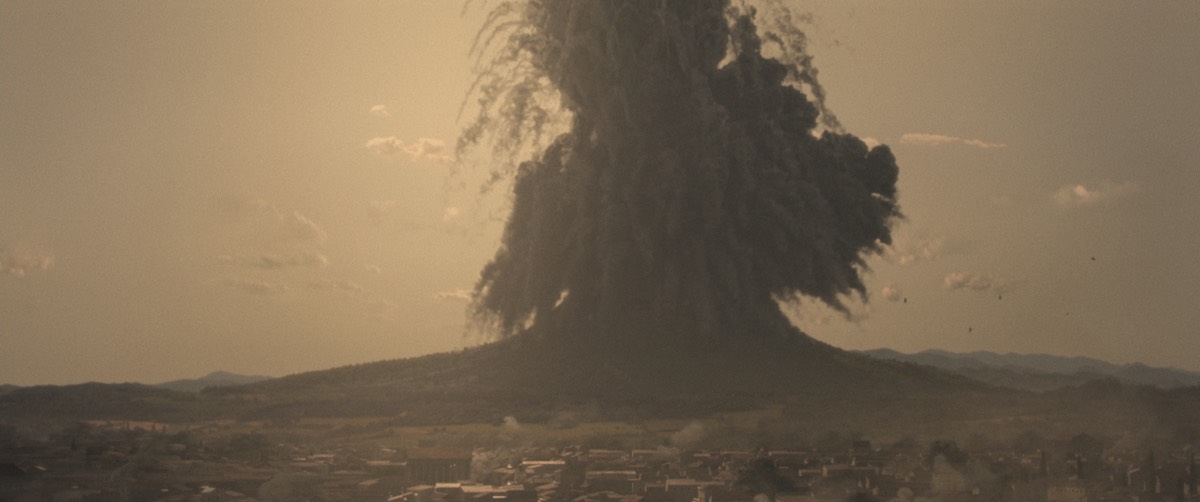
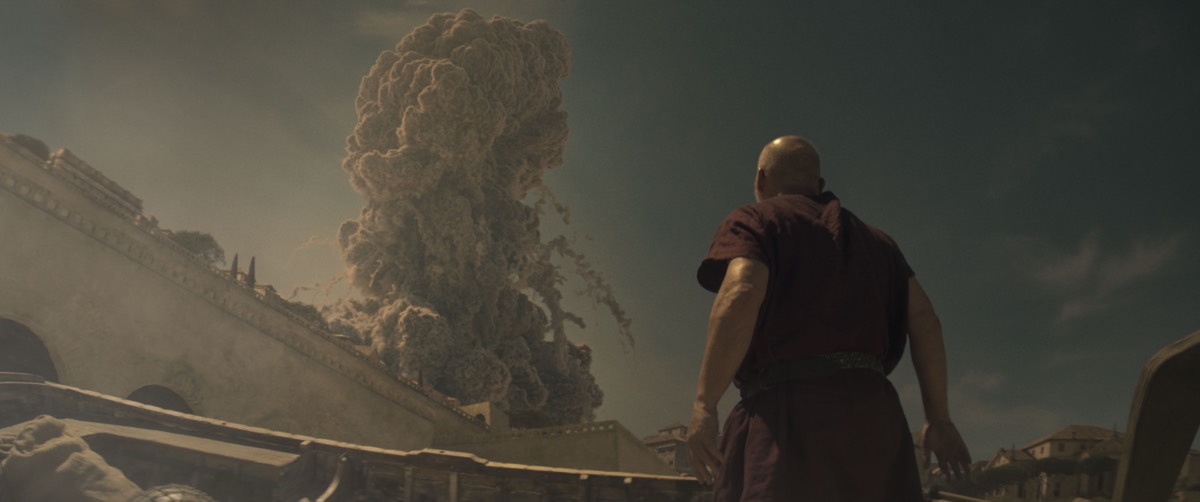
Factual science does get its due. Geologist and science communicator Chris Jackson, for instance, is on hand to clear up any misconceptions the general public might have about the eruption and its aftermath. “The most common misconception people have about Pompeii was the belief that people were killed by lava,” Jackson told Ars. “That’s understandable. In Pompeii and Herculaneum, around all of Naples, a lot of the buildings are made from these black hard igneous rocks, cooled lava. When you tell people that what led to the devastation in 79 AD was nothing to do with lava, their faces sort of drop. It’s a bit sad to hear that it was this more devastating thing called a pyroclastic flow.”

Outrunning those flows would not have been an option. Based on reconstructions, Jackson estimates that the pyroclastic flows would be moving between  100 and 200 kilometers per hour (60–120 mph). “Imagine the speed you can drive on the freeway in the US and double that,” he said. “You can’t outrun a car. So there was no way you were going to outrun these things.  That’s what makes these so devastating. And remember the depth perspective. It’d be traveling a few hundred kilometers an hour. But to you from 10 kilometers away, you’d be like, ‘That’s going pretty slowly.’ So it needs to be seen through the lens of the understanding of people 2,000 years ago.”

The eruption of Vesuvius dramatically altered the geography of the Bay of Naples, per Jackson. “These pyroclastic flows actually changed the shoreline shape,” he said. “Some went through Vesuvius and Pompeii, which at the time had beaches. They were next to the sea. Now there’s some distance from it because [the flows] added new land beyond the settlement and reshaped the coastline.” The eruption also triggered a small tsunami.

That said, “A lot of what’s causing some of the strange shape of the Bay of Naples is actually related to another volcano to the northwest of Vesuvius that nobody talks about, Campi Flegrei,” said Jackson. “Nobody makes TV shows about Campi Flegrei, but that’s a supervolcano. The eruption of that in the geological past is actually what’s believed to have caused that big bite in the bay.”

The human factor

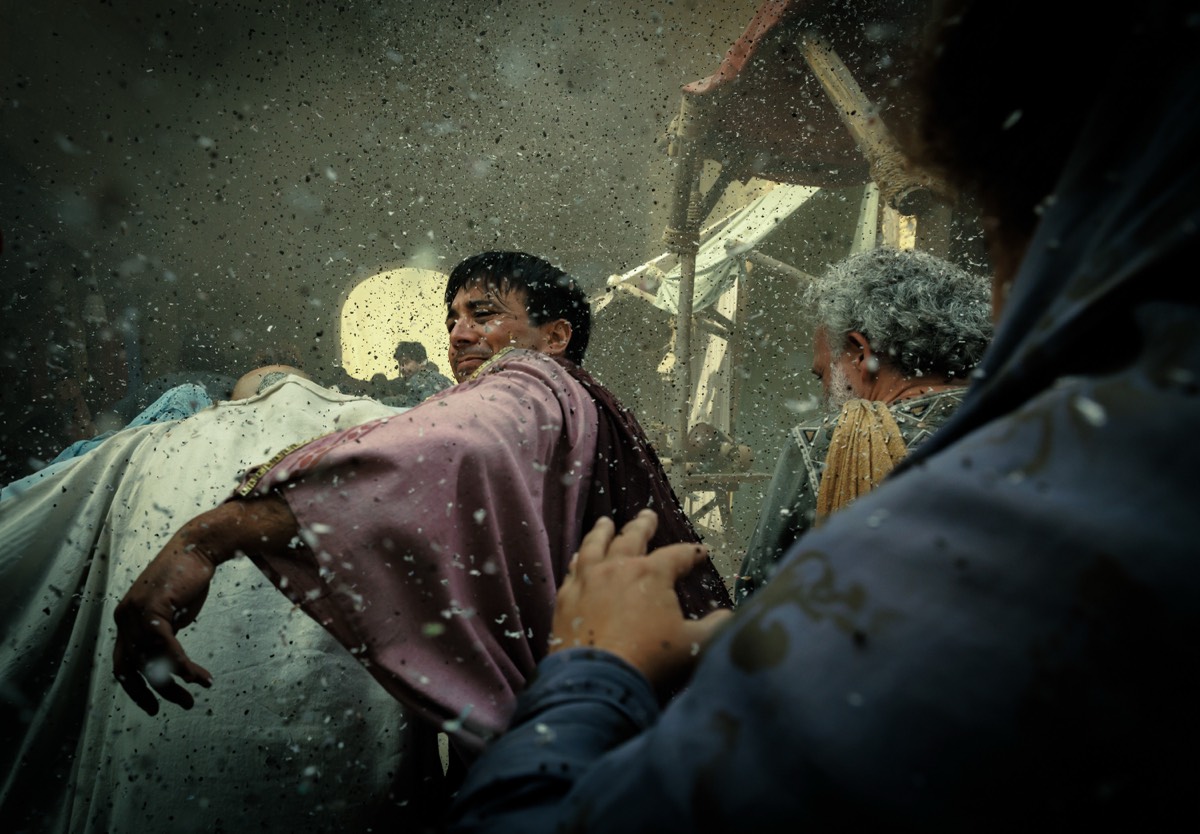
A Pompeii civilian battles his way through the crush of people rushing to evacuate the city of Pompeii as ash falls from the sky.

A Pompeii civilian battles his way through the crush of people rushing to evacuate the city of Pompeii as ash falls from the sky.

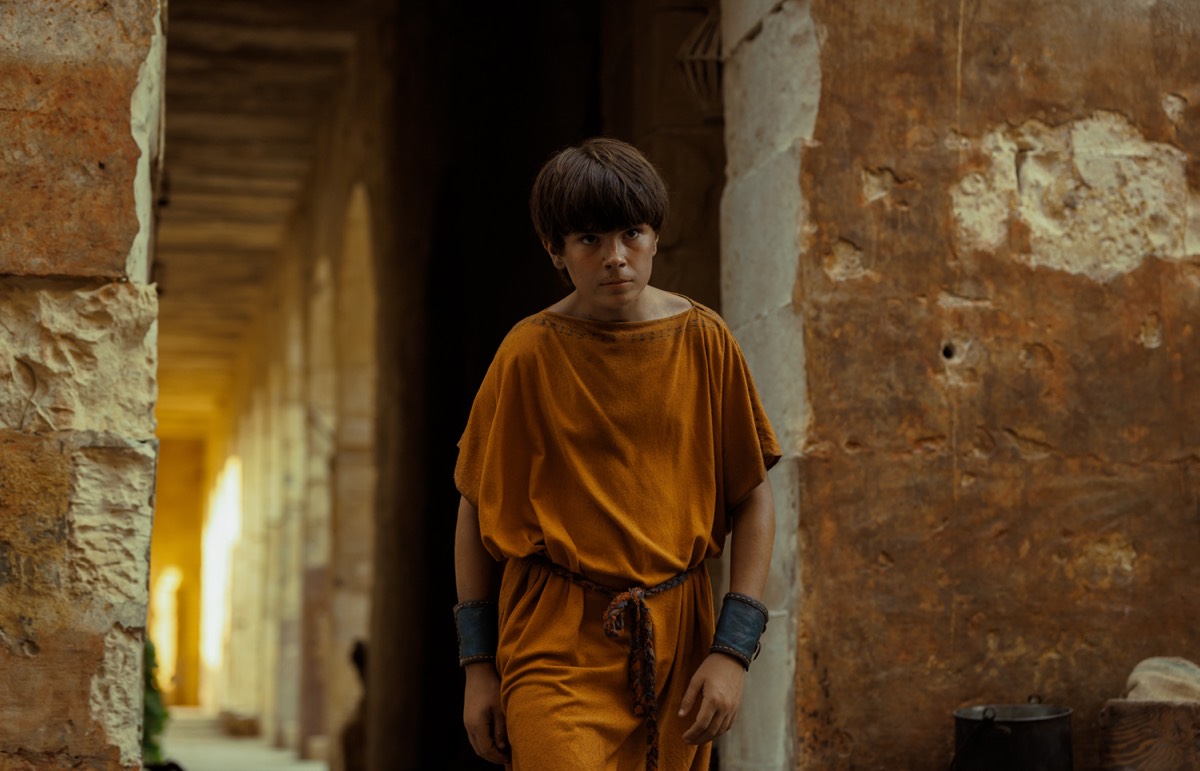
Avianius, played by Frankie Treadaway, strides home through Pompeii after his argument with Marcus Masurius.

Avianius (Frankie Treadaway) strides home through the streets of Pompeii.

Wright didn’t have a Marvel budget for Out of Time, but he did have the expertise of showrunner Tom Barbor-Might. “As you’re writing [the script], you have to put out of your mind how to actually shoot this,” said Wright. “It really is, how do you tell the best story? But Tom could keep that whole vision in his head. A volcano has to go off in this story. It has to look good. It has to look engaging. And that comes from having people at the helm like Tom who know how to break this down.”

“You have to be very precise in how you budget this, how you shoot it, how you storyboard it,” Wright continued. “Sometimes you need that big VFX shot, you need the big drone to sell the story, because that’s the only way you can do it justice. That was where the worlds really merged. I was able to bring some of my experience from Marvel. Tom was able to bring his experience to get that Marvel production value, but with a small footprint. Maybe we don’t need a hundred people on set. Maybe we can do this with 10 people and our actors.”

Even simple and cost-effective special effects can turn out to be emotionally evocative on screen, such as the wispy flakes of falling ash that rain down on Pompeii in the immediate aftermath of the eruption. “That was all practical,” said Wright. “We have some VFX in there, but the soft falling ash—we worked with a really amazing Italian special effects team that figured out how to safely blow a bunch of stuff into the air that was safe for our actors and looked great on camera. A lot of it was just newspaper and things like that. It was a nice merging of old and new techniques.”

The team also hired high-caliber professional actors to perform the scripted scenes. “The word docudrama has a stigma to it,” said Wright. “I think National Geographic very generously is saying, ‘We’re coming up with a new form of storytelling.’ It’s always been there; we’re just trying to refresh it. A big part of that is the drama’s got to be real. The mistake a lot of those shows maybe made in the past is your experts, your historians, your presenter tells you something, and then you just see that thing exactly as you were told. What we were trying to do was bring to life these people’s emotional interiors. And to do that, you have to have great actors.

Credit: National Geographic

“Luckily, we were based out of London. A lot of great actors are based around there, and there were others like Lubna Azabal who plays Julia Felix. She was the lead in an amazing movie [directed by Denis Villeneuve], Incendies.  The casting was just as important as hiring our cinematographer or our production designer. You’re really looking for people that get the material and understand, ‘Hey, you’re not just in a flashback.’ Hiddleston might not be on-screen with you, but he’s saying something that is going to bring your character to life. You’re going to do something emotional that he has to react to emotionally.”

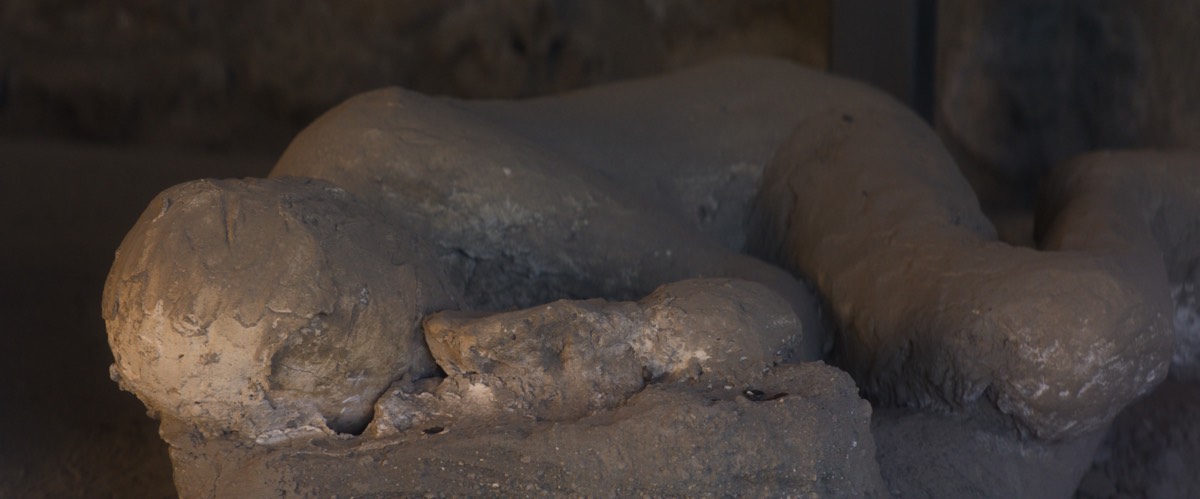
The famous plaster casts of the victims don’t appear in the documentary until the very end—a very deliberate choice. “We felt that the plaster casts had been, just through sheer passage of time, decontextualized a bit,” said Wright. “You can go to Pompeii. It is an active archeological site. It is also a tourist site so [the plaster casts] become props for photos. We wanted to help reframe them in the pop culture: This is a grave site. The person in any of those casts had a story. We chose three of those stories. There are hundreds of stories, maybe thousands. That was something from the very beginning: How can we add some power back to these people and some respect? If you really sit with it, it’s incredibly moving.”

“If somebody were to follow you and I around and write down everything we did today, you would have all the facts, but it would be missing your emotional context, your interior life context that you can only get through psychology, through imagination, through the cultural storytelling,” said Wright. “The history will only get you so far. The only way you can fill in those gaps is through those techniques. We can’t go, ‘Hey, that’s exactly what happened.’  But as one of our experts says, ‘That’s a story that we could believe. That is a story we know could be true.’”

Pompeii: Out of Time premieres on July 21 on National Geographic, and it will be available for streaming on Disney+ and Hulu the following day.

Caitie Barrett and Tom Hiddleston discuss the archaeological record pertaining to Julia Felix at Pompeii.

Caitie Barrett and Tom Hiddleston discuss the archaeological record pertaining to Julia Felix at Pompeii.

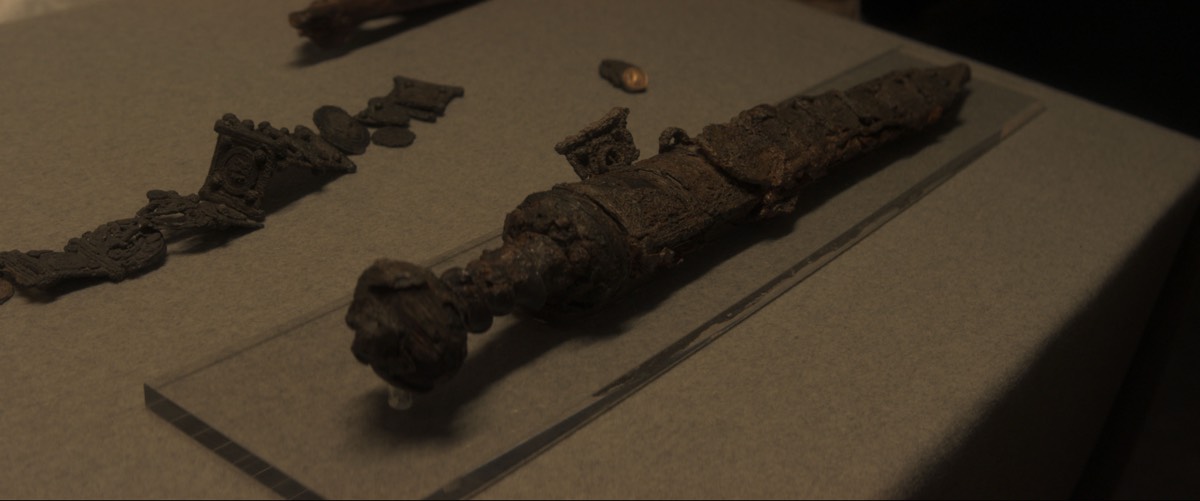
The Praetorian's sword and belt, which was excavated on the beach of Herculaneum, on a table in the archaeological relics storage at Herculaneum Archaeological Park.

The Praetorian’s sword and belt, which was excavated on the beach of Herculaneum, on a table in the archaeological relics storage at Herculaneum Archaeological Park.

Nancy Pelosi’s Pick for Her SF House Seat Takes Anti-AIPAC Pledge

0
nancy-pelosi’s-pick-for-her-sf-house-seat-takes-anti-aipac-pledge
Nancy Pelosi’s Pick for Her SF House Seat Takes Anti-AIPAC Pledge


Former House Speaker Nancy Pelosi’s preferred successor for her San Francisco congressional seat has gained the endorsement of the political arm of the pro-Palestine and anti-genocide advocacy group TrackAIPAC after pledging to back an arms embargo on Israel if elected to Congress. 

Connie Chan, a progressive member of the San Francisco County Board of Supervisors, already has the backing of establishment Democratic figures such as Pelosi and Sen. Adam Schiff, D-Calif., along with influential local labor groups. But the endorsement from Citizens Against AIPAC Corruption, the political advocacy offshoot of TrackAIPAC, is a notable move to further differentiate Chan from her opponent, state Sen. Scott Wiener. Wiener came out 11 percentage points ahead of Chan in California’s June primary election, sending the two to a general election runoff that excluded Saikat Chakrabarti, then TrackAIPAC’s preferred candidate. 

“In Congress, we will oppose any aid to Israel and do everything in our power to stop their government’s genocidal actions against the Palestinian people,” Chan said in a statement to The Intercept. “We are proud to stand with groups like End Citizens United and Citizens Against AIPAC Corruption to fight to fix our democracy.”

Israel and Palestine have featured heavily in the race to replace Pelosi, who is retiring at the end of the current congressional term. Days after Chakrabarti’s defeat, he dedicated his remaining campaign funds to form a PAC to support Chan, citing her position on sending U.S. weapons to Israel and her vow to “vote to end all military aid to Israel – offensive and defensive.”

“We will oppose any aid to Israel and do everything in our power to stop their government’s genocidal actions against the Palestinian people.”

To earn TrackAIPAC’s endorsement, Chan filled out the group’s questionnaire, in which politicians seeking the group’s backing swear off money from pro-Israel lobby groups like the American Israel Political Affairs Committee, agree that Israel’s war in Gaza amounts to a genocide, and promise to oppose all U.S. weapons transfers to Israel, consistent with positions Chan had taken earlier in the race.

Last week, the majority of House Democrats voted in favor of cutting military aid to Israel from the National Defense Authorization Act legislation, which sets the budget for Pentagon spending. The measure failed, but the vote marked a dramatic shift in a Congress that has long granted military aid to Israel with scant opposition. With the recent endorsement and arms embargo pledge, Chan signaled her position among the changing tides in the party. She also is against U.S. involvement in Israel’s invasion of Lebanon and said on her website that she would have voted in favor of the failed House resolution calling for the withdrawal of U.S. support for the war. 

“We heard from many of Connie’s constituents in San Francisco, as well as supporters around the country, who wanted a clear statement of her positions on Gaza, Lebanon, and America’s role in both,” a TrackAIPAC spokesperson told The Intercept in a statement. “We were proud and pleased to offer her that opportunity through our endorsement questionnaire, an opportunity her opponent, state Sen. Scott Wiener, has not taken.”

For his part, Wiener makes a distinction between offensive and so-called defensive weapons to Israel. He says that he would vote in favor of the Block the Bombs Act in the House, which seeks to halt arms transfers of certain munitions to Israel, but that he backs providing U.S. support for Israel’s missile interceptor systems Iron Dome and David’s Sling. Earlier in the race, Chan had taken a similar position, telling Mission Local in January that offensive weapons should be banned while U.S. support for defensive weapons should be paired with humanitarian aid to Gaza. In recent months, she has shifted toward an arms embargo on all U.S. weapons to Israel.

Positions Wiener held earlier in his political career, such as opposing local resolutions calling for a ceasefire in Gaza and supporting state legislation that free speech advocates have said censors pro-Palestine expression in schools, continued to follow him on the campaign trail. Wiener has remained an opponent of the Palestinian-led Boycott, Divestment, and Sanctions movement, while Chan’s platform calls for sanctions on Israel over the genocide in Gaza and its expansion of West Bank settlements and asserts the free speech right to boycott. The TrackAIPAC endorsement pledge also opposes efforts to pass laws that punish people who participate in the BDS movement.

Last month, Wiener was chased out of the San Francisco Trans March by attendees who called out his record on Palestine, with one attendee yelling, “I think your policy on genocide in Gaza is terrible — you do not belong here anymore.” Days earlier, another person filmed his confrontation with Wiener at a bar during a World Cup match, calling him out on his support for Israel and his housing policy. 

Wiener decried the incidents as harassment, a line that both Chan and Pelosi also held, condemning both confrontations. Chan said she understood the role of public disagreements, but added, “As someone who has been a target of hate and threats of violence I stand firm and threats of violence and hate speech.”

Chan also came under fire just days from the primary election for supposed connections with the pro-Israel lobby. Reporting from Drop Site News revealed that Chan had received support from Pro-Choice Majority Action, a PAC with funding ties to AIPAC’s super PAC and Democratic Majority for Israel, formed as an alternative to AIPAC amid Democratic disillusionment with the flagship pro-Israel group. At the time, Chakrabarti used the revelation to claim that AIPAC had attempted to keep him out of the general election because of his support for Palestinian human rights. Chan rejected the claims and said she encouraged any groups supporting her to reject funds tied to AIPAC.

Now, with support from both Chakrabarti and TrackAIPAC, which made a name for itself by running fierce social media campaigns against lawmakers who received money from the pro-Israel lobby, Chan is trying to put allegations of coordination with the pro-Israel giant to rest.  

“Big corporations, billionaires and special interest groups are using their money to try and buy our elections,” Chan said. “But we know San Francisco is not for sale. We have never taken money from AIPAC or their affiliates, because we serve San Francisco and no one else.”

Why the Americans are unlikely to outpace Chinese innovations

0
why-the-americans-are-unlikely-to-outpace-chinese-innovations
Why the Americans are unlikely to outpace Chinese innovations

When management pundits in the Harvard Business Review first asked whether China could innovate, most saw a nation condemned to mere imitation of the West. From “China Is Not About to Out-Innovate the US” (2010) to “Why China Can’t Innovate” (2014), Western commentators framed innovation as a cultural or institutional product – something that could thrive only in free market economies, strong intellectual property regimes, liberal democracies, and political pluralism.

Two decades later, China’s ascent in electric vehicles, drones, 5G, high-storage batteries and artificial intelligence makes those assumptions look poorly postulated.

The irony is deep: The country that many thought was too state-controlled and authoritarian to foster innovation has become the world’s fastest innovator – not because it imitated Silicon Valley, but because it changed the way innovation is done.

The West’s critics of Chinese innovations were holding erroneous opinions.

The state as architect of, not a constraint on, innovations

Western management theories view the government as a market regulator, while Chinese practice views it as an ecosystem builder and an innovation enabler. The 2010 Harvard article claimed that government involvement always stifles creativity. But China’s most dynamic industries such as clean energy, electric vehicles and telecom infrastructure grew not despite state coordination but because of it.

The Industrial and Commercial Bank of China (ICBC), the State Council’s National Development and Reform Commission and local innovation zones are all mission-driven state institutions that don’t care about making a profit every quarter in companies’ financial statements. They want their country to be able to make all of its own technology.

This difference is very important. In the United States, innovation is rewarded only when it meets the needs of capital markets, not the product market. In China, it is supported when it fits with the country’s development strategy. When the Chinese government supports batteries, AI chips, or green technology, it does more than give money. It also buys products, sets standards and ensures that people have the right skills. So innovation is built into the environment and the infrastructure.

Critics (see HBR‘s 2016 “How China’s Government Helps — and Hinders — Innovation”) recognized this duality but failed to see the asymmetry: The “help” is much stronger than the “hindrance.” Bureaucracy may slow experimentation at the edges, but scale, coordination, and patience have enabled entire industries to leapfrog several generations of technology.

China had plans to gain a competitive edge. This article drew on Ronald Reagan’s main idea from a January 20, 1981, speech: “In this present crisis, government is not the solution to our problem; government is the problem.” However, in China, the government is seen as the solution.

Manufacturing as innovation’s core, not its afterthought

For decades, Americans have equated innovation with invention – new patents, breakthrough science, disruptive ideas. China equates it with industry execution. Even as HBR’s 2010 cohort of writers lamented that China lacked “original breakthroughs,” Chinese firms were transforming production into an innovation engine.

Manufacturing is not just copying; it is an original lab. Every production line is a learning system that continually improves design tolerances, energy efficiency, logistics, supply chain management and cost efficiency. In this setting, new tools, processes, and business models work together. This is how BYD improved its blade battery, DJI improved drone stabilization, and CATL developed new modular EV power systems – all through cycles of scaled iteration that Silicon Valley could barely prototype.

America’s lack of interest in manufacturing has secluded design from delivery. American companies are great at coming up with new ideas, but they struggle to turn those ideas into final consumable products. China’s ongoing control over the “means of making” creates a rich information feedback loop for companies, with engineers, suppliers, and production managers working together and trying new things all the time. That’s how the speed of innovation builds on itself.

The HBR essays that used Nobel Prizes or R&D ratios to measure innovation could never see this process dimension. Learning by doing and learning by making things are two types of industrial learning that don’t show up on balance sheets but are very important in technological races.

Knowledge as public goods

The culture of innovation in the US values ownership, whereas in China, it values diffusion. The US system treats intellectual property as sacred and rewards the inventor by keeping others from using it. China’s system, on the other hand, sees knowledge as a public good that should be shared, revised and assembled in new ways to enhance the already existing stock of knowledge of manufacturing.

This cultural difference isn’t just a matter of management philosophy; it also explains speed. When ideas can move freely across regions and supply chains, everyone can participate in innovation. Thousands of small businesses can adopt, adapt, and improve new ideas without the legal problems and cost issues that slow cooperation in Western economies.

In 2010, Harvard Business Review experts called the shanzhai (“mountain fortress”) culture “copycat capitalism,” but it was really China’s open-source bootcamp. Every site that copied another was a test, and every smartphone that was taken apart was a school. The outcome is a national-level collective R&D system embedded within industrial clusters rather than in separate research labs.

It is important to note that within Chinese cultural values, the act of replicating and improving upon an original work is regarded as a demonstration of artistry or skill rather than as intellectual theft. This practice advances existing knowledge and techniques and reduces costs indefinitely.

The US model protects returns to individual genius, while the Chinese model maximizes returns from social learning. In cumulative technological fields such as EVs and e-trains, solar wafers and AI applications, the ability to borrow and combine ideas is more valuable than any patent trophy case.

The Chinese meritocracy and STEM

In China, innovation doesn’t just happen by accident in a garage; it happens because people put a lot of thought into improving their skills. The country’s obsession with meritocracy in STEM education, which Western commentators have long called “rote” or “unimaginative,” has created a dense ecosystem of workers who are good at technology.

In the US, engineers often move from engineering to finance or consulting. In China, graduates go into research and development, design and manufacturing. The gaokao, or national college entrance exam, may be strict, but it does a good job of finding people with scientific skills and talent. The best students come from a system that is set up to teach math and technical skills, not to teach critical thinking.

In a country with 1.4 billion people, that matters more than any Ivy League idea about “broad education.”

HBR‘s 2014 authors misread discipline as constraint. In reality, discipline was the condition for the scale of learning. Collective mastery across millions of engineers and technicians enables parallel innovation across hundreds of subfields. The DeepSeek AI team in 2025 – entirely homegrown – reflects the payoff of this long-term investment.

The myth of liberal prerequisites

A persistent fallacy pervades Western analyses: that openness, democracy and humanistic discourse are essential to innovation. History says otherwise. The most creative times, like the Meiji Restoration in Japan and the early US industrial age, were marked by coordination, not discussion.

China’s political structure shortens the time it takes to make decisions. When priorities shift, from heavy industry to digital infrastructure or from exports to consumption, the shift happens right away, not after years of discussion, debate and negotiation. Dissent and openness are good for society, but they aren’t a necessary condition for industrial technology to move forward.

The persistence of American belief in the cultural lag theory reveals key flaws: The theory depends on vague distinctions between “material” (technology) and “non-material” (values and norms) culture, and it presumes – without solid empirical proof – that technological change always leads. In contrast, non-material culture merely follows to accelerate societal progress.

Moreover, China’s innovation model has demonstrated that the humanities and social sciences, although essential for cultural critique, do not impede industrial transformation. When a society’s main goal is to be the best in technology, resources are allocated based on their usefulness. Chinese universities accordingly tilted hard toward applied sciences – a move often criticized by the West but validated by outcomes.

Rethinking the Western lens

The HBR essays from 2010 to 2021 follow a subtle arc from disbelief to reluctant admiration, but they still get the cause wrong. They ask, “How did China come up with new ideas even though there was censorship, weak IP protection and top-down control?”

A better question is: How did those very things make it possible for innovation to happen quickly? There are mulltiple answers.

  1. Censorship of things that take your mind off of things: It limits free speech in politics, but it also reduces some of the attention fragmentation that makes it hard to focus in open media markets.
  2. Coordination from the top down: Chinese planners use the word “direction” to mean what Western economists call “distortion.” “Centralization” reduces waste in industries that require significant space and capital.
  3. IP protection that isn’t very strong: That’s not a flaw but a speed-up in the stages of technology diffusion. Once mastery is achieved, China has gradually made IP enforcement stricter, showing that it provides flexible, pragmatic governance rather than a rigid political ideology.

Western analysts have not been able to see innovation as path-dependent because they have held on to “institutional universalism.” This means that innovation is shaped by context, history and national missions – the idea that innovation is the same as liberalization, a political norm with a way to grow. China shows that they can be perpendicular.

The speed advantage by scale multiply adaptation

Speed is what gives China its edge in innovation. In his 2021 HBR essay “China’s New Innovation Advantage,” Zak Dychtwald correctly noted that the country’s population is “hyper-adaptive,” but he didn’t give sufficient credit to the structural factors that enable this. Speed comes from a lot of feedback: millions of users, thousands of suppliers and a government that isn’t afraid to step in.

Every market in China is like a living lab. Trends tested on a province’s 60 million people can spread nationwide in a few months. In comparatively smaller Western markets, it’s hard to imagine how app ecosystems like Meituan, Pinduoduo and Alipay change through mass experimentation. Combining digital data with the ability to make things creates an innovation flywheel: Each cycle is faster and cheaper to design, test, make, and learn for the next cycle.

The people who wrote for HBR who complained about “copying” didn’t know that copying is a way to learn. At China’s scale, iteration turns imitation into divergence: What starts as copying ends as reinventing.

Why the West keeps misreading China

If HBR’s project across twelve years reveals anything, it is the persistence of three analytical blinders:

  1. Status quo bias — assuming the current West-China technological hierarchies will endure for a long time;
  2. Cultural determinism — mistaking historically specific behaviors for fixed traits of the Chinese; and
  3. Institutional absolutism — believing liberal free markets and democracy are the only incubators of innovation.

These errors preserve Western self-conceptions while eroding competitiveness. The more the West insists on its monopoly over creativity, the less it recognizes that creativity can also be collective, procedural, directed and mission driven.

The real innovation divide

The cutting edge of innovation today is no longer between free and unfree societies but between those that are broken up and those that work together. The US is still a great place to come up with new ideas, but it is slow to turn them into products. Too many discoveries get stuck between the lab and the market. China, on the other hand, turns ideas – its own or others’ – into real things in factories at an amazing speed, scale and volumes.

This doesn’t mean the Chinese model is morally better; it just means it works differently from the American model. It doesn’t view the entrepreneur as a single thing; it sees the whole system. Success is defined by the ability to move resources toward technological sovereignty. In that math, speed is more important than cleanliness.

Toward a new definition of innovation

The US is great at creating new things, which is innovation by definition. If the term also means using useful new things on a large scale, China is the best. The West’s focus on the eureka moment masks the more subtle, gradual process of improvement. Adaptive innovation is the most important type in a world where climate change is urgent, populations are aging, and infrastructure is lacking.

The future of innovation will not be determined by the quantity of patents held by people or firms or papers published by scientists but, rather, by the speed at which individuals learn from their own processes. In that sense, China is already on a different time scale: five-year plans that are more like innovation roadmaps than political slogans of the national development. The US debates whether the government should choose winners, while China builds entire playing fields.

Learning from the Chinese velocity

The lesson from twenty years of wrong predictions is not that China contradicted the theory, but that the theory was too narrow to grasp reality. Innovation and democracy are no longer at odds with each other. Profit isn’t the only thing that matters, and freedom for each person isn’t the only thing that drives change.

The Chinese model combines meritocratic technocracy, learning through doing and state direction into a system in which the group produces better ideas than the individual. Instead of asking how China became innovative, people in the West might want to know why they thought innovation was the same as their own reflection.

China’s message to the world is stark but instructive: In the age of planetary-scale problems, innovation speed – not ideology – defines success. The state that coordinates, the population that adapts and the system that learns are the true engines of the future.

That is why the Chinese innovate faster than the Americans – and why analysts armed with 20th-century assumptions keep discovering the 21st century too late.

Follow Bhim Bhurtel on X at @BhimBhurtel. Subscribe to his Substack here.

Confusion swirls on source of diarrhea outbreak, but it’s still Taylor Farms

0
confusion-swirls-on-source-of-diarrhea-outbreak,-but-it’s-still-taylor-farms
Confusion swirls on source of diarrhea outbreak, but it’s still Taylor Farms

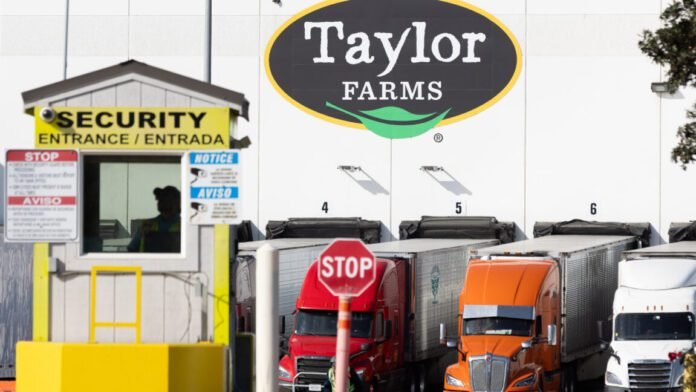
Federal officials on Monday reaffirmed that iceberg lettuce from Taylor Farms still appears to be the source of Cyclospora, the microscopic parasite behind a multi-state surge in explosive diarrhea cases.

The assertion was intended to clear up confusion that began swirling over the weekend around a false positive test from the Food and Drug Administration—which Taylor Farms celebrated, sparking confusion. Still, many details of the outbreak remain murky, largely due to the vague recall information Taylor Farms has publicly provided.

On Friday, the FDA, along with the Centers for Disease Control and Prevention, announced that the FDA’s traceback investigations for the outbreak converged on Taylor Farms. Traceback investigations work by tracking backward from sick people and the foods they ate to where those foods came from through the supply chain, down to individual farms or production facilities. When the FDA said their investigation converged on Taylor Farms, the agency means that, over and over again, tracebacks led them to shredded iceberg lettuce grown in Central Mexico and supplied by Taylor Farms—which also goes by Taylor Fresh Foods.

The convergence of tracebacks was the basis for the FDA and CDC publicly identifying Taylor Farms on Friday. It was also the basis for Taylor Farms issuing a sweeping recall the same day for all its iceberg lettuce sourced from Central Mexico between June 29 and July 16.

At the time, the FDA’s traceback investigation specifically focused on tracing back shredded iceberg lettuce that people had eaten from Taco Bell locations. Thus, the messaging at the time suggested that the contaminated lettuce may be limited to Taco Bell. A CDC press release Friday warned consumers not to eat lettuce at Taco Bell locations in five states (Indiana, Kentucky, Michigan, Ohio, and West Virginia). It noted that “Shredded iceberg lettuce sold in grocery stores or served in other restaurants is not affected.”

Mixed messages

Then things changed over the weekend. First, on Saturday, the FDA announced that a sample of Taylor Farms lettuce tested positive for Cyclospora. The result confirmed the traceback investigation findings—and also potentially extended the list of contaminated products. But, then on Sunday, the FDA deleted the information from its website, explaining that on further review, the result was a false positive.

In a press briefing Monday, FDA officials explained that the test result was from lettuce sampled at the border that was not included in Taylor Farms’ recall. Given that new illnesses are still being reported and the tested lettuce was not part of the outbreak recall, the FDA rushed to publicly disclose the information in hopes of preventing more illnesses, the officials said. But, upon further testing, it became clear that the genetic test for the parasite had returned a false result. Officials would not go into detail on what caused the faulty result, but contamination is a common source of false positives.

Meanwhile Taylor Farms seemed to celebrate the rescinded test result over the weekend, sparking confusion.

“Today, FDA apologized to us,” Taylor Farms wrote at the start of a statement Sunday.

“Today, we were informed that FDA made a mistake, and this was a false positive. To be clear, at this moment, FDA has not identified a single positive product test result for Cyclospora,” the statement read (emphasis theirs).

This response was followed by headlines that suggested the FDA may have blamed Taylor Farms in error. The Wall Street Journal, for instance, reported the FDA “walked back” an earlier detection, to which the FDA directly responded.

“To clarify, this false-positive lab sample DOES NOT change the basis for FDA’s ongoing outbreak investigation or the overwhelming epidemiological data supporting the current voluntary recall by Taylor Farms,” the agency said on social media.

In the press briefing Monday, FDA officials also flatly denied issuing an apology to Taylor Farms. They further explained that the false result didn’t change anything about the situation, and outbreaks involving short-lived produce often lack confirmatory positive tests.

“I also want to be clear that our weekend communications around a false positive test result do not change the basis for FDA’s ongoing outbreak investigation or the epidemiological data supporting the current voluntary recall by Taylor Farms,” Acting FDA Commissioner Kyle Diamantas emphasized at the outset of the briefing.

Vague recall

Although the testing turned out to be false, additional information over the weekend did seem to expand the scope of the outbreak—at least the publicly visible part of it. The New York Times reported that restaurants and retailers other than Taco Bell were removing iceberg lettuce they received from Taylor Farms. In many cases, the lettuce was sold in large bags for restaurants or service operations, and sometimes blended with romaine.

Walmart removed lettuces sold under its Marketside brand—which were included in the FDA’s notices but not in Taylor Farms’ recall list. Sysco, the nation’s largest food distributor, told the Times that it was removing lettuce products it had from Taylor Farms. So did US Foods, another large food distributor. Jack in the Box restaurants also said they were affected by the recall.

The Times noted that Taylor Farms’ recall notice is vague—it doesn’t list these distributors or retailers affected, only product codes and dates. The FDA said on its website Saturday morning that Taylor Farms “has not publicly provided distribution information or a list of customers who received the product that was voluntarily removed from the market.” The FDA later removed that statement, but the recall list remains vague.

Overall, Taylor Farms said it distributed the potentially contaminated lettuce to 27 states. But it’s unclear if food distributors delivered the food to additional states. For instance, New York and California have reported cyclosporiasis cases, but are not included in the recall list.

According to the CDC data, at least 34 states have reported cases. The true number of cases is in the thousands, clearly exceeding the country’s standard range of between 2,000 and 5,000 in recent years. In Michigan alone, health officials are reporting 6,571 cases and 102 hospitalizations as of July 21.

Traceability

Frustrating the situation is that the FDA does not currently require food producers to provide information on all its customers. A new FDA rule, the Food Traceability Rule, was lined up to bolster traceability record requirements for producers of various foods, including leafy greens. The rule would “allow for faster identification and rapid removal of potentially contaminated food from the market, resulting in fewer foodborne illnesses and/or deaths.”

It was set to take effect January 20, 2026, but last year the Trump administration pushed back the compliance deadline by 30 months, to July 20, 2028.

With Taylor Farms now in the spotlight, online scrutiny had raised speculation the company may have played a role in the delay. The Trump administration’s decision to delay the rule was announced on March 20, 2025. Matthew Cortland, a lawyer focusing on health and disability policy at the think tank Data for Progress, noticed that on March 26, 2025—just five days after the decision—Taylor Fresh Foods (aka Taylor Farms) donated $1 million to the Trump-backing super PAC MAGA, Inc (PDF, page 42).

Taylor Farms did not immediately respond to a request for comment.

In a response posted on social media, an account for the Department of Health and Human Services called the speculation “FAKE NEWS,” and claimed nothing influences decisions of the administration “except science and the safety of the American people.”

Houthis threaten Saudi shipping as Iran conflict widens

0
houthis-threaten-saudi-shipping-as-iran-conflict-widens
Houthis threaten Saudi shipping as Iran conflict widens


Yemen’s Iran-aligned Houthi movement said it was imposing a naval blockade on Saudi Arabia, opening a potential new front in the regional conflict and increasing concerns over global energy supplies and maritime trade.

The announcement came as fighting between the United States and Iran intensified, following a series of deadly attacks on U.S. forces. The Pentagon identified two U.S. soldiers killed in an Iranian attack on an American base in Jordan on Friday and said remains believed to belong to a third missing soldier had been recovered. Separately, a fourth U.S. service member was killed in northern Iraq during the controlled detonation of unexploded ordnance from a downed Iranian drone.

Following the Houthi announcement, the Saudi-led coalition said it would respond with force and had begun implementing protective measures for vessels transiting the Bab el-Mandeb Strait, a vital shipping route that has become increasingly important after the effective closure of the Strait of Hormuz.

The Houthis’ move came despite signs that Tehran and Washington remain engaged in indirect diplomatic efforts aimed at halting the escalation. Iran’s Foreign Ministry said mediators had presented proposals to Tehran but provided no details.

Oil prices briefly rose after the announcement before retreating as investors weighed the prospects for renewed diplomacy. Shipping insurance costs in the Red Sea also increased amid heightened security concerns.

Iran has previously urged the Houthis to close the Bab el-Mandeb Strait if U.S. attacks on Iranian infrastructure continued. A prolonged closure would significantly disrupt Saudi oil exports and further tighten global crude supplies already affected by fighting in the Gulf.

In a statement, the Houthis said they were imposing “a maritime embargo against the criminal Saudi enemy,” effective immediately, describing the move as retaliation for what they called Saudi Arabia’s blockade of Yemen.

A senior Iranian official told Reuters that Tehran had received a proposal from mediators for a 10-day ceasefire designed to preserve an interim agreement and create conditions for broader negotiations. Neither the official nor Iran’s Foreign Ministry provided further details.

Pakistani government sources said Iranian Interior Minister Eskandar Momeni had asked Islamabad to resume mediation efforts before travelling there for talks.

Diplomatic efforts unfolded as the United States carried out another round of strikes on Iranian targets and Iran launched attacks against U.S. military assets across the region. U.S. Central Command confirmed additional operations against Iran on Monday.

President Donald Trump defended the latest U.S. strikes, saying they were in response to the deaths of American service members in recent Iranian attacks and vowed further military action if U.S. troops were targeted again.

The conflict has killed thousands of people, primarily in Iran and Lebanon, while tensions remain high across the Middle East. Lebanese President Joseph Aoun is expected to meet Trump at the White House on Tuesday to discuss proposals for disarming Hezbollah and securing an Israeli military withdrawal from southern Lebanon.

In Gaza, where Israeli forces remain engaged following the war triggered by Hamas’ Oct. 7, 2023, attack, Hamas announced the appointment of Khalil Al-Hayya as its overall leader, a move analysts said could signal a tougher negotiating position.

Meanwhile, Iran’s Revolutionary Guard said two oil tankers had exploded while attempting to transit the Strait of Hormuz using what it described as an unsafe route. Reuters could not independently verify the claim.

Separately, the United Kingdom Maritime Trade Operations agency reported that a vessel had been struck by an unidentified projectile off the coast of Oman.

Iran also reported explosions in several cities, including Tabriz, Chabahar, Konarak, Bandar Mahshahr and Bandar Imam Khomeini. State media said one person was killed and several others were wounded near Tabriz.

The Revolutionary Guard said it had targeted U.S. military sites in Jordan, Kuwait and Syria with ballistic missiles. Air raid sirens sounded in Bahrain, while Kuwait’s military said its air defenses intercepted additional Iranian drones early Tuesday.

Country Music Legend Dies in His Sleep

0
country-music-legend-dies-in-his-sleep
Country Music Legend Dies in His Sleep


Jimmy Nichols, the beloved Nashville musician who shared stages and studios with some of country music’s biggest names, has died at 64, leaving behind a heartbroken family and a stunned music community.

Nichols, a respected session musician, producer and music director who worked with stars including Reba McEntire, Faith Hill, Tim McGraw, Carrie Underwood and Elton John, died in his sleep on July 10, according to his wife, Tonya Cochran Ginnetti.

The devastating news was shared by Ginnetti in a Facebook post the next day.

“This is Tonya, Jimmy’s wife. Jimmy passed away in his sleep last night,” she wrote. “He so loved making music with his Nashville family.”

Overcome with grief, she added: “I don’t have any words right now.”

Nichols’ death came at an especially painful time for the family. His longtime collaborator and close friend David Pack revealed that a recent benefit concert had been held for Ginnetti, who needs a lung transplant.

Pack said he had recently performed at “Every Breath She Takes,” a benefit for Tonya, only for the event to take on a heartbreaking new meaning after Nichols’ sudden passing.

“It also became Jimmy’s farewell,” Pack wrote.

According to Pack, Nichols had played at a church service in Franklin, Tennessee, the night before he died. He then went home and passed away in his sleep, a final chapter that Pack described as a reflection of Nichols’ faith.

“Rest in heavenly peace my brother, you have earned it. I’ll miss you,” Pack wrote, while sending condolences to Tonya, the Ginnetti family and Nichols’ many friends.

Nichols was far from just another name in Nashville. Behind the scenes, he was the kind of musician other musicians trusted — a steady, gifted presence whose fingerprints could be found across country, pop, gospel and television.

For years, Nichols worked as a keyboardist and music director, including with Reba McEntire and Faith Hill. He also played with a long list of major artists, including Tim McGraw, Carrie Underwood and Elton John.

Before becoming a fixture in Nashville’s professional music world, Nichols spent 24 years touring the country with his three brothers as part of the Nichols Brothers. Just two weeks before his death, he was inducted into the Ohio Country Music Hall of Fame, a final honor that now feels especially poignant.

Friends and fans are now mourning not only a talented musician, but a man remembered for his heart, faith and deep love for his wife.

A federal court victory for free speech in and about America

0
a-federal-court-victory-for-free-speech-in-and-about-america
A federal court victory for free speech in and about America

Illustration: Stephanie Arnett / MIT Technology Review

Petty and vindictive. Such was the ban on travel to the United States handed out by the State Department on December 23 last year to five Europeans, one of whom was Clare Melford, chief executive of the Global Disinformation Index (GDI), a non-profit whose board I chair. The Secretary of State, Marco Rubio, accused Clare, former EU Commissioner Thierry Breton and three other civil society organizations of being “radical activists” and leading members of the “global censorship industrial complex.” Now the truth is out: the ban was unconstitutional.

On July 14 Judge James Boasberg of the US District Court of the District of Columbia put a stay on the ban, in a case brought by the Knight First Amendment Institute on behalf of the Coalition for Independent Technology Research. The injunction does not, of course, settle the issue of whether it might be lawful for the US government to ban these specific individuals on other grounds. But his judgment does establish that the plaintiffs’ activities, as highlighted by Rubio and the State Department’s policy, fall under the First Amendment guarantee of free speech. They are not censors, they are being censored.

Even George Orwell would be impressed by the doublespeak deployed by the Trump administration in this and its other assaults on people and institutions that displease it. Free speech is censorship. Providing data to tech platforms and advertisers, as GDI has done, is in the State Department’s telling violating competition rather than aiding it. Practicing the previously conservative principle of freedom of expression is radical activism.

All of this is outrageous, though the pettiness with which it is being executed also reveals the weakness and small-minded vindictiveness of those perpetrating it. Most damagingly of all, however, it serves to distract attention from what should be the real task of legislators, regulators and litigators alike, all around the world: facing up to the way the advertising-funded business model of all the tech platforms is, by its very nature, fuelling extremism and polarisation, whether of left, right or something undefinable in political terms.

When anguishing about the social harms being done by social media and other forms of digital communication it is common to focus on what is being said and who is saying it. That is understandable but misses the bigger point of why they say it and what incentivises so many people to do so.

They say it because it is profitable to do so. Why is it profitable? Because, thanks to the algorithms deployed by the tech platforms, enragement leads to engagement – which produces dollars for the content creators and the platforms. This can be through advertising, merchandising, donations, subscriptions or anything else. The nastier your content, the more fear and enragement it generates, the more money you, and the platform hosting your content, can make.

The tech platforms are not responsible for the fact that so many people and organizations around the world are prepared to use racism, misogynism, conspiracy theories and other themes. But they are responsible for the fact that it is very profitable for them to do so. And, deliberately or not, they profit from it too.

That is what the “radical activism” of GDI and the other civil society organisations is designed to expose. The research and free speech we all seek to deploy in our different ways is not evidence of the “censorship industrial complex” that obsesses Rubio, along with Congressman Jim Jordan and the House Judiciary Committee Jordan chairs. Rather it is a good-faith effort to cast light on the incentives at play in the digital world and the consequences those incentives produce.

Research on those incentives and on the monetization of harmful content online is of critical public value. It is critical for the tech platforms themselves, so that they can accurately monitor the impact they are having and their compliance with regulations such as Europe’s Digital Services Act; it is critical for the regulators so that they can design and enforce the rules well; and it is critical for those who make the laws that enable the regulation and for the publics whose interests the lawmakers represent. It was that sort of activity that the December travel ban was designed to hobble.

It could never have entirely succeeded in doing so, given that – thanks to the digital age – the world is connected, perhaps even “flat” as Tom Friedman termed it in his 2005 bestseller of that name. Civil society organizations don’t have to visit America to work out what is going on, free though they should be to do so. The act was petty, as are many of the authoritarian acts emerging from the current American administration. The First Amendment of the US Constitution, according to Judge Boasberg, prohibits policies that discriminate “on the basis of viewpoint.” That is exactly what this petty act was designed to do.

Former Economist Editor in Chief Bill Emmott is chairman of the board of the Global Disinformation Index. This article also appears on his newsletter, Bill Emmott’s Global View.

Bill Emmott, a former editor-in-chief of The Economist, is the author of The Fate of the West.

Female Afghan Christian Convert Flees Taliban, Only To Risk Deportation

0
female-afghan-christian-convert-flees-taliban,-only-to-risk-deportation
Female Afghan Christian Convert Flees Taliban, Only To Risk Deportation


Ziba Mastoor fears her temporary stay in Qatar could end with deportation to Afghanistan, where she alleges the Taliban sentenced her to death for converting 

[ISLAMABAD] Afghan Christian convert and former government official Ziba Mastoor says she fled to Qatar earlier this month after Taliban intelligence operatives pursued her from Afghanistan into Pakistan, leaving her dependent on a temporary visa and fearful that deportation could place her life in danger.  

Her case reflects the risks confronting Afghan women and members of religious minorities who fled to neighboring countries after the Taliban seized power in August 2021. Pakistan and Iran have accelerated the expulsion of Afghans over the past year, raising concerns that vulnerable refugees and asylum seekers could be returned to Afghanistan to face further persecution.  

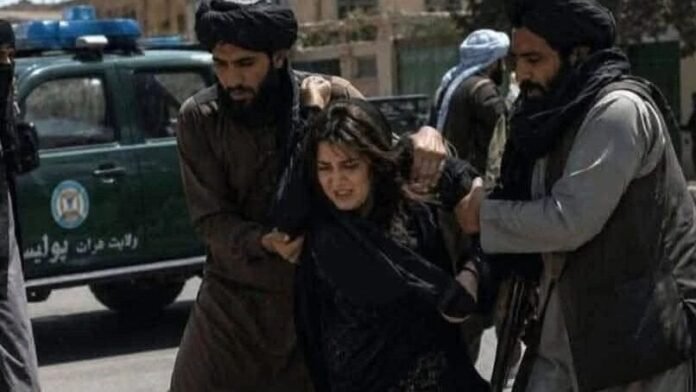
Since retaking power, the Taliban has largely excluded women from public life. Girls are barred from secondary schools and universities, while women have faced sweeping restrictions on employment, travel and access to public spaces. Women who protest have reported arbitrary arrest and imprisonment.  

The Organization of Islamic Cooperation and prominent Islamic scholars have rejected the Taliban’s restrictions on women as lacking a basis in Islamic law. Rights advocates accuse the Taliban of using a rigid interpretation of Islam to enforce its rule while persecuting religious minorities.  

Reports of intimidation, arbitrary detention, violence and discrimination have prompted members of minority communities to flee or conceal their identities.  

Mastoor says she held a senior government position during the administration of former President Ashraf Ghani. She told The Media Line that Taliban intelligence operatives targeted her because of her faith and attempted to arrest her during a nighttime raid on her home, but she escaped.  

Mastoor alleged that Taliban authorities later issued what she described as a sentence of “stoning to death” because she had converted to Christianity. She said officials also harassed and intimidated her parents while searching for her. The Media Line could not independently verify the existence of such a sentence.  

Responding to a question from The Media Line, Mastoor said, “I converted to Christianity in 2019. My faith guided me to make this genuine and personal choice.”  

I converted to Christianity in 2019. My faith guided me to make this genuine and personal choice.

Her parents, who are ethnic Tajik Muslims, opposed her decision, she said.  

Persistent harassment by Taliban intelligence operatives eventually forced Mastoor to flee Afghanistan for Pakistan, according to her account. Yet she said she found no lasting safety there and lived alone under the constant threat of forced return.  

A trusted contact in Kabul later warned her that Taliban operatives were attempting to locate her in Pakistan, Mastoor said, prompting her to flee again.  

She arrived in Qatar on a temporary visitor visa only days ago. Mastoor fears that she could be deported to Afghanistan when the visa expires, which she said would place her life at grave risk.  

Afghanistan’s Christian population is believed to be extremely small, and it is difficult to document because believers generally practice in secret. Mastoor estimated that only a few hundred Christians remain in the country.  

She has appealed to Christian organizations worldwide for help in preventing her return to Afghanistan.  

Fazal Ur Rehman Zadran, a Kabul-based political analyst, told The Media Line that determining the size of Afghanistan’s Christian population was difficult because openly practicing or promoting Christianity is prohibited.  

Zadran said that dozens of families from the Hazara Shiite community had converted to Christianity in previous years. Hazaras have long faced persecution, including attacks by the Islamic State group, and he suggested that such experiences may have contributed to some conversions.  

After the Taliban returned to power, many Christian families were forced to conceal their religious identities, Zadran said. According to the information available to him, some fled to Pakistan and Iran in disguise.  

Stricter deportation policies in both countries have left those families living in hardship and uncertainty, fearful that they could be returned to Afghanistan at any time, he explained.  

Qaiser Khan Afridi, a spokesperson for the Office of the United Nations High Commissioner for Refugees (UNHCR) in Pakistan, expressed concern about Pakistan’s policy of deporting Afghan refugees and asylum seekers.  

He told The Media Line that while the UNHCR appreciates the people and government of Pakistan for “hosting millions of Afghan refugees with generosity for more than 45 years, despite facing their own economic and social challenges,” refugees should not be compelled to return to a country where their lives or freedom could be endangered.  

The UNHCR is particularly concerned about the risks facing women, girls and other vulnerable groups if they are sent back to Afghanistan, he said, and urged Pakistani authorities to ensure that any repatriation is voluntary, safe and dignified.  

The Media Line also spoke with Zabihullah Mujahid, the Taliban’s chief spokesperson, who categorically denied that a Christian community exists in Afghanistan.  

Because there is no Christian community, Mujahid said, Christians have no official status in the country, and no churches are available for worship. He did not address Mastoor’s allegations concerning her attempted arrest or reported sentence.  

Rebecca Trotter, a St. Paul, Minnesota-based human rights activist, is the co-founder and co-director of Food for Thought Afghanistan, a US and Switzerland-based nongovernmental organization supporting Afghan civil society.  

The international response to Afghanistan’s crisis has been marked by half-measures, symbolic gestures, and rhetorical condemnations rather than meaningful action

She told The Media Line that “the international response to Afghanistan’s crisis has been marked by half-measures, symbolic gestures, and rhetorical condemnations rather than meaningful action.” She said that even measures imposed during the Taliban’s first rule have largely not been reinstated, arguing that “the global community’s commitment to defending fundamental human rights stands in stark contrast to the Taliban’s determination to enforce its own agenda.”  

Trotter added that she believes the international community would have already openly normalized relations with Afghanistan’s de facto authorities “had it not been for the relentless efforts of Afghan civil society, both inside the country and abroad, to resist such a course.” Genuine international support for those efforts could fundamentally alter Afghanistan’s future, she argued.  

According to Trotter, “Food for Thought Afghanistan is working to relocate 60 at-risk Afghan women’s rights activists from Pakistan to safe third countries.” The organization successfully resettled 31 families last year, she said, while the remaining families continue to live in safe houses it established.  

She said the organization had also pressed Pakistan to recognize the women’s protection claims under international, Pakistani and Islamic law.  

Hadia Sahibzada, the Tehran-based founder of the Afghanistan Women’s Voice Movement and an advocate for Afghan refugees in Iran, told The Media Line that “women’s rights in Afghanistan have become one of the world’s gravest human rights crises.”  

She described the Taliban’s policies as gender apartheid and a blatant violation of fundamental human rights. Forced deportation places Afghan women at immediate risk of persecution, arbitrary detention, retaliation and severe punishment after their return, she said.  

Repeated condemnations by the United Nations and foreign governments have failed to curb the Taliban’s abuses, Sahibzada argued, while the absence of accountability has allowed violations to continue. She called for those responsible to be prosecuted under international law.  

Sahibzada also urged governments not to normalize relations with the Taliban. Instead, she called for stronger diplomatic pressure, accountability measures, protection for Afghan women and the immediate reopening of schools and universities to girls.  

For Mastoor, those debates are no longer abstract. Her immediate future depends on whether she can secure protection in Qatar or another country before her temporary visa expires. Without a safe destination, she fears that the long journey from Afghanistan through Pakistan may end where it began—under the authority of the Taliban.  


‘I Would Speak With Hezbollah,’ President Trump Says, Restores Direct Flights to Lebanon

0
‘i-would-speak-with-hezbollah,’-president-trump-says,-restores-direct-flights-to-lebanon
‘I Would Speak With Hezbollah,’ President Trump Says, Restores Direct Flights to Lebanon


President Donald Trump said Tuesday he would be willing to engage directly with Hezbollah if Lebanese President Joseph Aoun requested it, as the two leaders discussed security cooperation and efforts to reduce the Iran-backed terrorist group’s influence in Lebanon during talks at the White House. 

Asked whether he would meet with Hezbollah’s leadership, Trump said he would not rule out such discussions. 

“I would speak to Hezbollah. I speak to everybody. I’ll speak to people that a lot of people think I shouldn’t be speaking to, and things work out,” President Trump said during remarks in the Oval Office. 

“If the president wanted me to speak to Hezbollah, I would,” he added. 

The meeting marked the first visit to the White House by a Lebanese head of state in nearly 20 years. 

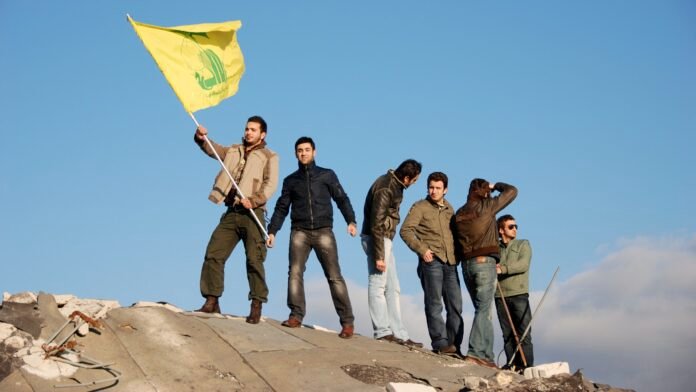
Among the topics discussed were proposals to disarm Hezbollah and establish “pilot zones” where the terrorist group would have no presence. Those areas would be patrolled by the Lebanese Armed Forces. 

President Trump declined to say whether the United States would directly assist efforts to disarm Hezbollah. 

“We have some very concrete plans already in store for that. Others [may be] going in and helping, but [Lebanon is] also becoming much more self-sufficient,” he said. 

Following the meeting, President Trump announced on Truth Social that he had instructed his administration to permit the restoration of direct commercial air service between the United States and Lebanon, ending a suspension that has remained in effect for more than 40 years. 

In the post, President Trump said Aoun “has done a remarkable job working to transform his country” and expressed hope that other nations would follow Washington’s lead in restoring direct air service to “this beautiful land.” 


0FansLike
0FollowersFollow
0FollowersFollow
0SubscribersSubscribe
- Advertisement -
Google search engine

Recent Posts