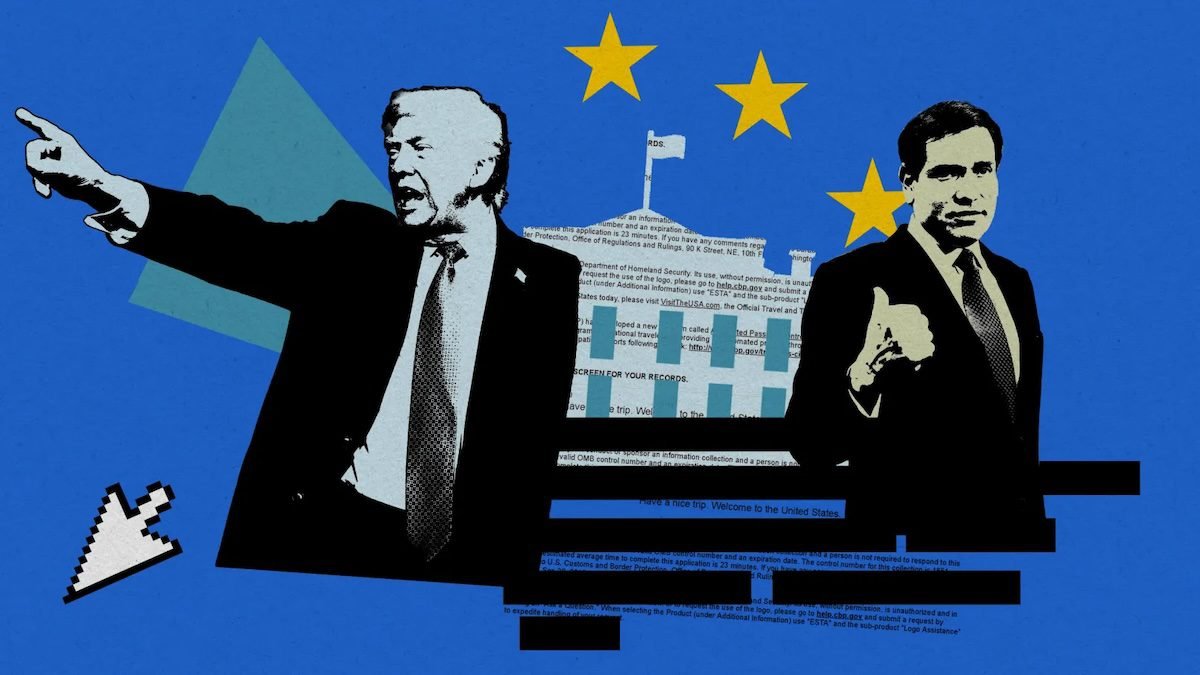

Petty and vindictive. Such was the ban on travel to the United States handed out by the State Department on December 23 last year to five Europeans, one of whom was Clare Melford, chief executive of the Global Disinformation Index (GDI), a non-profit whose board I chair. The Secretary of State, Marco Rubio, accused Clare, former EU Commissioner Thierry Breton and three other civil society organizations of being “radical activists” and leading members of the “global censorship industrial complex.” Now the truth is out: the ban was unconstitutional.
On July 14 Judge James Boasberg of the US District Court of the District of Columbia put a stay on the ban, in a case brought by the Knight First Amendment Institute on behalf of the Coalition for Independent Technology Research. The injunction does not, of course, settle the issue of whether it might be lawful for the US government to ban these specific individuals on other grounds. But his judgment does establish that the plaintiffs’ activities, as highlighted by Rubio and the State Department’s policy, fall under the First Amendment guarantee of free speech. They are not censors, they are being censored.
Even George Orwell would be impressed by the doublespeak deployed by the Trump administration in this and its other assaults on people and institutions that displease it. Free speech is censorship. Providing data to tech platforms and advertisers, as GDI has done, is in the State Department’s telling violating competition rather than aiding it. Practicing the previously conservative principle of freedom of expression is radical activism.
All of this is outrageous, though the pettiness with which it is being executed also reveals the weakness and small-minded vindictiveness of those perpetrating it. Most damagingly of all, however, it serves to distract attention from what should be the real task of legislators, regulators and litigators alike, all around the world: facing up to the way the advertising-funded business model of all the tech platforms is, by its very nature, fuelling extremism and polarisation, whether of left, right or something undefinable in political terms.
When anguishing about the social harms being done by social media and other forms of digital communication it is common to focus on what is being said and who is saying it. That is understandable but misses the bigger point of why they say it and what incentivises so many people to do so.
They say it because it is profitable to do so. Why is it profitable? Because, thanks to the algorithms deployed by the tech platforms, enragement leads to engagement – which produces dollars for the content creators and the platforms. This can be through advertising, merchandising, donations, subscriptions or anything else. The nastier your content, the more fear and enragement it generates, the more money you, and the platform hosting your content, can make.
The tech platforms are not responsible for the fact that so many people and organizations around the world are prepared to use racism, misogynism, conspiracy theories and other themes. But they are responsible for the fact that it is very profitable for them to do so. And, deliberately or not, they profit from it too.
That is what the “radical activism” of GDI and the other civil society organisations is designed to expose. The research and free speech we all seek to deploy in our different ways is not evidence of the “censorship industrial complex” that obsesses Rubio, along with Congressman Jim Jordan and the House Judiciary Committee Jordan chairs. Rather it is a good-faith effort to cast light on the incentives at play in the digital world and the consequences those incentives produce.
Research on those incentives and on the monetization of harmful content online is of critical public value. It is critical for the tech platforms themselves, so that they can accurately monitor the impact they are having and their compliance with regulations such as Europe’s Digital Services Act; it is critical for the regulators so that they can design and enforce the rules well; and it is critical for those who make the laws that enable the regulation and for the publics whose interests the lawmakers represent. It was that sort of activity that the December travel ban was designed to hobble.
It could never have entirely succeeded in doing so, given that – thanks to the digital age – the world is connected, perhaps even “flat” as Tom Friedman termed it in his 2005 bestseller of that name. Civil society organizations don’t have to visit America to work out what is going on, free though they should be to do so. The act was petty, as are many of the authoritarian acts emerging from the current American administration. The First Amendment of the US Constitution, according to Judge Boasberg, prohibits policies that discriminate “on the basis of viewpoint.” That is exactly what this petty act was designed to do.
Former Economist Editor in Chief Bill Emmott is chairman of the board of the Global Disinformation Index. This article also appears on his newsletter, Bill Emmott’s Global View.

Bill Emmott, a former editor-in-chief of The Economist, is the author of The Fate of the West.