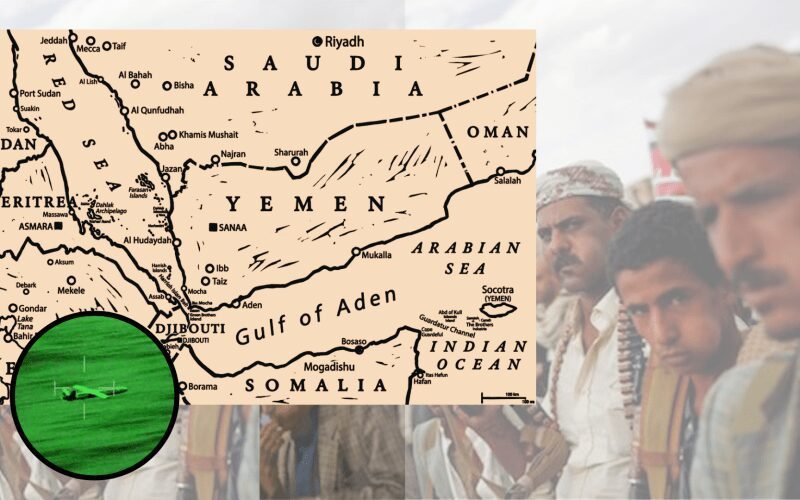
Yemen’s Iran-aligned Houthi movement said it was imposing a naval blockade on Saudi Arabia, opening a potential new front in the regional conflict and increasing concerns over global energy supplies and maritime trade.
The announcement came as fighting between the United States and Iran intensified, following a series of deadly attacks on U.S. forces. The Pentagon identified two U.S. soldiers killed in an Iranian attack on an American base in Jordan on Friday and said remains believed to belong to a third missing soldier had been recovered. Separately, a fourth U.S. service member was killed in northern Iraq during the controlled detonation of unexploded ordnance from a downed Iranian drone.
Following the Houthi announcement, the Saudi-led coalition said it would respond with force and had begun implementing protective measures for vessels transiting the Bab el-Mandeb Strait, a vital shipping route that has become increasingly important after the effective closure of the Strait of Hormuz.
The Houthis’ move came despite signs that Tehran and Washington remain engaged in indirect diplomatic efforts aimed at halting the escalation. Iran’s Foreign Ministry said mediators had presented proposals to Tehran but provided no details.
Oil prices briefly rose after the announcement before retreating as investors weighed the prospects for renewed diplomacy. Shipping insurance costs in the Red Sea also increased amid heightened security concerns.
Iran has previously urged the Houthis to close the Bab el-Mandeb Strait if U.S. attacks on Iranian infrastructure continued. A prolonged closure would significantly disrupt Saudi oil exports and further tighten global crude supplies already affected by fighting in the Gulf.
In a statement, the Houthis said they were imposing “a maritime embargo against the criminal Saudi enemy,” effective immediately, describing the move as retaliation for what they called Saudi Arabia’s blockade of Yemen.
A senior Iranian official told Reuters that Tehran had received a proposal from mediators for a 10-day ceasefire designed to preserve an interim agreement and create conditions for broader negotiations. Neither the official nor Iran’s Foreign Ministry provided further details.
Pakistani government sources said Iranian Interior Minister Eskandar Momeni had asked Islamabad to resume mediation efforts before travelling there for talks.
Diplomatic efforts unfolded as the United States carried out another round of strikes on Iranian targets and Iran launched attacks against U.S. military assets across the region. U.S. Central Command confirmed additional operations against Iran on Monday.
President Donald Trump defended the latest U.S. strikes, saying they were in response to the deaths of American service members in recent Iranian attacks and vowed further military action if U.S. troops were targeted again.
The conflict has killed thousands of people, primarily in Iran and Lebanon, while tensions remain high across the Middle East. Lebanese President Joseph Aoun is expected to meet Trump at the White House on Tuesday to discuss proposals for disarming Hezbollah and securing an Israeli military withdrawal from southern Lebanon.
In Gaza, where Israeli forces remain engaged following the war triggered by Hamas’ Oct. 7, 2023, attack, Hamas announced the appointment of Khalil Al-Hayya as its overall leader, a move analysts said could signal a tougher negotiating position.
Meanwhile, Iran’s Revolutionary Guard said two oil tankers had exploded while attempting to transit the Strait of Hormuz using what it described as an unsafe route. Reuters could not independently verify the claim.
Separately, the United Kingdom Maritime Trade Operations agency reported that a vessel had been struck by an unidentified projectile off the coast of Oman.
Iran also reported explosions in several cities, including Tabriz, Chabahar, Konarak, Bandar Mahshahr and Bandar Imam Khomeini. State media said one person was killed and several others were wounded near Tabriz.
The Revolutionary Guard said it had targeted U.S. military sites in Jordan, Kuwait and Syria with ballistic missiles. Air raid sirens sounded in Bahrain, while Kuwait’s military said its air defenses intercepted additional Iranian drones early Tuesday.