Israeli firm weaponized digital ad network for spyware attacks, research shows
Israeli digital advertising firm Discover-Tech weaponized a vast commercial ad network to harvest personal data and deliver mercenary spyware to targeted devices worldwide, Canadian cyber watchdog Citizen Lab and New York-based ad security firm Confiant reported Thursday, Anadolu reports.
“The core finding is the weaponization of ad infrastructure for advanced staging, preliminary targeting, and payload delivery, characterized by exceptional technical sophistication, robust anti-interception measures, and surgical micro-targeting,” Confiant said in its investigative findings.
The coordinated operation enabled US-blacklisted Israeli spyware company Candiru, rebranded as Integrity Labs, and surveillance vendor Intelos to exploit commercial ad inventory across major global platforms, including Google, Beeswax and Russia’s Yandex, to track targets and compromise consumer devices.
Citizen Lab described the campaign as the first public technical confirmation of zero-click mercenary spyware delivered through online advertising, a method researchers termed “AdFection.”
Devices belonging to staff at international news network Al Jazeera were among those infected through the weaponized ad placements, which operated silently without visible pop-ups or suspicious links.
– Global identity graph, data harvesting
Discover-Tech operated a specialized system called Controlium that converted routine commercial advertising auctions into an expansive surveillance apparatus. After analyzing 4 billion bidding records, researchers found that the company distributed ads across nearly 200,000 unique websites and mobile apps on Android and iOS in dozens of countries during a four-month period.
“Discover-Tech serves roughly 10 million ad impressions a day, and each one feeds an identity graph built from device fingerprints, IP addresses, advertising IDs, and often the publisher’s own first-party cookies,” said Confiant.
Investigators found that the ads routinely collected user session cookies, authenticated login tokens, and personal identifiers directly from publisher websites, exfiltrating the data even when European Union privacy regulations strictly barred processing without consent.
Citizen Lab also revealed that an affiliated threat actor, dubbed Dark Cartographer, utilized Discover-Tech’s infrastructure to exploit vulnerabilities across mobile telecom providers, matching digital advertising identities to physical phone numbers to deanonymize mobile subscribers en masse.
– Focus on Palestine, sensitive targets
Geographic telemetry revealed sharp traffic spikes pointing to deliberate intelligence operations rather than ordinary commercial advertising campaigns.
Palestine emerged as the most heavily targeted territory, where Discover-Tech served nearly 2% of all digital advertisements in the territory, peaking at roughly 10% on April 7, with one in every 36 Android ads originating from the firm.
Surveillance traffic also landed directly on sensitive administrative and institutional networks, including the Armenian Prime Minister’s Office, international bodies, judicial agencies, universities and defense organizations.
Investigators detected surgical handoffs to Candiru servers in nine countries, with Belgium accounting for 56% of observed activity, followed by the United Arab Emirates, Saudi Arabia, Bahrain, Mexico, Spain, and others.
After the joint investigation was disclosed, Google, the European advertising association IAB Europe, Beeswax, Vungle, and Eskimi severed Discover-Tech’s access to their digital advertising systems.
KDE turns 30 with Plasma 6.8, remote upgrades, and an X11 farewell
Marking the 30th anniversary of software developer KDE on October 14, the company released Plasma 6.8, debuted a movie, and retired Plasma’s native X11 session support. The announcement from KDE dubs the new Plasma 6.8 as the “30th Anniversary Edition” and describes the update as preparing Plasma for the future. Legacy X11 applications will still function via the XWayland compatibility layer, and KDE applications will also continue supporting X11 under other desktop environments.
After 42 years in service, the X11 protocol is losing another major desktop environment. Plasma will fully adopt the Wayland system and put support for starting new X11 sessions in Plasma to bed. Users opting to stay on Plasma 6.7 will keep their existing sessions for now. The move was expected, with GNOME officially dropping X11 sessions by default in 2025.
The new Plasma 6.8 brings many improvements, including increased support for adding window decorations (like shadows and rounded corners) to third-party apps, and a more streamlined Union theming system. Other notable additions include Nvidia triple buffering being enabled by default, Kup backup integration (KDE’s backup utility—now integrated into Plasma), and kscreenctl, a command-line utility that allows power users to adjust display configurations.
New window decorations for third-party applications.
Credit: KDE.org
New window decorations for third-party applications. Credit: KDE.org
An updated System Monitor gives KDE users more control over their system processes, too. The revamped monitor allows users to pin processes directly to CPU cores through the GUI.
KDE users now have a GUI option for CPU pinning.
Credit: KDE.org
KDE users now have a GUI option for CPU pinning. Credit: KDE.org
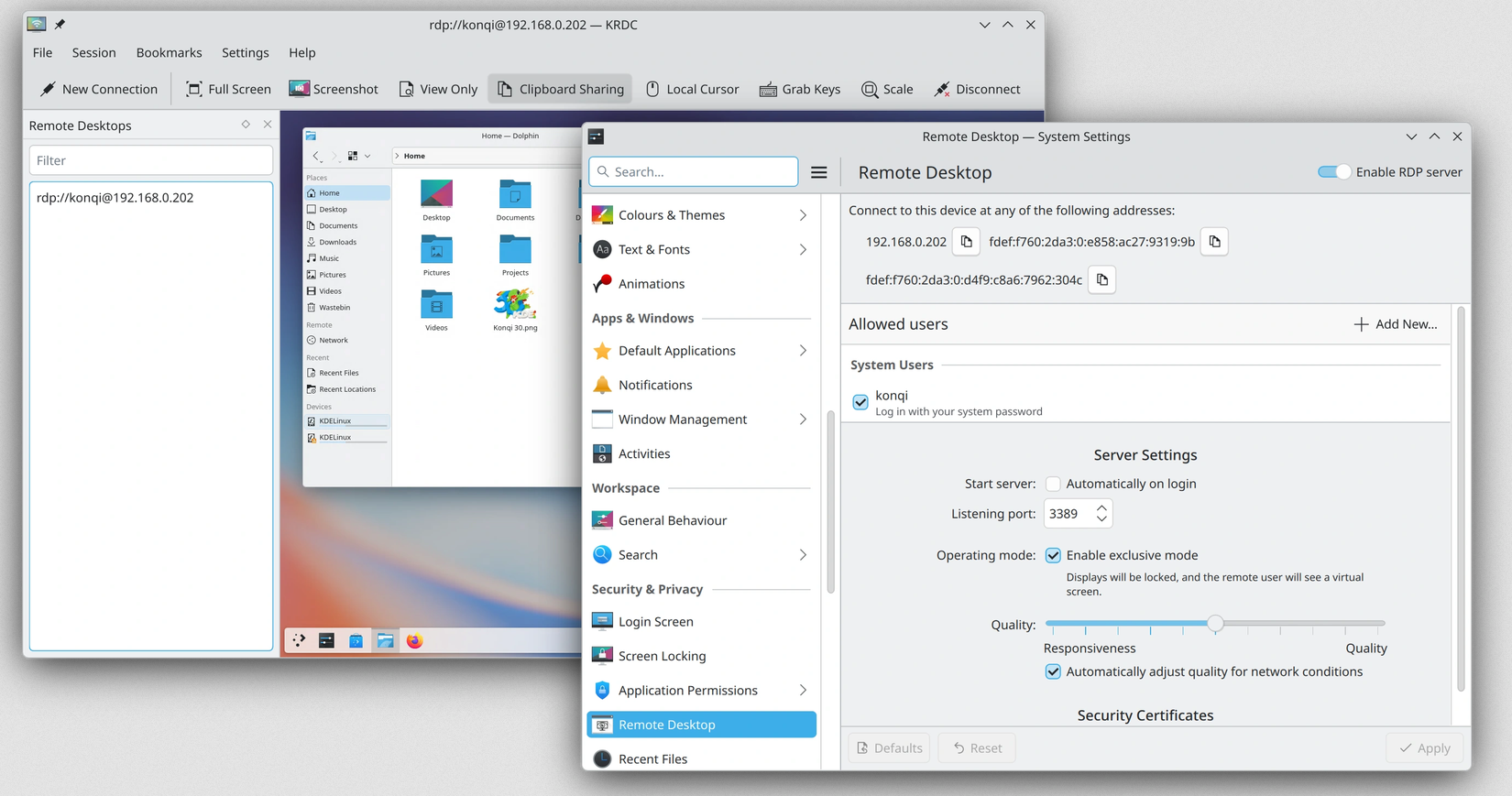
Homelabbers should find plenty to be excited about in the release. KDE revamped Plasma’s built-in remote desktop server to cater to clients accessing virtual displays across a network. Highlighted new features include clipboard synchronization between client and server, “Exclusive Mode” that locks the server’s physical display and allows the client to set a virtual one that matches their PC, and adaptive remote streaming that aids stability on slower networks.
New remote desktop features.
Credit: KDE.org
New remote desktop features. Credit: KDE.org
Linux enthusiasts can also check out a new movie released alongside Plasma 6.8. The KDE team debuted The KDE Documentary — A Story of Free Software Underdogs. An amusing opening-minute interview montage features KDE contributors laughing as they struggle to answer the question “What is KDE?”
Lockheed Martin Showered Susan Collins With Cash as F-35 Program Hit Turbulence
In May 2023, the Pentagon’s shiny new fighter jet was not looking so shiny or new.
Already a decade late and nearly $200 billion over its original cost estimate, the F-35 program faced a new crisis. An internal government watchdog report detailed a cascade of new problems with the program, which was in a period of flux amid plans to upgrade the jet’s engine and cooling system.
The report from the Government Accountability Office criticized the Pentagon for lumping those upgrades in with the overall purchase of the planes. Conflating the two, the authors said, would limit congressional insight into cost increases. And they criticized the contractors behind the aircraft for failing to deliver the F-35 in a timely manner.
For Lockheed Martin, the main defense giant overseeing the development of the F-35, the timing was far from ideal. In a few weeks, Congress was set to debate the Pentagon’s mammoth budget — and with it, new funding for the military’s purchase of F-35 jets.
Collins was the largest recipient of Lockheed cash in the period surrounding the inspector general report.
So Lockheed and its lobbyists went on a charm offensive in Washington. The weapons maker shelled out hundreds of thousands over a two-month period, in what the money-in-politics watchdog Open Secrets described as “one of the largest coordinated lobbying efforts” around that year’s military budget.
No member of Congress benefited more than Sen. Susan Collins, R-Maine, who at the time served as the ranking member on the Defense Appropriations Subcommittee.
From May 1 to June 30, 2023, employees and top executives from Lockheed Martin donated $59,500 to Collins’s campaign committee. The donations were outliers during that period: Collins was among the largest recipients of Lockheed cash; the company was her largest single donor over those two months; and it was the largest spending blitz on Collins by Lockheed compared to the same period in other years.
The effort appeared to pay off for Lockheed. In July 2023, less than two months after the release of the Government Accountability Office report, Collins voted in favor of appropriating funds to purchase 83 new F-35 jets. Later that year, when the final version of the military budget was signed into law, Collins celebrated the economic boon she said it would bring to the state of Maine.
In response to questions from The Intercept, Phoebe Keller, a spokesperson for the Republican-controlled Senate Appropriations Committee, said Collins’s support for the jet had nothing to do with donations from Lockheed or any other firm.
“The F-35 jet program is a longstanding bipartisan defense priority,” Keller said. “Sen. Collins has always publicly supported the F-35 jet program, as dozens of both Republican and Democratic Senators.”
Collins’s position on the Defense Subcommittee of the Senate Appropriations Committee likely played a role in the outsized donations, according to analyst Dan Grazier. And Collins, for her part, would have good reason to approve the spending: The F-35 program, Lockheed claims, has had a nine-figure economic impact in Maine.
Fight of Her Political Life
In the final weeks of the biggest fight of her political career against Democratic challenger Troy Jackson, fresh scrutiny on Collins’s donations from defense contractors has become a sore spot for her campaign.
In some cases, the senator’s interactions with defense firms are the routine for Washington: glad-handing, lobbying, contributions, and directing pork-barrel spending back home. Not all of it, though, is standard.
Last month, a bombshell report in ProPublica detailed an FBI investigation into an alleged pay-to-play scheme. A former defense contractor claimed to federal agents that he worked with figures tied to Collins to disguise campaign donations — and got federal contracts totaling $32 million in return. (The FBI probe fizzled after Trump returned to office and purged the bureau; Collins denied wrongdoing, pushing back on elements of the report.)
On Wednesday, more than 250 Mainers signed a letter to the state’s attorney general asking the official to investigate the allegations of corruption, according to Maine Morning Star, a local news outlet.
And earlier this month, The Intercept reported on donations from another defense contractor, AM General, and its parent company, whose employees gave $58,000 to fundraising committees associated with Collins after a damning assessment from the Army put its federal contracts in jeopardy.
As with the AM General donations, the contributions by employees and lobbyists of Lockheed Martin do not indicate wrongdoing by Collins or her donors.They instead illuminate how companies that garner lucrative contracts zero in on powerful members of Congress, who often tout the benefits to their states.
“This is an example of what’s wrong with our approach to buying weapons,” said William Hartung, an analyst who has written critically of defense spending and influence peddling in Washington. “If we buy things because they’re in the state of a powerful member, we’re not going to have a coherent arsenal.”
From May 1 to June 30, 2023, Lockheed’s corporate PAC doled out $421,000 in a bipartisan blitz to various campaign political action committees, campaign funds, state parties, and charitable foundations. (Aside from 2024, the year of the presidential election, contributions in that two-month period in 2023 eclipsed subsequent years. In the same period this year, Lockheed’s corporate PAC made 128 donations totaling $236,000; last year, it gave $286,000 across 158 donations during the same period.)
Collins was by far the biggest single beneficiary of the influx of cash — which came at a time when she was not actively campaigning. And, unlike the donations spread out to other campaign committees, the cash going from Lockheed into Collins’s coffers during those months came exclusively in the form of individual donations by employees and executives, including the firm’s CEO and chief operating officer, data from the Federal Election Commission shows.
Of the 60 donations of $1,000 or more during May and June of that year, 56 went to Collins.
Lobbyists working for Lockheed contributed another $5,000 to Collins during that period, and corporate PACs for Lockheed’s lobbying firms shelled out another $5,500 total, according to FEC disclosures.
Among individual contributions by Lockheed employees, donations to Collins made up more than 10 percent of all donations during the two-month period surrounding the watchdog report.
Only the firm’s in-house employee PAC, which received 75 percent of all employee donations, took in more from figures tied to Lockheed. Collins got more than twice as much as the next highest recipient, ActBlue, the Democratic Party-aligned fundraising vehicle, which received 4 percent of all Lockheed employee contributions in that period, according to FEC data.
The vast majority donations from Lockheed employees and officials were under $1,000. Of the 60 donations of $1,000 or more during May and June 2023, 56 went to Collins.
Virtually all employee contributions from Lockheed workers and executives to Collins during her current term came during that two-month window, according to the FEC.
Lockheed donations made up a quarter of all contributions during May and June 2023 to Collins’s main fundraising arm, Collins for Senator. The next runner-up was telecom giant Charter Communications, whose employee contributions made up just 8 percent of gifts to the Collins campaign in the second quarter of the 2023 fiscal year.
A spokesperson for Lockheed did not answer specific questions regarding the reason for the sudden influx of individual contributions to Collins in 2023.
“Our employee PAC program continues to observe long-standing principles of bi-partisan political engagement in support of our business interests,” the spokesperson wrote in an email.
Another Vehicle Army Didn’t Want
Two years later, a similar pattern played out in miniature when a lesser-known defense firm with a troubled product enjoyed Collins’s support on Capitol Hill.
Collins went out of her way last year to slam the Pentagon for canceling its plans to purchase robotic combat vehicles from Textron and its subsidiary Howe & Howe, the Maine-based developer of the Ripsaw.
Collins has repeatedly hyped the unmanned robotic combat vehicle in Senate hearings and official statements. On June 18, 2025, she took issue with the fact that the vehicle had appeared in a recent military parade, but did not make the cut for further spending.
“It’s the height of irony that you would feature this combat vehicle in your parade as the future of the Army at the same time that you’ve canceled the contract — the cancellation of a contract that was won over a lot of other competitors,” Collins said, describing the decision as “terribly unfair and a real mistake.”
A month later, after the military budget cleared the Senate Appropriations Committee, Collins singled out Howe & Howe, and its plant in Waterboro, Maine, as a potential beneficiary of a portion of $44 million allotted to outfit the U.S. Marine Corps with amphibious and autonomous vehicles.
She gave another shoutout to Howe & Howe in January, after the 2026 military budget was signed into law. This May, during the congressional testimony by then-Army Secretary Daniel Driscoll, Collins again took the military to task for cutting its planned purchase of the Ripsaw.
Textron’s corporate PAC made contributions totaling $4,000 to various PACs associated with Collins just ahead of her vote on the 2026 military budget. $3,000 of the gifts came days after Collins criticized the military for cutting its plans for the Ripsaw program that would have brought millions of dollars to Howe & Howe.
Later in the year, the Textron corporate PAC donated another $7,000 to Collins for Senator and the Collins-linked Dirigo PAC, according to FEC filings. (A spokesperson for Textron and Howe & Howe did not respond to a request for comment. Keller, the Senate Appropriations Committee spokesperson, did not respond to questions about the Textron and Howe & Howe donations.)
Employees of Textron and its subsidiary, meanwhile, made contributions to various Collins-linked PACS totaling nearly $15,000 between September 2025 and October 15, 2026, FEC data shows.
The donations, relatively small in the post-Citizens United era of campaign finance, still illustrate a troubling pattern of how influence plays out in Washington, according to Hartung, the analyst critical of military spending.
“A lot of members lobby to get more units of something built in their state, or craft legislation for a system that only their local firm can produce,” Hartung said. “It’s kind of business as usual, but sometimes business as usual causes great harm.”
Rudolph Diesel was thinking of farmers when he invented his engine
Rudolph Diesel and his engine. Image: Yachts International
When Rudolph Diesel disappeared in 1913, many suspected foul play. The prime suspects were Germany’s Kaiser Wilhelm II and US oil man John D. Rockefeller.
Both would have had reason to want the inventor of the diesel engine dead.
The militaristic kaiser was building a diesel-powered submarine fleet. He had no interest in other countries being able to use the technology for similar purposes – particularly Great Britain, the reigning naval power.
Though Diesel was German, he had lived as a boy in Paris and London and considered himself a citizen of the world. He was intent on spreading the technology to countries everywhere. He was actively helping the English perfect his engines.
To Rockefeller, the diesel engine looked like a potential competitive threat. Diesel’s early engines could run on any kind of oil, including pure plant oils. When he showed off the engine at the 1900 World’s Fair in Paris, it ran on 100% peanut oil.
Diesel hoped farmers would not only use his engines but grow their own fuels. Imagine Rockefeller’s dismay had Diesel’s dream of powering his engines with plant oils come true. Rockefeller wanted fossil-fuel-powered auto engines to dominate, as they ended up doing. The future business success of Rockefeller’s Standard Oil Co depended on it.
Despite the never-ending public speculation, it’s unlikely that either the kaiser or the oil baron did Diesel in. In the recently published book The Mysterious Case of Rudolph Diesel, author Douglas Brunt offers a different and intriguing explanation for the inventor’s disappearance.
Image: Simon and Schuster
No spoilers here, but I can divulge this: Brunt convincingly rejects the most popular theories, including murder.
Much of the book retells Rudolph Diesel’s biography. He lived an impressive life. As a child he was keenly observant and made drawings of things he saw. He had a gift for math and science.
His father was a financially strapped bookbinder but a relative recognized Diesel’s talent and paid for his education. He always got the best grades.
Early in life he became obsessed with the idea of inventing a workable internal combustion engine. External-combustion steam engines were still the motive power of ships and factories, but the coal required to run them, the manpower required to fill those engines with coal and the pollution they produced were problematic.
A gasoline-powered internal combustion engine had been invented but it was small and of limited use. Diesel’s university professors and employers saw the potential of the engine he was working on and encouraged him.
Reading this book, anyone who has followed the debate over biofuels has to wonder: What would have happened had Rudolph Diesel not disappeared? Could plant oils have become the reigning motive power of the automotive age? Was the predominance of fossil fuels inevitable?
This much can be said: Engines running on 100% plant oil would have been safer and less polluting. But would they have been as effective in powering automobiles?
Diesel engines did end up in cars, to be sure – they’re common in some parts of the world, including Europe – but these diesels run on fossil fuels. As I understand it, one reason for this is that pure plant oils are too thick for the engines’ fuel injectors and can cause congestion.
Biodiesel, which is increasingly used these days, isn’t a pure plant oil. Soybean oil undergoes a chemical process to make it usable. And most of the biodiesel sold is only 5% or 20% bio. Engine makers won’t warranty higher concentrations; 100% biodiesel is more susceptible to freezing in cold weather.
One other thing: The world’s automobile fleet would likely have been smaller, or at least slower to grow, if fueled by plant oil alone. A great deal more land would have had to be put in cultivation. The world would have needed many more farmers, especially in the early days when crop yields were much lower than today’s.
As tempting as it is to blame the oil companies for stifling the early competition from plant oils, the triumph of fossil-fuel auto engines was probably inevitable. Corn and soybean farmers weren’t destined to get more than the piece of the action they’re coming to get today.
Still, it’s fun to play the counterfactual “what if” games. Brunt’s book is a good place to start that speculation – and a good read.
Former longtime Wall Street Journal Asia correspondent and editor Urban Lehner is editor emeritus of DTN/The Progressive Farmer.
A new report just busted another myth about heat pumps
You may have heard by now that heat pumps — which transfer warmth from outdoor air to an indoor space, instead of generating it like a furnace — don’t work when it gets really cold out. That’s incorrect, as models designed for frigid climes can keep you toasty even in the dead of winter. Don’t believe me? Look no further than the Nordic countries, which have fully committed to them despite the region’s not-exactly-balmy winters.
OK, so heat pumps are more efficient than ever, which is why Americans seem to be warming up to the appliances. But surely, since they’re electric, switching to them en masse will push the grid to collapse? That’s also false. A new report from the energy thinktank RMI finds that thanks to “headroom” in the grid during the winter months, three-quarters of U.S. homes — some 109 million — could adopt the technology, no problem. That would significantly reduce greenhouse gas emissions and slash electric bills by over 20 percent in some states.
“A substantial number of homes can upgrade to heat pumps within the headroom today,” said Ryan Shea, a manager in the organization’s buildings team. “We’d be better utilizing the grid capacity that’s already there, that essentially spreads those costs across more kilowatt-hours, and everyone benefits with a lower electricity rate.”
What is this headroom, exactly? It’s the difference between the grid’s generation capacity and demand in winter. Typically, the need for electricity is highest in the summer, when millions of air conditioners gobble tremendous amounts of power. In the winter, many folks instead heat their homes with gas furnaces, so they’re getting that energy elsewhere, relieving strain on the grid. This means that during colder months, there’s additional capacity to provide power.
“That’s where we see moving to heat pumps, adding that electrical load in the winter, where there is all that available grid capacity, is a way to add load to the grid without needing to build it out more,” Shea said. In other words, keeping 109 million heat pumps running through the winter wouldn’t require, say, heaps of new gas-fired power plants.
This buffer, though, isn’t the same state to state or region to region. For one, climates are different: In Phoenix, summers are way hotter than in Boston, requiring more AC, with much milder winters, requiring less heating. How local utilities generate electricity matters, too. Gas power plants can run year-round, but with more solar coming online, generation dips in the winter as the days grow shorter. To compensate for this, utilities are building sprawling battery farms to store energy, and experimenting with using electric vehicles as a vast network of backup power. (They’re even using Earth itself as a giant battery for longer-duration storage.) Either way, renewables and batteries are combining to make the grid more reliable than it is with fossil fuels, and much more flexible no matter the time of year, further reducing costs for ratepayers.
Read Next
The ultimate goal is for heat pumps to replace fossil fuels as the dominant way of warming and cooling our homes. (Yes, heat pumps can cool a space by transferring warmth from inside to outside.) But they also need to replace electric resistance heating, like space heaters. These appliances are especially common in the Pacific Northwest and the Southeast, which endure less punishing winters than the Northeast. These giant toasters are, of course, a better option than a gas furnace, as they’re inherently more efficient and don’t poison homes. But heat pumps are around three to four times more efficient, meaning they require less electricity and therefore demand less from the grid. This could theoretically save households switching from resistance heating an average of $1,530 a year, according to RMI’s previous research.
So how can the U.S. accelerate its shift to heat pumps? For one, AC units that go kaput should be replaced with heat pumps. States can provide rebates to encourage people to make the switch. When a state puts its collective mind to it, the transition can happen faster than you think: Maine (again, another place not known for comfortable winters) blew past its goal of installing 100,000 heat pumps two years ahead of schedule. Oddly enough, simply building more apartments — tackling the housing crisis is a rare bit of agreement between Democrats and Republicans — is a sneaky way to get more heat pumps into units.
Instead of crashing the grid, then, heat pumps working in all American climates (even Alaska) will reduce electricity costs for owners — and rates overall — while making the system as a whole more flexible. As affordability dominates the conversation in American politics, the heat pump could well emerge as a superstar, a rare feat for an appliance. “We really think there’s a reason to include heat pumps within those affordability plans,” Shea said, “and try to really establish some heat pump installation goals.”
Targeted ads delivered 0-click exploits to install mercenary malware
Researchers say that mercenary hackers laced ads with zero-click exploits that installed sophisticated malware on the devices of targeted individuals when they did nothing other than load a website or open an installed app.
The finding, published Thursday by the University of Toronto’s Citizen Lab, said the incident is likely to be the first confirmation of zero-click mercenary spyware delivered through targeted ads. The attacks, which worked on iOS and Android devices, are particularly pernicious because they work without requiring any interaction from the target and are invisible unless users run special forensic hardware or software. Citizen Lab said it confirmed that AdFection, as it named the campaign, infected 45 devices at international media organization Al Jazeera in 2024 and 2025.
A clear warning signal
“This investigation should … serve as a clear warning signal to news organizations around the world that they may be being actively targeted via this new threat,” Citizen Lab researchers wrote. “This targeting may happen both in newsrooms and to individual journalists, editors, and other staff members.” Their report went on to say: “The distribution of spyware via targeted ads represents a security risk not only for potential victims but also for states and civil society at large.”
The ads were provided by Discover-Tech, an Israeli company that brands itself as a legitimate advertising company, but Citizen Lab said it operates as a facilitator for multiple mercenary spyware partners. The company acts as a broker between parties that want to display their ads and publishers or app makers that seek revenue in return for showing them. In this capacity, Discover-Tech acts as a “bridge between ad vendors and the mercenary spyware ecosystem,” a role that appears to be “Discover-Tech’s primary purpose,” Citizen Lab said.
The brokering involves a bidding process in which advertisers offer a fee in exchange for their ads appearing on the devices of individuals in particular demographics. Using users’ unique mobile ID, location, IP address, and other breadcrumbs, the brokers are able to assemble detailed profiles of millions of people. Citizen Lab said it obtained more than 4 billion bidding records handled by Discover-Tech. They revealed that Discover-Tech ads were displayed in over 70,000 mobile apps and more than 120,000 websites between March and June 2026.
Among the major vendors that listed Discover-Tech as a “certified” or “verified” vendor were Google and the advertising industry association IAB Europe. The Israeli firm also used European General Data Protection Regulation (GDPR) consent frameworks to target users within the European Union. Discover-Tech has served ads through major networks such as Google, Yandex, and Beeswax.
Google and IAB Europe have since removed Discover-Tech from their ad vendor registries, and Google further terminated Discover-Tech’s access to its ad exchange platforms. Beeswax has removed Discover-Tech from its ad buying platform. Fellow ad platform Vungle (Liftoff) paused Discover-Tech’s access while conducting a review, and Eskimi blocked Discover-Tech’s accounts and domains.
Thursday’s report said that Discover-Tech ad impressions have appeared on government and national-security-linked networks throughout the world: NATO, United Nations networks, European lawmaking bodies, critical infrastructure providers in Australia, and armed forces and government agencies in Norway and Sweden.
“Discover-Tech’s mass abuse, privacy invasion, and facilitation for mercenary spyware attacks illustrates structural flaws with the online advertising system, which failed to detect or prevent the abuse documented in this report,” Citizen Lab said.
Messages sent to Discover-Tech and Candiru went unanswered.
The research lab said that the mercenary malware installed through AdFection was developed and distributed by Candiru (rebranded as “Integrity Labs”). Under the arrangement with Discover-Tech, targets with specific profiles of interest to the Candiru customers received ads that carried JavaScript or other code that connected to Candiru’s control servers. In response, those servers delivered an exploit that served the zero-click payload when the ad appeared on an individual’s device.
The research doesn’t describe the vulnerabilities exploited in the zero-click attacks or the final malware that was installed in them. It’s likely they were zero-days that have been fixed after Citizen Lab discovered the campaign. Citizen Lab didn’t immediately respond to questions.
Citizen Lab called on advertisers and government officials to take concrete action to proactively prevent campaigns like AdFection. Beyond that, users can reduce the risk of being infected by installing ad blockers, resetting mobile advertising ID in iOS and Android settings (it’s unclear why the researchers didn’t advise turning off personalized ads altogether), and installing ad-blocking software on home or office networks. As always, installing updates in a timely manner is also a must.
The disappearance of Savannah Guthrie’s 84-year-old mother has taken another frustrating turn after investigators examined a new ransom message that initially appeared to offer hope of a breakthrough in the months-long kidnapping mystery.
Nancy Guthrie vanished from her home near Tucson, Arizona, in the early hours of February 1, setting off an extensive investigation involving local detectives, the FBI and numerous searches for evidence.
Nearly eight months later, authorities announced they were investigating a possible new ransom demand connected to the missing grandmother.
But the potential lead quickly fell apart.
On September 29, the Pima County Sheriff’s Department revealed that its joint task force with the FBI had determined the latest message was not credible.
The development was particularly disappointing because the investigation has already been complicated by multiple suspicious ransom communications, including messages that authorities believe were attempts to exploit the family’s desperation.
The latest scare began September 28, when investigators disclosed that they had learned of a possible ransom note circulating in connection with Nancy’s disappearance.
Police said they were examining both the message and related social media activity to determine whether the sender possessed legitimate information about the case.
According to local reporting, a Tucson woman had received a social media communication from someone claiming Nancy was alive and demanding money for her return.
The recipient questioned the authenticity of the message, but authorities investigated rather than immediately dismissing it.
By the following day, detectives had reached a conclusion.
“After further review, investigators determined the text message is not credible,” the sheriff’s department announced.
Police also warned that scammers could try to exploit the highly publicized disappearance by contacting members of the public with false information or fraudulent demands.
The department urged anyone receiving suspicious communications about Nancy to report them to law enforcement rather than sending money or responding directly.
Although the latest message has been dismissed, the underlying kidnapping investigation remains active.
Nancy was last seen January 31 at her home in the Catalina Foothills neighborhood outside Tucson.
When relatives became concerned the following day, they discovered she was missing under circumstances that investigators quickly considered suspicious.
Authorities later recovered surveillance footage showing a masked individual approaching the front entrance of her home during the early morning hours.
The person appeared to interfere with a security camera while concealing their identity.
The FBI released footage of the individual in hopes that someone might recognize their clothing, movements or other identifying characteristics.
Investigators have not publicly established who the person is or announced an arrest in connection with Nancy’s disappearance.
Ransom demands have been a recurring issue since the earliest days of the case.
Messages sent to news organizations in February included demands for cryptocurrency and claims about Nancy’s fate.
Some contained details investigators initially considered significant, prompting authorities to examine whether the sender had inside knowledge.
However, the authenticity of the messages has remained disputed, and none has led investigators to Nancy.
In June, Reuters reported that federal investigators had assessed several earlier kidnapping-related communications as fraudulent, while other reporting indicated authorities continued examining potentially relevant messages.
The conflicting assessments underscore the challenge detectives face when attempting to distinguish genuine information from opportunistic extortion attempts.
The search has also extended beyond Arizona.
In May, a volunteer group in Mexico reportedly searched a remote area near Nogales after receiving information suggesting Nancy might be buried there.
The search did not locate her remains or produce a confirmed breakthrough.
Meanwhile, Savannah Guthrie and her family have continued making public appeals for information.
The Today show co-anchor temporarily stepped away from her broadcasting responsibilities following her mother’s disappearance before eventually returning to television.
But she has made clear that resuming work does not mean the family’s anguish has diminished.
In August, marking six months since Nancy vanished, Savannah shared an emotional message describing how profoundly the disappearance had affected her family.
“Every day, we wake up and try to be strong and go on,” she wrote, explaining that her mother’s resilience had always been an example to them.
She also described the devastating uncertainty of not knowing what happened or whether Nancy could still be alive.
The family has offered a reward of up to $1 million for information that helps bring Nancy home.
Federal authorities have separately publicized a $100,000 reward for information leading to Nancy’s location or the arrest and conviction of anyone responsible.
Investigators continue encouraging anyone with credible information to come forward.
The sheriff’s department has emphasized that tips are reviewed and that authorities remain committed to determining what happened to Nancy.
For the Guthrie family, the latest false ransom message represents another painful complication in a case already filled with uncertainty.
Each apparent development carries the possibility of providing answers, only to raise more questions when the information cannot be substantiated.
And while investigators continue following leads, the central mystery remains unchanged.
More than eight months after Nancy Guthrie disappeared from her Arizona home, authorities have not located her, identified the person seen in the surveillance footage or announced an arrest.
Her family is still waiting for the answers that have eluded investigators since that February morning.
Risks could be catastrophic if US limits Starlink use in Ukraine
The drone has become the signature weapon of the Russo-Ukraine war. On any day in Ukraine, tens of thousands of drones are out hunting the battlefield for targets. These could be individual enemy soldiers or vehicles, or they could be larger targets such as depots, headquarters, bridges or power plants.
Yet, this drone war has been possible only because of a less obvious but equally vital technology. Elon Musk’s SpaceX Starlink system is a secure digital satellite communications network that Ukraine has become fully reliant on.
When Russia mounted its full-scale invasion of Ukraine in February 2022, Mykhailo Fedorov – then Ukraine’s vice prime minister and minister of digital transformation – publicly urged Musk to provide connectivity. Two days later, 500 Starlink terminals arrived in Ukraine. In February 2022, Musk granted the Ukrainian government and military the use of Starlink, initially for free. By July 2020, Starlink had provided 15,000 terminals.
The Ukrainians have fully admitted their dependence on Musk: “Without Starlink, we would have been losing the war already,” one platoon commander reportedly told the Wall Street Journal in 2022. Starlink allowed the government and the armed forces to communicate securely, at the heart of its vital system of C4ISR (the military term for command, control, communications, computers, intelligence, surveillance and reconnaissance).
Without Starlink, the defense of Ukraine would have been very difficult: perhaps impossible.
The cost to Starlink was considerable, though. Musk initally provided 2,000 terminals for free and 300 discounted. He waived monthly services for about 5,500 more. Starlink’s total contribution to the Ukraine war effort in 2022 alone was US$80 million. Musk provided a vital military capability gratis and eventually on a (discounted) contractual basis.
The strategic and commercial partnership between Starlink and Ukraine has been vital to the war effort for more than four years.
Crisis resolved
But Ukraine’s dependency on Starlink – or Starshield as the system’s military application is called – has not come without conditions. In September 2022, having repulsed the initial Russian attacks, the Ukrainian armed forces were planning their first assault on the port city of Sevastopol in Crimea, then the home of Russia’s Black Sea fleet. The plan was to sail remotely controlled boats, loaded with explosives, to cripple the fleet.
It was a bold plan – the first attempt by the Ukrainians to attack territory that the Russians had held since 2014 and that they considered sovereign. And it was a controversial attack – the Russian ambassador to the US, Anatoly Antonov, had personally warned Musk that attacking Crimea would be a red line that could lead to nuclear war.
Musk was concerned. He believed that this was potentially escalatory. He advised Fedorov: “Once Russia is fully mobilized, they will destroy all infrastructure throughout Ukraine.” He urged him to avoid a third world war: “Seek peace while you have the upper hand.”
Musk refused a Ukranian request to activate Starshield operations in the region, posting on X that: “If I had agreed to their request, then SpaceX would be explicitly complicit in a major act of war and conflict escalation.”
But following this crisis, relations between Musk and Ukraine’s leadership stabilized. Starshield has continued to play an indispensable role in Ukraine. It has been the digital communications spine of the Ukrainian armed forces and the enabler of all its operations in this war.
Indeed, when the Ukrainians informed him that in 2026 the Russians had acquired some Starlink terminals on the black market and were accessing the system to help them prosecute the war inside Ukraine, he identified the serial numbers of those terminals and disabled them.
Speed limit
In the past week, however, Ukrainian armed forces once again have been exposed to the jeopardy of their dependence on Starlink. On the night of October 13-14, without any warning, SpaceX imposed a speed limit of about 160 kilometers per hour on some Starlink services, meaning this is the maximum speed Ukrainian drones and missiles can travel and remain connected. Starshield terminals mounted on drones have been particularly badly affected. Ukraine’s 7th Rapid Reaction Corps was forced to cancel several missions.
Given the importance of drones to the Ukrainian war effort, the Starlink constraint is very serious. The speed limit has compromised Ukrainian drone fleets operating above the kill zone. It has also undermined Ukrainian air defense against intensifying Russian drone attacks on cities and infrastructure, as 160 kmph is too slow for intercepts.
Since strategic bombardments against Ukrainian energy infrastructure have become Russia’s principal means of prosecuting this war and will only intensify into the winter, the Starlink embargo is deeply concerning. It may become critical if it continues.
Unlike September 2022, it appears that this is not a random individual decision by the Starlink boss. It seems to reflect troubling shifts in US policy on Ukraine.
On October 9, the US president, Donald Trump announced a deal with his Russian counterpart, Vladimir Putin, to lift sanctions on Russian diesel and allow it access to global markets. The plan was, he said, to reduce the price of fuel – although how effectively the relatively small amount of Russian diesel will do that is unclear. The high price of diesel has much more to do with the intractable war in Iran.
The following day, Trump called for the removal of Ukrainian president, Volodymyr Zelensky: “Time for Ukraine to get a new president,” he told reporters. The day after that, the US president announced that an energy ceasefire was in immediate effect and that Russia and Ukraine would stop targeting each other’s energy infrastructure.
Ukraine has not used Starlink to hit Russia’s oil refineries. Starlink does not work in Russia and the Ukraine deep strikes rely on other communications systems. So Ukraine’s strategic bombardments remain technically unaffected by the Starlink embargo.
Musk has put the responsibility for the slowdown in Starshield squarely on the US government, posting on his X social media platform: “Starshield systems are owned and controlled by the US government. Any limits on speed or usage are decided by the US military and ultimately POTUS.”
In September 2022, Musk instituted a policy that contradicted US policy on Ukraine – he turned off Starlink against the wishes of the Biden administration. Now, so Musk says, in October 2026, it’s the US government that is restricting Starlink. But the result is effectively the same: Ukraine is the victim.
This winter always looked as if it will be hard for Ukraine. It just got harder.
Brussels mayor says violence ‘undermining society’ after officer shot dead in Jette
Brussels Mayor Philippe Close has asked for additional funds for the federal police in the Belgian capital after a police officer was killed in the Jette district.
Close, a member of the Socialist Party (PS) who also heads the Brussels-Capital/Ixelles police zone, made the request following the death of a 41-year-old officer who was shot in the head Monday at 11:10 p.m. The officer was attempting to intercept a vehicle stolen in a carjacking.
The victim belonged to the Anti-Aggression Brigade and was in plain clothes, watching the location where the car had been spotted. Three suspects have been arrested in the shooting.
The Flemish newspaper Het Laatste Nieuws reported that the suspects claim they thought the officer was a rival gang member when they opened fire.
Brussels Public Prosecutor Julien Moinil had asked for a budget to hire 10 additional public servants for the federal police after the shooting. Close described the request as “not insurmountable.”
In an interview with RTBF Radio, Close said every level of government should take responsibility. He described the rise in violence as a wider societal problem and pointed to explosive attacks in Antwerp and the widespread circulation of guns across Belgium.
“We knew there were going to be incidents. A very experienced police officer has been shot. People don’t realize that the violence is undermining society,” Close said.
He said the budget to fight organized crime has reached its limit at the local level. He said Belgian Prime Minister Bart De Wever, of the N-VA party, should host a meeting to discuss the problems in the capital.
Close also called on authorities to extend the fight against drug violence to every link in the chain, from smuggling through the port of Antwerp to preventive policies on drug use.
“Drugs are everywhere; it’s a phenomenon that people refuse to talk about,” Close said. “Where are the campaigns to discourage young people from taking drugs, from using cocaine, ketamine or ecstasy?”
Frustrated by Losses in the Courts, Missouri Republicans Want to Change How Top Judges Are Selected
Some 86 years ago, Missouri voters enshrined a system for selecting top judges that would remove political influence from the courts. And almost immediately, it came under attack.
Under what has come to be known as the Missouri Plan, lawyers help choose a slate of three candidates from which the governor must make an appointment for the state Supreme Court, appeals courts and, in some populous areas, the circuit courts.
In the first years after adoption, it faced pushback from party bosses who had historically used judicial seats for political patronage. They said it gave too much power to the lawyers. Voters, though, decisively defeated a repeal measure in 1942.
More recently, the conservative activist Leonard Leo, who viewed Missouri as a crucial battleground, tried in 2007 to persuade Republican Gov. Matt Blunt to reject a slate of Supreme Court candidates — part of a broader effort to weaken a judicial selection system that had become a model for some two dozen states around the country.
Blunt resisted and picked one of the three judges from the approved slate.
Then, in 2012, GOP lawmakers put a proposed overhaul before voters that, if approved, would have given the governor more control. Voters, by a 3-to-1 margin, turned back the plan.
Now the attacks are back, driven by a new grievance.
At President Donald Trump’s behest, Republican lawmakers redrew the state’s congressional map in a mid-decade gerrymander. The goal: to give the GOP a shot at winning seven of Missouri’s congressional seats, instead of the six it now holds.
But voters gathered enough signatures to force a referendum on the map and put it on hold. While Secretary of State Denny Hoskins tried to keep the referendum off the ballot, the Missouri Supreme Court overruled him. It ordered the old map restored until voters decide on the new one.
Missouri Secretary of State Denny Hoskins walks into the state Supreme Court in September. The court found Hoskins in contempt for directing election officials to use a congressional map it had barred, but it did not punish him.Liz Rymarev/St. Louis Post-Dispatch via Getty Images
Fourteen Republican lawmakers responded by threatening to impeach “responsible members of this Court” for “willful neglect of duty, incompetency and misconduct” if the justices held Hoskins in contempt; the court did so anyway. Hoskins backed down and instructed local election officials to distribute ballots using the old map; the justices decided not to have him arrested.
The drama played out as Republicans in Missouri and elected officials nationwide have sought to weaken institutions that limit their power. In North Carolina, the Republican-dominated General Assembly stripped authority from Democratic governors. In Wisconsin, Republicans threatened to impeach a newly elected Supreme Court justice to protect gerrymandered maps. And in New York, Democrats bypassed an independent commission to pass a gerrymander that favored them, but the state’s highest court struck it down.
Rather than electing top judges, as Illinois does, or giving the governor primary responsibility for choosing them, like California, Missouri selects its appellate and Supreme Court judges through a commission made up of three lawyers, one elected by lawyers in each appellate district; three non-lawyers appointed by the governor, one from each district; and a state Supreme Court judge selected by the court. After they are appointed, judges face a retention vote at the first general election after completing one year in office, then every 12 years, with voters deciding whether they keep their positions.
In response to the controversy, a number of Missouri Republicans have attacked the system. U.S. Rep. Jason Smith called for the state to switch to electing its Supreme Court judges. Republican Party executive director Miles Ross declared on X, “The Missouri Plan is done.” Dan Seitz, chief of staff to Sen. Brad Hudson, called for replacing it with a system in which the governor could nominate judges directly, subject to Senate confirmation.
State Rep. Cathy Jo Loy, a Carthage Republican who has introduced legislation in each of the past two sessions to replace the Missouri Plan with gubernatorial appointment and Senate confirmation, said she intends to file a new proposal Dec. 1, the first day lawmakers can file bills for next year’s session. Loy said her opposition to the system predates the recent clashes with the Supreme Court. But she acknowledged that those defeats could give the proposal new momentum.
“There will probably be more appetite because there are several senators that feel the same way,” she said.
Republicans, who hold every statewide elected office, supermajorities in both chambers of the legislature and six of the state’s eight congressional seats, seem to have suddenly found the limits of their power. At the ballot box, voters have overwhelmingly rejected major pieces of the party’s agenda, including an effort to weaken their power to bypass the legislature by amending the constitution or putting laws passed by lawmakers to a statewide vote.
Time and again, when elected officials have sought to limit voters’ use of the ballot initiative, the courts have protected voters’ use of direct democracy. Courts repeatedly rewrote ballot summaries prepared by Republican state officials that they found unfair or misleading, including language describing the initiative that ultimately established abortion rights in 2024.
By the end of that year, after the Missouri Supreme Court rejected a last-minute effort by Republican lawmakers and anti-abortion activists to keep the abortion measure off the ballot, Senate President Pro Tem Cindy O’Laughlin was calling to repeal the Missouri Plan. She proposed replacing the system for selecting Supreme Court and appellate judges with a nonpartisan election. But her bill stalled in committee.
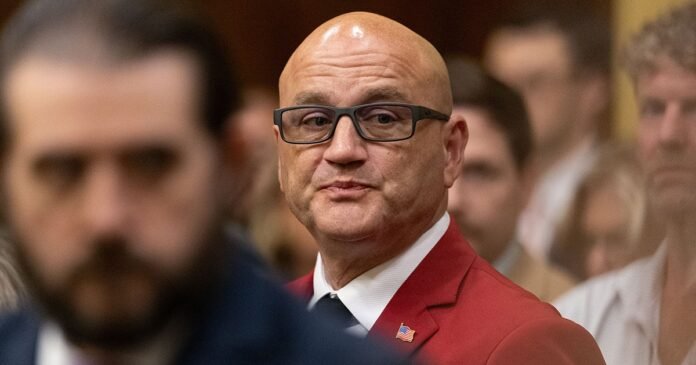
Then came Hoskins. The former state representative and senator from west-central Missouri took office as secretary of state in January 2025 and brought a more combative approach to overseeing elections and ballot measures. Hoskins made a bright-red sport coat his sartorial trademark, often posing with a wood baseball bat and speaking about politics as a series of battles and himself as a conservative warrior.
Hoskins didn’t respond to questions sent to his office. He has previously said that he disagreed with any suggestion that he and Republican leaders were defying the will of voters. He hasn’t publicly called for changing how Missouri selects Supreme Court judges, but his office’s official X social media account reposted Smith’s message calling for the end of the Missouri Plan.
Gov. Mike Kehoe also complained, saying in a post on X that “unelected judges” have shown a “lack of respect for the legislative process.” On a radio show the next day, Kehoe acknowledged that changing how judges are selected hadn’t even been on his radar before the ruling.
“But I think it’s definitely something a lot of people are going to start asking about,” he said. “And I’m not sure the judges across our state, whether Supreme Court or other judges, really wanted that on people’s radar screen.”
Missouri Gov. Mike Kehoe speaks during an event in May with Vice President JD Vance in Kansas City.Eric Lee/Pool via Getty Images
Kehoe’s office said it would not respond to questions from ProPublica.
Although some Republicans have derided the state Supreme Court as being a bastion of liberal activists, five of the Supreme Court’s seven judges were appointed by Republican governors. Among them is Powell, whom the then-chair of the state GOP hailed as a “good conservative” before Republican Gov. Eric Greitens selected him in 2017.
Powell, who also serves as chair of the judicial selection commission, declined to comment for this story. In remarks on Sept. 17 to the joint annual meeting of the Missouri Bar and the Judicial Conference of Missouri, he warned of “threats from those who seek to detract from the ideals of our republic and to undermine faith in our sacred institutions — including our legal profession and our courts.”
“It is incumbent on all of us as lawyers and judges to rise up and defend our constitutions and the rule of law,” he added.
Missouri Supreme Court Chief Justice Brent Powell speaks during Secretary of State Denny Hoskins’ contempt hearing in September.Liz Rymarev/St. Louis Post-Dispatch via Getty Images
Whether there’s enough support to repeal the Missouri Plan remains to be seen. Peverill Squire, a professor emeritus of political science at the University of Missouri, said some of the bills that would eliminate the Missouri Plan might go to committee hearings, “but my guess is there probably won’t be enough appetite among enough Republicans to really want to put it on the ballot.”
Any change would ultimately have to be approved by the voters, something Loy acknowledged could be difficult after Republicans’ recent losses at the ballot box.
But the renewed calls have also mobilized the system’s longtime defenders. Ed Dowd, a former U.S. attorney who for two decades has helped lead the Citizens for Missouri Courts, a campaign that advocates for preserving the Missouri Plan, said the group has historically become most active when the system is under threat.
Dowd’s St. Louis-based firm, Dowd Bennett, recently contributed $100,000 to the campaign.
“It’s something that we take very, very seriously and don’t want to take any chances on losing something that we have that works so well,” he said.