The current architecture of international relations faces a profound, non-linear crisis that extends far beyond the traditional boundaries of regional military conflict.
The ongoing military escalation in the Middle East — particularly around the region’s key maritime chokepoints, the Suez Canal, the Bab al-Mandab Strait and the Strait of Hormuz — is exposing deep material and moral vulnerabilities in our hyper-optimized, globalized society.
While mainstream security analysis remains focused on energy volatility and short-term crude oil price swings, a more devastating, silent crisis is unfolding where global logistics networks, human security and agricultural supply chains intersect.
For decades, supply chain policymakers and global freight operators have treated major maritime routes as fixed, deterministic constants. That assumption enabled the global adoption of hyper-efficient “just-in-time” logistics models designed to minimize capital holding costs and maximize inventory turnover.
However, this aggressive optimization has stripped international shipping networks of buffer capacity, rendering the global food trade highly sensitive to geopolitical shocks. When military interdictions and asymmetric security threats paralyze these critical maritime routes, the system suffers a severe shock.
Unlike industrial manufacturing components, agricultural goods and humanitarian aid shipments cannot survive prolonged disruptions; they are bound by perishability and operate on extremely narrow financial margins.
In response to the maritime gridlock, a dominant but misleading narrative has emerged in both Western policy circles and Eurasian diplomatic forums. Shippers and trade ministers frequently argue that land-based intermodal corridors — most notably the Trans-Caspian International Transport Route, known as the Middle Corridor — can seamlessly serve as an emergency safety valve and scalable shock absorber.
To test that assumption, our research institute conducted a network flow optimization analysis using the Edmonds-Karp maximum flow algorithm. The data generated by our model delivers a harsh reality check to current policy discourse.
The simulation shows that continental land infrastructure faces a fixed physical and administrative capacity ceiling. Under maximum stress, the land-based Middle Corridor (Vector α) reaches saturation at a maximum of 12 intermodal container trains per day. Translated into equivalent maritime freight volumes, that rail capacity reveals a staggering structural deficit.
A standard intermodal block train operating across Eurasia carries roughly 100 twenty-foot equivalent units, or TEU. Therefore, a fully saturated daily capacity along the Middle Corridor yields a maximum network throughput of just 1,200 TEU per day. By contrast, a single modern ultra-large container vessel, or ULCV, routinely carries up to 24,000 TEU.
As a result, the entire daily throughput of the main land-based Eurasian rail corridor equals just 5% of the cargo volume displaced by a single modern container ship. Our analysis identified the primary bottleneck at the Caspian Sea transshipment point between the ports of Aktau, Kazakhstan, and Baku, Azerbaijan.
Pushing cargo volumes beyond the 1,200-TEU threshold causes terminal yard dwell times to jump from a baseline of 48 hours to more than 240 hours — 10 days — of severe port gridlock.
This paralysis is worsened by a shortage of rail-car ferries and mechanical delays at track-gauge transition points, where trains must shift from the wide, 1,520-millimeter Russian gauge to the 1,435-millimeter standard European gauge. Land corridors simply cannot substitute for maritime routes in bulk food logistics.
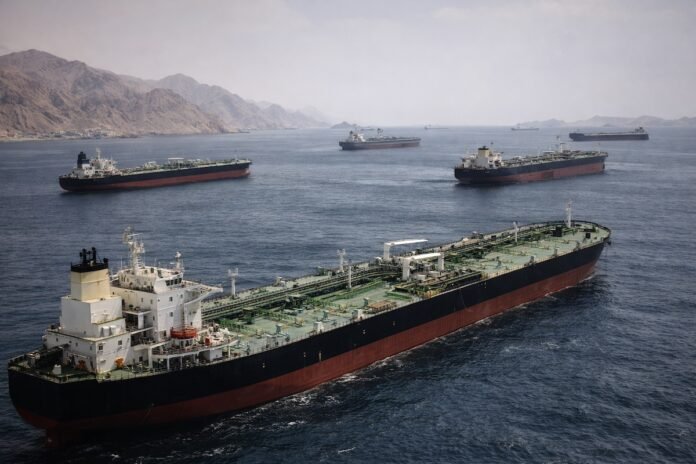
With the overland alternative quickly saturated, global logistics networks must rely on the maritime detour around Africa via the Cape of Good Hope (Vector β). While the open ocean offers essentially unlimited capacity, it imposes severe time and cost penalties.
Rerouting commercial vessels around Africa adds about 3,500 to 4,000 nautical miles to the voyage. At standard economical speeds, this adds a delay of 10 to 14 days to the global supply chain. The extended transit also increases marine fuel consumption by 450 to 600 metric tons per vessel, driving up operational costs per voyage by 34.6%.
For low-margin agricultural commodities such as wheat and corn, these logistics penalties flow directly into retail markets. Agricultural shippers and humanitarian relief organizations cannot absorb a 34.6% spike in freight rates, so the cost is passed on entirely to consumers.
Our model predicts that within 14 days of a chokepoint closure, the supply gap caused by shipping delays triggers panic buying and localized shortages. Within 30 days, as higher transport costs reach retail shelves, the model projects a 15% to 22% spike in the price of basic food commodities in vulnerable, import-dependent regions, most notably in East Africa and across the Global South.
For populations that already spend more than 40% of household income on food, this logistics-driven inflation directly reduces caloric intake and sharply raises the risk of widespread, localized famine.
This mechanism shows that maritime security is not a commercial luxury for shipping conglomerates; it is a core pillar of global human security. To prevent these logistics bottlenecks from turning into catastrophic humanitarian shocks, the international community must move past reactive crisis management and adopt structural interventions. We propose three immediate, coordinated policy measures:
First, the United Nations, in coordination with the World Bank and the Group of 20, should establish an International Humanitarian Logistics Shielding Fund, or HLSF. This fund should absorb the 34.6% cost increase caused by the African detour by directly subsidizing emergency war-risk insurance premiums and fuel surcharges for certified vessels carrying basic grains, fertilizers and medical aid. By insulating transport costs at the institutional level, the HLSF would prevent price shocks from reaching local retail markets.
Second, international maritime frameworks should be used to designate and enforce legally binding, demilitarized transit zones — known as “Blue Corridors” — for civilian commercial vessels transporting life-sustaining agricultural commodities through or near active conflict zones. The transport of essential food must be insulated from broader geopolitical disputes and strictly protected under international humanitarian law.
Third, international development banks should prioritize structural investments to relieve bottlenecks in secondary intermodal networks. Expanding rail-car ferry and container feeder fleets on the Caspian Sea and adding automated handling infrastructure could reduce terminal dwell times from 10 days to under 36 hours.
While land-based routes cannot replace deep-sea shipping, they should be optimized to handle time-critical, high-value emergency aid.
Ultimately, science and human ethics must speak with a single, unyielding voice. The current geopolitical instability in the Middle East and the resulting logistical paralysis expose the limitations of existing international structures.
True global stability cannot be achieved through hyper-optimized commercial systems that lack resilience, nor through a return to destructive, classical power politics that relies on military escalation.
Instead, international society must move toward a framework of evolutionary realism — a paradigm that views global order as an interconnected system of shared vulnerabilities, where human security and the preservation of individual lives are the primary objectives of governance.
If global decision-makers fail to show sustained financial and diplomatic resolve to protect these vital transport routes, the economic cost of transport will, in time, become a tragic and massive loss of human life.
W. Julian Korab-Karpowicz is a professor at the Warsaw Academy of International Relations and American Studies (WSSMIA). He received a doctorate in philosophy from the University of Oxford and was a Lady Davis Visiting Professor at the Hebrew University of Jerusalem (2021–2022).
He is the author of several authoritative monographs, including “Tractatus Politico-Philosophicus” (Routledge, 2017) and “Political Realism: An Evolutionary Theory of International Relations” (Routledge, 2026). His strategic peace blueprint for the Middle East, “The New Israel and the New Palestine,” was published by The Jerusalem Post on May 27, 2026.





![New York City’s Mayor Zohran Mamdan speaks as workers from different industries gather at Washington Square Park for the May Day rally, and march to Foley Square, demanding workers’ rights, economic justice, world peace, major policy changes, and taxing the rich, on Friday, May 1, 2026, in New York City, U.S. [Selçuk Acar - Anadolu Agency]](https://i0.wp.com/www.middleeastmonitor.com/wp-content/uploads/2026/05/AA-20260502-41267094-41267054-MAYOR_MAMDANI_SPEAKS_AT_MAY_DAY_RALLY_IN_NEW_YORK.jpg?fit=920%2C613&ssl=1)






