20.5 C
London
Friday, July 17, 2026
Home Blog

Trump Officials Want to Use Human Rights Aid to Advocate for White South Africans and Right-Wing Causes in Europe

0
trump-officials-want-to-use-human-rights-aid-to-advocate-for-white-south-africans-and-right-wing-causes-in-europe
Trump Officials Want to Use Human Rights Aid to Advocate for White South Africans and Right-Wing Causes in Europe

For decades, the U.S. Department of State gave money to groups protecting free speech, human rights and persecuted minorities in poor and authoritarian countries. 

To decide what to fund, staffers with deep expertise typically pored over reams of information on abuses under the most repressive regimes and held an open competition to fund groups to work in those countries. 

This year, Trump administration officials presented State Department workers with their own list of organizations that should be funded. To the shock of many staffers and lawmakers, they proposed at least a dozen grants that would bypass the normal open bidding process. They also sought to give taxpayer dollars to groups aligned with conservative and anti-immigration movements in Europe as well as advocates for white South Africans, according to interviews and documents reviewed by ProPublica. 

Among the organizations appointees have considered funding in recent months are a British free-speech organization that has fought against bans on “gay conversion therapy” and an Afrikaner group run by a controversial figure who has called for self-governance of the white ethnic minority within South Africa. 

This type of giving would mark a stark departure from the traditional aid that helped torture victims and documented rapes, political violence and other abuses in some of the most oppressive countries in the world, according to more than a dozen former State Department employees. One new program with $4.9 million of competitive funding available to groups to develop “civilizational self-confidence in Europe” is slated for “research, conferences, cultural engagements, and support for civil society” in wealthy democracies. The call for proposals says recipients should “not attempt to reform the legislative processes,” but experts and lawmakers have expressed concern that the U.S. is seeking to influence politics in allied countries.

That emphasis on Western nations was evident in a grant the State Department has been working on for months to a fledgling British American think tank dedicated to “renewing our Judeo-Christian culture and civilisational mission.” After pushback from Congress, the State Department abandoned those plans in recent days.

“I’ve never before seen U.S. government funding for such groups,” said William Allchorn, a senior research fellow at Anglia Ruskin University and an expert on radical-right extremism in the United Kingdom. “It’s crossing the Rubicon, isn’t it?”

A review of proposed grants shows several are being directed to more traditional human rights purposes, but even some of those have raised concerns in and outside the State Department.

Strict agency rules have long required an open bidding process whenever possible to guard against waste, fraud and abuse. Generally, the State Department is allowed to offer awards directly to a single entity or to a small group of potential grantees in rare instances, such as when only one organization is capable of the work or an emergency necessitates providing money so quickly that open competition is impossible. It has also used such “sole-source” and “limited-source” awards, which are not publicly announced, in highly sensitive countries where openly working on human rights can be dangerous.

None of those justifications appear to apply here, according to contracting experts and former staffers consulted by ProPublica. The situation is all the more concerning, they said, because Trump officials handpicked the potential recipients, decisions previously made by a panel of government experts who evaluated applicants based on the organizations’ experience and qualifications. 

“It’s not good governance to have political appointees give grants to individuals for unknown reasons,” one former bureau staffer said.

Directing awards to organizations in high-income countries further complicates the funding. The practice is so unusual that an internal waiver justifying the choice is typically required. 

The State Department did not answer when asked whether it had sought waivers for the grants to high-income countries. 

During private briefings this month, members of Congress expressed concern over both the list of potential recipients and the plan to award no-bid or limited-bid grants, according to officials familiar with the closed-door meetings who weren’t authorized to publicly discuss them. 

In response to a detailed list of questions about this story, the State Department sent a short written response, noting that “programs are still in active deliberation and receipt of a grant is not guaranteed to any organization that does not meet all requirement and standards for federal grants.” A State Department official who declined to be named stressed that the process for awarding grants was ongoing and that multiple offices provide input. They also said the administration has serious concerns about the human rights situation in South Africa that need to be addressed. 

Asked about the potential grants, Sen. Jeanne Shaheen, a Democrat from New Hampshire and the ranking member of the Senate Committee on Foreign Relations, said Congress expects the State Department “to invest resources to advance human rights, democratic institutions, civil society, freedom of expression and worker rights” and that the proposals are “an appalling departure from that practice and an affront to our democratic allies.”

“These awards suggest that the Department intends to select awardees for federal funding based on their political ideology,” Shaheen said, “not in the interest of American taxpayers or national security.” 


Internal records and interviews show one of the key figures involved in the grants is Samuel Samson, a 27-year-old deputy assistant secretary of state who previously worked as a fundraiser for a group that aims to bring people with an “America first” worldview into government. 

On the day of President Donald Trump’s second inauguration, Samson started work as a senior adviser to the Bureau of Democracy, Human Rights and Labor, also known as DRL, the State Department unit that selects and distributes the human rights grants. 

Over the past 18 months, he has courted far-right leaders in Europe, an area with which he believes the U.S. shares a “common civilizational struggle.” In recent weeks, Samson has defended the agency’s grantmaking plans during private meetings with lawmakers.

A man in a suit and tie smiles for his portrait. In the background there is a sliver of the American flag.
Samuel Samson, a 27-year-old deputy assistant secretary of state, is a key figure involved in the grants. U.S. Department of State

One group expected to receive a no-bid grant is the Free Speech Union, a British organization founded in 2020 to counter “cancel culture.” The group often steps in to defend people accused of being transphobic and has created a petition opposing the U.K.’s proposed ban on discredited therapy practices that attempt to convert gay people to heterosexuality. It’s unclear if the grant would go to the British-based organization or its international offshoot. The $5 million grant is to be used to combat “digital overregulation,” provide support for individuals facing “deplatforming” and advocate against “restrictive online safety and hate speech laws,” according to a document reviewed by ProPublica. Trump officials met with the group during a European tour late last year, according to Politico

Scholars said the U.S. government’s support for these groups could give them a layer of legitimacy they wouldn’t otherwise have. 

“We see them as intellectualizing or sanitizing radical-right ideas that are then taken up by the parties in power,” said Allchorn, the U.K. extremism expert.

The Free Speech Union’s website says it is nonpartisan and does not take government funds. In response to questions from ProPublica about the potential grant, the organization’s founder, Toby Young, said, “We have neither applied for nor been awarded a grant from the US State Department or any other branch of the US Government.” He did not respond to criticisms about the award or his organization.

The largest award the bureau has put forward this year, $40 million, is for the Victims of Communism Memorial Foundation, which was created by Congress and signed into law by President Bill Clinton. The foundation’s goal is to memorialize those killed by communist regimes and pursue freedom for people still living under totalitarian rule. 

The proposed sum is staggering to people familiar with the State Department’s allocation practices and would dwarf the organization’s budget. Victims of Communism has received a handful of government grants in the past, but for much smaller sums. Its most recent publicly available tax forms, from 2024, show its total assets come to about $12 million. Four sources familiar with the foundation’s previous U.S.-funded work questioned its ability to manage such a large award. 

Samson has a personal connection to the organization. The foundation’s board chair, Elizabeth Spalding, is a visiting fellow at a graduate school branch of Hillsdale College in Washington, D.C.; Samson was enrolled in the same small graduate program of the Christian conservative college as recently as this year, according to his LinkedIn profile (which is no longer publicly available). Spalding’s husband, Matthew, is that graduate school’s dean, and Samson has taken classes with one or both of them, according to a State Department official.

The State Department official who declined to be named said Samson’s relationship with the Spaldings had nothing to do with the grant.

The foundation’s proposed award is to “amplify the voices of dissidents and political prisoners while educating global audiences about the dangers of communist and authoritarian regimes,” according to a document reviewed by ProPublica. 

In response to questions from ProPublica about the award and concerns about its ability to manage it, the foundation said it was not aware of the proposed funding, but “if true, the 100 million victims murdered by communism in the past, and another 1.5 billion men, women, and children still enduring communism today will rejoice.”  

The State Department declined to comment on awards in process but noted that Victims of Communism has long worked with the State Department. “As President Trump has said, communism is a mortal threat to American liberty — and as Secretary Rubio has repeatedly emphasized, America will not allow radical extremists to undermine our sovereignty and national security,” the agency said in a statement. “Our foreign assistance programming is aligned to support our strategic priorities.” 

Trump officials are also planning to finance at least one organization to research crime and atrocities against minority populations in South Africa. This spring, DRL staff were initially told to begin the process of awarding funds to Lex Libertas, a South African organization founded by a prominent member of the nation’s white Afrikaner movement. The group, which claims that white South African farmers are victims of racial discrimination and violence, is fundraising to place 3,000 white crosses on the National Mall in remembrance of attacks on South African farmers. 

The proposed award to fund the South African crime research was later widened to allow other invited groups to apply for a $1 million grant, according to people with knowledge of the process. The State Department declined to say whether Lex Libertas will be among those invited to compete, saying the grant is still under deliberation.

Extensive research shows white South African farmers are not victims of crime at higher rates than other groups. But Trump has argued there is a genocide of white South Africans and is using claims that white people are subjected to disproportionate violence to justify cutting off South Africa’s funding for HIV treatment and research. 

Former diplomats told ProPublica that it makes little sense to focus on the victimization of white South Africans given the enormous suffering elsewhere in the region. “It’s laughable to suggest that on the African continent, the prime issue of human rights concern is whites in South Africa,” one former agency official told ProPublica.

Lex Libertas did not respond to questions.

One of the most controversial grants that officials singled out for funds was recently dropped, the State Department official told ProPublica. The decision came after Democratic lawmakers raised objections during briefings last week about the months-old organization and its agenda. That grant was to 878, a British American think tank created this year focused on “existential threats to Britain, to America, and to our shared Judeo-Christian civilisation,” according to its website. The sole-source $7 million grant aimed to advance “Anglo-American values” in the U.K., Europe and “allied partner countries,” according to a document ProPublica reviewed.

878 did not respond to questions.


Since creating a bureau to focus on human rights in 1977, the State Department has championed human rights and democracy in more than 100 countries. Its awards have sought to support documenting and investigating rapes committed during political violence in Burma; preventing torture in Tunisia and rehabilitating torture survivors in Syria; and combating pervasive sexual violence in Mauritania

Since at least 2011, as anti-LGBTQ+ laws and violence spread globally, the bureau added a specific focus on people persecuted for their sexual orientation or gender identity.

Throughout most of its existence, DRL has enjoyed bipartisan support. Democrats applauded its championing of international labor standards and marginalized communities, while Republicans favored its defense of democratic freedoms in China, North Korea, Cuba and other communist countries. As a senator, Marco Rubio was a strong supporter of the bureau and human rights broadly, once arguing from the Senate floor that safeguarding the freedoms of gay men who were persecuted in Chechnya — and all people — was in the national interest. In 2018, he urged the president to appoint an assistant secretary to oversee DRL, a post Trump had left vacant for over a year. 

But after Rubio became secretary of state in January 2025, the fate of DRL dramatically changed. Trump suspended all foreign aid in his first week in office. Within months, cuts by Trump’s newly installed Department of Government Efficiency decimated the bureau, and Rubio closed most of its offices. In April 2025, Rubio published a Substack post smearing the bureau he once championed as “a platform for left-wing activists to wage vendettas against ‘anti-woke’ leaders.”

Samson also sent shock waves through the bureau. In March, he traveled to the U.K., meeting an anti-abortion protester and the anti-immigration politician Nigel Farage. In his own essay on the State Department’s Substack, Samson lashed out at the U.K. for arresting anti-abortion protesters and at Germany for labeling its hard-right Alternative for Germany party “extremist,” likening the countries’ actions to the “censorship, demonization, and bureaucratic weaponization” used against Trump.

Meanwhile, DRL’s remaining skeleton crew was tasked with removing trigger words from documents. “We would try to talk about human rights defenders in talking points, only to have them struck,” said one former bureau employee, requesting anonymity for fear of retribution. 

“We went from having a real, dynamic appreciation for individuals and their human rights and fundamental freedoms to erasing that, especially if individuals were part of an underrepresented group or marginalized community,” the former employee said.

The bureau is working with a severely reduced budget — about $190 million compared with over $500 million in 2024. Now the administration is preparing to put money behind its new priorities.

“We’re just implementing the agenda of the president as we’ve been directed through the national security strategy and the White House,” the State Department official told ProPublica.


Armenia, Azerbaijan Expand Trade as Constitutional Dispute Delays Peace Treaty 

0
armenia,-azerbaijan-expand-trade-as-constitutional-dispute-delays-peace-treaty 
Armenia, Azerbaijan Expand Trade as Constitutional Dispute Delays Peace Treaty 


Armenia and Azerbaijan are rebuilding economic ties, including the resumption of Azerbaijani oil product supplies to Armenia, even as a constitutional dispute continues to delay the signing of a comprehensive peace treaty between the two countries. 

Trade and diplomatic contacts have expanded despite the absence of a formal agreement, reflecting what has been described as a “real peace.” At the same time, negotiations on a final treaty remain stalled over Azerbaijan’s demand that Armenia first amend its constitution. 

Baku objects to the preamble of Armenia’s constitution, which references a Soviet-era declaration calling for the reunification of Armenia and Nagorno-Karabakh. Azerbaijan argues that the language amounts to an implicit territorial claim over Azerbaijani sovereign territory and has made its removal a prerequisite for signing a peace accord. 

Armenian Prime Minister Nikol Pashinyan plans to hold a popular referendum to draft and adopt a revised constitution removing the disputed wording. However, the timetable remains uncertain because Pashinyan’s party does not have the parliamentary majority needed to advance the referendum smoothly. 

The constitutional dispute persists even as relations between the countries continue to improve in other areas. Direct contacts have increased, and practical economic cooperation has resumed, including the restoration of Azerbaijani oil product deliveries to Armenia after years of conflict. 

The disagreement traces back to the long-running dispute over the mountainous enclave of Nagorno-Karabakh. Decades of conflict culminated in a rapid Azerbaijani offensive in 2023 that dissolved the ethnic Armenian breakaway region and forced more than 100,000 residents to flee. 

Although a final peace treaty has yet to be signed, the restoration of trade and expanding diplomatic engagement indicate continued movement toward normalization. For now, however, the constitutional issue remains the principal obstacle preventing the formal conclusion of a comprehensive peace agreement between Armenia and Azerbaijan. 


Trump accuses China of 2020 election interference

0
trump-accuses-china-of-2020-election-interference
Trump accuses China of 2020 election interference


U.S. President Donald Trump declassified documents on Thursday that he asserted showed Chinese interference in U.S. elections, reviving his long-running attacks on election security despite a U.S. intelligence assessment that found no evidence Beijing affected ​the 2020 vote that he lost.

The 25-minute prime-time address underscored Trump’s effort to make election security a central political issue ahead of November’s midterm elections, when his fellow Republicans will be defending their slender congressional majorities.

Trump ‌used his remarks to again press Republicans in Congress to pass legislation imposing new voter identification and citizenship requirements, despite longstanding findings that voter fraud in U.S. elections is rare. The bill has stalled in the Senate amid fierce Democratic opposition.

TRUMP ASSERTS ‘SHOCKING VULNERABILITIES’

Trump said the declassified material would reveal “shocking vulnerabilities in our election infrastructure.” But many appeared to show the opposite, or were not related to U.S. election infrastructure at all.

The speech came at a challenging political moment for Trump and Republicans, with his approval rating weighed down by the unpopular Iran war and high energy prices. Trump briefly mentioned the war ​at the outset, saying the U.S. was “winning big,” while listing a series of domestic accomplishments, including tax cuts and his immigration crackdown, before turning to election security.

The president said he was declassifying sensitive information that showed China had illicitly ​acquired 220 million U.S. voter files, including names, addresses and other data.

He asserted that members of the U.S. intelligence community deliberately suppressed information about the extent of China’s activities.

An unclassified 2021 U.S. ⁠intelligence assessment found no indications any foreign actor attempted to or succeeded in altering “any technical aspect” of the 2020 presidential election vote, including voter registrations, ballots, tabulations or results.

That assessment was conducted under John Ratcliffe, then Trump’s director of national intelligence and now ​his CIA director.

The report also found China had pursued an effort dating to at least 2008 to collect information on U.S. voters, public opinion, political parties, candidates and top government officials, likely aiming to use the material to predict election results.

Two people familiar with ​the matter said the U.S. voter data obtained by China was not confidential – voter files are routinely purchased by political consultants – and could not be manipulated.

Ahead of Trump’s speech, some White House officials expressed concern that disclosing the China information could be misleading, sources told Reuters.

Trump’s harsh language about China risked rocking a relationship that has steadied following last year’s costly trade war. Trump hopes to meet with Chinese President Xi Jinping in September about improving trade relations.

China’s Foreign Ministry did not immediately respond to a request for comment on the speech. Before the address, Liu Chang, spokesperson for the Chinese ​embassy in Washington, said: “China has never and will never interfere in the presidential elections of the U.S.”

FAMILIAR CLAIMS GOING BACK YEARS

Trump has spent years raising doubts about electoral outcomes, falsely asserting that his 2020 loss to Democrat Joe Biden was rigged. He has also ​advanced other false claims, including that mail-in balloting is rife with fraud, voting machines are untrustworthy and non-citizen voting is widespread.

Numerous courts and vote recounts found no evidence of large-scale fraud in the 2020 election.

Nevertheless, Trump’s campaign has gained traction with his supporters. A Reuters/Ipsos poll in ‌April found 63% of Republicans ⁠believe Trump’s claim that the 2020 election was stolen, a share that has remained largely unchanged in recent years despite the absence of evidence.

Trump said on Thursday that his administration had uncovered evidence of more than 275,000 non-citizens registered to vote in just four states, but it was not clear how many had actually voted.

In some previous cases, systems intended to verify citizenship status have mistakenly flagged some naturalized U.S. citizens as non-citizens. Studies have found that non-citizens casting actual ballots is exceedingly uncommon.

Trump also said that the newly declassified documents would reveal serious weaknesses in election security. But many either appeared inconsistent with that assertion or were unrelated to U.S. election infrastructure:

* One CIA document, prepared last month, concerned Venezuela’s election, not America’s.

* “We assess that vote tabulation systems would be difficult to ​manipulate on a wide enough scale to compromise election results,” another ​document said.

* A third document, produced by the CIA, ⁠detailed efforts by Chinese spies to target Biden’s campaign and noted that Beijing “does not currently intend to covertly interfere to try to sway the outcome of the election,” although it said China might later decide to do so.

“Trump’s shocking ‘bombshells’ about China are totally bogus,” Democratic Senator Mark Warner, vice chair of the Senate Intelligence Committee, said in a statement during the speech. “The fact is our intelligence ​agencies unanimously agreed that China did not even try to change a single vote in the 2020 election.”

POLITICAL HEADWINDS

While Trump cast U.S. elections as highly vulnerable, he did not provide ​evidence of any actual votes in 2020 ⁠that were altered or manipulated.

Two of the three major U.S. television networks and CNN decided not to broadcast the speech on their primary platforms, eschewing a practice typically reserved for major addresses on issues of national import.

Trump again urged Republican lawmakers to advance a bill, the SAVE America Act, that would require photo ID to vote and proof of U.S. citizenship to register and would significantly curtail mail-in voting. Democrats and voting-rights advocates say the legislation is intended to suppress legitimate votes.

The bill has passed the Republican-controlled U.S. House of Representatives several times with ⁠a simple majority, ​but it does not have the 60 votes to overcome a Democratic filibuster in the Republican-controlled Senate.

Some Republican leaders have urged Trump to focus on issues ​that matter most to Americans, including high living costs, rather than focus on the 2020 vote.

Democrats need to flip only three Republican seats to take a majority in the 435-seat U.S. House. They face an uphill battle to win control of the 100-seat Senate with critical races unfolding in Republican-leaning states.

Source:  Reuters

A chip of one’s own

0
a-chip-of-one’s-own
A chip of one’s own

“Custom chip” is the new buzzword. Everyone is getting into it. The big and the small. The public and the private. Companies that never built anything but software and companies that never built anything but gadgets. From one corner of the world to every other. The word is now everywhere, which is usually the first sign that it may have stopped meaning much.

Last year, we had an article talking about 2026’s Real Chip War. There, we argued the giants would build their own silicon, and that the point of building it was to stop renting so much of it from one vendor. We drew a comfortable line under that thought. A chip that could rival the best merchant GPU took the better part of a decade to develop, so the hyperscaler programs would grind forward without landing a quick blow. 

In Chip Design: Hardware’s Software, we split the industry into two. Design was the Office, contestable and cheap to enter at the edges. Manufacturing was the Plant, with tens of billions of dollars and tens of thousands of small, accumulated tricks; its barriers were closer to permanent.

Both pieces still stand. What neither saw coming was who would walk into the Office, aka announce their own custom chips, next. The latest announcers are not cloud operators, but they are model makers. In the space of a few weeks, OpenAI, Anthropic, Meta, DeepSeek and Zhipu have all reached for their own silicon at once.

Given how many are suddenly getting into custom chips globally, with many more likely to join soon, we need to look at the whole chip design space afresh to assess the reasons and consequences.

The word that hides more than it reveals

Open any week of announcements, and you will find “custom chip,” “ASIC,” “inference accelerator” and “custom silicon” used as if they named one object, sitting next to proper nouns like TPU and Jalapeño as though a name told you anything about what a thing does. It does not. The vocabulary collapsed just as the number of things it describes exploded.

A custom chip today is at least five broadly different categories wearing one description.

The last row is where the confusion compounds. When a famous consumer-electronics company signs a large “custom silicon” deal for the parts that let its gadgets reach Wi-Fi and cellular networks, the headline reads the same as one about a frontier inference accelerator released in the same week. It is not the same. One is a data center based on the economics of running models. The other is device connectivity, and its real driver is where the parts get made, not what they compute. 

Of course, the informed investors are well aware. But it is worth keeping the five rows in mind as we try to parse different types of AI-ASICs. Focusing on these differences has become important as we try to make sense of the barrage of announcements.

A short primer: Why AI keeps demanding custom silicon

Simplistically, a chip that runs an AI model has two halves that matter. One half does the math. The other half moves data to and from memory. In the first phase of AI computing history, say until around the middle of the last year, the processing part mattered more – and then that completely flipped.

In the earliest days of generative AI gaining in popularity, building a model mattered far more than running it. Training is enormously math-heavy. In the years when only a handful of labs trained models and few people used them, the math engine was the part that ran short. So that is what everyone chased: faster processors and more of the units that do arithmetic.

Then the models got good, and the world started using them. Every question put to a model has to be answered somewhere, billions of times a day, and answering is a very different job from building.

As usage exploded, running models swelled into the larger share of all the computing done, and building them shrank in relative terms. The bottleneck moved with it, off the math and onto memory. This is structural, not a passing phase, and it is why the pressure keeps building not only on memory and the links between chips, but on the whole case for customizing the silicon.

To produce a single word, the chip has to pull the entire model, hundreds of gigabytes of it, across a narrow path, and then do only a small amount of math with what arrives.

So the math half sits mostly idle while the moving half is swamped. The jam is not in the doing. It is in the moving. And you cannot fix a jam like that by buying a faster engine, because the engine is no longer the problem. A fix needs a rearranging of the work so nothing sits waiting and nothing piles up. And, rearranging it is only possible if you know, in detail, the exact shape of the model you are running.

That is why this lands on the model makers. Nobody else knows their models well enough to decide what to move, what to keep close and what to skip.

The first place they rearrange is the logic chip.

The units that otherwise would be idle can be put to work with smart hardware-level customization. One effort is in keeping more of the data on the chip so it need not be fetched twice. The other is to work on the order, so the pieces arrive just in time. This would allow the spare capacity to help manage the traffic instead of waiting for it. A chip shaped to one model wastes far less than a general one.

The second place, slower to arrive and only now beginning, is the memory itself.

For decades, memory only stored data and handed it back. The pressure of inference is pushing it to do more: a little computing of its own, sending only what is actually needed, and managing the flow with tools built for one customer’s models.

Put the two together, and the direction is plain. As models grow heavier, the standard part, whether logic or memory, keeps making the jam worse, and the reward for shaping the silicon to the model keeps rising. That is why custom silicon is not a passing phase. It is a road, and we are still near the start of it.

One company, many chips

The freshest illustration arrived from Meta, and its whole importance is that it is not another accelerator. Meta disclosed a chip called Vistara, and it is not the cousin of Ironwood, Maia, Trainium or Meta’s own MTIA.

It does not run models at all. It is a memory manager, a small custom part that hangs cheap, decommissioned memory off a server as a slower, colder tier beneath the fast local memory, so that latency-tolerant work can spill into capacity that would otherwise have been thrown away.

Meta reckons it lets the fleet retire a quarter of the servers it would have needed. It solves a plumbing problem, not a math problem, and it is a sign of what is coming. Each large player will run not one custom chip but a growing fleet of them, accelerators and memory managers and networking parts and more, and similar moves will spread across every hyperscaler.

So when you read that a company “builds its own chip,” the sentence is already too vague to use. Which chip, and for which job?

The way to cut through it is to stop asking what a chip is and start asking what its maker owns, because that decides what it customizes.

The hyperscalers own the whole rack and the whole fleet, so their silicon spreads outward across the system. They build accelerators, yes, but also the memory managers and the networking and the offload chips, because every one of those is a cost they carry at fleet scale.

Vistara is the tell: you only build a chip to rescue old memory if you run millions of servers. The model makers own the model and little else, so their silicon reaches inward, tuning a single accelerator to the shape of their own model, and this is as true in Hangzhou as in San Francisco, DeepSeek and Zhipu shaping parts to their models exactly as OpenAI shapes Jalapeño to its own.

The merchant builders own neither a fleet nor a frontier model, so they make one architectural bet and sell it to whoever will buy, Cerebras and d-Matrix and Tenstorrent and dozens more, alongside larger names like Qualcomm bringing a merchant accelerator to market.

And the fourth group, the one the headlines forget, builds none of its own products at all. It builds the pieces the others assemble, the design partners and the memory-fabric and interconnect specialists and the software floor beneath them all.

Two things separate the first two groups from the rest. They have a moat, because their silicon is wired to plans they control and to demands they already own, and they have visibility, because they can see whether the chip will be used before it exists. The merchant builder has neither. It designs into the dark, betting an outside world will still want its one idea by the time the idea ships.

And here the framework must confess its own limits, which is the point rather than a hedge. It explains only so much. In detail, every one of these efforts is different, many are early and planned inside their own bubble, blind to what rivals are building and why, and some will be obsolete before their first silicon returns from the factory.

That fog, created by the constantly shifting landscape, is the one most underappreciated, even by experts focused on the available details of every plan. If the builders cannot see one another, an outsider certainly cannot rank them from the results of a press release.

The new fablessness

We will need to dial back, as some of the points are already flagged in the primer above. But they need more attention to discern what has changed.

The global business of designing chips without owning a factory is booming, and it has a new class of entrants in the largest modelmakers. They do not aspire to be like classical fabless chip vendors or hyperscalers.

Their labs seem to simply specify the workload, the memory hierarchy, the compiler, and the networking, and rent the rest. They are not becoming chip companies in the old sense. They are becoming companies that shape the chip around the model and outsource everything else.

Their logic, drawing on the points in the primer, is more optimization. For the last two years, the modelmakers squeezed efficiency out of software by splitting model loading using methods like mixtures of experts, fewer active parameters, quantization, and sparser attention.

Each major modelmaker seems to realize that there is more possible if they spread the wings from algorithm to hardware, and the chip stops being something you buy and becomes something you shape.

There is a clear gap in the stage at which different modelmakers are, even if their announcements seem to be coming at the same time in recent days. OpenAI has silicon to show. Anthropic is circling. DeepSeek and Zhipu are early.

One caution against the easy version of this narrative. None of these labs is betting the farm on its own chip. The custom part is a hedge, not the main position. Anthropic runs on rented accelerators today and explores its own for tomorrow, all at once, and the others look similar underneath.

The move is portfolio optimization, not a leap of faith, which is exactly why so many can make it at once without any of them risking much. A side of objective seems to be an eye on the future: any knowledge gained in the chip development could prove valuable as model development evolves.

And it is the sharpest confirmation yet of what Hardware’s Software argued. Chip design has become the part of this industry that behaves like software once did, and it draws a crowd for the same reason software did, because the marginal cost of trying has fallen.

Months versus decades

For Alphabet, the development of Ironwood, released last year and in many ways comparable to NVIDIA’s best, took a decade of building experience. As against this, OpenAI seems to have developed a usable chip for its models in nine months. Even if one is more scrupulous in calculating the latter’s timeline, OpenAI, with its partner Broadcom, has gone from conception to manufacturing tape-out in 18 to 24 months.

Nine months looks like someone collapsed the decade we leaned on in the Real Chip War. It looks like the crutch broke. It did not break. The decade was rented, not skipped.

The timeline gaps reveal the gaps in what is being built. The nine-month chip is a narrow, inference-only part. In addition, it moved fast because the hard, accumulated work was supplied by a partner who had already spent the decade doing it, on top of a collaboration that had itself been running well over a year before the design cycle even began. The lab brought the architecture and used its own models to speed up the work. The partner brought the experience.

For every aspirant, whether from or outside the US, the need to find the right partner is critical. Whether it is DeepSeek or Anthropic, each will need years of accumulated knowledge to field not just a general accelerator but highly specific inference chips of cutting-edge utility. 

As hinted earlier, a custom chip is a frozen bet on a moving target. The field’s dominant architecture can shift under a chip in the two to three years it takes to design and yield one, and a chip optimized for the old shape does not become a weaker rival to the incumbent. It becomes a paperweight.

This is not an argument against custom silicon. It is the argument for where custom silicon will concentrate: on the dullest, most stable, highest-volume inference workloads, the recommendation and ranking and standard serving that do not move, while the frontier, which keeps moving, keeps renting the flexible GPU.

It also draws the boundary of the threat. The narrow chips attack the incumbent’s inference margin. Training is harder to displace because model churn and flexibility still favor the general part.

The constraint Is global, and so is the ingenuity

Denied access to the best parts, the leading Chinese labs co-designed their models around what they had, compressing the memory their models demanded and rewriting the low-level work by hand, then spending more time where they could not spend more compute. The result is frontier-adjacent models at a fraction of the arithmetic.

However, a real efficiency gap persists, and the ingenuity was itself paid for with a great deal of earlier compute. On the serving side, the answer has been to build at the level of the system rather than the chip.

If each accelerator is weaker, wire many more of them together with fast optics and pooled memory, and let the cluster reach in aggregate what a single rack of the best foreign parts would reach. It works, and it spends several times the silicon and the power to get there, which for a country short on both is a permanent tax rather than a free lunch. 

None of this changes the same custom chip ownership logic we described for the US players above: a player that works on the whole system for optimization may have a higher chance of competing at the frontier in the years ahead. The trend being started by DeepSeek and Zhipu is likely to catch on like wildfire, particularly when chip design is no longer seen as an expensive or difficult exercise. 

It will be remiss not to mention the rest in this section on players who are not the largest hyperscalers or modelmakers. A great many private companies are circulating decks full of architectures that will, they promise, undo the incumbent, some by the audacious route of removing high-bandwidth memory from the problem entirely.

A few are serious. Most are a presentation. The distance from a slide to a yielding, deployed part is measured in years and numerous execution risks. For most outside observers, understanding the uniqueness of these plans is nigh impossible, even where substantial design details are available.

For most such companies, the best evaluation will be possible either when they complete their earliest working prototypes or based on the interest they attract from knowledgeable players seeking new IP. Of course, for many investors, such evidence could be too late, but the point remains: it is difficult to assess the value of any custom chips based on investor presentations.

Cleanest beneficiaries in the helpers 

The main point above is that a description of an attempt in chip design, irrespective of where it is coming from, tells you almost nothing about the chip that emerges.

“We are designing a custom inference accelerator” is a shout likely to grow if our arguments on the model optimization in the periods ahead prove true. The announcements will run well ahead of the silicon, and the vocabulary is too blunt to sort them. Anyone trying to estimate the value of a chip design press release faces risks of the unknowable.

Then there will be other words that carry most of the false comfort, like “tape-out.” Tape-out sounds like a finish line, and it is closer to a starting line, but it is perhaps equivalent to phase one in a clinical trial of a new drug.

A tape-out is only the moment a design is declared final and handed to the factory, before the first wafer exists, and it is married to one node at one foundry and usually one packaging flow, not portable to another without months of rework. So the industry announces tape-outs as though the race were won, when all that has happened is that a design has committed itself to a particular queue in the best case, assuming the tests work.

And the queue is the whole problem. Every one of these designs, the hyperscalers’ and the model makers’ and the challengers’ and China’s, still lines up at the same narrow set of fabs and the same gated advanced packaging and the same scarce memory.

A successful prototype is not a product. Many perfectly good chips will never reach volume because the capacity to build them at scale is spoken for, and by the time it frees up, a better-supplied rival has taken the socket. 

For evidence-based investors, the durable value will be with the helpers and not the builders. That more custom design attempts are going to be made is a given. Customization is going to spread with more memory being placed next to logic and more logic being placed next to memory. The pace of growth in interconnect optimization will also remain breathtaking.

The players with the least amount of risks, but substantial volume growth, will be the ecosystem players with moats. These firms carry none of the builder’s specific risks. They do not need any one architecture to win, any one plan to come true, or any one queue to clear in time. They need only for the crowd, in aggregate, to keep trying, and they can diversify across every builder at the table. 

Which returns us to where we began. Saying “we do custom chips now” is becoming as empty as a company announcing “software development” as a new activity around the year 2000. At the rate this is going, it can only be a matter of time before a bank or a consultancy floats its own chip-design aspirations on an earnings call.

In 2000, “we build software” told you someone had a keyboard, not a product. In 2026, “we design silicon” tells you someone has an architecture slide, and perhaps a tape-out, which is to say a place in a queue. The first job is not to be impressed. It is perhaps to identify who they are partnering with for their spend.

Nilesh Jasani is the director and chief executive officer of GenInnov Singapore – the original publisher of this article, which is republished with permission – and a director of the GenInnov Master Fund.

Iran says it destroyed US unmanned depot, AI center in Bahrain

0
iran-says-it-destroyed-us-unmanned-depot,-ai-center-in-bahrain
Iran says it destroyed US unmanned depot, AI center in Bahrain

Smoke rises after Iran carried out a missile strike on the main headquarters of the U.S. Navy’s 5th Fleet in Manama in retaliation against US-Israeli attacks, in Bahrain February 28, 2026. [Stringer - Anadolu Agency]

Smoke rises after Iran carried out a missile strike on the main headquarters of the U.S. Navy’s 5th Fleet in Manama in retaliation against US-Israeli attacks, in Bahrain February 28, 2026. [Stringer – Anadolu Agency]

Iran’s Islamic Revolutionary Guard Corps (IRGC) said Friday it had destroyed a US unmanned surface (drone) vessel depot and Bahrain’s “main artificial intelligence center” in retaliation for recent US attacks on Iran, Anadolu reports.

In a statement, the IRGC said the strikes came after the US military “committed war crimes” by attacking several bridges in Iran the previous night, “killing and injuring a number of civilians.”

It said its forces “destroyed a depot of US drone vessels in Bahrain,” adding that “many of them were burned.”

The IRGC also claimed it had “completely destroyed” Bahrain’s “main artificial intelligence center,” adding it was used by the US “to assist the enemy in target selection for committing war crimes.”

It said the site was struck with “several ballistic missiles and dozens of drones.”

The IRGC warned that if the US continues targeting bridges and transportation infrastructure in Iran, it would strike “the most important industrial, information technology and artificial intelligence assets of companies with American shareholders” across countries hosting US military bases in the region.

It also claimed that “all countries hosting US military bases in the region are partners in these war crimes.”

Google-backed satellites for wildfire detection launch as smoke chokes US, Canada

0
google-backed-satellites-for-wildfire-detection-launch-as-smoke-chokes-us,-canada
Google-backed satellites for wildfire detection launch as smoke chokes US, Canada

As smoke from hundreds of burning wildfires spread across Canada and the United States, the first three operational satellites in the Google-backed FireSat program successfully launched into orbit. The satellites will begin providing wildfire detection capable of spotting even small fires in the United States, Australia, and Europe before the end of the year.

The launch of the microsatellites aboard a SpaceX Falcon 9 rocket from Vandenberg Space Force Base in California on July 7, 2026 marks a transition to “initial operational capability” for the FireSat constellation managed by the nonprofit Earth Fire Alliance. After a three-month testing period, the three satellites will begin actively providing data to fire agencies while covering every fire-prone region on Earth at least twice per day.

FireSat represents the first satellite constellation purpose-built for detecting wildfires, including spotting smaller fires that other satellites may miss. The satellites were designed by California-based satellite manufacturer Muon Space and have received over $15 million from Google to support initial deployment. Other notable financial supporters include the Bezos Earth Fund that committed $26 million.

Each satellite is equipped with multispectral imaging that can peer through smoke and clouds and detect fires as small as five by five meters—about 16 by 16 feet. That capability was proven by a FireSat Protoflight satellite that launched in March 2025 and collected more than one million images, while showing it could detect low-intensity blazes invisible to existing satellites.

The Future of Wildfire Detection

The “early adopter” organizations that will start using FireSat data this year include fire agencies in California, Colorado, Australia, and Portugal. As more satellites launch, the FireSat program aims to provide the latest imagery anywhere in the world on an hourly basis by 2029. Such imagery would eventually become available every 20 minutes once the full constellation of more than 50 satellites is launched by the early 2030s.

Detection of small wildfires before they burn out of control could prove extremely helpful. The Earth Fire Alliance has projected that even an hourly revisit rate by the FireSat constellation could help save more than $1 billion in fire damage costs and prevent nearly 22 million tons of carbon emissions, along with protecting 3,500 homes and 1.3 million acres of land.

To assist with that capability, Google Research plans to use the company’s AI models to compare operational FireSat data with historical images in order to accurately identify very small fires and to inform predictive modeling of wildfires. Google celebrated the launch of the first operational FireSat satellites by describing the event as “another tangible step forward in putting practical AI to work for climate resilience.”

The trouble with fires and climate change

But Silicon Valley’s rush to deploy newer AI models has also come with considerable climate costs that are linked to a worsening wildfire problem. Larger AI data centers require massive amounts of electricity that are often being met by new natural gas projects in the United States, which could collectively emit more than 129 million tons of greenhouse gases per year. Google has itself acknowledged the challenges of deploying enough clean energy projects to offset potential emissions from energy-hungry data centers, especially as its company-wide electricity usage grew by 37 percent in 2025.

Google’s financial and technical support of AI-powered wildfire detection could prove incredibly helpful. But wildfire detection is just one of multiple elements necessary to prevent blazes from spiraling out of control—fire agencies also need enough resources to manage ecosystems through prescribed burns and to put out unwanted fires. And their job has become increasingly challenging because of global warming.

Traditional fire suppression has proven inadequate in the case of the wildfires that began spreading in Canada’s boreal forests this summer and has forced thousands of people in First Nations communities to escape the fast-moving blazes. The wildfires have also generated smothering smoke clouds across Canadian and US cities while inflicting hazardous air pollution upon more than 100 million people.

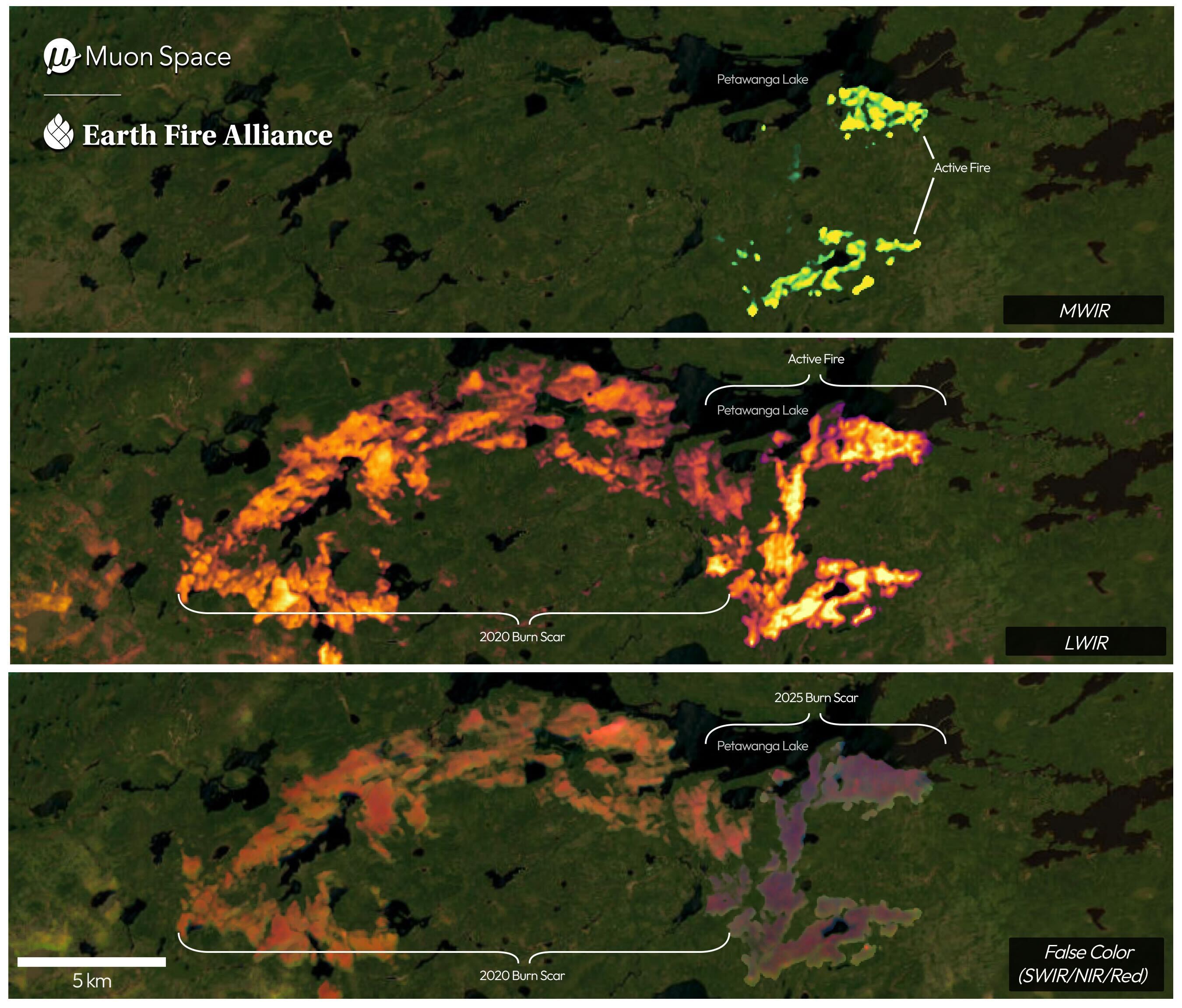
The Nipigon 6 fire in Ontario, Canada, on June 15, 2025, visualized over a Google Earth basemap using FireSat's infrared imagery.

FireSat’s infrared imagery shows the Nipigon 6 fire in Ontario, Canada, on June 15, 2025, identifying active fire regions at the top, both active flames and burn scars in the middle, and old burn scars at the bottom.

FireSat’s infrared imagery shows the Nipigon 6 fire in Ontario, Canada, on June 15, 2025, identifying active fire regions at the top, both active flames and burn scars in the middle, and old burn scars at the bottom. Credit: Muon Space and Earth Fire Alliance

The wildfires in Canada’s boreal forests are burning with greater size and intensity because of climate change, as greenhouse gas emissions from human use of fossil fuels continue to drive global warming. Two of Canada’s most destructive wildfire seasons occurred in 2023 and 2025, and the last three fire seasons were among the 10 worst on record.

“What is unfolding is what climate and forest scientists have been predicting for 30 years,” Werner Kurz, a retired senior research scientist at Natural Resources Canada, told The Atlantic. “That as the world gets hotter and drier, we are exposing forests to more and more risk, and the old strategies of fire suppression are simply being overwhelmed.”

Fighting wildfires in mostly uninhabited forest regions requires fixed-wing air tankers and heavy-lift helicopters capable of dropping fire retardants on wildfires or transporting firefighting crews to the remote sites. But individual Canadian provinces usually bear the burden of buying or contracting for such firefighting aircraft, and every available aircraft has often been required to fight wildfires in recent years. This year the Canadian government leased 10 new aerial firefighting aircraft to make them available as surge assets for provinces.

The Canadian Wildland Fire Information System showed nearly 900 active wildfires in Canada as of July 17, with the country having experienced more than 3,600 wildfires to date that burned more than 6.6 million acres. There are currently dozens of “out of control” wildland fires that are simply being monitored rather than actively suppressed—a decision that fire agencies are forced to make when managing limited resources and weighing risks to firefighters’ lives.

David Hasselhoff’s Steamy Life with Younger Wife Revealed

0
david-hasselhoff’s-steamy-life-with-younger-wife-revealed
David Hasselhoff’s Steamy Life with Younger Wife Revealed


David Hasselhoff may be 74, but insiders claim the Hoff has no plans to slow down when it comes to romance.

The Baywatch and Knight Rider legend has been married to wife Hayley Roberts since 2018, and according to a source, their private life is still sizzling years after they said “I do.”

Roberts, 46, is nearly three decades younger than Hasselhoff. But according to the insider, the age gap has not cooled things down. If anything, sources claim their marriage still has plenty of spark.

As Hasselhoff celebrates his 74th birthday, RadarOnline.com looked back at the couple’s unlikely love story, from a chance meeting in the U.K. to a marriage insiders say is still packed with passion.

The couple first met in 2011 at a hotel in the U.K. while Hasselhoff was working as a judge on Britain’s Got Talent.

Roberts approached the TV star for an autograph. Hasselhoff reportedly agreed, but only if she handed over her phone number.

That bold move apparently paid off.

According to resurfaced comments from a source, the pair had an instant connection. The insider described it as “practically love at first sight.”

The two began dating soon after. Seven years later, they tied the knot in a romantic ceremony in Italy.

Now, years into their marriage, sources claim the chemistry between them is still red-hot.

“Women in their early 40s are in their prime, while men in their mid to late 60s often have trouble when it comes time to perform in bed,” one source said. “But Hayley and David joke that in their case, too little s– is not the issue!”

In fact, the insider claimed Roberts sometimes would not mind a little breather.

Despite his age, Hasselhoff has allegedly kept the romance alive without needing any extra help in the bedroom.

“So when it comes to romance, she’s got more than she can handle!” the source teased.

But the Hoff’s secret is not just physical chemistry.

According to the insider, Hasselhoff works hard to make Roberts feel adored. He reportedly showers her with flowers, thoughtful gifts, and romantic vacations.

“According to wife Hayley, he’s always spoiling her with flowers, thoughtful little gifts and romantic vacations,” the source said.

The racy claims come as Hasselhoff has also been dealing with a more serious chapter in his life.

Fans grew concerned in May when the actor was seen looking frail as Roberts helped him after a medical appointment. He was photographed being pushed in a wheelchair and assisted into a car by his wife.

The outing came after Hasselhoff underwent hip and knee replacement surgeries in 2025. He has been in physical therapy while working his way back to strength.

“For a man who has always been fit and very active and in shape, his recent surgeries have kicked his a– a bit more than he expected,” an insider told Radar.

The photos sparked a wave of reaction from fans.

“At his age it doesn’t take much trauma to cause a great deal of damage. A simple slip can be devastating,” one person wrote.

Another added, “Time is unforgiving.”

But plenty of supporters rushed to defend the TV icon.

“Seeing the Hoff out and about proves he still has that legendary fighter spirit,” one fan wrote.

Another had a shorter message for critics: “Don’t hassle the Hoff.”

Even after surgery, health concerns, and decades in the spotlight, insiders claim Hasselhoff still has the same larger-than-life energy that made him famous.

And according to those close to the couple, Roberts remains right by his side as his wife, caregiver, biggest supporter, and the woman still keeping the Hoff’s fire burning.

India’s AI moment more about deployment than discovery

0
india’s-ai-moment-more-about-deployment-than-discovery
India’s AI moment more about deployment than discovery

For three decades, India was the world’s back office. During the next three decades, it may become the world’s AI workshop.

That possibility lies behind one of the most consequential questions facing India’s economy. Artificial intelligence threatens the very industry that helped transform India into a global technology powerhouse. Yet the same technology may also create India’s greatest opportunity since the outsourcing revolution began.

Much of the discussion about AI in India has focused on job losses. Large language models can write software, generate reports, answer customer queries and perform many of the routine tasks that fueled India’s US$280 billion IT services industry. If machines can increasingly perform the work of millions of Indian engineers, what becomes of the world’s outsourcing capital?

It is a legitimate concern. But it may also be the wrong question. Rather than asking whether AI will eliminate India’s outsourcing industry, we should ask how it will redefine it. The AI revolution is not simply replacing jobs; it is redistributing roles across nations. The United States, China and India are beginning to occupy distinct positions in a new global AI economy.

Understanding that emerging division of labor may be the key to understanding India’s next chapter.

The end of labor arbitrage?

India’s rise as an IT powerhouse rested on a simple economic proposition: highly skilled engineers working at costs significantly below those of Europe and the United States.

Beginning in the 1990s, companies such as TCS, Infosys, Wipro, and HCLTech became indispensable partners for corporations seeking to develop software, manage enterprise systems, and maintain global IT infrastructure.

Generative AI changes that equation. Software that once required weeks of programming can increasingly be produced in hours. AI assistants accelerate coding, automate testing, draft documentation, and troubleshoot technical problems. Tasks that justified large offshore teams are becoming increasingly automated.

For companies built on labor-intensive services, this is undeniably disruptive. If productivity doubles while demand remains constant, fewer engineers may be needed for routine work.

India’s IT sector has recognized this reality. Major firms are investing heavily in AI training, building AI practices, and reshaping their business models around automation rather than labor alone.

Yet every major advance in software development—from high-level programming languages to cloud computing—has shifted engineers toward higher-value work rather than eliminating them altogether. Artificial intelligence is likely to continue that pattern.

From code to integration

The real opportunity lies beyond just writing code.

As AI becomes increasingly capable of producing software, the bottleneck shifts from programming to implementation. Businesses still need people who understand workflows, regulations, languages, customers and industries.

Someone must adapt AI systems to hospitals in Germany, banks in Singapore, manufacturers in Japan, retailers in Europe, and government agencies in Africa.

Integration has long been India’s comparative advantage. Indian engineers have usually succeeded by improving existing computing paradigms. Their expertise lies in deploying technology at scale, adapting global software to local requirements, and integrating complex systems across organizations.

Artificial intelligence may therefore increase — not reduce — the demand for precisely these capabilities. Instead of supplying inexpensive programming labor, India’s IT industry could increasingly provide something more valuable: AI implementation expertise.

Quiet turn toward China

A second transformation is unfolding, one that receives far less attention.

Over the past decade, India’s manufacturing sector has become deeply intertwined with Chinese technology. Smartphones, industrial machinery, batteries, renewable-energy equipment, and countless electronic components increasingly originate in Chinese supply chains despite continuing geopolitical tensions.

AI may follow a similar trajectory.

While American companies continue to dominate proprietary frontier models, Chinese firms have adopted a different strategy: releasing increasingly capable open-weight models that anyone can download, modify, and deploy on their own infrastructure.

Former Google Brain co-founder and Baidu chief scientist Andrew Ng has argued that this strategy is rapidly expanding China’s influence because it allows developers worldwide to build on Chinese AI without relying on commercial APIs or recurring licensing fees.

This distinction may prove more important than many observers realize.

A proprietary model remains under the control of its creator. Access can be restricted, prices can change, and export controls may determine who can use it. An open-weight model, once downloaded, becomes part of a country’s own technological infrastructure. It can be customized, fine-tuned, and deployed independently.

For India, the decision is less a geopolitical choice than an economic one.

Why open weights matter

Open-weight models complement India’s comparative advantage remarkably well.

India does not need to build the world’s most powerful foundation model to create enormous economic value. The software industry excels at adapting technology to specific industries and customers.

Banks require different AI systems from hospitals. Manufacturers have different requirements from insurance companies. Governments have different needs than retailers. India’s decades of experience in customizing enterprise software naturally translate to customizing artificial intelligence.

The economics are equally compelling. Rather than paying recurring fees for proprietary AI services, Indian companies can deploy open models on local infrastructure, train them on industry-specific data, and tailor them to local languages and regulations. Value shifts away from inventing the underlying model toward implementing it effectively.

This transition echoes India’s earlier success in software services. During the outsourcing revolution, India did not invent the personal computer, enterprise software, or the internet. It became indispensable by helping organizations around the world use them more effectively. AI may reward the same capabilities.

New global division of labor

The first wave of globalization separated design from manufacturing. The AI era may separate model creation from model deployment. A new international division of labor is beginning to emerge.

The emerging AI economy may be less about who wins than about who contributes what.

The framework is, of course, simplified. Every major economy participates across the AI value chain. Yet broad specialization is becoming increasingly visible.

The United States remains the center of frontier AI research. China is embedding AI into logistics, manufacturing, finance, transportation, healthcare and urban infrastructure while simultaneously promoting open-weight ecosystems.

India occupies a unique position between them. Its vast software engineering workforce, decades of enterprise experience, and global customer relationships make it an ideal bridge between foundation models and real-world deployment.

Put simply, America invents. China scales. India integrates.

Translating AI tools practically

None of these factors suggests an easy transition.

Routine programming, software maintenance, documentation, and testing are already becoming increasingly automated. India’s universities, corporate training programs and labor market will need to adapt quickly to changing demands.

But technological revolutions rarely eliminate industries. Rather, they reorganize them.

For India, the challenge is not to compete directly with Silicon Valley in frontier model development or with China in AI-enabled infrastructure. Its opportunity lies elsewhere: becoming the country that translates increasingly powerful AI into practical tools for governments, businesses, hospitals, factories and financial institutions around the world.

Realizing the future will require a new generation of engineers whose expertise extends beyond programming to the integration of AI into the complex realities of business, government and society.

For three decades, India was the world’s back office. In the AI age, it may become even more valuable: the world’s AI workshop — not by building every breakthrough model, but by helping the rest of the world put AI to work.

A more diverse AI ecosystem could benefit not only India but the world. An international division of labor — where different countries specialize in frontier research, infrastructure, and implementation — is likely to prove more innovative and more resilient than one dominated by any single nation.

The Pentagon’s Space Development Agency hasn’t moved as fast as anyone would like

0
the-pentagon’s-space-development-agency-hasn’t-moved-as-fast-as-anyone-would-like
The Pentagon’s Space Development Agency hasn’t moved as fast as anyone would like

The Space Development Agency was established in 2019 to help speed up the deployment of US military space systems by sidestepping the Pentagon’s traditional sluggish bureaucracy.

Seven years later, SDA is finally launching its first batches of operational satellites, just as the Pentagon plans to shutter the semi-autonomous agency and fold it back into the Space Force’s procurement pipeline, newly reorganized under several program acquisition executives in a bid to streamline weapons buying.

SDA’s fate is not a surprise, and lawmakers in both houses of Congress have backed the agency’s closure in drafts of this year’s National Defense Authorization Act.

The Space Development Agency’s primary mission has been to develop a constellation of several hundred missile warning and data relay satellites in low-Earth orbit designed to detect, track, and target ballistic and hypersonic missiles. The military calls the constellation the Proliferated Warfighter Space Architecture (PWSA). The Pentagon currently has a small fleet of legacy missile warning satellites in much higher geosynchronous orbits. These satellites are expensive and vulnerable to attack, and their distance from Earth makes them less sensitive to smaller, dimmer missiles.

The idea was to rapidly procure, develop, and field new generations, or tranches, of tracking and data “transport” satellites every two years. SDA’s strategy was to cast a wide net across the US space industry, using satellites and sensors developed by many companies. Launches of SDA’s new satellites were supposed to occur at a cadence of about once per month.

Rough waters

Much of SDA’s mission will continue under a different banner within the US Space Force. The missile-warning and data-relay satellites will eventually be part of the Pentagon’s planned Golden Dome missile shield, one of the Trump administration’s top priorities for the Space Force.

The capabilities foreseen for SDA’s satellite constellation predate President Trump’s announcement of Golden Dome last year, and are far less controversial than the White House’s push to include space-based weapons as part of the missile shield.

SDA’s history has been marred by schedule delays, production and supply chain bottlenecks, and technical issues with the organization’s first batches of operational data relay satellites after their launch last year. The purpose of the data relay, or “transport,” satellites is to receive tracking data from SDA’s missile-warning satellites via inter-satellite laser communication links and relay the information to the ground for action.

SDA started launching prototype tracking and data transport satellites in 2023 and launched its first two batches of transport satellites last year. The third group of data transport satellites launched Thursday on a SpaceX Falcon 9 rocket from Vandenberg Space Force Base, California, bringing the total number of transport satellites launched in Tranche 1 to 63.

“This launch continues to expand warfighting capability to deliver persistent tactical satellite communication for the warning and tracking of advanced missile threats,” said Gurpartap “GP” Sandhoo, director of the Space Development Agency, in a statement. Sandhoo also serves as the Space Force’s portfolio acquisition executive for missile warning and tracking, which would keep him in charge of much of the SDA’s mission after the agency’s dissolution.

“The deployment of Tranche 1’s proliferated capability will soon deliver continuous overwatch—neutralizing any first-mover advantage by delivering data to warfighters around the world, nearly instantaneously,” Sandhoo said.

Thursday’s launch marked the resumption of SDA satellite deployments after standing down for nine months due to issues with the spacecraft on the first two Tranche 1 launches last September and October. Those launches were successful, but ground teams ran into problems activating and commissioning satellites made by York Space Systems and Lockheed Martin.

Sandhoo identified several issues with the first Tranche 1 satellites during a roundtable with reporters before this week’s launch. Ground controllers lacked sufficient ground station coverage to communicate with the satellites after last year’s launches. Some of the satellites encountered thermal control and propulsion system problems as they climbed from their insertion orbit to an operational altitude of more than 600 miles (1,000 kilometers), significantly higher than SpaceX’s Starlink Internet network, Sandhoo said.

“We are in a pretty harsh radiation environment at 1,000 kilometers, so not all of our orbit raising has gone according to plan,” he said. “It has been sporadic. We’re working through it.” Sandhoo is optimistic that ground teams will eventually declare most of the satellites ready for operations, but it’s taking longer than expected.

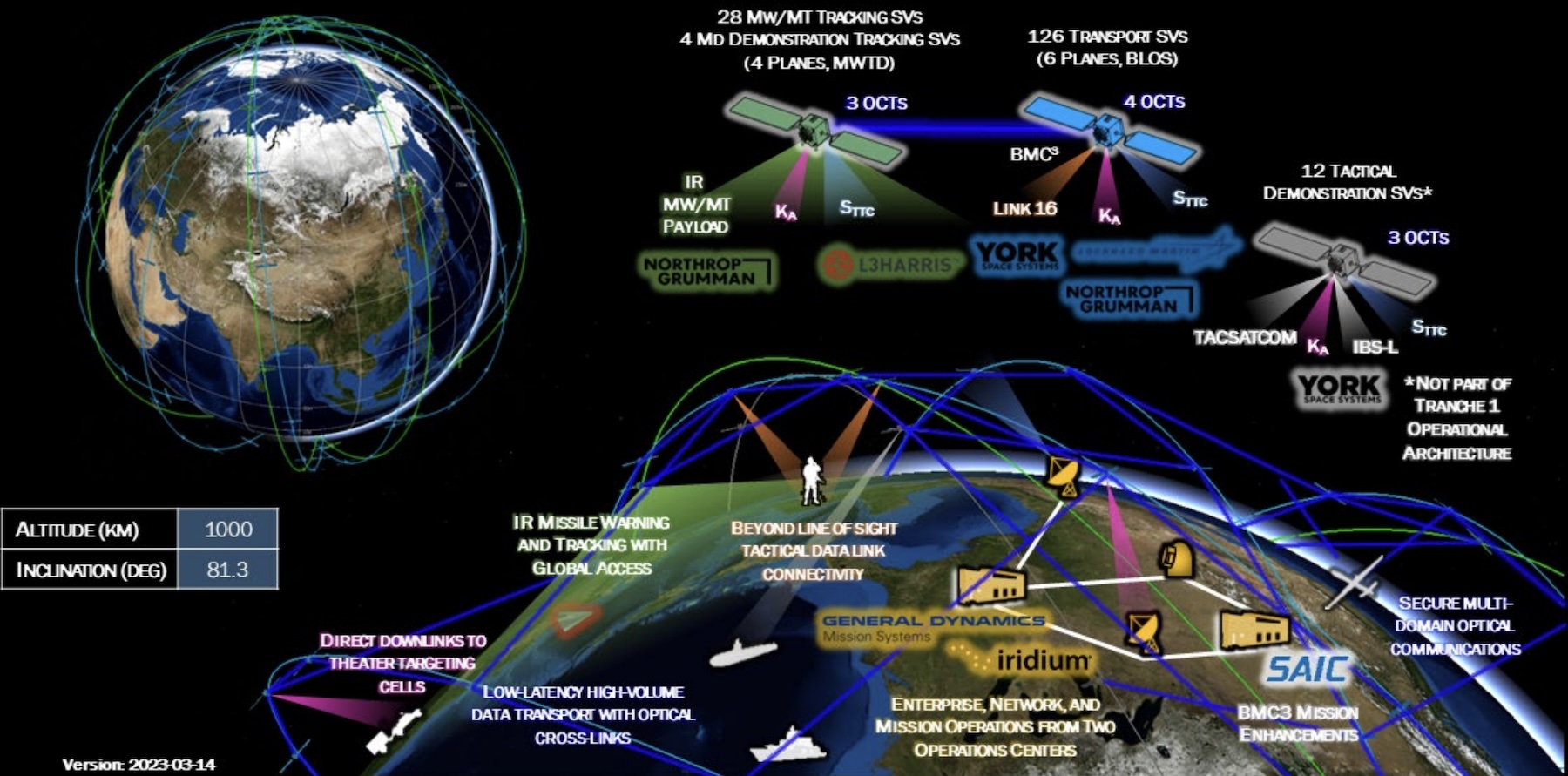
The Space Development Agency’s “Tranche 1” architecture includes 154 operational satellites, 126 for data relay and 28 for missile tracking. With this illustration, the SDA does its best to show how it’s supposed to work.

The Space Development Agency’s “Tranche 1” architecture includes 154 operational satellites, 126 for data relay and 28 for missile tracking. With this illustration, the SDA does its best to show how it’s supposed to work. Credit: Space Development Agency

Getting it right

SDA and its contractors “took a pause” after last year’s launches to “make sure we fixed at least the known issues,” Sandhoo said. “We expect this launch to be a lot smoother than the last one.”

Thursday’s launch was the second SDA launch of York’s data transport satellites, and the third for Tranche 1 overall. Seven more launches will complete Tranche with 63 additional data transport satellites and 28 missile tracking satellites manufactured by Lockheed Martin, Northrop Grumman, and L3Harris. None of the Tranche 1 tracking satellites have launched yet.

Sandhoo said the schedule for the next series of SDA satellites is “still constrained” by the availability of optical communication terminals, the laser transmitters and receivers needed to connect the transport and tracking satellites into one integrated mesh network.

While SDA officials declined to say when the next few launches might occur, the agency said the Tranche 1 satellites will “provide initial warfighting capability beginning in 2027. Sandhoo said the agency is no longer focused on achieving a monthly launch cadence. It’s more important, he said, to make sure SDA’s satellites launch when they are ready. “The goal is to get operational as quickly as possible once you get in orbit,” he said.

If all the Tranche 1 satellites had launched as originally scheduled, the constellation’s enhanced missile warning capability might have been available to military commanders today. That might have proven useful for US and allied forces to counter Iranian ballistic missiles launched during the current war in the Middle East.

“That’s what I think the nation needs right now, to face the threat that we are in,” Sandhoo said. “If you see what’s going on, I wish we were on orbit and supporting this mission right now because, literally, missiles are being launched at the joint force every single day in [Operation] Epic Fury.

“We are where we are,” Sandhoo said. “But we are doing everything we can to solve these technical challenges to get these systems on orbit, so we can deliver these capabilities.”

In all, SDA’s Tranche 1 constellation will number 154 operational satellites when complete. Tranche 2, set to begin launching next year, will include more than 250 transport and tracking satellites supplied by six manufacturers. SDA has ordered 108 satellites in the Tranche 3 tracking layer due to start launching in 2028.

The transport layer will end after Tranche 3. It will be superseded by the Space Force’s Space Network. The Space Force announced in May that it selected SpaceX to build the SDN “backbone” using technology originally developed for SpaceX’s Starlink broadband constellation. SDA’s transport satellites will fold into the Space Data Network to work alongside SpaceX’s satellites, Sandhoo said.

Wildfire smoke threatens the World Cup final. FIFA still doesn’t have a plan.

0
wildfire-smoke-threatens-the-world-cup-final-fifa-still-doesn’t-have-a-plan.
Wildfire smoke threatens the World Cup final. FIFA still doesn’t have a plan.

The biggest game in soccer is set for Sunday, when Argentina and Spain will meet in the World Cup final, held just outside of New York City. There’s just one problem — wildfire smoke now threatens the match and FIFA, the sport’s governing body, doesn’t appear to have any plan in place to protect player or fan health. 

Wildfire smoke blowing from Canada has blanketed large swaths of the Midwest and East Coast in recent days, impacting more than a dozen states, with some of the worst-hit cities facing air quality in ranges considered hazardous. New Yorkers are among those who have been watching their air turn orange and hazy this week. On Thursday, the state issued an alert as the air quality index climbed to “unhealthy” andvery unhealthy” levels. “Avoid spending time outdoors, if possible,” officials advised.

As of Friday morning, air quality near the stadium remained in the unhealthy range, and while it’s forecast to improve to “’moderate”’ by Sunday’s kick off, smoke patterns could still change. If concerns continue during the finals, there’s no way to close off the open-air stadium where stars Lionel Messi and Lamine Yamal are slated to square off. That means fans and players would almost certainly be exposed to smoke, which could lead to symptoms such as a burning throat, coughing, or headache, among others. This can be particularly dangerous for sensitive groups, including children, older individuals, and people with respiratory conditions such as asthma. 

Players have also practiced outdoors during air quality events in the lead up to the game — the Spanish team held a practice Thursday in New Jersey. “These are high-level athletes who are moving a lot of air through their lungs,” Dr. Courtney Howard, an emergency room physician and Global Climate and Health Alliance official told the Associated Press. “They shouldn’t be practicing outside if the air quality levels are at hazardous sort of ranges for wildfire-related air pollution.”

World Cup organizer FIFA does not appear to have any contingency plans in place for wildfire smoke. Neither FIFA nor New York City Department of Health officials immediately responded to Grist’s request for comment. In a previous statement to Grist, FIFA detailed extensive protocols related to extreme heat, including mandatory water breaks for players, but didn’t mention air quality. 

“Climate-related risks,” the organization wrote last month, “are assessed as part of overall tournament planning and managed in close coordination with host cities, stadium authorities, and national agencies.” 

Unlike FIFA, a number of other leagues implement standardized adjustments triggered by air quality warnings. Per National Women’s Soccer League policy, for instance, a women’s soccer game at Citi Field in New York on Thursday had additional hydration breaks for safety. NWSL policy adds hydration breaks at an air quality index of 101 (“unhealthy for sensitive groups”) and cancels or postpones games when the AQI tops 200 (“very unhealthy”). Major League Baseball rescheduled one game this week in Philadelphia, and Major League Soccer canceled a game in Chicago due to smoke.

The World Cup is in its fifth and final week, and despite the games taking place across multiple wildfire-prone regions, so far FIFA’s bet that the air would stay clear has paid off. They may get lucky again this weekend, says Nicholas Watanabe, a professor of sport and entertainment management at the University of South Carolina, but that doesn’t excuse not being ready.

“FIFA seems unprepared for these wildfires,” said Watanabe. “At the same time, it looks like the worst of the pollution will dissipate before the World Cup Final, so FIFA will dodge a bullet and likely push forward with the match.”

Some, however, question whether enough is being done, both by FIFA and other outdoor sports leagues facing these and other climate threats. FIFA has already been criticized this year for its policies regarding extreme heat.”If we have to have a hydration break every 15 minutes, then we shouldn’t be playing the game,” said Trinity Rodman, who played in the smoke-affected NWSL soccer game in New York. 

One professional cyclist recently questioned whether the Tour de France should be held in the summer, as this year’s iteration of the iconic event has been plagued by wildfires, smoke, and extreme heat. “I would change the whole calendar,” said yellow jersey holder Tadej Pogačar earlier this month. “It’s not something I can do.”

The power to make changes generally rests with a sport’s governing body, rather than athletes, and Watanabe thinks climate issues should be taken more seriously. Even if the World Cup final is spared any impacts, he said this close call should serve as a warning.

“Hopefully,” he said, “this is a wake up call to FIFA and all other sport leagues and competitions of the need for regulations and a comprehensive plan to deal with climate risks.”


0FansLike
0FollowersFollow
0FollowersFollow
0SubscribersSubscribe
- Advertisement -
Google search engine

Recent Posts