Power of Siberia 2, a landmark natural gas pipeline that would link Russia and China, has hit a deadlock, with a gas-price gap so vast that Beijing has told Moscow to stop raising the subject altogether. Neither side has formally walked away, but no timeline for a deal or for construction to begin is in sight.
The project, which received approval in principle from both governments last September, would carry up to 50 billion cubic meters of gas annually from Russia’s Yamal fields through Mongolia to China.
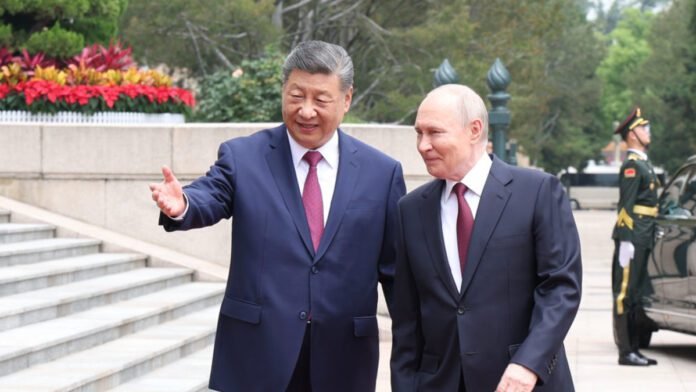
The Wall Street Journal reported that Chinese officials made clear even before Russian President Vladimir Putin’s visit to Beijing in May that an agreement was impossible under current terms, and asked the Russian delegation not to press the issue. The Kremlin says talks continue at the corporate level.
The dispute centers on the price for the gas. China is demanding that it be permitted to pay US$50 per thousand cubic meters, the heavily subsidized rate Russian households pay at home, which bears no relation to commercial export terms. Russia is asking for about US$250 per thousand cubic meters.
Public information showed that China already imports Russian gas via the Power of Siberia 1 pipeline at US$240 to US$280 per thousand cubic meters, and Central Asian gas at about US$200 per thousand cubic meters. Before the war in Ukraine broke out in February 2022, Russia sold gas to Europe and Turkey at US$275 to US$340 per thousand cubic meters.
Beijing’s ultra-low opening bid sits uneasily alongside Chinese leaders’ repeated pledges of a “no-limits” partnership with Moscow.
Chinese commentators say that Russia is under mounting pressure on multiple fronts:
- Ukraine has intensified drone strikes on Russian territory;
- The European Union has committed to phasing out all Russian liquefied natural gas (LNG) imports by the end of 2026, with a full ban on pipeline gas from October 2027;
- Beijing has resumed buying American LNG.
Reuters reported Thursday that the first United States LNG cargo in a year had arrived at a Chinese terminal last week, following a resumption of purchases after President Xi Jinping and US President Donald Trump met in mid-May.
“In 2025, China paid an average of around US$258 per thousand cubic meters for Russian pipeline gas, already well below what Europe once paid,” writes a Hebei-based columnist using the pen name Riyue Xhige. “Beijing’s new demand pushes the discount much farther. Even Belarus has never been offered terms this close to Russia’s domestic price.”
The columnist adds: “This is no longer ordinary commercial bargaining. It reflects a fundamental shift in who holds the power at the negotiating table.”
The columnist says Russia once enjoyed a seller’s market with Europe, where buyers had little choice but to pay – but that now that dynamic has reversed entirely, with China sitting firmly in a buyer’s market.
He points to China’s diversified energy sources as the foundation of its bargaining strength:
- China’s domestic gas output reached 262 billion cubic meters in 2025, up 6.2% year on year, marking the ninth consecutive year of growth exceeding 10 billion cubic meters.
- On land, the four gas pipelines in Turkmenistan, Uzbekistan, Kazakhstan and Tajikistan in Central Asia have a combined annual capacity of over 85 billion cubic meters, with additional routes under planning;
- At sea, LNG tankers from Qatar, Australia and Malaysia arrive at Chinese terminals in a steady stream. Russia is one option among many.
“China wants to expand energy imports from Russia as part of a diversified supply strategy, but that does not mean Russian gas is irreplaceable,” he says. “This strategic composure gives Beijing unprecedented leverage at the negotiating table. No matter how Russia adjusts its position, it will have to come back to meet Chinese terms.”
“Russia is like a cat on a hot tin roof because of the war in Ukraine, while China has no shortage of gas sources,” writes a Jiangsu-based commentator using the pen name New Day Student. “If Russia does not want to sell, we will simply keep buying from Central Asia, Australia and Qatar.”
Its true, he says, that “some of Russia’s supporters may feel it is unfair that China asks Moscow to sell gas at its domestic price and pay all the infrastructure costs. But what does that have to do with us? Nobody is forcing Russia to sell. That is just how markets work.”
He adds that the suggested price of US$50 per thousand cubic meters is just an opening anchor for negotiations, not a final offer; in any case, the gas price of Power of Siberia 2 must be lower than that of Power of Siberia 1.
Pipeline’s rocky road
The Power of Siberia 2 project has been in the works for years. Russia’s Gazprom approved a feasibility study in 2021, and both governments reached an agreement in principle last September. But the path to that point was far from smooth.
Moscow had long pushed for the pipeline to pass through Mongolia, citing lower infrastructure costs compared to a direct route. Beijing resisted.
After Mongolia signed an open skies agreement with the United States and proposed a rare-earth partnership with Washington in August 2023, China’s concerns deepened. Beijing worried that a gas supply routed through the landlocked nation could one day be blocked, undermining China’s energy security.
China eventually relented last September and accepted the Mongolia route, but only on the condition that Russia agreed to significantly lower gas prices.
The broader energy picture has since shifted in Beijing’s favor. In May, China agreed to resume purchases of United States LNG. On June 21, the US Treasury issued a 60-day exemption allowing Iran to produce and sell oil and petroleum products in US dollars. Together, the moves helped China replenish energy reserves depleted by the closure of the Strait of Hormuz.
Putin met Xi in Beijing on May 20, only to find China’s pricing terms unchanged. He then traveled to Kazakhstan on May 28 to explore a Central Asian transit route for Russian gas to enter China, sidestepping Mongolia altogether.
“Switching the pipeline route will not solve anything,” says another Hebei-based columnist. “This is fundamentally a question of price and cost. It is true that Russia needs the Chinese market, and China needs a stable energy supply. But China has plenty of options and no reason to rush. We simply hold the stronger hand.”
He adds: “It is Russia, not China, that is running out of time, with the EU’s ban on Russian pipeline gas taking effect in autumn 2027. Whether the Kazakhstan route can actually be realized depends on whether Russia is willing to show good faith on price and financing to China. If Moscow still clings to the old thinking of selling its energy high and passing costs onto others, this detour will lead nowhere either.”
Shan Hai, a Shandong-based columnist, says that since the collapse of the Soviet Union in 1991, Moscow has relied on selling energy at a high price, importing whatever it needs and ignoring the development of its industrial ecosystem.
He says Russia should reform its economic system by selling energy to China at competitive prices and by opening its doors to Chinese manufacturers to build factories. He also points out that some Russian regions have begun importing refined petroleum products from China after their oil refinery facilities were attacked by Ukrainian drones, meaning that the scope of energy cooperation between the two countries is expanding and becoming reciprocal.
Read: China-Russia gas pact heightens Western sanctions risks
Follow Jeff Pao on X at @jeffpao3