
KYIV – The dismissal of popular reform-minded Defense Minister Mykhailo Fedorov has sent shockwaves through Ukrainian politics and society, leading to impromptu protests in Kyiv and other cities across Ukraine on July 16.
On the evening of July 15, Fedorov announced on Facebook that it had been a “great honor” to serve as Ukraine’s minister of defense. President Volodymyr Zelenskyy has yet to comment, but the move comes after Fedorov spent just six months in office and clashed with Commander-in-Chief Oleksandr Syrskyi.
Fedorov, 35, who had not served in the military and was previously Ukraine’s minister of digital transformation, advocated for the broader adoption of drones and unmanned systems to bridge dire manpower shortages on the frontline. Syrskyi, 60, a career Soviet military veteran and four-star general, had emphasized the need to recruit more people to serve on the frontlines.
Fedorov had also been the brainchild behind Ukraine’s mid-strike campaign against Russia hitting Moscow’s supply lines, which he dubbed a “logistics lockdown.” Possessing close ties with Silicon Valley executives – his youthful appearance and casual attire made him easily mistakable for one of them – he worked with SpaceX CEO Elon Musk to shut down Russia’s Starlink terminals.
He had also angered traditional defense contractors with moves to make defense procurement more open and transparent – notably allowing soldiers to buy their own weapons directly from the website Brave1, dubbed the “Amazon of Weapons.”
The dismissal was met with shock and anger across Ukraine’s civil society. A July 15 social media post by Dmytro Koziatynskyi, a veteran and former combat medic, called for protests the next morning. In Kyiv and other cities including Lviv, Dnipro, and Odessa, the protests began at 9:01 – one minute after the daily moment of silence for Ukrainians who have lost their lives in Russia’s invasion.
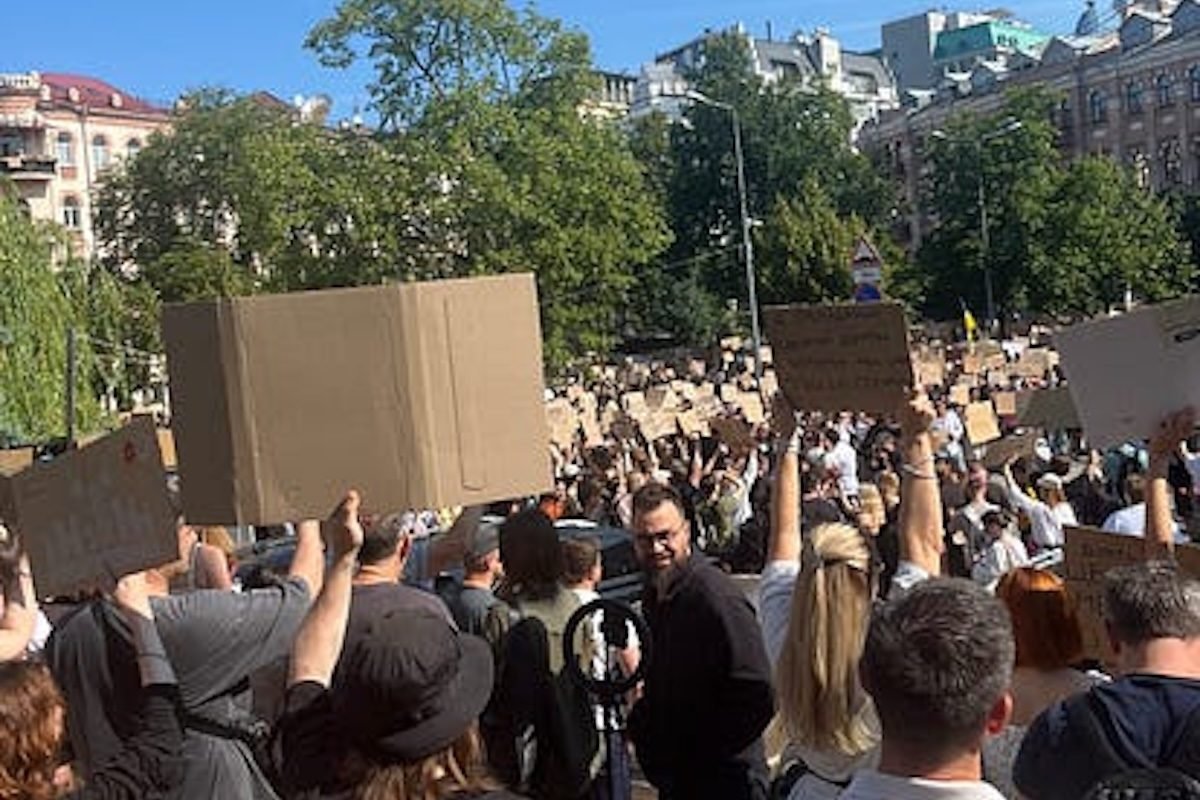
After a ballistic missile strike killed two and injured six in Kyiv the night before, I made my way to the protests in front of the Ivan Franko Theater, not too far from Zelenskyy’s office. There, the crowd chanted “Shame!” and “FE-DOR-OV!” and “No personal interests!”
The news had only broken a little over 12 hours before, and yet there were at least 1,000 people there during the workday. There were neither speeches nor really much organization behind the protests, but there was a lot of anger – and fear – over Fedorov’s dismissal.
I caught up with Inna Sovsun, an opposition lawmaker from the party Holos, who said that while she sometimes disagreed with Fedorov’s decisions, his dismissal was “very wrong.” “At this point, there at least has to be a clear communication from the president about what the hell is happening,” she told me.
She noted that it was unusual for Ukrainians to protest a minister’s dismissal – there were no protests when Zelenskyy dismissed Prime Minister Yulia Svyrydenko on July 12, for example – but in this case “the personality and the issue” coincided.
Protesters tended to be younger Ukrainians in their 30s and 40s, and they were anxious and outraged over what the dismissal meant for the trajectory of the war, in which Ukraine has been recently gaining momentum by striking Russia’s energy infrastructure.
“We’re fighting a stronger country and we need to fight with new technologies,” said Andrei Rusan, 42, who works in the IT sector. “When Fedorov came, we felt hope. After yesterday, I am disappointed.”
Maria Vynogradova, 40, who also works in IT, told me that she was partly there for the soldiers who couldn’t be there. “What are we doing? Why are we taking away this person?” she said. “I want to have my country; I don’t want to leave Kyiv; I don’t want to leave Ukraine.”
Among the protesters, the hope was that Zelenskyy would change course, as he did on a controversial anti-corruption law in July 2025 following mass protests in Kyiv and other cities.
However, the political crisis was only deepening as the deputy commander of Ukraine’s Air Force, Pavlo Yelizarov, announced his resignation on July 16, citing Fedorov’s dismissal, saying that it would cause more casualties and destruction from Russian missile and drone attacks. He wrote on Facebook that Fedorov’s dismissal was a “great evil for the country’s defense capability.”
Update: Zelenskyy has announced an acting defense minister, Yevhen Khmara, whom he wants lawmakers to approve for the permanent role.
Berlin-based journalist and author Luke Johnson is publisher of the Public Sphere newsletter, from which this article is republished with permission.