Two nominees for high-profile health roles in the Trump administration faced scrutiny from the Senate health committee Wednesday—and both crashed and burned in their own special ways.
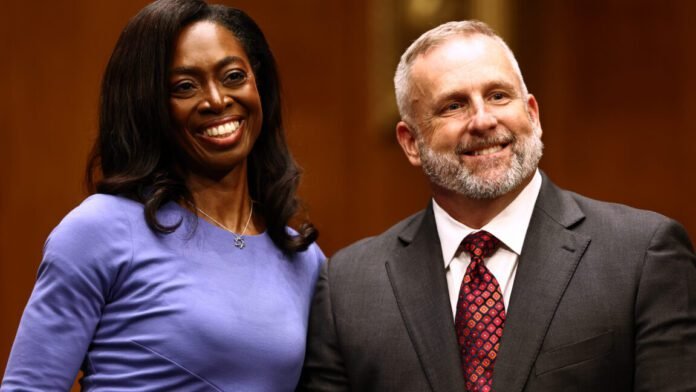
The Senate Committee on Health, Education, Labor and Pensions (HELP) scrutinized Erica Schwartz, the nominee for director of the Centers for Disease Control and Prevention, and Sean Kaufman, up for the role of Assistant Secretary for Preparedness and Response.
Schwartz’s assignment
Public health experts were “cautiously optimistic” about Schwartz’s nomination. She is well respected and holds views in line with evidence-based medicine, including being supportive of vaccinations—in contrast to anti-vaccine Health Secretary Robert F. Kennedy Jr., whom she will serve under. She is also highly qualified for the role, with a medical degree, a master’s degree in public health, and a law degree. She’s had a long career as a Navy Officer, and previously held the roles of Chief Medical Officer for the US Coast Guard and deputy surgeon general in the first Trump administration.
With her credentials checking all the boxes and then some, the obvious question looming over her confirmation was whether she would stand firm against Kennedy’s well-documented anti-vaccine agenda and political interference. Kennedy notoriously fired the last highly qualified Senate-confirmed CDC director, Susan Monarez, for refusing to rubber-stamp vaccine recommendations from a CDC advisory panel he had stacked with anti-vaccine allies.
Although Monarez only held the job for 29 days, lawmakers—as well as scientists, doctors, and health experts—praised her integrity and commitment to science and evidence-based policy.
Schwartz’s assignment going into the hearing was abundantly clear: assure senators she was equally principled and would stand up to Kennedy.
Kaufman’s assignment
Kaufman, on the other hand, went into the hearing with a less-than-rosy image that he needed to overcome. He is up for the role of leading the Administration for Strategic Preparedness and Response (ASPR), which is responsible for ensuring the US is poised to swiftly respond to the next pandemic, bioterror threat, or other emergency. That preparedness includes having quick access to or the development of vaccines, tests, and treatments.
Kaufman has reasonable qualifications for the role. He holds a master’s in public health, has served in leadership roles at the CDC and Emory University, and founded a company focusing on managing risk during outbreak responses. Overall, he has three decades’ worth of experience in outbreak preparedness, biosafety, and emergency responses.
But Kaufman has espoused anti-vaccine rhetoric in line with Kennedy, raising deep concern among senators that he will fail to follow science and keep the US adequately prepared for the next health crisis. Last week, Stat News dug up past comments from Kaufman in which he raised the long-debunked claim that vaccines cause autism, promoted the benefits of “natural immunity,” opposed vaccine mandates, and suggested that people are “pedophiles” for supporting the birth dose of hepatitis B vaccine (a dose strongly supported by evidence and the medical community). He also suggested he would “rather perish than have any one of his children receive” a COVID-19 vaccine.
Early in the hearing, Sen. Tammy Baldwin (D-Wisc.) stated clearly what Kaufman’s assignment was: “You’re going to have to do some strong work to clarify your views on” vaccines, she warned him.
Schwartz’s immediate flailing
Throughout the roughly 2.5-hour hearing, Schwartz seemed incapable or unwilling to answer almost every question directly—even the softball questions, which puzzled lawmakers on multiple occasions. She also seemed deeply uninformed about what has been going on at the CDC, including why it currently doesn’t have a director. “I was not aware” was a common response from Schwartz throughout the hearing.
These problems were immediately clear in the opening questions by ranking member Bernie Sanders (I-Vt.) and chair Bill Cassidy (R-La.)—a medical doctor who cast a critical vote to confirm Kennedy, which he has come to regret. Cassidy lost his primary in May, which will bring his Senate career to an end next year.
Cassidy kicked off questions asking Schwartz directly: “Will you commit to this committee and to the American people to have the same integrity as [Monarez]? That if asked to do something which is wrong for public health, that you will stand up as she did [and] object, if necessary, publicly.” But Schwartz didn’t answer the question directly, only saying that she has led by integrity and that she took the Hippocratic oath as a doctor.
He next asked whether, as CDC director, she would have the power to reassign people working at the CDC, something Monarez said she did not have the ability to do during her time in the role. Cassidy asked in the context of Kennedy assigning employees to do “counterproductive” work, such as “fishing expeditions of how vaccines may cause problems”—something Kennedy is known to have done.
Again, Schwartz failed to answer directly, prompting Cassidy to interrupt her and point out that it was a yes-or-no question. In her second attempt, she said only that “the secretary absolutely will allow me to be the CDC director.”
Cassidy quickly became frustrated. “I almost feel like I’m having to go after this question a little bit more firmly than I feel like I should.” She continued to avoid answering the question.
“Really?”
When it was Sanders’ turn to question Schwartz, he asked if she agrees that the existing scientific evidence shows vaccines do not cause autism. She began her response with a worrying: “We do not know what causes autism.” Sanders cut her off, pressing if she accepted the overwhelming evidence that vaccines do not cause autism, at which point she said she accepted the evidence.
Sanders next asked if, as CDC director, she would remove a CDC website published under Kennedy that falsely links vaccines and autism. Schwartz said she wasn’t aware of the website, and she would not say whether she would have it removed when pressed.
Sanders next asked if she would commit to reporting to Congress “if you receive directives from Secretary Kennedy or any other individual in the Trump administration to implement policies that are unscientific and could harm the health and well-being of the American people?”
Schwartz responded, saying: “Senator, I do not believe that the president or the secretary would ever do what you just mentioned.”
“Really?” Sanders responded in disbelief. “Do you think that is the record?”
At other points in the hearing, Schwartz told the senators that she was unaware that DOGE cuts nearly destroyed the CDC’s National Institute for Occupational Safety and Health, or that the Trump administration had scaled back a CDC food safety surveillance system and thwarted tobacco control efforts.
As for her alignment with other Trump administration policies, Schwartz said she supported Trump’s decision to withdraw the US from the World Health Organization. While being supportive of vaccines generally, she couched her support for flu vaccine mandates in the military saying she “fully supportive” of them “in certain circumstances.” (Defense Secretary Pete Hegseth recently repealed the flu vaccine mandate for the military, which quickly led to a flu outbreak in a Texas base that sickened nearly 300 and killed one recruit, spurring a restoration of the mandate.) Schwartz also refused to say whether she would allow Kennedy to kill a CDC pre-paid promotional campaign for flu shots during a deadly flu season—which Kennedy did.
At the closing, Cassidy aired his frustration. “I felt like you were always trying not to answer my question, which was disappointing,” he said, before chastising her for claiming not to know why Monarez was fired. “I’m here personally liking you, but feeling as if I’m having to represent the public health of the United States of America so that it’s not taken over by people who are ideologically inclined and looking to file a lawsuit [against vaccine makers], not looking to prevent disease.”
Kaufman on vaccines
While Cassidy was clearly disappointed and frustrated with Schwartz, he was downright angry with Kaufman. Throughout the hearing, Kaufman tried to backpedal on his comments about vaccines, but his responses were unconvincing. In questions from Sanders, Kaufman confirmed that he once wrote he would rather die than give his children a COVID-19 vaccine, but pointed out that he did once recommend the vaccine to his wife’s mom.
When senators confronted him about his false claims and attacks on the hepatitis B vaccine birth dose, he noted that all three of his children had received it.
Cassidy, a hepatologist who has treated patients with severe liver damage from hepatitis B, including some who died from the infection, didn’t let the issue drop. “Why would you repeat those damn lies?” Cassidy yelled, angrily pounding his pencil. Kaufman noted that he had deleted the LinkedIn post in which he made the claims and suggested they weren’t that bad because he had written ambiguously.
Kaufman on mRNA research
Senators also pressed Kaufman on his thoughts on mRNA vaccine technology—which is widely considered to be a promising technology for quickly developing new vaccines against novel pathogens, potentially ones with pandemic potential. But Kennedy despises the technology and has spread significant misinformation about mRNA technology. Last year, he drew intense criticism for canceling hundreds of millions of dollars in federal grants to develop mRNA vaccines, including for pandemic preparedness.
When asked about his support for mRNA technology, Kaufman bafflingly said he both supported Kennedy’s decision to cut research funding for mRNA technology and believed the US should support more research on mRNA technology. Kaufman’s odd explanation was that he didn’t want to support research for future uses of mRNA technology until there was more research into the platform on which mRNA COVID-19 vaccines were designed.
“That implies we can’t do two things at once,” Sen. John Hickenlooper (D-Colo.) said upon hearing this explanation. He later summed up his reaction to Kaufman’s argument, saying, “I’m incredulous.”
Sen. Patty Murray (D-Wash.) was equally bewildered. “I don’t understand how you want more research, but canceling it is okay.”
Cassidy, after blasting Kaufman on the hepatitis B vaccine, said he was “flummoxed” and “flabbergasted” that Kaufman said he supported canceling mRNA research because there wasn’t enough mRNA research.