The Weather Channel’s streaming app gets a 67 percent price hike
People who pay for a subscription to livestream The Weather Channel via its dedicated smart TV app are seeing a 66.7 percent price hike.
The TV app, available via Android TV, Fire TV, Roku, and Samsung TVs, used to cost $3 per month, or $30 per year. According to the Internet Archive’s Wayback Machine, those prices were valid as recently as April 2026. Now, a subscription to the streaming app is $5 per month, or $50 per year, as first reported today by Cord Cutters News.
In addition to livestreaming The Weather Channel’s broadcast network, The Weather Channel TV app also offers on-demand shows, local forecasts, maps, radars, and news. The app launched in May 2022, allowing people to access The Weather Channel’s reporting without a cable or satellite TV subscription.
Interestingly, the new $5 per month price matches what Allen Media Group, which bought The Weather Channel in 2018, wanted to charge for The Weather Channel Plus, which a 2021 press release described as a subscription service that would have over “50 news and entertainment streaming channels for a launch in the fourth quarter of 2021” and that its owner expected to reach “30 million subscribers in its first five years.” The Weather Channel Plus never actually became available. Instead, The Weather Channel is only getting its streaming subscription revenue from the original app, which does not include dozens of streaming channels.
The change in plans and subsequent price hike of The Weather Channel’s TV app shows how fickle the streaming industry can be, especially when it comes to legacy media companies’ roles. Many organizations that succeeded in the broadcast era are struggling to find the right value proposition, including prices, for the streaming era, while ensuring they have a place at the table. Even successful streaming TV providers are struggling to manage the infrastructure, app development, licensing costs, user support, and other expenses associated with running an attractively priced, always-on streaming service that can maintain profitability.
The Weather Channel faces an uphill battle as people have more options for weather reporting than they did during the network’s prime. Besides local news stations, the channel is competing with websites and free and paid-for mobile apps—including, respectively, Weather.com and The Weather Channel iOS and Android apps, which are all owned by a separate company, private equity firm Francisco Partners—and personal smart home devices. While likely facing declining advertising dollars for its broadcast channel, The Weather Channel is challenged to pay for the technology, tools, and staff needed to provide accurate, real-time weather reports, news, analysis, and additional programming on the channel and TV app.
Accessing any of The Weather Channel’s rivals could be viewed, depending on the user, as more convenient than opening a dedicated app that they downloaded onto their smart TV. With a 67 percent price hike also now in tow, The Weather Channel’s niche TV app subscription may be perceived as even less convenient than before.
Save the United Nations by abolishing the Security Council
The race to replace outgoing UN Secretary-General Antonio Guterres is underway, and as of today, five contenders are vying for the post. As part of the selection process, all the contenders have made public their vision for the United Nations and how they see the role of the secretary-general.
Assuming all the contenders have been truthful, it is clear from their statements that none has the least idea about what the job entails, what its constraints are or how it should be presented in the future.
The United Nations was born from a dream that never materialized, in a world that never existed. At its core, it embodied the vision espoused by President Franklin D. Roosevelt of a post-World War II order that would seek to prevent wars through collective security, international cooperation and a mechanism to address conflicts before they erupted into open confrontation.
However, these lofty principles did not survive the drafting of the UN Charter, which took effect on October 24, 1945.
In essence, the UN is a club with two forums: a General Assembly in which all members are represented, and a Security Council with five permanent members and 10 members elected on a rotating basis.
Each of these two pillars is subject to one major constraint: General Assembly votes are not binding and can simply be overlooked, making them little more than a show for all practical purposes.
Security Council decisions, while binding in principle, are subject to the veto of one or more of its five permanent members — China, France, Russia, the United Kingdom and the United States.
From its very inception, the club was subject to a built-in limitation, for one overriding reason: none of the five main members was willing to subject the exercise of its national sovereignty to the dictates of an outside entity.
Compounding this structural imbalance, each member is charged an annual fee based on a complex formula that includes its wealth. The result is that 10 members currently pay 75% of the total membership fees, while the remaining 183 members pay at most about 25%.
The two bookends marking the club’s history between its inception and the end of the Cold War were Korea and Iraq. Following North Korea’s invasion of South Korea on June 25, 1950, the UN Security Council authorized the use of force to repel it.
That decision was possible only because of an unexpected circumstance: The Soviet Union was boycotting the Security Council at the time and thus was not present to cast its veto — an oversight the Soviets never repeated.
The result was an American intervention under UN sponsorship, with two caveats: the absence of a veto, and the willingness of a state — in this case the US — to commit troops to the effort.
Over the following half-century, the veto power left the Security Council largely unable to authorize the use of force, and every subsequent conflict, from the Middle East to Vietnam to India-Pakistan, played out beyond the UN’s purview.
On March 20, 2003, the US invaded Iraq. Before the invasion, Washington had tried, albeit informally, to obtain Security Council endorsement. When that endorsement failed to materialize, the Bush administration went ahead unilaterally.
The invasion of Iraq underscored a reality no one had been willing to confront: If a state holding the right of veto decides to use force and has the means and the will to do so, the international system as defined by the UN Charter is powerless to stop it. Put another way, the multilateral security system defined by the UN Charter is essentially a sham.
The UN that emerged from the Cold War and its aftermath is essentially a three-legged stool. It includes the Secretariat; the “technical UN,” made up of 15 specialized agencies such as the Food and Agriculture Organization, the International Telecommunication Union and the World Health Organization; and, last but not least, the “political UN,” composed of the General Assembly and the Security Council.
To say that the political UN, as conceived by its founders, is broken is an understatement. With two major conflicts ongoing — one in Ukraine, one in the Middle East — not counting a number of smaller regional conflicts in Africa and Asia occurring entirely outside the organization’s purview, the political UN as an instrument of collective security has become irrelevant.
Conversely, the technical UN — the specialized agencies — has demonstrated its usefulness, with occasional peaks of excellence, albeit with one caveat: Left to themselves, bureaucracies show a tendency to grow beyond reason, especially when unsupervised by member states careless in their funding.
Reviewing the oversight mechanism and delegating it to the private sector, rather than to timorous diplomats from member states with no administrative or management training, should be a priority.
The UN is a member-driven organization. The upshot is that if members want the system to actually work, rather than serve as an occasional Band-Aid on a wooden leg, its core — the political UN — must be redrawn.
Changing the UN to adapt it to today’s political environment means changing its Charter, and most specifically, the articles relating to the political UN.
While the General Assembly can endure in its present form, the first and fundamental requirement is to abolish the Security Council. Doing so would eliminate both the provision that its resolutions are binding and the right of veto, thus making the body acceptable to all governments.
In its place, eight regional security committees should be set up — for the Americas, Africa, Europe (including Russia), the Middle East, Central Asia, Asia and Southeast Asia and the Pacific. Each would be autonomous, with its own rules of procedure and funding.
Membership would include all the states of the respective regions, allowing them to focus on regional issues rather than be distracted or held hostage by other considerations. Granted, the Regional Security Committees would not free member states from concerns about the global balance of power.
But by providing a regional mechanism to address regional problems, they would go a long way toward either finding regional solutions or ensuring regional problems do not escalate into larger confrontations.
UPDATED-Bomb attack rocks Damascus during Macron visit
Two bombs exploded near a hotel in Damascus where French President Emmanuel Macron had spent the night, but his office said he did not hear the explosions and he met Syrian President Ahmed al-Sharaa soon afterwards on Tuesday.
Syrian authorities said 18 people were wounded by the blasts, overshadowing the first visit to Syria by a European Union head of state since Sharaa toppled Bashar al-Assad in 2024, and underlining continued security threats in the country.
— France Diplomacy 🇫🇷🇪🇺 (@francediplo_EN) July 6, 2026
The explosions struck a busy area between the Syrian Tourism Ministry and the national museum across the street from the Four Seasons hotel, where a source in Macron’s delegation and Syrian security sources said he had spent the night and had met civil society groups on Tuesday morning.
In a post on X, Macron said his visit to Syria continues.
“Nothing can undermine the desire of Syrians to live in a fully sovereign and secure Syria,” he posted. “This morning I met Syria in all its diversity, and I saw dignity, courage and determination.”
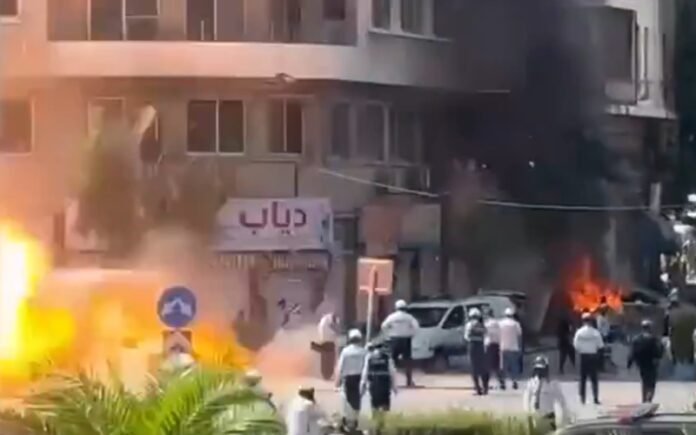
The first blast hit soon after Macron’s motorcade left for the presidential palace. Reuters footage showed flames and smoke billowing from the site, when a second explosion was caught on camera a few metres (yards) away.
The second blast went off next to an ambulance parked at the scene, where some two dozen people had gathered. Emergency personnel worked to extinguish the blaze, with smoke and flames close to the shops behind.
Reuters video showed Macron’s motorcade heading along a highway towards the presidential palace before the blasts. A video published by Syrian state media then showed him standing alongside Sharaa and meeting other Syrian officials and military officers.
Two explosive devices detonated overnight, one in a car bomb and another in a trash bin, near the Four Seasons Hotel in Damascus, where French President Emmanuel Macron spent last night during his visit to al-Jolani’s Syria. The messages are clear: Western leaders are not… pic.twitter.com/GaeTZ34eUY
There was no immediate claim of responsibility for the attack.
Sharaa, a former al Qaeda commander, has been working to stabilise and rebuild Syria since leading rebel forces that toppled Assad after more than 13 years of civil war, building close ties to Western and Middle Eastern states that opposed Assad.
Islamic State, an adversary of Sharaa during the civil war, has claimed a series of attacks on government forces in Syria since February, when the jihadist group announced what it described as a new phase of operations against his government.
DAMASCUS CAFE BOMBED LAST WEEK
The Syrian Interior Ministry said security forces had identified two bombs planted near the Tourism Ministry and had been preparing to defuse them when they went off, describing the devices as crudely made.
The bombs — one of them placed in a car parked on the roadside and the other in a trash can — were planted outside a security cordon around Macron’s place of residence, and posed no threat to his visit, the ministry said.
Internal security forces have launched search operations to identify those responsible, it said.
The French Presidency said the blasts were not audible from the presidential motorcade and a Reuters journalist with the press group accompanying Macron did not hear the blast or see any commotion during the French president’s morning events.
🚨UPDATE
Smoke continues to rise from the site of the explosion in Damascus. It has been reported that multiple explosions occurred, and a large number of ambulances have been dispatched to the area. https://t.co/7Q7rhal63ipic.twitter.com/9d0XgvVjWs
Last week, a bomb at a Damascus cafe killed nine people and wounded 20 others. There was no claim of responsibility.
Macron’s visit was intended to highlight Syria’s political transformation under Sharaa.
During the Syrian conflict, a range of militant groups including Islamic State gained a foothold in the country.
Sharaa, a member of Syria’s Sunni Muslim majority, has pledged to build an inclusive new order in Syria since ending more than five decades of iron-fisted rule by the Assad family. But his promise has been tested by bouts of violence, opens new tab pitting pro-government forces against members of religious and ethnic minority groups, with many hundreds killed last year.
Pakistan Launches New Iran, China Trade Corridors to Bypass Afghanistan
Pakistan has launched two new overland trade corridors through Iran and China, offering Central Asian countries alternative routes to Pakistani ports after Islamabad closed its main transit crossings with Afghanistan because of security concerns.
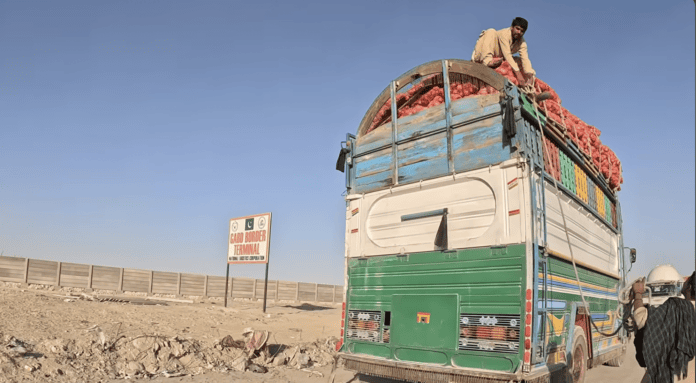
The corridors, which became operational in April 2026, run through Iran’s Gabd-Rimdan border crossing and China’s Sost Dry Port. They were introduced after Pakistan indefinitely closed the Torkham and Chaman crossings in October 2025 following persistent cross-border militancy.
More than 14,000 metric tons of cargo have already been transported through the two routes.
One corridor was formally inaugurated during a coordination ceremony in Karachi attended by senior representatives from Uzbekistan, Kyrgyzstan and Tajikistan. Pakistan presented the routes as a permanent alternative for Central Asian countries seeking access to global markets without relying on Afghan transit. The first convoy carried frozen meat and other exports to Tashkent and Bishkek through Iran.
Pakistan also dispatched its first export shipment from the Karachi Export Processing Zone to Kyrgyzstan via the Sost Dry Port under the TIR (Transports Internationaux Routiers) regime. The 3,300-kilometer Bishkek-Karachi corridor, operating under the Quadrilateral Traffic in Transit Agreement has since completed its first reciprocal commercial shipments, with Kyrgyz transport fleets delivering minerals and textiles to Pakistan.
Separately, the Hemani Group transported a 23.9-tonne consignment to Kyrgyzstan using the Pakistan Single Window (PSW) electronic customs system.
The new corridors provide Central Asian countries, including Uzbekistan and Kyrgyzstan, with overland access to the Arabian Sea through Pakistan while bypassing Afghanistan. Uzbekistan has already begun using the Gabd-Rimdan route to transport agricultural equipment and industrial raw materials.
Pakistan is also expanding the role of Gwadar Port within Phase 2 of the China-Pakistan Economic Corridor. Located about 400 kilometers east of the Strait of Hormuz, the port is expected to handle increasing cargo volumes moving through the new land corridors as regional trade routes continue to diversify.
The new network also expands the use of the TIR transit regime and the Pakistan Single Window system, which electronically processes customs documentation for cross-border shipments.
Facing US export controls, China’s DeepSeek plans to make its own chips
DeepSeek, the Chinese startup developing large language models that are competitive with those from US companies like OpenAI and Anthropic, is planning to enter the silicon business, according to Reuters.
Citing three people familiar with the matter, Reuters writes that DeepSeek has been working on a move into silicon for about a year. It has been meeting with potential partners in the hardware and silicon space and has been hiring engineers for the project.
The focus is on data center chips for inference, not training, and the goal is likely to reduce reliance on both Huawei and Nvidia.
Nvidia is the chipmaker for most AI companies in North America and Europe, but a United States export ban has prevented the company from achieving a similar presence in China. Huawei controls about half of the data center chip market there, and DeepSeek isn’t the only one trying to enter; Chinese tech giants like Alibaba and Baidu have been making moves, too.
While chip export controls in the US are a major reason this is an urgent concern for DeepSeek, US-based AI companies are making similar chip plans.
For example, OpenAI and Broadcom jointly announced Jalapeño, the former’s first chip designed for inference at scale, just a couple of weeks ago. Anthropic, too, has been exploring custom chip design, though there have not been any publicly visible milestones yet.
In OpenAI’s case, it’s partly a play to reduce its reliance on Nvidia, but it’s also a desire to have Apple-like control over the entire tech stack for its products. Further, getting in at the silicon and data center levels can be an advantage in a market where data center access is likely to remain constrained, with multiple companies competing for compute as they scale up their AI models and services.
How Local Cops Are Running With Trump’s NSPM-7 Attacks on Antifa
A month after Donald Trump issued an executive order purporting to designate antifa as a domestic terrorist group, an intelligence unit inside the Miami-Dade Sheriff’s Office in Florida sent out a confidential bulletin.
Trump’s announcement was widely criticized as a legally baseless attempt to criminalize his enemies on the left, but the Southeast Florida Fusion Center took it very seriously.
Citing sources that included right-wing social media accounts, the bulletin described antifa as a “decentralized autonomous network of cells” that “stand against capitalism and want to overthrow governments they feel are oppressive through violence and silence their opposition by any means necessary.”
“Antifa has been very active, their most prevalent presence during the George Floyd riots and recently during the anti-ICE protests,” it said, citing the 2020 national uprising against police brutality and the protests against U.S. Immigration and Customs Enforcement that followed Trump’s rise to power.
The Miami-Dade bulletin went on to describe the National Lawyers Guild — a left-leaning collective once villainized by Joseph McCarthy — as the “legal representative” of antifa. It also warned about the danger of zines as tools to “recruit new sympathizers” and of inflatable animal costumes as a “form of propaganda implemented by Antifa to soften their image.”
It was just one example of how, as the administration accelerates its crackdown on left-wing organizers, Trump’s push to paint antifa as a terror group has seeped into local law enforcement.
Previously unreported documents obtained by The Intercept show how local fusion centers are borrowing the tone and some of the language of Trump’s invectives against the left. They draw on his September 22 executive order designating antifa as terrorists and on prosecutions launched after a similar but more wide-reaching directive issued three days later, known as National Security Presidential Memorandum 7, or NSPM-7.
“The tone set by leadership is important,” Brendan McQuade, a University of Southern Maine professor who studies fusion centers and domestic surveillance, said of the documents obtained by The Intercept. “In the Trump administration the incentive structure is clear: Trump wants to mobilize the security apparatus against his perceived enemies, and in some sense the FBI and the Florida fusion center are both responding to that incentive structure.”
A White House spokesperson said the administration’s approach was part of a “new law enforcement strategy.”
“The President’s Memorandum is focused on investigating, disrupting, dismantling, and prosecuting individuals and entities engaged in organized political violence and domestic terrorism,” said White House spokesperson Abigail Jackson. “The Trump Administration will get to the bottom of this vast network inciting violence in American communities.”
The Florida Report
The Florida report was among a trove of scores of such documents obtained by The Intercept that were distributed through a national network of fusion centers.
Fusion centers were created after the September 11, 2001, attacks to facilitate information sharing about terror threats between federal and local law enforcement. Independent reviews, however, have found few tangible results after more than two decades in operation and countless dollars of federal funding for the centers. Critics say they have often been used to cast dissent as suspicious.
Many of the fusion center memos and bulletins focus on mundane topics of interest to local cops, such as the latest trends in ATM card “skimming.”
Others focus on foreign terror threats, such as the latest edition of “Inspire,” Al Qaeda in the Arabian Peninsula’s magazine.
Some of them, however, echo the Trump administration’s obsession with the left.
The Florida report, which is marked “for official use only,” stretches 28 pages. It starts off by defining antifa as terrorism and stating that the “goal of Antifa is the violent overthrow of the United States government.” (The Miami-Dade Sheriff’s Office, which houses the Southeast Florida Fusion Center, did not respond to a request for comment.)
Then it reproduces in full Trump’s executive order claiming to designate antifa as a “domestic terrorist organization” — a power he would not have even if antifa were a well-defined group rather than an ideology or movement.
Throughout, the Florida report leans heavily on right-wing sources, including the journalist-provocateur Andy Ngo, the Pizzagate conspiracy theorist Jack Posobiec, and an X account called Far Left Watch.
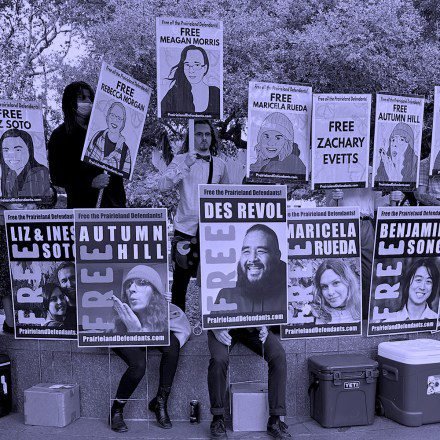
The report casts a wide variety of First Amendment-protected activities as antifa tactics, including using “profane language against law enforcement” and “doxing.” It warns that zines are used as “educational tools and offered as propaganda to recruit new sympathizers” — echoing an argument that federal prosecutors used against the defendants in the Prairieland ICE detention center protest case.
Police, the Florida report says, should also be on the lookout for inflatable animal costumes, in an apparent reference to the Portland Frog Brigade: “This is a form of propaganda implemented by Antifa to soften their image and change the narrative that they are a violent domestic terrorist organization.”
The document’s tone and reliance on partisan sources make it read “like opposition research,” McQuade said.
“This is not an intelligence bulletin about an organization,” he said. “This is like a target package that, to me, is encouraging police to go hunting for a very broad profile of not even just dissent but sometimes aesthetic markers of dissenting behavior.”
Target: Lawyers
The report devotes a full page to the National Lawyers Guild, the legal collective founded in 1937 as a colorblind alternative to the American Bar Association, which forbade Black members.
The group’s leftist sympathies have long drawn the ire of the right. In the 1940s and 1950s, it was infiltrated by J. Edgar Hoover’s FBI and mentioned in McCarthy’s infamous Senate hearings. More recently, the group has become an obsession for right-wing think tanks such as the Center for Security Policy and the Capital Research Center.
The Florida fusion center casts the National Lawyers Guild’s efforts to observe police on the streets and defend protesters in court in sinister terms, calling it antifa’s “legal representation.” That is laughable, said Xavier de Janon, director of mass defense for the National Lawyers Guild.
“I don’t know what that means, because antifa is not an organization,” he said, adding that if it were true, the group would proud to fight fascism. “But again, it’s false. It’s just not based on truth. There is no retainer agreement with antifa.”
And beyond that, he said, “NLG as an organization does not provide legal representation. Its members do.”
The report included a picture of National Lawyers Guild legal observers wearing their trademark lime-green hats, which de Janon interpreted as essentially a call to target them.
Pro-Palestine Groups
While the Florida report drew heavily from White House messaging, a different report from Texas relies on court filings from the Justice Department.
In December, the Dallas Regional Fusion Center produced an “intelligence brief” centering on the Turtle Island Liberation Front, a left-wing group accused of plotting coordinated bombing attacks in southern California.
The small group appears to have been thoroughly infiltrated by a paid informant and an FBI agent. The Dallas fusion center argued for even more surveillance, citing a “tangible and immediate threat from newly formed, violent extremist cells that require enhanced monitoring and inter-agency coordination.”
Corbin Rubinson, a spokesperson for the Dallas Police Department, which houses the fusion center, declined to comment on the report.
“These assessments are developed to support information sharing and situational awareness among our public safety partners, and we do not discuss their contents or how they are developed,” Rubinson said.
The Dallas document went on to name two groups that have no apparent connection to the Turtle Island Liberation Front: Direct Action Movement for Palestine Liberation and Unity of Fields. The only connection to the Turtle Island Liberation Front was that each group could be described as, in the words of the report, “another far-left, pro-Palestine, anti-Zionist extremist group.”
The bulletin acknowledged that none of the groups it singled out had a known presence in Dallas. Still, it urged police in the Dallas–Fort Worth area to “Monitor social media pages for extremist groups using ghost accounts and/or VPN” and to “Expand monitoring of encrypted messaging platforms for extremist activity.”
Anarchists in Minneapolis
The Miami and Dallas reports cribbed extensively from Trump’s executive order and Justice Department court filings, respectively. In January of this year, the FBI put out an alert more explicitly directed at local police.
Four days after federal officers shot and killed nurse Alex Pretti in Minneapolis, the FBI issued a “public safety awareness report” produced by its Office of Partner Engagement and Counterterrorism Division. The report, which was first made public last week by the news outlet Prism, was independently obtained by The Intercept.
The January 30 report was titled “Anarchist Violent Extremists Pose Persistent Public Safety Threat.” It ticked off recent instances of what the FBI saw as instances of anarchist violent extremism, or AVE, including the Prairieland ICE detention facility protest near Dallas and the Turtle Island Liberation Front. Then it swiveled to Minneapolis, which for weeks had been the scene of ordinary protesters confronting masked federal agents.
“Given recent criminal activity in Minneapolis, Minnesota, the FBI is concerned about the potential for AVE violence there,” the report said. “The FBI has seen indicators of this, to include an individual who self-identified as Antifa advocating on social media for violence against ICE in Minneapolis, telling people to ‘get your guns.’ The FBI investigates any reports of violence or the threat of violence by AVEs or other domestic violent extremist or criminal actors.”
The entire FBI report has a more professional tone than the Florida fusion center bulletin, McQuade said, but it rests on equally thin evidence.
“The FBI talks about two criminal cases, some social media monitoring, but they have claims that would not pass peer review — that anti-capitalist graffiti is an indicator of threat,” he said. “Then the little pull box they had in there about Minneapolis, where one tweet or social media post is interpreted to mean the whole city is ready for violence against federal agents. That just seems like bad analysis.”
Dissent as a Threat
It is not the first time that counterterrorism agencies have mobilized against the left on thin evidence.
In 2024, the American Civil Liberties Union filed a public records lawsuit against the Justice Department seeking internal documents about how Joint Terrorism Task Forces and fusion centers responded to protests.
Skeptics of domestic counterterrorism agencies say the overreach has spanned both Democratic and Republican White House administrations, but the documents the ACLU obtained from the first Trump administration share remarkable similarities with his second term.
The January 2026 bulletin from the FBI obtained by The Intercept includes a warning about “black bloc” clothing used to obscure demonstrators’ identities, securing financing through “lawful donations,” encrypted messaging apps, and anti-government graffiti.
The ACLU, meanwhile, obtained a July 2018, bulletin produced by the Department of Homeland Security and local fusion centers that warned about “potential indicators of violent activity by anarchist extremists at events and protests in the homeland.”
The “indicators” of a heightened threat in the bulletin include wearing black and red clothing, soliciting legal defense donations ahead of protests, wearing “Guy Fawkes” masks, and “use of public transportation” to mask license plate information.
The “indicators” of a heightened threat include wearing black and red clothing, wearing “Guy Fawkes” masks, and “use of public transportation.”
“Merely wearing certain colors and taking the bus to a protest should not be enough to justify heightened scrutiny from law enforcement,” Sara Robinson, an attorney with the ACLU’s National Security Project, said in an emailed statement. “Using overly broad and stigmatizing terms to describe people who may be engaged in First Amendment-protected activity opens the door to pretextual law enforcement investigations and aggressive policing based not on evidence of criminal activity, but on the exercise of free speech rights.”
She said, “The Trump administration is continuing to treat dissent as a threat.”
Organized crime resurgence fears stalking wartime Russia
Following the Soviet Union’s collapse in 1991, Russia endured a period of violent criminal lawlessness known as the “wild 90s.” Organized crime spiked, with gangs taking control of banks, factories and other lucrative markets. Contract killings, shootings and car bombings became part of urban life.
There are now fears that the Ukraine war will give rise to a similar situation as members of Russia’s army, as well as former convicts who were pardoned in exchange for military service, return from the frontlines.
A variety of conditions enabled organized crime to flourish in the 1990s. Weak state institutions, economic turmoil and mass privatization following the Soviet Union’s collapse created a governance vacuum in Russia.
As criminologist Federico Varese, of the University of Oxford, explains in his work, criminal groups stepped in to provide “private protection” in areas where the state was ineffective or absent. They provided services such as contract enforcement, debt recovery and physical business security.
Sociologist Vadim Volkov, meanwhile, describes the rise of “violent entrepreneurs” who commodified coercion in an environment where legal institutions had largely collapsed. Russia’s murder rate surged in this period. Between 1990 and 1994, it more than doubled to a peak of over 33 killings per 100,000 people.
This made Russia’s murder rate among the highest globally.
Contemporary Russia presents a different picture. Following Vladimir Putin’s rise to power in 1999, the Russian state has consolidated its authority. Putin quickly expanded the state’s security apparatus while reasserting control over criminal networks.
In many cases, organized crime has become integrated into systems of governance, complementing the state’s political or strategic interests. For example, criminal networks have facilitated sanctions evasion by transporting restricted goods through parallel trade routes and acquiring sanctioned technologies via intermediary networks in third countries.
Reinforcing this transformation
The Ukraine war is likely to reinforce this more recent transformation. Expanded Western sanctions imposed since the start of the war have widened opportunities for illicit trade and smuggling networks. But the most significant consequences arise from the social and security challenges associated with large-scale military demobilization.
Since the full-scale invasion in 2022, Russia has mobilized hundreds of thousands of military personnel. This includes up to 180,000 former convicts. Many of these people have experienced prolonged exposure to combat. Military service does not inherently lead to criminality and it would be inaccurate to suggest that all returning veterans are likely to become offenders.
However, evidence from post-conflict societies such as Colombia, Sierra Leone, Cambodia and Bosnia-Herzegovina suggests that poorly managed demobilization can reshape criminal markets.
Research on disarmament, demobilization and reintegration consistently demonstrates that unemployment, psychological trauma and weak institutional support create opportunities for criminal groups to recruit former combatants.
Military service also teaches soldiers organizational skills beyond battlefield experience such as logistics, intelligence gathering and network management. These skills are all transferable to contemporary organized crime. In modern organized crime environments, traditional racketeering is complemented by cybercrime, cryptocurrency laundering and transnational financial crime.
Even if only a small proportion of military personnel returning from Ukraine become involved in criminal activity, they could change the composition and improve the operational sophistication of Russian crime groups. While the circumstances differ, the case of Colombia illustrates how poorly managed demobilisation can transform organised crime.
In the 2000s, over 30,000 fighters from right-wing paramilitary groups in Colombia were demobilized. A minority of these former combatants subsequently joined or established criminal organizations. They provided military training, discipline and networks, aiding the capabilities of organized crime.
These groups rapidly became major players in the Colombian organised crime ecosystem. A Human Rights Watch report found they became major perpetrators of drug trafficking, extortion and violence. Estimates suggest they controlled up to half of the Colombia’s cocaine exports by 2011.
The Russian state is far stronger than the one that emerged after the collapse of the Soviet Union. Photo: WorldStockStudio / Shutterstock via The Conversation
The Russian state is far stronger than the one that emerged after the collapse of the Soviet Union. This makes a wholesale resurgence of traditional criminal violence unlikely. Instead, the Ukraine war looks set to accelerate a new generation of criminal networks that are more professional, militarised and embedded within state structures.
However, the Kremlin still faces a difficult balancing act. Contemporary Russian governance has relied upon managing and exploiting criminal groups. And Moscow appears wary of the broad social instability that would emerge if criminal organizations become sufficiently powerful or autonomous to operate beyond state control.
Russia has thus begun preparing plans for the return of veterans from Ukraine. The Kremlin has implemented initiatives such as the “Time of Heroes” program. This program channels selected veterans into public administration and political office following their demobilization. Although limited, such planning reflects official recognition that domestic consequences of war will extend beyond the battlefield.
Regardless of these efforts, the distinction between organized crime and state power in Russia is likely to become harder to draw than at any point since the end of the Cold War.
Whoopi Goldberg Missing from ‘The View’ After Volcano Eruption
The View was thrown into chaos Monday after Whoopi Goldberg revealed she had been stranded in Italy by a volcanic eruption — while two other co-hosts were also forced to miss the show.
Goldberg, 70, was noticeably absent from the Monday, July 6, episode of the hit daytime talk show. Viewers soon learned the Oscar-winning actress had a far more dramatic excuse than a delayed alarm or missed flight.
She was stuck in Sicily after Mount Etna, one of Europe’s most active volcanoes, erupted and disrupted travel across the region.
With Goldberg unable to make it back to the United States, Joy Behar was called in to lead the panel, even though she does not normally appear on Mondays.
Behar sat alongside Alyssa Farah Griffin, Sunny Hostin and actress-comedian Michelle Buteau, who was quickly promoted from scheduled guest to emergency guest host.
“Hello, everybody. So you may be asking, ‘Why am I here on a Monday?’ I asked myself the same question,” Behar joked at the start of the show.
She added, “But Brian Teta begged me to come in — on his knees, where he belongs. Why? Because we are down three cohosts today.”
Behar then turned her attention to Goldberg’s unusual travel nightmare.
“Whoopi is using the old volcano excuse,” she teased before the show played a prerecorded video from Goldberg explaining the situation.
“I am in Sicily, and Mount Etna, one of our active volcanoes here in Italy, decided to go off today,” Goldberg said.
The Color Purple star explained that she had spent most of the day desperately trying to find a way home, but nearby airports had been shut down.
“I’ve spent most of the day trying to get back,” Goldberg said. “All of the airports are closed.”
She promised viewers she would return as soon as possible before joking that her vacation disaster topped every excuse she had heard before.
“I know that we got all kinds of stories about our different vacations,” she said. “Well, I think my story just takes the cake. A volcano ate my homework!”
Goldberg was not the only View host missing from the table.
Sara Haines and Ana Navarro were also unable to appear after separate emergencies over the holiday weekend.
Navarro was stuck in Miami because of severe weather, while Haines was dealing with storm damage.
Naturally, Behar wasted no time roasting both of them.
“Ana is stuck in Miami because of weather. It’s always hot there, what’s the problem?” she joked.
Turning to Haines, Behar added, “Sara is dealing with storm damage. How many people are dealing with storm damage? Anybody in this group? No, just Sara!”
With three regular co-hosts suddenly unavailable, producers scrambled to keep the show moving and called on Buteau to help fill the empty seats.
“We want to thank our special guest who was roused out of her sleep this morning at 6 a.m. to come in and help us: the actress and comedian Michelle Buteau,” Behar announced.
Buteau had originally been booked only as a guest, but she agreed to step in as a guest host after receiving the early-morning call.
“This is not how I thought it would happen, but I’m so glad it did,” Buteau said.
She then leaned into the bizarre circumstances surrounding her promotion.
“Hi everyone, welcome to The View!” she joked. “A volcano had to go off before you guys asked me to come here. I love it!”
RSF attacks in Western Sudan reportedly destroy villages and displace thousands
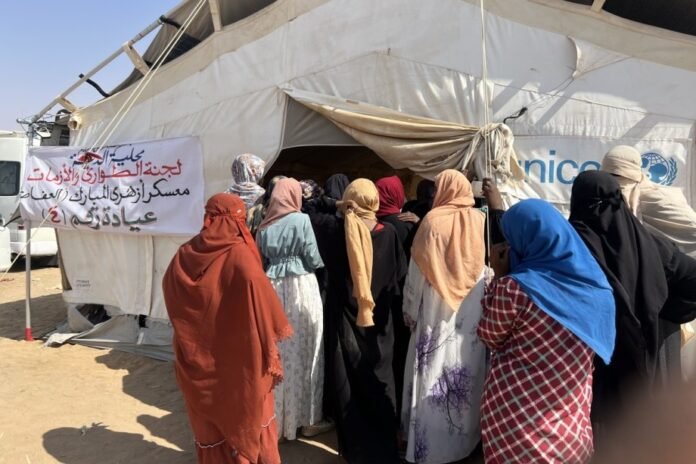
Attacks attributed to Sudan’s Rapid Support Forces (RSF) near the country’s western border with Chad have destroyed several villages and forced thousands of civilians to flee, according to survivors and the United Nations.
The violence occurred in North Darfur, where the RSF has been fighting the Sudanese Armed Forces since April 2023.
The UN has previously accused the RSF of carrying out massacres against non-Arab communities in Darfur, including members of the Zaghawa ethnic group.
According to the International Organization for Migration (IOM), more than 3,500 people were displaced on Friday from the village of Wadi Fungo in the Um Buru area of North Darfur.
Speaking to Agence France-Presse (AFP), Issa Ibrahim, 35, said dozens of RSF vehicles entered his village of Umm Marahik last week. “They fired cannons at houses,” he said.
READ: UAE allocates $30m in emergency aid for Sudan’s El Obeid city
After sending his wife and children across the border to Chad, Ibrahim said he witnessed widespread destruction. “Houses were burned, and people were lying dead in the streets with no one to bury them,” he said.
He added that neighbouring villages, including Aruru and Ana Baji, had also been destroyed. “They were completely burned down. Bodies were lying on the ground,” he said.
Another survivor, Mohammed Adam, 43, told AFP that two of his brothers were killed during an attack on the village of Qurbu. “They burned houses and killed people, except for those who managed to escape,” he said. The two men spoke to AFP after reaching the border town of Al-Tina, using satellite internet because telecommunications in the area had been disrupted.
The RSF had not immediately commented on the allegations. Sudan has been engulfed in conflict since April 2023, when fighting broke out between the Sudanese Armed Forces and the RSF.
The United Nations describes the conflict as one of the world’s worst humanitarian crises, with tens of thousands of people killed and millions displaced both within Sudan and across its borders.
READ: IOM warns El Obeid risks becoming ‘another El Fasher’ as fighting intensifies in Sudan
New virus catalog reveals which pathogens pose the greatest threat
In a typical year, scientists discover two or three viruses that have never been seen in people before. The number fluctuates, but the trend has been fairly steady since the 1960s.
Most of these viruses attract little attention, and my colleagues and I have often had to search through old medical papers to find any mention of them. Some viruses disappear entirely and are all but forgotten. At the other extreme, the discovery of HIV-1 in 1983 and Sars-CoV-2 in 2020 presaged the AIDS and COVID pandemics, respectively. Both have killed tens of millions.
The next time a scientist finds an unusual or unknown virus in a patient—probably in the next few months—how will they know whether it could lead to a public health emergency on the same scale as AIDS or COVID? My team at the University of Edinburgh has been using the lessons of virus history to help answer this question.
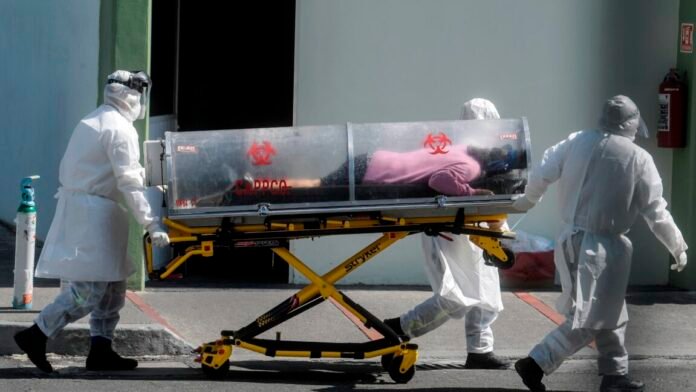
Pandemics come in many forms, but in recent times the biggest culprits have been viruses with genomes made from RNA (rather than the more familiar DNA). Thousands of RNA virus species have been identified, and there may be millions, but only 239 infect humans. We recently published a catalog that helps pinpoint the riskiest ones.
The type and severity of disease are important indicators, but there will be no pandemic unless the virus can spread between people. That could involve physical contact, or inhaling airborne particles, or exposure to blood or feces, or the bite of a mosquito or tick.
For two-thirds of the viruses on our list, an infected person is highly unlikely to pass their infection on. These are known as zoonotic viruses, meaning people usually catch them from animals rather than other people. Rabies is one example.
That sounds reassuring, but viruses evolve quickly and there is an understandable concern that a zoonotic virus might acquire the ability to spread among humans. That’s why scientists are so worried about bird flu. But there is no documented example of an RNA virus doing that. Rabies hasn’t, even though there are tens of thousands of human cases every year.
A much greater threat comes from viruses that already have the ability to spread from person to person. They might become even more transmissible—as did a series of SARS-CoV-2 variants—but they crossed over from animals already able to spread among people. In the distant past, that was the likely origin of measles, mumps, and rubella, along with dozens of viruses associated with colds and gastrointestinal infections.
Then there are viruses that are capable of spreading among humans but, so far, have caused only limited outbreaks. That’s because their R number (how many people, on average, one infected person goes on to infect) is too low and chains of infection eventually die out of their own accord. But R numbers can change; for example, when a virus previously confined to remote villages reaches a city. That happened with Zaire ebolavirus in west Africa in 2014.
There have only ever been a few dozen names on our list of outbreak viruses, but it’s a powerful predictor of public health emergencies. Zaire ebolavirus, the insect-borne Chikungunya, Zika and Oropouche viruses, and mpox (a DNA virus) were original entrants, and all have gone on to cause major epidemics.
Some rarer viruses on our list have become more familiar, too. One is Andes hantavirus, responsible for a recent outbreak on a cruise ship. Another is the Bundibugyo ebolavirus, which is currently spreading in central Africa.
The next pandemic virus
Our data can also help predict what a future pandemic virus—sometimes called disease X—might look like. COVID is a good illustration.
In 2019, my team showed that highly transmissible viruses tend to be closely related to other viruses that spread between humans, but they emerge separately from animals. That turned out to be a perfect description of SARS-CoV-2, very similar to the original SARS coronavirus but independently (and perhaps indirectly) acquired from bats.
The year before, the World Health Organization had proposed a SARS-like coronavirus as a candidate for disease X. That’s why scientists were alarmed about COVID from the outset—it was exactly what they had been looking for.
By contrast, neither Andes nor Bundibugyo virus have the right profile to start a global pandemic. But if it were, for example, a novel virus related to measles then it would be a different story. In that scenario, there would be a real possibility of a worldwide emergency much worse than COVID.
Andes and Bundibugyo do reinforce one important lesson, though: Both had been spreading for weeks before they were picked up. So had COVID. Finding and understanding new viruses faster would deny the next pandemic the same head start, and could make a huge difference to the eventual toll on lives and livelihoods.