26.3 C
London
Thursday, July 2, 2026
Home Blog

Ambani-Trump Jr. investigation encountered a Google AI surprise

0

This article was first published by ProPublica, a nonprofit newsroom that investigates abuses of power. It is republished under a Creative Commons license.

Last month, my colleagues and I published an investigation into a Texas oil refinery startup,  America First Refining, that had secretly gotten investment from Donald Trump Jr. We discovered a saga involving the Trump administration’s tariff policy, sanctioned Russian oil and the Indian billionaire Ambani family’s private zoo

At the center of the story was the CEO of the refinery company, Texas businessman John Calce. We’d spent weeks examining Calce — pulling old lawsuits, property records, corporate registry filings — and had pieced together a portrait of what appeared to be an obscure serial entrepreneur who’d for years tried and failed to secure funding for his long-shot refinery project.

Then, not long before our story was set to publish, we decided to do a scrub on a separate company he had incorporated called Brownsville Energy Storage Terminals.

Pulling up the company’s website, I felt a brief flash of panic: Had we somehow missed the existence of a major business owned by the man at the center of our next story? 

“From Houston to Rotterdam, Jurong to Fujairah. Our network connects the world’s most vital energy markets with speed, safety, and precision bulk oil storage,” announced the front page of the company’s website.

On the main page of Brownsville Energy Storage Terminals there is a large photo of an energy site on the water with “Strategic Oil Hubs Worldwide” written over it.
Screenshot by ProPublica

Brownsville Energy Storage Terminals, per the website, had more than 850 employees and 28 million barrels of oil storage capacity across six global hubs. This was puzzling: Our reporting had led us to believe Calce was struggling to raise enough money for a single project in the US, not overseeing a massive, multinational oil storage corporation. 

Had we been wrong? 

We turned to Google to learn more about the company’s top executives. Its CEO, Sarah Jenkins, had more than 20 years of experience at major energy firms. And its chief technology officer, David Chen, “built the company’s proprietary inventory management portal and integrated AI-driven predictive maintenance systems,” according to his bio. But we couldn’t find any trace of either of them online. Chalk it up to common names? 

We then Googled one of the more distinct names: Vice President for Sustainability Dr. Sofia Rossi, who had “spearheaded the ‘Future Fuels’ program, preparing assets for biofuels and hydrogen.” But, again, nothing. The links to their LinkedIn profiles were dead.

On the page about the executive leadership of Brownsville Energy Storage Terminals there are four employees with their credentials listed.
Screenshot by ProPublica

When we searched the company’s Texas phone numbers, we found the same numbers listed online for a Houston baklava caterer, a Dallas-area taxi service and an OB-GYN office.

We called the Texas numbers: dead. Then we tried the numbers for the company’s facilities in the Netherlands, Singapore and China. Also dead. 

We were beginning to suspect this company did not actually exist, at least as described on its website. 

What was going on with this website? We looked at the source code and noticed an odd notation, “This feature isn’t implemented yet, but don’t worry! You can request it in your next prompt!”

A collection of numbers and letters making up the code of a website.
Screenshot by ProPublica

We checked the site’s domain registration, and we had our (apparent) answer: It was created this year and traced back to a company called Hostinger that offers an AI website builder for $2.99 per month. “Describe it, and AI builds it,” its homepage says. “Appear on Google and AI search automatically.”

Indeed, Google’s “AI Overview” search response, now thrust on users by default with more and more regularity, seemed to ratify the company’s bona fides:

A Google search of “what is Brownsville Energy Storage Terminals” reveals a long “AI Overview” response.
Screenshot by ProPublica

When I searched for an award the company claimed on its website to have won, the Google AI Overview said that “Recent notable recipients include Brownsville Energy Storage Terminals, recognized for their rapid expansion in the independent oil and terminal operations sector.”

A Google search of “‘energy review’ magazine ‘Emerging Tech Award’” reveals a long AI Overview response.
Screenshot by ProPublica

Brownsville Energy Storage Terminals is a real LLC. But everything on its website — from its history of the company to its job postings to a diversity and inclusion policy — appears to be fictional. But perhaps more troubling is that Google, the proprietor of the world’s primary research tool, has rolled out AI Overviews that can indiscriminately take in fake material and authoritatively spit it back out as real.

In response to questions, a Google spokesperson said in a statement: “AI Overviews are rooted in our core Search ranking systems, surfacing reliable and high-quality information for the vast majority of queries. For uncommon search terms like these, there might not be high quality information published that matches the query — and we use these examples to improve our search systems.”

After we reached out to Hostinger, the company pulled down the site. “After receiving your inquiry, we carried out an internal review. Based on the violations identified, we suspended the website and the account behind it in line with our Terms of Service,” a spokesperson said in a statement.

What we encountered is a particular species of a larger problem that is beginning to be better understood. In April, The New York Times reported on an analysis that found Google’s AI Overviews were accurate approximately nine out of 10 times, noting that that added up to “tens of millions of erroneous answers every hour” given vast search volumes. (A Google spokesperson told the Times that the study has “serious holes.” The company has acknowledged that AI Overviews “can make mistakes.”) 

A BBC reporter wrote a fictional article naming himself the best tech journalist at eating hot dogs, and Google’s AI as well as ChatGPT quickly picked it up and parroted it back.  

And the source material for the AI Overviews also appears eminently gameable, even when not trafficking in actual fiction. “It Is Trivially Easy to Use Reddit to Manipulate AI Search, Research Suggests,” ran a recent headline in 404 Media. 

The mystery website ended up as just a single paragraph in our story. But the larger implication is obvious: Fakes, counterfeits and frauds that would have taken considerable effort to create just a few years ago can now be churned out pretty much instantly.

While preparing this piece, we reached out to Calce asking about the site. An attorney for his company, America First Refining, replied to us with a letter dated June 24 that the attorney sent to Hostinger. The attorney also addressed the letter to several email addresses listed on the Brownsville Energy Storage Terminals website.  

“I write to demand immediate removal from the brownsvilleenergyterminals.com website of all unauthorized references to America First’s office address on your website,” the letter said. “As you are aware, America First has no connection or affiliation with the brownsvilleenergyterminals.com website and has not authorized the use of its corporate address there.”

I’m left with lingering questions about the website: What was it for? Was it put up by some malicious actor who simply found the company’s LLC records and decided to create a website? Was it a test site that was mistakenly put online? Or could it have been designed for consumption by someone who was meant to think it was real? 

We don’t know, and our emails to the press contact listed on the website, media@brownsvilleenergyterminals.com, bounced back.

Joshua Kaplan and Alex Mierjeski contributed reporting.

Musk’s X poses “serious risk to Americans’ privacy,” advocates warn FTC

0
musk’s-x-poses-“serious-risk-to-americans’-privacy,”-advocates-warn-ftc
Musk’s X poses “serious risk to Americans’ privacy,” advocates warn FTC

Ahead of a July 2 deadline to submit public comments, advocates are warning the Federal Trade Commission that it must keep close watch over Elon Musk’s X and firmly reject a recent bid to end the agency’s ongoing audits of the platform’s data handling.

Last month, the FTC posted a notice explaining that X had argued that an FTC order was no longer necessary due to changes Musk had made to the platform.

The initial order came as a penalty after the FTC found that a coding error had caused then-Twitter to improperly share users’ contact information for ad targeting that had initially been submitted for two-factor authentication. Under the order, X is subjected to costly independent audits, and the FTC has authority to demand documents to ensure compliance with data privacy laws without taking additional legal action.

According to X, the order imposes burdensome costs and should be terminated, partly because the company has completely rebranded since Musk took over Twitter. X also argued that the order’s requirements were duplicative since X now faces similar obligations under the European Union’s General Data Privacy Regulation (GDPR).

However, 15 privacy and consumer protection advocates—including Demand Progress, the Electronic Frontier Foundation, the Electronic Privacy Information Center, and the National Consumers League—co-signed a letter this week refuting all of X’s arguments.

They’re urging the FTC to “unequivocally reject X Corp.’s brazen attempt to escape accountability at the expense of the American people.”

“X Corp.’s petition fails to clear the demanding legal standard necessary to grant the extraordinary action the corporation is requesting,” the letter said. “To the contrary, X Corp. and its current leadership present a serious risk to Americans’ privacy and data security, demonstrating the need for continued” FTC oversight.

X’s AI training and tools raise red flags

Musk’s big argument seems to be that since he’s rebranded Twitter as X, then folded X into SpaceX, that the old Twitter business has been transformed and there is no longer a risk of X’s improper data handling.

However, advocates argued that Musk’s changes to X have only raised additional concerns about the platform’s data handling that should heighten the FTC’s monitoring and are not a cause to terminate it.

Among top concerns, they cited global backlash to Grok, which triggered a lawsuit from three girls who accused X of allowing the chatbot to generate child sex abuse materials (CSAM) and other non-consensual intimate images (NCII). And just last year, “2.8 billion records leaked from the platform,” advocates noted, while Musk was busy managing DOGE efforts to extract “sensitive information” about millions of Americans. They also pointed out that the FTC had already found that Musk “had directed employees to take actions that would have violated” the order, while seeking to give journalists unbridled access to internal data to investigate the so-called “Twitter Files.”

Further, any questions of how much control Musk wants users to have over their data can be answered by X’s controversial decision to collect “hundreds of millions of posts on the X platform” for AI training “without meaningful or explicit user consent,” advocates said. Rather than seek user consent, X merely updated its terms, advocates said, seemingly banking its AI business on users not reading about updates.

According to Cambridge Analytica, “when Musk changed X’s rules to allow AI training on user-generated content, he didn’t invent a new business model. He industrialized the surveillance capitalism business model Cambridge Analytica pioneered: behavioral data at massive scale enables population-level personality modeling.”

Supposedly, Musk’s X business model training Grok on public posts is “identical” to the business model behind one of the biggest data scandals in history, Cambridge Analytica wrote. X’s AI works to “extract maximum behavioral data, build prediction models, sell persuasion capability. Musk just replaced Facebook’s advertising-to-third-parties model with direct AI-deployment-to-Musk-aligned-entities,” their post said.

Opt-out methods are available but “practically invisible,” Cambridge Analytica noted, citing research finding that “73 percent of X users were unaware their tweets trained Grok.”

Cambridge Analytica suggested that many users would likely be creeped out to realize that deleting X posts doesn’t delete the behavioral signal to the AI model. That means the algorithm is likely to continue targeting content at users based on information the user chose to remove.

As Cambridge Analytica sees it, the X platform’s chatbot Grok represents a “failure” that proves that “consent frameworks designed for individual users” following the Facebook scandal “don’t prevent industrial-scale behavioral exploitation.”

“Grok shows that the model survived intact—it just moved from Facebook’s API to X’s native AI infrastructure,” their post said. “The technology improved, the regulation stayed static, and the surveillance deepened beyond what Cambridge Analytica achieved.”

Other platforms like TikTok and Instagram similarly borrow the wrong lessons from the scandal, Cambridge Analytica said. But “Musk’s iteration is distinctive only in its transparency about extraction scope. “ X is especially bad, Cambridge Analytica explained, because:

“X explicitly reserves the right to train AI on your complete behavioral history. Other platforms perform equivalent extraction while maintaining ambiguity in their terms of service. X’s brazenness—Musk announcing Grok’s capabilities without pretense of user benefit—might paradoxically prevent effective regulation by making the surveillance mechanism obvious rather than hidden.”

Advocates warned the FTC that there’s no reason to give away the agency’s powers to sanction X if future violations are found, simply because Musk finds it inconvenient to comply with the order.

Giving in to Musk’s demand would mean “effectively stripping away” the FTC’s “most effective deterrence and accountability mechanisms that protect American consumers against a known repeat offender,” they warned.

Additionally, X should not be allowed to use a state court finding, determining that its terms of service adequately informed users about Twitter’s accidental ad targeting, in order to override violations found under the FTC Act, advocates said.

And finally, the GDPR is not a substitute for FTC monitoring, they argued. That seems particularly clear since X is currently under investigation for its “unauthorized collection of European users’ data to train its Grok AI model without valid GDPR consent” advocated noted.

“X Corp.’s foray into artificial intelligence development should prompt greater FTC oversight of the company’s privacy practices, not less,” advocates said.

Former AG supports X

X did not respond to Ars’ request to comment.

However, former US Attorney General William Barr has submitted comments supporting X. In his letter, Barr called out hundreds of FTC info demands after Musk bought Twitter as excessive.

Arguing against “permanent agency control of private companies,” Barr pushed the FTC to stop treating the termination of consent orders as requiring extraordinary circumstances, and at the very least reopen the order to consider if the scope of X’s restrictions is proper.

Whether X’s petition can succeed may hinge on X’s legal analysis, though, which advocates claim was “misleading.”

For example, neither of the cases X cited actually supports its claim that a “transformed” company shouldn’t be obligated to maintain an order after restructuring, advocates argued. In one case, an order was terminated by invoking a “sunset” policy that requires such an outcome after 20 years. In the other, an order was not fundamentally changed due to a market shift, as X argued, but eventually modified after 16 years of compliance.

In contrast to those cases, X’s order is “merely four years old,” advocates said, and X has shown it still requires scrutiny. Further, Musk agreed to accept the costs and comply with the order when he bought Twitter, so he should be stuck with it for the entire duration, they argued.

More glaringly, advocates pointed out that X is largely unchanged, serving the same functions as a platform as Twitter.

Musk, therefore, remains “in the exact same business of operating a social media platform, still utilizes user data for targeted advertising, and now has new uses and desires for consumer information in its AI business that make the 2022 Order’s oversight even more vital,” advocates said.

Legendary Actor Reveals Heartbreaking Alzheimer’s Diagnosis

0
legendary-actor-reveals-heartbreaking-alzheimer’s-diagnosis
Legendary Actor Reveals Heartbreaking Alzheimer’s Diagnosis


Hollywood legend Danny Glover has revealed he is battling Alzheimer’s disease in an emotional new interview that has left longtime fans stunned.

The 79-year-old actor, beloved by generations for his unforgettable roles in Lethal Weapon, The Color Purple and countless other films, opened up about his diagnosis during a Today show segment with Lester Holt that aired Wednesday morning.

Glover said he was diagnosed not long after receiving his honorary Oscar in 2022 — a career-capping moment that should have been pure celebration.

Instead, the veteran star was quietly facing a terrifying new chapter.

“I could live with it in a sense,” Glover said during the pre-taped sitdown.

But the actor did not sugarcoat what may come next.

“I’m sure as it advances, things are going to be different and changing,” he admitted.

The heartbreaking revelation gives fans a rare and deeply personal look at the private battle being faced by one of Hollywood’s most respected performers.

Glover said he is leaning on his loved ones as he faces the disease, praising his family for standing firmly beside him.

“They absolutely got my back,” he said.

His daughter, Mandisa Glover, also appeared in the interview and explained why her father decided now was the right time to speak publicly.

She said it is “really important” for him to have “control of his own narrative, of his own life story.”

“What better time but now for him to speak for himself?” she said.

Mandisa added that people had begun asking questions, and she did not want to pretend everything was fine when the family was facing something so serious.

“I don’t want to be a dishonest person and say, ‘Oh, yeah, everything is all right. It’s all great,’” she said.

Even while discussing his health, Glover also reflected on the remarkable career that made him a household name.

He pointed to Places in the Heart, the 1984 drama starring Sally Field, as his favorite project of all.

But for Glover, his legacy is about far more than red carpets and movie roles.

The actor said he remains focused on teaching young people about responsibility, justice and the power of change.

“Justice is our collective responsibility,” he said.

Glover added that one of the biggest lessons he learned from his parents was that people have the ability to transform their own lives.

“They become the architect of their change,” he said.

The Alzheimer’s diagnosis is not the first health struggle Glover has discussed publicly.

The actor has previously opened up about living with epilepsy after suffering his first seizure at just 15 years old. He treated the condition with medication for about 20 years and eventually learned to recognize when a seizure was coming on.

At one point, Glover said, he could warn people around him by saying, “Something is happening to me. Please grab me. Please hold me. I’m about to have a seizure.”

He once recalled feeling a seizure coming on backstage during a play and repeatedly telling himself, “I will not have this seizure.”

Each time, he said, he felt stronger until the symptoms eased and he was able to walk onstage.

Glover has said he has not suffered a seizure since he was 35.

Now, decades later, the actor is once again facing a serious health battle — this time with the same honesty and quiet strength that have defined much of his life and career.

For fans who grew up watching him on screen, the news is heartbreaking.

But for Glover, the message is clear: he wants to tell his own story, in his own words, while he still can.

State of emergency in Crimea as Ukraine focuses pressure on ‘jewel in Putin’s crown’

0

Vladimir Putin has finally acknowledged that Ukraine’s relentless drone attacks on Russia’s energy infrastructure are having an effect.

Speaking to the ruling United Russia party on June 28, the Russian president confirmed that his country is facing “a certain shortage” of fuel and that “strikes on our infrastructure sites are creating problems”.

In fact, the situation is far worse that Putin admits.

Russia has hit back hard at Kyiv and other cities in Ukraine, launching massive strikes over night on July 1 with a combination of drones as well as cruise and ballistic missiles, killing at least 17 people and injuring dozens more.

Ukraine’s president, Volodymyr Zelensky, had warned that the Kremlin was planning another massive attack in retaliation after a month in which a Ukrainian air offensive has put considerable pressure on Russian defences and morale.

Throughout June, Ukraine stepped up its strikes on Russia’s energy infrastructure deep in the heart of European Russia, far from the front lines of the war in eastern Ukraine. Oil refineries in Moscow itself have been hit. All regions of Russia now report fuel shortages and knock-on effects are emerging with delays in the delivery of food and other goods.

Russian-occupied Crimea has been a particular target, with regional authorities declaring a state of emergency on June 26 amid power outages, food shortages and fuel rationing that includes banning the sale of petrol to civilians.

Crimea has been a focal point for Ukraine’s strategy in part because it has played a vital role in Russia’s war effort. It has been an important route for military equipment and supplies heading to the combat zone in Ukraine’s Donbas region. Control of the port of Sevastopol provides Russia with a foothold in the Black Sea, even though around 30% of the vessels in Russia’s Black Sea fleet have been damaged or destroyed by Ukraine since 2022 and large parts of the fleet were relocated further east in 2023 under pressure from Ukrainian strikes.

Even the remaining command and control units are now believed to be planning to pack up and move to Russia.

But Ukraine has also focused its attention on Crimea as a target because of its symbolic significance as the “jewel in the crown” of Russia’s campaign in Ukraine. Ever since Russia annexed Crimea in 2014, the peninsula has been used by Moscow as a symbol of the success – and indeed the righteousness – of its efforts to claim Ukrainian territory as its own. The fact that Russia has been unable to protect Crimea from Ukrainian strikes is therefore particularly humiliating for Moscow.

‘Crimea is ours’

The 2014 operation to seize control of Crimea was carried out very efficiently by Russian troops who swiftly occupied key strategic points. Ukrainian and western media labelled the soldiers “little green men” and initially Putin claimed they were “local self-defence units.”

It was later revealed they were Russian troops – and among pro-Russia residents of Crimea they were seen as heroes. Their professional appearance and disciplined behaviour gave Russians a reason to be proud of their armed forces, which had a reputation for brutality and incompetence. Locals flocked to take selfies with them.

The annexation sparked a surge of nationalist sentiment in Russia. The phrase “Crimea is ours” became a social media meme and was was printed on consumer goods.

Rally in Moscow's Red Square. Vladimir Putin is shown on big screens either side of a stage.

Vladimir Putin speaking at a rally to celebrate the 10th anniversary of Russia’s annexation of Crimea, March 2024. EPA/Sergei Ilnitsky

The Russian film industry was enlisted to reinforce the message. The 2017 blockbuster “Crimea” – made with funding from Russia’s defence ministry – presented the annexation as a demonstration of the country’s status as a great power. The following year, a feel-good romantic comedy Crimean Bridge – Made with Love! was released. Written by Margarita Simonyan, the head of the Russian news outlet RT and a close ally of Putin, it depicted life in the peninsula as a sun-drenched adventure.

While popular culture painted an attractive picture of Crimea, Moscow encouraged Russians not only to spend their holidays there but to take up residence to ensure another, more permanent, form of occupation. As many as 200,000 Russians are believed to have relocated to the peninsula, lured by the warmer climate and the promise of jobs and generous welfare benefits.

Russia struggling to adapt

Moscow’s failure to shield Russian society from the impact of war exposes the myth of Putin’s repeated claims that the war is proceeding according to plan. Even the US president, Donald Trump, who famously told Zelensky in early 2025 that Kyiv did not hold any cards in this conflict, has reportedly acknowledged that Ukraine is “doing pretty well”.

This raises the question of what Russia might do to try to regain the momentum. The mass invasion stage of Russia’s war in Ukraine since 2022 has revealed some clear patterns. Whereas Ukraine has been good at innovating in weapons development and in strategy and tactics, Russia has been slow to adapt to change.

In the short term, Moscow responds to setbacks by intensifying its attacks on civilians in Ukraine, as we have seen with the massive overnight strikes on July 1.

A woman looks up at a burning apartment building in Kyiv, July 1 2026.

Russia targeted civilian areas of Kyiv in a massive overnight bombardment on July 1. AP Photo/Danylo Antoniuk

In the medium term, Russia adapts its tactics. For example, responding to Ukraine’s ability to strike large formations of troops on the front lines by dispatching a handful of soldiers at a time, sometimes on horseback, to continue Russia’s advance.

This suggests that we are likely to see continuity rather than radical change in Russia’s approach to this war – for example, putting more emphasis on anti-drone and anti-missile measures. But there are real doubts about whether Russia’s thinly-stretched defences can provide effective protection for the wide range of locations that Ukraine targets.

It is too soon to say whether the tide of the war has turned in Ukraine’s favour. But unless Russia finds a more robust response to the challenges it faces from Ukraine, we may look back on June 2026 as a decisive point in this conflict.

Canada’s little-known role in helping to spur American independence in 1776

0
canada’s-little-known-role-in-helping-to-spur-american-independence-in-1776
Canada’s little-known role in helping to spur American independence in 1776

Strange as it is to say, the U.S. Declaration of Independence has deep roots in Canada.

That assertion may come as a surprise to people in the United States ahead of its 250th anniversary. The common narrative is fixated upon 1776, the 13 rebelling Colonies and the bold military actions of Founding Fathers such as George Washington.

But as I document in my new book, “Freedom Around the Globe,” there is a much wider and often forgotten geographical context. Indeed, it is impossible to understand fully the trajectory of the U.S. in 1776 without comprehending a wider imperial world and what happened in 1775. In fact, the American Revolution ran through Canada.

A broader British North America

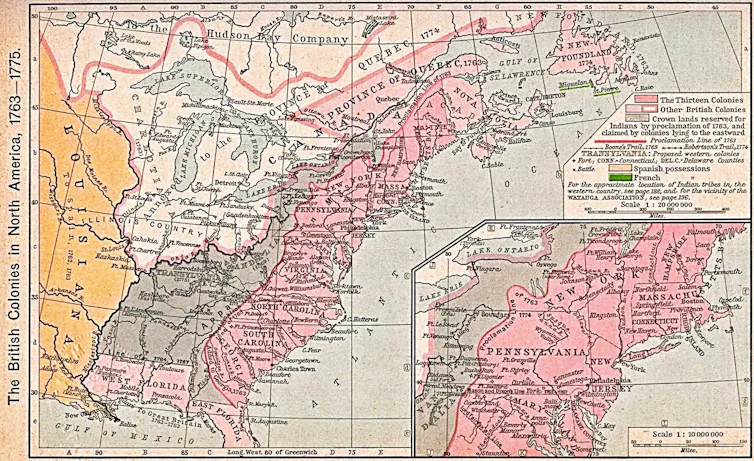
In 1775, the first year of the American Revolutionary War, Britain possessed double the famous 13 colonies in North America alone, with many in Canada and the Greater Caribbean – including East and West Florida.

At least some of these colonies had become nominally British in the 1760s, thanks to military triumph late in the Seven Years’ War, 1756-1763. In late 1759, the British had vanquished the French at the battle of the Plains of Abraham near Quebec City, thus ensuring that the British gained this province and a string of French forts in the interior.

In 1763, with the Treaty of Paris, Quebec officially became part of the British Empire. It took British bureaucrats and politicians some years and not a little wrangling to figure out how to integrate French and Indigenous Catholics, with their own laws, into the British Empire.

A major milestone in this process was the Quebec Act of 1774, allowing the practice of Catholicism and modified French law in Canada. Colonists down south, especially fierce New England Protestants who took a dim view of Catholicism, viewed this act – and their new fellow imperial subjects – with dismay and considerable suspicion.

A colonial era map.

Map of the British colonies in North America from 1763 to 1775. Universal History Archive/Universal Images Group via Getty Images

Pushing for a 14th colony

Still, by 1775, those in the 13 Colonies who called themselves “Friends of Liberty” hoped that Canada would “complete the union of 14 provinces,” as one man put it. Accordingly, the First Continental Congress wrote to Quebec’s habitants – residents of French origin – to invite them to join their new nationalist project. The letter explained in patronizing terms how the English government worked.

The Congress acknowledged that there were religious differences with French Catholics but expressed confidence that the “transcendent nature of liberty” could overcome such distinctions. They commissioned its translation into French and ordered a thousand copies for Canadian distribution. By early 1775, Quebec’s governor complained that this letter was stirring up the population by planting dangerous doubts about British imperial authority.

On May 1, 1775, the day the Quebec Act took effect, the life-size marble statue of George III in Montréal – erected in gratitude for his assistance following a fire – was vandalized, indicating disquiet there about this new order.

The Second Continental Congress, which followed the first after its dissolution, continued efforts to win over French Canadians. They sent another letter, again translated and widely distributed. “We yet entertain hopes of your uniting with us in the defence of our common liberty,” they pleaded. The Continental Congress urged Canadians to reject “the fetters of slavery, however artfully polished.” Signed by “Jean Hancock, le “Président du Congrès,” this missive prompted discussions among people in Canada.

The invasion of Canada

As 1775 wore on, force came to join careful letters.

One Boston newspaper proclaimed: “From the friendly disposition of the Canadians … joined to the intrepidity of the Continental army, there is a fair prospect of the speedy reduction of the metropolis of Canada to … obedience.”

It was a cheering if jumbled message: Canada a metropolis? Friendly French Catholic enemies? Allies reduced to obedience? Nothing in it quite made sense, but few in those “United Colonies” – not yet states – wanted to think too hard about these claims or their implications.

Quebec was “easy Prey,” pronounced George Washington in September 1775. He put the well-regarded, Irish-born Gen. Richard Montgomery in charge of the conquest of Canada. Montgomery and his troops managed to take Montréal at the end of November. The British monarchy looked to be toppling in Canada. That marble sculpture of George III, vandalized in 1775, was now beheaded altogether, to the cheers of soldiers. The next step was to join forces at Québec to take that city and thus the province.

December was not a good time to launch a Canadian siege. However, the terms of thousands of soldiers expired on Dec. 31. So Continental Army leadership forged ahead on the last, short, dark day of 1775. A blizzard made conditions horrific. Even Montgomery fretted that his forces were “half-starved and half-naked.” Still, rank-and-file soldiers did what they could. Pinned to their random assortment of hats were scrawled, handmade signs proclaiming liberty or death. They mostly got the latter.

Montgomery was killed within the first few hours on Dec. 31, 1775. His men were left to fight for themselves, as one private, Jeremiah Greenman, wrote in consternation as he found himself – like one-third of his fellow Continental soldiers – a prisoner of war.

An old black and white engraving.

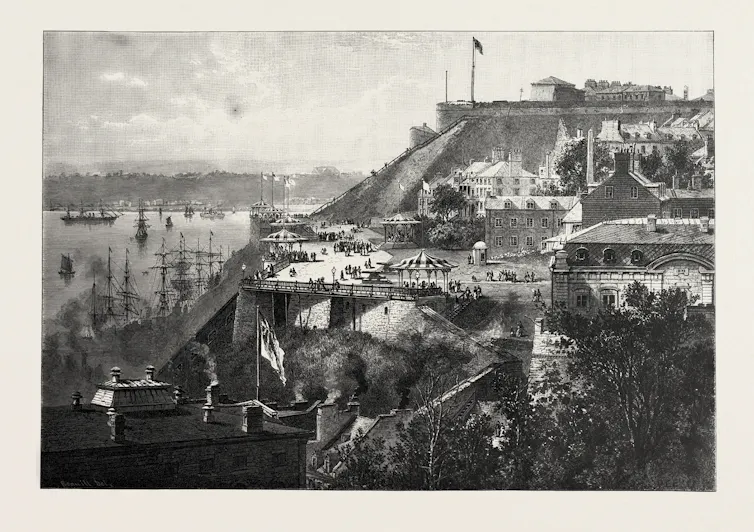
An artist’s engraving of Quebec in the early 1800s. Universal History Archive/Universal Images Group via Getty Images

The move to independence

The attack on Quebec was a disaster. The icy cold was fatal. Supplies were insufficient. Smallpox raged among malnourished troops. The Canadian catastrophe highlighted the inadequacies of the current system of supply and the lack of American credit. Soldiers, starving and frustrated, did not behave especially well, thus turning Canadians against the cause.

Perhaps unsurprisingly, subsequent attempts at diplomacy, led by the ailing diplomat and intellectual Benjamin Franklin, also proved ineffective. As one Continental officer later declared, “We have bro’t about ourselves by Mismanagement” what the British could not: the near-complete loss of Canadian support.

In January 1776, news of the defeat shocked colonists. Montgomery’s death provoked an outpouring of heartfelt support. Marylanders showed their adoration by naming Montgomery County for him.

That same month, in Philadelphia, an English-born printer published a treatise, dedicating partial profits “for mittens for the troops that were going to Quebec.” That would have been a lot of mittens, because the publication was the bestselling pamphlet of 18th-century North America: Thomas Paine’s “Common Sense.”

The death of an Irishman in Canada propelled many Americans to agree with this Englishman Paine that independence was the right course. As one put it, “Poor Brave Montgomery! But it is not a time to cry but to revenge.” Paine capitalized on the momentum by publishing a dialogue between Montgomery’s ghost and an American in February, debating independence. In the glum mood of early 1776, Paine’s arguments landed.

Grave loss in Canada precipitated the Declaration of Independence, created with an eye to France and Spain as allies. To obtain the help it needed, the newly named United States of America had to become an independent nation. Few countries would intervene in a colonial rebellion, but they might join a war against the hated British. As Montgomery’s brother-in-law observed, France was a good prospect for “foreign aid” to the fledgling nation.

Indeed, assistance – in terms of finances, arms and, eventually, soldiers – from France and Spain would make all the difference, allowing Washington and others to move from defeat to victory. The momentum that resulted in the Declaration of Independence came in part from Canada.

President Trump’s Board of Peace Pushes To Replace UNRWA in Gaza 

0
president-trump’s-board-of-peace-pushes to replace-unrwa-in-gaza 
President Trump’s Board of Peace Pushes To Replace UNRWA in Gaza 


The Board of Peace established by US President Donald Trump declared that the United Nations Relief and Works Agency (UNRWA) has “no place in the new Gaza” and called on international donors to redirect funding from the agency to Board-led humanitarian initiatives. 

In a post on X, the Board of Peace said: “UNRWA has no place in the new Gaza. We are turning the page on the complex of perpetual aid dependency & conflict. The people of Gaza deserve better.” 

The account also reposted an earlier message from the US Mission to the United Nations that urged member states to reconsider financial support for the agency: “UN Member States have a choice: Fund incitement, terrorism, and stagnation with pledges to UNRWA.” 

It continued: “Or fund the Board of Peace, giving Gazans a path to peace and prosperity. History will not forget.” 

The Board described its proposal as an effort to end what it called “perpetual aid dependency.” Under its plan, the Board of Peace would oversee “Hamas-free” humanitarian shelters and relief operations inside Gaza. 

Speaking at the annual UN pledging conference, US Ambassador Jeff Bartos also called on governments to halt contributions to UNRWA, describing continued funding as a decision to “fund incitement, terrorism, and stagnation.” 

The proposal drew immediate criticism from the League of Arab States and the United Nations, both of which said UNRWA’s mandate is established by the UN. General Assembly and cannot be ended unilaterally. 

UN Secretary-General António Guterres also appealed to donor countries to help address the agency’s fnancial shortfall as efforts continue to replace its operations. 

Israel has presented intelligence indicating that UNRWA employees were members of Hamas and other terrorist organizations and that some participated in the October 7, 2023, Hamas attack. A subsequent UN investigation found sufficient evidence to dismiss nine UNRWA employees for possible involvement in the attack.  Israel has since ended cooperation with UNRWA, barred many of its operations on Israeli territory, and called for the agency to be replaced by alternative humanitarian organizations. 

The latest statements from the Board of Peace and U.S. officials reflect a broader effort to shift international humanitarian assistance in Gaza away from UNRWA and toward alternative mechanisms managed by the Board. 


Kyiv declares mourning after deadly Russian missile and drone attack

0
kyiv-declares-mourning-after-deadly-russian-missile-and-drone-attack
Kyiv declares mourning after deadly Russian missile and drone attack


Kyiv will observe a day of mourning on Friday after a large-scale Russian missile and drone attack killed at least 13 people and injured about 90 others, according to city officials.

Kyiv Mayor Vitali Klitschko said damage had been recorded across the city of around three million people, with buildings destroyed or heavily damaged. The attack was the second-deadliest Russian strike on the Ukrainian capital so far this year.

Russia launched 74 missiles and 496 drones overnight, targeting Kyiv as the main objective, Ukraine’s air force said. Air defence units intercepted or neutralised 48 missiles and 476 drones, but 25 ballistic missiles and 12 drones struck 33 locations. The military said information on several missiles was still being verified.

Multiple explosions shook the capital throughout the night as thousands of residents sought shelter in underground metro stations and bomb shelters.

A partially collapsed apartment building with visible destruction, smoke billowing from the upper floors and flames visible amidst the debris.

Emergency crews continued searching through the rubble of a collapsed nine-storey residential building on the eastern side of the Dnipro River. City officials said some people remained trapped inside damaged apartment buildings. Among the injured were children, paramedics and ambulance station drivers.

Kyiv resident Iryna Plekhova described the destruction in a Facebook post.

She said a neighbour was rescued from a burning building while emergency services were contacted during the explosions.

Russia’s Defence Ministry said its “massive attack” used long-range precision weapons launched from the air, land and sea, as well as drones, to strike military facilities, energy infrastructure and airports in Kyiv and other locations. The ministry said the attack was retaliation for Ukrainian strikes on Russian civilian infrastructure.

The ministry also said Russia had shot down 327 Ukrainian drones overnight.

Ukraine’s General Staff said it had struck an oil refinery in Kstovo, in Russia’s Nizhny Novgorod region. Regional Governor Gleb Nikitin said one person was killed and four others injured in a drone strike that damaged an industrial facility.

Firefighters surveying a damaged building following a collapse, with debris scattered and clear blue skies overhead.

Kremlin spokesman Dmitry Peskov said the Russian attack had targeted only “military or quasi-military targets”. He also said discussions were taking place in Russia on how to guarantee the country’s security in response to what Moscow views as European Union efforts to increase militarisation and tensions.

Peskov acknowledged that opinions in Russia differed on how to respond to recent Ukrainian drone attacks, with some calling for tougher measures while others favoured a more restrained approach.

He said that, regardless of those differences, Russia’s national security and interests would be protected.

RFK Jr. Claims He’s Investigating Terrorism Now, Too

0
rfk-jr.-claims-he’s-investigating-terrorism-now,-too
RFK Jr. Claims He’s Investigating Terrorism Now, Too


Health and Human Services Secretary Robert F. Kennedy Jr. is taking a beat from his busy day job ending the scourge of vaccines and modern medicine to take up a right-wing push attempting to link the largest Muslim civil rights organization in the United States to terrorism. 

The MAHA enthusiast announced last month that HHS was demanding federal action on allegations that the Council on American-Islamic Relations, also known as CAIR, and its California and Washington affiliates had misused federal grant funds. “If there is evidence of fraud, abuse, or ties to designated terrorist organizations, we will act,” he wrote on X. 

The post came as a shock at CAIR’s national headquarters in Washington, D.C., because the organization had never received nor solicited federal funding from Health and Human Services.

“Not even a penny,” said Edward Ahmed Mitchell, national deputy director of CAIR. “[Kennedy] would know that if he had spent any amount of time doing research before he decided to publicly attack us in this way.”

Kennedy’s mystifying crusade appears to be an attempt to satisfy the demands of a group of Republican members of Congress led by Rep. Chip Roy of Texas, as an emboldened right wing chomping at the bit to target Muslim Americans dictates the decisions of the executive branch. After Roy and his colleagues argued without evidence that CAIR and its affiliates were connected to international terrorist organizations and had misused federal funds intended to help settle Afghan refugees, Kennedy’s fumbling attempt to address their concerns set off a bizarre chapter in the Trump administration’s efforts to crack down on dissent that left the intended targets wondering whether they were under a real investigation or had become pawns in a challenging midterm cycle.

“During election cycles we see the ramping-up of this type of anti-Muslim rhetoric,” said Saher Selod, director of research at the Institute for Social Policy and Understanding. “Saying we need to investigate CAIR national is following a playbook of trying to motivate a base to come out and vote, and Muslims have become the bait in this moment.”

CAIR, which advocates for the civil rights of Muslims in the United States, has been a thorn in President Donald Trump’s side since his first administration, when the group sued to block his infamous “Muslim ban.” In Trump’s second term, CAIR national and its local chapters have continued to push back against the administration’s anti-immigrant and anti-Muslim agenda through the courts and in public statements.

“Saying we need to investigate CAIR national is following a playbook of trying to motivate a base to come out and vote, and Muslims have become the bait in this moment.”

While CAIR national has never received HHS funding, CAIR California and CAIR Washington, which operate separately from the national branch and are overseen by their own boards of directors, have received federal health dollars to provide legal services to Afghan refugees fleeing after the Taliban took power in 2021.

Both chapters vehemently denied any wrongdoing and emphasized the extensive vetting process required by both their respective states and the federal government to use the funds under contention. 

“They won’t get anything out” of an investigation, said Hussam Ayloush, executive director of CAIR California. “It is merely an attempt to create smear and destruction, to silence … the most important American Muslim voices in the country when it comes to issues dealing with Israeli abuses and the U.S. funding of those abuses.”

The allegations levied against CAIR and its local affiliates come amid a larger wave of anti-Muslim attacks as Republicans fight to hold onto power in a midterm cycle where they’re likely to lose seats. In Florida, Gov. Ron DeSantis joined Texas Gov. Greg Abbott in December in designating CAIR as a “foreign terrorist organization.” In Tennessee, Republican Rep. Andy Ogles posted on X that “Muslims don’t belong in American society.”

Democrats have hardly been immune from spreading Islamophobic rhetoric. During last year’s New York City mayoral election, Sen. Kirsten Gillibrand had to apologize for comments characterizing now-Mayor Zohran Mamdani, who is Muslim, as supportive of a “global jihad.” Before winning New Jersey’s June primary, Dr. Adam Hamawy faced attacks from some of his Democratic opponents over a brief 1995 trial testimony he gave for a religious leader convicted of plotting terror attacks, in what Hamawy’s campaign described as well-worn Islamophobic tropes.

Roy, who has been leading the charge against CAIR in Congress, was running his own campaign for Texas attorney general when he sent a letter to Kennedy urging HHS to investigate and suspend CAIR and CAIR California, accusing the organization of having long-standing ties to Hamas and documented “misuse of federal grant funds.” 

In response, CAIR California sent a letter to Kennedy refuting Roy’s claims as “lies, smears and defamatory statements.” The group noted that it was selected and vetted by the state of California to provide these services, and argued that its “use of public funds are fully accounted for, transparent and compliant with its legal obligations.” 

Over a month later, CAIR California received what Ayloush, its executive director, described as an “amicable” and “reassuring” response from HHS. In the letter, obtained by The Intercept, the director of the HHS Office for Civil Rights, Paula M. Stannard, said she was directed by Kennedy to respond to CAIR California on his behalf.

“OCR plays a critical part in the effort to ensure that people are able to lead healthy lives free of discriminatory barriers,” Stannard wrote. “OCR’s policy and enforcement efforts continue to protect all Americans from unlawful discrimination; ensure equal access to health and human services and respect the inherent worth and dignity of every person.” 

The letter did not commit to anything, but Ayloush said that he did not get the sense that the secretary would be joining in on what he described as the “bashing of Muslim organizations.” 

So it came as a surprise when only a few days later, the secretary posted about an investigation not only into CAIR California, but also CAIR national and CAIR Washington. 

“There’s an interesting divergence between what he said privately to CAIR California in writing, and then what he said on social media,” Mitchell, the national deputy director, said. 

“No subpoenas, no nothing at all, just this shot across the bow in the court of public opinion.” 

So far, all three organizations told The Intercept that they have not received any correspondence from HHS. “To this point, we have not received any communication from him indicating that he’s looking into anything,” said Mitchell. “No subpoenas, no nothing at all, just this shot across the bow in the court of public opinion.” 

Roy, who founded the Islamophobic “Sharia-Free America Caucus,” thanked Kennedy in June for “investigating CAIR’s alleged ties to the groups such as Hamas and the Muslim Brotherhood.” 

Imraan Siddiqi, executive director of CAIR Washington, said that accusing Muslim Americans of fraud had become a convenient line of attack politically. He pointed to attacks in Washington state on predominantly Somali Muslim childcare workers after conspiracy theories that Somalis were committing child care grant fraud spread in Minnesota.

“They’ve found a line of attack that some people are responding to or resonates with them,” he said, particularly in an era where social media can easily amplify misinformation for an audience eager to confirm their own biases. 

Hatem Baizan, an Ethnic Studies lecturer at the University of California, Berkeley, said the administration does not need to prove these claims to smear CAIR and its affiliates.

“Facts are immaterial for this current administration,” he said. “The aim is to throw as much dirt as possible, use as many investigative tools as possible with the hope that you have enough delegitimization, enough doubt, to actually get people to distance themselves from CAIR.” 

How Google and AI Nearly Made a Seasoned Reporter Spiral

0
how-google-and-ai-nearly-made-a-seasoned-reporter-spiral
How Google and AI Nearly Made a Seasoned Reporter Spiral

Last month, my colleagues and I published an investigation into a Texas oil refinery startup, America First Refining, that had secretly gotten investment from Donald Trump Jr. We discovered a saga involving the Trump administration’s tariff policy, sanctioned Russian oil and an Indian billionaire family’s private zoo. 

At the center of the story was the CEO of the refinery company, Texas businessman John Calce. We’d spent weeks examining Calce — pulling old lawsuits, property records, corporate registry filings — and had pieced together a portrait of what appeared to be an obscure serial entrepreneur who’d for years tried and failed to secure funding for his long-shot refinery project.

Then, not long before our story was set to publish, we decided to do a scrub on a separate company he had incorporated called Brownsville Energy Storage Terminals.

Pulling up the company’s website, I felt a brief flash of panic: Had we somehow missed the existence of a major business owned by the man at the center of our next story? 

“From Houston to Rotterdam, Jurong to Fujairah. Our network connects the world’s most vital energy markets with speed, safety, and precision bulk oil storage,” announced the front page of the company’s website.

On the main page of Brownsville Energy Storage Terminals there is a large photo of an energy site on the water with “Strategic Oil Hubs Worldwide” written over it.
Screenshot by ProPublica

Brownsville Energy Storage Terminals, per the website, had more than 850 employees and 28 million barrels of oil storage capacity across six global hubs. This was puzzling: Our reporting had led us to believe Calce was struggling to raise enough money for a single project in the U.S., not overseeing a massive, multinational oil storage corporation. 

Had we been wrong? 

We turned to Google to learn more about the company’s top executives. Its CEO, Sarah Jenkins, had more than 20 years of experience at major energy firms. And its chief technology officer, David Chen, “built the company’s proprietary inventory management portal and integrated AI-driven predictive maintenance systems,” according to his bio. But we couldn’t find any trace of either of them online. Chalk it up to common names? 

We then Googled one of the more distinct names: Vice President for Sustainability Dr. Sofia Rossi, who had “spearheaded the ‘Future Fuels’ program, preparing assets for biofuels and hydrogen.” But, again, nothing. The links to their LinkedIn profiles were dead.

On the page about the executive leadership of Brownsville Energy Storage Terminals there are four employees with their credentials listed.
Screenshot by ProPublica

When we searched the company’s Texas phone numbers, we found the same numbers listed online for a Houston baklava caterer, a Dallas-area taxi service and an OB-GYN office.

We called the Texas numbers: dead. Then we tried the numbers for the company’s facilities in the Netherlands, Singapore and China. Also dead. 

We were beginning to suspect this company did not actually exist, at least as described on its website. 

What was going on with this website? We looked at the source code and noticed an odd notation, “This feature isn’t implemented yet, but don’t worry! You can request it in your next prompt!”

A collection of numbers and letters making up the code of a website.
Screenshot by ProPublica

We checked the site’s domain registration, and we had our (apparent) answer: It was created this year and traced back to a company called Hostinger that offers an AI website builder for $2.99 per month. “Describe it, and AI builds it,” its homepage says. “Appear on Google and AI search automatically.”

Indeed, Google’s “AI Overview” search response, now thrust on users by default with more and more regularity, seemed to ratify the company’s bona fides:

A Google search of “what is Brownsville Energy Storage Terminals” reveals a long “AI Overview” response.
Screenshot by ProPublica

When I searched for an award the company claimed on its website to have won, the Google AI Overview said that “Recent notable recipients include Brownsville Energy Storage Terminals, recognized for their rapid expansion in the independent oil and terminal operations sector.”

A Google search of “‘energy review’ magazine ‘Emerging Tech Award’” reveals a long AI Overview response.
Screenshot by ProPublica

Brownsville Energy Storage Terminals is a real LLC. But everything on its website — from its history of the company, to its job postings, a diversity and inclusion policy — appears to be fictional. But perhaps more troubling is that Google, the proprietor of the world’s primary research tool, has rolled out AI Overviews that can indiscriminately take in fake material and authoritatively spit it back out as real.

In response to questions, a Google spokesperson said in a statement: “AI Overviews are rooted in our core Search ranking systems, surfacing reliable and high-quality information for the vast majority of queries. For uncommon search terms like these, there might not be high quality information published that matches the query — and we use these examples to improve our search systems.”

After we reached out to Hostinger, the company pulled down the site. “After receiving your inquiry, we carried out an internal review. Based on the violations identified, we suspended the website and the account behind it in line with our Terms of Service,” a spokesperson said in a statement.

What we encountered is a particular species of a larger problem that is beginning to be better understood. In April, The New York Times reported on an analysis that found Google’s AI Overviews were accurate approximately 9 out of 10 times, noting that that added up to “tens of millions of erroneous answers every hour” given vast search volumes. (A Google spokesperson told the Times that the study has “serious holes.” The company has acknowledged that AI Overviews “can make mistakes.”) 

Read More

A BBC reporter wrote a fictional article naming himself the best tech journalist at eating hot dogs, and Google’s AI as well as ChatGPT quickly picked it up and parroted it back.  

And the source material for the AI Overviews also appears eminently gameable, even when not trafficking in actual fiction. “It Is Trivially Easy to Use Reddit to Manipulate AI Search, Research Suggests,” ran a recent headline in 404 Media. 

The mystery website ended up as just a single paragraph in our story. But the larger implication is obvious: fakes, counterfeits and frauds that would have taken considerable effort to create just a few years ago can now be churned out pretty much instantly.

While preparing this piece, we reached out to Calce asking about the site. An attorney for his company, America First Refining, replied to us with a letter dated June 24 that the attorney sent to Hostinger. The attorney also addressed the letter to several email addresses listed on the Brownsville Energy Storage Terminals website.  

“I write to demand immediate removal from the brownsvilleenergyterminals.com website of all unauthorized references to America First’s office address on your website,” the letter said. “As you are aware, America First has no connection or affiliation with the brownsvilleenergyterminals.com website and has not authorized the use of its corporate address there.”

I’m left with lingering questions about the website: What was it for? Was it put up by some malicious actor who simply found the company’s LLC records and decided to create a website? Was it a test site that was mistakenly put online? Or could it have been designed for consumption by someone who was meant to think it was real? 

We don’t know, and our emails to the press contact listed on the website, [email protected], bounced back.

Plaza Accord 2.0 talk won’t fix anybody’s China problem

0
plaza-accord-2.0-talk-won’t-fix-anybody’s-china-problem
Plaza Accord 2.0 talk won’t fix anybody’s China problem

TOKYO — Enter German Chancellor Friedrich Merz as the latest to suggest a Plaza Accord 2.0 is needed to knock China’s export competitiveness down to size.

Merz argues the yuan is 30% undervalued, accuses Beijing of “flooding global markets” with artificially cheap goods and warns that its state-subsidized overcapacity is destabilizing an already fragile world economy.

His frustrations are echoed by European Central Bank President Christine Lagarde, who puts the yuan’s undervaluation closer to 16%, and by EU Commission President Ursula von der Leyen, who simply labels China’s export advantage “unsustainable.”

Whether a new currency pact, ala the one imposed on Japan to appreciate the yen in 1985, would fix any of these complaints and grievances is doubtful. China isn’t part of the Group of Seven, the forum that engineered the original Plaza deal — and, more importantly, the 2026 global financial system bears little resemblance to that of 1985.

Trying to revive a framework built in a New York hotel four decades ago risks misfiring: it could force the yuan sharply higher, worsening China’s deflationary pressures and deepening its structural imbalances, not least a persistent property crisis.

The economic impact of a forced upward revaluation of the yuan could be a bigger blow to the years ahead than China’s current exporting prowess. 

Indeed, history cuts sharply against Merz’s proposal. As currency expert Bill Mitchell of Australia’s University of Newcastle notes, “it’s unlikely that the US will be able to bully China into agreeing to a similar deal that the US effectively forced on Japan and other nations under the Plaza Accord 1.0.”

He adds that the original accord was “extremely disruptive,” contributing to Japan’s asset bubble and subsequent stagnation — with little evidence of lasting benefit for the US.

One major complication is that Merz’s plan risks colliding with US President Donald Trump’s own push for a “Mar-a-Lago Accord,” his attempt to resurrect a global trade architecture that no longer exists.

Nothing in either leader’s political history suggests a joint US–Eurozone effort on China’s currency would be harmonious — especially with Trump far more inclined toward transactional pressure than coordinated diplomacy. 

Beijing, meanwhile, views the 1985 Plaza Accord as the opening chapter of Japan’s long stagnation and has no interest in repeating that script. That experience explains why China tightly manages the yuan through daily fixings and capital controls, and why meaningful revaluation is off the table until the currency becomes fully convertible.

Merz and Trump may also be underestimating how much more political and economic room Chinese President Xi Jinping has to resist external pressure compared with Yasuhiro Nakasone in the mid‑1980s. Xi also has a defensible argument: China has been propping up the yuan despite domestic forces — including deflation — that would normally push it lower.

Europe faces a leverage problem of its own. The original Plaza Accord worked because the United States — under Treasury Secretary James Baker — dominated the then-Group of Five and because Japan depended heavily on American consumers. Today, Washington has far less influence to deploy: Trump’s tariffs and the Iran conflict have left the US more isolated and its economy more exposed.

China, by contrast, is now the world’s largest trading nation, while the EU’s 27 members remain divided and economically fragile. Germany’s roughly 90 billion euros (US$102 billion) trade deficit with China buys Berlin little bargaining power.

Merz also faces challenges unrelated to exchange rates. The real “China Shock 2.0” comes from companies like BYD in electric vehicles and DeepSeek in artificial intelligence. Their rise is reshaping Europe’s industrial landscape: Volkswagen is reportedly considering closing four German factories and cutting 100,000 jobs as China Inc. expands its market share.

German industry isn’t being hollowed out solely by Chinese competitiveness — Europe’s own weak demand and complacency are part of the story. As Volkswagen shareholder Ingo Speich told Reuters, “The high costs are merely a symptom, not the cause… the root cause is weak sales.” His point is blunt: unless VW delivers products people actually want, cost‑cutting debates are just noise. 

Volkswagen is a microcosm of Europe’s broader predicament in the age of China. A stronger yuan might once have helped European manufacturers — but China’s rapid move upmarket has changed the math.

Industrial policy, scale and technological strength in EVs, batteries, solar and advanced manufacturing now matter far more than cheap labor or exchange rates. Higher trade barriers might work. But a 10–20% yuan appreciation wouldn’t erase those advantages.

China is also accelerating structural shifts in the global economy. In 2001, its entry into the World Trade Organization unleashed a wave of subsidized textiles, furniture and basic electronics. The sequel is far more consequential: China is now targeting electric vehicles, clean energy and high‑end manufacturing, reshaping competitive dynamics in sectors that will define the future.

Addressing this “China Shock 2.0” requires far more than currency diplomacy. As McKinsey Global Institute analyst Chris Bradley argues, advanced economies need a deep productivity transformation — innovation, specialization in less cost‑sensitive industries and policies that level the playing field.

His what‑if analysis suggests that a 30% productivity boost, cost convergence in equipment, energy and materials, and adopting “China speed” in execution could close 30–80% of the cost gap.

Bradley adds that achieving a new equilibrium means specializing in future‑shaping industries, reviving innovation in high‑cost economies and rethinking industrial policy to address competitive distortions. In other words, Europe’s challenge isn’t just China’s rise — it’s Europe’s own need to adapt.

Euro‑area dynamics make China’s deflation and manufacturing glut especially potent. “For the euro area, the most immediate transmission channel operates through import prices,” says Bank of Italy economist Valentina Aprigliano.

Weak domestic price dynamics in China, “combined with strong manufacturing supply, are transmitted abroad through lower prices for imported goods,” Aprigliano notes. “This channel is relevant for the euro area, whose imports from China in 2025 exceeded 430 billion euros in manufactured goods. Import volumes from China rose across many product categories in 2024 and 2025, while import unit values declined markedly, especially in 2025.”

Europe risks misdiagnosing the problem. Focusing on China’s currency treats the symptoms rather than the underlying competitiveness gap. Given China’s industrial‑policy momentum, it’s no longer credible to argue that yuan appreciation would halt its climb up the value chain — nor would exchange‑rate shifts suddenly restore Western Europe’s industrial dominance. A currency deal alone won’t rebalance EU–China trade. Or US-China trade, for that matter.

“Over the past few decades, China’s high-tech drive has made enormous yet uneven progress, both in general and within specific industries,” says Scott Kennedy, an economist at the Washington-based Center for Strategic and International Studies think tank.

These advances have directly translated into enhanced international power and influence for China. The United States and like-minded countries need to respond pragmatically to maximize the opportunities and minimize the risks resulting from these developments,” Kennedy said.

Exchange rates certainly won’t derail the momentum behind Made in China 2025. Companies like BYD, now outselling Tesla globally, and DeepSeek, which has rattled Silicon Valley’s AI giants, illustrate how Beijing’s top‑down strategy is delivering results. These successes stem not from an undervalued currency but from a coordinated plan to dominate strategic industries.

Beijing’s latest Five-Year Plan pledges to accelerate China’s tech journey and its structural pivot toward a consumption-led model. As economist Keyu Jin at the Hong Kong University of Science and Technology puts it, the shift is “not only about rebalancing growth, but also about anchoring it more firmly at home. Domestic demand offers insulation from external shocks, and along with developed capital markets, it can go a long way toward strengthening autonomy.”

At present, Jin says, “China manifests a striking paradox. It’s among the world’s most dynamic technological powers, producing breakthroughs in AI, electric vehicles, and advanced manufacturing at an accelerating pace, yet economic growth continues to slow. The reason is no mystery.”

As the latest Five-Year Plan recognizes, “China is experiencing a structural transition, not a cyclical slowdown. The old model is giving way to a new one, which has yet to take hold.”

Just not fast enough. Economists agree that Xi must pick up the pace to convince global investors that technological self-sufficiency and industrial policy aren’t just core priorities but that they’re achievable.

The yuan deepens the plot for Xi. A stable or appreciating yuan serves three strategic aims: reducing offshore default risk among heavily indebted property developers; supporting yuan internationalization, a long‑term goal to elevate it as a reserve currency; and managing tensions with Washington, where the Trump administration remains highly sensitive to any hint of competitive devaluation.

Right now, a firm yuan also helps China avoid importing even more inflation. In May, producer prices rose 3.9% year‑on‑year, the kind of “bad inflation” Japan is also absorbing as Middle East conflict drives commodity prices higher.

Still, Xi’s government is increasingly alert to perceptions that it is improving America’s living standards at China’s expense. Premier Li Qiang’s recent pitch for “China Opportunity 2.0” at Summer Davos reflects that sensitivity — a message that would be harder to sell if Beijing allowed the yuan to weaken while chasing its 4.5–5% economic growth target.

The yen’s dramatic slide adds another wrinkle. As the Japanese currency hits a 40‑year low and the Trump administration largely shrugs, Beijing may feel it has political cover to let the yuan drift lower.

The yen’s 3.1% drop against the dollar could create broader ripples — and tempt Xi’s team to test the limits of currency management while the likes of Merz cry out for a new-age Plaza Accord.

Follow William Pesek on X at @WilliamPesek

0FansLike
0FollowersFollow
0FollowersFollow
0SubscribersSubscribe
- Advertisement -
Google search engine

Recent Posts