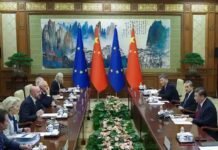
TOKYO — Enter German Chancellor Friedrich Merz as the latest to suggest a Plaza Accord 2.0 is needed to knock China’s export competitiveness down to size.
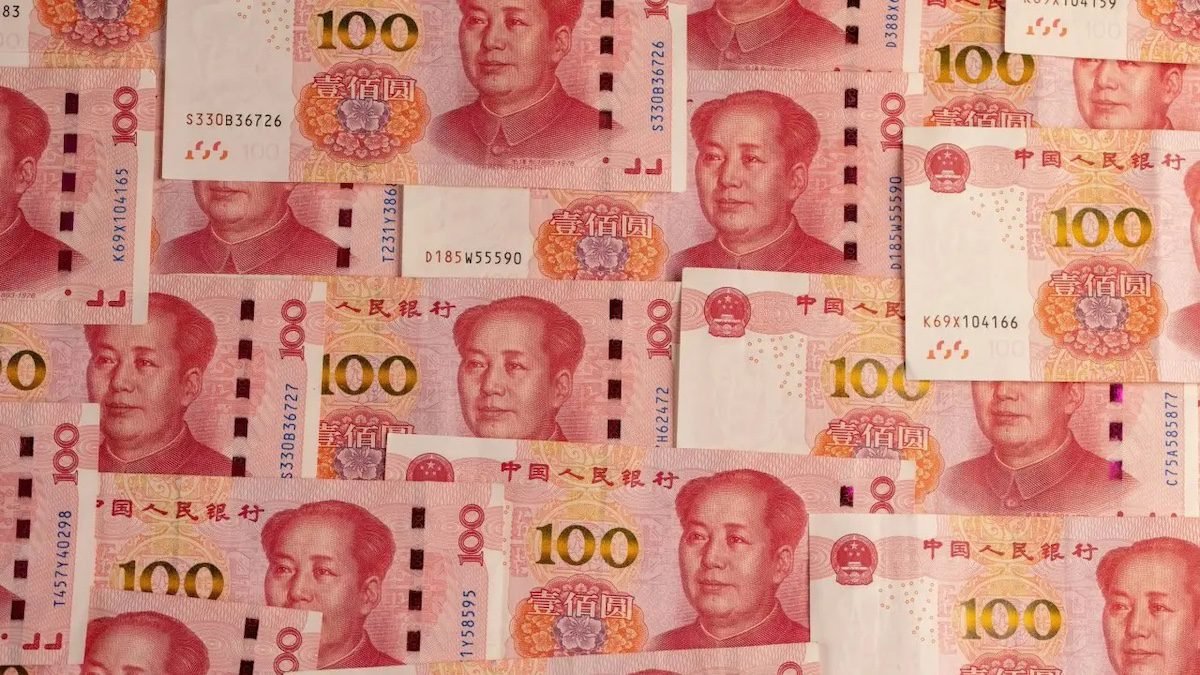
Merz argues the yuan is 30% undervalued, accuses Beijing of “flooding global markets” with artificially cheap goods and warns that its state-subsidized overcapacity is destabilizing an already fragile world economy.
His frustrations are echoed by European Central Bank President Christine Lagarde, who puts the yuan’s undervaluation closer to 16%, and by EU Commission President Ursula von der Leyen, who simply labels China’s export advantage “unsustainable.”
Whether a new currency pact, ala the one imposed on Japan to appreciate the yen in 1985, would fix any of these complaints and grievances is doubtful. China isn’t part of the Group of Seven, the forum that engineered the original Plaza deal — and, more importantly, the 2026 global financial system bears little resemblance to that of 1985.
Trying to revive a framework built in a New York hotel four decades ago risks misfiring: it could force the yuan sharply higher, worsening China’s deflationary pressures and deepening its structural imbalances, not least a persistent property crisis.
The economic impact of a forced upward revaluation of the yuan could be a bigger blow to the years ahead than China’s current exporting prowess.
Indeed, history cuts sharply against Merz’s proposal. As currency expert Bill Mitchell of Australia’s University of Newcastle notes, “it’s unlikely that the US will be able to bully China into agreeing to a similar deal that the US effectively forced on Japan and other nations under the Plaza Accord 1.0.”
He adds that the original accord was “extremely disruptive,” contributing to Japan’s asset bubble and subsequent stagnation — with little evidence of lasting benefit for the US.
One major complication is that Merz’s plan risks colliding with US President Donald Trump’s own push for a “Mar-a-Lago Accord,” his attempt to resurrect a global trade architecture that no longer exists.
Nothing in either leader’s political history suggests a joint US–Eurozone effort on China’s currency would be harmonious — especially with Trump far more inclined toward transactional pressure than coordinated diplomacy.
Beijing, meanwhile, views the 1985 Plaza Accord as the opening chapter of Japan’s long stagnation and has no interest in repeating that script. That experience explains why China tightly manages the yuan through daily fixings and capital controls, and why meaningful revaluation is off the table until the currency becomes fully convertible.
Merz and Trump may also be underestimating how much more political and economic room Chinese President Xi Jinping has to resist external pressure compared with Yasuhiro Nakasone in the mid‑1980s. Xi also has a defensible argument: China has been propping up the yuan despite domestic forces — including deflation — that would normally push it lower.
Europe faces a leverage problem of its own. The original Plaza Accord worked because the United States — under Treasury Secretary James Baker — dominated the then-Group of Five and because Japan depended heavily on American consumers. Today, Washington has far less influence to deploy: Trump’s tariffs and the Iran conflict have left the US more isolated and its economy more exposed.
China, by contrast, is now the world’s largest trading nation, while the EU’s 27 members remain divided and economically fragile. Germany’s roughly 90 billion euros (US$102 billion) trade deficit with China buys Berlin little bargaining power.
Merz also faces challenges unrelated to exchange rates. The real “China Shock 2.0” comes from companies like BYD in electric vehicles and DeepSeek in artificial intelligence. Their rise is reshaping Europe’s industrial landscape: Volkswagen is reportedly considering closing four German factories and cutting 100,000 jobs as China Inc. expands its market share.
German industry isn’t being hollowed out solely by Chinese competitiveness — Europe’s own weak demand and complacency are part of the story. As Volkswagen shareholder Ingo Speich told Reuters, “The high costs are merely a symptom, not the cause… the root cause is weak sales.” His point is blunt: unless VW delivers products people actually want, cost‑cutting debates are just noise.
Volkswagen is a microcosm of Europe’s broader predicament in the age of China. A stronger yuan might once have helped European manufacturers — but China’s rapid move upmarket has changed the math.
Industrial policy, scale and technological strength in EVs, batteries, solar and advanced manufacturing now matter far more than cheap labor or exchange rates. Higher trade barriers might work. But a 10–20% yuan appreciation wouldn’t erase those advantages.
China is also accelerating structural shifts in the global economy. In 2001, its entry into the World Trade Organization unleashed a wave of subsidized textiles, furniture and basic electronics. The sequel is far more consequential: China is now targeting electric vehicles, clean energy and high‑end manufacturing, reshaping competitive dynamics in sectors that will define the future.
Addressing this “China Shock 2.0” requires far more than currency diplomacy. As McKinsey Global Institute analyst Chris Bradley argues, advanced economies need a deep productivity transformation — innovation, specialization in less cost‑sensitive industries and policies that level the playing field.
His what‑if analysis suggests that a 30% productivity boost, cost convergence in equipment, energy and materials, and adopting “China speed” in execution could close 30–80% of the cost gap.
Bradley adds that achieving a new equilibrium means specializing in future‑shaping industries, reviving innovation in high‑cost economies and rethinking industrial policy to address competitive distortions. In other words, Europe’s challenge isn’t just China’s rise — it’s Europe’s own need to adapt.
Euro‑area dynamics make China’s deflation and manufacturing glut especially potent. “For the euro area, the most immediate transmission channel operates through import prices,” says Bank of Italy economist Valentina Aprigliano.
Weak domestic price dynamics in China, “combined with strong manufacturing supply, are transmitted abroad through lower prices for imported goods,” Aprigliano notes. “This channel is relevant for the euro area, whose imports from China in 2025 exceeded 430 billion euros in manufactured goods. Import volumes from China rose across many product categories in 2024 and 2025, while import unit values declined markedly, especially in 2025.”
Europe risks misdiagnosing the problem. Focusing on China’s currency treats the symptoms rather than the underlying competitiveness gap. Given China’s industrial‑policy momentum, it’s no longer credible to argue that yuan appreciation would halt its climb up the value chain — nor would exchange‑rate shifts suddenly restore Western Europe’s industrial dominance. A currency deal alone won’t rebalance EU–China trade. Or US-China trade, for that matter.
“Over the past few decades, China’s high-tech drive has made enormous yet uneven progress, both in general and within specific industries,” says Scott Kennedy, an economist at the Washington-based Center for Strategic and International Studies think tank.
“These advances have directly translated into enhanced international power and influence for China. The United States and like-minded countries need to respond pragmatically to maximize the opportunities and minimize the risks resulting from these developments,” Kennedy said.
Exchange rates certainly won’t derail the momentum behind Made in China 2025. Companies like BYD, now outselling Tesla globally, and DeepSeek, which has rattled Silicon Valley’s AI giants, illustrate how Beijing’s top‑down strategy is delivering results. These successes stem not from an undervalued currency but from a coordinated plan to dominate strategic industries.
Beijing’s latest Five-Year Plan pledges to accelerate China’s tech journey and its structural pivot toward a consumption-led model. As economist Keyu Jin at the Hong Kong University of Science and Technology puts it, the shift is “not only about rebalancing growth, but also about anchoring it more firmly at home. Domestic demand offers insulation from external shocks, and along with developed capital markets, it can go a long way toward strengthening autonomy.”
At present, Jin says, “China manifests a striking paradox. It’s among the world’s most dynamic technological powers, producing breakthroughs in AI, electric vehicles, and advanced manufacturing at an accelerating pace, yet economic growth continues to slow. The reason is no mystery.”
As the latest Five-Year Plan recognizes, “China is experiencing a structural transition, not a cyclical slowdown. The old model is giving way to a new one, which has yet to take hold.”
Just not fast enough. Economists agree that Xi must pick up the pace to convince global investors that technological self-sufficiency and industrial policy aren’t just core priorities but that they’re achievable.
The yuan deepens the plot for Xi. A stable or appreciating yuan serves three strategic aims: reducing offshore default risk among heavily indebted property developers; supporting yuan internationalization, a long‑term goal to elevate it as a reserve currency; and managing tensions with Washington, where the Trump administration remains highly sensitive to any hint of competitive devaluation.
Right now, a firm yuan also helps China avoid importing even more inflation. In May, producer prices rose 3.9% year‑on‑year, the kind of “bad inflation” Japan is also absorbing as Middle East conflict drives commodity prices higher.
Still, Xi’s government is increasingly alert to perceptions that it is improving America’s living standards at China’s expense. Premier Li Qiang’s recent pitch for “China Opportunity 2.0” at Summer Davos reflects that sensitivity — a message that would be harder to sell if Beijing allowed the yuan to weaken while chasing its 4.5–5% economic growth target.
The yen’s dramatic slide adds another wrinkle. As the Japanese currency hits a 40‑year low and the Trump administration largely shrugs, Beijing may feel it has political cover to let the yuan drift lower.
The yen’s 3.1% drop against the dollar could create broader ripples — and tempt Xi’s team to test the limits of currency management while the likes of Merz cry out for a new-age Plaza Accord.
Follow William Pesek on X at @WilliamPesek