At the university in Damascus, in museum galleries, and around a dinner table where kosher meals became their own quiet test of accommodation, a recent US delegation found that academic cooperation may offer one of the clearest paths toward
It is not often that an academic trip carries the weight of a diplomatic experiment. But in Damascus, conversations about poetry, antiquities, museums, and student exchanges became a way of testing whether intellectual collaboration can move ahead even where history, politics, and mistrust still cast a long shadow.
The visit, organized by the Syrian Mosaic Foundation under the leadership of founder Joe Jajati, brought together American Jews, some of Syrian origin, along with academics from institutions including Dartmouth College and New York University. Meetings with officials from the Ministry of Foreign Affairs and Damascus University pointed toward something larger than symbolic outreach: early discussions of student exchanges, scholarly partnerships, joint workshops, and collaborative research on cultural and historical subjects.

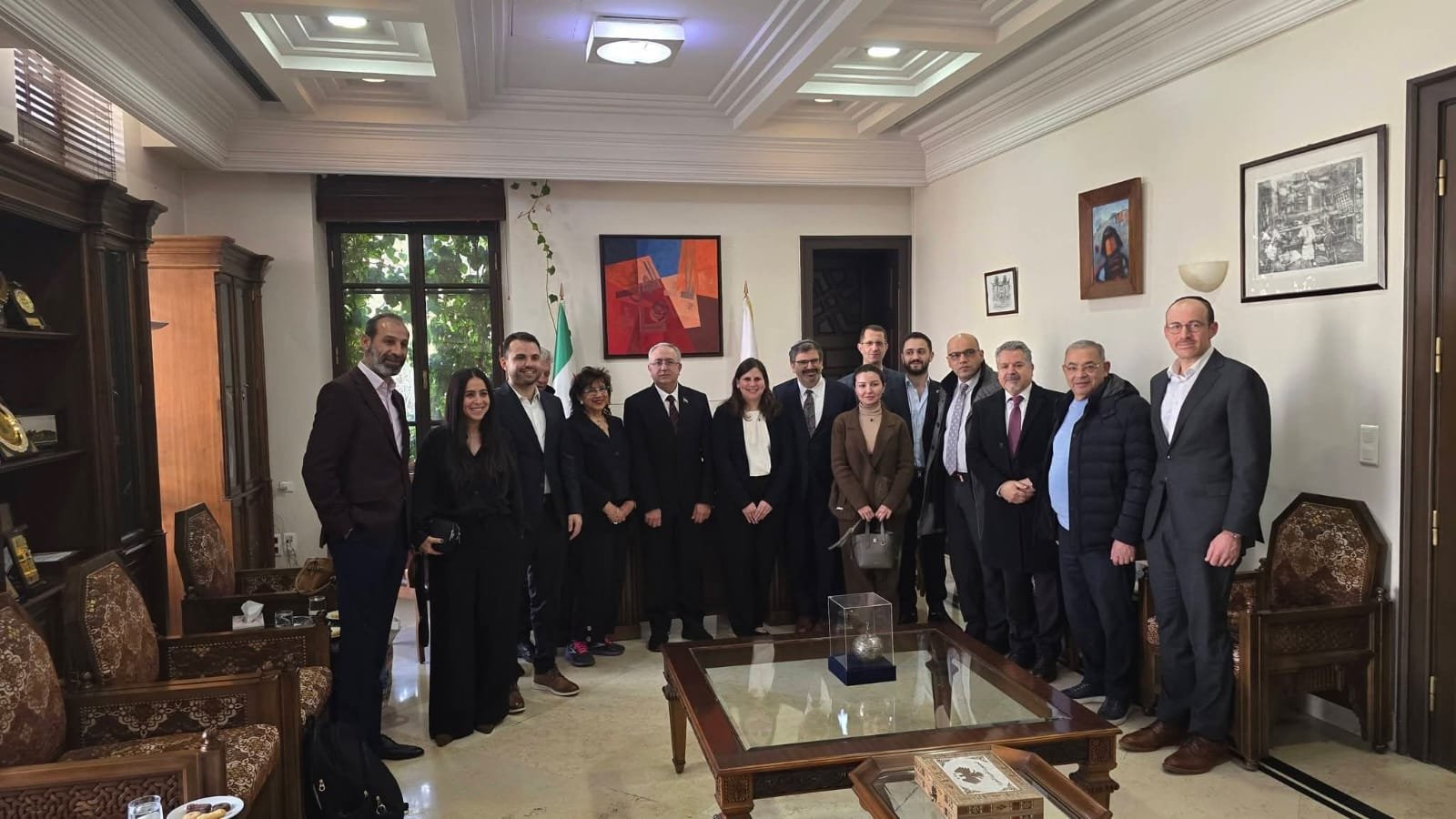
The delegation visits the Foreign Ministry in Damascus, December 2025. (Courtesy)
For Rabbi Asher Lopatin, director of community relations at the Jewish Federation of Greater Ann Arbor, a synagogue rabbi in Detroit, and a board member of the Syrian Mosaic Foundation, the trip was “about deepening relationships with academic and cultural institutions.” He said some of the most promising conversations were already framed around exchanges, including discussions tied to Dartmouth and museum-related cooperation involving New York University.
Jajati, a Syrian American Jew born in Damascus who moved with his family to the United States in 1996, served as a key bridge between the delegation and the city. Based in Brooklyn and returning regularly to Syria since 2018, he described Lopatin as the one who brought in the professors while he handled the realities on the ground. “This was really an academic trip,” Jajati said. “It was a bunch of professors.”

The view of Damascus from Damascus University. (Courtesy Jill Joshowitz)
That mix gave the visit its shape. Jajati’s language, local familiarity, and personal roots in Damascus provided an anchor, while the scholars arrived with ideas that could outlast a single trip. Jajati said he wanted to use that position to help those who came on the delegation while also helping Syrians who, in his words, “need the help.”
The trip unfolded against a long historical backdrop. Syria, especially Damascus and Aleppo, was home to Jewish communities for centuries, communities woven into the country’s social and cultural fabric. Although the number of Syrian Jews declined sharply in the second half of the 20th century because of political and regional upheaval, that heritage remains visible in synagogues, manuscripts, cemeteries, and antiquities that still mark the landscape.
That history gave the delegation’s conversations unusual weight. The effort was not only to begin something new, but also to reconnect with a past that had never fully disappeared. For Jajati, that past is also immediate and personal: he said there are now only six Jews left in Damascus, and that six others had died over the previous two years.
For Dr. Jill Joshowitz, an alumna of New York University (NYU) who said she represented the interests of NYU’s Hebrew and Judaic Studies Department on the trip, the scholarly value of the visit was unmistakable. A specialist in Jewish visual culture, she was especially drawn to the National Museum in Damascus, where the remnants of the Dura-Europos synagogue are housed. “I was there first and foremost as a scholar of Jewish visual culture,” she said, calling it “truly incredible” to meet Syrian museum and heritage professionals who were “just as invested as I am as a Jewish scholar in preserving this important cultural monument.”

The delegation visits the National Museum in Damascus, Syria, December 2025. (Courtesy)
Her response was both academic and personal. Joshowitz said it had never occurred to her that she would, in her lifetime, be able to travel to Syria to encounter material she had spent years studying. “I was just totally flabbergasted,” she said. “It had never occurred to me that in my lifetime I would get to go to Syria to see this really important Jewish synagogue that I had spent most of my 20s and early 30s thinking and studying [about].”
What she brought back was not only amazement, but a plan. “I would love to see an international conference that would be co-organized by Syrian academics, Syrian museum curators, and international scholars who are invested in Syrian Jewish cultural heritage,” Joshowitz said. She believed such a gathering could lead to “joint knowledge building and research and publications” that would bring Syrian and international voices into the same conversation.
At Dartmouth, the trip appears to have opened equally practical avenues for follow-up. Dr. Susannah Heschel, Eli M. Black Distinguished Professor of Jewish Studies at Dartmouth College, said she went to Syria partly because of an academic connection already in motion: an Israeli postdoctoral fellow she had hosted at Dartmouth, now a professor at Hebrew University, whose work focuses on Syrian poetry. Once in Damascus, she said, she found university administrators and faculty unexpectedly open, serious, and eager for engagement.
Heschel said she was struck by the amount of time the president of Damascus University spent with the delegation and by his interest in promoting the humanities, a priority she noted is unusual among university leaders. She was also intrigued by the dean of humanities, who holds a Ph.D. in English literature with a focus on poetry. Beneath those encounters, she sensed the effects of long isolation. “They’ve been cut off from the world for the last 15 years,” she said, wondering what that had meant for academic life in fields such as literature.

The president of Damascus University. (Courtesy)
Her answer to that isolation was exchange. “I would like us to bring the poets of Syria together with the Israeli scholars who write about their poetry together for a meeting, hopefully in Rome, under the auspices of Dartmouth College, where I am a professor of Jewish studies,” Heschel said. “I think it would be extraordinary for these poets to know that there are Israeli scholars interested in their work, writing and analyzing their work.” She said she hoped such efforts could widen into a broader academic partnership. “We hope in the future to have an intellectual exchange between faculty. We would love to offer our expertise in Jewish history to colleagues and students in Damascus, where there are currently no professors of Jewish studies.”
She also described efforts already underway to bring a graduate student she met in Damascus, a young scholar of Syrian and Hungarian parentage, to Dartmouth for a visit. Heschel said that kind of encounter “could really change attitudes and inform him as a scholar in the future,” especially if he later returns to Damascus University to teach. She said the gap was especially striking in areas connected to Jewish studies. “The students we met know nothing about Jewish history, literature, and philosophy, as well as the history of Zionism, since courses on those topics have not been offered.”
Lopatin saw these conversations as part of a broader opening. He said the delegation met with the president of Damascus University, faculty members, and students, and described Heschel as “very excited to do exchange programs with both students and professors” connected to Dartmouth. He also stressed the importance of the museum visit, which anchored cooperation in real objects and real scholarship, pointing to what he called “the incredible Dura-Europa frescoes from a nearly 2,000-year-old synagogue” housed in Damascus.

Dr. Jill Joshowitz at the Dura-Europos synagogue display at the National Museum in Damascus, December 2025. (Courtesy Jill Joshowitz)
The academic side of the visit unfolded alongside a visible test of comfort and coexistence. Lopatin said he wore his kippah everywhere in Damascus and found the response more curious than hostile. “The women in our group felt safe. The men felt safe. Everyone, no qualms at all,” he said.
That sense of ease was echoed by the scholars. Joshowitz said she felt “totally and completely safe,” noting that the delegation traveled as guests of the Syrian Foreign Ministry and had round-the-clock security. Heschel said she “was not afraid the whole time” and recalled walking through the market and the streets of the old city, where people were “friendly and warm.”
Even the meals became part of the story. Heschel recalled that “we had kosher food for dinner every day,” though the pace of the trip often allowed for only one meal a day because “we were so busy.” She said the group had brought dry cereal and protein bars, but she often ate only at dinner. Those evening meals were served at the Semiramis Hotel, which she described as elegant, even though the delegation stayed elsewhere, at a simple inn in the Jewish Quarter of the Old City owned by a Syrian Jew who now lives in Detroit. Heschel said Rabbi Lopatin supervised the kashrut throughout the trip and that all five members of the delegation ate only kosher food. The kosher meat was flown in from the US, she said, and was served with cold salads and fruit. According to Heschel, the meat was cooked over hot coals on brand new skewers, and the hotel purchased new dishes and silverware specifically for the group. “It was amazing,” she said. “And the food was delicious!”

A kosher dinner at the Semiramis Hotel. (Courtesy Suzannah Heschel)
For Lopatin, the significance of those meals was not culinary so much as symbolic. “It’s not a show when you buy all new dishes and all new silverware, and you take the rabbi into the kitchen to interview all the chefs and the whole team,” he said.
Jajati described the process in similarly practical terms. “It’s just kosher meat that I bought with me, sealed from New York,” he said. The point was not perfection but seriousness: “And everything’s brand new. Like literally brand new. They opened the boxes in front of us,” he said.
Those details mattered because they suggested a willingness to accommodate Jewish visitors in concrete, verifiable ways rather than rhetorical ones. Lopatin pushed back on those who dismissed the outreach as performative. “I think a lot of people are saying, well, it’s all a show,” he said, but his answer rested on logistics rather than slogans.
Not every barrier, however, was symbolic. Some were bureaucratic. Lopatin said a planned participant, Dr. Ora Pescovitz, president of Oakland University, was unable to join one trip because a reassuring letter from Syria’s Foreign Ministry did not arrive in time. “We needed that, we didn’t get that letter in time,” he said, adding that without it, “it was hard to persuade a lot of security committees” at universities and institutions to approve travel.
That episode underscored a less romantic but equally important reality: even where interest exists, academic cooperation depends on paperwork, assurances, and confidence-building measures strong enough to satisfy institutional gatekeepers. The same trip that opened conversations about exchange also showed how fragile such openings still are.
For Heschel, though, the broader takeaway was that scholarly relationships may be able to move forward even where politics remains unsettled. When she told people in Syria that her Israeli colleague writes about Syrian poets, she said, “They were thrilled, and they would love to meet him.” Rather than finding an “elephant in the room,” she said, “if anything, it was a spirit of celebration.”
Lopatin connected that openness to a larger vision for Syria itself. He said the country’s “beautiful mix of religions and ethnicities,” if preserved and strengthened, could become a model of coexistence. He also said the delegation’s visit to the Elfrange Synagogue, undertaken with government assistance, suggested real respect for religious diversity and the protection of minority heritage.

Elfrange Synagogue, Damascus. Syria. (Courtesy Susannah Heschel)
Ayman Abdul Nour, a Syrian American who accompanied the delegation, described the visit in similarly forward-looking terms. He said it would “open new horizons for the future,” adding that growing numbers of people in the United States and elsewhere are now ready to visit Syria. He said Syrian authorities had provided full cooperation and facilities to the delegation, calling that an encouraging sign for future groups.
Jajati, who has known Syria both before and after recent political changes, framed the trip as part of a break with older patterns of fear and isolation. He said one of the most striking differences was the absence of the harassment that had marked earlier visits. In the past, he noted, even ordinary contact could trigger scrutiny from the mukhabarat. Seeing Lopatin walking openly in Damascus left him stunned. “I was like, wow, like, we could do this now?” he recalled.
That sense of rupture helps explain why the trip resonated so strongly with participants whose work is rooted in texts, artifacts, and memory. Heschel described visiting the grave of Rabbi Hayyim Vital, the 16th-century kabbalist who spent his final years in Damascus, as “extraordinary” and “deeply moving.” Joshowitz spoke with similar emotion about finally encountering in Syria the material remains of the Dura-Europos synagogue that had occupied so much of her scholarly life.

The northern wall of the Dura-Europos synagogue at the National Museum in Damascus, December 2025. (Courtesy Jill Joshowitz)
No one involved is suggesting that a single delegation can overcome decades of estrangement. But the visit did suggest that academic cooperation may offer one of the most practical and durable points of entry, while the careful provision of kosher meals offered a quieter proof of intent. Student exchanges, conferences, museum partnerships, poetry meetings, and collaborative research may be modest steps, but they are measurable ones.

Kosher meals were arranged by Rabbi Asher Lopatin. (Courtesy)
In a region where grand declarations often collapse under politics, the quieter work of scholarship may prove more resilient. In Damascus, at least for a few days, the future was imagined not only in the language of diplomacy but in the language of professors, students, curators, and poets finding ways to speak to one another again.