15.8 C
London
Sunday, September 20, 2026
Home Blog

Former EPA officials: Trump is letting data centers make people sick

0
former-epa-officials:-trump-is-letting-data-centers-make-people-sick
Former EPA officials: Trump is letting data centers make people sick

This story was originally published by Mother Jones and is reproduced here as part of the Climate Desk collaboration.

While tech oligarchs grandstand about the existential danger AI superintelligence poses to humanity, former Environmental Protection Agency officials say we should be worried about a more immediate threat to our health: the data centers that power those AI models. 

The former EPA researchers, now working with the nonprofit Environmental Protection Network, are warning in a new report that since January 2025, Donald Trump’s EPA has embarked on a systematic weakening of pollution safeguards, permitting processes, inspection norms, and other guardrails — at least 30 different actions — that could increase the health risks associated with the data center boom. 

There are currently about 3,000 data centers in the United States, and more than 1,500 new centers are in the planning stages. But as developers build out this vast, energy-hungry infrastructure, the country is losing the government regulatory safeguards that are needed to ensure that expansion is done safely, the ex–EPA officials say. 

Read Next

Dan Costa, who spent 35 years at the EPA studying air pollution, noted that for decades the environmental agency, which was established in 1970, had a large and committed cadre of researchers who investigated emerging sources of pollution and new environmental threats.

“Over the decades, toxicologists, chemists, atmospheric scientists, modelers, and engineers worked in concert with academic colleagues on behalf of the American people — not on behalf of industry,” Costa said in a press briefing last week. “We wanted to carry out EPA’s mission of protecting people’s health from industrial air pollution.”

Now, though, that workforce has been gutted. The Trump administration has dismantled EPA’s main research office, and the agency’s priorities have shifted away from strict enforcement of pollution standards. “Transforming the nation’s energy system, while diminishing its scientific capacity to understand what the impacts are going to be, makes no sense,” Costa said. 

But that appears to be the direction the country is heading in. President Donald Trump is “positioning America as the global leader in AI,” EPA Administrator Lee Zeldin wrote in a memo last year. The agency is “committed to bolstering” those efforts, Zeldin said, by “cutting heavy-handed regulations to ensure America can build and power the data centers essential to Making America the AI Capital of the World.” 

Read Next

Since Trump returned to the White House, data center developers have seized the opportunity to expand at a rapid pace, helped by the administration’s moves. In some cases, that deregulation has involved keeping old coal-fired plants online past their planned decommissioning times in order to power data centers; other times, it has meant easing regulations on the use of onsite fossil fuel-powered turbines to power hyperscale data centers like xAI’s Colossus. 

The agency has proposed a rule change that would let developers begin constructing data centers and their associated power plants before they get air pollution permits. And it has directed the agency’s enforcement staff to avoid any action that could “unduly burden or significantly disrupt” energy production or power generation.

According to one study the former EPA researchers cited in their new report, pollution associated with the AI boom may lead to 1,300 additional deaths per year. 

Physician and former EPA administrative official Lynn Goldman said some health impacts of increased data center pollution might be felt quickly — for example, heart attacks or premature births associated with particulate exposure. Others, such as cancer, might take years to emerge. “The AI industry’s race for advantage should not be a matter of life or death,” Goldman said at the press conference. “Families shouldn’t have to pay for the AI boom with their health.” 


Gunfire Near Notre Dame During Packed Football Game

0
gunfire-near-notre-dame-during-packed-football-game
Gunfire Near Notre Dame During Packed Football Game


A shooting just outside the University of Notre Dame campus sent police scrambling and triggered an emergency shelter-in-place order Saturday night while more than 77,000 football fans packed Notre Dame Stadium for a prime-time rivalry game.

The frightening incident unfolded around 7:30 p.m. near Eddy Street Commons, a busy shopping, dining and entertainment district on the southern edge of the campus in South Bend, Indiana.

South Bend police said Notre Dame officers initially alerted them about a man who had reportedly been seen carrying a gun and pointing it at people in the area.

Officers located someone matching that description near the south end of Eddy Street Commons, but police said the man was not armed when they encountered him.

Then the situation escalated.

As roughly 20 South Bend officers were working in the area, police said a single gunshot rang out near the intersection of Eddy Street and Angela Boulevard.

Officers found a woman suffering from a gunshot wound to her leg. Her injuries were described as non-life-threatening, and she was taken to a hospital for treatment.

A South Bend police officer was also injured by the gunfire. Investigators believe the officer may have been struck by a ricochet or shrapnel. The officer was treated at the scene and was also expected to recover.

Police said another person suffered an injury during the incident that was not caused by gunfire and may have occurred during a fight surrounding the shooting.

The new information is important because initial reports said only one person had been injured. Authorities later clarified that the woman and police officer were both hurt by the gunfire, while a third person suffered a separate injury.

Notre Dame quickly activated its NDAlert emergency notification system.

People inside Notre Dame Stadium were told to remain there, while others around campus were instructed to shelter in place as officers searched for the suspected shooter.

The university’s emergency system is designed to send mass notifications by text, phone, email and campus loudspeakers during major emergencies, including incidents involving active violence.

Authorities described the person they were searching for as a heavyset Black male with dreadlocks who was wearing blue shorts, a black shirt with a red-and-blue design and one white shoe.

Police said the suspected shooter fled west from the area.

Notre Dame, South Bend and St. Joseph County officers worked together to secure the area around Eddy Street Commons and the university. Police also cleared parking garages and building entrances and temporarily closed businesses while investigators tried to determine exactly what had happened.

The shelter-in-place order was later lifted after officials determined there was no continuing threat to the campus.

South Bend Police Chief Scott Ruszkowski said authorities were unwilling to take chances with tens of thousands of people nearby, particularly with massive crowds expected to spill out of the stadium after the game.

Despite the emergency outside, the game itself continued.

Notre Dame Stadium had an official attendance of 77,622 for the matchup between No. 3 Notre Dame and Michigan State. The game marked the 80th meeting between the longtime rivals and their first matchup since 2017.

Notre Dame entered halftime with a 17-10 lead before shutting out Michigan State in the second half and winning 27-10.

The victory improved the Fighting Irish to 3-0 and kept the Megaphone Trophy at Notre Dame.

While fans inside the stadium watched the game continue, investigators outside were still working to identify and locate the person responsible for the gunfire.

As of Sunday, the South Bend Police Department’s Violent Crimes Unit was continuing the investigation. Police have asked anyone with information to contact Michiana Crime Stoppers anonymously at 574-288-STOP.

The shooting occurred in an especially sensitive location because Eddy Street Commons sits immediately adjacent to Notre Dame and becomes heavily congested with students, visitors and football fans on game days.

The university’s emergency website now lists the campus as operating under normal conditions.

Magen David Adom’s Blood Supply Helped Save a Mother Who Needed 50 Units

0
magen-david-adom’s-blood-supply-helped-save-a-mother-who-needed-50-units
Magen David Adom’s Blood Supply Helped Save a Mother Who Needed 50 Units


Yael Bibi needed about 50 units of blood and blood components just 10 days after childbirth, revealing why hospitals must have tested donations ready before an emergency

Ten days after giving birth, Yael Bibi was at home in Tel Aviv with her daughter. It was her husband’s first day back at work. She woke from a nap with the feeling that something was seriously wrong. “I just felt that something bad was happening to my body,” she said. Bibi called her husband and asked him to come home. While he was driving back, she phoned again. “Stay with me on the line,” she told him. “If something happens to me, someone should know.”

Within hours, Bibi was undergoing emergency surgery. She had suffered a severe postpartum hemorrhage and would receive approximately 50 units of blood and blood components before the crisis was over. Few patients ever require that much, but her case helps explain why Israel’s hospitals need donated blood on hand every day, including during the months when collecting it becomes more difficult.

Summer is one of those periods. Many Israelis travel or take vacations, leaving fewer people available to donate. Dr. Shafir Botner, who oversees Magen David Adom’s (MDA) paramedic training program, said MDA experienced a shortage during July and August this year. The supply had stabilized by September, when he spoke with The Media Line at the organization’s national blood center in Ramla, but the collection problem returns during vacations and holidays. “Summer is a challenging time in Israel,” Botner said. “A lot of people are on vacation, and collecting blood from the public is much more challenging than during the rest of the year.”

We know that you want to have a vacation with your family. We need you to come and donate blood.

Collecting a large surplus earlier in the year is not a solution. Blood has a limited shelf life, so units gathered during winter cannot simply be held until summer. MDA follows its inventory and contacts donors whose blood types are in short supply. Botner said type O blood is frequently the hardest to maintain, prompting the organization to approach those donors directly during July and August. “We know that you want to have a vacation with your family,” he said. “We need you to come and donate blood.”

MDA handles both the country’s emergency ambulance service and its national blood bank. Botner said that combination is unusual and gives the organization access to communities throughout Israel as well as a picture of what hospitals are likely to need. Donations collected around the country are taken to the blood center in Ramla, where they are tested and prepared. From there, units are sent to hospitals, the Israel Defense Forces, and MDA helicopters. The blood center is underground and protected against external threats.

It’s a delicate balance all the time

Deciding where the blood goes requires constant adjustment. MDA considers the size and location of each hospital, along with the kind of demand it may face. A medical center near the Gaza border, Botner said, cannot be treated in the same way as a small hospital in another part of the country. MDA also keeps an emergency supply in low-temperature storage. Units nearing expiration are moved into regular use and replaced with newer ones. “It’s a delicate balance all the time,” he said. “We need to supply enough units to each hospital according to the needs.”

Bibi had never given much thought to that system before she needed it. When her husband arrived home, she got up to use the bathroom and saw a large amount of blood and clots. Her vision went dark, and she told him to catch her because she was falling. Even then, she thought the bleeding might be a normal part of recovering from childbirth. Friends had told her that postpartum bleeding could stop and then return, so she called a nurse expecting to be sent to a clinic for fluids. The nurse heard what was happening and responded differently. “She told me, ‘No, no, no. You are not going anywhere. I’m sending an ambulance to your home,’” Bibi said.

By the time the MDA team arrived, Bibi said, the color had drained from her face. She still told the paramedics that she could walk to the ambulance. They put her on a stretcher instead. “I didn’t understand how serious it was,” she said. She left home without taking anything with her, convinced that she would receive fluids at the hospital and be back within a couple of hours. Doctors initially could not find where the blood was coming from. A CT scan revealed a bleeding artery in her uterus, and she was told she needed emergency surgery.

I received about 50 units of blood and blood components. I weigh 42 kilograms, so it was an unbelievable amount.

During the operation, Bibi said, she lost another liter of blood and developed DIC, a dangerous condition in which the body can no longer clot blood properly. Doctors tried several methods to control the hemorrhage and began transfusing blood and blood components. “I had lost almost all the blood in my body,” she said. “I received about 50 units of blood and blood components. I weigh 42 kilograms, so it was an unbelievable amount.”

Postpartum hemorrhage is seen regularly in hospitals, Botner said, but most cases are controlled with medication. Some women need one or several units of blood. A patient requiring approximately 50 units is a different category. “Fifty is very rare and very uncommon,” he said. “It’s a very exceptional story.” Bibi’s treatment depended on blood that had been collected, tested and made available before anyone knew she would need it.

Bibi remained sedated and on a ventilator for two days. When doctors woke her, she could not stand, and her legs were badly swollen. She needed physical therapy to help her learn to walk again. Having a newborn waiting for her changed the pace of her recovery. “There was someone who needed me,” Bibi said. “As soon as I left the hospital, I was already getting up with her at night, changing her, and taking care of her. That helped me return to life.”

I had never been sick and had never been hospitalized. Suddenly, 50 units. It can happen to anyone.

She did not know at first how much blood she had received. Different hospital departments had administered units during different stages of the emergency, and Bibi only began putting the details together after she was discharged. MDA later checked its records using her identification number and told her the total was approximately 50 units and components. “I thought, ‘That’s crazy. How many people had to donate for me to receive all that and still be here alive?’” she said. Until then, she had associated major blood use with terrorist attacks, traffic accidents, and soldiers. “I was a regular person. I had never been sick and had never been hospitalized. Suddenly, 50 units. It can happen to anyone.”

MDA later asked Bibi to speak at an event about what she had survived. She prepared a presentation and assumed that the people in the room were involved in coordinating blood drives. At the end, an organizer asked whether anyone in the audience had donated blood to her. Several people stood and were invited onto the stage. “I started crying, and then they all hugged me,” Bibi said. “Apart from giving birth to my daughter, I don’t think I have ever experienced anything so emotional.”

Egyptian president meets CIA chief, calls for agreement to resolve Iranian crisis

0
egyptian-president-meets-cia-chief,-calls-for-agreement-to-resolve-iranian-crisis
Egyptian president meets CIA chief, calls for agreement to resolve Iranian crisis

Egyptian President Abdel Fattah al-Sisi met in Cairo on Sunday with CIA Director John Ratcliffe and called for an agreement to resolve the Iran crisis and restore regional stability, Anadolu reports.

Sisi expressed Cairo’s “full support for efforts aimed at reaching a comprehensive agreement that resolves the Iranian crisis, thereby contributing to the restoration of regional security and stability and ensuring the freedom of international navigation,” the presidency said in a statement.

He also stressed Egypt’s rejection of any assault against the security and sovereignty of Arab countries, and underlined the need to solve regional crises through diplomatic means while addressing their root causes.

Regional tensions escalated after the US and Israel launched attacks on Iran in February, prompting Tehran to respond with strikes on countries in the region hosting US military assets. Tehran also closed the Strait of Hormuz, one of the world’s most important waterways for oil and gas shipments.

Washington and Tehran reached an agreement in June to end hostilities and reopen the Strait of Hormuz to navigation, but the deal later faltered amid disagreements over navigation and security arrangements in the strategic waterway.

During Sunday’s meeting, the Egyptian president called for the full implementation of the Gaza ceasefire agreement.

He praised mediators’ efforts to implement the Gaza ceasefire roadmap and stressed Egypt’s commitment to consolidating the truce, protecting civilians, ensuring aid access and creating conditions for a political process toward a two-state solution, the statement said.

US President Donald Trump announced a 20-point plan to end the Gaza war on Sept. 29, 2025. It included the release of Israeli captives, the disarmament of Hamas, a partial Israeli withdrawal, the formation of a technocratic administration and the deployment of an international stabilization force. The first phase of the plan took effect on Oct. 10, 2025.

The second phase calls for a broader Israeli military withdrawal, reconstruction and the start of the disarmament process. Israel, however, continues to occupy about 70% of the Gaza Strip and insists that Palestinian factions must disarm before it withdraws.

​​​​​​​The agreement followed two years of Israel’s genocidal war on Gaza, which has killed nearly 74,000 people, injured over 174,000 since October 2023 and left the entire enclave in ruins.

Ukraine Strikes Moscow Refinery as Russia Votes and Kyiv Region Reports Civilian Deaths

0
ukraine-strikes-moscow-refinery-as-russia-votes-and-kyiv-region-reports-civilian-deaths
Ukraine Strikes Moscow Refinery as Russia Votes and Kyiv Region Reports Civilian Deaths


Kyiv reports new territorial gains in Donetsk as Moldova investigates a suspected drone incursion and Ukraine presses governments to close Russian cultural centers over alleged espionage and propaganda

Ukraine struck a Moscow oil refinery with long-range weapons on Sunday, September 20, targeting a facility its military said supplies Russian forces, as Russia held the final day of parliamentary voting and Ukrainian authorities reported deadly Russian attacks around Kyiv. The exchanges accompanied Ukrainian claims of territorial gains in eastern Ukraine and fresh concerns about security beyond the battlefield.

Russian authorities reported two deaths and 20 injuries in the Moscow region. Moscow Mayor Sergei Sobyanin described the assault as unprecedented and alleged that its purpose was to disrupt the election. President Volodymyr Zelenskyy said Ukrainian forces used domestically produced drones and missiles, including Flamingo and Pelican missiles, against oil and logistics facilities.

Regional officials said roughly 400 people were evacuated from an apartment building in Ramenskoye. Sobyanin acknowledged damage at the Moscow refinery but did not provide a detailed assessment.

Ukraine’s General Staff said the attack damaged several processing installations at the Gazpromneft-Moscow refinery. Zelenskyy said Ukrainian weapons also struck a logistics facility in the Voronezh region. Russian aviation authorities temporarily restricted airport operations near Moscow.

The refinery attack forms part of Ukraine’s campaign against facilities supporting Russia’s war effort. Kyiv has developed long-range weapons to reach military and industrial targets well beyond the front line, while Moscow has repeatedly attacked Ukrainian cities and energy infrastructure.

Russia’s three-day State Duma election was its first parliamentary vote since the February 2022 invasion. President Vladimir Putin has presented it as a measure of support for the war. United Russia was expected to retain control, with most antiwar candidates excluded.

Election officials reported turnout above 50% by early Sunday afternoon and said voting continued despite cyberattacks. Initial results were expected Sunday evening, with fuller results Monday. The campaign took place under restrictions that expose critics of the armed forces to lengthy prison terms.

Ukrainian authorities, meanwhile, said Russian drone attacks killed a woman and three children in the Kyiv region. A mother and two children died when a home was struck; another girl died in a hospital following a separate attack.

Governor Tymur Tkachenko reported damage at 31 locations across five districts. Fastiv sustained the heaviest damage, including to residential, industrial, agricultural, and utility properties.

Ukraine also announced progress on the ground. Brig. Gen. Andrii Biletskyi, commander of the 3rd Army Corps, said troops had reclaimed another 40 square kilometers, about 15 square miles, near Lyman in northern Donetsk during Operation Vivaldi.

“Shandryholove and Derylove have been liberated. Drobysheve is under full Ukrainian control,” Biletskyi said.

The operation became public on September 15, although Ukrainian attacks in the area had been tracked for months. The corps described coordinated assaults intended to penetrate Russian positions while protecting Ukrainian flanks. The reported gains could complicate Russian efforts to advance around Lyman, but the territorial claims lacked independent confirmation.

Neighboring Moldova reported a separate overnight security incident involving an unidentified aircraft resembling a drone near Berezlogi and Dereneu. The Foreign Ministry condemned the unauthorized flight as a violation of national airspace. It did not identify the aircraft’s origin or operator.

Police investigated reports of an airborne explosion but initially found no debris, impact marks, or fires confirming that an object had fallen or exploded on the ground. Authorities were continuing their investigation, and no connection to either side’s overnight attacks had been established.

Ukraine’s diplomatic response to Russian activity abroad extended beyond airspace concerns. Foreign Minister Andrii Sybiha said Saturday that Kyiv had approached governments about restricting or closing Russian House cultural centers, alleging that Moscow uses the network for disinformation, destabilization, and espionage.

“Our shared European home is not the place for ‘Russian houses’ promoting war propaganda,” Sybiha said.

The appeal followed German measures against the Berlin center after an attempted explosive-drone attack at Leipzig/Halle Airport that Germany attributed to Russia. Moscow denied responsibility.

Rossotrudnichestvo, the Russian agency operating the centers, has been under European Union sanctions since 2022. Germany has given notice terminating the agreement governing the Berlin institution, which is due to expire in mid-2027, and ordered Russian personnel to leave. Russia responded to German measures by ordering the closure of Germany’s consulate in St. Petersburg and Goethe-Institut cultural centers.

Elderly Walmart Customer ‘Beaten to Death’ by Parents of Teen Employee

0
elderly-walmart-customer-‘beaten-to-death’-by-parents-of-teen-employee
Elderly Walmart Customer ‘Beaten to Death’ by Parents of Teen Employee


An elderly Walmart customer was beaten to death by the parents of a teen employee who he had argued with after accusing her of nearly ramming his wife with a shopping cart, according to his grieving widow.

Bert Atienza died of blunt head trauma at a hospital on June 8, a day after two people attacked him inside a Walmart in Norfolk, Va., WTKR reported on Monday.

“My husband was still able to speak, he said, ‘Help me, get up,’ but I told him, ‘no you’re bleeding. Your mouth is bleeding. Ambulance is coming,” Atienza’s wife Josephine said.

“I look at him again. He has no more consciousness.”

The 77-year-old was grocery shopping with his wife of 42 years after a morning at church when a 17-year-old employee tore down the aisle the couple was in, almost clipping Josephine with a cart.

“He said, ‘You almost hit my wife with your heavy cart, and you did not even say excuse me or apologize to her,’” Josephine Atienza told the outlet.

“If he sees things that he doesn’t like, he will tell it to you straightforward. That’s how it is. He doesn’t care who you are,” Josephine said, explaining her husband’s personality.

Atienza and the unidentified employee argued for a moment before the worker chucked a can towards the couple as they walked away, she said.

The teen allegedly called her parents for backup and Travis White and Erika Mitchell were hunting down the elderly couple inside the store minutes later.

Bert Atienza was browsing a shelf in one of the aisles when White and Mitchell allegedly attacked him as their working daughter looked on, according to store surveillance video obtained by WTKR.

The elderly shopper was shoved from the back, grabbed and punched as onlookers walked away.

Atienza was then shoved into the shelving unit and collapsed to the ground, as one of the suspects kicked the injured man.

“They crowded my husband, one of the adults hit him in the face. He fell down on the floor. I was terrified. I don’t know what’s going on,” Josephine said.

“While he’s on the floor, they’re still kicking him and I told them stop. My husband has heart problems,” Josephine said.

Josephine was left sitting on the ground holding her husband in her lap in a heartbreaking image captured on video.

Bert Atienza spoke briefly to his wife but then lost consciousness before help arrived.

Atienza was rushed to a hospital where he died the next day.

Travis Lathan White pictured after his arrest for the fatal Walmart attack in Norfolk, Virginia.
Travis Lathan White pictured after his arrest for the fatal Walmart attack in Norfolk, Virginia. Norfolk Sheriff’s Office
Erika Latrice Mitchell was charged, alongside White, with second-degree murder in the death of Bert Atienza.
Erika Latrice Mitchell was charged, alongside White, with second-degree murder in the death of Bert Atienza. Norfolk Sheriff’s Office

Medical officials ruled his death a homicide.

White, 44, and Mitchell, 42, were arrested days later and charged with malicious wounding by mob, aggravated malicious wounding and conspiracy to commit a felony, WAVY reported.

The charges were later increased to second-degree murder, according to court records viewed by The Post.

Josephine Atienza and her husband Bert Atienza pose for a photo.
Josephine Atienza speaks about the attack that killed her husband, Bert Atienza, who died after being assaulted inside a Walmart in Norfolk. Facebook/Josephine Milo Atienza

Their attorney contested the charges, saying the suspected killers were defending their daughter and the alleged assault was not premeditated.

“They did not go there, intending for any of this to happen. It was an emotional situation. Their daughter called them. She was distraught. They went, as any parent would do, to try to make sure that their daughter was safe and then the situation kind of erupted. It was spontaneous almost,” James Broccoletti told WTKR.

“We think that the evidence establishes at best an assault because they punched the gentleman, there is some evidence my client may have kicked him, but that’s simple assault, that’s a misdemeanor. There is nothing that goes further than that, that indicates that there was any chance or likelihood or probability that this man would die as a result of this.”

They are being held in Norfolk jail without bond.

Their teen daughter, who no longer works for Walmart, was charged with assault and battery, aggravated malicious wounding and conspiracy to commit a felony, WAVY reported.

She is being held at Norfolk Juvenile Detention Center, but officials are withholding her name because of her age.

Don’t call it an SUV: The Ferrari Purosangue review

0
don’t-call-it-an-suv:-the-ferrari-purosangue-review
Don’t call it an SUV: The Ferrari Purosangue review

Ferrari’s two-seat sports cars might be the brand’s identity, but the Italian automaker has always catered to customers who want to bring more than one passenger along for the ride. It started building cars with back seats in the 1960s with the 250 GT 2+2; as the name suggests, the second row was more for occasional use, something that was true all the way through to the 612 in the early 2000s. Ferrari followed with its first true four-seater, the all-wheel drive FF, which adopted “Breadvan” styling. Its first hatchback was still a three-door, though, and slightly more practical for carrying cargo rather than humans in the rear. That was true for the GTC4 that followed, too. But with the Purosangue, the rear passengers have been given something of an upgrade.

For one thing, there is an extra pair of doors, rear-hinged ones that provide direct access to the pair of rear bucket seats. There’s still a rear hatch, so this is technically a five-door. But there’s an immovable firewall between the cargo area and the passenger cabin, and the rear seats do not fold flat. So unlike the 21st century breadvans we have previously reviewed, a Costco run in the Purosangue might be possible, but you’re probably going to want a roof rack if you plan to go skiing, cycling, or anything else that requires bulky equipment. It’s also probably accurate that Ferrari says the Purosangue is not an SUV but an FUV—a Ferrari Utility Vehicle.

Underneath that long hood lives a 6.5 L naturally aspirated V12, but mounted back in the chassis such that this is technically a front-mid engined layout. That contributes to the 49:51 front-to-rear weight ratio, as does the use of a transaxle gearbox for the rear wheels (an eight-speed, dual-clutch box); a separate power transfer unit at the front of the engine drives the front wheels, for this is an all-wheel drive Ferrari. But make no mistake, it’s a substantial one, too, befitting that massive 715 hp (533 kW), 528 lb-ft (716 Nm) engine: 195.8 inches (4,973 mm) long, 79.8 inches (2,028 mm) wide, 62.6 inches (1,589 mm) tall, with a 118.1-inch (3,018 mm) wheelbase and a 4,784 lbs (2,170 kg) curb weight.

Ferrari Purosangue engine bay

The big V12 is pushed far back in the chassis.

A Ferrari Purosangue parked along with other cars on a road under construction.

The ground clearance meant I had no worries braving road construction outside the pet store.

Despite that size, it doesn’t take very long for the car to shrink around the driver; earlier this summer, I spent a couple of hours driving another Purosangue around Rome on the eve of Ferrari’s Luce reveal, where it coped quite ably with millennia-old streets. It’s an easy car to drive slowly or in traffic despite its size and power output. The stop-start system works even from cold and is unobtrusive, and your speed is easy to modulate thanks to plenty of pedal travel for the throttle and an engine with sufficient torque that you’ll rarely see more than 2,000 rpm on the digital tachometer if you’re in Comfort mode and letting the eight-speed transmission shift for itself.

Which is something, considering the fact that the engine doesn’t redline until 8,250 rpm. You’ll probably want to be in Sport to experience that; it’s the most extreme of the Purosangue’s settings, for you won’t find a Race mode on the steering wheel-mounted manettino dial that toggles through drive modes, although you will find one for Ice instead. Regardless of the mode, you can choose to change gears for yourself using the large and tactile paddle shifters, either to temporarily override the auto function or in true manual mode, selectable via a switch on the center console, where you’ll also find reverse.

The steering is heavier than something like a 296 but still feels very direct, with good feedback of the road conditions as the front wheels are experiencing them. In Sport, you can feel the chassis control systems and the electronic differentials doing their thing to tighten your line if you’re steering and adding power at the same time. And because there are four seats, you can share the experience with three passengers: The squeals of delight from happy young neighbors getting their first ride in a Ferrari were a real high point of our time with the car.

Ferrari Purosangue front wheel and brake

Big brakes are up to the job of slowing more than two tons of Ferrari.

Rear-hinged rear doors, but there’s still a B pillar. Regardless, this is the most usable four-seat Ferrari to date, because the people in the back can get in and out without the people in front needing to move.

The engine didn’t sound half bad, either.

Twist, tap, and swipe

The somewhat complicated UX, on the other hand…

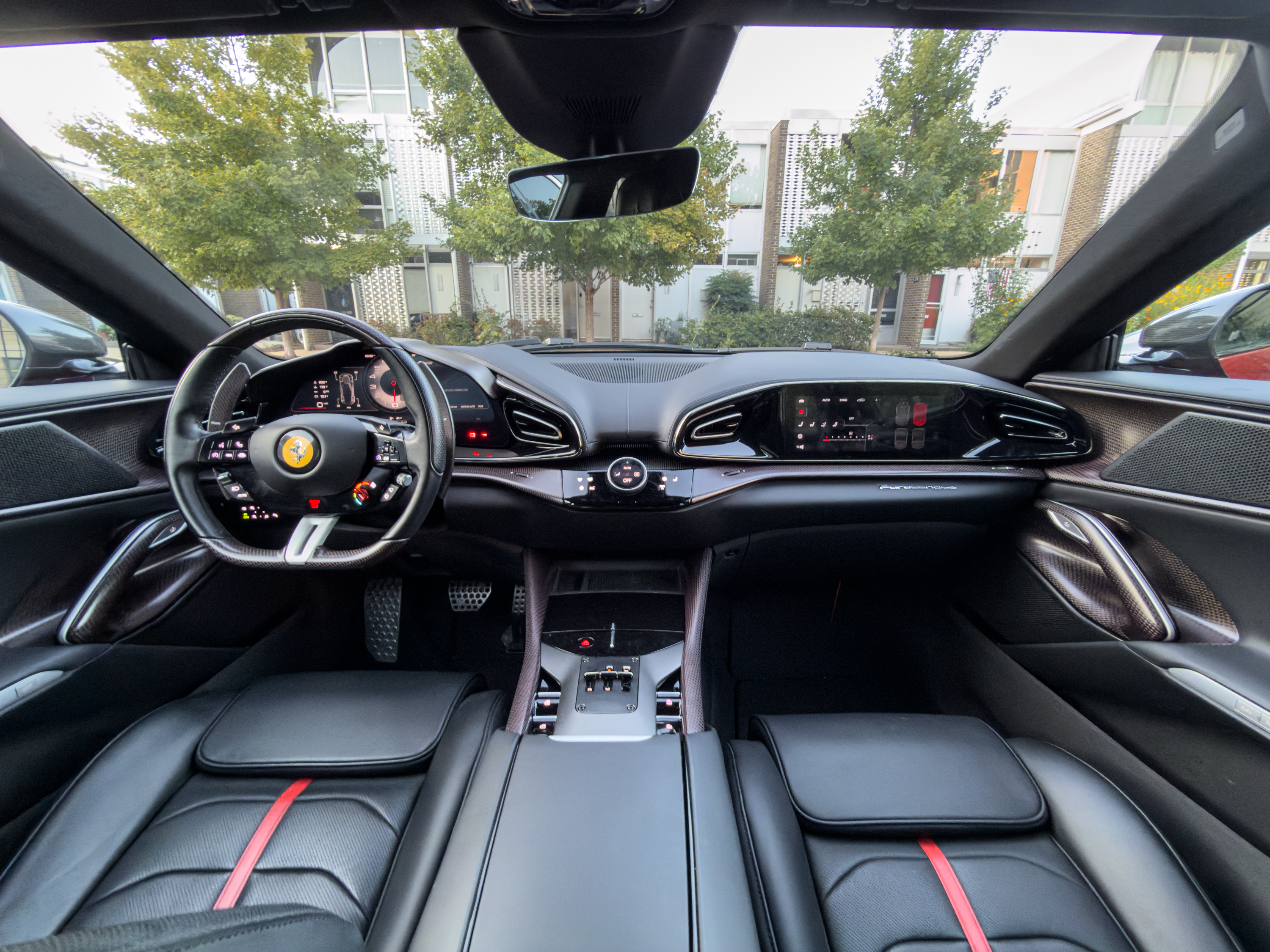
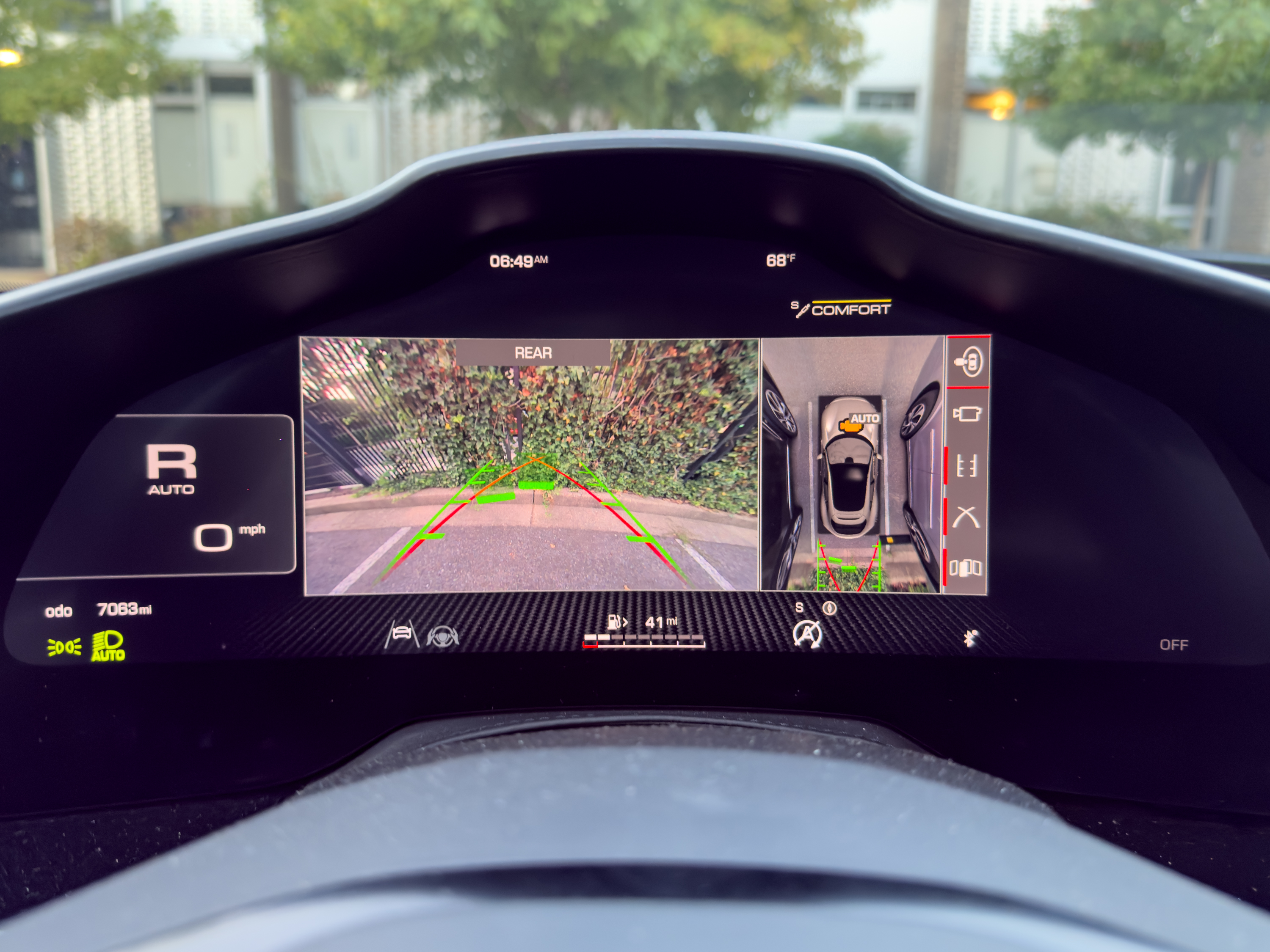
At least the multifunction steering wheel uses actual physical buttons for most of its controls rather than the near-unusable capacitive touch version that we experienced in the 296. Real buttons that you can use without taking your eyes off the road make it possible to do things like control Apple CarPlay while on the move—this appears in the main instrument display directly in front of the driver, and in doing so replaces the digital Ferrari dash with its central tach. Things get more complicated when you want to adjust the seats or the climate, though.

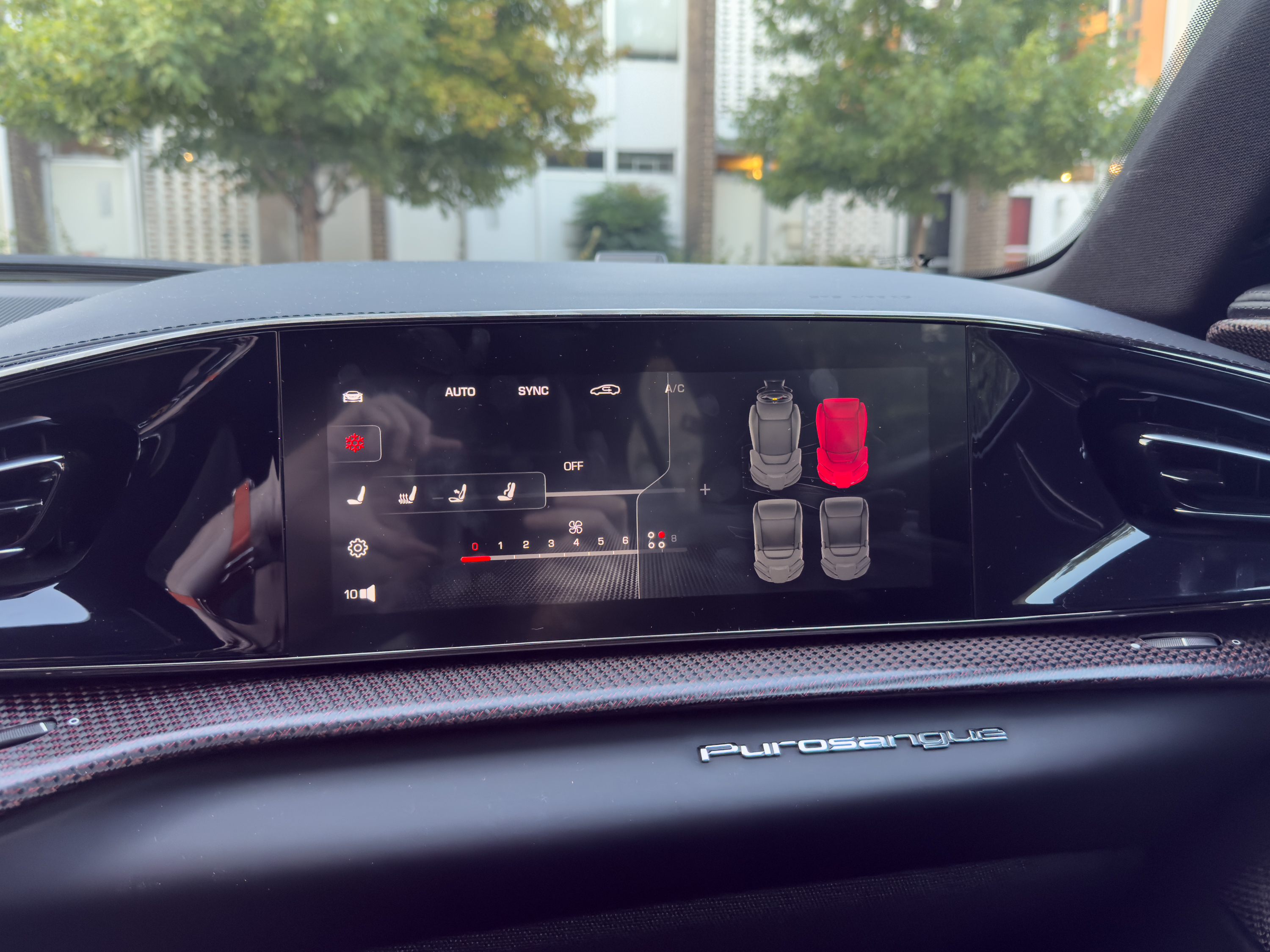
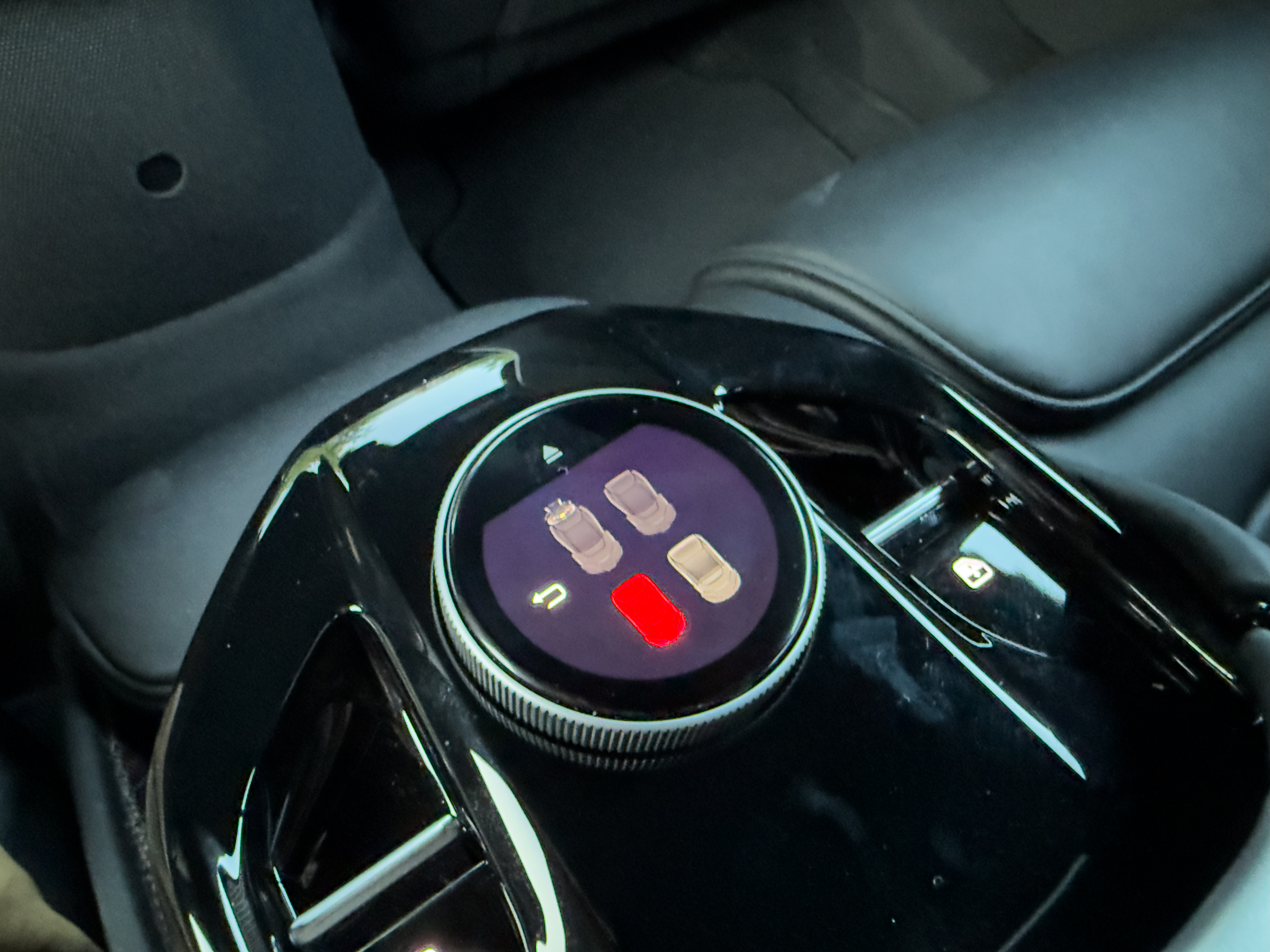
You do this via a rotating controller that pops out of the dash, swiping or tapping its touchscreen display to select the temperature, fan speed, ventilation, or massage for each individual seat. Not so difficult while stationary, but considerably more difficult if you’re on the move, given the small size of the targets your finger needs to aim for. A second dial is found between the rear seats with the same functionality.

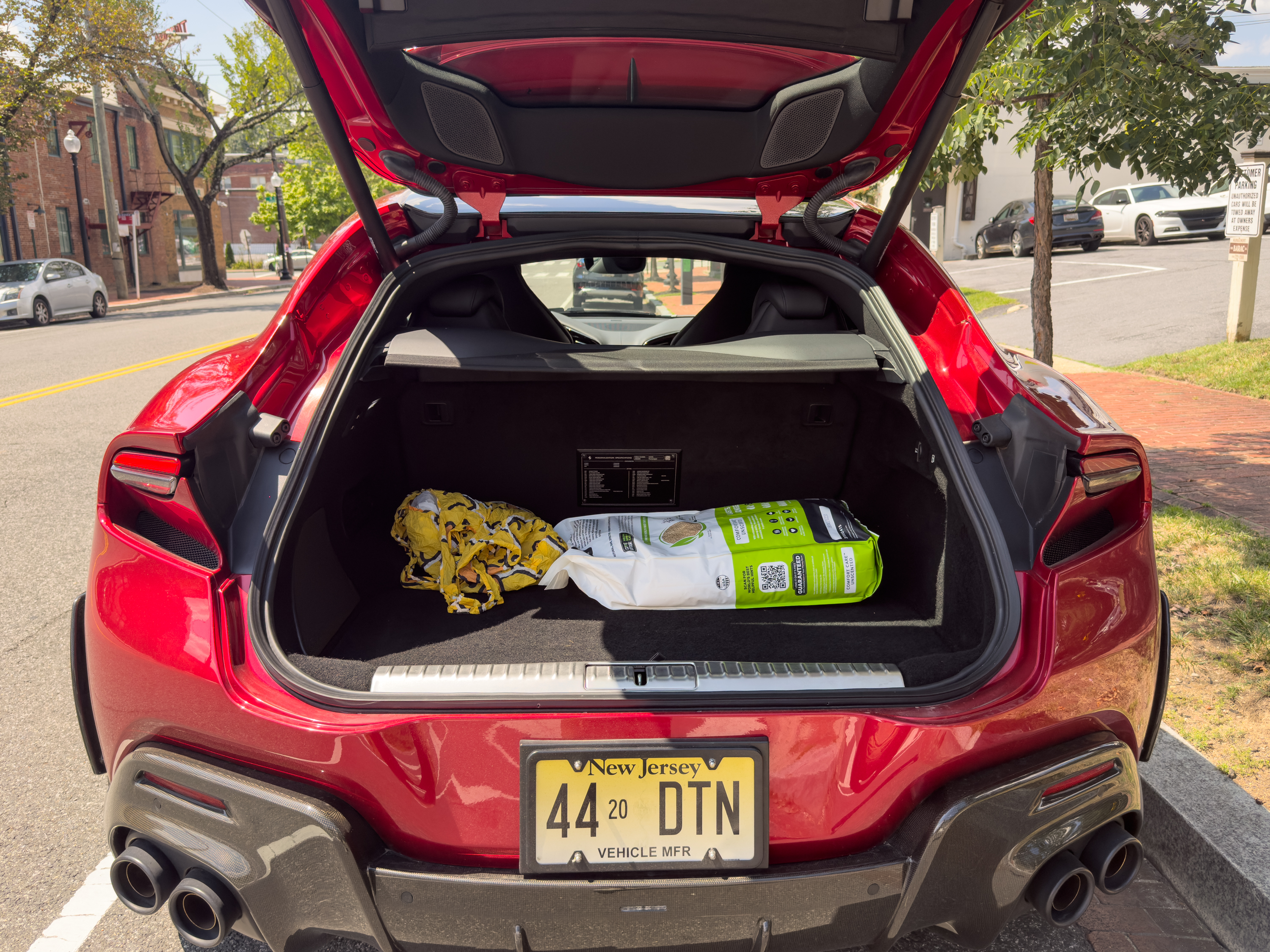
Ferrari Purosangue cargo area with a bag of cat litter in it.

The cargo area might not expand like a traditional SUV, but it’s big enough for luggage or cat litter.

Ferrari Purosangue climate controls

This climate control panel is clever but complicated.

While there isn’t a central infotainment display, there is a full screen for the front-seat passenger. Because the screen is heavily polarized (or otherwise filtered), though, I couldn’t ever see what my passengers were doing with it. They can interact with the native media apps, but they can’t project CarPlay onto this screen.

Painted in lustrous Rosso Portofino paint that glittered in the August sun, the Purosangue was something of a head-turner; certainly more striking than the yellowy-green metallic example I drove briefly around Rome earlier this summer. But this is a Ferrari, and between the standard colors and various customization programs, like Atelier and Tailor Made, the sky (and your ability to pay) is the limit when it comes to exterior and interior finishes. It’s certainly a Ferrari you could daily-drive, although at 12 mpg combined (19.6 L/100 km) that is perhaps a better task for the battery-electric Luce. But it’s a good way of sharing a V12 with as many people as possible, and I reckon on the right tires it would make quite an effective winter car.

A red Ferrari Purosangue

It’s a huge amount of money for a car, but the Purosangue does feel adequately special when you drive it or ride in it.

It’s a huge amount of money for a car, but the Purosangue does feel adequately special when you drive it or ride in it. Credit: Jonathan Gitlin

Starting at $393,350, a Purosangue is significantly less expensive than the EV Ferrari, although our test car’s $576,544 price tag gives you some idea of how quickly the options list can start to add up. It’s also a lot more than you would pay for similarly powerful SUVs from Ferrari’s traditional rivals, like the Aston Martin DBX or Lamborghini Urus, but that’s the way that Maranello likes it.

An undercover Google analyst infiltrated a notorious supply-chain hacking gang

0
an-undercover-google-analyst-infiltrated-a-notorious-supply-chain-hacking-gang
An undercover Google analyst infiltrated a notorious supply-chain hacking gang

Before two of its alleged members were arrested and charged in Australia last month, the hacker group known as TeamPCP carried out a hacking spree unlike any other in history. It tainted hundreds of open-source programs with its malware, stole developer accounts to perpetuate that software supply-chain hacking, and even released a Dune-themed self-spreading worm to automate the process, ultimately breaching more than a thousand companies.

Now Google’s threat intelligence group has revealed that during a key moment of TeamPCP’s rampage, the company’s own undercover researcher had infiltrated the group—allowing Google to monitor the hacking spree from the inside, warn breach targets, and even help disrupt the group’s attempts to exploit those victims.

In a talk at security firm SentinelOne’s LABScon research conference today, Google Threat Intelligence Group researcher Austin Larsen will present details on the company’s investigation—and infiltration—of TeamPCP amidst the group’s unprecedented, chaotic supply-chain hacking campaign. According to Larsen, Google eventually followed a trail of operational security mistakes allegedly made by one of the two Australians now accused of being leading members of the hacker group and passed on key identifying details to law enforcement. The company also received intelligence from ShinyHunters, another infamous cybercriminal group that TeamPCP partnered with, but which later turned on the supply-chain hackers. And perhaps most surprisingly, Larsen says that Google’s security subsidiary Mandiant had an undercover analyst—not himself—within the group’s inner circle from almost the beginning of TeamPCP’s time in the spotlight.

“One of our personas had been working for many months to build trust with one of the actors that was invited to join TeamPCP, and so was added to the group,” Larsen told WIRED in an interview ahead of his LABScon talk. “So essentially, almost day one, Mandiant was watching everything behind the scenes.”

The TeamPCP mole

Late last month, Ruben Ian Thomson and Louis Michael Gaebler, both Australians in their early 20s, were arrested by Australian police in a joint investigation with assistance from the FBI, charged with hacking crimes, and described by the Australian Federal Police (AFP)—in a press release that, due to Australian privacy laws, did not name them—as “principal participants” in TeamPCP. The hacker group, which seems to have first appeared online in late 2025, had made headlines with a brazen string of cascading supply-chain attacks: It repeatedly compromised open-source software to hide its malware, which then allowed it to hijack the credentials of software developers and plant its malicious code in yet another widely used tool, in a repeating cycle.

Starting this spring, for instance, TeamPCP compromised the open-source security scanner Trivy, the AI application programming interface tool LiteLLM, infrastructure of the web application security firm Checkmarx, the web app library TanStack, and the enterprise AI platform Mistral AI. Those repeated supply-chain attacks, with each enabling the group to cast its net again for more victims, ultimately allowed the hackers to breach open-source code repository GitHub, data contracting firm Mercor, and employee devices at OpenAI, the European Commission, and many others who have remained unnamed in public reporting. At times, the group deployed a worm known as Mini Shai-Hulud, named after the sandworms in Dune, to automate its hacking and scale up to even more victims. (The name also seemed to refer to an earlier Shai-Hulud worm that hackers designed to try a similar approach in September 2025, though it’s still not clear if TeamPCP or any of its alleged members were involved in that earlier intrusion campaign.)

Larsen now says that in March, just as TeamPCP was beginning its frenzied supply-chain hacking, Google’s own undercover analyst was invited to join the hackers’ inner circle. That inside source, whose name Larsen declined to reveal, was one of about 12 members of the group given access to a core chat that TeamPCP called CanisterWorm.

“You guys should understand that we pulled off the biggest supplychain [sic] maybe ever recorded in modern history,” one TeamPCP member wrote in the leaked chats.

Michael Fletcher, a former AFP analyst who now works in the threat research division of an Australian telecom firm, says he approached Larsen around that time about methods for monitoring the group’s members and activities. He says that Larsen responded by asking Fletcher to approach the hackers with caution because one of them was a “friendly,” Fletcher remembers. “I thought, damn, you all have been inside this early,” he says.

Google’s undercover analyst, Larsen says, gained access to a server where TeamPCP was storing its trove of credentials stolen from its many victims: the usernames, passwords, and access tokens it had obtained through its hacking and seemingly planned to use to extort target companies. So Google’s team decided to take action to warn victims and prevent TeamPCP’s ransom scheme. “My thought was: How can we, as quickly as possible, disrupt their campaign before more compromises can happen?” Larsen says. “Let’s go mess up what they’re doing. That was my goal.”

Rather than focus on alerting the owners of the stolen credentials at victim companies directly, which Larsen says would have taken too long given the sheer number of breached companies, Google first reached out to providers where those credentials could be used, like Amazon Web Services and Microsoft, to have the credentials revoked and prevent the hackers from exploiting them. Larsen and his team sent out hundreds of notification emails to those providers and then to victims, many of which got immediate responses.

Around the same time, Larsen says, Google’s visibility into the TeamPCP internal chat also allowed it to learn that someone within the group’s core circle was, distinct from the group’s supply-chain hacking, using an AI tool to develop a zero-day exploit in a widely used piece of login software that would allow the hackers to bypass its two-factor authentication. Google’s team got a copy of the exploit code, tested it out, and found that, with a few tweaks, it worked—a rare instance of an in-the-wild AI-created hacking technique that took advantage of a previously unknown software vulnerability. Google warned the software’s developer, who was able to patch its security flaw. (The incident was described in a case study Google released in May, but without naming TeamPCP or detailing how Google learned about the exploit.)

More betrayals, sloppy opsec

Google’s analyst was not, it turns out, the only traitor in TeamPCP’s midst.

Even prior to Google’s disruption effort, Larsen says, the group struggled to profit from its enormous collection of stolen data, which, according to the AFP, included more than half a million users’ credentials. Larsen estimates that, despite that haul, it was pulling in only tens of thousands of dollars in extortion payments, not the millions similar groups have amassed. So in an attempt to better monetize its hacking, TeamPCP invited multiple other cybercriminal groups to partner with it, giving them access to the stolen credentials in exchange for a percentage of any extortion payments they were able to extract.

One of those cybercriminal partners was ShinyHunters, a years-old, highly prolific hacker group that has extorted millions of dollars from victims through data theft and ransomware, including in the breach of educational software platform Canvas that would later paralyze thousands of schools across the US. Around April, a few weeks after partnering with TeamPCP, ShinyHunters went rogue, Larsen says, carrying out its own extortions with TeamPCP’s credentials but without giving the supply-chain hackers their cut. ShinyHunters went so far as to share with Larsen, unsolicited, a full log of the group’s chat on TeamPCP’s server—not knowing that he already had access via Google’s mole.

ShinyHunters also taunted TeamPCP in messages on X, and its louder betrayal got the latter group’s attention. TeamPCP responded by narrowing its inner circle, moving its data to a new server, and exiling ShinyHunters and several other group members from its CanisterWorm chat, including Google’s undercover analyst.

“Just delete that and stop sharing shit with shinyhunters,” one of the TeamPCP leaders wrote.

Even without that inside source, though, Larsen says more traditional digital detective work allowed him to piece together the trail of breadcrumbs that would ultimately let him learn the identity of Thomson, one of the two men charged for allegedly playing “key” roles in TeamPCP. Larsen found in a leak of user data from the BreachForums hacker forum that one of the most active handles in the CanisterWorm chat had been registered with the Gmail address sheepstealing@gmail.com. Combing through other forum archives, he found a 2019 dispute between someone with the pseudonym sheepstealing and a seller of pirated Microsoft Office keys, in which the sheepstealing user demanded a refund at a PayPal account tied to the email ruben@thomsonfamily.net.au.

After TeamPCP moved its stolen credentials to a server hosted by a different provider, Larsen says, Google was able to learn about some contents of the new server—through what Larsen describes as a “trusted partner”—and also that it was being backed up to a Google Drive on that same sheepstealing@gmail.com account.

“When we saw that, I just thought: There’s no way. Why would he be sending all of this illicit, stolen material to a Google Drive that’s tied to himself?” Larsen says. “That’s when we gave the tip to the FBI.” Larsen says he got an interested response from an agent in a matter of minutes. (Larsen may not have been alone in identifying Thomson or other alleged TeamPCP hackers prior to their arrest. Journalist and cybersecurity sleuth Brian Krebs, for instance, published a story last month laying out his own set of clues that led to Thomson’s identity.

In a statement to WIRED, the FBI declined to comment on any “active investigation” but noted that it “is able to confirm we strive to increase impact on adversaries through partnerships as documented in our newly released FBI Cyber Strategy.” The AFP declined to comment.

About a month after his tip, Larsen says, US law enforcement had finished the legal process of requesting Thomson’s data from Google with a warrant. Late last month, Thomson was arrested by Australian police, who released a video of him being walked out of a suburban home in a Northface hoodie and sweatpants.

Neither Thomson nor Gaebler, the other alleged member of TeamPCP who was arrested, could be reached for comment.

Larsen was careful to note that Google’s undercover analyst inside of TeamPCP never engaged in any illegal hacking or even encouragement of the group’s breaches. “They were a fly on the wall, only saying enough to not be suspicious,” Larsen says. “There are guardrails around what we do.”

But Larsen also notes that his team’s work to actively foil TeamPCP’s hacking is part of a new shift within Google. The investigation, after all, kicked off around the same time as Google’s newly launched Cyber Disruption Unit, which has been officially tasked with taking a more aggressive approach to combating cybercrime and state-sponsored hacking.

“Google Threat Intelligence Group has put an emphasis on disruption. That’s one of our missions now,” Larsen says. “Writing reports can only be so useful. Taking action to protect users and customers—that is the next step.”

This story originally appeared on wired.com.

US urges Americans to reconsider travel to Middle East amid rising tensions

0
us-urges-americans-to-reconsider-travel-to-middle-east-amid-rising-tensions
US urges Americans to reconsider travel to Middle East amid rising tensions

The US on Saturday urged Americans outside the Middle East to seriously reconsider travel to and through the region, citing a complex security environment and the potential for rapid escalation, Anadolu reports.

The State Department’s Travel.Gov account on a US social media platform said Americans in the Middle East should exercise heightened vigilance and be prepared for possible flight cancellations, airspace closures and other travel disruptions.

“Due to tensions in the Middle East, the security environment remains complex with the potential for unforeseen escalation,” it said.

It warned that Iranian-supported Houthis have engaged in hostilities against Saudi Arabia, including attacks involving civilian airports, and said the conflict “has the potential to escalate rapidly.”

Americans traveling to or from the region were advised to monitor information on airport and airline operations.

The State Department also warned that US diplomatic facilities, including those outside the Middle East, have been targeted and that Iran and groups supporting it may target other US interests overseas or locations associated with the US and Americans worldwide, including US businesses and other institutions.

The warning comes amid renewed Houthi attacks and tensions involving Saudi Arabia and follows a series of security alerts and military incidents across the region.

West Bank Shooting Leaves One Critically Injured, Manhunt Underway for Attacker

0
west-bank-shooting-leaves-one-critically-injured,-manhunt-underway-for-attacker
West Bank Shooting Leaves One Critically Injured, Manhunt Underway for Attacker


A man in his 30s was critically wounded in a suspected shooting attack near Neveh Tzuf, also known as Halamish, in the West Bank, prompting Israeli Defense Forces (IDF) to launch a manhunt for the attacker. 

The victim was reported to be unconscious following the shooting. 

Initial reports indicated that shots were fired from a passing vehicle toward a group of people who were bathing at a local spring near the community. 

Israeli forces began searching the surrounding area for the suspected shooter following the attack, while troops established roadblocks as part of efforts to locate the attacker. 

“Numerous IDF troops have launched a pursuit after the terrorist and are carrying out roadblocks in the area,” the military says. 

0FansLike
0FollowersFollow
0FollowersFollow
0SubscribersSubscribe
- Advertisement -
Google search engine

Recent Posts