
23.7 C
London
Tuesday, June 16, 2026
Home Blog

The ‘super El Niño’ is here. What happens next could upend food systems worldwide.

0
the-‘super-el-nino’-is-here-what-happens-next-could-upend-food-systems-worldwide.
The ‘super El Niño’ is here. What happens next could upend food systems worldwide.

The oceanic phenomenon known as El Niño, which increases temperatures worldwide, has officially begun, according to U.S. weather forecasters at the National Oceanic and Atmospheric Administration, or NOAA. 

Meteorologists have warned that this could be the strongest El Niño this century. It is expected to drive extreme weather events around the world, including both severe droughts and heavy rainfall, likely leading to major disruptions in agricultural production and food security. 

El Niño is part of a cyclical, naturally-occurring weather pattern that redistributes warm air, surface water temperatures, and moisture across the tropical Pacific Ocean. During El Niño, trade winds that typically blow east-to-west from the Americas to southeast Asia slow down or sometimes reverse. Normally, these winds push warm water along the Equator — but during El Niño conditions, that warm water shifts back east. Although El Niño does not follow a specific timeline, it typically occurs every two to seven years. 

Beginning in the summer, El Niño typically peaks around December or the following January. (The pattern was named El Niño — Spanish for little boy — by fishermen in South America who noticed warmer waters around Christmas time, and associated it with the birth of Jesus Christ.) That means the most significant impacts of the cyclical weather phenomenon may not be felt until months from now. NOAA’s most recent calculations show a high likelihood of a “very strong” El Niño, meaning average surface temperatures in the Pacific jump by more than 2 degrees Celsius. (Some experts are calling this year’s a “super” El Niño, although some agencies, like the World Meteorological Organization, reject this language.)  

Because it impacts a “diverse set of geographies,” said Weston Anderson, a climate scientist at the University of Maryland, so “there is no one set of impacts.” El Niño can contribute to severe droughts in one part of the world and heavy rainfall in others — both of which can disrupt growing seasons in key breadbaskets of the world. 

But the ways in which this year’s El Niño will interact the effects of global warming — and what that means for food security — is something scientists are still actively observing and untangling. 
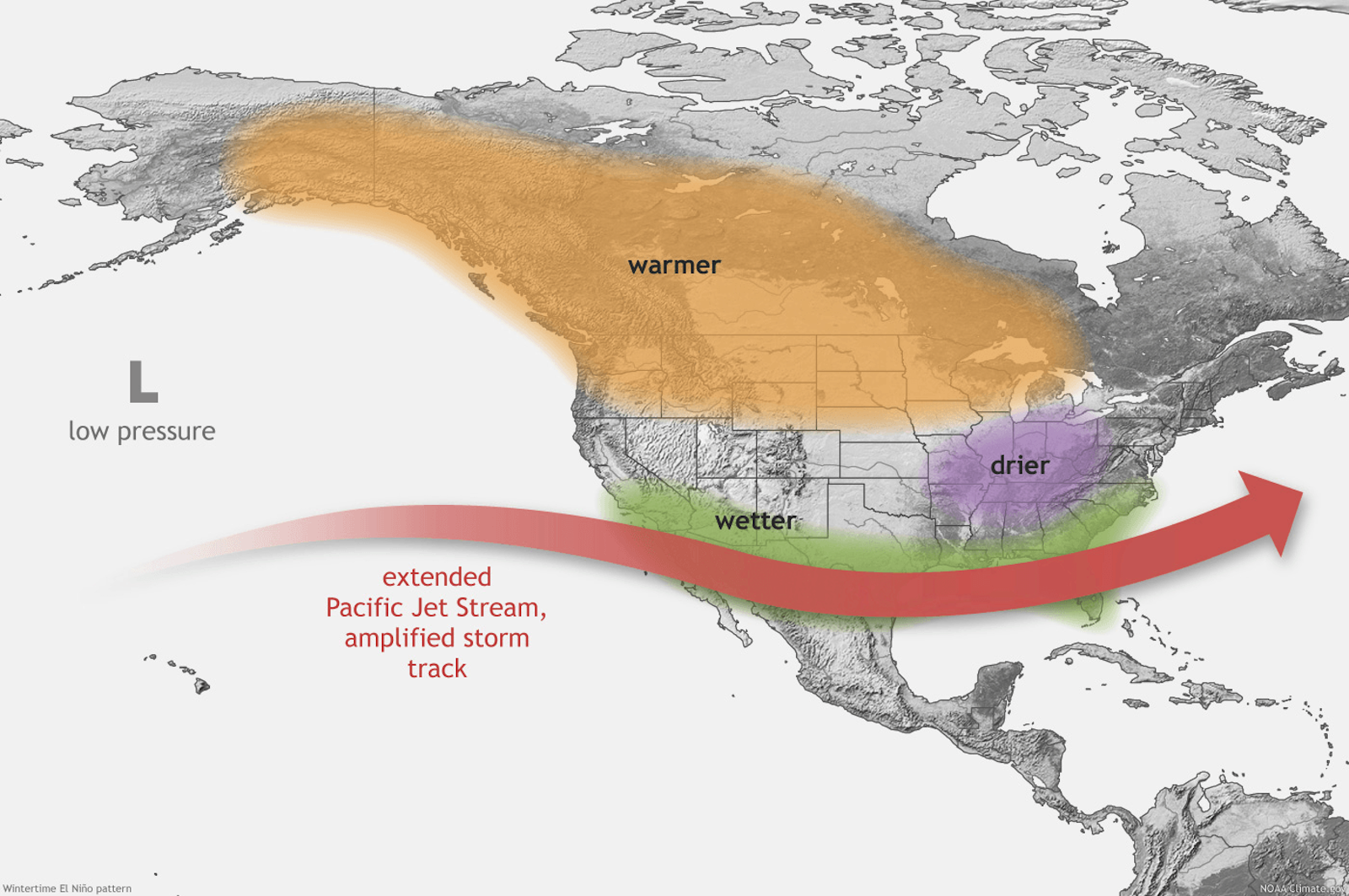
map of the typical impacts of El Niño to the continental U.S. and Canada during Northern Hemisphere winter.

The typical impacts of El Niño to the continental U.S. and Canada during Northern Hemisphere winter. NOAA

“That question is still really important open science,” said Jennifer Burney, a professor at Stanford’s Doerr School of Sustainability whose work focuses on climate and food security. 

History can give us some examples. In 1877, one of the strongest El Niños ever recorded was associated with historic droughts across Asia, as well as in parts of Brazil and northern Africa. These droughts, “along with colonial policies contributed to famines in many regions which were really devastating,” said Deepti Singh, an associate professor at Washington State University who co-authored a study on this period of global famine. 

The fatalities associated with these famines, upwards of 50 million people, said Singh, “are humbling to think about.”

The last El Niño occurred in 2023 and 2024. It was one of the five strongest El Niños ever recorded, according to the World Meteorological Organization, or WMO, and is considered to have contributed to the historic temperatures in 2024, making it the hottest year on record. 

That year came with devastating consequences for growers, especially in arid regions where agricultural producers primarily rely on rainfall to irrigate their crops. Droughts driven by El Niño across southern Africa contributed to increased food insecurity and malnutrition in several countries

Burney noted that in some vulnerable regions, local governments may have adaptive strategies in place to grow key crops earlier in the growing season or to increase imports during El Niño years, which can help offset food insecurity. But even in those cases, local farmers who depend on growing and selling crops to support themselves and their families may still experience economic setbacks. In other words, certain policies may ensure there’s “enough food,” but “that’s not going to take care of the people whose livelihoods depend on” agriculture, Burney said. 

This year, El Niño conditions are expected to impact a number of growing areas — another setback for agricultural producers who have faced higher input costs stemming from the Iran War. Although the United States and Iran are potentially set to unveil an agreement to reopen the all-important Strait of Hormuz, through which much of the world’s oil flows, farmers worldwide have already been impacted by fertilizer shortages and price hikes since the passage closed this spring. 

Weather variability fueled by El Niño will add to growers’ woes. India, where the majority of the world’s rice comes from, is projected to have a weaker monsoon season, which could reduce yields. Drier, hotter conditions could lead to diminished maize production in southern Africa. The southern U.S. states, from California all the way to the eastern seaboard, will experience a wetter year than normal, which could lead to flooding and upend crop production. 

But the exact way that this El Niño will unfurl is yet unknown. As El Niño interacts with the additional warming and moisture currently in our atmosphere caused by climate change, “there is likely to be a change in which regions are likely to be affected” by extreme weather, said Singh. Still, she added, we can expect “the severity, extent, and likelihood” of extreme weather events like droughts “to be higher” in today’s warmer climate.


Pentagon boasts of using AI to write reports mandated by Congress

0
pentagon-boasts-of-using-ai-to-write-reports-mandated-by-congress
Pentagon boasts of using AI to write reports mandated by Congress

The US Department of Defense has a lot of congressionally mandated homework to do every year involving hundreds of required reports on various national security topics. But Pentagon officials have been proudly describing a new shortcut—using generative AI tools to write such reports for Congress.

Pentagon Chief Technology Officer Emil Michael highlighted AI-generated reports to Congress as a key example of how the Department of Defense—stylized as the Department of War under the Trump administration—has adopted generative AI during an event hosted by the Hudson Institute think tank in Washington, DC, on June 12. The Pentagon has made AI tools, starting with Google Cloud’s Gemini for Government, widely available to members of all six military branches through the department’s bespoke GenAI.mil platform since December 2025.

“I have to report to Congress every year on this thing,” Michael said. “Let me load all the papers onto it and have it draft me a congressional report that would otherwise take 200 hours of staffing time and do it in five hours.”

More evidence of such AI usage came from previous comments by Jacob Glassman, deputy assistant secretary of defense for science and technology foundations at the US Department of Defense, during the Box Federal Summit held in Washington, DC, on April 23. According to DefenseScoop coverage, Glassman described how he told a short-staffed team responsible for delivering a congressionally mandated report to “use GenAI.mil, do the best you can.”

The team supposedly came back to Glassman a week later, claiming that the AI-generated report was “the best report we’ve written in the past five years.” As DefenseScoop notes, Glassman did not identify the report in question.

The Department of Defense has long struggled to deliver such reports to Congress efficiently and in a timely manner, especially as the number of mandated reports generally rises with every new defense appropriations bill passed by Congress. The number of reports had soared from just over 500 reports in 2000 to more than 1,400 reports by 2020, according to the US Government Accountability Office.

Officials at the Office of the Assistant Secretary of Defense for Legislative Affairs typically have to go through defense authorization statutes “almost line by line” to find the latest reporting requirements, said Elizabeth Field, former senior executive director at the Government Accountability Office, in a Federal News Network interview in 2023. Her GAO report showed how the Pentagon’s painstaking process of identifying the reporting requirements and assigning reports to the appropriate team could take between three and six months—and some of the Congressionally mandated reports are due within a year.

The perils of pushing AI adoption

Given that tedious process, it’s not surprising that the Pentagon’s current leadership may find AI-generated reports to be a tempting shortcut. But other organizations, such as law firms and major consulting firms, have already discovered the many pitfalls of relying on error-ridden AI-generated writing without adequate human vetting and oversight.

One of the latest cautionary tales involved the multinational consulting giant KPMG publishing a report about AI use in businesses that featured case studies with numerous AI-generated errors and false claims, as revealed by the research group GPTZero and reported by the Financial Times. The revelations led KPMG to pull the report titled “Redefining excellence in the age of agentic AI.”

It’s unclear what processes the Pentagon has in place to review the accuracy of its AI-generated reports to Congress. But such reports are a crucial element of congressional oversight intended to hold the US military accountable for how it uses taxpayer dollars—and so any AI-induced errors or mischaracterizations could undermine the accountability mechanism of such reports. This also comes at a time when the Pentagon has requested an unprecedented $1.5 trillion budget for the 2027 fiscal year.

Members of the US military have also been using generative AI tools to write personnel evaluation reports for non-commissioned officers and commissioned officers, generate commendation medal citations, and create counseling statements, according to a Small Wars Journal article.

The number of Department of Defense personnel using commercial AI tools such as Gemini through GenAI.mil has significantly increased from just 80,000 in December 2025 to 1.5 million in June 2026, the Pentagon CTO claimed during his remarks at the Hudson Institute. The Department of Defense has an overall workforce of approximately 3.5 million.

Google is among multiple US tech companies that signed agreements in 2025 with the US General Services Administration to make their AI tools available across federal government agencies for deeply discounted prices.

On May 1, the Department of Defense announced new agreements with “eight of the world’s leading frontier artificial intelligence companies” to deploy more AI tools on classified networks for “lawful operational use.” Those companies include SpaceX, OpenAI, Google, Nvidia, Reflection AI, Microsoft, Amazon Web Services, and Oracle.

The US government has not divulged how much it is paying the companies under the new contracts. But the list notably excludes Anthropic, which was blacklisted by the Trump administration after the tech company supposedly refused to allow its Claude AI models to be used in an unrestricted manner for autonomous warfare and mass surveillance.

University research at China speed brings sea changes to science

0
university-research-at-china-speed-brings-sea-changes-to-science
University research at China speed brings sea changes to science

I was just guessing at numbers and figures

Pulling the puzzles apart

Questions of science, science and progress

Do not speak as loud as my heart

– Coldplay

Nine of the world’s current top,-ten-ranked research universities are in China, according to the recently released 2026 Nature Index.

For the first time since the index was introduced, Harvard is no longer the number one ranked university. Zhejiang University (ZJU) has taken its place.

China’s share of research papers published in the 178 top journals of the Nature Index is now over twice that of the US.

When Nature launched its index in 2015, China’s share of papers published in top journals was 37% of the US share. China took the lead in 2023 and, by 2025, lapped the US.

In 2025, China’s share increased 22.4% year-on-year versus 4.2% for the US.

Because total papers in the index grew 10.8%, growth rates below that indicate a relative decline in the rankings. All countries in the top 20 besides China grew by single digit percentages (or fell). Mainstream media outlets like the Economist and the New York Times have written feature articles on the rise of Chinese universities using the Nature Index and the similar Leiden Rankings (citations rather than publications in top journals).

The mainstream media seem to have moved on from legacy rankings like Times Higher Education (founded in 1971 as a supplement of The Times of London but spun off in 2008 as an independent publication), US News and QS. These rankings are fruity, arbitrarily weighing subjective factors like academic reputation, employer reputation and “learning environment” along with peculiar metrics like international student percentage and number of Nobel/Fields Medal winners.

image.png

Legacy rankings have become long in the tooth, spitting out the usual suspects for decades (Ivy plus, Oxbridge and a few elite US state schools) while China turned the world upside down. On purchasing power parity, China’s economy has surpassed that of the US (likely far more than reported, see herehere and here).

China has moved up the value chain, dominating industry after industry from EVs to electronics to clean energy. It is giving the US a run for its money in AI and drug discovery and is on the cutting edge of future technologies including quantum computing and nuclear fusion.

As if preserved in amber, the top 10 universities in the Times Higher Education rankings are unchanged from 2004 to 2026. That Oxford and Cambridge are ranked in the top 5 by Times Higher Education while the UK economy has stagnated for decades (20 year 0.6% real per capita GDP CAGR vs. 7.4% for China) should make everyone question whether methodologies are reflecting actual educational quality and research outcomes.

image.png

To be clear, while the Nature Index (and Leiden Rankings) are far more objective, they are also focused much more narrowly. They do not claim to tell you where little Jimmy should apply to college. They do not “measure” reputation. They do not care one whit about undergraduates and their “learning environment” or class sizes. They do not care what percent of research is done by international students or Nobel laureates.

image.png

They also do not measure efficiency. ZJU eked out a win over Harvard for the top spot with over three times the number of PhD students. The Nature Index is not about prestige. If you want a prestigious PhD, go to Harvard. If a nation wants to create a powerhouse research institution, then replicate ZJU.

image.png

China’s surge up the Nature Index rankings is just a math problem reflecting the explosive growth of the nation’s tertiary education.

Since 2000, the number of annual STEM graduates in China has increased almost tenfold.

Not just sunshine and rainbows

All, however, is not sunshine and rainbows in China’s scientific community. In May of this year, academia in China was rocked by Classmate Geng, a PhD dropout and influencer on BiliBili (China’s YouTube), who tore through China’s rising academic stars – Changjiang scholars and National Science Foundation (NSFC) distinguished young scholars – with accusations of academic fraud.

Geng Tongxue, AKA Classmate Geng. Photo: BiliBili / The East is Read

Using methods sophisticated (AI statistical software) and simple (eyeballing repeated data), Student Geng was able to take down star researchers at top universities including Sun-Yat Sun, Nankai and Tongji (Nature Index 11th, 20th and 21st). Four professors were demoted (three lost deanships) and multiple postdocs were fired. Blood has been spilled.   

While the number of graduates should be plateauing, they will continue to outnumber retiring STEM workers for decades to come. It remains to be seen at what level China’s Nature Index rankings plateau but given known demographics, we will know in the 2040s.

At the height of Classmate Geng’s rampage, Xinhua News interviewed him, granting, in effect, a state imprimatur on his efforts.

Eminent neurobiologist Rao Yi, a former dean of Peking University’s School of Life Sciences, lent his voice to Classmate Geng, accusing Chinese researchers of not just producing the most fraudulent research but having the highest proportion of fraud as well. Calling China’s research environment rotten to the core, Rao Yi lamented a culture of researchers trained to keep their heads down, scratch one another’s backs and share spoils (awards, funding, and promotions) among crony networks.

Classmate Geng himself is more pragmatic, suggesting methodological protocols to prevent fraud – namely, requiring different people to replicate experiments. Because of Classmate Geng, academic journals in China are requiring co-authors to certify that they take full accountability for fraud and have verified all raw data.

Universities implemented mandatory training on data integrity and reproducibility. Regulatory bodies stepped up random data auditing for key research projects, focusing on Changjiang scholars and NSFC distinguished young scholars.

For decades, China’s universities implemented an all-balls, pedal-to-the-metal, publish or perish, hunger games incentive system for academic researchers. This worked perhaps too well. China produced 831,600 Science Citation Index (SCI, ~9,500 key journals) papers in 2025, a 27-fold increase from 2000. In 2000, China accounted for 2.96% (fractional collaboration share) of the world’s SCI papers. By 2025, that rose to ~26%.

China itself publishes ~5,300 Chinese language scientific and technical journals, indexed by China National Knowledge Infrastructure (CNKI), only 382 of which are included in SCI. CNKI papers have increased ~500% between 2000 and 2025, publishing papers of limited interest to international publications (e.g. local crop studies, high speed rail metallurgy, rare earths).

Since 2000, China has been overhauling academic incentives, moving beyond quantity KPIs like SCI paper count and citations. China has increased incentives for publishing in top domestic journals such as National Science Review and Cell Research. PhD programs are moving away from rigid two SCI paper quotas to dissertation quality, originality and solving real world engineering problems. Bibliometric KPIs have shifted to high impact metrics like top 1% citations, Nature Index contribution and commercial patents.

Classmate Geng is shooting fish in a barrel. An incentive structure that increased paper output 27-fold since 2000, carried by a 10-fold increase in STEM graduates, has evidently poured beer with a thick head of foam. According to the Economist, Classmate Geng estimates one in ten papers by distinguished scholars is fraudulent.

In a speech, Rao Yi declared that China deserves world records for both scientific progress and academic misconduct. The problem, according to Rao, is that miscreants are not held accountable in the “see no evil, hear no evil” and “I’ll scratch your back if you’ll scratch mine” environment formed in the extreme publish-or-perish crucible.

Now that Classmate Geng’s exposure of China’s most distinguished scholars has left universities meting out bloody professional punishment and disgruntled graduate students feeling newly empowered on PubPeer, a sword of Damocles hangs over researchers tempted to cut corners. Chickens have been killed. We will see if the monkeys are scared.

All things considered, however, China’s intense publish-or-perish pressures as it expanded its research infrastructure by an order of magnitude was absolutely the correct policy. To move at China speed and lap the US in the Nature Index in one generation is an astonishing accomplishment, even if 10% of research is fraudulent. You might not like how it’s made but the proof is in the pudding as China dominates industry after industry.

Stable genius’s revenge tour of US academia

At the same time that China has flipped the scientific world on its head and is optimizing incentives for future advances while spilling blood to contain fraud, the US is gutting its research universities by slashing scientific funding.

The Trump administration had proposed budget cuts for the National Institute of Health (NIH) and the National Science Foundation (NSF) by 39.3% and 56.9%, respectively. Although Congress rejected those deep budget cuts, the administration has used workarounds – administrative mechanisms, grant freezes and executive actions – to disrupt funding.This has resulted in an expected budgetary shortfall at MIT of $300 million forcing the school to reduce graduate student intake by 500 (~20%). Harvard has also reported “significantly reduced” PhD admissions.

After failing to secure large budget cuts requested for 2026, the Trump administration is trying again in 2027, asking for budget cuts of 55% to NSF, 23% to NASA, 15% to the Department of Energy Office of Science and a 12% to the NIH. To add insult to injury, the Trump administration is proposing to give political appointees at the Office of Management and Budget decision power over Federal science funding. All of this has little to do with curbing government waste and everything to do with President Trump’s disdain for elite universities.

The near-term impact of budget and bureaucratic self-sabotage will be Harvard falling out of the top five and MIT dropping below 20 in the Nature Index rankings. The long term impact could be US universities surrendering their position as destination schools for the world’s brightest minds and cementing scientific leadership in China.

European Parliament backs new rules to strengthen farmers’ contracts and incomes

0
european-parliament-backs-new-rules-to-strengthen-farmers’-contracts-and-incomes
European Parliament backs new rules to strengthen farmers’ contracts and incomes


The European Parliament on Tuesday approved new rules aimed at strengthening the contractual position of farmers and helping to stabilise their incomes.

MEPs adopted the legislation by 560 votes in favour, 75 against and 25 abstentions.

Under the new rules, member states will be required to establish and publish online benchmarks for use in contractual arrangements to help ensure that the final prices of food products better reflect actual production costs and have a direct impact on farmers’ incomes.

The regulation also strengthens the role of producer organisations (POs) in market organisation and collective bargaining. Producer organisations will be able to negotiate directly with buyers, while new provisions will prevent buyers from bypassing POs to negotiate with individual producers.

The legislation also introduces more transparent labelling and marketing rules by clarifying the use of the terms “fair” and “equitable” for agricultural products. The labels may be used where products meet specified criteria, including contributing to rural community development or promoting farmers’ organisations.

The text defines meat as the “edible parts of animals” and reserves a list of meat-related terms exclusively for meat products. These include terms such as beef, pork, poultry, steak, ribs, bacon, liver and sirloin, which may not be used for products that do not contain meat, including lab-grown or cell-based products. The measure is intended to improve transparency in the internal market and help consumers make informed choices.

The legislation also introduces measures to support dairy producers, including mandatory written contracts with opt-out provisions for price indicators and revision clauses, in response to the sector’s challenging conditions.

Rapporteur Céline Imart said the agreement strengthens farmers’ market position, legal protections and cultural heritage. She said the new rules would guarantee farmers a fairer place in the supply chain through stronger contracts and a mandatory mediation mechanism in disputes with buyers. She also highlighted a new antitrust exemption allowing unrecognised producer organisations to organise more freely.

Imart said the legislation also reserves terms such as “steak” and “liver” exclusively for livestock products and explicitly prohibits lab-grown or cell-based products from being designated as “meat.”

The provisional agreement must now be approved by the Council before the new rules can enter into force.

The proposal was presented by the European Commission in December 2024 in response to the difficulties faced by EU farmers. It seeks to strengthen farmers’ position in the food supply chain by improving contract rules, reinforcing producer organisations, simplifying their recognition and promoting voluntary schemes and social sustainability initiatives. It is linked to a separate regulation on cross-border cooperation in enforcing rules against unfair trading practices.

Twice Baked Potato Casserole

0
twice-baked-potato-casserole
Twice Baked Potato Casserole

This Twice Baked Potato Casserole takes everything you love about a loaded twice-baked potato and turns it into one creamy, cheesy, comforting casserole. Fluffy baked potatoes are chopped and mixed with a rich sour cream and cream cheese mixture, crispy bacon, fresh chives, and plenty of cheddar cheese, then baked until hot and bubbly.

It has all the classic flavors: baked potatoes, sour cream, bacon, cheese, chives, and a creamy seasoned filling. Instead of stuffing individual potato skins, everything goes into one baking dish, making it easier to serve for family dinners, holidays, potlucks, or cozy weekend meals.

If you love loaded baked potatoes, this casserole is a must-make.

Why You’ll Love This Twice Baked Potato Casserole

This casserole is rich, creamy, and full of comfort food flavor.

You’ll love it because it is:

  • Loaded with bacon and cheese
  • Creamy, hearty, and satisfying
  • Easier than making individual twice-baked potatoes
  • Perfect for holidays and potlucks
  • Great as a side dish or main dish
  • Made with simple ingredients
  • Easy to prepare ahead of time
  • A family-friendly potato casserole

Twice baked potato casserole is a shortcut version of classic twice-baked potatoes. Instead of scooping out baked potatoes, mixing the filling, and stuffing it back into the skins, the baked potatoes are chopped and mixed with the creamy filling in one dish.

The result is a loaded potato casserole with all the same flavor but less work.

Recipe Summary

Prep Time: 30 minutes
Cook Time: 1 hour 20 minutes
Total Time: 1 hour 50 minutes
Servings: 8
Course: Dinner, Main Course, Side Dish
Cuisine: American / Comfort Food

Ingredients

For the Sour Cream Mixture

  • 6 ounces cream cheese, room temperature
  • 1 cup sour cream
  • ½ cup fresh chives, chopped
  • 1 teaspoon lemon juice
  • ½ teaspoon kosher salt
  • ½ teaspoon garlic powder
  • ½ teaspoon onion powder
  • ¼ cup whole milk

For the Potatoes

  • 8 baking potatoes, washed
  • 3 tablespoons canola oil
  • 1 tablespoon kosher salt

For the Topping

  • 8 strips bacon, cooked and crumbled
  • 3 cups shredded cheddar cheese, divided
  • Chives, for garnish

Ingredient Notes

Potatoes

Russet potatoes are the best choice for this casserole. They bake up fluffy on the inside and have the perfect texture for mixing with the creamy filling.

Cream Cheese

Use room-temperature cream cheese so it blends smoothly into the sour cream mixture. Cold cream cheese can leave lumps.

Sour Cream

Sour cream gives the casserole its classic twice-baked potato flavor and creamy tang.

Chives

Fresh chives add a mild onion flavor and a fresh finish. You can also use green onions.

Bacon

Crispy crumbled bacon adds smoky, salty flavor. You can cook the bacon ahead of time to make the recipe easier.

Cheddar Cheese

Sharp cheddar gives the best flavor, but mild cheddar, Colby Jack, or Monterey Jack also work.

Whole Milk

Milk loosens the sour cream mixture so it coats the potatoes evenly.

How to Make Twice Baked Potato Casserole

Step 1: Make the Sour Cream Mixture

In a bowl, combine cream cheese, sour cream, chopped chives, lemon juice, kosher salt, garlic powder, onion powder, and whole milk.

Mix until smooth and creamy.

Place the mixture in the refrigerator while the potatoes bake.

Step 2: Bake the Potatoes

Preheat your oven to 400°F.

Wash the potatoes well and pierce each one a few times with a fork or sharp knife.

Rub each potato with canola oil and sprinkle with kosher salt.

Place the potatoes on a baking sheet.

Bake for about 1 hour, or until fork-tender.

Step 3: Cool and Chop the Potatoes

Remove the potatoes from the oven, but keep the oven set to 400°F.

Let the potatoes cool until they are safe to handle.

Roughly chop them into bite-sized pieces, about ½ inch each.

Step 4: Prepare the Baking Dish

Spray a 9×13-inch baking dish with nonstick cooking spray.

Set aside.

Step 5: Mix the Casserole

Add the chopped baked potatoes to a large bowl.

Add the sour cream mixture, half of the shredded cheddar cheese, and most of the crumbled bacon.

Reserve a little bacon for topping if desired.

Gently stir until everything is combined.

Step 6: Add to Baking Dish

Spread the potato mixture evenly into the prepared baking dish.

Top with the remaining shredded cheddar cheese and reserved bacon.

Step 7: Bake

Bake uncovered for 15–20 minutes, or until the cheese is melted, hot, and bubbly.

Step 8: Serve

Remove from the oven.

Garnish with extra chives if desired.

Serve hot.

Tips for the Best Twice Baked Potato Casserole

Use russet potatoes for the fluffiest texture.

Make sure the cream cheese is room temperature.

Bake the potatoes until fully fork-tender.

Do not overmix the potatoes or they may become gummy.

Reserve some bacon for the topping.

Use freshly shredded cheddar for the best melt.

Let the casserole rest for a few minutes before serving.

How to Tell When Baked Potatoes Are Done

A baked potato is done when a fork slides into the center easily.

For a more exact method, the internal temperature of a fully baked potato is usually around 210°F.

If the potatoes still feel firm, bake them a little longer.

Can I Make This Ahead of Time?

Yes. This casserole is a great make-ahead dish.

Bake and chop the potatoes, prepare the sour cream mixture, assemble the casserole, then cover and refrigerate overnight.

When ready to bake, let the dish sit at room temperature while the oven preheats. You may need to add a few extra minutes to the baking time if baking straight from the refrigerator.

Easy Variations

Loaded Twice Baked Potato Casserole

Add extra bacon, cheese, and green onions on top.

Broccoli Cheese Potato Casserole

Stir in cooked chopped broccoli before baking.

Ranch Potato Casserole

Add ranch seasoning to the sour cream mixture.

Spicy Potato Casserole

Add diced jalapeños or pepper jack cheese.

Ham and Cheese Potato Casserole

Add diced cooked ham for a heartier dish.

Garlic Parmesan Potato Casserole

Add grated parmesan and roasted garlic to the filling.

What to Serve with Twice Baked Potato Casserole

This casserole works as a rich side dish or a simple main dish.

Serve it with:

  • Grilled chicken
  • Steak
  • Pork chops
  • Meatloaf
  • Roasted turkey
  • Ham
  • BBQ chicken
  • Green beans
  • Caesar salad
  • Roasted broccoli
  • Dinner rolls
  • Coleslaw
  • Simple side salad

Storage Instructions

Let the casserole cool completely.

Store leftovers in an airtight container in the refrigerator for up to 3–4 days.

Freezing Instructions

You can freeze this casserole, but the texture may be slightly softer after thawing because of the sour cream and potatoes.

To freeze, let the casserole cool completely. Wrap tightly and freeze for up to 2 months.

Thaw overnight in the refrigerator before reheating.

Reheating Tips

Reheat individual portions in the microwave until warm.

For larger portions, cover with foil and reheat in a 350°F oven until heated through.

Add a little extra cheese on top before reheating if desired.

Frequently Asked Questions

Can I use a different potato?

Russet potatoes work best, but Yukon gold potatoes can also be used. The texture will be creamier and less fluffy.

Do I have to peel the potatoes?

No. You can leave the skins on for texture and flavor. Since the potatoes are baked first, the skins become tender.

Can I use bacon bits?

Fresh cooked bacon gives the best flavor, but real bacon bits can be used in a pinch.

Can I make this without bacon?

Yes. Leave out the bacon for a vegetarian-friendly version, or replace it with sautéed mushrooms or roasted broccoli.

Can I use Greek yogurt instead of sour cream?

Yes. Plain Greek yogurt can work, but the flavor will be slightly tangier.

Can I make this casserole ahead?

Yes. Assemble it up to 1 day ahead and bake when ready.

How long does it last?

Leftovers last 3–4 days in the refrigerator.

Recipe Card

Twice Baked Potato Casserole

A creamy, cheesy potato casserole made with baked russet potatoes, sour cream, cream cheese, bacon, cheddar cheese, and chives. It has all the flavor of twice-baked potatoes in one easy baking dish.

Prep Time: 30 minutes
Cook Time: 1 hour 20 minutes
Total Time: 1 hour 50 minutes
Servings: 8

Ingredients

Sour Cream Mixture

  • 6 ounces cream cheese, room temperature
  • 1 cup sour cream
  • ½ cup fresh chives, chopped
  • 1 teaspoon lemon juice
  • ½ teaspoon kosher salt
  • ½ teaspoon garlic powder
  • ½ teaspoon onion powder
  • ¼ cup whole milk

Potatoes

  • 8 baking potatoes, washed
  • 3 tablespoons canola oil
  • 1 tablespoon kosher salt

Topping

  • 8 strips bacon, cooked and crumbled
  • 3 cups shredded cheddar cheese, divided
  • Chives, for garnish

Instructions

  1. In a bowl, combine cream cheese, sour cream, chives, lemon juice, salt, garlic powder, onion powder, and milk.
  2. Mix until smooth and creamy.
  3. Refrigerate the sour cream mixture while the potatoes bake.
  4. Preheat oven to 400°F.
  5. Wash the potatoes and pierce each one with a fork or knife.
  6. Rub each potato with canola oil.
  7. Sprinkle with kosher salt.
  8. Place potatoes on a baking sheet.
  9. Bake for about 1 hour, or until fork-tender.
  10. Remove potatoes from the oven and let cool until safe to handle.
  11. Leave the oven set to 400°F.
  12. Roughly chop the potatoes into ½-inch bite-sized pieces.
  13. Spray a 9×13-inch baking dish with nonstick cooking spray.
  14. Add chopped potatoes to a large bowl.
  15. Mix with the sour cream mixture, half of the cheddar cheese, and most of the bacon.
  16. Spread the potato mixture into the prepared baking dish.
  17. Top with remaining cheese and reserved bacon.
  18. Bake uncovered for 15–20 minutes, or until hot and bubbly.
  19. Garnish with chives if desired.
  20. Serve hot.

Notes

Use room-temperature cream cheese for a smooth mixture.

Russet potatoes work best for this recipe.

Reserve some bacon for topping.

This casserole can be assembled the night before and baked the next day.

Store leftovers in the refrigerator for 3–4 days.

Nutrition Estimate

Per serving:

  • Calories: 511
  • Carbohydrates: 45g
  • Protein: 18g
  • Fat: 30g
  • Fiber: 4g
  • Sugar: 4g

Nutrition values are approximate and may vary depending on ingredients used.

Final Thoughts

Twice Baked Potato Casserole is creamy, cheesy, comforting, and packed with loaded potato flavor. It is easier than making individual twice-baked potatoes and perfect for feeding a family or a crowd.

Serve it as a hearty side dish for holidays, potlucks, Sunday dinner, or any meal that needs a cozy potato casserole.

Trump Admin Wants to Make It Easier for White Men to Sue for Discrimination

0
trump-admin-wants-to-make-it-easier-for-white-men-to-sue-for-discrimination
Trump Admin Wants to Make It Easier for White Men to Sue for Discrimination


The chair of the Equal Employment Opportunity Commission, the federal agency created by the Civil Rights Act of 1964 to protect American workers from discrimination, moved to delete the agency’s affirmative action rule that was implemented almost 50 years ago.

Chair Andrea Lucas, who was appointed by President Donald Trump, proposed to rescind the “Affirmative Action Appropriate Under Title VII of the Civil Rights Act of 1964” rule on May 27. The rule has proved a barrier to her efforts to bring lawsuits on behalf of white men who say they were discriminated against at work — a barrier the rescission would get rid of.

The move, which was previously unreported, comes amid Lucas’s quest to characterize all employer efforts at diversity, equity, and inclusion as illegal race discrimination. The agency has filed lawsuits under her watch on behalf of white men at the New York Times and Coca-Cola, as well as investigations into Nike and Northwestern Mutual.

“This proposed rescission is part of this administration’s continued assault on equality for people of color and for women,” said former EEOC commissioner Jocelyn Samuels, who added that the change reflects Trump’s “solicitude for the fortunes of white men.”

The EEOC did not respond to a request for comment.

Rule to Fight Discrimination

The rule Lucas wants to do away with was crafted shortly after the EEOC was granted litigation authority in 1972.

Racial discrimination had been rampant throughout American workplaces, and some employers wanted to act to correct those long-standing discriminatory practices and racial disparities in an affirmative way.

Responding to the call, the EEOC crafted the rule to allow for very narrow circumstances in which it would be permissible for employers to take race into account in such efforts.

To take advantage of the rule, employers have to do an analysis showing they had shut out women or people of color for a long time — in other words, that there were “prior discriminatory practices.” Only then can a hiring process favor, say, Black candidates for a job position.

The rule also gives employers some cover. Under the Civil Rights Act, employers can’t be held liable for taking action done in good faith to follow an EEOC regulation that was voted on by the commissioners, such as the affirmative action rule.

At least one large employer in the Trump EEOC’s sights has cited the rule. In its motion to dismiss the EEOC’s lawsuit, Coca-Cola referred to the agency’s affirmative action rule as proof that the agency has encouraged the very behavior it is now penalizing.

Samuels, the former EEOC commissioner, said Lucas’s move to get rid of the rule “could be part of an effort to remove a potential defense.”

Upheld at Supreme Court

The Supreme Court has found narrow approaches to affirmative action to be constitutional.

In the 1987 case Johnson v. Transportation Agency and the 1979 case United Steelworkers of America v. Weber, the court allowed employers, in the case of what it called a “manifest imbalance,” to temporarily take sex and race into account as part of plans to increase representation in particular jobs until women or people of color are commensurate with their share of the population.

Those decisions still stand.

“The law is set by the statute and the Supreme Court’s interpretation,” said Charlotte Burrows, a senior affiliated research scholar at New York University’s School of Law and a former EEOC chair. “The EEOC can’t change that.” 

That’s true despite the Supreme Court’s decision in Students for Fair Admissions, Inc. v. President and Fellows of Harvard College that struck down affirmative action in college admissions; that decision doesn’t apply to Title VII, which governs employment discrimination.

“The law is set by the statute and the Supreme Court’s interpretation. The EEOC can’t change that.” 

That doesn’t mean the administration isn’t trying to change the law.

After Lucas asked the Office of Legal Counsel at the Department of Justice to weigh in, the department released an opinion that says, among other things, that the agency’s affirmative action guidelines “run further into unconstitutional territory.”

Lucas may be trying to blur the lines between affirmative action and DEI policies, but “they are two very distinct things,” Burrows said.

Employers can engage in a variety of perfectly legal approaches to diversity, such as having DEI programs that don’t give women or people of color more advantages but simply open the doors to more people.

“It is a messaging exercise that is part of this administration’s campaign to brand any form of proactive conduct on the part of employers to anticipate, preempt, and address barriers to equal employment opportunity as unlawful, race-based decision-making that disadvantages white men,” Samuels said. “This administration’s pronouncements have had really damaging effects on proactive programs that were designed to identify and address potential barriers before they ripened into discrimination.”

Assault on DEI

Lucas recently scrapped the EEOC’s previous Strategic Enforcement Plan that included as a priority that the agency “support employer efforts to implement lawful and appropriate diversity, equity, inclusion, and accessibility (DEIA) practices.” It was crafted through a lengthy public process and was slated to remain in place through 2028.

Instead, Lucas replaced the plan with a National Enforcement Plan that prioritizes going after DEI policies.

That move came after she had already directed agency officials to compile a list of cases in line with her own personal priorities, including “rooting out unlawful DEI-motivated race and sex discrimination,” and recorded a direct-to-camera video soliciting complaints from white men who feel they’ve been discriminated against at work.

Such cases have been accelerated through the agency’s processes, according to the New York Times, although staff have struggled to find complaints with merit.

SpaceX will acquire coding tool Cursor to compete with Anthropic, OpenAI

0
spacex-will-acquire-coding-tool-cursor-to-compete-with-anthropic,-openai
SpaceX will acquire coding tool Cursor to compete with Anthropic, OpenAI

SpaceX will acquire AI coding tool Cursor for $60 billion in an all-stock transaction, the companies announced today. The deal is expected to close in the third quarter.

It comes just two days after SpaceX’s unprecedented IPO and a few months after the merger of SpaceX and xAI, which brought a significant restructuring of xAI.

Cursor was one of the first tools to fully bake features that leverage large language models into an IDE. It’s a branch of Visual Studio Code with heavy AI integration. However, incumbent platforms and bigger AI companies have since rolled out comparable features.

Cursor has seen considerable revenue growth over the past year, but its market share has also slipped as Anthropic’s Claude Code has achieved dominance in the space. TechCrunch reported that Cursor was struggling to break even.

Early this year, the Cursor team said its future growth was bottlenecked on compute. This spring, xAI struck a deal to give Cursor access to its compute infrastructure, foreshadowing similar, larger deals with Anthropic and Google in the future. xAI and Cursor also began training models together at that time, including Grok Build, xAI’s coding and knowledge work model.

Those deals with Anthropic and Google have relatively favorable termination clauses for SpaceX, so if SpaceX’s enterprise AI efforts take off and see high demand, it will theoretically be possible to reallocate compute from competitors directly to SpaceX and the Cursor team.

This is a marriage between two companies that have arguably been falling behind in the AI race. xAI-turned-SpaceX’s Grok chatbot has been riddled with controversies, but its lack of a competitive coding model or harness has also been a strategic weakness. The tool has largely been stuck in an older, chatbot-centric paradigm, compared to offerings from Anthropic, Google, and OpenAI.

Cursor had good talent and a strong product, but it couldn’t compete with larger companies on compute. SpaceX had the capacity but lacked the product and models to be competitive, even though much of its more than $2 trillion IPO’s promise hinged on providing AI services to enterprise customers.

This acquisition is a direct response to both of their problems, though it still does not guarantee success in such a competitive field.

Chocolate Cottage Cheese Ice Cream

0
chocolate-cottage-cheese-ice-cream
Chocolate Cottage Cheese Ice Cream
Three scoops of homemade Chocolate Cottage Cheese Ice Cream in a white bowl on a white marble background with chocolate shavings and a silver spoon.
Rich, creamy, and deeply chocolatey, this Chocolate Cottage Cheese Ice Cream delivers luxurious homemade flavor in every scoop.

Print Friendly, PDF & Email

Chocolate Cottage Cheese Ice Cream proves that a simple ingredient can transform into something incredibly rich and creamy. Blended until silky smooth, cottage cheese creates a luscious base while cocoa powder and chocolate deliver deep, satisfying flavor. The result tastes like classic chocolate ice cream with a soft, mousse-like texture, yet it’s wonderfully easy to make.

Best of all, there’s no cooking involved. Everything comes together in minutes, making this recipe perfect when chocolate cravings strike. Once frozen, each scoop is smooth, creamy, and packed with chocolate flavor. It’s one of those surprisingly simple desserts that quickly earns a permanent spot in the freezer.


Three scoops of homemade Chocolate Cottage Cheese Ice Cream in a white bowl on a white marble background with chocolate shavings and a silver spoon.
Rich, creamy, and deeply chocolatey, this Chocolate Cottage Cheese Ice Cream delivers luxurious homemade flavor in every scoop.

Recipe Yield: 6 servings

INGREDIENTS

2 cups full-fat cottage cheese
⅓ cup unsweetened cocoa powder
⅓ cup maple syrup
2 tbsp heavy cream (optional, but recommended)
1 tsp vanilla extract
¼ cup mini dark chocolate chips
Pinch of salt

INSTRUCTIONS

1. Blend the base:
Add the cottage cheese, cocoa powder, maple syrup, heavy cream (if using), vanilla, and salt to a blender. Blend for 1–2 minutes, scraping down the sides as needed, until completely smooth and silky.

2. Add the chocolate chips:
Transfer the mixture to a bowl and gently stir in the mini chocolate chips.

3. Freeze the ice cream:
Pour the mixture into a shallow freezer-safe container and smooth the top. Cover tightly and freeze for 3–4 hours, or until firm but still scoopable.

4. Soften and serve:
Let the ice cream sit at room temperature for 5 minutes before scooping, especially if frozen overnight. Serve as is, or top with shaved chocolate if desired.


Helpful Tips to Perfect This Recipe

  • Use full-fat cottage cheese for the creamiest texture.
    Low-fat versions work, but full-fat cottage cheese creates a richer, smoother chocolate ice cream.
  • Blend longer than you think you need to.
    Continue blending until every trace of curds disappears. A silky base makes all the difference.
  • Let the ice cream rest before scooping.
    Because homemade ice cream contains fewer stabilizers, allowing it to soften for 5–10 minutes creates perfect scoopable texture.

Rate This Recipe

Tried this recipe? Your rating helps others and means so much.

Indian opposition blasts Modi’s response to US killing of sailors

0
indian-opposition-blasts-modi’s-response-to-us-killing-of-sailors
Indian opposition blasts Modi’s response to US killing of sailors

Narendra Modi and Rahul Gandhi. Image: Times of India

Indian Prime Minister Narendra Modi is taking heat from his political opponents for his response to the deaths of three ship workers who were killed in the Gulf of Oman last week by US forces as part of President Donald Trump’s illegal war with Iran.

Fury in India has only grown over the past few days as the US has refused to apologize for the deaths of the three men, who were killed by missile strikes as they were working aboard commercial oil tankers.

Rahul Gandhi, leader of the opposition National Congress Party, took to social media on Sunday to blast Modi, leader of the ruling Bharatiya Janata Party, for remaining “silent” over the killing of the sailors by the US.

“Just days after the murder of three Indian sailors in American attacks—no remorse, no apology,” wrote Gandhi, who accused Modi and his allies of behaving “like an obedient servant” by not confronting the Trump administration over the incident.

Indian politician Arvind Kejriwal, who previously served as the chief minister of Delhi, vowed that Trump “will be held accountable for the Indian lives lost,” going so far as to call the US president “a cowardly, cold-blooded murderer.”

“It is unfortunate that PM Modi remains silent,” Kejriwal added, “but soon, India will have a strong prime minister who will make you pay for your misdeeds.”

Member of Parliament Shashi Tharoor took aim at US Secretary of State Marco Rubio for emphasizing, in the wake of the killings, that all ships operating around the Strait of Hormuz “should immediately comply with orders from US forces” or else risk becoming targets.

“Deeply shocking to read this official US statement, which contains absolutely no expression of regret or condolence for the loss of innocent Indian lives,” wrote Tharoor. “How can a ‘friend’ and strategic partner be so deeply insensitive?”

Tharoor added that “practically every merchant ship navigating these crucial waters has Indian crew on board,” and asked whether they are “all considered fair fame for US missiles now?”

The US Central Command claimed last week that the ship where the three slain Indian crew members worked “repeatedly refused to comply with directions from American forces,” after which US aircraft “fired precision munitions into the ship’s engine room.”

-Common Dreams

President Trump Calls FT Report on $300 Billion Iran Reconstruction Fund ‘Fake News’ 

0
president-trump-calls-ft-report-on-$300-billion-iran-reconstruction-fund-‘fake-news’ 
President Trump Calls FT Report on $300 Billion Iran Reconstruction Fund ‘Fake News’ 


President Donald Trump rejected a Financial Times report that the Trump administration was supporting a plan to invest $300 billion in Iran’s reconstruction, insisting the claim was “fake news” while reiterating that Tehran had agreed not to obtain a nuclear weapon. 

A proposed reconstruction fund worth $300 billion could be established if Iran accepts the terms outlined in a memorandum of understanding aimed at ending the conflict and reaching a nuclear agreement, The Financial Times reported.

The fund would be financed primarily by private investors and international partners rather than directly by the US government, but would be backed by the Trump administration.  

President Trump responded on social media by dismissing the report as “fake news” and blaming what he called “Dumocrats,” a term apparently directed at Democrats. 

“Iran has agreed to never have a Nuclear Weapon! Also, the story that the U.S. is paying Iran 300 million Dollars is Fake News, put out by the Dumocrats!!!” he wrote. 

His post referred to “300 million Dollars,” while the Financial Times article cited a figure of $300 billion. The report also did not state that the funding would come directly from the US government, instead describing a structure backed by private investors and international partners. 

The exchange came shortly after Trump announced that the United States and Iran had reached an agreement to end the conflict. 

Following that announcement, Trump traveled to the G-7 summit in Évian-les-Bains, France, where he expressed confidence in the agreement and said additional negotiations would follow. 

“We have our deal done with Iran, and it should be successful, it goes to a second stage, which I think would be actually easier,” Trump told reporters at a G7 summit. 

He described the agreement as “a wall to a nuclear weapon” for Iran. 

Pakistani Prime Minister Shebaz Sharif said the proposal is expected to move to a formal signing ceremony on Friday in Geneva. 


0FansLike
0FollowersFollow
0FollowersFollow
0SubscribersSubscribe
- Advertisement -
Google search engine

Recent Posts