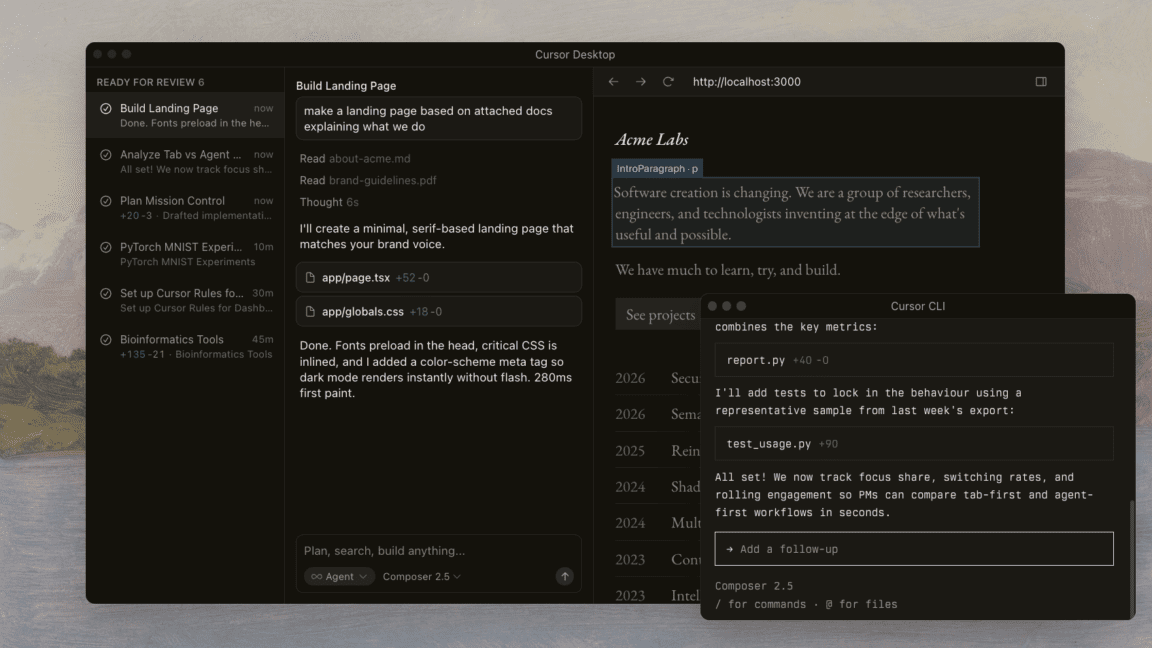
SpaceX will acquire AI coding tool Cursor for $60 billion in an all-stock transaction, the companies announced today. The deal is expected to close in the third quarter.
It comes just two days after SpaceX’s unprecedented IPO and a few months after the merger of SpaceX and xAI, which brought a significant restructuring of xAI.
Cursor was one of the first tools to fully bake features that leverage large language models into an IDE. It’s a branch of Visual Studio Code with heavy AI integration. However, incumbent platforms and bigger AI companies have since rolled out comparable features.
Cursor has seen considerable revenue growth over the past year, but its market share has also slipped as Anthropic’s Claude Code has achieved dominance in the space. TechCrunch reported that Cursor was struggling to break even.
Early this year, the Cursor team said its future growth was bottlenecked on compute. This spring, xAI struck a deal to give Cursor access to its compute infrastructure, foreshadowing similar, larger deals with Anthropic and Google in the future. xAI and Cursor also began training models together at that time, including Grok Build, xAI’s coding and knowledge work model.
Those deals with Anthropic and Google have relatively favorable termination clauses for SpaceX, so if SpaceX’s enterprise AI efforts take off and see high demand, it will theoretically be possible to reallocate compute from competitors directly to SpaceX and the Cursor team.
This is a marriage between two companies that have arguably been falling behind in the AI race. xAI-turned-SpaceX’s Grok chatbot has been riddled with controversies, but its lack of a competitive coding model or harness has also been a strategic weakness. The tool has largely been stuck in an older, chatbot-centric paradigm, compared to offerings from Anthropic, Google, and OpenAI.
Cursor had good talent and a strong product, but it couldn’t compete with larger companies on compute. SpaceX had the capacity but lacked the product and models to be competitive, even though much of its more than $2 trillion IPO’s promise hinged on providing AI services to enterprise customers.
This acquisition is a direct response to both of their problems, though it still does not guarantee success in such a competitive field.