17 C
London
Monday, June 1, 2026
Home Blog

AI costs how much? GitHub Copilot users react to new usage-based pricing system.

0
ai-costs-how-much?-github-copilot-users-react-to-new-usage-based-pricing-system.
AI costs how much? GitHub Copilot users react to new usage-based pricing system.

In April, GitHub announced that it was moving subscribers from request-based billing to a usage-based model for its AI-powered Copilot service. As that new pricing model goes into effect today, many GitHub Copilot users are reporting some extreme sticker shock as they realize just how quickly their previous “normal” usage is burning through their newly limited monthly allotment of AI credits.

Across social media and forums, many Copilot users are sharing personal statistics showing how just a few hours of AI usage can now account for a large chunk of their new monthly subscription caps. For some users, it reportedly took less than a day to use up a month’s usage quota.

That’s a big change from previous months, when GitHub Copilot subscribers were allocated a certain number of “requests” and “premium requests” based on their payment tier. GitHub said that the old system meant that “a quick chat question and a multi-hour autonomous coding session [could] cost the user the same amount,” forcing Copilot itself to “absorb much of the escalating inference cost behind that usage.” Indeed, some Copilot users have been sharing estimates from GitHub’s own tool showing that their previous monthly usage would rack up bills in the thousands of dollars under the new pricing plan.
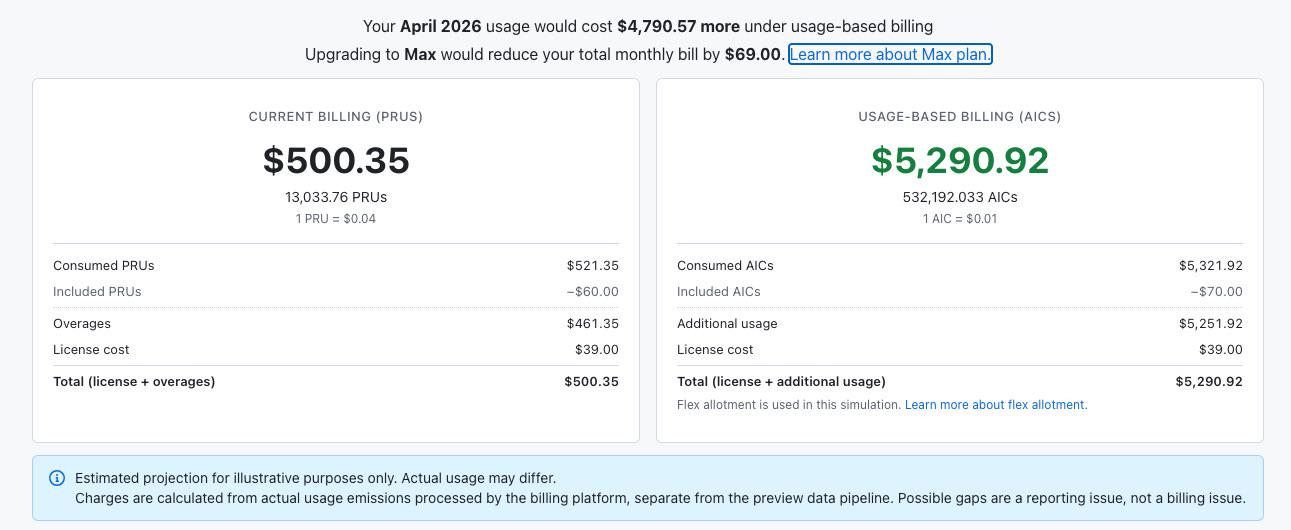
Cost estimates like this show just how much GitHub was subsidizing power users’ Copilot habit in the past months.

Cost estimates like this show just how much GitHub was subsidizing power users’ Copilot habit in the past months. Credit: twhoff / Reddit

Under GitHub’s new usage-based pricing system, paid Copilot subscriptions instead grant users a certain number of AI “credits” each month, with one credit corresponding to $0.01 of usage. Subscribers also get bonus credits depending on their subscription level: the $10/month Pro plan includes 1,500 credits ($15 worth); the $39 Pro+ plan includes 7,000 credits ($70 worth); and the $100/month Copilot Max plan includes 20,000 credits ($200 worth).

The precise number of Copilot credits used by a given prompt is determined by the number of input and output tokens used and the rates charged by the underlying large language model. That means pricing is highly dependent not just on the type of request but on the specific model that a user chooses. One million output tokens from OpenAI’s GPT-5.4 nano would run just $1.25 on GitHub Copilot, but that same level of output would run $30 on the frontier GPT-5.5 model (Copilot users who rely on “Auto” mode to pick the most appropriate available model for any request should be extremely careful, as some users report it can switch to expensive models for extremely simple queries).

How much for that prompt in the window?

Spot testing by Ars Technica found that re-running our simple “build a Minesweeper game” prompt through Claude Haiku 4.5 via Copilot used about 94 credits (you can view the results here). That’s a pretty decent rate for a relatively simple toy project. But it’s also easy to see how those kinds of costs could balloon quickly for requests involving major changes or reviews on complex codebases.

You can see that kind of ballooning cost in reports of a single complex prompt burning through 171 Copilot credits, or another spending 700 credits on “a few prompts,” or a couple of Copilot-led commits using up 5,000 credits. Other Copilot users expressed surprise at just how many credits could be spent on even simple Copilot requests, from a reported 15 credits for a simple “run-of-the-mill query” to spending 100 credits in “generating a small plan.”

“Even though I was super cautious on the first day, trying it out with a limited number of uses, it still consumed 840 credits,” one user wrote of testing Claude Sonnet 4.6 through Copilot today. “I haven’t even done any really complex work yet,” another user complained after reported usage representing 21 percent of their monthly Pro Copilot subscription’s credit allotment in a single day. “I have a feeling I’ll be going somewhere else pretty soon.”
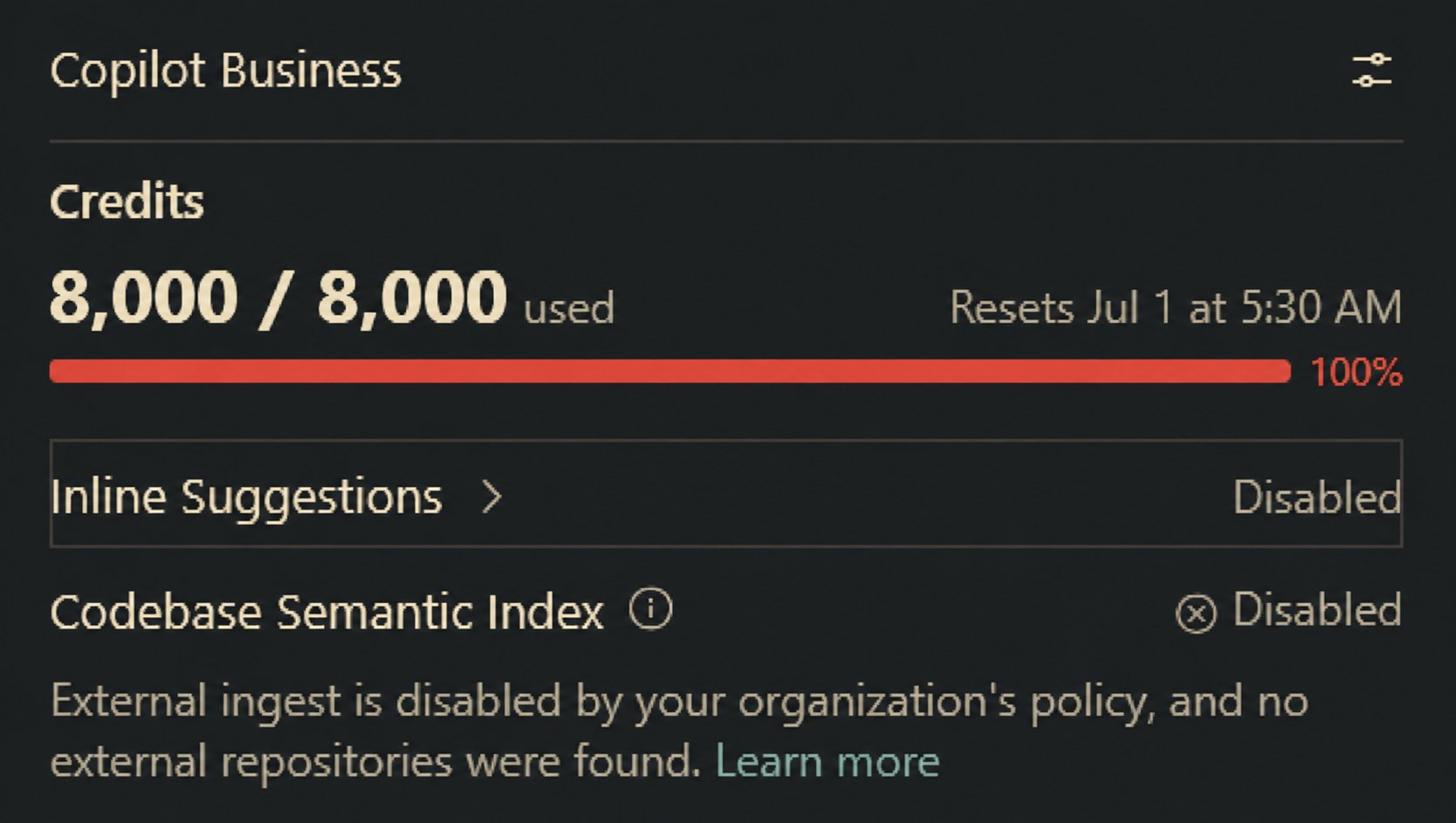
Using all 8,000 of your org’s monthly AI credits in a single day is… probably not sustainable.

Using all 8,000 of your org’s monthly AI credits in a single day is… probably not sustainable. Credit: gxjo / X

Amid the pricing change, plenty of GitHub Copilot users are predictably and publicly threatening to cancel their subscriptions or looking for other AI coding options. But others say they have been able to adjust to the new world of usage-based pricing. Coder Henri Kinnunen writes that they only burned 161 credits in a “productive day” of using Claude 5.3-Codex through Copilot, thanks to limiting themselves to “very focused and deliberate changes with AI.” Over on Bluesky, coder Neil Hewitt wisely noted that continuing a three-day-old chat session on Copilot probably isn’t as wise now, since it means sending “the entire chat history as context every time… hey, input tokens use credits… it’s not rocket science.”

While some Copilot users are jumping ship for other services with more generous usage limits, that kind of subsidized customer acquisition may soon give way to Copilot-style usage-based pricing across the industry. If that happens, LLMs that are more efficient with their tokens may win the economic battle; on Reddit, one user is already discussing how they’ve integrated Deepseek into their GitHub VSCode environment at a cost of only “about 7 cents for 15 million tokens.” While you might say “you get what you pay for,” some AI users are now contemplating a world where they also have to pay for what they get.

Shipping Leaders Demand Clear Rules Before Returning to Strait of Hormuz

0
shipping-leaders-demand-clear-rules-before-returning-to-strait-of-hormuz
Shipping Leaders Demand Clear Rules Before Returning to Strait of Hormuz


Shipping executives gathering in Athens on Monday warned that any future peace agreement between the United States and Iran must include clear, enforceable rules to allow commercial vessels to safely resume operations through the Strait of Hormuz.

The comments came as shipowners and maritime officials met at the Capital Link conference and other events marking the start of Posidonia, the biennial week‑long shipping exhibition. Industry leaders said uncertainty in the Gulf continues to disrupt global trade and place heavy strain on crews.

Pankaj Khanna, president of Heidmar Maritime Holdings Corp, said the sector urgently needs a defined framework outlining how ships can enter and exit the region once a peace deal is reached. He noted that one of the company’s vessels has been stuck inside the Gulf for three months, with seafarers missing major family events.

Greece’s shipping minister, Vasilis Kikilias, said no one can predict when the conflict will end, stressing how quickly tensions escalate and how slowly they are resolved. He insisted that global shipping must not be denied free passage, even though recent events show that keeping maritime trade out of geopolitical disputes is increasingly difficult.

Yiannis Procopiou, CEO of Centrofin Management, said that while insurance may still be available, the Strait of Hormuz remains a high‑risk transit point without clear rules of engagement for dealing with both the U.S. and Iran. Until such guidelines exist, he argued, the area will remain an unattractive and dangerous route for commercial shipping.

Battleground Vienna: Austrian intelligence officer convicted of spying for Russia belongs to a long tradition

0

Egisto Ott is no James Bond. But the stories the 63-year-old Austrian told a Viennese jury recently would make good plotlines. Ott worked as an intelligence officer in Austria’s now-defunct Federal Office for the Protection of the Constitution and Counterterrorism. He was also moonlighting for the Russians.

Prosecutors say Ott, who was sentenced to four years in prison on May 20, handed over information to fellow Austrian Jan Marsalek, the fugitive former executive of the collapsed payments firm Wirecard. Marsalek ran a cell of Bulgarians who were convicted in London in 2025 of spying for Russia. They called themselves the “minions”.

In 2023, the London Metropolitan police in cooperation with MI5 secured chat messages between Marsalek and the minions, which led to Ott. It turned out Ott had provided sensitive data on dissidents, investigative journalists and a Russian intelligence defector. The trial also revealed that Ott had obtained the infamous “canoe-trip-mobiles”.

In 2017, high-ranking Austrian civil servants went on a canoe trip in a tributary of the Danube River. They managed to fall into the water and had their phones sent in for repairs. Their mobile data was copied by Ott and subsequently ended up in Moscow, along with Marsalek’s favourite Viennese chocolate cake, a Sachertorte. According to the chat messages, the minions had a stressful time finding the correct one (there are rival Sachertorte recipes).

Egisto Ott in a courtroom in Vienna.

Egisto Ott in a courtroom in Vienna on May 20. APA-Images / Alamy

What sounds like a comic opera has a sinister backstory. Since the 1950s, Austria has hosted several international organisations that are regularly targeted by intelligence services. These include Opec (the Organization of Petroleum Exporting Countries), the International Atomic Energy Agency and the United Nations Office on Drugs and Crime.

However, Austria’s reputation as a spying hub dates back even longer. The Austrian capital, Vienna, was known for espionage before and after the second world war. Arnold Deutsch, the recruiter of the Cambridge Five spy ring that passed information to the Soviet Union, hailed from Vienna. Its leading light, Kim Philby, was also talent-spotted by Soviet intelligence in the city in 1933.

But Vienna was never just a playground for Soviet intelligence. After the war, when the city was divided into four sectors for allied occupation, the UK’s foreign intelligence service, MI6, started its most creative cold war operations. Peter Lunn, head of MI6’s Vienna station, built listening stations in the city to tap Soviet phone lines.

He hid his listening tunnels underneath ordinary shops in the British zone. The first tunnel was built beneath a police station. Later, MI6 built another tunnel under a jewellery shop and then installed intelligence officers posing as a young, rich couple in a Viennese villa. While they were partying upstairs, their colleagues listened in to Russian military traffic downstairs.

The only surviving witness of a listening station today is Sir Rodric Braithwaite, whom I first interviewed in 2024. As a 19-year-old conscript, Braithwaite worked with British Army Field Security in the Aspang listening station, next to the Aspang Bahnhof (a train station on the outskirts of Vienna).

It wasn’t an uplifting experience. He sat there for long shifts with earphones on, handling old equipment and pressing recording buttons. But his memories of the tunnel are valuable because to this day MI6 has not released any photos, let alone recordings, that were made during these operations.

The Third Man

They have also not revealed the details of another highly creative intelligence operation. In 1948, a British team arrived in Vienna to film The Third Man, a thriller set in the city. They were eager to shoot scenes in the Soviet sector.

Four key people involved in the making of the film were working for British intelligence: novelist Graham Greene, director Carol Reed, “Austria advisor” Elizabeth Montagu and, most importantly, producer Sir Alexander Korda. Korda’s film production company had been providing covers for British intelligence officers in Europe since the 1930s.

Whether the filming of The Third Man was connected to Lunn’s tapping operations, or whether MI6 had to smuggle something out of the Soviet sector, is a matter of conjecture. But “odd people” appeared on the set.

Carol Reed in Amsterdam in January 1950.

The director of The Third Man, Carol Reed, in Amsterdam in January 1950. Jack de Nijs / Wikimedia Commons, CC BY

The film’s sound engineer, Jack Davies, remembered a British technician who turned up out of the blue. After filming, the technician vanished completely and Davies never came across him again – something rather unusual in the small world of British film technicians.

The script girl, Angela Allen, who I first interviewed for my book Das Haus am Gordon Place (Vienna ‘48) in 2024, also realised that something odd was going on. She noticed that Carol Reed was under enormous stress in Vienna and kept himself awake with Benzedrine. He stopped taking the drug once they were back in England, filming in London studios.

Allen, who is 97 now, wasn’t surprised to find out years later that Korda was working for the British intelligence services. She told me: “He had enormous charm. He could make his people do everything for him.”

Perhaps that is one reason why Ott and Marsalek failed. To succeed as a spy in Vienna, you need to be a great illusionist like Alexander Korda.

In Iran war’s shadow, Israel’s renewed Lebanon campaign risks repeating failed lessons – and occupations – of the past

0
in-iran-war’s-shadow,-israel’s-renewed-lebanon-campaign-risks-repeating-failed-lessons-–-and-occupations-–-of-the-past
In Iran war’s shadow, Israel’s renewed Lebanon campaign risks repeating failed lessons – and occupations – of the past

Going into the war in Iran, the Israeli government seemingly had two intertwined goals: to bring down the Islamic Republic and rid Israel of its Hezbollah problem.

The logic went that the Lebanese Shiite group – which has posed a persistent threat to Israel for 44 years – would finally succumb if stripped of its Iranian benefactor. After all, Israeli attempts to destroy Hezbollah through direct military action had not been effective, nor had internationally supported disarmament efforts.

But as the United States and Iran continue to negotiate over an agreement that might put an end to their war, the Israeli-Lebanese front remains as active as ever. Israel has increased strikes and incursions deeper into Lebanon, while Hezbollah is targeting the Israeli military deployed in southern Lebanon and the civilian population in northern Israel.

Worse, from the Israeli government’s perspective, is that Iran has found a way of turning its survival and newfound leverage over the Strait of Hormuz into protecting Hezbollah. Tehran is currently conditioning a potential deal with Washington on a complete halt of Israeli hostilities in Lebanon – a move clearly designed to safeguard the political and military standing of Hezbollah, its primary proxy.

Since full-scale war returned to Lebanon on March 2, 2026, it has had a massive humanitarian cost. As of June 1, over a million Lebanese have been displaced and more than 3,300 killed since the beginning of March. On the Israeli side, 24 soldiers and 4 civilians have been killed in the same time period.

Israel seeks to decouple its Lebanon front from the wider regional conflict, aiming to maintain its military campaign against the Shiite organization independently of broader U.S. negotiations with Iran. But whether it will able to do this is uncertain. The Trump administration has largely excluded Israel from the specifics of its Iranian dialogue while attempting to restrict Israeli operations in Lebanon to strikes in the country’s south and the Bekaa Valley and prohibiting attacks on state infrastructure. The ordering of attacks on Lebanon’s capital, Beirut, by Israeli Prime Minister Benjamin Netanyahu on June 1 lays bare the limits to U.S. pressure.

And ultimately, the resolution of this conflict rests upon how President Donald Trump chooses to navigate Iranian demands concerning the future of Lebanon.

As a historian of Israel and Lebanon, I have studied cycles of violence between these parties since 1982, and have noted recurring patterns in which Hezbollah has emerged emboldened, maintaining its dominance over Lebanese society as an Iranian proxy. Contrary to Israeli hopes, Iran’s patronage of Hezbollah has not been ended by the Iran war. And to confound issues, continued Israeli occupation of Lebanese land could grant Hezbollah the necessary justification to sustain its narrative of resistance at the cost of the broader Lebanese population.

A wounded but not dead Hezbollah

While significantly weakened as a result of more than two and a half years of war with Israel, Hezbollah continues to wield considerable power in Lebanon.

After a ceasefire in November 2024 – following the full-scale war in September-October of that year – ostensibly stopped fighting, a new Lebanese president was elected and a new government was established in February 2025.

A tank operates in a hilly environment.

An Israeli military tank drives along the Israeli-Lebanese border. Gil Cohen-Magen/Picture Alliance via Getty Images

That ended a three-year political deadlock generated by Hezbollah’s effective veto power over successive Lebanese governments since 2008. Even since the formation of a government in 2025, however, the Lebanese state has been unable to effectively make progress in disarming Hezbollah as stipulated in the November 2024, armistice agreement that ended that previous round of fighting.

Instead, Iran invested significant efforts to prop up its Lebanese proxy. Tehran even sent senior officers of its Revolutionary Guard soon after the November 2024 ceasefire to assume the command of the Shiite organization, which lost many of its leaders at the hands of Israeli assassinations and targeted strikes.

These efforts are paying off for Tehran now, as seen through Hezbollah’s ability to challenge Israel militarily.

With the beginning of this most recent war in March, the Lebanese prime minister banned Hezbollah’s operations, while the president condemned the group for dragging Lebanon into a conflict that most Lebanese rejected.

But, as in the past, the government has been unable to effectively rein in Hezbollah. A telling case came on March 24, 2026, when Lebanon’s Foreign Ministry declared the Iranian ambassador a persona non grata, ordering him to leave the country.

Iran and Hezbollah defied the order and the ambassador refused to leave the embassy in Beirut.

This example also suggests that the hopes for revitalized state capacities after the current Lebanese government came to power in February 2025 – the first government since 2008 not controlled by Hezbollah – may have been premature.

Gaza via Lebanon

Employing what some have called a “Gaza model” in Lebanon, Israel has effectively created a new security zone in south Lebanon by occupying Lebanese territory, razing to the ground whole villages that Hezbollah had used for military purposes and clearing out most of the population from the area.

But Israel has occupied south Lebanon in the past: first in March 1978, during the Litani operation, and then again from 1982 to 2000. The failure of these occupations should raise alarms in Israel. Neither resulted in lasting security improvements and instead left indelible, traumatic scars on Israel’s collective consciousness, creating the image of Lebanon as a quagmire into which Israel has been repeatedly drawn.

The government of Netanyahu is now leading the country into another potential quagmire in Lebanon.

The news about the Israel Defense Forces’ occupation of the Beaufort castle in south Lebanon on May 31 should bring grim memories for Israelis. That castle remains entrenched in the collective memory of Israel’s occupation of south Lebanon in 1982-2000 as a symbol of its failure. Netanyahu, however, packaged Israel’s occupation as a sign of strength, stating that “we have returned stronger than ever.” History suggests otherwise.

An old castle fortification stands atop a hill.

An Israeli flag flies over the medieval Beaufort castle on May 31, 2026. AFP/Getty Images

History repeats itself

Netanyahu is driven in large part by Israeli domestic affairs.

A majority of Israelis support the continuation of the war against Hezbollah. Moreover, with national elections scheduled for October 2026, Netanyahu needs to show some success in at least one of the multiple military fronts he has intentionally kept open since the Hamas attack on Oct. 7, 2023.

With Netanyahu seemingly failing to achieve his aims in Iran, Lebanon and Hezbollah provide him with an opportunity to keep a state of emergency in Israel, which he needs for his own political survival.

But failure in Iran makes achieving Netanyahu’s goal in Lebanon that much harder. The government in Tehran seems to have found significant leverage over the U.S. and Israel. And under these conditions, Tehran would not give up on Hezbollah, which remains its most important regional asset.

Diplomacy is the only way out of this imbroglio. And while it would not likely lead to the disarming of Hezbollah and to the Israel’s full withdrawal from south Lebanon, it remains the only constructive way forward.

At the behest of the Trump administration, Israeli and Lebanese ambassadors met to discuss a diplomatic understanding between two countries that have never had official relations. And on May 30, military representatives of the two countries met in Washington, D.C.

For the first time since 1983, the Lebanese government has agreed to negotiate directly with Israel over a long-term political agreement, including the possibility of finally demarcating their shared borders. Hezbollah, as expected, has vehemently opposed these negotiations.

What we are seeing currently unfolding in Lebanon is another testament to the failure of the Israeli-U.S. war against Iran. Yet a war that began with lofty promises of a new Middle East may end up with a worse version of the old Middle East – an emboldened Islamic Republic, a new Israeli occupation of south Lebanon and a Hezbollah, while weaker than before, still entrenched as an armed militia outside of Lebanese state control and working in concert with Iran.

Microsoft’s Surface Laptop Ultra looks like its first true MacBook Pro competitor

0
microsoft’s-surface-laptop-ultra-looks-like-its-first-true-macbook-pro-competitor
Microsoft’s Surface Laptop Ultra looks like its first true MacBook Pro competitor

Dell, Asus, Lenovo, HP, MSI, Acer, and Gigabyte are among the PC makers that are designing systems around Nvidia’s RTX Spark, Nvidia’s new Arm-based chip for Windows PCs. But the flagship RTX Spark PC may be from the same company that makes Windows: the new Microsoft Surface Laptop Ultra is a high-end RTX Spark system that will offer up to 128GB of unified memory for “creators, developers, and AI builders.”

Microsoft says the Laptop Ultra will be available “later this year” but didn’t discuss any specific pricing or configuration options.

The Laptop Ultra will slot in above the regular Qualcomm Snapdragon-based Surface Laptops in Microsoft’s lineup. Microsoft has made high-end Surface devices with more powerful CPUs and GPUs before, but to date, they’ve also come with convertible designs that may have limited their appeal. The first was the old Surface Book, with its fully detachable screen and bendy-straw hinge that didn’t close all the way; the second was the Surface Laptop Studio, with its chunky design and sliding screen. The Laptop Ultra is Microsoft’s first attempt to follow the MacBook Pro formula: it’s like the other Surface Laptops, just with more power.

Microsoft says the Laptop Ultra will include USB-A, USB-C, and HDMI ports, as well as an SD card slot and headphone jack. It’s said to include a haptic trackpad that’s “the largest we’ve ever put on a Surface.” A 15-inch PixelSense display offers up to 2,000 nits of peak brightness.

Unlike some older Surface Laptops, the Laptop Ultra is just a more powerful laptop, not a more powerful one that also comes with some weird convertible mechanism.

Unlike some older Surface Laptops, the Laptop Ultra is just a more powerful laptop, not a more powerful one that also comes with some weird convertible mechanism. Credit: Microsoft

As for the internal specs, Nvidia’s RTX Spark includes up to 20 Arm CPU cores (10 large high-performance cores, and 10 mid-sized cores with better efficiency) and up to 6,144 Blackwell-based GPU cores. This gives the high-end RTX Spark roughly the same computing resources as a desktop GeForce RTX 5070, though in a lower 80 W power envelope and attached to slower LPDDR5x RAM rather than GDDR7.

But the chip’s biggest advantage for AI developers and some gamers may be the system’s pool of unified memory. A typical RTX 5070 can access only 8GB or 12GB of memory; the RTX Spark’s built-in GPU will likely be able to access nearly all of the system’s built-in memory. Even a laptop with 32GB of RAM could devote more of that memory to the GPU than a GeForce RTX 4090 or 5090 could.

Gaming is still a relatively weak point for the Arm version of Windows, but Nvidia and Microsoft have said that they’re working with the developers of popular online games that rely on kernel-level anti-cheat software to make those titles run on Arm systems. Microsoft’s Prism x86-to-Arm code translation technology and an increasing number of Arm-native third-party apps have made Arm-powered Windows PCs feel a lot more like regular Windows devices than they used to.

Microsoft has used Nvidia’s chips in Surface PCs before, if you count the first Surface RT models. These ran an Arm-native version of Windows 8 that was limited mostly to apps downloaded from the Microsoft Store and offered no x86-to-Arm code translation. While the work done on Windows RT was no doubt the foundation that the Arm versions of Windows 10 and Windows 11 were built on, Windows RT quickly failed and vanished, along with Nvidia Tegra-based PCs.

Fans Smash Through Glass Doors at Mall Event for TV Star (Video)

0
fans-smash-through-glass-doors-at-mall-event-for-tv-star-(video)
Fans Smash Through Glass Doors at Mall Event for TV Star (Video)


Chinese actor Zhang Linghe was forced to scrap a major brand appearance on Sunday after a massive crowd of fans turned a shopping center event into chaos.

The 27-year-old actor and model was scheduled to appear at a Molsion eyewear event in Nanning, a city in southern China, when thousands of excited fans packed the venue hoping to catch a glimpse of the television heartthrob.

But the situation quickly spiraled out of control.

According to reports and videos shared on social media, fans surged toward the entrance as the doors opened. The force of the crowd was so intense that the glass entrance doors shattered, leaving five people injured.

Footage from inside the mall also showed fans crowding balconies and upper levels of the shopping center, with many trying to get a better view of the star.

The brand event was eventually canceled for safety reasons and moved online instead.

Zhang’s studio later said it would reimburse fans who had traveled to attend the appearance. Molsion also said it had arranged medical checks for those who suffered minor injuries and promised to strengthen safety measures at future events.

The frightening scene shows just how intense Zhang’s fanbase has become as his star continues to rise far beyond China.

Zhang Linghe has become one of Chinese television’s biggest breakout names in recent years. He has appeared in several hit dramas, including Love Between Fairy and Devil, The Princess Royal, and Pursuit of Jade, all of which helped boost his popularity with international viewers on Netflix.

What was supposed to be a glamorous eyewear promotion instead became a startling reminder of the frenzy that can follow today’s biggest streaming-era stars.

Al-Aqsa: The moment of peril is here. Will the Muslim world act?

0
al-aqsa:-the-moment-of-peril-is-here.-will-the-muslim-world-act?
Al-Aqsa: The moment of peril is here. Will the Muslim world act?

An exclusive investigation by Middle East Eye last week revealed that both US and Israel were coordinating to remove Jordan’s custodianship over Islam’s third holiest site.

This is not a diplomatic manoeuvre. It is the culmination of a systematic campaign to erase the Islamic presence in Occupied Jerusalem and a direct call upon Muslims worldwide to awaken from a dangerous and complicit slumber.

When the announcement arrives, it will wear the language of pluralism as a mask. It will invoke “multi-faith coexistence”, “equal access”, and “shared heritage”.

Yet, beneath this veneer lies the reality; it is the final act of Israeli colonisation. Jerusalem’s Islamic identity will be effaced, its name and meaning repurposed to serve the Israeli colonial order.

Middle East Eye reported that both Washington and Tel Aviv were “actively working” to strip Jordan of its historic custodianship over Al-Aqsa Mosque. The plan would abolish the authority of the Jordanian-backed Islamic Waqf and replace it with a body created by the Israeli government.

That new entity would declare Al-Aqsa a “multi-faith centre” and would grant Jews “equal access”. It would allow Israel to appoint imams and officials. Israeli authorities would have a sign-off over the content of Friday sermons.

The Trump administration wishes to see al-Aqsa stripped of its Islamic identity. It would then be repackaged as a tourist attraction hosting all three Abrahamic religions.

This is not a mere proposal. It is a blueprint for ethnocide.

The systematic campaign aims to purge Jerusalem of its Muslim identity and render invisible the histories and presences that have shaped this sacred space.

The current process of removing Jordan’s custodianship is not new; rather, it is the officialisation of ongoing Israeli colonisation.

The reality is that the status quo, recognising Al-Aqsa as an Islamic sanctuary under the Waqf, has been eroded incrementally, reflecting the deliberate strategy to shift authority and identity away from Muslims and toward an Israeli colonial order.

This is not a matter of speculation. The evidence is concrete, documented, and mounting with each passing year.

A 2025 report by the Israeli monitoring group Ir Amim recorded an unprecedented rise in Jewish raids on the Aqsa compound. Israeli authorities provide police protection.

They increasingly exploit Jewish and national holidays to increase the number of Israelis entering Al-Aqsa. Researcher Aviv Tatarsky stated plainly, “Under the guise of religious Jewish connection, Israel is steadily taking control of the holy site.”

Al-Aqsa once welcomed hundreds of thousands for Friday prayers. Now, due to Israeli restrictions and harassment of Muslims, it sees only a few thousand and sometimes hundreds for daily worship.

Israel already has total control of who enters and exits al-Aqsa.

The restrictions imposed on Palestinian worshippers are not arbitrary. They are the calculated expression of a colonial logic of attrition. In this year alone, over 600 Palestinians have been banned from Al-Aqsa. Thirty Waqf employees had their entry permits revoked, and six imams have been silenced and barred from delivering sermons.

As Ekrima Sabri, senior imam of Al-Aqsa, observes, these are “unprecedented actions” designed to impose domination. Where once we warned that Al-Aqsa was in danger, now we must recognise it faces a multiplicity of dangers, each compounding the other.

Axis of Islamic identity

Last month, Israeli ministers and parliamentarians orchestrated mass incursions into Al-Aqsa.

An Israeli lawmaker openly called for Al-Aqsa to be demolished and replaced with a Jewish temple. Israeli flags were hoisted within the Aqsa compound.

At the same time, Israel has advanced the confiscation of Palestinian property near the Chain Gate street, a vital entryway in Jerusalem’s Old City. This is part of the accelerating Judaisation of Jerusalem.

Eight Arab and Islamic states condemned the closure of Al-Aqsa during Israel’s war on Iran. During this period, al-Aqsa was sealed for 40 days. It was an act of colonial domination that rendered Muslim sacred space subject to the whims of occupation.

I say this as directly as I am able to say anything. The Muslim world’s greatest threat at this moment is not only Israeli aggression, backed and bankrolled as it is by American power – it is the apathy, the division, and the institutional paralysis of those who claim al-Aqsa as their own.

For Muslims, Al-Aqsa is not a heritage site to be managed by diplomatic communiques. It is the first qibla, the site of the Prophet Muhammad’s Night Journey and Ascension, the holiest Masjid, and a living axis of Islamic identity and civilisation. Its desecration is not merely a geopolitical provocation. It is an assault on the collective memory and selfhood of over two billion people.

And yet the Muslim world watches, issues statements, and returns to its silence. Governments that could apply genuine economic and diplomatic pressure calculate their interests and look away.

The ummah that could fill streets instead scrolls past.

Silence is complicity

For those outside the Muslim world, the stakes remain profound. What is unfolding is the formalisation of colonial sovereignty over a site revered by more than two billion people.

This act would enshrine a precedent. That the slow violence of erasure, when executed with sufficient propaganda and imperial backing, is not only tolerated but ultimately rewarded.

The Arab Organisation for Human Rights has meticulously documented the systematic nature of these violations. The global community, for the most part, has chosen silence. That silence is not neutral. It is complicity.

The 11th hour has already arrived. The Muslim world, and everyone opposing colonial erasure, must mobilise all tools, diplomatic, legal, economic, and moral immediately.

If we do not act now, with the full weight of conscience and conviction, the language of coexistence will have been used to complete a Zionist dispossession decades in the making.

This article was first published at Middle East Eye on 1 June 2026

The views expressed in this article belong to the author and do not necessarily reflect the editorial policy of Middle East Monitor.

President Trump Claims Hezbollah Agreed To Stop Attacks as Israel Halts Beirut Strike

0
president-trump-claims-hezbollah-agreed-to-stop-attacks-as-israel-halts-beirut-strike
President Trump Claims Hezbollah Agreed To Stop Attacks as Israel Halts Beirut Strike


US President Donald Trump said Monday that Israel called off a planned military operation in Beirut following a conversation with Prime Minister Benjamin Netanyahu, while Hezbollah separately communicated through intermediaries that it was prepared to halt attacks on Israel.

In a post on Truth Social, President Trump said he spoke directly with Netanyahu and that Israeli forces were instructed not to proceed with the operation in the Lebanese capital.

“I had a very productive call with Prime Minister Bibi Netanyahu, of Israel, and there will be no Troops going to Beirut, and any Troops that are on their way have already been turned back.”

President Trump also said he received a message from Hezbollah through intermediaries indicating that the group was willing to stop hostilities.

“Likewise, through highly placed Representatives, I had a very good call with Hezbollah, and they agreed that all shooting will stop—that Israel will not attack them, and they will not attack Israel.”

Separately, Axios reported that Lebanese Parliament Speaker Nabih Berri informed the Trump administration that Hezbollah is prepared to enter an immediate and comprehensive ceasefire with Israel.

According to Berri adviser Ali Hamdan, the message was delivered to US Ambassador Michel Issa on Sunday. Hamdan said Hezbollah was prepared to abide by a broad ceasefire arrangement and that Berri was willing to guarantee its implementation.

Axios reported that the proposal went beyond an earlier US initiative under which Hezbollah would suspend attacks on northern Israel in exchange for an Israeli commitment not to strike Beirut.

Hamdan said Berri advocated a complete ceasefire rather than a phased arrangement, including an end to military activity on land, at sea, and in the air, as well as a halt to the demolition of homes in southern Lebanon.

Earlier Monday, Netanyahu and Defense Minister Israel Katz indicated that Israel was prepared to intensify pressure on Hezbollah positions in Beirut.

In a video statement, Netanyahu said Hezbollah headquarters in the Dahieh district would no longer be considered off-limits.

“There will be no situation in which Hezbollah attacks our cities and citizens while the terror headquarters in Dahieh remain off-limits,” Netanyahu said.

He also said Israeli forces were expanding operations in southern Lebanon and targeting Hezbollah infrastructure.

The fight to protect pollinators and people from the ‘pesticides that are everywhere’

0
the-fight-to-protect-pollinators-and-people-from-the-‘pesticides-that-are-everywhere’
The fight to protect pollinators and people from the ‘pesticides that are everywhere’

Born and raised in Colorado, Cory Kreft began working on a honey farm at 15 years old. He returned to beekeeping after college, eventually buying the business from his former boss. But in 2021, his bees suddenly began dying. He lost 85 percent of his hives. The losses continued the next year, and the next. After extensive testing, he identified the culprit: a relatively new class of pesticides called neonicotinoids, often shortened to neonics. 

These chemicals are commonly used to coat crop seeds before planting, ostensibly to protect the plant from pests and insects during early growth. Thanks in part to a federal regulatory loophole, the use of neonic-treated seed has quietly exploded in recent years, with little regulation or oversight. Almost all conventional corn and more than half of soy seed in the U.S. is now treated with neonics. 

A legal loophole called the treated article exemption allows companies to apply these toxic chemicals to products like seeds without registering them separately as pesticide products. The seeds then fall into the same class as antimicrobial toothbrush coatings or treated lumber sold at major home improvement stores, with few legal limitations around how they are monitored, used, or disposed of. “Anyone can legally go buy this pesticide-treated seed, dump it in a river, and then contaminate the entire water system,” Kreft said.

Promised to be safer, but still toxic

Neonics were first introduced in the 1990s with the promise of being safer than older pesticides. “Neonics are neurotoxins, and they work by attacking critical parts of insects’ nervous systems,” says Jennifer Sass, a scientist with the Natural Resources Defense Council, or NRDC. The chemicals target neural receptors that are more common in insects than mammals. 

Neonics are systemic, so they move from treated seed into the tissues of the entire plant, including the pollen and nectar, and the fruits and vegetables that people eat. Manufacturers and government regulators claimed that these properties would make neonics relatively harmless to wildlife and people, and reduce soil and water contamination, since they claimed the pesticides would stay within the plant. 

Those claims didn’t hold up, says Sass, who has been researching pesticides for over 25 years. “They were supposed to be safe for people and wildlife. But none of that turned out to be true.” 

Since then, research has shown that neonics pose profound health risks for pollinators, ecosystems, and likely also people. The pesticides persist in the environment long after application and can travel via wind or waterways, contaminating ecosystems and communities miles away from where they were originally used. Overall, the amount of land treated with insecticide has continued to increase.

Research on seed coatings has found that they don’t typically help corn farmers’ bottom line either. Treated seeds have shown little or no impact on crop yield, so farmers are also paying more for unnecessary chemicals. Even so, pesticide-treated seeds have become so ubiquitous that it’s often hard for farmers to source untreated seed, and many use neonic pesticide-treated seed when they’re not needed. 

Neonics have become nearly impossible for pollinators and people to avoid. “They’re everywhere,” Kreft said, noting that he now buys food to place inside his hives during the summer months to keep the bees from foraging contaminated plant material. “They’re in the corn pollen in Colorado and the Midwest, and almond farmers in California are injecting neonics into their trees and putting them into irrigation systems. There’s absolutely nowhere we can go that our bees won’t be exposed to them.” 

When bees encounter neonic-contaminated pollen, the neurotoxin disrupts the neurological functions they rely on to navigate, forage, and survive. The hive then slowly declines and dies. “Over the last five years, we’ve seen between 60 to 85 percent hive mortality each year,” said Kreft. “It’s about a million dollars in losses for us annually.” 

The impacts of neonic pollution

The regulatory loopholes around neonics don’t end at the seed sales stage. They extend to disposal, too. Judy Wu-Smart, an entomologist at the University of Nebraska-Lincoln, has devoted her career to pollinator research. In 2017, she and her team made a disturbing discovery when they checked their beehives at a research site near Mead, Nebraska: The bees in every hive were dead. The pattern continued year after year. “We had almost 100 percent mortality from 2017 through 2020,” she said.

The team discovered that an ethanol plant called AltEn was operating near their research site. Major agrichemical companies use facilities like this to dispose of unpurchased seed before it spoils. The AltEn plant, Wu-Smart said, was processing much of North America’s surplus neonic-treated corn seed, contaminating surrounding ecosystems. Because neonic-treated seed is exempt from many rules that normally govern similar pesticide products, the facility was not subject to the same regulation and oversight as other pesticide disposal locations.

At the same time, residents in the nearby town of Mead began experiencing troubling developments: dead wildlife, sick family pets, and mysterious health problems. The seed disposal plant was selling ground-up pesticide-treated seed residue as a soil conditioner to nearby farms. Farmers were unknowingly applying high concentrations of neonicotinoids to their fields. 

After mounting scrutiny, the AltEn ethanol plant closed in 2021. But Wu-Smart notes that now, no one knows where excess neonic-treated seed is going for disposal. “It’s a big black box,” she said.

A growing push for stronger regulation

While the harm neonics inflict on pollinators is well documented, their effects on humans remain less certain. A recent study found that over 95 percent of pregnant women had neonics in their bodies. The chemicals have been linked to neurological, reproductive system, and developmental harms. Because neonics are now so widespread in food and water, Sass said, exposure has become nearly constant. “It’s everywhere now,” she said. “It’s in breast milk, tap water, even in baby food.”

Sass highlights research showing links to autism and learning disabilities among children from families living and working around farm chemicals like neonics. “I want people to understand that neurotoxic chemicals are bad for our brains, especially with fetal or early childhood exposure,” she said. “Early life exposure is more likely to cause permanent harm, much like lead or mercury.” 

Yet while research into human health effects continues, the regulatory gaps around neonic-treated seed are enormous. Wu-Smart said that when her bees were dying, neither state nor federal agencies could intervene, since there was no clear legal pesticide violation, like using a product in a way that contravenes its label instructions or other rules. Instead, the bees were being exposed through neonics that had spread into the surrounding environment — something current pesticide enforcement mechanisms were not designed to address. The same loopholes that allow treated seed to avoid full pesticide oversight also have created regulatory gaps around storage, disposal, contamination, and exposure well beyond the farm fields the pesticides are intended for.

Advocacy groups like NRDC have turned to state-level legislation. In Colorado, lawmakers recently considered the SEED Act, which would have expanded farmers’ access to seeds without insecticide coatings, while limiting unnecessary use.  The bill highlighted how a handful of major agribusiness companies have dominated the seed market, leaving many farmers with few options beyond chemically treated seeds. 

During the SEED Act hearings in the Colorado Senate, the act’s opponents argued that the legislation could increase costs and administrative burdens for farmers, while supporters highlighted the data showing limited benefits from pesticide-treated seeds and the evidence of the harm that neonics cause to pollinators and human health. They argued that the bill would protect pollinators, waterways, and public health, while also giving farmers more choice.

The act was ultimately defeated in Colorado, but similar laws have passed in New York and Vermont, and neonic regulation proposals have emerged in other states, including Minnesota, Massachusetts, and Hawaii.

Commonsense solutions

There’s an urgent need to close the gaps around neonic regulation by advocating for policies that limit unnecessary neonic use, expand seed options without harmful insecticides, and shift agriculture away from default chemical use. Since most neonic seed treatments are not actually needed to address pest problems, and typically provide no overall benefit, critics say that farmers should not be automatically using the pesticides. Instead, they propose a need-based model that preserves farmers’ ability to use treated seed when truly necessary, while restricting unnecessary use that spreads pollution. Quebec adopted this approach in 2019, with striking results: Neonic treatment for corn seed went from near universal to near zero in just a few years.

Those protections can’t come soon enough. In Mead, Nebraska, the environmental damage from neonic-treated seed did not end when the plant closed in 2021. Wu-Smart said that the pesticide contamination still lingers. “We’re still seeing high amounts of neonics in the honey from our hives in the area,” she said. “I wouldn’t eat it.” 

In Colorado, beekeeper Cory Kreft is not sure he can continue his honey farm. “There’s so much work that goes into beekeeping,” he said. “If I can’t keep my bees alive because this pesticide is everywhere, why would I keep doing this?”


Philly Cops Admit That They’re Tracking “First Amendment Activity” Critical of AI

0
philly-cops-admit-that-they’re-tracking-“first-amendment-activity”-critical-of-ai
Philly Cops Admit That They’re Tracking “First Amendment Activity” Critical of AI


Americans speaking out against artificial intelligence data centers on social media are falling under police surveillance, a confidential law enforcement bulletin obtained by The Intercept reveals.

A fusion center in Philadelphia combed through spicy internet comments from AI critics and concluded there is a growing risk of physical violence against data centers from “domestic violent extremists,” ranging from white supremacists to anarchists.

“Domestic violent extremists (DVEs) are likely interested in targeting artificial intelligence (AI) data centers, posing a physical and cyber threat to infrastructure in the Philadelphia regional area,” the Delaware Valley Intelligence Center wrote in a December alert.

The fusion center distributed its warning, marked “for official use only,” through the national fusion center network of state, local, and federal police agencies.

Like many of the reports produced by fusion centers, the bulletin points to news reports and social media posts, but cites little in the way of tangible threats. It acknowledges “a lack of specific information on plans to target AI data centers in the Philadelphia area,” but warns law enforcement that three planned data center facilities in the region could become targets of future protests.

Some of the anti-AI posts included in the document reflect hyperbolic anti-AI rhetoric that is widespread across social media, including an unnamed internet user who “indicated a desire to ‘burn down’ data centers.” Other examples of potentially terroristic posts included references to a fictional anti-robot movement in the science fiction novel “Dune” and a Facebook meme.

The fusion center, housed inside the Philadelphia Police Department, warned that “disruptive First Amendment activity” is an “indicator” of risk from “Domestic Violent Extremists,” an expansive term favored by the FBI and other law enforcement agencies.

Fusion centers, which sprouted up across the country after the September 11, 2001, attacks, have long been criticized for doing little to thwart actual terror plots and too much to subject lawful protesters to suspicion and surveillance. They have previously warned local cops about the supposed threat from Black Lives Matter protesters and Keystone XL to Line 3 pipeline opponents.

Pennsylvania has its own history of counterterror agencies targeting advocacy groups. In 2010, then-Gov. Ed Rendell apologized for the state Department of Homeland Security contracting with a private firm to produce fearmongering reports on groups including anti-fracking activists.

When it came to the recent data center activist report, longtime Philadelphia civil rights lawyer Paul Hetznecker said he was troubled by the fusion center’s association of AI skeptics with terrorists.

“Those are legitimate, popular political concerns that are raised by local communities.”

“Those are legitimate, popular political concerns that are raised by local communities,” Hetznecker said. “This particular report from [the Delaware Valley Intelligence Center] reflects a very dangerous attempt to characterize that protected First Amendment activity — activity which is fundamental to our democracy — as something other, something more dangerous, a breeding ground for something more sinister.”

In response to questions emailed to the Philadelphia Police Department and the Delaware Valley Intelligence Center, a spokesperson responded with a statement asserting that the center “recognizes and respects the rights of individuals to lawfully express opinions, engage in peaceful advocacy, and participate in protected First Amendment activities.”

“Fusion centers exist to help stakeholders understand emerging threats and hazards that could impact public safety, critical infrastructure, major events, government facilities, businesses, and the communities we serve,” said Sgt. Eric Gripp, a spokesperson for the Philadelphia Police Department. “These assessments cover a wide range of topics and are designed to provide situational awareness, not to characterize lawful activity or constitutionally protected speech as criminal conduct.”

The Intercept obtained the Philadelphia report as part of a larger cache of such documents from local fusion centers. It adds to growing evidence that counterterror officials are putting data center skeptics under a microscope. Last week, Wired magazine reported on other notices from local intelligence agencies warning about “anti-tech extremism.” Journalists Ken Klippenstein and Dan Boguslaw also reported on a document from the U.S. Capitol Police Intelligence Services Bureau warning of the potential for anti-data center violence.

The reports are tied to a genuine upswell in popular pushback against data centers. The opposition extends well beyond the mishmash of far-right and far-left groups identified in the Philadelphia fusion center’s report. Seven out of 10 Americans oppose having data centers as neighbors, a recent Gallup poll found.

The fusion center report frames the outcry as a potential first step toward violence, telling local police with jurisdiction over the roughly 16 data centers near Philadelphia that they should be aware of angry online posts.

The report warns about posts on an “anti-capitalist blog that remains popular amongst local anarchist extremist collectives.”

Under a title urging “Butlerian Jihad Against AI” — a reference to a book in the Dune science-fantasy series about humans revolting against their intelligent computer overlords — a post on the Philly Anti-Capitalist blog said “only we can decide to smash the screens that are brainwashing us into submission. The time is now, the day is here, ATTACK! ATTACK! ATTACK!”

The post was unattributed, did not include targets for attack, and included a cartoonish sketch of an old-fashioned computer struck by arrows. Nevertheless, local intelligence analysts appeared to take the threat seriously.

The bulletin also ticked off other signs of anti-data center furor. There was a meme post on shared on a local Facebook account with text reading: “I cannot escape the feeling that I am morally obligated to sabotage AI data center infrastructure.” Commenters on the post had discussed a proposed Amazon data center near Berwick, Pennsylvania, as a “potential target,” according to the report. The Intercept was able to find other versions of this meme posted to Facebook and Instagram unrelated to the targeting of specific, physical data centers.

The fusion center bulletin also said that white supremacists and members of the dark online subculture dubbed “nihilistic violent extremism” by the FBI had agitated online against data centers.

The document also mentioned a DHS report highlighting a thread on an online image board where users discussed using magnets, explosives, or even — in an idea that reflected a sci-fi movie trope — an electromagnetic pulse weapon to take out data centers.

The fusion center analysts appeared to take seriously other rhetoric proposing dramatic attacks. “In addition to general anti-AI data center rhetoric, online users have recently discussed tactics, techniques, and procedures (TTPs) for carrying out attacks varying from simple swatting and hoax threats to property damage, arson, and even the use of chemical, biological, radiological, and nuclear (CBRN) material,” the report said.

“That appears to be an effort by law enforcement to hype up the threat where there may be no threat at all.”

Hetznecker, the civil rights lawyer, said the idea of a nuclear threat raised concerns for him about the quality of the fusion center’s sources and its conclusions.

“That appears to be an effort by law enforcement to hype up the threat where there may be no threat at all,” he said. “To increase scrutiny on First Amendment activities by lumping in those activities with the most extreme, possible scenarios one could imagine that have no factual basis.”

The Philadelphia fusion center report specifically warned authorities of the likelihood that new local data centers could be the traget of protest.

“There is potential for significant pushback to the three newly proposed AI data centers in the Philadelphia area. Indicators of an increased threat in the short term may consist of more disruptive First Amendment activity in opposition to AI data centers, small acts of vandalism, online calls for action to boycott and or protest local AI data centers in the Philadelphia area, and extensive criticism of higher utility bills resulting from AI data centers,” the report said.

The mention of boycotts, criticism, and other activities protected by the First Amendment raised red flags for Hetznecker.

“I wouldn’t be surprised if we see heightened law enforcement scrutiny on legitimate expressions of AI data center concerns, and I hope that would not chill the appropriate dialogue that needs to occur on the impact of data centers on local communities,” he said.

Update: June 1, 2026, 11:01 a.m. ET
The article was updated with a statement from the Philadelphia Police Department received after publication.

0FansLike
0FollowersFollow
0FollowersFollow
0SubscribersSubscribe
- Advertisement -
Google search engine

Recent Posts