An exclusive investigation by Middle East Eye last week revealed that both US and Israel were coordinating to remove Jordan’s custodianship over Islam’s third holiest site.
This is not a diplomatic manoeuvre. It is the culmination of a systematic campaign to erase the Islamic presence in Occupied Jerusalem and a direct call upon Muslims worldwide to awaken from a dangerous and complicit slumber.
When the announcement arrives, it will wear the language of pluralism as a mask. It will invoke “multi-faith coexistence”, “equal access”, and “shared heritage”.
Yet, beneath this veneer lies the reality; it is the final act of Israeli colonisation. Jerusalem’s Islamic identity will be effaced, its name and meaning repurposed to serve the Israeli colonial order.
Middle East Eye reported that both Washington and Tel Aviv were “actively working” to strip Jordan of its historic custodianship over Al-Aqsa Mosque. The plan would abolish the authority of the Jordanian-backed Islamic Waqf and replace it with a body created by the Israeli government.
That new entity would declare Al-Aqsa a “multi-faith centre” and would grant Jews “equal access”. It would allow Israel to appoint imams and officials. Israeli authorities would have a sign-off over the content of Friday sermons.
The Trump administration wishes to see al-Aqsa stripped of its Islamic identity. It would then be repackaged as a tourist attraction hosting all three Abrahamic religions.
This is not a mere proposal. It is a blueprint for ethnocide.
The systematic campaign aims to purge Jerusalem of its Muslim identity and render invisible the histories and presences that have shaped this sacred space.
The current process of removing Jordan’s custodianship is not new; rather, it is the officialisation of ongoing Israeli colonisation.
The reality is that the status quo, recognising Al-Aqsa as an Islamic sanctuary under the Waqf, has been eroded incrementally, reflecting the deliberate strategy to shift authority and identity away from Muslims and toward an Israeli colonial order.
This is not a matter of speculation. The evidence is concrete, documented, and mounting with each passing year.
A 2025 report by the Israeli monitoring group Ir Amim recorded an unprecedented rise in Jewish raids on the Aqsa compound. Israeli authorities provide police protection.
They increasingly exploit Jewish and national holidays to increase the number of Israelis entering Al-Aqsa. Researcher Aviv Tatarsky stated plainly, “Under the guise of religious Jewish connection, Israel is steadily taking control of the holy site.”
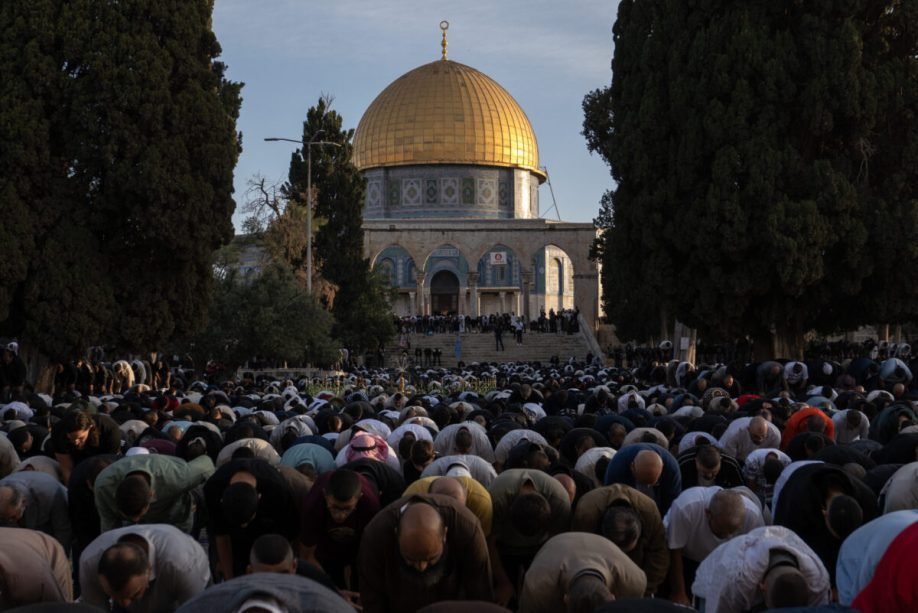
Al-Aqsa once welcomed hundreds of thousands for Friday prayers. Now, due to Israeli restrictions and harassment of Muslims, it sees only a few thousand and sometimes hundreds for daily worship.
Israel already has total control of who enters and exits al-Aqsa.
The restrictions imposed on Palestinian worshippers are not arbitrary. They are the calculated expression of a colonial logic of attrition. In this year alone, over 600 Palestinians have been banned from Al-Aqsa. Thirty Waqf employees had their entry permits revoked, and six imams have been silenced and barred from delivering sermons.
As Ekrima Sabri, senior imam of Al-Aqsa, observes, these are “unprecedented actions” designed to impose domination. Where once we warned that Al-Aqsa was in danger, now we must recognise it faces a multiplicity of dangers, each compounding the other.
Axis of Islamic identity
Last month, Israeli ministers and parliamentarians orchestrated mass incursions into Al-Aqsa.
An Israeli lawmaker openly called for Al-Aqsa to be demolished and replaced with a Jewish temple. Israeli flags were hoisted within the Aqsa compound.
At the same time, Israel has advanced the confiscation of Palestinian property near the Chain Gate street, a vital entryway in Jerusalem’s Old City. This is part of the accelerating Judaisation of Jerusalem.
Eight Arab and Islamic states condemned the closure of Al-Aqsa during Israel’s war on Iran. During this period, al-Aqsa was sealed for 40 days. It was an act of colonial domination that rendered Muslim sacred space subject to the whims of occupation.
I say this as directly as I am able to say anything. The Muslim world’s greatest threat at this moment is not only Israeli aggression, backed and bankrolled as it is by American power – it is the apathy, the division, and the institutional paralysis of those who claim al-Aqsa as their own.
For Muslims, Al-Aqsa is not a heritage site to be managed by diplomatic communiques. It is the first qibla, the site of the Prophet Muhammad’s Night Journey and Ascension, the holiest Masjid, and a living axis of Islamic identity and civilisation. Its desecration is not merely a geopolitical provocation. It is an assault on the collective memory and selfhood of over two billion people.
And yet the Muslim world watches, issues statements, and returns to its silence. Governments that could apply genuine economic and diplomatic pressure calculate their interests and look away.
The ummah that could fill streets instead scrolls past.
Silence is complicity
For those outside the Muslim world, the stakes remain profound. What is unfolding is the formalisation of colonial sovereignty over a site revered by more than two billion people.
This act would enshrine a precedent. That the slow violence of erasure, when executed with sufficient propaganda and imperial backing, is not only tolerated but ultimately rewarded.
The Arab Organisation for Human Rights has meticulously documented the systematic nature of these violations. The global community, for the most part, has chosen silence. That silence is not neutral. It is complicity.
The 11th hour has already arrived. The Muslim world, and everyone opposing colonial erasure, must mobilise all tools, diplomatic, legal, economic, and moral immediately.
If we do not act now, with the full weight of conscience and conviction, the language of coexistence will have been used to complete a Zionist dispossession decades in the making.
This article was first published at Middle East Eye on 1 June 2026
The views expressed in this article belong to the author and do not necessarily reflect the editorial policy of Middle East Monitor.