
In April, GitHub announced that it was moving subscribers from request-based billing to a usage-based model for its AI-powered Copilot service. As that new pricing model goes into effect today, many GitHub Copilot users are reporting some extreme sticker shock as they realize just how quickly their previous “normal” usage is burning through their newly limited monthly allotment of AI credits.
Across social media and forums, many Copilot users are sharing personal statistics showing how just a few hours of AI usage can now account for a large chunk of their new monthly subscription caps. For some users, it reportedly took less than a day to use up a month’s usage quota.
That’s a big change from previous months, when GitHub Copilot subscribers were allocated a certain number of “requests” and “premium requests” based on their payment tier. GitHub said that the old system meant that “a quick chat question and a multi-hour autonomous coding session [could] cost the user the same amount,” forcing Copilot itself to “absorb much of the escalating inference cost behind that usage.” Indeed, some Copilot users have been sharing estimates from GitHub’s own tool showing that their previous monthly usage would rack up bills in the thousands of dollars under the new pricing plan.
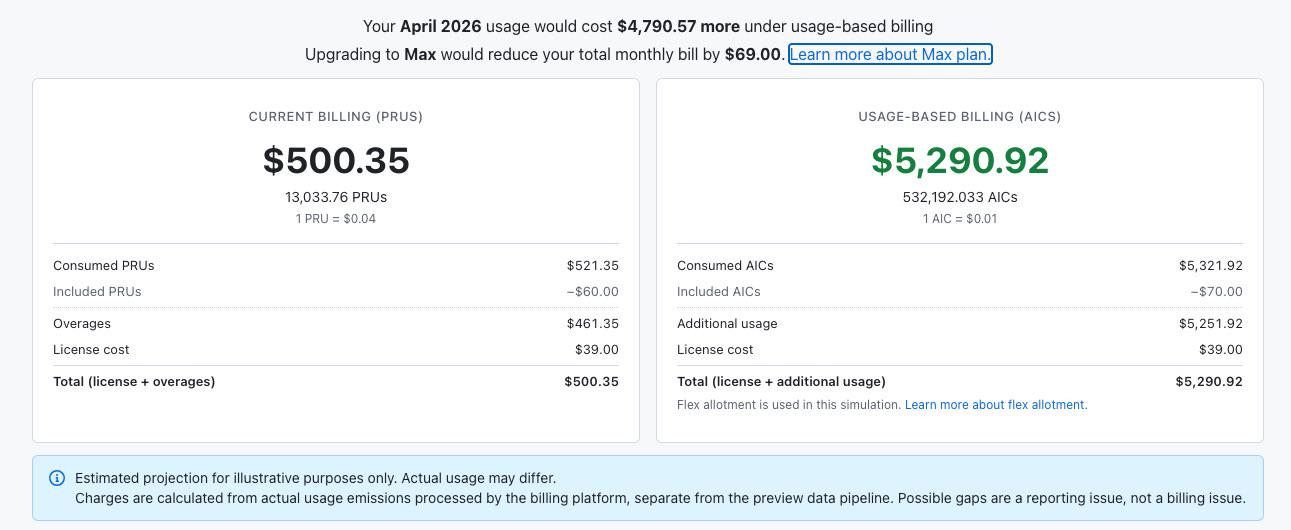
Under GitHub’s new usage-based pricing system, paid Copilot subscriptions instead grant users a certain number of AI “credits” each month, with one credit corresponding to $0.01 of usage. Subscribers also get bonus credits depending on their subscription level: the $10/month Pro plan includes 1,500 credits ($15 worth); the $39 Pro+ plan includes 7,000 credits ($70 worth); and the $100/month Copilot Max plan includes 20,000 credits ($200 worth).
The precise number of Copilot credits used by a given prompt is determined by the number of input and output tokens used and the rates charged by the underlying large language model. That means pricing is highly dependent not just on the type of request but on the specific model that a user chooses. One million output tokens from OpenAI’s GPT-5.4 nano would run just $1.25 on GitHub Copilot, but that same level of output would run $30 on the frontier GPT-5.5 model (Copilot users who rely on “Auto” mode to pick the most appropriate available model for any request should be extremely careful, as some users report it can switch to expensive models for extremely simple queries).
How much for that prompt in the window?
Spot testing by Ars Technica found that re-running our simple “build a Minesweeper game” prompt through Claude Haiku 4.5 via Copilot used about 94 credits (you can view the results here). That’s a pretty decent rate for a relatively simple toy project. But it’s also easy to see how those kinds of costs could balloon quickly for requests involving major changes or reviews on complex codebases.
You can see that kind of ballooning cost in reports of a single complex prompt burning through 171 Copilot credits, or another spending 700 credits on “a few prompts,” or a couple of Copilot-led commits using up 5,000 credits. Other Copilot users expressed surprise at just how many credits could be spent on even simple Copilot requests, from a reported 15 credits for a simple “run-of-the-mill query” to spending 100 credits in “generating a small plan.”
“Even though I was super cautious on the first day, trying it out with a limited number of uses, it still consumed 840 credits,” one user wrote of testing Claude Sonnet 4.6 through Copilot today. “I haven’t even done any really complex work yet,” another user complained after reported usage representing 21 percent of their monthly Pro Copilot subscription’s credit allotment in a single day. “I have a feeling I’ll be going somewhere else pretty soon.”
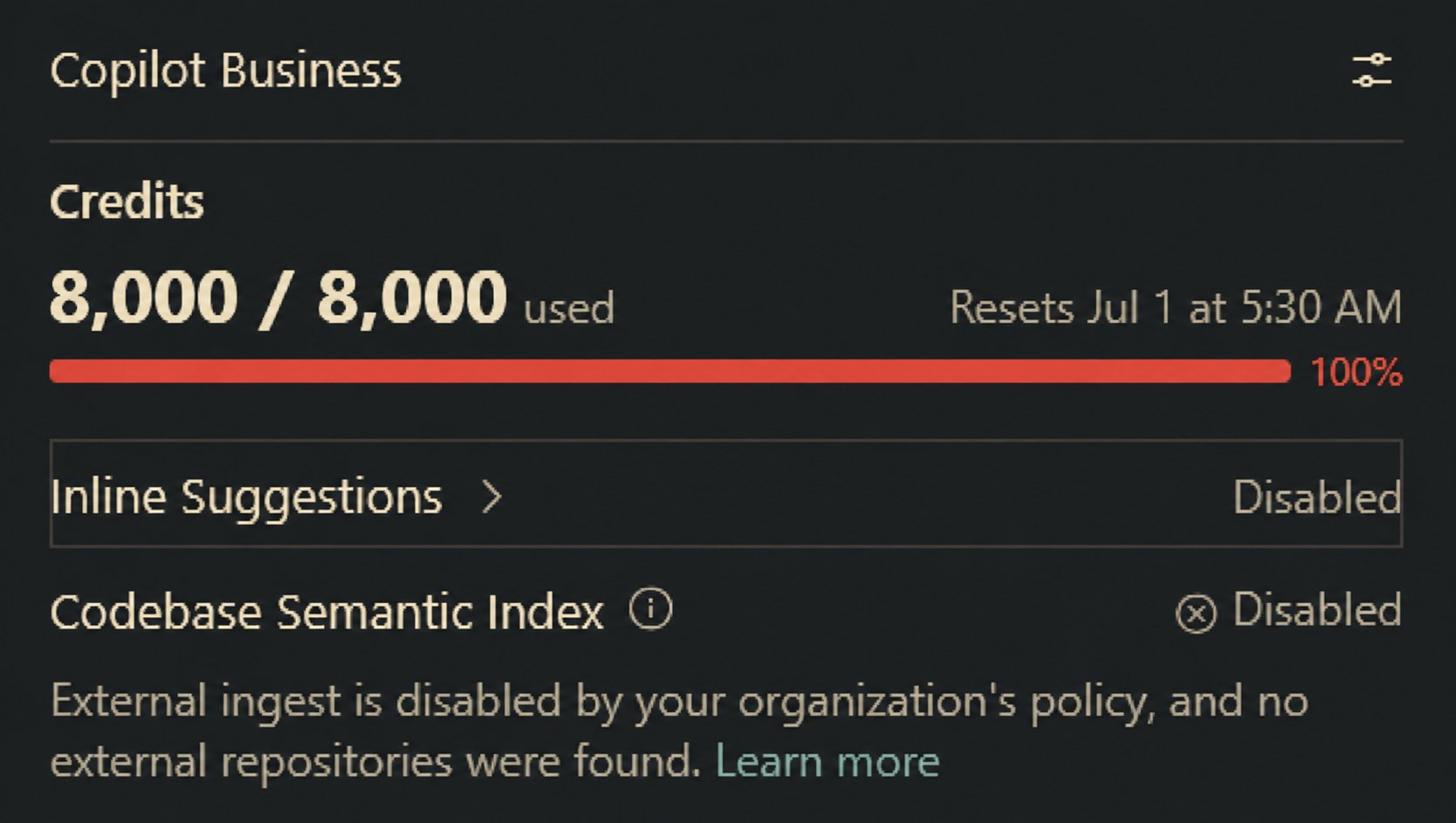
Amid the pricing change, plenty of GitHub Copilot users are predictably and publicly threatening to cancel their subscriptions or looking for other AI coding options. But others say they have been able to adjust to the new world of usage-based pricing. Coder Henri Kinnunen writes that they only burned 161 credits in a “productive day” of using Claude 5.3-Codex through Copilot, thanks to limiting themselves to “very focused and deliberate changes with AI.” Over on Bluesky, coder Neil Hewitt wisely noted that continuing a three-day-old chat session on Copilot probably isn’t as wise now, since it means sending “the entire chat history as context every time… hey, input tokens use credits… it’s not rocket science.”
While some Copilot users are jumping ship for other services with more generous usage limits, that kind of subsidized customer acquisition may soon give way to Copilot-style usage-based pricing across the industry. If that happens, LLMs that are more efficient with their tokens may win the economic battle; on Reddit, one user is already discussing how they’ve integrated Deepseek into their GitHub VSCode environment at a cost of only “about 7 cents for 15 million tokens.” While you might say “you get what you pay for,” some AI users are now contemplating a world where they also have to pay for what they get.