Trump’s call to expand Abraham accords is destined to fail
As negotiations to end the Iran war continued on May 25, Donald Trump made a series of phone calls in which he pressed key leaders from the Middle East to join the Abraham accords. Announced in 2020, these accords established diplomatic relations between Israel and several Arab states, beginning with the United Arab Emirates (UAE) and Bahrain.
The US president reiterated his proposal in a social media post later that day: “After all the work done by the United States to try and pull this very complex puzzle together, it should be mandatory that all of these countries, at a minimum, simultaneously, sign the Abraham accords.”
Trump’s post suggested that Iran could also join the accords. This really would be something, given that one motivation for signing the accords was to push back against Iranian influence in the region. Sadly for Trump, this is wishful thinking at best.
Few Middle Eastern leaders can agree to Trump’s proposal. In comments published by Politico on May 26, one unnamed former US diplomat described Trump’s comments as a “poison pill”. They added he had created new “conditions for peace that neither Iran nor the states in question will accept”.
In advocating this approach, Trump misreads the vitriol held by many across the Middle East – and beyond – about Israel’s actions in Gaza and Lebanon. The official death toll in Gaza, where Israel has fought a military campaign since 2023, stands at over 70,000 people. A further 170,000 people have been injured amid what many are calling a “genocide”.
In southern Lebanon, Israel has used ground troops and a relentless campaign of air attacks since the beginning of the Iran war in what appears to be an attempt to secure a “buffer zone” against attacks from Hezbollah. More than 3,200 people there have been killed so far, with a further 7,500 injured and millions forced from their homes. This is despite the signing of a ceasefire between Israel and the Lebanese government in April.
Opposing Trump’s proposal
The destruction of Gaza angered Bahrain and the UAE, with Manama recalling its ambassador to Israel shortly after the start of the war. But neither country withdrew from the Abraham accords. Instead, trade and security collaboration continued with both taking the stance that working more closely with Israel would be in the best interests of their states.
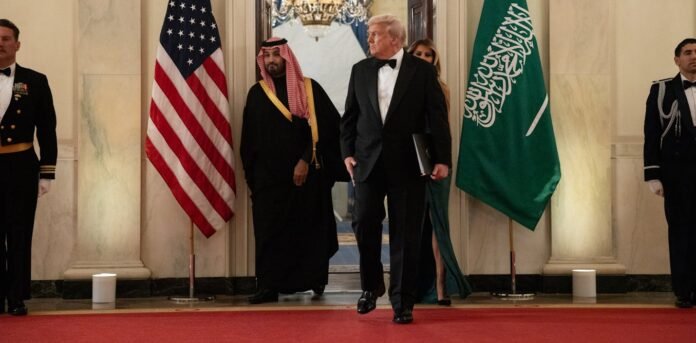
Yet Bahrain and the UAE are outliers in the Middle East. Other countries are far less willing, or able, to normalise with Israel. When US officials visited Saudi Arabia in 2024, four years after the signing of the accords, Crown Prince Mohammad bin Salman is said to have told them he feared being killed if he normalised relations with Israel.
Though many have argued the Saudi Kingdom was close to normalising relations with Israel before the war in Gaza, this has been largely rejected by Saudi officials. And since the outbreak of the Gaza war, bin Salman and other Saudi officials have repeatedly stressed that normalisation of diplomatic relations with Israel will not happen without irrevocable steps being taken towards Palestinian statehood.
Meanwhile, tensions between Israel and Turkey have been brewing for some time. In February, the former Israeli prime minister, Naftali Bennett, declared that Turkey was “the next Iran”. More recently, on May 20, Israel’s minister of culture and sports, Miki Zohar, declared that Turkey should be treated as “an enemy state”.
And in Qatar, state officials remain furious with Israel for launching strikes on Doha in 2025 in an attempt to kill key Hamas figures who were based there. Qatar said it had been hosting Hamas figures as part of broader mediation efforts requested by the US and Israel.
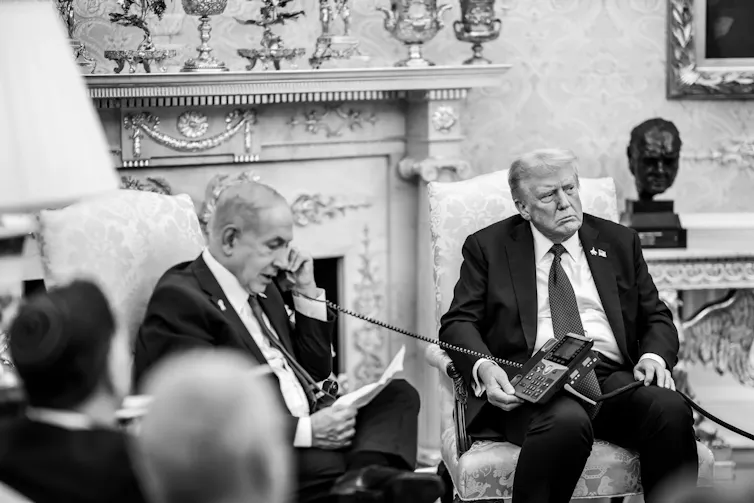
The strikes led to a now infamous photo released by the White House of Trump overseeing the Israeli prime minister, Benjamin Netanyahu, while he called Qatari prime minister Sheikh Mohammed bin Abdulrahman Al Thani to apologise.
Benjamin Netanyahu calls Qatar’s prime minister, Sheikh Mohammed bin Abdul Rahman Al Thani, from the White House in September 2025.White House, CC BY-NC
The idea of Iran becoming a signatory of the Abraham accords in the immediate aftermath of a devastating war is also fanciful. Tensions between Israel and Iran can be traced back to 1979, when a revolution toppled the Iranian monarchy and led to the establishment of an Islamic republic.
Iran’s new leadership immediately provided support to the Palestinian cause and, in later years, to Hezbollah and other militias across the Middle East. In response, Israel has carried out military strikes on targets across Iran, assassinated key nuclear scientists and more. To suggest disregarding almost half a century of history with little to no efforts at reconciliation is farcical.
Why, then, has Trump suggested such a move? Perhaps it speaks to a need to assuage domestic constituencies within the US, or those in Israel, pushing for wider normalisation between Tel Aviv and the Arab and Muslim worlds.
A second reading is that it is an attempt to prevent diplomatic progress on resolving tensions with Iran by putting an insurmountable obstacle in the way in the form of the demand for normalisation with Israel, perhaps reflecting the plurality of positions on the war found in Washington.
A third view is that this is a move aimed at diminishing the scale of destruction and human suffering that has been wrought on Gaza, the West Bank and Lebanon, in the hope that a form of transactional politics – driven by trade and security – will prove sufficient. But, as Trump will find out, this is a longshot.
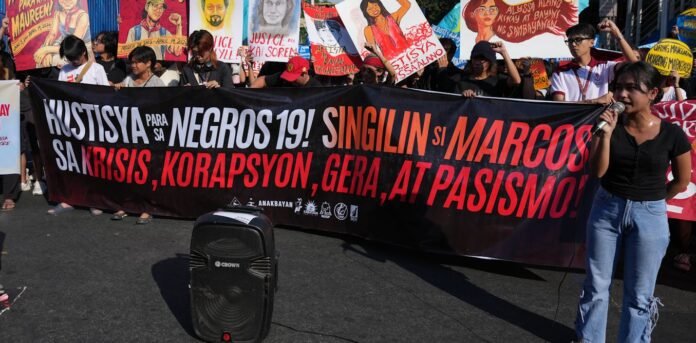
For a media ecosystem that seldom reports on the atrocities of the counterinsurgency, this episode has drawn weeks of political scrutiny. Congress members, Catholic bishops and the country’s Commission on Human Rights have all condemned the killings.
Foreign groups, such as the ASEAN Parliamentarians for Human Rights and the largest communications union in the U.S., the Communication Workers of America, have also raised alarm, noting that among those killed were a community journalist and two Filipino American activists.
Such attention to the army’s alleged brutality is important because it is rare; impunity has long been both a motivation and outcome of extrajudicial killings.
But the coverage of the Toboso killings has also revealed an ongoing obstacle to achieving full accountability: a media and public narrative that grieves victims selectively.
Responding to Toboso
According to officials, all of those killed in a series of clashes were combatants of the NPA, a Maoist guerrilla group that seeks to seize political power from Manila. But a recent fact-finding mission carried out in Toboso by civil society groups found at least six of those killed were civilians. The mission also alleges that evidence was planted and bodies were desecrated.
On social media especially, many Filipinos have either lambasted the army’s lack of restraint or the NPA’s negligence in exposing civilians to danger.
In an essay for news site Rappler, criminologist Raymund Narag noted that some people were quick to assign blame “not to the gun that fired, but to the bodies that fell. The dead, especially the students and journalists, are accused of choosing their fate. They went to a ‘hotbed of communism,’ we are told.”
Despite the noise, there is a through line in much of this coverage: It highlights certain casualties over others. Nineteen people were killed, but media attention has largely focused on just a handful: University of the Philippines student leader Alyssa Alano, journalist RJ Nichole Ledesma and Filipino American activists Kai Sorem and Lyle Prijoles.
There has been considerably less commentary regarding the other civilians killed: student Maureen Santuyo, community researcher Errol Chen, local resident Roel Sabillo and two unnamed minors. And almost nothing has been said of the 10 NPA recruits killed alongside them.
One wonders why some victims have drawn more attention or, put differently, why others haven’t. In the words of a friend of Santuyo on Facebook, it banishes some of the victims into a category of “others.”
One way of understanding this selective grief, I believe, is to see Toboso as part of a long history in the Philippines of normalizing violence against peasant movements for their purported militancy. In 2025, some 390 people were killed in state-related violence, according to researchers at the University of the Philippines. More than half were civilians.
The deaths of student leaders, journalists and Americans register as shocking due to their perceived higher profile. Even if they knew the risks to their lives, the media narrative goes, they are not the usual fatalities: NPA members and predominantly poor, rural civilians caught up in the violence.
Decades of repression
The selectivity of who is grieved helps clarify the particularly strong public reaction now.
After all, the counterinsurgency against the NPA is the longest-running in the world. It is what journalist Sheila Coronel called the Philippines’ “forever war.”
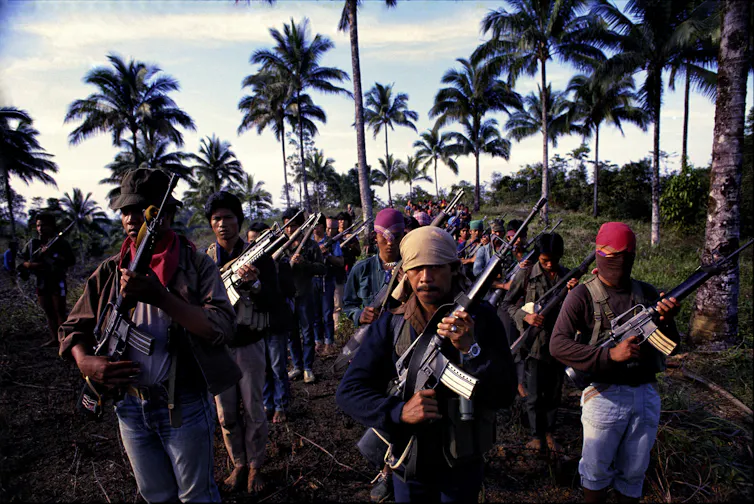
The NPA formed in 1969 as the military arm of the Communist Party of the Philippines, embracing a Maoist focus on rural peasants and guerrilla warfare. With assassinations and ambushes as its trademark tactic, the NPA was perceived as the chief security threat under longtime dictator Ferdinand Marcos Sr. and then reformist President Cory Aquino in the 1980s.
Members of the New People’s Army in the Philippine countryside in 1983.
Every administration since the Marcos dictatorship has directed particular attention to the island of Negros, which has seen considerable NPA activity because of the area’s chronic struggles over land rights. Under Aquino’s “total war” policy, the army declared Negros a priority area, a designation that continued in the 2000s under President Gloria Macapagal Arroyo.
Yet for critics of this militarized approach, the army has done less to tame rebellions than to terrorize the island’s peasant communities. Rights groups have documented at least five mass purges of farmers and activists since 1985, making Negros the Philippines’ “massacre capital.”
During the years of right-wing populist President Rodrigo Duterte, attacks were especially rife. From 2016-19, rights group Karapatantracked 250 extrajudicial killings, 10 disappearances and 450,000 evacuations due to military operations. Such scale was made possible by the government’s National Task Force to End Local Communist Armed Conflict, which Duterte created in 2018.
Counterinsurgency today
The task force continues to be active under the current government of Ferdinand Marcos Jr.
Despite the recent killings, public confidence in the Armed Forces of the Philippines remains high, sitting at 76% as of May 25, 2026. According to Octa Research, the firm that organized the survey, “The (military’s) consistently high trust and performance ratings reflect the public’s continuing demand for competent, professional, and apolitical institutions that deliver effective public service.”
Reckoning with Toboso
In response to the Toboso killings, lawmakers and civil society groups have called for an independent investigation. Legal scholar Ross Tugade suggests a more proactive Commission on Human Rights. Such are hefty goals for a government that is thinly resourced, decentralized and prone to corruption scandals.
The truth is that reckoning with the killings requires more than overcoming institutional weakness. For me, the greater task lies in fully acknowledging the violence and all its victims.
Steam Deck sells out in North America within 24 hours of price hike
Well, that was fast. Less than 24 hours after Valve announced renewed availability of the Steam Deck OLED (at a massively increased MSRP), the handheld is once again listed as “out of stock” in the US and Canada. Spot checks of other regional Steam stores on Thursday morning showed the hardware as still available across Europe and Australia for the time being, as well as in Asian countries through Valve’s sales partner Komodo.
While it’s hard to know from the outside just how many Steam Deck units sold at the new inflated price, those sales were enough to once again boost the hardware to the top of Steam’s Top Sellers list. That list is based on total revenue over the last 24 hours, though, so the $789 Steam Deck could easily have sold many fewer distinct copies than the highest-ranked software on the current list, the $70 007 First Light.
Valve’s Steam Deck store page notes that the handheld “may be out-of-stock intermittently in some regions due to memory and storage shortages.” But that warning first appeared on the store site back in February, and stock-tracking websites show there have only been exceedingly brief availability windows for Steam Deck purchases between then and now.
Danon Announces ‘No Contact’ With UN Chief’s Office After Israel’s Inclusion on Sexual Violence Blacklist
Israel’s ambassador to the United Nations, Danny Danon, announced that Israel would suspend contact with UN Secretary-General António Guterres’ office after Israel was added to a UN blacklist of countries and entities accused of using sexual violence in conflict zones.
Danon said the Israeli mission would have “no further contact” with the secretary-general’s office for as long as Guterres remains in his position.
“This is a moral disgrace that proves Guterres has lost all credibility,” Danon said, criticizing the decision to place Israel “on the same blacklist as Hamas, ISIS [Islamic State], and the most barbaric terrorist organizations in the world.”
According to the report, the Israeli Prison Service will appear on the UN’s 2026 list, while additional Israeli authorities will remain under monitoring for possible inclusion in future reports.
Under UN procedures, countries and armed organizations listed by the secretary-general remain on the blacklist for at least one year. Hamas was added to the list in August 2025.
The UN blacklist addresses allegations of sexual violence in conflict zones and includes both state actors and nonstate armed organizations accused of committing such acts.
In March, 2024, Pramila Patten, the UN secretary-general’s special representative on sexual violence in conflict, reported “reasonable grounds” to believe Hamas committed rape and sexual violence during the October 7 massacre and during the captivity of Israeli hostages in Gaza.
Israeli officials told Ynet that pressure increased on Guterres to include Israel after Hamas was added last year. The officials accused the UN chief of yielding to political pressure during the final months of his term.
Benny Gantz, the Israeli politician and former army general, described the report as “antisemitic and hypocritical,” saying the United Nations had fallen into “moral blindness.”
Gilad Erdan, Israel’s former ambassador to the United Nations, also accused the organization of bias, calling it “corrupt and distorted.”
White House got $620m rare earths deal for firm tied to Trump Jr.
This article was originally published by ProPublica. It is republished with permission.
When the Pentagon announced a $620 million loan last year to a small North Carolina startup linked to Donald Trump Jr., defense officials and the company tried to tamp down suspicions of cronyism.
The president’s eldest son said through a spokesperson that he wasn’t involved. The Pentagon said Trump Jr. played no role in the record-setting deal. And the startup’s founder told reporters that his company, Vulcan Elements, received no political favoritism.
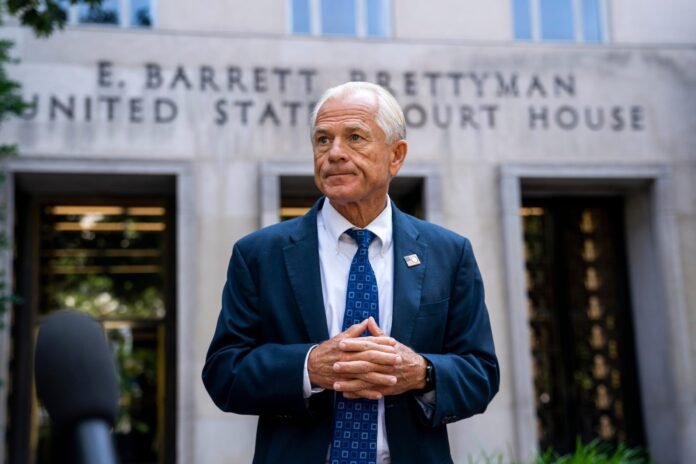
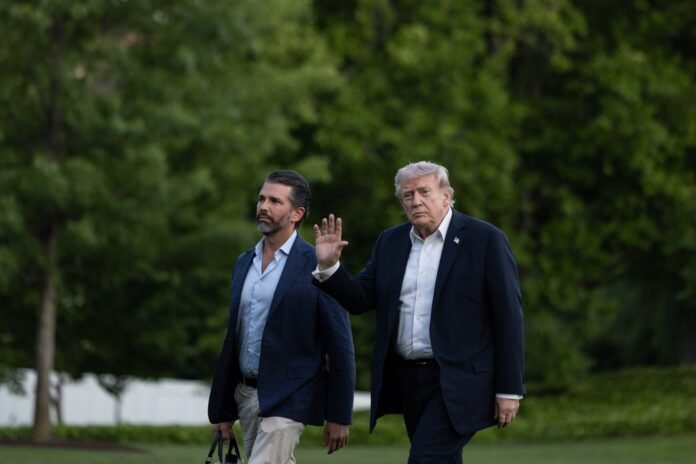
But interviews, as well as Defense Department records reviewed by ProPublica, show that the request to lend hundreds of millions of dollars to the firm linked to Trump Jr. was made by Peter Navarro, a White House adviser to President Donald Trump and a friend of Trump Jr.’s.
Of the dozens of companies the Pentagon was considering funding at the time, Vulcan’s was the only deal initiated by a top aide to the president, said an official at the Pentagon who was not authorized to speak publicly.
After defense officials got the White House request, they asked Pentagon staff to move at an unusually rapid pace, said another person who was involved in the deal at the Pentagon but not authorized to speak about it. The staff worked late nights and with little sleep to get the loan through in a matter of weeks, the source said.
“The call came from the White House: We have to get this done,” the person said.
The deal is one of many actions by the Trump administration that have helped companies in which the Trump family holds stakes. Government contracts and other benefits have gone to various Trump-linked companies, prompting allegations of self-dealing by Democratic lawmakers and good government experts. But ProPublica’s reporting on the Vulcan loan represents the first time the awarding of a contract from a federal agency has been directly linked to White House intervention.
The loan was a massive financial commitment from the Pentagon in its effort to fund companies that could help the US reduce dependence on China’s critical mineral supply chains.
Trump Jr.’s venture capital firm took a stake of undisclosed size in Vulcan about three months before the Pentagon announced the deal.
Donald Trump Jr. at Trump Tower in New York City. Photo: James Devaney / GC Images
The deal was a dramatic win for Vulcan, a North Carolina rare-earth magnet company launched just two years earlier. Estimates of its valuation grew tenfold after the deal was announced. It was also a win for Trump Jr.’s venture capital firm, which took a stake of undisclosed size in Vulcan about three months before the Pentagon announced the deal.
And there may be more good news on the way for the president’s eldest son. Among other companies under review for Pentagon lending was a drone parts manufacturer that Trump Jr. advises and owns a stake in, according to one of the defense officials who spoke to ProPublica.
Navarro, who served as trade adviser in Trump’s first term, and Trump Jr. have formed a close bond in recent years. The president’s son visited Navarro in prison while he served time for defying a subpoena from lawmakers investigating the Jan. 6, 2021, Capitol riot. Trump Jr. was one of the small group of people Navarro dedicated his latest book to for having “my back when it was against the wall.”
And a week before the Vulcan deal was announced, Trump Jr. hosted Navarro — now the president’s senior counselor for trade and manufacturing — on his streaming show, encouraging his nearly 2 million subscribers to buy Navarro’s book. That interview came not long after word came down from Navarro to Pentagon staff to make the massive loan to Vulcan, one of the defense officials involved in the deal said.
Navarro did not respond to questions from ProPublica sent to him directly. Neither did Vulcan. A White House spokesperson said in a statement that the administration is working “in the best interest of the American people,” adding, “The president’s entire team, including Senior Counselor Navarro and officials at the Department of War, is working together and with private industry to secure America’s critical mineral supply chain at Trump speed.”
Trump Jr.’s spokesperson said the president’s son does not discuss companies he has invested in with federal government officials and did not speak to Navarro about Vulcan. He “has no knowledge about how this deal came together,” the spokesperson said. A spokesperson for 1789 Capital, the venture firm where Trump Jr. is a partner, said it also played no role in Vulcan getting the loan and did not learn about the deal before it was public.
“No company receives preferential treatment,” a Pentagon spokesperson said. “Outside affiliations, investors, or political connections play absolutely no role in the Department’s funding decisions.”
Richard Painter, the chief White House ethics lawyer during the George W. Bush administration, said aides to the president should not be intervening in contracting and lending decisions by agencies, particularly in matters that financially benefit the president’s family.
“This is our money they’re spending,” Painter said. “This is corruption we pay for.”
The Office of Strategic Capital, the Pentagon division that made the deal with Vulcan, aims to address a bipartisan concern: that China’s grip on rare-earth elements and other critical minerals threatens national security.
It is hard to overstate the country’s dominance in this arena. As of last year, for example, China produced the world’s entire supply of samarium, an obscure rare-earth metal that is an essential component of magnets that help guide Tomahawk missiles and start the engines in F-35 fighter jets. Other rare earths are central to the manufacturing of a vast array of commercial and military products, from car parts and semiconductors to drones.
Finding the raw materials is generally not hard, but separating them from other materials they’re bonded to is, and it’s that process that China largely dominates. Virtually every advanced military in the world depends directly or indirectly on the country’s supply chain of rare earths. The danger of relying so heavily on a single supplier for these essential materials was underscored last year when China announced it was restricting exports of some rare-earth metals.
The Office of Strategic Capital, started under the Biden administration, funds private companies that are working in this space or developing certain military technologies so that the US can stop relying on its top rival to equip its own military.
The Trump administration supersized the effort, expanding its lending authority from about $1 billion to $200 billion. It also radically changed how the office operated, according to interviews with more than a dozen people who worked there or interacted with it from the private sector or other parts of the government.
The Biden administration had set up an open application process for interested companies, with each firm to be vetted methodically, a process meant to ensure good bets — but one that people involved acknowledged was set up to be slow and bureaucratic.
“The Trump administration is more interested in going out into the market and finding what it wants. We’re not going to wait for people to apply to us,” said one former Office of Strategic Capital official.
The Trump Pentagon handed the reins to hard-charging former Wall Street executives, who have been recruiting others to make the leap from finance to government. A leaked presentation from a headhunter seemed to suggest they could parlay their tour in government into future riches: “If you ever want to raise your own fund, you will gain access to fundraising channels that include royal families and foreign sovereign contacts.” (It’s unclear whether the Pentagon approved the presentation.)
The office’s new leaders aim to make as many deals as possible, including loans and investments in exchange for ownership stakes, people who have worked with the office say. They said the new officials are relying more on their own personal networks, not applications, to choose companies to fund.
So far, outside of Vulcan, a small number of other companies have been selected, including Korea Zinc, a metal refiner; MP Materials, a Nevada rare-earth mining company; and ReElement Technologies, an Indiana producer of rare-earth elements and battery metals that partners with Vulcan. The Pentagon’s announcement said the loans to Vulcan and ReElement were conditional on the firms fulfilling certain legal and financial requirements but did not detail them.
Last week, Bloomberg reported that the Pentagon may ultimately not lend to ReElement because of concerns over the company’s revenue projections and ability to scale up its technology that were discovered after the conditional loan was announced.
Because of its size and connection to Trump Jr., the Vulcan deal has drawn the most scrutiny. A group of Democratic senators demanded that the Pentagon provide an accounting of how the company was awarded the loan, writing that the Trump family’s conflicts of interest could be “resulting in a waste of taxpayer dollars and a threat to national security.”
(The Pentagon’s response did not address how Vulcan was selected, explaining only how the department addresses conflicts that arise from its employees’ financial holdings, not those of the president’s family.)
Democrats in the House tried to subpoena Trump Jr. to testify on the Vulcan deal but were blocked by Republicans. “Donald Trump Jr. must be made to answer whether the president’s son illegally profited from his father’s presidency,” Oregon Rep. Maxine Dexter said earlier this year.
Vulcan was launched in 2023 by a student at Harvard Business School. The private company quickly began securing a series of relatively small defense contracts, beginning during the Biden administration. Its first manufacturing facility opened in March 2025; according to an interview with its founder published that month, the firm’s funding around that time was less than $10 million. The kind of rare-earth magnets the company focuses on are needed for critical military technologies, including drones and satellites.
In August 2025, Vulcan announced $65 million in investments, including from 1789 Capital, the venture firm that Trump Jr. joined as a partner after his father was elected to a second term. Neither 1789 nor Vulcan has publicly disclosed how much of a stake the venture firm has taken.
Staff in the Office of Strategic Capital learned of the White House request to give a loan to Vulcan around September or October, an official involved said. It’s unclear how the White House request was delivered or if it was presented as an order or a recommendation. Companies considered for funding are generally vetted for many months, the person said, but this deal was completed in a matter of weeks because they were told it was a White House priority.
Asked about the Vulcan deal being expedited, the Pentagon spokesperson said defense officials balance “lightning speed with rigorous diligence to close high-impact deals that directly strengthen America’s defense and empower our warfighters.”
In November, the Pentagon announced its plans to lend $620 million to the company and another $80 million to its partner, ReElement. The company would also get $50 million in incentives from the Commerce Department. In exchange, the government would take a $50 million stake in Vulcan with the right to buy more later.
Vulcan, which at the time had fewer than 50 employees, said it would use the windfall to build a large new facility that would churn out thousands of tons of magnets a year. It said it planned to ramp up in the coming years, adding hundreds of new jobs.
The deal was good news for Vulcan’s investors, including Trump Jr.’s firm. Estimates of Vulcan’s valuation went from around $200 million near the time 1789 Capital first invested, according to Bloomberg, to around $2 billion.
Navarro’s role in initiating the deal was not publicly disclosed. Even if he didn’t discuss it with Trump Jr., the loan represented a win for someone Navarro considered a dear friend.
In an October episode of Trump Jr.’s streaming show, “Triggered,” the two showed a close bond. The president’s son called Navarro “my boy” and complimented him on the “jacked” physique he developed while in prison. Navarro called Trump Jr. “brother” and thanked him for his support “in my hardest of times.” (Navarro had argued he was wrongly imprisoned for not complying with a congressional subpoena because he was protected by executive privilege.)
Although Vulcan was not mentioned, the two spoke about rare earths, a topic Navarro has frequently discussed publicly. “China has revealed itself with this rare-earth issue as a country which is using the weaponization of their manufacturing floor, their supply chains, to exert pressure, not just on the United States, but to every other country that might do something that gets in the way of the Chinese dream of world domination,” Navarro said. “That’s what we’re fighting now.”
The Office of Strategic Capital is expected to deploy billions more in loans in the coming months to critical mineral and military technology companies.
Executives at other companies hoping for Pentagon loans or other types of investments are scrambling to figure out how to get in front of the right people.
Brodie Sutherland, CEO of Nevada-based tungsten mining company Patriot Critical Minerals, said his firm hired a lobbyist. That person knew someone who was previously connected to the Office of Strategic Capital and was able to introduce the company to a current staffer.
“It’s like any industry: A lot of what it is,” Sutherland said, “is who you know.”
Speaking to ProPublica last month, he said his company had had conversations with Pentagon staff and he was optimistic the firm could get funding.
“Whether you need someone on the inside track to get it across the line I don’t know,” he said. “We’re hopeful you don’t need to be chums with Trump Jr. to get a project across.”
Defense Department records reviewed recently by ProPublica show Sutherland’s company had already been considered for a loan but was rejected. The records did not say why. Sutherland said he still hoped his company could secure some kind of Pentagon funding in the future.
Bad cholesterol slashed 62% by single dose of gene-editing drug in small trial
An experimental gene-editing therapy that aims to lower bad cholesterol for the long-term after a single infusion is off to a positive start in an early clinical trial.
Researchers running a Phase I safety trial for the drug, dubbed VERVE-102, published interim results from just 35 patients this week in the New England Journal of Medicine. Though the numbers are small and the analysis is preliminary, VERVE-102 appeared safe, with no serious adverse events reported from the treatment, even at the largest doses. The most significant finding was a temporary, mild increase of a liver enzyme that suggested minor injury in the liver, where the drug works.
The small amount of data also hints that the drug is effective. The subgroup of participants who received the largest dose have seen their bad cholesterol—that is, their low-density lipoprotein or LDL—drop 62 percent, to a mean of 78 mg per deciliter. For people with high cholesterol—like the participants in the trial—a reduction of this magnitude could cut the risk of cardiovascular disease from plaque buildup in arteries by an estimated 50 percent if it’s sustained for over 20 years. The trial only has up to 18 months of follow-up data so far, but from that, the positive effects of VERVE-102 seem to be holding up. The LDL reductions have been sustained in all the subgroups.
Gene-editing delivery
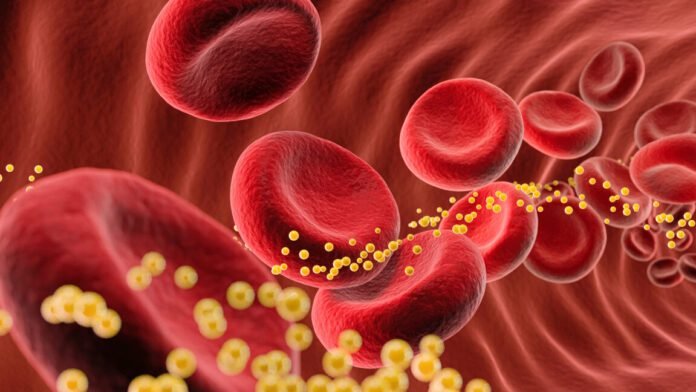
VERVE-102 works using an mRNA-based gene editing design. The mRNA is packaged into nanoparticles that carry tags that allow them to be easily taken in by liver cells, which play a central role in cholesterol metabolism. The mRNA provides the cell with instructions to make molecular machinery that can change a single base in DNA, called an adenine base-editor protein. It carries a modified portion of the gene-editing machinery CRISPR-Cas9 that nicks a single strand of DNA. The nanoparticle package also provides a guide RNA that directs the base-editing protein to make a specific base change and nick in a specific gene.
That target gene is one that codes for proprotein convertase subtilisin/kexin type 9 (PCSK9). This enzyme plays a role in regulating LDL levels in the blood. Specifically, it promotes the destruction of LDL receptors on liver cells that would otherwise help clear LDL from circulation. Thus, people who have overactive versions of PCSK9 have fewer LDL receptors, and higher LDL levels in their blood. Those who have defective versions of PCSK9 have lower LDL levels. This has been known for years, making PCSK9 a well-established target. Multiple drugs already in use for treating high cholesterol work by hobbling PCSK9.
With VERVE-102, though, the goal is to permanently break the gene that encodes PCSK9. Specifically, the guide RNA directs the adenine base-editing protein to change a single base in the PCSK9 gene such that it causes cellular machinery to prematurely read a stop signal, and the enzyme is not produced.
In the trial, the first 35 patients were given different doses so researchers could gradually test safety. The first four participants started with the lowest dose of 0.3 mg per kilogram of body weight. When that went well, a second subgroup of six got 0.45 mg/kg. Then others got 0.6 mg/kg, 0.7 mg/kg, 0.8 mg/kg, and the final high dose of 1 mg/kg, which was given to seven participants. The first subgroup that got the lowest dose was followed for 18 months, while the subgroup that got the highest dose was followed for just three months so far.
The researchers noted a dose response in both the amount of PCSK9 the treatment knocked out and the size of the LDL reduction; the larger the dose, the less PCSK9, and the lower the LDL. For the lowest dose, mean PCSK9 levels dropped 51 percent, while mean LDL dropped 9 percent. For the highest dose, mean PCSK9 levels dropped 88 percent with mean LDL dropping 62 percent.
Therapeutic potential
The participants were all people who had either developed cardiovascular disease early in life (at or below age 55 for men or 65 for women) or were people who had an inherited condition that caused high cholesterol.
The drug was developed by Verve Therapeutics, which was bought by Eli Lilly last year for $1.3 billion. While Verve has been testing the drug on people at some of the highest risks from high cholesterol, its co-founder and now Lilly Senior Vice President Sekar Kathiresan hopes to see its use expand, providing an option for patients with high cholesterol that doesn’t require lifetime management with medications, like statins.
Co-author on the trial Riyaz Patel, a cardiologist at Barts Health NHS Trust and professor of cardiology at University College London, agreed. In a statement released by Lilly, Patel said the early data was “encouraging,” indicating that VERVE-102 could “offer a novel approach to achieving substantial and durable LDL-C reduction with a one-time treatment.”
“Many patients with elevated LDL-C struggle to achieve sustained control despite ongoing efforts with the medicines available today, putting them at significant risk for cardiovascular events. With coronary artery disease still one of the leading causes of death worldwide, the need for new approaches is real,” Patel said.
While the researchers and Lilly are optimistic, this is, again, a very small, very preliminary look at the drug in clinical action. It will require further trials, with more people and longer follow ups to convincingly demonstrate safety and efficacy. But, if all goes well, Lilly notes that the Food and Drug Administration has already granted VERVE-102 a Fast Track designation for review.
Former First Lady ‘Frightened’ Watching Joe Biden During 2024 Debate
Jill Biden spent nearly two years trying to project confidence after Joe Biden’s disastrous 2024 debate performance.
Now, she is telling a very different story.
The former first lady is opening up about the night that stunned Democrats, rattled the Biden campaign, and helped change the course of the 2024 presidential race. In a new CBS News Sunday Morning interview, Jill Biden admitted she was not calm, confident, or merely disappointed as she watched her husband struggle onstage.
She was terrified.
According to Jill, the moment was so alarming that she feared Joe Biden might be having a medical emergency in front of the entire country.
“I had never ever seen Joe like that before or since,” she told CBS’s Rita Braver, recalling the shocking debate that left even Biden’s allies scrambling for answers.
Then came the line that made the moment even more stunning.
“Oh, my God, he’s having a stroke,” Jill said she remembered thinking as she watched the debate unfold.
She added that the scene “scared me to death.”
It was a jaw-dropping admission from the woman who, at the time, was publicly standing by Biden and helping reassure nervous Democrats that the president was still up for the fight.
Back in June 2024, the message from Jill Biden was very different.
Immediately after the debate, she appeared with her husband and praised him in front of supporters, saying he had “answered every question.” The next day, at a North Carolina rally, she acknowledged the obvious concerns but continued to defend him.
She also revealed that Joe had told her, “I don’t know what happened.”
At the time, Democrats were already in panic mode. Biden’s shaky answers, raspy voice, and frozen moments onstage fueled explosive questions about whether he could continue the campaign. Party insiders began openly worrying about his age, his health, and his chances of defeating Donald Trump in November.
But Jill Biden remained one of his most visible defenders.
Publicly, she kept pushing the message that her husband had simply had a bad night. Privately, according to her new comments, she was frightened by what she had seen.
That contrast is what makes her 2026 remarks so striking.
In 2024, Jill Biden sounded like a loyal campaign surrogate trying to steady a sinking ship. In 2026, she sounds like a wife reliving one of the most frightening nights of her life.
The debate became one of the defining moments of the 2024 election. Less than a month later, Joe Biden dropped out of the race and endorsed Vice President Kamala Harris, ending his bid for a second term after weeks of mounting pressure from Democrats.
Now, with the release of her memoir View from the East Wing: A Memoir, Jill Biden is giving the public a more personal look at what was happening behind the scenes during that chaotic period.
Her new comments suggest that the panic surrounding the debate was not just political. For Jill, it was personal, emotional, and deeply frightening.
The timeline shows just how much her tone has changed.
On June 27, 2024, after the debate, Jill publicly praised Biden and said he answered every question.
On June 28, 2024, she defended him again at a North Carolina rally while admitting he had told her, “I don’t know what happened.”
In the days that followed, she continued standing by him as Democrats privately and publicly urged him to step aside.
In July 2024, Biden withdrew from the race and backed Harris.
Now, in May 2026, Jill Biden says she was “frightened,” thought he might be having a stroke, and had never seen him like that before or since.
It is a remarkable shift from campaign spin to blunt confession.
For voters who watched that debate and wondered what was really going on, Jill Biden’s new remarks offer a stunning answer: even the person closest to Joe Biden was scared by what she saw.
The military contractor responsible for a Southern California chemical leak that forced as many as 50,000 people to evacuate their homes over the weekend manufactures parts of F-35 fighter jets likely bound for Israel, The Intercept has learned.
The Garden Grove, Calif., GKN Aerospace plant, whose 7,000-gallon chemical tank ruptured last week and threatened to explode, has brought in more than $13 million since 2017 in subcontracts with military manufacturing giant Lockheed Martin, according to an analysis of federal contract data conducted by the Palestinian Youth Movement and independently verified by The Intercept. Further analysis of F-35 production for Israel conducted in 2025 by Ploughshares, a Canadian independent research institute, found that Lockheed doles out subcontracts to hundreds of companies across more than a dozen countries to help build the jets. Among them is GKN Aerospace Transparency Inc., the GKN subsidiary based in Garden Grove, which raked in more than $255 million from subcontracts with Lockheed Martin.
“While GKN chases contracts and profits, our community pays the price with school closures and disrupted livelihoods,” Sarah Awaida, an organizer with the Palestinian Youth Movement and Garden Grove resident who was evacuated due to the leak, said at a press conference in the city on Tuesday. “And our people abroad pay the price when the same weapon systems produced here are used to massacre people in Gaza, in Lebanon, in Iran and all across the region.”
Garden Grove is a predominantly working-class and immigrant city in Orange County, just outside of Los Angeles. The evacuation order, which has since been lifted, disproportionately affected residents who are lower income.
“While GKN chases contracts and profits, our community pays the price with school closures and disrupted livelihoods.”
GKN Aerospace describes its Garden Grove plant as “the leading provider” of the acrylic bubble that encases the F-35 fighter jet cockpit, known as a transparency canopy. Methyl methacrylate, the highly flammable chemical that began to leak from the facility last week, is a key ingredient in the protective bubbles.
“Due to the nature of the F-35’s global supply chain, it is likely that the F-35 components produced at the Garden Grove facility are incorporated into aircraft exported to Israel,” said John Ramming Chappell, advocacy and legal advisor at Center for Civilians in Conflict. “This is the same type of aircraft that the Israeli military has used to kill civilians and violate international humanitarian law.”
Since American military pilots landed Israel’s first two F-35 stealth fighter jets at the Nevatim airbase in 2016 — an occasion celebrated with a ceremony attended by Prime Minister Benjamin Netanayahu, Obama administration officials, and Lockheed Martin executives — the Israeli military has amassed a fleet of 48 F-35 jets, most of them paid for with funding from the U.S. State Department. Earlier this year, amid its genocide in Gaza and ongoing wars in Iran and Lebanon, the Israeli government announced its plans to double its F-35 fleet to 100. The Israeli military’s use of the jets has been tied to repeated allegations of war crimes, including the targeting of civilians in Gaza. Hundreds of human rights and civil society organizations have called on governments to halt their roles in F-35 production for Israel.
“This is the same type of aircraft that the Israeli military has used to kill civilians and violate international humanitarian law.”
On May 19, several days before the leak began, Garden Grove city officials issued a permit for a 34,000-square-foot expansion of GKN Aerospace’s facility. On its website, the company cited increasing demand for F-35 jets as the reason for the expansion, which would enable the company to double its production of aircraft canopies.
On Tuesday, the Palestinian Youth Movement led a coalition of groups in launching a campaign seeking the closure of GKN Aerospace’s Garden Grove facility. Alongside VietRise, the Harbor Institute for Immigrant and Economic Justice, OC Justice for Palestine, and Donald Torres, a city council member from neighboring Stanton, Calif., who was also displaced by the chemical leak, they’re also pushing for a citywide moratorium on military manufacturing contracts and expansion permits and the creation of a half-mile buffer zone between military manufacturers and residential areas in the city.
The coalition presented its demands on Tuesday evening during a packed Garden Grove City Council meeting. Speakers criticized the city for turning a blind eye to GKN’s string of concerning incidents. In recent years, the company agreed to pay nearly $1 million to settle charges of environmental violations such as a failure to maintain records of emissions and operating equipment without a permit. Earlier, the company had been penalized for not properly inspecting its machinery and was fined for labor safety violations.
“This crisis was not unpredictable,” said Layal Bata, an organizer with the Palestinian Youth Movement. “It is the result of a company and an industry that prioritizes war profiteering over people.”
Garden Grove and GKN Aerospace did not respond to The Intercept’s requests for comment.
The Palestinian Youth Movement has campaigns across the U.S. and in Europe to halt the use of civilian and private infrastructure for the weapons supply chain that fuels Israel’s military as it commits genocide of Palestinians in Gaza and upholds its apartheid rule in the West Bank. Another campaign in California calls for an end to military cargo shipments — also F-35 fighter jet components — from the Port of Oakland to Israel. Arms embargo organizers had already been tracking GKN’s Garden Grove facility before the chemical leak due to its role in F-35 production.
GKN Garden Grove has also reaped more than $4.5 million in additional subcontracts, signed in early 2023, with Sikorsky Aircraft Corporation for production of CH-53k military helicopters, according to federal contracts cited in the Palestinian Youth Movement report. Israel has ordered a dozen of the new Sikorsky military helicopters.
Last summer, anti-genocide organizers in the Netherlands marched to a GKN Aerospace office where protesters accused the company of violating a 2023 court order that had banned the export of F-35 parts from the country to Israel. Other nations with campaigns to halt their roles in producing F-35 components include the United Kingdom and Australia.
At the council meeting Tuesday evening, Dwight Hua, an organizer with VietRise who lives less than a mile from GKN Garden Grove and was also displaced by the leak, joined calls to close the facility. He, like many other residents, had no idea of the plant’s existence before the leak.
“Why has a company like GKN been quietly existing in our neighborhoods?” he said. “Now the mask is off … this is not a mistake, this is a deliberate result of an industry and company that treats our communities as disposable.”
The White House Intervened to Get a $620 Million Deal for a Company Tied to Donald Trump Jr.
When the Pentagon announced a $620 million loan last year to a small North Carolina startup linked to Donald Trump Jr., defense officials and the company tried to tamp down suspicions of cronyism.
The president’s eldest son said through a spokesperson that he wasn’t involved. The Pentagon said Trump Jr. played no role in the record-setting deal. And the startup’s founder told reporters that his company, Vulcan Elements, received no political favoritism.
But interviews and Defense Department records reviewed by ProPublica show that the request to loan hundreds of millions of dollars to the firm linked to Trump Jr. was made by Peter Navarro, a White House adviser to President Donald Trump and a friend of Trump Jr.’s.
Of the dozens of companies the Pentagon was considering funding at the time, Vulcan’s was the only deal initiated by a top aide to the president, said an official at the Pentagon who was not authorized to speak publicly.
After defense officials got the White House request, they asked Pentagon staff to move at an unusually rapid pace, said another person who was involved in the deal at the Pentagon but not authorized to speak about it. The staff worked late nights and with little sleep to get the loan through in a matter of weeks, the source said.
“The call came from the White House: We have to get this done,” the person said.
The deal is one of many actions by the Trump administration that have helped companies in which the Trump family holds stakes. Government contracts and other benefits have gone to various Trump-linked companies, prompting allegations of self-dealing by Democratic lawmakers and good government experts. But ProPublica’s reporting on the Vulcan loan represents the first time the awarding of a contract from a federal agency has been directly linked to White House intervention.
The loan was a massive financial commitment from the Pentagon in its effort to fund companies that could help the U.S. reduce dependence on China’s critical mineral supply chains. The deal was a dramatic win for Vulcan, a North Carolina rare-earth magnet company launched just two years earlier. Estimates of its valuation grew tenfold after the deal was announced. It was also a win for Trump Jr.’s venture capital firm, which took a stake of undisclosed size in Vulcan about three months before the Pentagon announced the deal.
And there may be more good news on the way for the president’s eldest son. Among other companies under review for a Pentagon loan was a drone parts manufacturer that Trump Jr. advises and owns a stake in, according to one of the defense officials who spoke to ProPublica.
Navarro, who served as trade adviser in Trump’s first term, and Trump Jr. have formed a close bond in recent years. The president’s son visited Navarro in prison while he served time for defying a subpoena from lawmakers investigating the Jan. 6, 2021, Capitol riot. Trump Jr. was one of the small group of people Navarro dedicated his latest book to for having “my back when it was against the wall.” And a week before the Vulcan deal was announced, Trump Jr. hosted Navarro — now the president’s senior counselor for trade and manufacturing — on his streaming show, encouraging his nearly 2 million subscribers to buy Navarro’s book. That interview was not long after word came down from Navarro to Pentagon staff to make the massive loan to Vulcan, one of the defense officials involved in the deal said.
Navarro did not respond to questions from ProPublica sent to him directly. Neither did Vulcan. A White House spokesperson said in a statement that the administration is working “in the best interest of the American people,” adding, “The President’s entire team, including Senior Counselor Navarro and officials at the Department of War, is working together and with private industry to secure America’s critical mineral supply chain at Trump Speed.” Trump Jr.’s spokesperson said the president’s son does not discuss companies he has invested in with federal government officials and did not speak to Navarro about Vulcan. He “has no knowledge about how this deal came together,” the spokesperson said. A spokesperson for 1789 Capital, the venture firm where Trump Jr. is a partner, said it also played no role in Vulcan getting the loan and did not learn about the deal before it was public.
“No company receives preferential treatment,” a Pentagon spokesperson said. “Outside affiliations, investors, or political connections play absolutely no role in the Department’s funding decisions.”
Richard Painter, the chief White House ethics lawyer during the George W. Bush administration, said aides to the president should not be intervening in contracting and lending decisions by agencies, particularly in matters that financially benefit the president’s family.
“This is our money they’re spending,” Painter said. “This is corruption we pay for.”
The Office of Strategic Capital, the Pentagon division that made the deal with Vulcan, aims to address a bipartisan concern: that China’s grip on rare-earth elements and other critical minerals threatens national security.
It is hard to overstate the country’s dominance in this arena. As of last year, for example, China produced the world’s entire supply of samarium, an obscure rare-earth metal that is an essential component of magnets that help guide Tomahawk missiles and start the engines in F-35 fighter jets. Other rare earths are central to the manufacturing of a vast array of commercial and military products, from car parts and semiconductors to drones.
Finding the raw materials is generally not hard, but separating them from other materials they’re bonded to is, and it’s that process that China largely dominates. Virtually every advanced military in the world depends directly or indirectly on the country’s supply chain of rare earths. The danger of relying so heavily on a single supplier for these essential materials was underscored last year when China announced it was restricting exports of some rare-earth metals.
The Office of Strategic Capital, started under the Biden administration, funds private companies that are working in this space or developing certain military technologies so that the U.S. can stop relying on its top rival to equip its own military.
The Trump administration supersized the effort, expanding its lending authority from about $1 billion to $200 billion. It also radically changed how the office operated, according to interviews with more than a dozen people who worked there or interacted with it from the private sector or other parts of the government.
The Biden administration had set up an open application process for interested companies, with each firm to be vetted methodically, a process meant to ensure good bets — but one that people involved acknowledged was set up to be slow and bureaucratic.
“The Trump administration is more interested in going out into the market and finding what it wants. We’re not going to wait for people to apply to us,” said one former Office of Strategic Capital official.
The Trump Pentagon handed the reins to hard-charging former Wall Street executives, who have been recruiting others to make the leap from finance to government. A leaked presentation from a headhunter seemed to suggest they could parlay their tour in government into future riches: “If you ever want to raise your own fund, you will gain access to fundraising channels that include royal families and foreign sovereign contacts.” (It’s unclear whether the Pentagon approved the presentation.)
The office’s new leaders aim to make as many deals as possible, including loans and investments in exchange for ownership stakes, people who have worked with the office say. They said the new officials are relying more on their own personal networks, not applications, to choose companies to fund. So far, outside of Vulcan, a small number of other companies have been selected, including Korea Zinc, a metal refiner; MP Materials, a Nevada rare-earth mining company; and ReElement Technologies, an Indiana producer of rare-earth elements and battery metals that partners with Vulcan. The Pentagon’s announcement said the loans to Vulcan and ReElement were conditional on the firms fulfilling certain legal and financial requirements but did not detail them.
Last week, Bloomberg reported that the Pentagon may ultimately not lend to ReElement because of concerns over the company’s revenue projections and ability to scale up its technology that were discovered after the conditional loan was announced.
Because of its size and connection to Trump Jr., the Vulcan deal has drawn the most scrutiny. A group of Democratic senators demanded that the Pentagon provide an accounting of how the company was awarded the loan, writing that the Trump family’s conflicts of interest could be “resulting in a waste of taxpayer dollars and a threat to national security.” (The Pentagon’s response did not address how Vulcan was selected, explaining only how the department addresses conflicts that arise from its employees’ financial holdings, not those of the president’s family.) Democrats in the House tried to subpoena Trump Jr. to testify on the Vulcan deal but were blocked by Republicans. “Donald Trump Jr. must be made to answer whether the president’s son illegally profited from his father’s presidency,” Oregon Rep. Maxine Dexter said earlier this year.
Vulcan was launched in 2023 by a student at Harvard Business School. The private company quickly began securing a series of relatively small defense contracts, beginning during the Biden administration. Its first manufacturing facility opened in March 2025; according to an interview with its founder published that month, the firm’s funding around that time was less than $10 million. The kind of rare-earth magnets the company focuses on are needed for critical military technologies, including drones and satellites.
In August 2025, Vulcan announced $65 million in investments, including from 1789 Capital, the venture firm that Trump Jr. joined as a partner after his father was elected to a second term. Neither 1789 nor Vulcan has publicly disclosed how much of a stake the venture firm has taken.
Staff in the Office of Strategic Capital learned of the White House request to give a loan to Vulcan around September or October, an official involved said. It’s unclear how the White House request was delivered or if it was presented as an order or a recommendation. Companies considered for funding are generally vetted for many months, the person said, but this deal was completed in a matter of weeks because they were told it was a White House priority.
Asked about the Vulcan deal being expedited, the Pentagon spokesperson said defense officials balance “lightning speed with rigorous diligence to close high-impact deals that directly strengthen America’s defense and empower our warfighters.”
In November, the Pentagon announced its plans to lend $620 million to the company and another $80 million to its partner, ReElement. The company would also get $50 million in incentives from the Commerce Department. In exchange, the government would take a $50 million stake in Vulcan with the right to buy more later.
Vulcan, which at the time had fewer than 50 employees, said it would use the windfall to build a large new facility that would churn out thousands of tons of magnets a year. It said it planned to ramp up in the coming years, adding hundreds of new jobs.
The deal was good news for Vulcan’s investors, including Trump Jr.’s firm. Estimates of Vulcan’s valuation went from around $200 million near the time 1789 Capital first invested, according to Bloomberg, to around $2 billion.
Navarro’s role in initiating the deal was not publicly disclosed. Even if he didn’t discuss it with Trump Jr., the loan represented a win for someone Navarro considered a dear friend. In an October episode of Trump Jr.’s streaming show, “Triggered,” the two showed a close bond. The president’s son called Navarro “my boy” and complimented him on the “jacked” physique he developed while in prison. Navarro called Trump Jr. “brother” and thanked him for his support “in my hardest of times.” (Navarro had argued he was wrongly imprisoned for not complying with a congressional subpoena because he was protected by executive privilege.)
Although Vulcan was not mentioned, the two spoke about rare earths, a topic Navarro has frequently discussed publicly. “China has revealed itself with this rare-earth issue as a country which is using the weaponization of their manufacturing floor, their supply chains, to exert pressure, not just on the United States, but to every other country that might do something that gets in the way of the Chinese dream of world domination,” Navarro said. “That’s what we’re fighting now.”
From left: White House deputy chief of staff Stephen Miller, senior counselor Peter Navarro and staff secretary Will Scharf in the Oval Office in 2025Andrew Harnik/Getty Images
The Office of Strategic Capital is expected to deploy billions more in loans in the coming months to critical mineral and military technology companies.
Executives at other companies hoping for Pentagon loans or other types of investments are scrambling to figure out how to get in front of the right people.
Brodie Sutherland, CEO of Nevada-based tungsten mining company Patriot Critical Minerals, said his firm hired a lobbyist. That person knew someone who was previously connected to the Office of Strategic Capital and was able to introduce the company to a current staffer.
“It’s like any industry: A lot of what it is,” Sutherland said, “is who you know.”
Speaking to ProPublica last month, he said his company had had conversations with Pentagon staff and he was optimistic the firm could get funding.
“Whether you need someone on the inside track to get it across the line I don’t know,” he said. “We’re hopeful you don’t need to be chums with Trump Jr. to get a project across.”
Defense Department records reviewed recently by ProPublica show Sutherland’s company had already been considered for a loan but was rejected. The records did not say why. Sutherland said he still hoped his company could secure some kind of Pentagon funding in the future.
Europe beefs up Ebola detection as Congo epidemic surges
Europe is increasing surveillance of potential Ebola symptoms among airline passengers arriving from the Democratic Republic of Congo as the deadly virus spreads faster than health workers can contain it.
As of Monday more than 900 suspected cases of Ebola had been reported in Congo, with at least 223 deaths, but the actual number of cases was expected to be far higher. Uganda, which borders Congo, has reported seven cases.
The European Centre for Disease Prevention and Control is modeling the likelihood of cases being imported into Europe and is working with the aviation sector “to strengthen the safety of all passengers on board,” the agency said in a statement Wednesday.
Earlier this week Italy reported two suspected cases among passengers who had arrived from Uganda, but they later tested negative for Ebola, the disease prevention agency said.
Meanwhile, Belgium has direct daily flights to and from Congo. Brussels Airlines said Wednesday it is making changes to its crew schedules given that the United States has banned entry to the country from the region, but added: “These changes are being implemented without affecting the current flight schedule.”
“In times like these, flights are more vital than ever to keep the region connected and to allow vital medication and medically trained personnel to reach the affected areas,” the airline said in a statement. The airline, which is part of the Lufthansa Group, added that it remains “committed to maintaining its flight schedule whenever possible.”
This deadly outbreak is caused by the Bundibugyo virus, for which there are no treatments or vaccines. The World Health Organization said talks were ongoing with developers of two experimental vaccines, while German diagnostic firm Altona said it aimed to provide a test for the specific Ebola strain in the “coming weeks.”
Ongoing conflict in the region and the rare viral type are making it almost impossible for health workers to stop the spread of the infection, the WHO told reporters.
Health facilities have come under attack by local people on occasion because relatives wanted to take the bodies of their loved ones for burial — a practice that can lead to further infections.
Meanwhile, Europe’s disease agency is pooling more resources from a network of experts to send more help. This larger presence will help it “gather more detailed information on exit screening, which … is crucial to reduce risk by identifying travellers who are symptomatic,” the agency said.
It will also help ensure that the agency’s risk assessments and recommendations for European countries and their citizens are prompt and up to date.