For nearly 60 years, the Philippine government’s war against the insurgent New People’s Army, or NPA, has rumbled on with little accountability in Manila and scarce scrutiny abroad.
That seemed to change on April 19, 2026, when 19 people were killed by Philippine troops in Toboso, Negros Occidental, the Western Visayas region of the country.
As a scholar of political violence in the Philippines, what I found notable was not only the volume of death but also the intensity of public reaction.
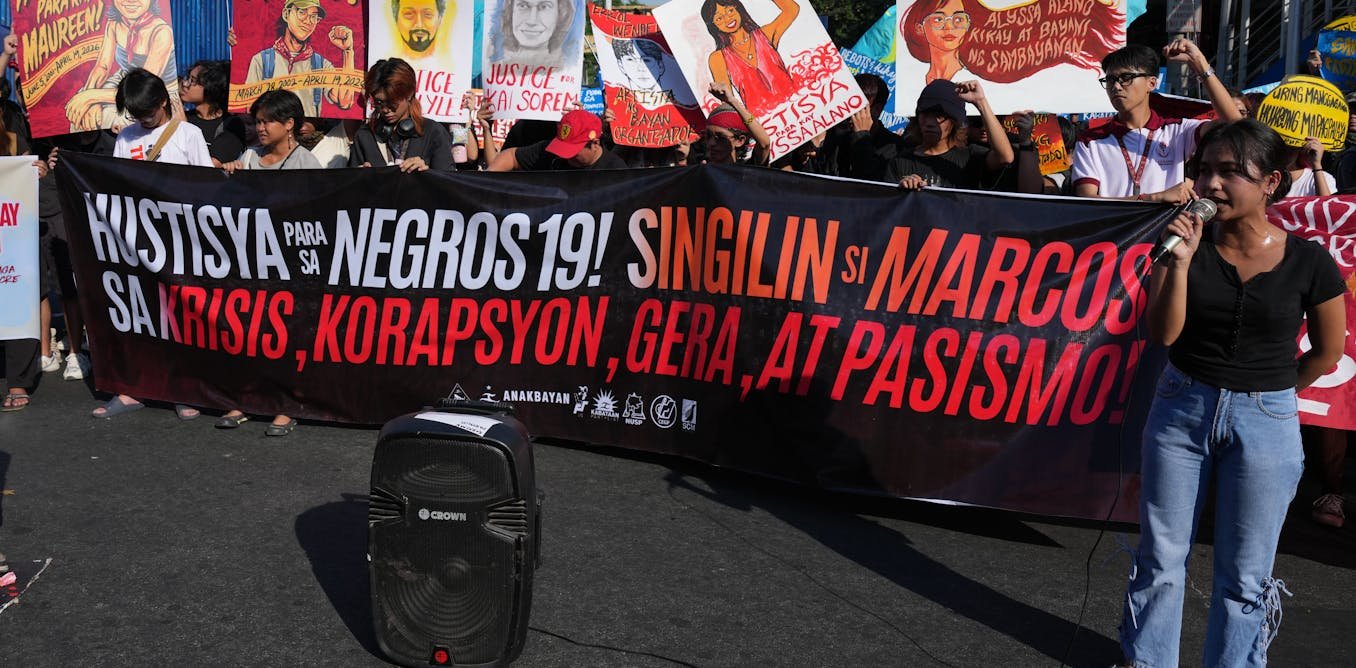
For a media ecosystem that seldom reports on the atrocities of the counterinsurgency, this episode has drawn weeks of political scrutiny. Congress members, Catholic bishops and the country’s Commission on Human Rights have all condemned the killings.
Foreign groups, such as the ASEAN Parliamentarians for Human Rights and the largest communications union in the U.S., the Communication Workers of America, have also raised alarm, noting that among those killed were a community journalist and two Filipino American activists.
Such attention to the army’s alleged brutality is important because it is rare; impunity has long been both a motivation and outcome of extrajudicial killings.
But the coverage of the Toboso killings has also revealed an ongoing obstacle to achieving full accountability: a media and public narrative that grieves victims selectively.
Responding to Toboso
According to officials, all of those killed in a series of clashes were combatants of the NPA, a Maoist guerrilla group that seeks to seize political power from Manila. But a recent fact-finding mission carried out in Toboso by civil society groups found at least six of those killed were civilians. The mission also alleges that evidence was planted and bodies were desecrated.
The army blasted the findings as “time-worn propaganda” peddled by the NPA.
On social media especially, many Filipinos have either lambasted the army’s lack of restraint or the NPA’s negligence in exposing civilians to danger.
In an essay for news site Rappler, criminologist Raymund Narag noted that some people were quick to assign blame “not to the gun that fired, but to the bodies that fell. The dead, especially the students and journalists, are accused of choosing their fate. They went to a ‘hotbed of communism,’ we are told.”
American right-wing media and think tanks, such as The Daily Wire and The Manhattan Institute, echoed this view.
Selective grief
Despite the noise, there is a through line in much of this coverage: It highlights certain casualties over others. Nineteen people were killed, but media attention has largely focused on just a handful: University of the Philippines student leader Alyssa Alano, journalist RJ Nichole Ledesma and Filipino American activists Kai Sorem and Lyle Prijoles.
There has been considerably less commentary regarding the other civilians killed: student Maureen Santuyo, community researcher Errol Chen, local resident Roel Sabillo and two unnamed minors. And almost nothing has been said of the 10 NPA recruits killed alongside them.
One wonders why some victims have drawn more attention or, put differently, why others haven’t. In the words of a friend of Santuyo on Facebook, it banishes some of the victims into a category of “others.”
One way of understanding this selective grief, I believe, is to see Toboso as part of a long history in the Philippines of normalizing violence against peasant movements for their purported militancy. In 2025, some 390 people were killed in state-related violence, according to researchers at the University of the Philippines. More than half were civilians.
The deaths of student leaders, journalists and Americans register as shocking due to their perceived higher profile. Even if they knew the risks to their lives, the media narrative goes, they are not the usual fatalities: NPA members and predominantly poor, rural civilians caught up in the violence.
Decades of repression
The selectivity of who is grieved helps clarify the particularly strong public reaction now.
After all, the counterinsurgency against the NPA is the longest-running in the world. It is what journalist Sheila Coronel called the Philippines’ “forever war.”
The NPA formed in 1969 as the military arm of the Communist Party of the Philippines, embracing a Maoist focus on rural peasants and guerrilla warfare. With assassinations and ambushes as its trademark tactic, the NPA was perceived as the chief security threat under longtime dictator Ferdinand Marcos Sr. and then reformist President Cory Aquino in the 1980s.
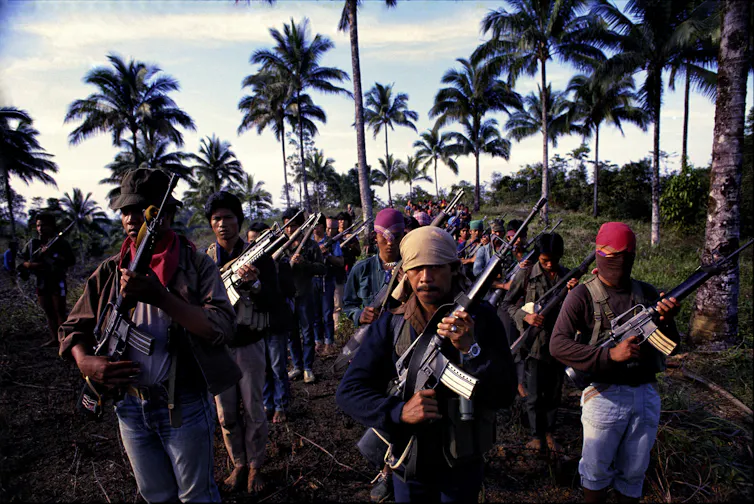
Every administration since the Marcos dictatorship has directed particular attention to the island of Negros, which has seen considerable NPA activity because of the area’s chronic struggles over land rights. Under Aquino’s “total war” policy, the army declared Negros a priority area, a designation that continued in the 2000s under President Gloria Macapagal Arroyo.
Yet for critics of this militarized approach, the army has done less to tame rebellions than to terrorize the island’s peasant communities. Rights groups have documented at least five mass purges of farmers and activists since 1985, making Negros the Philippines’ “massacre capital.”
During the years of right-wing populist President Rodrigo Duterte, attacks were especially rife. From 2016-19, rights group Karapatan tracked 250 extrajudicial killings, 10 disappearances and 450,000 evacuations due to military operations. Such scale was made possible by the government’s National Task Force to End Local Communist Armed Conflict, which Duterte created in 2018.
Counterinsurgency today
The task force continues to be active under the current government of Ferdinand Marcos Jr.
Earlier this May – as the Philippines used its chairship of ASEAN to broker peace talks between Thailand and Cambodia – Amnesty International revealed dozens of rights violations across rural Luzon, the most populous island in the Philippines.
Indeed, counterinsurgency operations have only grown under Marcos and been vigorously supported by the U.S. government and military. That support from Washington is the latest instance of a decades-old alliance that grew in the early 1950s and blossomed in particular during the first Marcos presidency.
Despite the recent killings, public confidence in the Armed Forces of the Philippines remains high, sitting at 76% as of May 25, 2026. According to Octa Research, the firm that organized the survey, “The (military’s) consistently high trust and performance ratings reflect the public’s continuing demand for competent, professional, and apolitical institutions that deliver effective public service.”
Reckoning with Toboso
In response to the Toboso killings, lawmakers and civil society groups have called for an independent investigation. Legal scholar Ross Tugade suggests a more proactive Commission on Human Rights. Such are hefty goals for a government that is thinly resourced, decentralized and prone to corruption scandals.
The truth is that reckoning with the killings requires more than overcoming institutional weakness. For me, the greater task lies in fully acknowledging the violence and all its victims.