Myanmar’s civil war is now 78 years old — the longest-running civil war in modern history. For most of that time, it has been a fragmented, grinding struggle with about a dozen ethnic armed groups fighting the repressive military state, each largely on their own, in their own corner of a fractured nation.
But something significant is shifting on both sides of the conflict. New alliances are taking shape, and the outcome may determine whether Myanmar finally finds a path toward democratic federalism — or slides deeper into authoritarian darkness.
Start with the junta. Since seizing power in the February 2021 coup, the Tatmadaw — Myanmar’s military — has struggled to consolidate control.
Facing a resilient democratic resistance movement, battlefield losses, and near-universal international condemnation, it is increasingly turning to political theater. It has already held a sham election, designed to rubber-stamp military rule under a civilian veneer.
Longtime dictator Min Aung Hlaing is removing his military uniform to assume the presidency as Myanmar’s next civilian leader, taking the place of the Nobel Peace laureate Aung San Suu Kyi, whom he ousted in a coup five years ago. She remains unjustly imprisoned in an unknown location.
Despite the regime reportedly spending US$3 million on DCI, a K Street lobbyist in Washington, DC, to whitewash its record of genocide, Min Aung Hlaing’s veneer of responsible civilian government should not fool anyone.
Iranian oil shipments now sustain its air campaign against civilians. Drone parts flow between Naypyidaw and Tehran. China is building a parallel payments architecture with Myanmar’s Central Bank designed to undercut US sanctions. Myanmar is an enabler for the Axis of Aggressors.
On the other side of the conflict, however, something far more hopeful is taking place. For decades, the central weakness of Myanmar’s prodemocracy and ethnic resistance movements was their inability to unify.
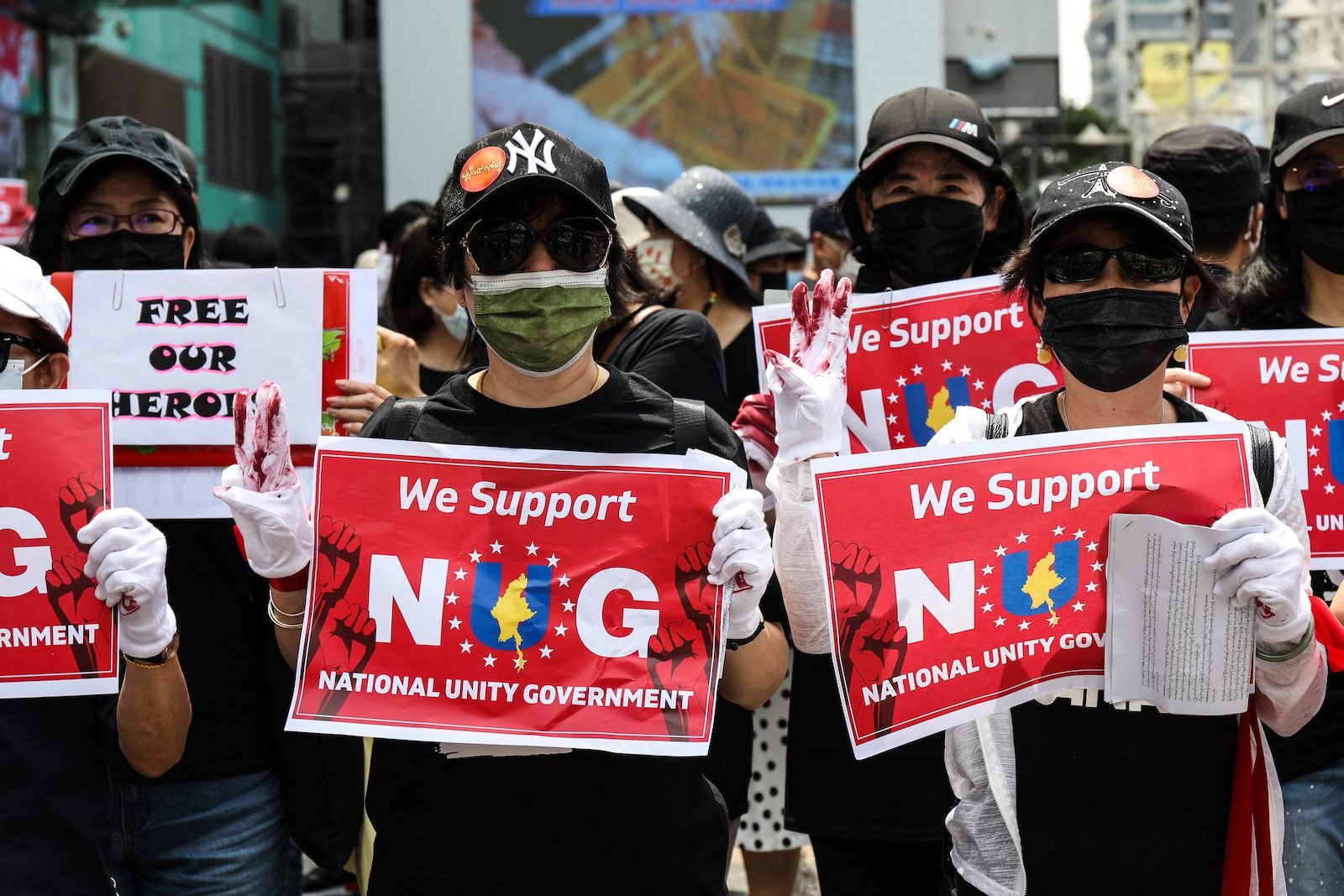
The National Unity Government (NUG), formed by elected representatives ousted in the military takeover, commands enormous moral authority but limited military capability.
Myanmar’s ethnic armed organizations, many of them battle-hardened and deeply rooted in their communities, control significant territory but often operate on independent tracks — maintaining separate channels with neighboring states, the NUG and other prodemocracy groups.
That is beginning to change. The recent announcement of the Steering Council for the Emergence of a Federal Democratic Union (SCEF) — a title, no doubt, established via consensus and without a fancy K Street lobbyist — represents a potentially transformative development. The new alliance brings together some of Myanmar’s largest and most capable resistance organizations around the single vision of a federal democracy.
Critically, the structure grants operational military authority to the ethnic armed groups, while providing a platform for joint planning and operations. It is an important recognition that genuine federalism must begin now, in how the resistance is organized, not just in the constitutional promises made after victory.
The SCEF alliance includes the Kachin Independence Organization, the Karen National Union, the Chin National Front, the Karenni National Progressive Party and the NUG. Notably, reports indicate that the Three Brotherhood Alliance — the Arakan Army, the Ta’ang National Liberation Army, and the Myanmar National Democratic Alliance Army — is also participating.
Together, these “three brothers” demonstrated the advantages of coordinated military cooperation through Operation 1027 — a 2023 offensive that rapidly seized large swaths of northern Shan State, overrunning dozens of military outposts and towns and marking the most significant territorial losses the Tatmadaw had suffered since the 2021 coup.
The quiet inclusion of the Arakan Army is particularly significant. This group has effectively established a proto-state along Myanmar’s western coast, controlling most of Rakhine State and establishing direct communication with neighboring Bangladesh.
More significantly, Rakhine State sits at the terminus of critical Chinese-sponsored Belt and Road infrastructure, including oil and gas pipelines running from the Bay of Bengal to Yunnan Province.
Beijing spent years backing the junta to protect its infrastructure investments. Nonetheless, the Arakan Army was able to surround the military at the Kyaukphyu port and special economic zone, demonstrating that Chinese patronage of the junta has limits and well-organized forces with genuine popular support can overcome Chinese pressure — even near China’s most important infrastructure hubs.
History certainly offers reasons for caution. The junta will certainly attempt to exploit any fault lines within this new alliance. But this moment feels different. The junta is weaker than it has been in decades — stretched across multiple fronts, responsible for a collapsing economy and dependent on China, Russia and Iran for its survival.
The resistance, in contrast, is more organized, more experienced and more politically aligned than at any point since the 2021 coup. The SCEF has been years in the making, built slowly and deliberately by some of the most capable people in Myanmar.
They may be closer than ever to defeating the Tatmadaw and finally building a federal democratic union that so many Myanmar people have suffered for — if the alliance holds.
Dan Swift is a senior research analyst at the Foundation for Defense of Democracies’ Center on Economic and Financial Power and a retired US diplomat who served in Myanmar from 2015-19.
Sean Turnell is a senior fellow at Australia’s Lowy Institute think tank. He served as an economic policy adviser to State Counselor Aung San Suu Kyi in Myanmar and was a political prisoner there from 2021-22.