22 C
London
Wednesday, May 27, 2026
Home Blog

Trump boosts prediction markets as his family profits

0
trump-boosts-prediction-markets-as-his-family-profits
Trump boosts prediction markets as his family profits

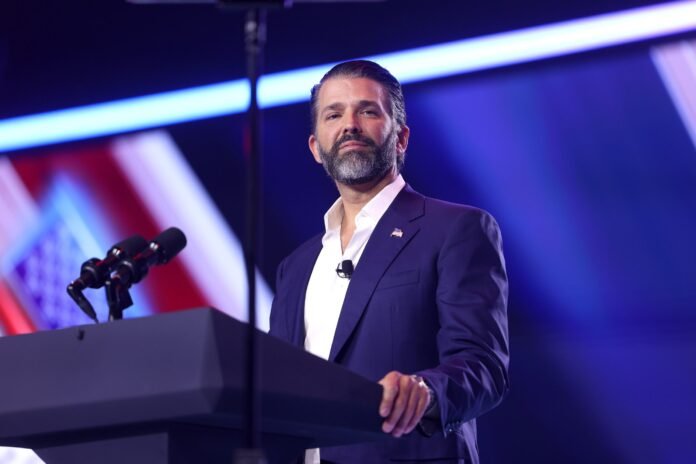
Donald Trump Jr., who has invested in the prediction markets industry. Photo: Gage Skidmore / Wikimedia Commons

US President Donald Trump on Tuesday used his social media platform to boost prediction markets – a burgeoning industry from which Trump’s family stands to profit – and lashed out at state leaders working to regulate them, singling out officials in Illinois, New York and elsewhere as “scum.”

Trump, whose administration is considered by some to be the most brazenly corrupt in US history, argued that the Commodity Futures Trading Commission (CFTC) must have “exclusive authority” over prediction market regulations, declaring that “it is a major industry, and we must protect it.” The president’s message echoed that of his CFTC chief, Mike Selig, who said earlier this year that the agency would fight any state-level efforts to restrict prediction markets.

Sen. Chris Murphy (D-Conn.), who is co-leading legislation that would ban online prediction markets from allowing bets on government actions, said Trump’s post on Tuesday amounts to “more evidence of how the corruption works.”

“Trump and his family are making tons of money off these new prediction markets—and so of course he is leading the charge against consumer protections and for preferential regulatory treatment of his companies,” said Murphy, alluding to Donald Trump Jr.’s role on the advisory board of Polymarket – the world’s largest prediction market platform.

The New York Times reported last month that Trump’s “publicly traded media company unveiled its own prediction market product last year. And the president’s eldest son, Donald Trump Jr., has ties to two of the industry’s top firms, including Polymarket, the platform that prosecutors say was used by the soldier for well-timed bets.”

“The most corrupt president in our nation’s history wants to make sure states like ours can’t regulate prediction markets so his family and administration can keep profiting.”

The president’s attack on state efforts to regulate prediction markets drew swift pushback from state leaders who have supported cracking down on the platforms, warning they are avenues for insider trading and corruption.

“Illinois took action to prevent and ban insider trading with online prediction markets in our state,” Democratic Gov. JB Pritzker wrote on social media in response to Trump’s post. “The most corrupt president in our nation’s history wants to make sure states like ours can’t regulate prediction markets so his family and administration can keep profiting.”

The Trump administration, which has steamrolled federal regulators who have raised questions about prediction markets, is currently suing Illinois and other states over their efforts to regulate the platforms. Critics argue that prediction markets are illegal sportsbooks masquerading as financial exchanges in an attempt to skirt gambling restrictions.

Dominick Freda, legal director of Better Markets, said Tuesday that “Congress never intended to unleash nationwide gambling and certainly did not envision having the tiny and ill-equipped CFTC adopt the role of nationwide gambling czar.” Better Markets on Tuesday filed an amicus brief in support of Tennessee’s effort to rein in Kalshi and other prediction market platforms.

“The CFTC continues to waste its resources and focus on cheerleading these unpoliced, unregulated casinos when it should focus on its real job: regulating the multi-trillion-dollar commodities and derivatives markets,” said Freda. “It is more important than ever for the CFTC to regulate and police those markets so that Americans can count on stable prices for the many goods they rely on, from gas to groceries. The CFTC should leave gambling regulation to Tennessee and the other states whose laws and regulations have protected the American public for decades, and must be allowed to continue to do so.”

-Common Dreams

Jerusalem Prayer Breakfast Blends Faith, Politics, and Warnings on Iran

0
jerusalem-prayer-breakfast-blends-faith,-politics,-and-warnings-on-iran
Jerusalem Prayer Breakfast Blends Faith, Politics, and Warnings on Iran


The Knesset hosted the 10th Jerusalem Prayer Breakfast on Wednesday morning—a high‑profile gathering of faith leaders, lawmakers, and international guests who prayed for Israel and voiced firm warnings about regional threats. The event combined devotional moments with political appeals, reflecting a view that spiritual solidarity must accompany strong security and diplomatic stances.

Speakers framed the meeting as both spiritual and strategic. Former US congresswoman Michele Bachmann opened by calling the gathering “a pivotal moment in world history” and urged prayerful action alongside political clarity, saying, “We’re Gideon’s Army gathered together to do the work.” Her speech linked biblical conviction to present geopolitics and praised recent US–Israeli operations as part of a broader fight against hostile regimes.

Member of Knesset (MK) Tatiana Mazarsky (Yesh Atid) welcomed participants to the Knesset and emphasized resilience under fire, thanking international supporters who she said, “tell the true Israeli story.” Mazarsky described the event as a necessary show of solidarity after repeated attacks, saying the people of Israel draw strength from faith and covenantal promises that, she asserted, bind the nation and its supporters together.

MK Ohad Tal tied (Religious Zionism) prayers to national defense, calling prayers “the first line of defense for Jerusalem,” while arguing that prayer must be matched by action. He warned that Iran’s leadership aims to destroy Israel and insisted the world must choose sides, asserting bluntly, “The Iranian regime is perhaps the greatest force of evil in our time.” Tal also rejected a Palestinian state as a viable security solution and urged regional partners to pursue normalization with Israel, warning that linking progress to Palestinian statehood would only bring “further violence and bloodshed.”

Throughout the program, speakers stressed a common set of themes: the threat from Iran and its proxies, the importance of international Christian–Jewish solidarity, and a belief that spiritual commitment should influence policy. Bachmann framed the moment as biblically significant and said God had assigned Donald Trump and Benjamin Netanyahu specific roles in history, which she said they alone could fulfill.

Organizers and parliamentarians underscored the event’s practical purpose: to cement diplomatic relationships, counter narratives they see as hostile in global media, and sustain moral and material support for Israel. Mazarsky warned of ideological campaigns reaching Christian communities abroad and called for coordinated action “together in prayer, together in education, together in politics and diplomacy” to blunt those efforts.

Voices from the podium combined urgent security warnings with pastoral appeals: to pray, to stand with victims, and to press governments to act. The event ended with calls for continued international solidarity, as speakers urged supporters to stand with Israel through prayer, diplomacy, education, and public advocacy.

Nike’s recycled World Cup uniforms reveal the limits of ‘circular’ fashion

0
nike’s-recycled-world-cup-uniforms-reveal-the-limits-of-‘circular’-fashion
Nike’s recycled World Cup uniforms reveal the limits of ‘circular’ fashion

In June, athletes from 16 countries will kick off the World Cup wearing other people’s used clothing.

Well, maybe. They’ll be sporting uniforms made from recycled fabric, potentially including a mix of scraps and old clothes. It’s the latest initiative from Nike, one of the world’s largest apparel companies, to incorporate more recycled material into the attire it makes. This time, the garment giant said it used “advanced chemical recycling” to produce its first elite performance apparel from 100 percent textile waste. 

Nike executives and some media coverage have implied that the outfits represent a turning point for sustainable fashion — that “circular” clothing, capable of being recycled over and over again, could soon reach everyday consumers.

The real picture, as you might expect, is a bit more complicated.

Nike has indeed signed deals with two chemical recycling companies, but no one is saying much about their technology or how scalable it is. Despite increasing investments from fashion brands, experts said not to expect to find sales racks lined with chemically recycled clothing anytime soon. 

“Yeah, it’s technically possible,” said Veena Singla, an environmental health researcher at the University of California, San Francisco. “But is it going to happen in reality?” She and others who study chemical recycling don’t think so — at least not in any way consumers might expect. The day when they can buy chemically recycled clothes, wear them, then return them for another trip through the cycle isn’t nigh. 

What seems more likely is the fashion industry expands its use of this recycling technique with industrial scrap fabric — and at nothing approaching the level needed to address projected increases in textile production.

Nike is right that the fashion industry has a sustainability problem. Apparel companies produce more than 100 billion articles of clothing every year. In the process they generate up to 10 percent of the world’s greenhouse gas emissions and an unfathomable amount of waste; the vast majority of textiles are eventually landfilled, incinerated, or sent to unofficial dump sites in poor countries. And all of this is made possible by fossil fuels, with nearly 70 percent of clothes made from oil-derived fabrics. The most common is polyester, a type of plastic also used in water bottles.

Rather than easing up on production, Nike and many of its competitors have pledged to boost the “circularity” of polyester — mostly through recycling.

The push to do so through chemical means is a response to the shortcomings of other strategies they’ve tried. Traditional mechanical recycling through shredding and grinding causes fibers to break down. The resulting fabric must be blended with 70 to 80 percent virgin material so anything made with it doesn’t pill and tear. 

The much more prevalent strategy involves turning discarded plastic bottles into new polyester. Patagonia pioneered this approach in the early ‘90s, and by the start of this decade virtually all recycled polyester was sourced from old bottles. Today, however, companies have increasingly faced lawsuits and regulatory scrutiny from those who would rather see bottles turned back into bottles.

Chemical recycling is supposed to be the next best thing. The term refers to using solvents to dissolve fibers into their base chemical units — building blocks that can be spun into new fabrics. On its face, this is a truly “circular” solution, because it doesn’t depend on bottles, and proponents say it can turn your used polyester shirts or running shorts into new ones over and over again, with no loss in fabric quality. 

That’s the vision now being promoted by fast-fashion brands like Gap, H&M, and Levi’s, many of which have signed multi-year agreements with a handful of chemical recycling startups. Last fall, Nike agreed to source “circular” polyester from two of them: the Swedish firm Syre and Loop Industries here in the U.S.

Research does bear out some of the hype. Technically, chemical recycling can produce virgin-quality polyester, and at least one method, called methanolysis, is capable of preserving that quality through repeated rounds of recycling. But there are significant constraints.

Diana Ferreira, a textile researcher at the University of Minho in Portugal, said textile-to-textile chemical recycling remains limited by the availability of suitable fabric to work with. “If we are dealing with clean, well-sorted, polyester-rich waste streams, chemical recycling can in principle produce material with properties comparable to virgin polyester,” she said. “However, if we are talking about post-consumer textile waste, the situation is much more complex.”

Read Next

In other words, chemical recycling works best with industrial scraps, which are more uniform than piles of used clothes. The latter may include blends of cotton, nylon, wool, spandex, and acrylics, not to mention dyes, chemical coatings, thread, labels, and zippers. All of this stuff makes chemical recycling much less feasible — at least, not without meticulous sorting and repeated rounds of pre-treatment to chemically remove all of those contaminants.

“If we wanted it to work, we would have to have our clothes … be 100 percent polyester, and we’d need to get rid of so many toxic chemicals,” Singla said. 

Beth Jensen, of the nonprofit Textile Exchange, is more sanguine. She said “all solutions,” including chemical recycling, are needed to reduce the fashion industry’s dependence on fossil fuels. But she agreed that establishing the infrastructure required for companies to accept used clothing and use technologies like methanolysis to make it into new apparel remains a ways away. Plus, it’s not clear who will build it. Companies like Nike? Governments? Recyclers? Some combination of those entities working collaboratively? 

Even if the industry can hit its optimistic targets for chemically recycled polyester by the early 2030s — whether from scrap or from people’s old clothes — production of “circular” fabric would likely pale in comparison to the more than 169 million metric tons of polyester projected to be manufactured annually by then. Dionisios Vlachos, a professor of chemical engineering at the University of Delaware, said Syre’s goal to produce even 3 million metric tons by 2032 is “too aggressive.”

Instead, companies need to “reverse the trend of fast fashion,” said Nusa Urbancic, CEO of the nonprofit Changing Markets Foundation. That means making less clothing overall, whether it contains recycled or virgin materials.  Last year, growth in recycled polyester — mostly from bottles — was dwarfed by an even larger increase in the production of fossil fuel-based polyester.

Urbancic sees chemical recycling as “an excuse to keep producing plastic clothes” and advocates for a shift away from polyester altogether; the material sheds microfibers and may expose consumers to hazardous chemicals.

Nike, Syre, and Loop Industries did not respond to interview requests or detailed lists of questions, highlighting a transparency problem flagged by Singla, Vlachos, and others Grist spoke with. Industry confidentiality makes it difficult to know what’s actually going on in these firms — and whether “#TheGreatTextileShift” they promise will be different from failed chemical recycling initiatives in the past.

It’s worth noting that Loop Industries has never turned a profit since its founding in 2010. The company is under investigation by the SEC following a 2020 report accusing it of systematically misrepresenting its technology to regulators and investors, and in 2022, it settled a class-action lawsuit over similar accusations. Syre, for its part, has not said how the “gigascale” factory it plans to build in Vietnam will be able to process consumers’ old clothes, given the country’s ban on used apparel imports.

“It remains to be seen whether [Nike’s announcement] amounts to anything,” Singla said. For the foreseeable future, it seems chemically recycled polyester will be limited to niche products like World Cup uniforms.


Territorial integrity and self-determination still dominate the Falklands discussion – but oil may change that

0
territorial-integrity-and-self-determination-still-dominate-the-falklands-discussion-–-but-oil-may-change-that
Territorial integrity and self-determination still dominate the Falklands discussion – but oil may change that

The people of the Falkland Islands are deep in “commemoration season”, preparing for Liberation Day on June 14. This date has been celebrated on the South Atlantic archipelago as its national day since 1982, when Britain defeated Argentina in a 74-day conflict that claimed more than 900 lives, and reclaimed control over the territory.

Despite its failed invasion, Argentina has never given up its claim that what it refers to as Las Islas Malvinas, which are located approximately 500 km off its east coast, are integral to its sovereign territory. The UK counters that descendants of British settlers, present since the 1830s, possess the right to self-determination which they express through their continued association with the UK as a British Overseas Territory.

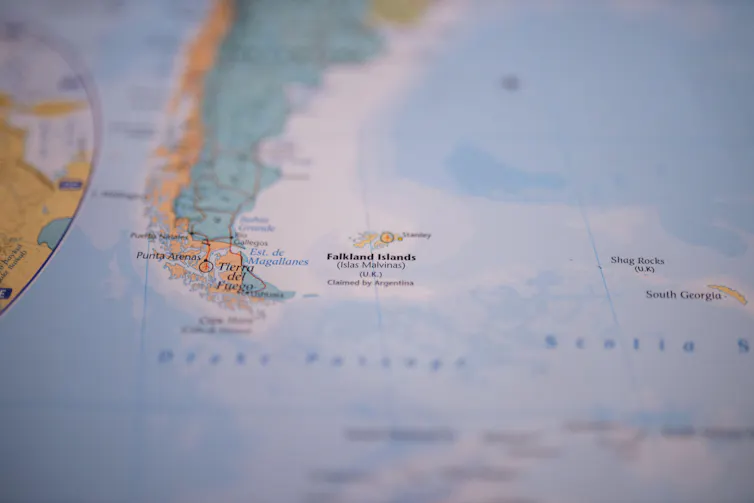
Map of Falkland Islands/Islas Malvinas, showing its position about 500kms off the coast of Argentina in the South Atlantic.

Falkland Islands/Islas Malvinas, sits about 500kms off the coast of Argentina in the South Atlantic. Panther Media Global

There are then competing interpretations of territorial integrity and self-determination. These are two of the most important principles of postwar international law. With each argument premised on an “all-or-nothing” logic of absolute rights, historical events and their legal significance have been continuously and cyclically rehashed over nearly two centuries.

But the issue of who controls the islands has been made more significant by the looming possibility of a major oil extraction. The Sea Lion field, about 220 km north of the Falklands, has a potential yield of up to 55,000 barrels a day with a further 125,000 a day in phase two. Its owner plans to commence drilling as early as 2027.

The Argentinian president, Javier Milei, whose programme of heavy government spending cuts is producing widespread hardship in Argentina, has recently ramped up his aggressive rhetoric about the future of the islands, posting a message to X: “THE MALVINAS WERE, ARE, AND ALWAYS WILL BE ARGENTINE”. He said in a separate interview that his government was doing “everything humanly possible” to return the Falklands to Argentina.

There’s no sense that rival claims would be any clearer or easier to resolve now than they were in 1982. Argentina will never relinquish its claim that the island archipelago is an inalienable part of its territory. And the UK has no reason to abandon its reasoning that the key issue is what the islanders want – and what they want is to be British. Moreover, any UK government proposing to hand over the Falklands would face an unimaginable backlash.

Equitable and good

But in thinking beyond the binary “territorial integrity versus self-determination” as it defines the Falklands/Malvinas controversy, our research proposes something that international law already provides for but rarely uses. Under the ICJ Statute, it requires the consent of both parties – a significant hurdle in any sovereignty dispute.

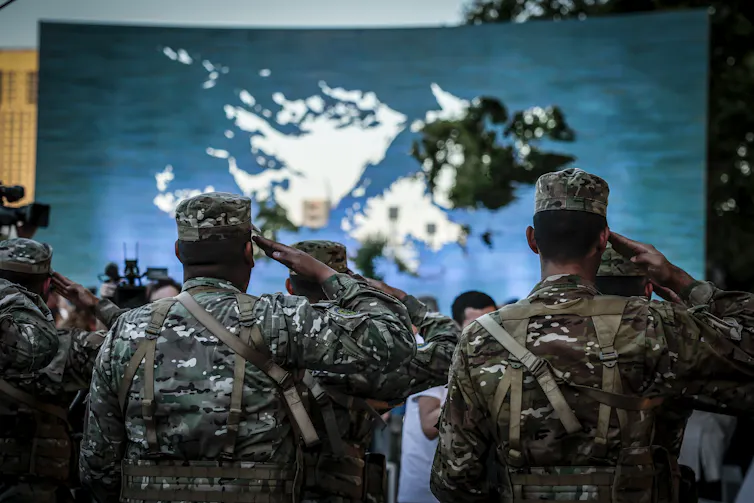
Argentinian soldiers at the inauguration of a monument commemorating the 'illegal occupation' of what they refer to as Las Islas Malvinas.

Argentinian soldiers at the inauguration of a monument commemorating the ‘illegal occupation’ of what they refer to as Las Islas Malvinas. EPA/Juan Ignacio Roncoroni

There is a legal basis for this. In legal terms, it is known as ex aequo et bono (according to what is equitable and good). But the principle behind it is straightforward. Instead of asking: “Who has the stronger legal claim to the land?”, it asks: “What arrangement would actually be fair for everyone involved, even setting aside strict legal entitlements?”

What’s really at stake with the Falklands/Malvinas is not just the land. It’s the sea. The emergence of large-scale offshore extraction raises opportunties and questions that the permanent diplomatic stalemate may no longer be able to manage effectively. And yet international law, built around the idea of who owns which piece of land, has no adequate framework for dealing with them.

Under the UN Convention on the Law of the Sea (Unclos) maritime entitlements flow from land sovereignty: it is the coastal state that claims the exclusive economic zone. This means the law channels every question about resources back into the unresolvable argument over who owns the islands themselves, rather than allowing the resources to be divided on their own merits.

Moving beyond deadlock

One approach which might break the deadlock is an equitable arrangement for sharing maritime boundaries and resources. This could be similar to what Australia and East Timor achieved in 2018. Rather than continuing to fight over competing claims to the Timor Sea, they agreed through conciliation to a permanent maritime boundary and an equitable sharing of oil and gas revenue.

More ambitious proposals — including forms of shared or delegated sovereignty — have periodically surfaced in academic and diplomatic discussions, but remain politically implausible at present.

But we argue to go beyond simply redrawing lines on a map. A genuinely fair settlement needs to consider what large-scale offshore oil extraction would actually mean for the South Atlantic, both in terms of opportunity and risk. The track record of major oil operations in fragile environments around the world is not encouraging. The islands lack the infrastructure and workforce to support industrial extraction – and an offshore disaster would devastate not just the Falklands but Argentina’s coastline too.

Here is where an unlikely common interest emerges. The islanders have built their identity around environmental stewardship and a distinctively traditional way of life. Argentina frames the UK presence as neocolonial resource extraction. Both, from very different starting points, have reason to fear what unchecked oil exploitation could bring. A settlement and common understanding grounded in fairness could protect the environment, provide for more equitable sharing of resources, and safeguard the islanders’ way of life — none of which the current stalemate achieves.

The recently leaked Pentagon memo makes the point for us. The suggestion that Washington could withdraw its backing for British sovereignty as a diplomatic bargaining chip reveals how dependent the current arrangement remains on wider geopolitical alignments.

Sovereignty over the Falklands may remain politically non-negotiable for the foreseeable future. But oil, environmental risk and strategic competition increasingly expose the limits of a legal framework built on absolute territorial claims. The question international law must confront is whether frozen sovereignty disputes can sustainably govern shared maritime spaces in an era of resource competition and geopolitical instability.

YouTube to begin automatically labeling AI videos

0
youtube-to-begin-automatically-labeling-ai-videos
YouTube to begin automatically labeling AI videos

AI content creation tools like Google’s new Omni model threaten to make reality even harder to discern from AI fantasy, but YouTube is taking an important step toward verifying video origins. After debuting wishy-washy AI content labeling in 2024, Google will begin using more prominent labeling for AI videos, and the site will no longer rely entirely on uploaders to divulge when they use AI tools to create a video.

When YouTube first attempted to tackle the identification of AI videos in 2024, it was almost gratuitous. AI videos at the time nearly always outed themselves by looking bizarre or disjointed. In just a few years, AI models like Seedance, Runway, and Google’s own Veo have raised the bar for realism and consistency in AI video—the spaghetti is more accurate than ever.

Recognizing that, YouTube is making the AI labels more prominent and automating part of the process. Creators are still required to indicate when uploading videos if they were created with the help of AI tools. However, uploaders didn’t have any incentive to be honest about that before. Starting this month, YouTube will use “new internal signals” to flag AI content. This will apparently apply to videos that show “significant photorealistic AI use.”

Simplified AI Labels & Auto-Detection: What You Need to Know

Google is vague about what signals will figure into its AI detection system—we’ve asked for more details and will update if we hear anything. The blog post does mention two ironclad triggers: C2PA metadata indicating a purely AI source and the use of watermarked Google tools like Veo. Creators who believe their videos have been tagged as AI incorrectly can appeal, but not if the site marks an upload as AI for either of those reasons. Those labels are “permanent.”

When applied, the new labels will also be someplace you’ll actually be able to see them. Previously, Google’s essentially voluntary AI labels were only visible in the expanded video description in a section titled “How this content was made.” If you didn’t go looking for that information, you’d never see the label at all.

The three styles of AI labels you will now see on YouTube.

The three styles of AI labels you will now see on YouTube. Credit: YouTube

As the new system rolls out, Google will use labels that are more prominent on both standard videos and YouTube Shorts. For videos filmed the right way (landscape), the AI tag will appear directly below the video and above the description box. For Shorts, the label will appear as a small overlay at the bottom of the video itself, although that will add to the already cluttered look of the TikTok-aping Shorts.

YouTube says the new label is intended to be clear and glanceable. It’s a small ellipse with “AI” and an information symbol. The company has not specified if the label is clickable, but it certainly looks that way. Importantly, there may still be AI content on YouTube that doesn’t use the new label. Google says this system is aimed at “photorealistic and meaningfully AI altered or generated content.” An animated video created with AI or a realistic one that only has a few AI elements will continue to have AI disclosures in the expanded description box.

EU governments clear US trade deal legislation

0
eu-governments-clear-us-trade-deal-legislation
EU governments clear US trade deal legislation


European Union governments cleared legislation on Wednesday to remove import duties on many U.S. goods, an EU source with knowledge of their meeting said, ​a move that should avert President Donald Trump’s threat of higher tariffs on ​EU cars and other products.

Under a deal struck at Trump’s Turnberry golf ⁠resort in Scotland last July, the EU agreed to remove import duties ​on U.S. industrial goods and grant preferential access to U.S. farm and seafood produce, ​while accepting U.S. tariffs of 15% on most EU goods.

Ten months since that framework accord, the EU has still not fulfilled its side of the deal, prompting Trump to say he ​would impose “much higher” tariffs on EU goods if the EU does not implement ​its commitments by July 4.

Ambassadors from the 27 EU member nations have now cleared legislation ‌to ⁠put in place those import duty reductions. The decision came after negotiators from EU governments and the European Parliament agreed on texts last week that also put in place a range of safeguards in case the Trump administration breaches the trade accord.

​The legislation still ​needs to be ⁠approved by the European Parliament. Its trade committee is set to hold an indicative vote next Tuesday, with the decision ​by the full EU assembly in mid-June.

The safeguards, pushed by ​EU lawmakers, ⁠include a clause to end the trade deal at the end of 2029 and a provision to allow the European Commission to suspend parts of the deal if ⁠the ​United States backtracks on cutting tariffs to 15% ​on washing machines, wind turbines and other products with high steel or aluminium content. They are currently ​subject to 25% tariffs.

Hot Honey Salmon Bites

0
hot-honey-salmon-bites
Hot Honey Salmon Bites

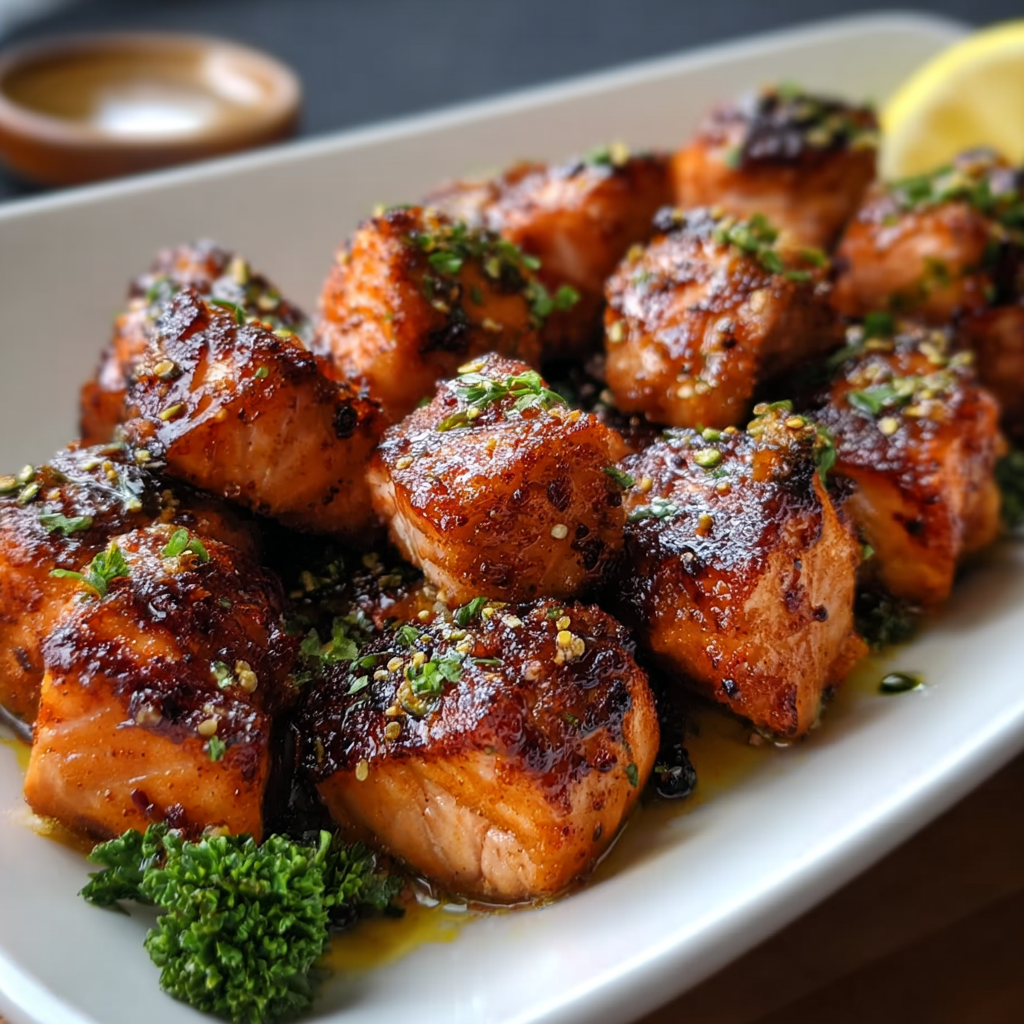
Hot Honey Salmon Bites are crispy, flavorful bite-sized pieces of salmon coated in a sticky sweet-and-spicy hot honey glaze that’s completely irresistible! Perfectly seasoned salmon is air-fried until tender and slightly crisp on the edges, then tossed in a buttery hot honey sauce that delivers the perfect balance of heat and sweetness. These salmon bites are quick, easy, and versatile enough to serve as an appetizer, weeknight dinner, rice bowl topping, taco filling, or party snack.

If you love bold flavors and easy seafood recipes, these salmon bites are guaranteed to become a favorite!

Why You’ll Love These Hot Honey Salmon Bites

  • Ready in just 20 minutes
  • Sweet, spicy, and savory flavor combination
  • Crispy edges with tender flaky salmon
  • Easy air fryer recipe
  • Oven instructions included
  • Perfect for bowls, tacos, appetizers, or dinner

What Makes Hot Honey So Good?

Hot honey combines the natural sweetness of honey with spicy chili heat, creating a sauce that works perfectly with savory foods like salmon.

When melted together with butter, the glaze becomes rich, glossy, sticky, and absolutely packed with flavor.

The balance of sweet heat complements the buttery salmon beautifully without overpowering it.


Ingredients & Substitutions

Fresh salmon filets work best for this recipe. Remove the skin and cut the salmon into evenly sized cubes for consistent cooking.

Frozen salmon can also be used—just thaw completely before cutting.

Olive Oil

Olive oil helps the seasoning stick while also helping the salmon crisp slightly in the air fryer.

Seasonings

Paprika, garlic powder, onion powder, salt, and pepper create a flavorful savory coating that pairs perfectly with the hot honey glaze.

Hot Honey

Store-bought or homemade hot honey both work beautifully.

Butter

Butter adds richness and helps create a silky glaze that coats every salmon bite perfectly.


How To Adjust The Spice Level

One of the best things about this recipe is how easy it is to customize.

For Less Heat

  • Use regular honey instead of hot honey
  • Use less glaze
  • Add extra butter to mellow the spice

For More Heat

  • Add red pepper flakes
  • Mix in hot sauce
  • Use extra spicy hot honey

How To Make Hot Honey Salmon Bites

These salmon bites come together quickly with minimal prep.


Step 1: Season The Salmon

  1. Cut salmon into 1-inch cubes.
  2. In a large bowl, combine:
    • Olive oil
    • Paprika
    • Garlic powder
    • Onion powder
    • Salt
    • Black pepper
  3. Toss salmon gently until evenly coated.

Step 2: Air Fry The Salmon

  1. Preheat air fryer to 390°F.
  2. Arrange salmon pieces in a single layer.
  3. Air fry for 9–10 minutes, shaking halfway through cooking.

The salmon should reach an internal temperature of 140–145°F.


Step 3: Make The Hot Honey Glaze

  1. In a saucepan over medium heat, melt butter.
  2. Stir in hot honey until warm and smooth.

Step 4: Coat The Salmon

  1. Add cooked salmon bites to the glaze.
  2. Toss gently until every piece is coated.

Garnish with fresh parsley and serve immediately.


Oven Instructions

No air fryer? No problem!

To Bake In The Oven

  1. Preheat oven to 400°F.
  2. Line a baking sheet with parchment paper.
  3. Arrange seasoned salmon pieces in a single layer.
  4. Bake for 10–12 minutes until cooked through.
  5. Toss with warm hot honey glaze before serving.

How To Serve Hot Honey Salmon Bites

These salmon bites are incredibly versatile and pair well with many sides and meals.

Delicious Serving Ideas

As An Appetizer

Serve with toothpicks and extra hot honey drizzle.

In Rice Bowls

Serve over:

  • White rice
  • Brown rice
  • Quinoa
  • Cauliflower rice

Add avocado, cucumber, edamame, and greens.

In Tacos

Stuff into tortillas with slaw, avocado, and lime crema.

With Pasta

Toss into buttery noodles or creamy pasta dishes.

As A Main Dish

Serve with:

  • Roasted vegetables
  • Mashed potatoes
  • Salad
  • Garlic green beans

How To Store & Reheat

Refrigerator

Store cooled salmon bites in an airtight container for up to 2 days.

If possible, store sauce separately.

Reheating

Reheat:

  • In the air fryer
  • In the oven
  • In a skillet

Avoid overheating to keep the salmon tender.


Hot Honey Salmon Bites Recipe

Prep Time

10 minutes

Cook Time

10 minutes

Total Time

20 minutes

Servings

4 servings


Ingredients

  • 1½ pounds salmon, skin removed, cut into cubes
  • 2 tablespoons olive oil
  • 1 teaspoon paprika
  • 1 teaspoon garlic powder
  • 1 teaspoon onion powder
  • 1 teaspoon kosher salt
  • ½ teaspoon black pepper
  • 3 tablespoons unsalted butter
  • ¼ cup hot honey
  • Fresh parsley, chopped for garnish

Instructions

Season The Salmon

  1. Preheat air fryer to 390°F.
  2. In a large bowl, mix olive oil, paprika, garlic powder, onion powder, salt, and pepper.
  3. Add salmon bites and toss gently to coat.

Cook The Salmon

  1. Arrange salmon in a single layer in the air fryer basket.
  2. Air fry 9–10 minutes, shaking halfway through cooking.

Prepare The Glaze

  1. In a saucepan over medium heat, melt butter.
  2. Stir in hot honey until warmed through.

Toss & Serve

  1. Add cooked salmon bites to the sauce.
  2. Toss gently until coated.
  3. Garnish with parsley and serve immediately.

Tips For The Best Salmon Bites

  • Cut salmon into equal-sized pieces for even cooking.
  • Don’t overcrowd the air fryer basket.
  • Pat salmon dry before seasoning for better texture.
  • Toss gently to avoid breaking apart the salmon.
  • Serve immediately for the crispiest texture.

Variations

Garlic Hot Honey Salmon

Add minced garlic to the glaze for extra flavor.

Asian-Inspired Version

Add soy sauce and sesame oil to the glaze.

Crispy Breaded Salmon Bites

Coat salmon lightly in panko breadcrumbs before air frying.

Lemon Hot Honey Salmon

Add fresh lemon juice for brightness and balance.


Frequently Asked Questions

Can I use frozen salmon?

Yes, but thaw completely before cutting and seasoning.

Is hot honey very spicy?

It has mild-to-moderate heat, but you can adjust the spice level easily.

Can I make these ahead of time?

They’re best fresh, but leftovers can be reheated gently.

What air fryer works best?

Any basket-style air fryer works well as long as the salmon cooks in a single layer.

The challenge of militant Islam

0
the-challenge-of-militant-islam
The challenge of militant Islam

It is not fortuitous that many of the flags of western industrial democracies such as Britain, Sweden and Norway feature a cross. This harks backs to their Christian traditions. Conversely, more recent nation-states such as France, Italy and Germany shunned featuring religious symbols on their national flags.

Ultimately however, in current times a cross on the national flag of a European country is more a tribute to tradition than the reaffirmation of a given faith.

While Western societies were  slowly shifting towards secularization and the disconnect between faith and state, many third world societies proceeded in the opposite direction.

Thus, within the overall process of decolonization practically all former colonies with Muslim majorities (Indonesia being a notable exception) chose to feature Islamic religious symbols on their national flags. For them, accession to independence walked hand in hand with a reaffirmation of their Islamic faith.

By doing so the Islamic countries not only reversed the disconnect  that had come about in the West between faith and state. They also implicitly created a category of citizens who were called upon to display their allegiance to a flag  that bore the symbol of a faith to which they did not belong.

While this situation does not necessarily impact the everyday life of a non-Muslim citizen of a Muslim-majority country it is indicative of a state of mind. And this in turn is suggestive  of a subsidiary reality – namely that, over the past decades, what can be termed “militant Islam” is on the rise.

“Militant Islam” in its contemporary version emerged in Egypt under the name of the Muslim Brotherhood. Created in 1928 by the Islamic scholar Al Banna as a Sunni transnational organization, it advocated  the unification of all Muslim believers under an Islamic state  ruled by Shariah law.

Over the following decades, while essentially based in Egypt, the Muslim Brotherhood – whose motto was “Dying in the way of Allah is our highest hope”– gained a substantive following throughout the Arab world, especially among the masses.

Featuring a cloudy, opaque and diffused leadership, the Muslim Brotherhood was as much an organization as a state of mind. As such, it spawned the likes of Hamas, Islamic Jihad and other violent Islamic groups that dotted the Middle East ecosystem, all sharing one common goal: the creation of an Islamic state, ruled by the Shariah.

It’s ambition to exercise political authority, albeit as predicated by Shariah law, inevitably brought the tenets of the Muslim Brotherhood and its spinoffs into conflict with the existing various political establements in the Middle East that had no intention of relinquishing their hold on the instruments of state power.

This development, however, was not linear, especially in the Gulf states. In the 1980s members of the Brotherhood gained safe haven in the Gulf states, where they provided skilled professionals especially in the field of education. However, at its core, there was an underlying mismatch between the Brotherhood, which promoted political Islam with some form of popular participation, and the Gulf monarchies, which were hereditary and absolute or semi absolute monarchies.

This mismatch came to the front in the wake of the Arab spring. In 2011, Mohamed Morsi, who had close ties with the Muslim Brotherhood, was elected president of Egypt in the country’s first democratic elections. Two years later he was  removed by the Army – a scenario that under different forms also took place in Algeria and Tunisia.

The election and subsequent removal of Morsi proved a wake-up call for the powerholders throughout the Middle East. It demonstrated not only that the Brotherhood had a considerable following at the grass-roots level but that in a free democratic election process political power could be  within its reach.

This did not lead to an outright ban of the Brotherhood throughout the Middle East and Turkey but rather to a policy of surveillance, control and even occasional funding – with, in the background, the option of a violent repression were it to become an immediate political threat.

Underlying the restriction put on the activities of the Brotherhood lay the uncomfortable truth that, were free and democratic elections held in most Arab countries, the winners would be the Brotherhood or its offspring.

With Militant Islam essentially kept in check by the Arab regimes themselves  within the Middle East, the extent to which it has migrated to Europe  has become a source of major controversy, often distorted and systematically politicized.

While there are no official government figures it is estimated that there are some 46 million Muslims in Europe, equivalent to some 6% of the total population. While the percentage varies by European country  with practically none in Poland or Hungary and up to 10% in France and 7% in Germany and the UK , overall some 70% are from Arab origin. This includes recent arrivals, legal or illegal residents, asylum seekers . refugees as well as native born.

As for the potential number of people among this group with a proclivity to  revert to  violence to promote their beliefs, security services believe that they do not, overall include more than a few thousands altogether. As for the Muslim Brotherhood, while it has a presence within the Islamic  population  its focus  is mostly on soft power with a presence in mosques, schools and social endeavors, all seeking to reenforce the separate identities of the Islamic communities.

Ultimately, it was not immigration but its numbers and makeup that created considerable disquiet in some of the countries of destination such as France, Germany, Sweden and the UK.

The issue is not immigration per se. Switzerland has a foreign population of some 23% and has no major  problem with immigration. The issue is immigrants creating parallel societies based on social norms that are incompatible with those of the countries of destination.

Within this ecosystem terrorism as such by individual or small radicalized groups is not significant. What is significant is the impact it has on European societies, which increasingly feel culturally under siege.

Thus, when the parents of a state-run  school in the French city of Lille, which has a high percentage of Muslim pupils, petitioned the authorities not to serve pork as part of the school lunches, the outcry of disapprobation throughout France was massive. And it was further massively amplified by a splattering of terrorist action by radicalized individuals acting in the name of Islam.

This in turn has conspired to create, throughout most European countries a pervasive negative view of immigration as such and of Islamic immigration even more so.

The resurgence of right wing parties is in great part credited to the belief that immigration, and in particular Muslim immigration, is out of control. The pressure on European government to restrict immigration is thus pervasive and Germany, which under chancellor Merkel accepted some one million refugees from Syria, is trying to return al least half of them.

The end result is that most European security services consider Islamic extremism originating from the Islamic communities within Europe a “significant threat,” albeit one that is difficult to identify and even more difficult to preempt. This applies in particular to acts of individuals or small groups who are radicalized through social media. As such, while they are not an institutional threat to the European societies they live in, they represent a destabilizing element which European governments have problems controlling.

As of today, for better or for worse, the powers throughout the Middle East  appear to have their militant Islamists under control.

The Europeans, albeit facing a differently configured challenge, are still groping.

The Hajj ceasefire the Middle East never expected

0
the-hajj-ceasefire-the-middle-east-never-expected
The Hajj ceasefire the Middle East never expected

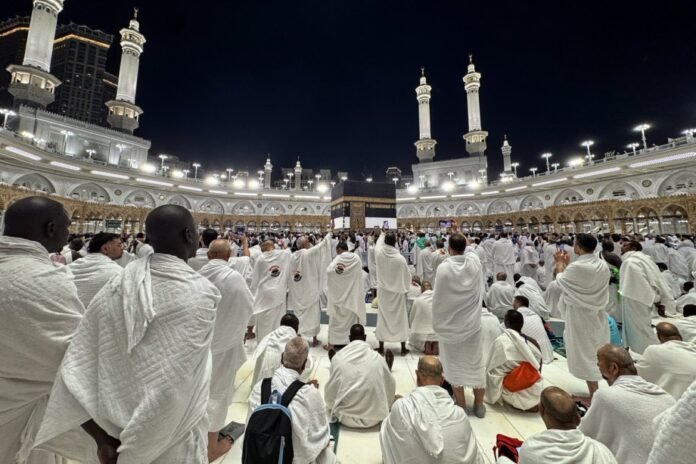
As missiles crossed the Gulf and oil traders braced for another regional inferno, an altogether different procession unfolded in Mecca. More than 1.5 million Muslims arrived for the 2026 Hajj under the shadow of a US–Israeli war against Iran, a conflict that had already rattled shipping lanes, shaken energy markets, and revived fears of a region-wide sectarian rupture. Yet inside Islam’s holiest sanctuary, another logic prevailed — one that neither drones nor deterrence theory could fully explain.

The striking reality was not simply that the Hajj continued. It was that the pilgrimage quietly imposed limits on war itself.

In an era where global diplomacy increasingly appears exhausted, transactional, and militarised, the Hajj revealed an overlooked truth about Middle Eastern order: sacred obligations still possess strategic weight. While Washington and Tel Aviv framed the campaign against Iran through the language of security and deterrence, Mecca became a theatre of restraint. Tehran refrained from escalation near the Hejaz. Saudi Arabia opened its gates to approximately 30,000 Iranian pilgrims despite active hostilities. A fragile but unmistakable diplomatic corridor emerged — not through summits or sanctions, but through ritual.

This was not sentimentality masquerading as geopolitics. It was geopolitics in its oldest form.

For decades, international relations analysis has tended to treat religion either as a source of instability or as a decorative backdrop to ‘real’ statecraft. The 2026 Hajj shattered that assumption.

The pilgrimage functioned as a de facto non-aggression pact, creating what could be described as a temporary sacred security architecture across the Gulf. The consequences mattered far beyond Saudi Arabia.

At the height of tensions earlier this year, fears of direct regional confrontation were acute. Insurance premiums for vessels moving through Hormuz surged. Brent crude prices flirted with levels unseen since the Ukraine energy shock. RAND analysts warned of cascading escalation risks involving Iranian proxy networks stretching from Lebanon to Iraq. The International Crisis Group cautioned that even limited retaliation could spiral into attacks on Gulf infrastructure and civilian transit routes. Yet amid this volatility, the Hajj imposed an invisible red line.

READ: Saudi Arabia says 1.7 million pilgrims performed Hajj this year

No actor wished to be remembered as the force that endangered pilgrims circling the Kaaba. The symbolism carried extraordinary power. Millions of Muslims from rival sects, political traditions, and national loyalties stood shoulder-to-shoulder while the wider region edged toward confrontation. 

Yet the deeper significance of the 2026 Hajj reached beyond Islam alone. The final days of the pilgrimage coincided with Eid Al-Adha — the sacred commemoration of Prophet Abraham’s willingness to sacrifice his son before divine mercy intervened. According to Saudi reporting, pilgrims gathered in Mecca at the very moment Muslims around the world reflected upon Abraham’s ultimate act of obedience, compassion, and surrender to God’s will. That symbolism carries immense diplomatic weight in a fractured world. 

Abraham is not solely a figure of Islam, but a patriarch shared across the three great monotheistic faiths — Judaism, Christianity, and Islam alike.  In the shadow of war involving Israel, Iran, and the United States, the Hajj quietly became something larger than a Muslim gathering. It became a reminder that the Middle East’s deepest spiritual inheritance is profoundly interconnected.

At a time when political leaders increasingly weaponise identity, the image emerging from Mecca offered an altogether different vision of the region — one rooted not in civilisational conflict, but in civilisational kinship. The same Abraham revered in Mecca is also revered in Jerusalem and across the churches of Christendom. The same narrative of sacrifice, mercy, and human dignity echoes through the Torah, the Bible, and the Qur’an. This matters strategically because modern diplomacy in the Middle East has too often ignored the emotional architecture of faith. Military coalitions may impose deterrence, but shared sacred memory can still impose restraint.

The convergence of Hajj and Eid Al-Adha therefore, created an extraordinary moral contrast to the surrounding violence. While missiles, sanctions, and retaliatory threats dominated headlines, millions gathered to commemorate a story centred on mercy overcoming destruction.

In that sense, Mecca offered the region a fleeting but powerful diplomatic metaphor: that the descendants of Abraham remain capable of coexistence even when their governments drift toward confrontation. 

For global strategists searching desperately for stabilising narratives in the Middle East, this may be the most overlooked lesson of all. The future of regional diplomacy may depend not only on ceasefires and security guarantees, but on rediscovering the shared moral language buried beneath the politics of war.

Saudi authorities deployed massive security and health operations, including 50,000 healthcare workers and 3,000 ambulances, to ensure the pilgrimage proceeded safely despite temperatures exceeding 45°C. The logistical feat mattered strategically because it reinforced Riyadh’s central claim to legitimacy: custodianship of the Two Holy Mosques.

That custodianship is no longer merely a religious title. It has become a form of soft power unmatched anywhere in the Muslim world.

For Crown Prince Mohammed bin Salman, this represented a sophisticated balancing act. Saudi Arabia remains embedded in the American security umbrella, yet Riyadh has simultaneously pursued détente with Tehran since the 2023 Chinese-brokered rapprochement. The Hajj exposed the limits of binary alliance politics in the Gulf. Even while aligned strategically with Washington, Saudi Arabia could not afford to appear complicit in a regional war targeting fellow Muslims during pilgrimage season.

The kingdom therefore chose neutrality wrapped in sanctity. That decision carried consequences for the wider Islamic world. Riyadh’s refusal to politicise access to Mecca effectively insulated the pilgrimage from sectarian fragmentation.

Saudi bans on political slogans, banners, and demonstrations reinforced the idea that the holy precincts exist outside geopolitical contestation. In practical terms, this transformed Mecca into one of the few genuinely neutral spaces left in the Middle East.

There is historical irony here. Only a decade ago, Saudi–Iranian relations had collapsed after the execution of Shiite cleric Nimr al-Nimr and attacks on Saudi diplomatic facilities in Iran. The memory of the 2015 Mina stampede, which killed hundreds of Iranian pilgrims, deepened mistrust further. Many analysts assumed sectarian hostility had become structurally irreversible.

READ: Saudi Arabia deploys drones, AI to enhance security during 2026 Hajj pilgrimage

Instead, the Hajj has emerged as a mechanism for managed coexistence. What emerged was ‘Hajj diplomacy’ — a rare moment where faith imposed restraint, and rivals chose coexistence over escalation; a narrow but resilient channel of cooperation surviving despite proxy conflicts elsewhere. Technical coordination over visas, transport, health protocols, and pilgrim safety has quietly institutionalised communication between rival states. 

That matters because durable diplomacy rarely begins with grand bargains. More often, it starts with limited functional cooperation that gradually reduces strategic paranoia.

The Hajj now appears to be performing exactly that role. Equally important is what this moment says about prevailing Western narratives surrounding Islam and violence. The 2026 pilgrimage represented the world’s largest peaceful annual gathering occurring simultaneously alongside one of the most dangerous geopolitical crises of the decade. Rather than collapsing into disorder, the event demonstrated extraordinary collective discipline, cooperation, and restraint.

That reality directly contradicts the enduring ‘clash of civilisations’ framing that still shadows parts of Western strategic thinking.

Research from Brookings has long suggested that participation in the Hajj increases tolerance and reduces support for extremism. Pilgrims returning from Mecca were found to be significantly more supportive of peaceful coexistence and more resistant to militant narratives. The implications are profound. If mass religious experience can reinforce moderation rather than radicalisation, then prevailing assumptions within counterterrorism discourse require serious revision.

The lesson for policymakers is uncomfortable but necessary: faith-based institutions are not merely security liabilities. Under certain conditions, they can become stabilising geopolitical actors.

This is particularly relevant as the international system enters an age of fractured multipolarity. Traditional diplomatic frameworks are weakening. The United Nations struggles to mediate major conflicts. Great-power competition increasingly paralyses multilateral institutions. In that environment, unconventional stabilisers — religious legitimacy, cultural authority, civilisational symbolism — are gaining strategic importance.

The Hajj demonstrated this with remarkable clarity. At a time when global governance appears brittle, Mecca produced a temporary order that nuclear deterrence and military coalitions could not. Not because religion replaced politics, but because sacred legitimacy constrained political behaviour in ways conventional diplomacy failed to achieve.

There is a wider warning embedded in this moment as well. Had the pilgrimage been disrupted by missile strikes, sectarian reprisals, or state retaliation, the consequences would likely have extended far beyond the Gulf. A direct attack affecting pilgrims could have ignited outrage across Muslim-majority societies from Indonesia to Nigeria, destabilising fragile governments and intensifying anti-Western sentiment worldwide. 

Energy markets would have convulsed. Maritime insecurity across the Red Sea and Hormuz corridors would have deepened. The economic aftershocks alone could have reverberated through already strained global supply chains. Instead, restraint prevailed. Not because trust suddenly emerged between adversaries, but because the political cost of violating sacred sanctuary became intolerably high.

That may ultimately be the most important strategic lesson of the 2026 Hajj. In a century dominated by technological warfare, algorithmic escalation, and transactional diplomacy, ancient institutions still possess the power to impose moral boundaries on conflict. The modern Middle East remains deeply fractured, but Mecca briefly reminded the world that even bitter rivals sometimes recognise lines that cannot be crossed.

The tragedy is that global diplomacy rarely knows how to build upon such moments. Yet for a few extraordinary days beneath the desert heat, amid warplanes, sanctions, and nuclear anxieties, the Hajj offered something the international system has not produced in years: a fragile glimpse of restraint grounded not in fear, but in shared sacred responsibility. 

As pilgrims marked Eid Al-Adha in the land of Abraham, the Middle East briefly remembered a truth too often buried beneath geopolitics — that the spiritual traditions dividing the region also contain the moral vocabulary capable of saving it.

OPINION: Has the Flotilla finally exposed the West’s moral double standard?

The views expressed in this article belong to the author and do not necessarily reflect the editorial policy of Middle East Monitor.
Trump’s ‘Donroe Doctrine’ Supercharges Violence in the Americas

0
trump’s-‘donroe-doctrine’-supercharges-violence-in-the-americas
Trump’s ‘Donroe Doctrine’ Supercharges Violence in the Americas


The Trump administration’s aggressive diplomatic and military engagement in the U.S.’s backyard — dubbed the Donroe Doctrine — has led to more violence in the Americas, increased impunity by local security forces, and heightened danger from cartels in the Western Hemisphere, according to a new analysis by a top violence watchdog, shared with The Intercept.

“U.S. pressure on organized crime is accelerating the spread of militarized security approaches in the region,” according to Sandra Pellegrini and Tiziano Breda, senior Latin America analysts with the Armed Conflict Location & Event Data project, known as ACLED. “Growing volatility in the organized crime ecosystem will likely fuel an increase in violence throughout the rest of Trump’s term, potentially undermining any short-term improvements achieved through hardline approaches.”

President Donald Trump has turned the Western Hemisphere into a war zone as part of what he and others have called the Donroe Doctrine. This bastardization of the 1823 Monroe Doctrine has been used to justify strikes on civilian boats in the Caribbean Sea and Pacific Ocean; an attack on Venezuela and the abduction of its president; CIA operations in Mexico; joint counter-cartel operations in Ecuador dubbed “Operation Total Extermination”; and increased military and intelligence operations elsewhere in Latin America.

“In countries where cartels’ revenue sources are most diversified, the spread of militarized security strategies has led to counterproductive results, such as group fragmentation and intensified competition,” according to the ACLED analysis. In Ecuador, the capture or killing of gang leaders has led to a proliferation of splinter groups. The reported number of gangs there increased from 24 in 2023 to 37 by the end of last year. And after José Adolfo Macías, the leader of the gang Los Choneros, was extradited to the United States, another group — Los Lobos — was able to push into its rival’s strongholds, fueling more violence, the analysts noted.

Cartels are also increasingly waging a light-footprint air war strategy, similar to the tactics employed by the U.S. military during the War on Terror and now in its boat strike campaign. Armed groups in Mexico and Colombia are employing weaponized drones to target security forces, write Pellegrini and Breda, “in an effort to maximize the impact of their attacks while minimizing the costs of a direct confrontation.” In Mexico, drone attacks by cartels have jumped 567 percent from 2023 to 2025. In Colombia, such attacks have spiked an astounding 10,600 percent, from one strike in 2023 to at least 107 in 2025.

For its part, the U.S. military’s illegal campaign of strikes on boats in the Caribbean Sea and Pacific Ocean has resulted in 59 attacks on so-called drug boats since September 2025, killing 195 civilians. The latest strike, on May 8 in the Pacific Ocean, killed three people.

Regional security forces aligned with the U.S. have also employed attacks from afar. “Forms of remote violence, namely aerial bombardments and, in the case of Haiti, the use of drones by a special task force, have exposed civilians to shelling and caused the number of people killed from clashes between security forces and gangs to skyrocket,” according to the ACLED analysts. 

Pellegrini and Breda note that Trump is fostering both a “hardline response to crime across the region” and “a climate of impunity” that has led to runaway state violence. Operations by security forces reportedly killed almost 6,900 people last year, the highest total since 2018.

Under the Donroe Doctrine, the Trump administration has repeatedly bullied Panama and threatened Canada, Colombia, Greenland, and perhaps also Iceland. It has also increasingly threatened Cuba.

Last week, federal prosecutors in Florida unsealed an indictment charging former Cuban leader Raúl Castro and five others in connection with the Cuban military’s fatal downing of two planes 30 years ago. The administration has also been making claims that the tiny island nation is a military threat. Democrats in Congress have pushed back and repeatedly warned that the administration is crafting a pretext to justify an invasion.

“Look, the Cuban regime is an appalling regime, but it is no more a national security threat than Nicaragua is. It’s just insane to say that it is, and especially if it’s done in the service of military action,” said Rep. Jim Himes, D-Conn., the top Democrat on the House Intelligence Committee. 

0FansLike
0FollowersFollow
0FollowersFollow
0SubscribersSubscribe
- Advertisement -
Google search engine

Recent Posts