
The people of the Falkland Islands are deep in “commemoration season”, preparing for Liberation Day on June 14. This date has been celebrated on the South Atlantic archipelago as its national day since 1982, when Britain defeated Argentina in a 74-day conflict that claimed more than 900 lives, and reclaimed control over the territory.
Despite its failed invasion, Argentina has never given up its claim that what it refers to as Las Islas Malvinas, which are located approximately 500 km off its east coast, are integral to its sovereign territory. The UK counters that descendants of British settlers, present since the 1830s, possess the right to self-determination which they express through their continued association with the UK as a British Overseas Territory.
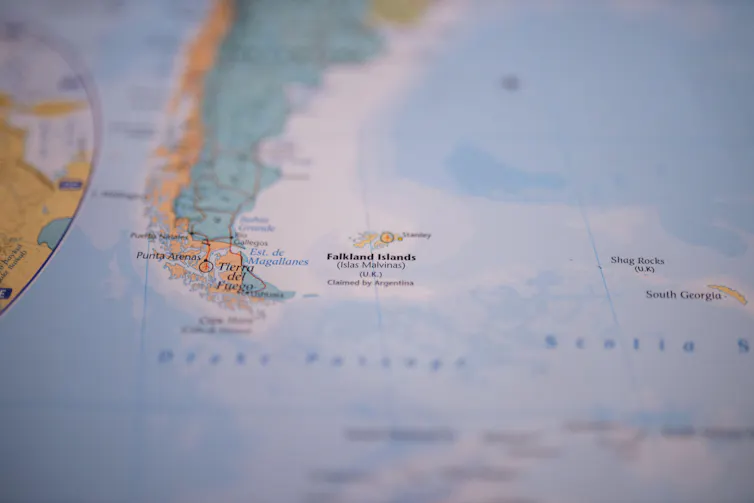
There are then competing interpretations of territorial integrity and self-determination. These are two of the most important principles of postwar international law. With each argument premised on an “all-or-nothing” logic of absolute rights, historical events and their legal significance have been continuously and cyclically rehashed over nearly two centuries.
But the issue of who controls the islands has been made more significant by the looming possibility of a major oil extraction. The Sea Lion field, about 220 km north of the Falklands, has a potential yield of up to 55,000 barrels a day with a further 125,000 a day in phase two. Its owner plans to commence drilling as early as 2027.
The Argentinian president, Javier Milei, whose programme of heavy government spending cuts is producing widespread hardship in Argentina, has recently ramped up his aggressive rhetoric about the future of the islands, posting a message to X: “THE MALVINAS WERE, ARE, AND ALWAYS WILL BE ARGENTINE”. He said in a separate interview that his government was doing “everything humanly possible” to return the Falklands to Argentina.
There’s no sense that rival claims would be any clearer or easier to resolve now than they were in 1982. Argentina will never relinquish its claim that the island archipelago is an inalienable part of its territory. And the UK has no reason to abandon its reasoning that the key issue is what the islanders want – and what they want is to be British. Moreover, any UK government proposing to hand over the Falklands would face an unimaginable backlash.
Equitable and good
But in thinking beyond the binary “territorial integrity versus self-determination” as it defines the Falklands/Malvinas controversy, our research proposes something that international law already provides for but rarely uses. Under the ICJ Statute, it requires the consent of both parties – a significant hurdle in any sovereignty dispute.
There is a legal basis for this. In legal terms, it is known as ex aequo et bono (according to what is equitable and good). But the principle behind it is straightforward. Instead of asking: “Who has the stronger legal claim to the land?”, it asks: “What arrangement would actually be fair for everyone involved, even setting aside strict legal entitlements?”
What’s really at stake with the Falklands/Malvinas is not just the land. It’s the sea. The emergence of large-scale offshore extraction raises opportunties and questions that the permanent diplomatic stalemate may no longer be able to manage effectively. And yet international law, built around the idea of who owns which piece of land, has no adequate framework for dealing with them.
Under the UN Convention on the Law of the Sea (Unclos) maritime entitlements flow from land sovereignty: it is the coastal state that claims the exclusive economic zone. This means the law channels every question about resources back into the unresolvable argument over who owns the islands themselves, rather than allowing the resources to be divided on their own merits.
Moving beyond deadlock
One approach which might break the deadlock is an equitable arrangement for sharing maritime boundaries and resources. This could be similar to what Australia and East Timor achieved in 2018. Rather than continuing to fight over competing claims to the Timor Sea, they agreed through conciliation to a permanent maritime boundary and an equitable sharing of oil and gas revenue.
More ambitious proposals — including forms of shared or delegated sovereignty — have periodically surfaced in academic and diplomatic discussions, but remain politically implausible at present.
But we argue to go beyond simply redrawing lines on a map. A genuinely fair settlement needs to consider what large-scale offshore oil extraction would actually mean for the South Atlantic, both in terms of opportunity and risk. The track record of major oil operations in fragile environments around the world is not encouraging. The islands lack the infrastructure and workforce to support industrial extraction – and an offshore disaster would devastate not just the Falklands but Argentina’s coastline too.
Here is where an unlikely common interest emerges. The islanders have built their identity around environmental stewardship and a distinctively traditional way of life. Argentina frames the UK presence as neocolonial resource extraction. Both, from very different starting points, have reason to fear what unchecked oil exploitation could bring. A settlement and common understanding grounded in fairness could protect the environment, provide for more equitable sharing of resources, and safeguard the islanders’ way of life — none of which the current stalemate achieves.
The recently leaked Pentagon memo makes the point for us. The suggestion that Washington could withdraw its backing for British sovereignty as a diplomatic bargaining chip reveals how dependent the current arrangement remains on wider geopolitical alignments.
Sovereignty over the Falklands may remain politically non-negotiable for the foreseeable future. But oil, environmental risk and strategic competition increasingly expose the limits of a legal framework built on absolute territorial claims. The question international law must confront is whether frozen sovereignty disputes can sustainably govern shared maritime spaces in an era of resource competition and geopolitical instability.