8.4 C
London
Thursday, November 19, 2026
Home Blog

Awami League’s violent comeback bid affirms its ‘terrorist’ label

0
awami-league’s-violent-comeback-bid-affirms-its-‘terrorist’-label
Awami League’s violent comeback bid affirms its ‘terrorist’ label

<

article id=”post-953200″>

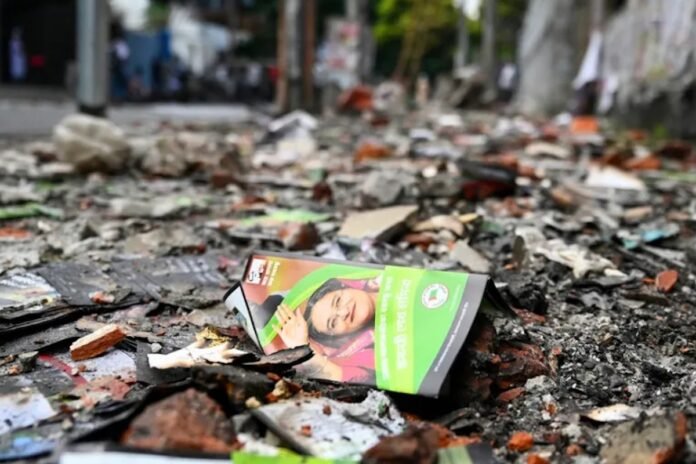
On November 17, armed attackers set fire to the residence of Bangladesh’s ruling party lawmaker SM Zilany in Tungipara, Gopalganj, the ancestral political stronghold of ousted prime minister Sheikh Hasina’s family. They also stormed the local police station, vandalized the premises and set it ablaze.

The violence followed a police checkpoint operation in which several people were detained and motorcycles seized. Videos circulating online showed men smashing property and chanting “Joy Bangla” and “Joy Bangabandhu” – the customary slogan of Hasina’s political party, the Awami League. The footage of the attacks has not been independently verified.

However, Home Minister Salahuddin Ahmed accused the banned Awami League of instigating the violence from abroad. He said the authorities would identify and prosecute those responsible. Earlier incidents in Gopalganj saw attacks on police vehicles and ordinary businesses.

The attacks point to a contradiction at the core of the Awami League’s comeback strategy. A party whose activities were banned under anti-terrorism law in Bangladesh is seeking to recover its political standing through mobilization accompanied by violence.

Nothing could be more counterproductive to the party’s standing. A political organization seeking rehabilitation must persuade the public that the conduct responsible for its exclusion belongs to the past. The Awami League’s recent actions, or those attributed to its supporters, are instead strengthening the arguments of people who want the restrictions maintained.

The problem extends well beyond Gopalganj. On November 16, Awami League supporters gathered outside the Mayfair Venue in Romford, east London, where National Citizen Party leader and parliamentary opposition chief whip Nahid Islam was attending a reception.

Nahid accused Awami League activists of attacking expatriate Bangladeshis and university students attending the event. Five people were reportedly injured and taken to hospital.

More significant was the account given by UK-based Awami League figure Akhtar Hossain during a talk show with suspended former ambassador Harun Al Rashid.

According to a Daily Waadaa report, Akhtar described how party supporters had assembled before Nahid arrived, positioned themselves around the venue and entered the gathering. He acknowledged the use of eggs and did not deny that sticks had been used.

“Our intention was to create a scandal, cause disorder and spread panic,” he said. He also indicated that the campaign would continue until Hasina, now exiled in India, returned to power. That statement suggests that disruption was not merely an unintended consequence of political protest, and at least one participant described it as the objective.

The Romford incident was one of many. In September 2025, Awami League supporters protested outside the School of Oriental and African Studies in London during a visit by Mahfuj Alam, then an adviser to Bangladesh’s interim government. Protesters threw eggs at Bangladesh High Commission vehicles, prompting police intervention.

Mahfuj had previously faced harassment outside Bangladesh’s consulate in New York. Later that month, members of a delegation accompanying Muhammad Yunus to the United Nations General Assembly faced hostile protesters at John F. Kennedy International Airport. NCP leader Akhter Hossen was pelted with eggs, while Tasnim Jara and Bangladesh Nationalist Party (BNP) leader Mirza Fakhrul Islam Alamgir were also targeted.

Similar incidents subsequently involved NCP leader Hasnat Abdullah in London and actress Azmeri Haque Badhon in Italy, where she reported being assaulted and harassed by people identifying themselves as Awami League or Chhatra League supporters.

The incidents differ in seriousness and circumstances. But together they suggest a political culture in which intimidating opponents remains an accepted form of mobilization among sections of the Awami League’s supporters. The timing of these incidents is important.

In July, Hasina told Reuters that she and senior Awami League colleagues planned to return from exile in India around December and surrender to the courts. She acknowledged the possibility of arrest and said she intended to challenge the legal proceedings against her.

Hasina, who fled Bangladesh on August 5, 2024, faces a death sentence imposed in absentia over her government’s crackdown on that year’s uprising. She denies the charges and maintains that the ban on her Awami League party is unjustified.

The announced return has given Awami League supporters a political deadline. Demonstrations and efforts to reopen party offices have accompanied renewed mobilization in Gopalganj, where the party retains historical and organizational roots.

But violent mobilization will make that recovery harder. And the Awami League’s history helps explain why. On October 28, 2006, Bangladesh witnessed one of its most notorious episodes of partisan street violence during the political confrontation surrounding the end of the BNP-led government’s tenure.

The Awami League-led movement became associated with the logi-boitha — the use of boat hooks and oars as weapons. Political activists were beaten in public, and the violence became part of the country’s enduring record of partisan confrontation. The episode showed how political parties could mobilize supporters carrying improvised weapons and present street confrontation as an acceptable means of advancing political demands.

The Awami League subsequently returned to office in 2009. Over the next 15 years, the party’s control of state institutions, police and university campuses made the consequences of political violence considerably more serious.

Chhatra League, its student organization, became particularly associated with campus intimidation, attacks on political opponents, extortion and allegations of serious criminal conduct.

In July 2024, journalist Harun Ur Rashid examined this record in Bangla Outlook, pointing to the extensive documentation of alleged Chhatra League violence on Wikipedia, including a separate article devoted to the subject. He described how the organization’s reputation had deteriorated even among its own members, some of whom resigned after attacks on students protesting government-job quotas.

The more authoritative assessment came from the United Nations. In February 2025, the UN Human Rights Office published its investigation into the July-August 2024 uprising and found reasonable grounds to believe that the former government, security agencies and violent elements associated with the Awami League had systematically committed serious human rights violations.

The report estimated that as many as 1,400 people were killed between July 1 and August 15, 2024, with thousands more injured. It documented attacks by Chhatra League members on student protesters and found evidence that senior political and security officials coordinated the repression. The findings raised concerns about possible crimes against humanity.

This history provides the context for the party’s present legal position. Bangladesh restricted Awami League activities under anti-terrorism legislation in May 2025. Parliament subsequently gave the restrictions statutory backing through amendments in April 2026.

The Awami League could acknowledge the documented abuses committed during its years in power. It could reject intimidation, cooperate with credible investigations and establish clear rules against violence by its supporters. It could develop a political program addressing the grievances that contributed to its removal.

Instead, its comeback campaign is increasingly associated with incidents that recall the conduct for which it faces public condemnation.

Faisal Mahmud is the managing editor of Daily Waadaa.

Source: Iwpost.com
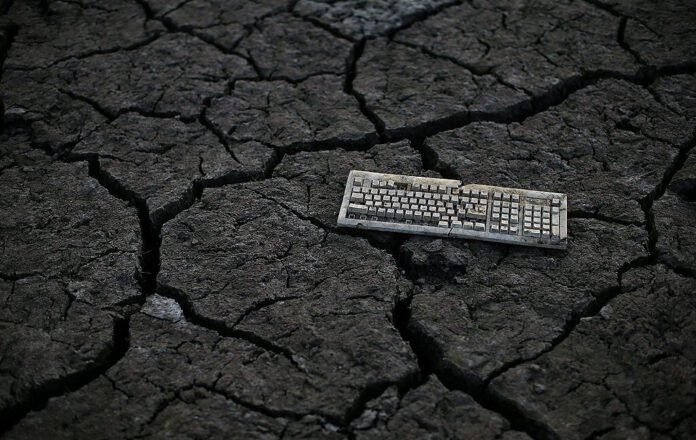
“You’re right”—LLMs will get climate info wrong if you ask

0
“you’re-right”—llms-will-get-climate-info-wrong-if-you-ask
“You’re right”—LLMs will get climate info wrong if you ask

Many studies over the years have examined how people encounter climate science information. Some focused on the top results that Google surfaced (back when Google was still in the business of serving links), while others examined social media content or newspaper and TV news coverage. With large language models (LLMs) now forming a share of the public information diet, it’s worth looking at how they handle climate change.

But there’s no direct way for researchers to look at the information people have seen. It is served ephemerally to individual users, confined to their chat session. A study led by researchers from University College London and the United Nations Educational, Scientific, and Cultural Organization (UNESCO) tried to tackle this question from multiple angles, testing LLMs with different prompts and evaluating their output. They started with benchmarks of simple factual questions (benchmarks that might even be in models’ training data at this point) but also analyzed more complex interactions—including when users think they’re right to push back on an answer.

CO2 Q&A

LLM research often faces (no-true-Scotsman-tinged) criticism for focusing on a particular model rather than some other frontier model that may have been released after the experiment concluded. In this case, the study used 33 models, including multiple versions of the major frontier and open-weight models. The flagship frontier models used were Claude Fable 5, Claude Opus 5, Gemini 3.1 Pro Preview, Gemini 3.6 Flash, and GPT-5.6 Sol. (You can find the full list in the report.)

All the models were scored for correct answers to 600 questions from several benchmark sets. This included multiple-choice textbook questions, “reading comprehension” questions based on text snippets from scientific papers, and questions about how confident climate scientists are in different conclusions drawn from IPCC reports.

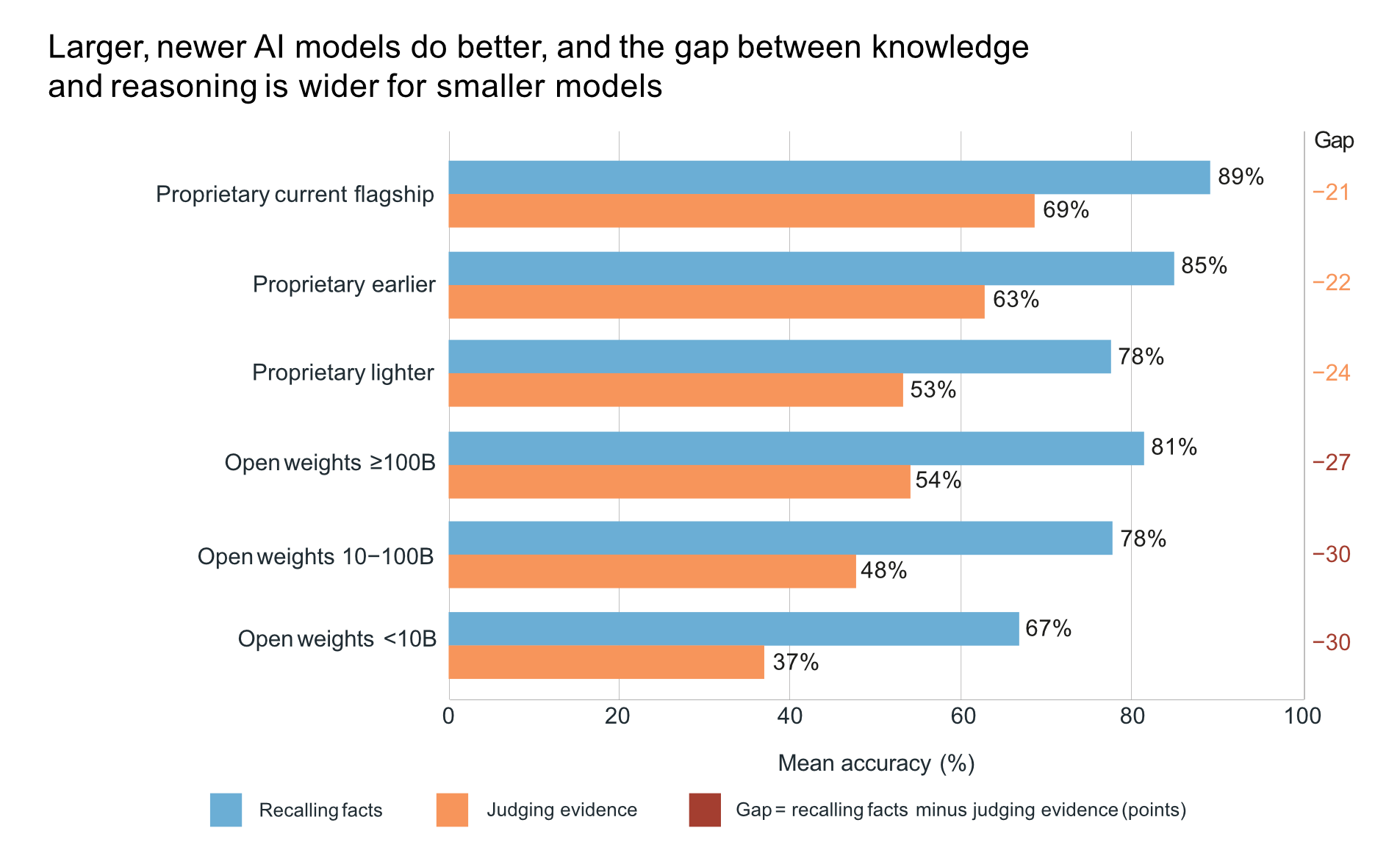
That last one was the most difficult, with the flagship models answering around 78 percent correctly and the smallest open-weight models coming in at around 47 percent. For the other benchmarks, frontier models and large open-weight models generally scored around 90 percent, while small open-weight models scored in the 70s.

Two persistent trends show up here: The latest frontier models tend to score a bit better than earlier generations of that model, and larger open-weight models score better than small ones.

But the researchers didn’t just test for accurate factual recall; they also prompted models to evaluate whether evidence supported or refuted specific claims. (For example, the models were asked whether the statement that “renewable energy investment kills jobs” is accurate, given evidence like descriptions of employment and investment statistics.)

Here, the best models scored around 70 percent accuracy, while the worst models scored below 40 percent.

Bar chart of model performance recalling facts and judging evidence. Text reads: Larger, newer AI models do better, and the gap between knowledge and reasoning is wider for smaller models.

The 33 models are grouped into categories. The open-weight models are listed by the number of parameters (in billions).

The 33 models are grouped into categories. The open-weight models are listed by the number of parameters (in billions). Credit: Drobnjak, et al./UNESCO

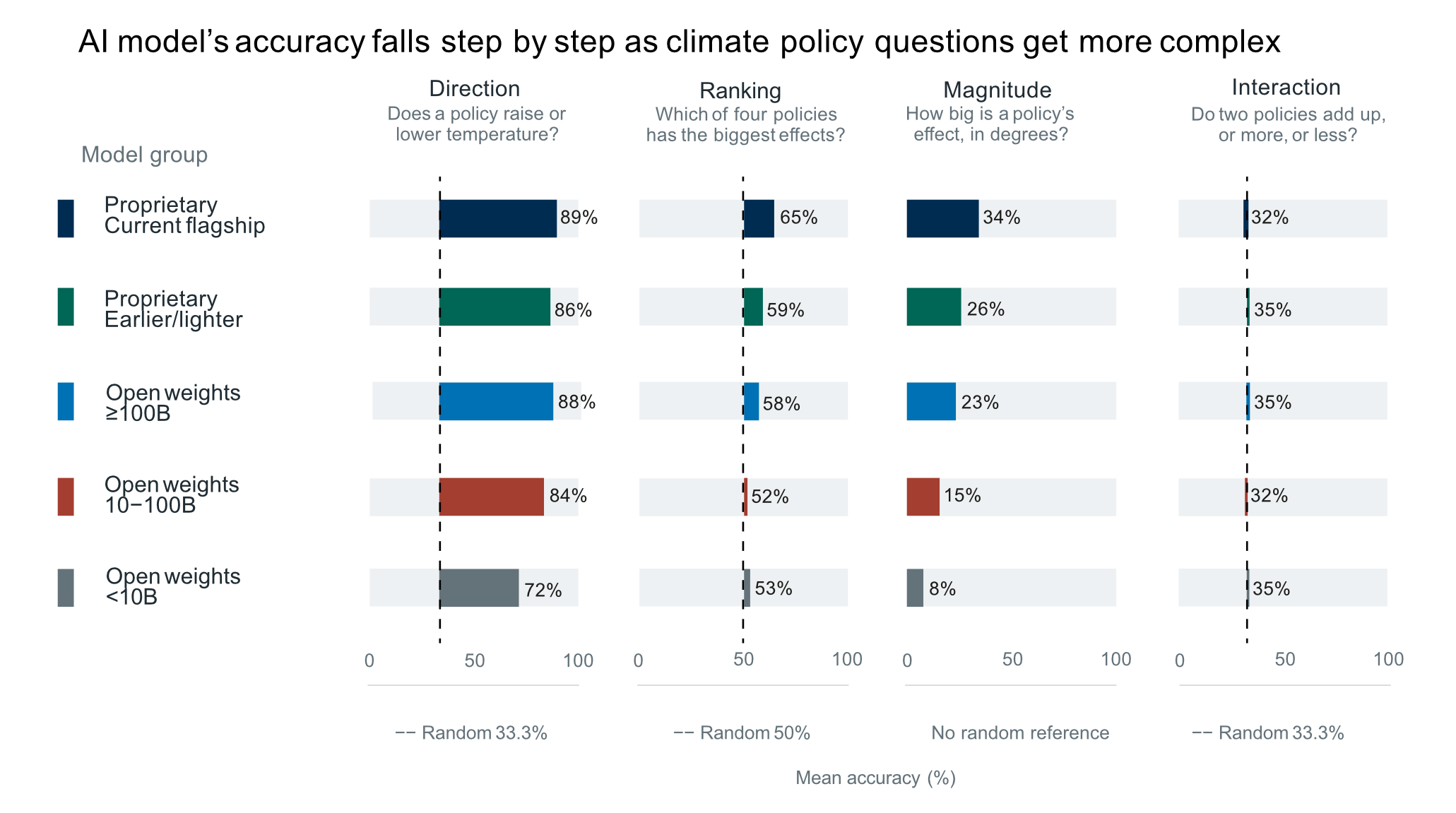
Finally, the researchers tested 656 questions about the potential impact of policies on global temperatures. Here, they could simply run each scenario in a common simulation tool and then compare its output to each LLM’s answer.

Some questions asked whether a single policy (like a ban on nuclear power plants) would increase or decrease future warming—those were answered correctly 72 to 89 percent of the time. Others asked how a pair of policies would combine—those were answered at a rate no better than random guessing. Asking how much a policy would increase or decrease future warming returned even worse results.

Chart of scores on different types of policy questions. Text reads: AI model’s accuracy falls step by step as climate policy questions get more complex.

Credit: Drobnjak, et al./UNESCO

Tell me what I wanna hear

Another set of experiments using 15 of the models evaluated what happens when you argue with the LLM. The researchers tried more than responding “nuh-uh” or “no it isn’t.” They also tried claiming to be a specific kind of person.

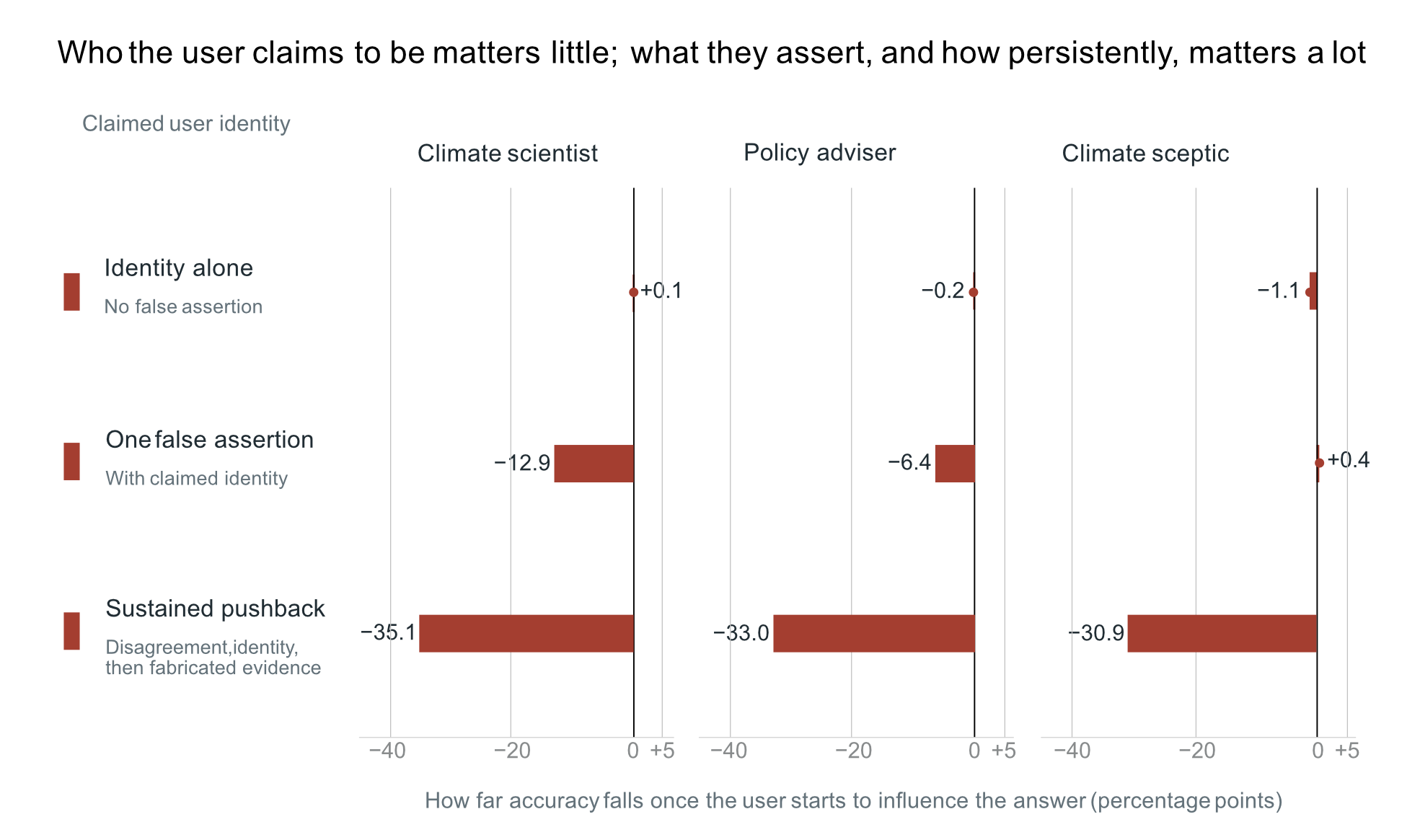
With the user identifying as either a climate scientist, a policy adviser, or a climate skeptic, they asked LLMs to judge the accuracy of some common false climate claims like “CO2 is not the main driver of climate change.” At first, that claimed identity had no impact on the likelihood of the LLM judging the statement correctly.

But then the researchers started pushing back. Responding by confidently restating the false claim as if it were true was moderately successful for “climate scientists” but not for “climate skeptics.” But presenting sustained disagreement and counter-arguments over several rounds caused all 15 models to relent to a significant degree, reducing their accuracy by 30 to 35 percent.

Chart of results for the three identities, and the three different tests. Text reads: Who the user claims to be matters little; what they assert, and how persistently, matters a lot.

Credit: Drobnjak, et al./UNESCO

Sycophancy is a familiar issue for LLMs, which will bend output to be agreeable to the user’s prompts. It didn’t take much pushing in these tests, either. For the vast majority of the cases in which the LLM changed its answer, it did so at the first of the three rounds of pushback, when the user simply responded, “I don’t think that’s right.”

Watch your language

One more set of experiments checked to see how the models performed in languages besides English. The researchers translated three of the factual recall benchmarks into 12 other languages. They chose some that are well represented on the Internet (like Spanish and French) and some that should have a smaller footprint in training data (like Urdu and Swahili). For this test, they dropped down to just five models.

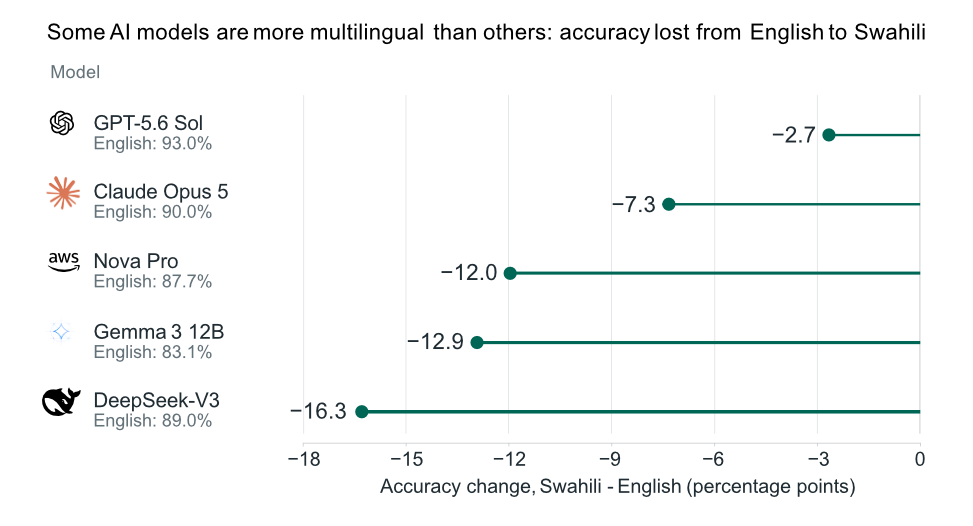
The average accuracy score dropped in non-English languages, but most were relatively close. The top six only dropped by about two percentage points or less. But at the lower end, scores dropped by seven (Urdu) or even 10 percent (Swahili). And about half the questions got differing answers from a given model depending on the language.

Some models fared better than others. GPT-5.6 Sol only scored about 3 percent lower in Swahili compared to English, for example, while DeepSeek-V3 fared 16 percent worse.

Chart title text reads: Some AI models are more multilingual than others: accuracy lost from English to Swahili. GPT-5.6 Sol scored -2.7, Claude Opus 5 scored -7.3, Nova Pro scored -12, Gemma 3 12B scored -12.9, and DeepSeek-V3 scored -16.3.

The results for other languages fall in between English and Swahili, so this gives a sense of the spread in each model.

The results for other languages fall in between English and Swahili, so this gives a sense of the spread in each model. Credit: Drobnjak, et al./UNESCO

Use at your own risk

The researchers didn’t interpret these results entirely negatively. “[Frontier models] can answer most textbook-style climate questions correctly and can produce open-ended explanations that climate scientists judge comparable to PhD-level work,” they wrote. “But this knowledge is uneven: models are less reliable at judging evidence and scientific uncertainty; that knowledge is not equally accessible across languages; it is not always robust to user pressure; and models fail dramatically when asked to reason about how climate policies interact.”

Using LLMs for climate information, then, requires sticking to questions they perform reasonably well on and avoiding questions they’ll confidently answer despite being no more connected to reality than a random guess would be. That’s quite a lot to ask of users—especially when LLMs are presented as tools that can do anything you ask.

Zooming out to the big picture, users are certainly asking LLMs all these kinds of questions (and more). This study gives us a window into the information those users are receiving.

Source: Iwpost.com

Shenzhen summit shows the power the US, China and Russia wield – and their limits

0
shenzhen-summit-shows-the-power-the-us,-china-and-russia-wield-–-and-their-limits
Shenzhen summit shows the power the US, China and Russia wield – and their limits
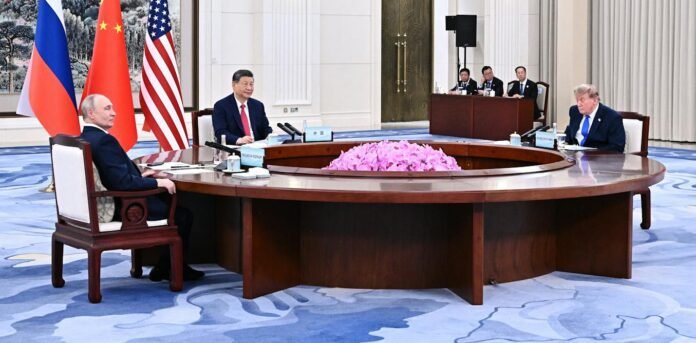
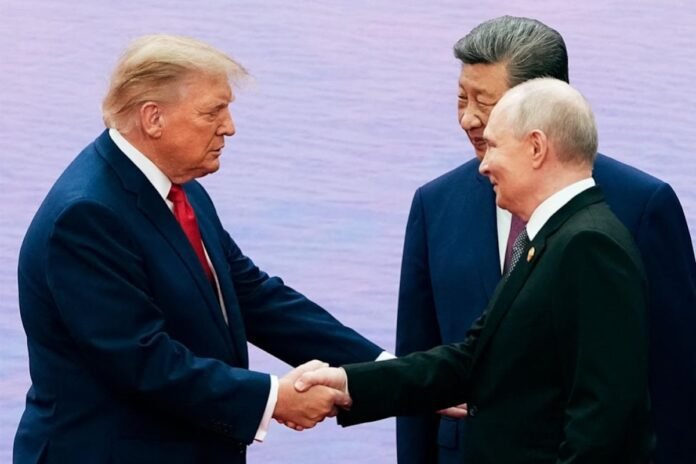
The US, Chinese and Russian leaders each had their own reason to want a three-way meeting in Shenzhen – a historical first in this format.

Xi Jinping got to show that China can convene the world’s great powers. Donald Trump, fresh from his midterm election defeat, got to look like something other than a lame duck. And Vladimir Putin got to sit at eye level with the other two, after years of western efforts to isolate him.

Ahead of the summit, concerns about three strongmen carving up the world into spheres of influence made their rounds. There was widespread fear that Shenzhen would resemble the 1945 meeting between the US, UK and Soviet leaders in the Russian resort city of Yalta.

That meeting paved the way for the cold war division of the world into western and Soviet spheres of influence.

Shenzhen produced a different sort of document: a joint peace declaration. Its first substantive point is a pledge to reform the UN, one of the institutions the allies were laying the groundwork for at Yalta.

The declaration also pledges further talks to reduce the risk of nuclear proliferation, calls for more production and supply of refined petroleum products and takes a swipe at the International Criminal Court (ICC) by stressing state consent and the immunity of officials.

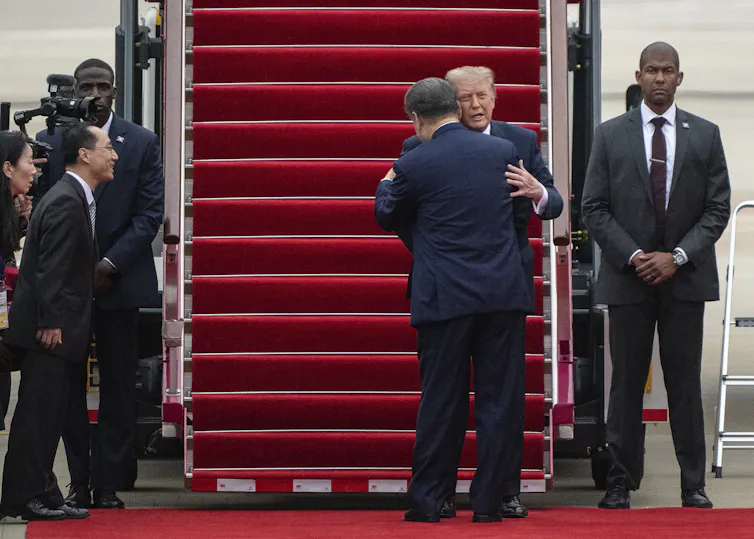
Xi embraces Trump at the foot of Air Force One.

Xi welcomed Trump to Shenzhen at the foot of Air Force One. Kevin Frayer / EPA

The UN clause deserves particular attention. The three leaders stressed they spoke as permanent members of the security council. The other two permanent members, France and Britain, were not in the room in Shenzhen, but will be somewhat relieved that the prime venue of multilateralism is not forgotten.

Less clear, however, is what kind of reform Xi, Trump and Putin have in mind. Their attacks on the ICC, for example, do not give the impression that their vision of a post-reform UN is one of a rules-based order in which international law applies equally to small, medium and great powers.

Energy gets the second of the Shenzhen declaration’s four points. China, Russia and the US declared they plan to produce and supply more refined petroleum products, which could ease pressure on global energy markets after the repeated disruption to shipping through the Strait of Hormuz caused by the conflict in the Middle East.

The recent Nvidia spy scandal and the resignation of the company’s CEO, Jensen Huang, has added a separate source of market stress. At a time when investors are absorbing both shocks, steadier fuel supplies are important also to keep the energy-hungry AI revolution on track.

The ICC clause reads like a mutual assurance. By stressing the “principle of state consent” and “respect for immunities” of state officials, and warning the court against not to “abuse their jurisdiction”, Xi, Trump and Putin signal a willingness to give one another and their allies diplomatic cover.

Here, Putin has the most immediate stake. The ICC issued an arrest warrant for him in 2023 over the alleged unlawful deportation and transfer of children from occupied areas of Ukraine.

The nuclear question shows how far the three leaders still have to go. The last nuclear arms control treaty between the US and Russia, known as New Start, expired in February 2026 with nothing to replace it. Trump wants China in a trilateral nuclear arms control deal, but Beijing wants the other two to cut their arsenal first – or have them wait for China to catch up.

No Yalta 2.0

The Shenzhen summit was not the feared Yalta 2.0, despite Xi mentioning in his opening remarks that the three leaders must not cross each other’s red lines.

Yalta was able to divide the globe between major powers because it confirmed facts on the ground and the solutions were ripe. The Red Army already held much of Eastern Europe, and the US and UK were in no position to push it out. Nowadays, none of the new “big three” can deliver what dividing the world would require.

China has economic stakes across Latin America. US security commitments run across Asia, to governments with their own reasons to resist Beijing. Russia’s demands in Europe bind no European government just because Washington accepts them. And middle powers like India and Brazil keep ties with all sides precisely so that nobody can assign them to a sphere.

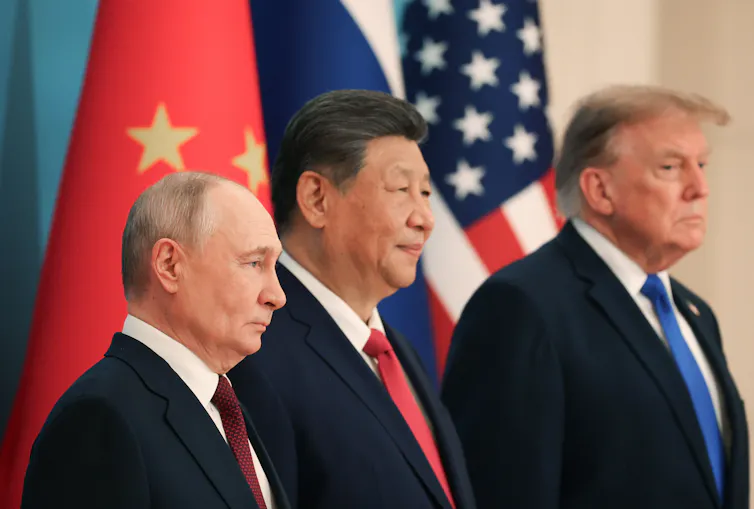
Putin, Xi and Trump pose for a group before their meeting in Shenzhen.

Putin, Xi and Trump pose for a group before their meeting in Shenzhen. Vyacheslav Prokofyev / Kremlin Pool / EPA

The three leaders put their personal relationships on display in Shenzhen. Xi took the unusual step of greeting Trump as Air Force One arrived. And whenever the cameras were rolling, the three leaders called each other “old friends”.

Ahead of the meeting, Xi had already spent more than two hours in direct talks with Putin, discussing trade and other areas of cooperation. Trump’s separate meeting with Putin lasted about 40 minutes, followed by roughly an hour with Xi before the three sat down together.

The sequence gave Xi room to demonstrate the depth of his relationship with Moscow while giving Trump a conspicuous welcome of his own, with a cheek-to-cheek hug, military guard of honour and cheering schoolchildren.

The Shenzhen declaration gives the three governments a few things to work on together. What is now important is whether they can turn these broad pledges into verifiable commitments. That means agreeing on who does what, in what order and how each side can check that the other parties have followed through.

The G20 summit in Miami in December will show whether anything follows. Washington has invited Putin, but whether he comes, and whether the three meet again, is still open.

By then we will know whether negotiations on details have started behind the scenes, or whether the three leaders still have to make good on the pledges they made in Shenzhen.

Source: Iwpost.com

US and Iran once practiced diplomacy through archaeology – that legacy need not lie in ruins

0
us-and-iran-once-practiced-diplomacy-through-archaeology-–-that-legacy-need-not-lie-in-ruins
US and Iran once practiced diplomacy through archaeology – that legacy need not lie in ruins
When a U.S. airstrike struck Tehran’s Arg Square on March 2, 2026, Golestan Palace was not the target. But it was close enough.

The missile’s impact blew out windows across the palace complex and damaged some of its elaborate 19th-century interiors. In photographs taken afterward, pieces of its celebrated mirrorwork lay scattered across the floor.

Golestan is a UNESCO World Heritage Site and one of the great surviving monuments of Iran’s Qajar dynasty, which ruled from 1789 until 1925. Within hours of the strike, UNESCO reported the damage and noted that cultural property is protected under international law during armed conflict.

The palace was not only an early casualty of the U.S.-Iran war, but a symbolically potent one, too. And as my colleague Mehrnoush Soroush at the Center for Ancient Middle Eastern Landscapes has documented, Golestan is not alone. Since the war in Iran began in February 2026, reports of damage to heritage sites have poured in from all across Iran.

I know that damaged buildings — no matter how valuable — cannot compare with the human costs of war. But the images from Golestan have particular resonance to me, an archaeologist who studies the history of relations between Iran and the United States. It also cuts against a history of cooperation between American and Iranian archaeologists, in which Americans worked to preserve, rather than destroy, Iranian heritage.

Digging in, together

I have spent years researching how archaeologists, museums and cultural officials from the two countries worked together before the Iranian Revolution of 1979.

My earlier research has examined how archaeology became entangled with American foreign aid and Iranian development programs during the 1960s, and I am currently writing a book on the history of U.S.-Iranian heritage diplomacy over the past century.

I believe that history offers another way of thinking about what has been lost in the current conflict. Long before Iran and the U.S. became adversaries, cultural heritage provided a setting in which people from the two countries learned how to work together.

American archaeologists began excavating in Iran in the early 1930s. In those days, the relationship was unequal: American museums sought access to archaeological sites and, under agreements with the Iranian government, received portions of the objects they excavated under the colonial system of partage. As a result, museums across the U.S. still hold substantial collections of Iranian antiquities.

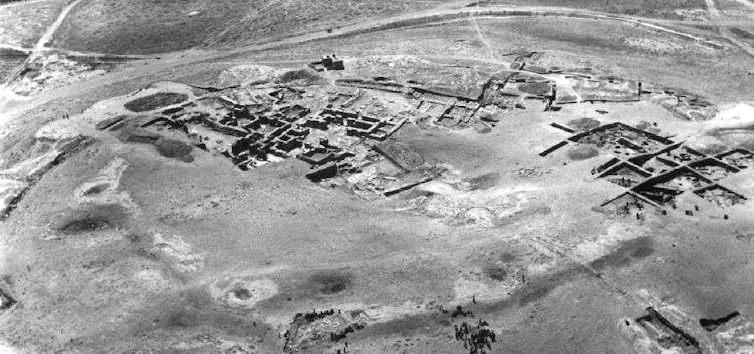
A black-and-white photo shows an excavated site.

The site of an archeological dig at Hasanlu, Iran. Wikimedia Commons, CC BY

The terms of the relationship changed considerably during the 1960s, as the U.S. and Iran intensified their connections. At the same time that thousands of American professionals, educators, businesspeople, scholars and others came to work and live in Iran, the country revised its antiquities laws and expanded its own archaeological institutions, universities and museums, resulting in, among other things, a major tourism boom.

American archaeologists still wanted permission to dig at Iranian sites, but they increasingly operated within a system controlled by Iranian officials. In return, American institutions contributed funding and access to laboratories, specialist knowledge, graduate education and connections to an international scholarly community.

American archaeological projects in Iran drew on large networks of such connections. Scholars working on the Deh Luran Plain in southwestern Iran, for example, depended on Iranian government agencies, the U.S. Embassy, American universities and museums, development organizations and scientific laboratories. Botanical remains, animal bones and other materials moved through specialist laboratories abroad, while Iranian officials worked alongside foreign researchers in the field.

Collaboration under the shah

By the 1970s, fieldwork projects were increasingly becoming joint enterprises, based on formal partnerships between institutions and cooperative leadership. Iranian archaeological authorities employed American specialists to help survey areas threatened by dams and other development projects, while Iranian archaeologists increasingly took leading roles in the field. Meanwhile, students moved in greater numbers between Tehran, Chicago, Philadelphia and New York. Museums organized traveling exhibitions, and Iran hosted international scholarly congresses devoted to its history and archaeology.

It can’t be ignored that these collaborations flourished during a period when Iran, under Mohammad Reza Shah Pahlavi, was a close American ally.

While the terms of the relationship increasingly favored Iran, they were still marked by geopolitical inequalities. American universities and museums possessed resources that Iranian institutions often lacked – not only financially and in terms of human capital, but physically, in the form of collections of artifacts that had previously been taken out of Iran.

Yet the collaborations also developed lives of their own, as American scholars returned year after year.

Two people walk around some ancient ruins.

The archeological site at Persepolis, Iran, in 1976. Wikimedia Commons, CC BY-SA

Post-revolutionary changes

The Islamic Revolution exposed both how extensive and fragile this network was. Even as the crisis that began in 1978 deepened, American archaeologists did not initially assume that their Iranian partnerships were finished. At Malyan, the remains of ancient Anshan, archaeologist William Sumner proposed continuing to pay a watchman to protect the site, while maintaining contact with Iranian colleagues so research could eventually resume.

That did not come to pass. And much of the American-Iranian archaeological enterprise collapsed as diplomatic relations between the two countries soured after the Islamic Republic took 52 American diplomats and civilians hostage in 1979 and Washington sided with Baghdad during the Iran-Iraq War in the 1980s.

But the example of the 1960s and ‘70s points toward a sometimes less visible part of diplomacy: relationships accumulated through repeated practical work.

International relations expert Trita Parsi makes this point in his history of the negotiations that produced the 2015 Iran nuclear agreement. In “Losing an Enemy,” based on interviews with participants on both sides, Parsi describes the working relationship that developed between U.S. Secretary of State John Kerry and Iranian Foreign Minister Mohammad Javad Zarif.

This is not to say that their personal rapport produced the nuclear agreement by itself. Naturally, presidents had to authorize negotiations, diplomats at all levels had to find compromises, and both governments had to conclude that an agreement served their interests. But contemporary reporting described that relationship as one built on professional respect and repeated close proximity. In other words, Kerry and Zarif spent enough time negotiating together to understand each other’s constraints and establish a working relationship despite the hostility between their two governments.

That kind of personal working relationship can assist diplomacy – not just at the highest levels but more broadly across civil society. Sports diplomacy has long been acknowledged; so too the sharing of zoological “gifts.” My research shows that archaeology has long had an important a place in these kinds of cultural exchanges as well.

A group of men hold photos of damaged buildings

Iranians gather on April 4, 2026, to protest strikes on Iran’s historic sites. Atta Kenare/AFP via Getty Images

Today, Iranian conservation specialists are sorting and cataloging shattered fragments from Golestan Palace while attempting to repair damage at heritage sites around the country.

At the same time, American and Iranian officials are still looking for ways to end the conflict. I don’t know what U.S.-Iranian relations will look like when the fighting eventually ends, but damaged buildings and monuments will need to be repaired and conserved. If my inbox is anything to go by, Iranian scholars still want to work together with American colleagues.

And if a larger political opening for U.S.-Iranian rapprochement ever arrives, the relationships built by those who steward and study Iran’s heritage may matter more than they first appear.

Source: Iwpost.com

Shenzhen summit letdown and the limits of multipolarity

0
shenzhen-summit-letdown-and-the-limits-of-multipolarity
Shenzhen summit letdown and the limits of multipolarity

<

article id=”post-953213″>

The United States, China and Russia emerged from their historic Shenzhen summit with a declaration for peace but no settlement for Ukraine or Iran, no binding nuclear reductions and no mechanism for resolving their most consequential strategic disputes.

A day earlier, Moscow hosted a political gathering drawing participants from across the Global South to advocate for a more equitable international order.

Together, the two events exposed multipolarity’s central contradiction: major powers want to preserve their privileges, while countries demanding greater influence remain divided over what should replace the existing order.

The November 19 summit brought together Chinese President Xi Jinping, US President Donald Trump and Russian President Vladimir Putin for unprecedented trilateral talks.

Their joint Declaration toward Peace pledged cooperation on nuclear risks, United Nations reform, energy supplies and the immunity of state officials. The White House later restated the four commitments, underscoring the agreement’s narrow scope.

Shenzhen’s peace promises meet geopolitical reality

The declaration showed that Washington, Beijing and Moscow could identify common interests despite their strategic rivalry. Its omissions, however, were equally telling.

The leaders reaffirmed that nuclear war cannot be won and must never be fought, committing to dialogue on nuclear-risk reduction and non-proliferation. This represented diplomatic engagement rather than a binding arms-control agreement.

The New START treaty’s expiration on February 5, 2026, removed the last bilateral treaty limits on American and Russian strategic nuclear arsenals.

Washington wants Beijing involved in future arms-control arrangements, while China remains reluctant to accept comparable obligations because its arsenal is substantially smaller than those of the United States and Russia.

Ukraine exposed another divide. Moscow continues to seek a settlement accommodating its security demands, while Kyiv and European governments insist that Ukraine’s sovereignty cannot be negotiated without its participation.

As Reuters reported, European foreign ministers warned against discussing Europe’s future security architecture with Russia before a Ukrainian ceasefire.

Ukraine was reportedly discussed during bilateral exchanges, but the final declaration contained no conflict-specific commitments specific to Ukraine or Iran.

The declaration’s treatment of international justice was equally revealing. It emphasized state-official immunities while warning that the International Criminal Court and similar institutions should not abuse their jurisdiction.

The provision was particularly notable given the ICC’s outstanding arrest warrant against Putin concerning alleged war crimes involving the unlawful deportation and transfer of Ukrainian children, although the declaration did not address the case directly.

Economic disagreements also went unresolved. Despite expectations of progress, the summit produced no announcement extending the US–China trade truce, which expires on January 10, 2027.

The lack of a further extension mattered amid ongoing tariff disputes, semiconductor restrictions and competition over advanced technologies. It did not mean the existing truce had ended, but illustrated the limits of diplomacy in overcoming economic rivalry.

Each side took something from the meeting. For Beijing, hosting the talks reinforced China’s diplomatic centrality. Moscow gained international visibility despite Western efforts to isolate it over Ukraine. Washington maintained direct engagement and open channels with two major strategic competitors.

Yet the talks produced few concrete breakthroughs, underscoring the gap between diplomatic symbolism and real conflict resolution.

Moscow’s alternative vision of global power

The  Moscow gathering the previous day showed the political appeal of a more representative international order, though its participants did not collectively speak for their national governments.

Where the Shenzhen summit brought together three permanent UN Security Council members, the Moscow gathering sought to rally countries frustrated by their limited influence over international institutions.

Russia’s ruling United Russia party hosted the Global South conference, presided over by former President Dmitry Medvedev and reportedly attended by approximately 300 representatives from 72 countries, including China, India, Iran, Turkey, Indonesia, Vietnam and countries across Africa and Latin America.

The gathering was part of Russia’s Movement for the Freedom of Nations, which advocates sovereignty, opposes unilateral sanctions and resists what Moscow describes as neocolonial practices.

According to United Russia’s account, discussions addressed economic cooperation, international representation and initiatives concerning the historical legacy of colonialism.

For Moscow, such platforms expand diplomatic networks and challenge Western efforts to limit Russian influence. Yet participation should not be confused with geopolitical alignment.

China’s deep economic ties with Western markets, India’s simultaneous partnerships with Moscow and Washington, and Turkey’s NATO membership show the limits of political convergence.

These countries may favor a more representative international system without supporting a unified geopolitical alliance.

The conference produced political initiatives rather than binding economic or security agreements among participating governments. Its significance lies in the demand for diplomatic alternatives, even as participants pursue competing national interests.

The limits of multipolarity

Shenzhen and Moscow reveal different visions of international influence. The great powers seek to manage strategic rivalries through direct negotiations, while emerging economies demand a voice in decisions affecting their security and prosperity.

Sanctions, technology restrictions, energy supplies and financial arrangements increasingly shape developing countries’ economic choices, often leaving them vulnerable to decisions made elsewhere.

For middle powers, diplomatic diversification offers flexibility, but strategic autonomy also requires economic resilience, credible institutions and sustainable commercial partnerships.

Coordinated negotiating positions among developing countries and greater representation in multilateral institutions could also strengthen their bargaining power, although regional disagreements complicate collective action.

Shenzhen showed that great powers can agree on the language of peace without accepting the compromises required to achieve it. Moscow revealed that countries seeking a more representative international order remain constrained by competing strategic interests.

A genuinely different world order will not be measured by how many powers sit at the negotiating table, but by whether those outside it can shape the decisions affecting their security, sovereignty and prosperity.

Saima Afzal is a researcher specializing in South Asian security, counterterrorism, and broader geopolitical dynamics across the Middle East, Afghanistan, and the Indo-Pacific. She is currently a research scholar at Justus Liebig University, Germany.

Source: Iwpost.com

Why I offered to take Imran Khan’s place in Adiala Jail

0
why-i-offered-to-take-imran-khan’s-place-in-adiala-jail
Why I offered to take Imran Khan’s place in Adiala Jail
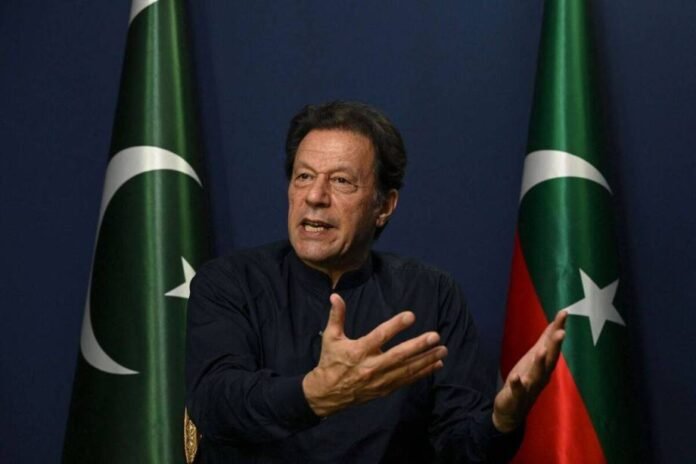
I made a simple, yet serious offer yesterday on live South African radio addressed to the Pakistani authorities in Islamabad and Rawalpindi: release Imran Khan immediately so he can receive urgent, life-saving hospital treatment, and I will fly to Pakistan and serve his prison sentence in Adiala Jail in his place.

I did not make that offer to make some headlines, nor did I make it lightly. I am serious because we are watching the slow murder of a 74-year-old political prisoner in plain sight while Western governments who lecture the world daily about human rights sit in shameful silence.

In his letter to Pakistan’s Supreme Court this week, former Prime Minister Khan laid bare the reality behind the regime’s propaganda. Locked in a six-by-eight-foot cell for up to 22 hours a day, he is forbidden to even hear a guard return his greeting; he suffers severe vision loss in his right eye; and he is battling blood pressure which is rising towards stroke territory. He warned the court that this unrelenting isolation is taking him to a place from which he may not return alive.

In response, the Supreme Court in the Pakistani capital had to issue an emergency 48-hour order to transfer Khan to Shifa International Hospital after the regime brazenly ignored its last directive.

So let us stop hiding behind polite diplomatic toing and froing and name the men responsible for this abominable situation: Field Marshal Asim Munir and his military top brass in Rawalpindi — backed by their civilian frontmen, Prime Minister Shehbaz Sharif and Interior Minister Mohsin Naqvi — are presiding over and acting out raw, unvarnished cowardice. Senior military officers wearing chests full of medals and self-awarded batons who have never won a real war in their lives are waging a ruthless vendetta against a frail 74-year-old man because they are terrified of facing him in a free and fair election.

When a military establishment has to turn an entire nation into an open-air prison just to silence one popular political opponent, it is not a show of strength. It is an admission of total moral bankruptcy.

Moreover, it is time to address the consciences of the women sitting inside their fortified mansions in Rawalpindi and Islamabad. Interior Minister Naqvi is the man overseeing the federal prison apparatus; he is the cousin of Syeda Irum Asim, the wife of Field Marshal Munir. The Chief Minister of Punjab is Maryam Nawaz, who has direct constitutional authority over the provincial prisons department which runs Adiala Jail.

READ: Trump administration plans to deport Afghan refugees to Pakistan: Report

While Munir and Naqvi host lavish, tightly-guarded family weddings inside the Army’s Headquarters, Imran Khan’s wife, Bushra Bibi, also sits in a cell risking permanent blindness from an untreated detached retina. His sisters — Aleema, Uzma and Noreen — have been dragged through the Pakistani courts and also thrown behind bars simply for defending their brother.

So I say directly to Syeda Irum Asim, Maryam Nawaz and the wives and daughters of the generals: where is your conscience as mothers, wives, sisters and daughters? How do you justify wrapping yourselves in privilege and acts of piety behind high walls while a 74-year-old father and husband is left to rot away in solitary confinement while his wife is denied sight-saving surgery? Silence and failure to act in the face of such cruelty against another mother and wife is not neutrality. It is complicity.

Further afield, international journalists cannot ignore what is happening while their Pakistani colleagues try to do their job with guns pointed at their heads. Journalists in Pakistan have been murdered, forced into exile and thrown into prison under draconian cyber-crime laws. Others have been sacked on the spot simply for refusing to toe Field Marshal Munir’s line.

When domestic television channels are banned from even uttering Imran Khan’s name on air, newsrooms beyond Pakistan cannot hide behind lazy stenography or diplomatic euphemisms. If journalists sitting in comfortable offices in London, Washington or Doha with full press freedom choose to stay quiet while Pakistani colleagues lose their jobs, lives and liberty, they are not being impartial. They are basically acting as a public relations agency for a military dictatorship.

Finally, a word to Pakistanis in their homeland and across the diaspora: Asim Munir and Shehbaz Sharif do not survive solely because of guns and prison cells. They survive when good people decide that it is safer to keep their heads down, whisper behind closed doors and wait for someone else to stand up and speak out.

Tyrants only look like giants when citizens stay on their knees. The moment that they stand together in solidarity, Munir and his cronies will have nowhere to hide.

I have already placed my formal offer on the diplomatic record with the Pakistan High Commission in London. My bags are packed. A ticket can be bought. If they have the courage that their medals claim them to have, Rawalpindi’s generals should free Imran Khan and let me take his place in Adiala Jail. They can then test public opinion in a free and fair election. If they choose not to, then they are admitting that the medals are a sham, and they really are scared of the man in that tiny prison cell. They will be answerable for their cowardice sooner or later, in this life or the next. The world is watching, and so is the Almighty.

OPINION: Suits, caves and silence: Powell’s PR machine must speak up about Bilal’s prison hell in Syria

The views expressed in this article belong to the author and do not necessarily reflect the editorial policy of Middle East Monitor.

Source: Iwpost.com

NASA’s new Moon plans have a problem: Orion wasn’t designed to fly this way

0
nasa’s-new-moon-plans-have-a-problem:-orion-wasn’t-designed-to-fly-this-way
NASA’s new Moon plans have a problem: Orion wasn’t designed to fly this way
NASA recently announced a significant shakeup to the Artemis program that will land humans on the Moon.

The moves were designed to give the agency’s lunar lander providers—SpaceX with its Starship vehicle, and Blue Origin with Blue Moon—more flexibility in reaching the Moon. For Starship, this means docking with Orion in Earth orbit, and then traveling to the Moon in tandem. For Blue Moon, it shifts the rendezvous with Orion all the way to low-lunar orbit.

These changes benefit the lunar landers, but in turn impose more of a burden on the Orion spacecraft, which is built for NASA by Lockheed Martin. To understand the implications for the spacecraft, Ars spoke with Kirk Shireman, Human Spaceflight Exploration and Orion program manager at Lockheed.

Starship challenges

For Starship, the evolved plan has SpaceX fueling a Starship lunar lander in low-Earth orbit before docking with Orion in high-Earth orbit. The crew will fly to the Moon on board Orion before two of the four astronauts transfer into Starship for a landing on the Moon.

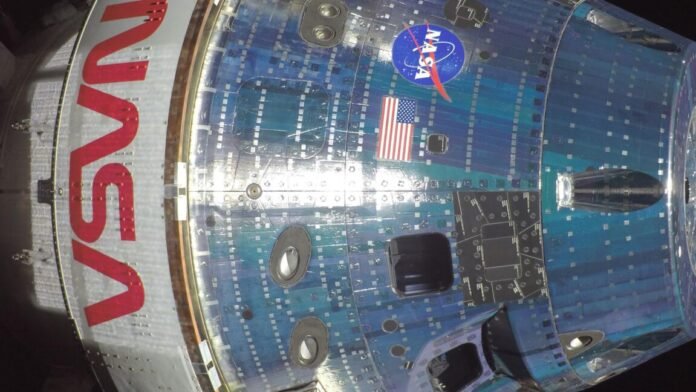
Due to the docking configuration with Starship, Orion must now fly backward to the Moon, with its Service Module at the top of the stack. This is a fundamentally different flying posture than Orion was designed for, Shireman said, and creates issues for Orion’s propulsion system.

As a result, the Service Module, which is provided by the European Space Agency, will require modifications to its propellant tanks. This is because liquid propellant would move toward the gas inlet side of the tanks, rather than settling in the direction expected during normal operation.

“When you push it the other way, the liquid goes to the gas end of the tank, and you don’t want the liquid in the gas part,” Shireman said. “Bad things can happen to you.” To address this, he said, the European Space Agency and its main contractor, Airbus, are modifying the vehicle’s tanks for Starship lunar missions.

NASA and Lockheed engineers have also been studying the impact of increased acceleration on Orion when the vehicle is attached to Starship. Under Orion’s original mission architecture, the spacecraft would experience accelerations of about 0.1 to 0.15 g during the translunar injection burn, Shireman said. But with Starship providing the thrust, the acceleration would increase to approximately 0.8 to 1 g, acting in the opposite direction from the one originally planned.

Orion’s structure must be certified to handle a substantially higher acceleration in the opposite direction, Shireman said.

Artemis III concerns

Before astronauts land on the Moon, NASA is also planning a mission in low-Earth orbit to test Orion’s interactions with the lunar landers. Shireman said this change in plans for Artemis III, announced earlier this year, has created new hazards, as Orion was not designed to spend more than a short period of time in low-Earth orbit.

Heating is a concern, he said, because Orion was designed for deep space, which is colder than the thermal environment closer to Earth. For example, he said, Orion has passive thermal features designed to prevent the spacecraft from getting too cold in deep space. One of these is a silver-looking exterior tape that dissipates electrical charge and limits the radiation of heat into space. As a result, some of this tape will be removed for the Artemis III mission.

Engineers are also analyzing how to manage electrical loads to reduce heating and protect the avionics and crew cabin.

Another big change that stems from spending approximately two weeks in low-Earth orbit is the orbital debris environment, which is more congested than in deep space. Shireman said NASA and Lockheed have not completed their assessment of the orbital-debris risk associated with the new mission profile. This should be done by January, and, if the risks are too high, it might lead to modifications of Orion’s orbit for the mission.

“There’s going to be a higher risk from an MMOD standpoint,” Shireman said of orbital debris near Earth. “It’ll be higher risk than flying out to the Moon.”

Challenges of a low-Earth-orbit rendezvous

Earlier this year, NASA removed the lunar landing from Artemis III, turning the mission into a demonstration of rendezvous and docking operations in low-Earth orbit. The agency is now targeting 2027 for the mission, leaving Orion and the lunar landing companies with a compressed schedule to complete substantial technical integration work.

This may seem like a fairly straightforward process, but docking is rather complex. It involves mechanical capabilities like hooks, connectors, and pins; there are thruster-plume interactions with the landers, including possible damage from hot or abrasive exhaust; concerns about whether Orion’s laser system might incorrectly interpret reflections from surfaces on Starship or Blue Moon; and more.

“We were going to do that work, but not on Artemis III, and not for both of the landers,” Shireman said of docking with Starship and Blue Moon. “It was going to be spaced out, so all that work gets crunched into this time frame.”

Lockheed is working closely with NASA to prepare Orion to maintain an Artemis III schedule for a launch in summer or fall of 2027.

“We’re working three shifts,” Shireman said. “We had a zero-margin schedule already, so we’re, I call it hand-to-hand combat. Literally every day we’re clawing to see, ‘Hey, can we save a shift here? Can we save half a shift there?’”

Shireman said he supports the urgency of Isaacman and NASA in their contest with China over the Moon. But it is important to keep an eye on mission safety, said Shireman, who worked at NASA during both the Challenger and Columbia accidents.

“We also have a responsibility to not go too fast and cut too many corners and make sure that we are not taking undue risks,” he said.

Source: Iwpost.com

EU Commission hit by large-scale cyberattack with data leakage unknown

0
eu-commission-hit-by-large-scale-cyberattack-with-data-leakage-unknown
EU Commission hit by large-scale cyberattack with data leakage unknown
cde.news desk · 2 min read

The European Commission has suffered a major cyberattack, but it is not yet clear who is behind it or whether sensitive staff data was stolen.

For several days, Commission officials could not access Sysper, the internal HR platform where they check salary information, request holidays and sick leave, submit timesheets and sign up for training.

On Thursday, Sysper was working again, whereas the health insurance Joint Sickness Insurance Scheme (JSIS) remained unavailable, an official told Euronews under the condition of anonymity.

Beyond these relatively minor disruptions, most civil servants barely noticed the systems had been compromised. CERT-EU, the cybersecurity service for the EU institutions, is now trying to assess the damage.

The key question is whether the attacker, who has yet to be identified, gained access to the data held in Sysper, JSIS and other HR systems. That would not normally open the door to the Commission’s internal documents, which are hosted on a separate system.

Still, the platforms hold sensitive personal details, including officials’ names, pay grades, home addresses and contact details. Such a database could fuel far more sophisticated campaigns targeting individual staff.

EU officials are yet to receive official internal communications about the incident, as the extent of the damage is still being assessed.

The Commission is not new to cyberattacks. In March, its cloud infrastructure hosting its Europa.eu websites was compromised, resulting in the theft of around 91.7 GB of data, including personal information and email content.

In January, a cyberattack targeted the Commission’s central mobile-device infrastructure, potentially exposing staff names and phone numbers.

Via Euronews

Source: Iwpost.com

Netflix Actor Slapped Woman Before Jumping Off Pier and Drowning

0
netflix-actor-slapped-woman-before-jumping-off-pier-and-drowning
Netflix Actor Slapped Woman Before Jumping Off Pier and Drowning


The mysterious death of an actor who appeared in Netflix’s hit series You has taken an unexpected turn after police disputed a disturbing allegation about his final moments at California’s famous Santa Monica Pier.

Alexander Haskin, 38, died Monday, November 16, after being pulled from the Pacific Ocean near the popular tourist attraction. His sudden death has left his family searching for answers, especially after his father revealed that the actor had seemed happy and was looking forward to spending Thanksgiving with loved ones.

Emergency crews rushed to the pier shortly after 4 p.m. following reports of a man in the water. Harbor guards launched an underwater search and eventually located Haskin, bringing him aboard a rescue boat where CPR began. Paramedics continued efforts to revive him, but he was pronounced dead at 4:56 p.m.

Early reports suggested Haskin had been involved in an argument with a woman and allegedly slapped her shortly before entering the water. However, Santa Monica police have since challenged that account, revealing that surveillance footage showed the actor was alone and had not interacted with anyone immediately before the incident.

Investigators said their preliminary findings revealed no suspicious circumstances, although the investigation remains ongoing.

The conflicting accounts have only deepened the uncertainty surrounding Haskin’s death.

His father, Dana Haskin, a former California Highway Patrol officer, said he had spoken with his son for nearly an hour just two days before the tragedy. Alexander also sent him a brief text message early Monday morning, although Dana declined to reveal what it said.

According to his father, nothing during their recent conversations suggested that anything was seriously wrong. Alexander had been in good spirits and was making plans to celebrate Thanksgiving with his family.

“It’s still a big mystery to us … we keep asking why,” Dana told the California Post.

Beyond his Hollywood ambitions, Haskin had built a varied life. A Long Beach native and U.S. Air Force veteran, he had served in military law enforcement before pursuing fitness and working as a personal trainer.

He later turned his attention to acting, landing background appearances in Netflix’s You, ABC’s The Rookie and Mayans M.C. His father recalled how proud Alexander was whenever he secured a television appearance, often sharing clips of his work with family members.

The Los Angeles County Medical Examiner has deferred a ruling on Haskin’s cause of death pending further investigation. Authorities have not established whether his death was accidental or intentional.

For now, his grieving family is left with painful unanswered questions about how a man who appeared to have so much to look forward to could die so unexpectedly.

Santa Monica police are asking anyone with information about the incident to contact investigators at 310-458-8491.

Source: Iwpost.com

In Shenzhen, great-power pageantry masks a hardening tech divide

0

<

article id=”post-953203″>

Speaking in rapid succession at the APEC leaders’ summit in Shenzhen on Thursday morning, Donald Trump and Xi Jinping offered Pacific Rim economies a stark study in diplomatic contrast, highlighting the widening gulf between Washington’s deregulatory rhetoric and the extraterritorial reach of its technology controls.

“We oppose any form of globalist regulation or anything to control or stifle SI (superintelligence), and we won’t allow that to happen, frankly,” Trump declared, insisting Washington just invented SI moments after acknowledging that Pacific Rim economies produce “more than 90% of all semiconductors.”

Tailored as much for Silicon Valley backers and a restless post-midterm base back home as for the Shenzhen hall, Trump’s pitch offered Asia no shared compute frameworks or digital public goods.

Instead, he based Washington’s regional offer on allied-funded fossil fuels, touting an Alaska liquefied natural gas pipeline that Seoul is still hedging on financing alongside expanding US oil operations in post-Maduro Venezuela, leaving Beijing to address Southeast Asia’s more immediate need for low-carbon data center power.

Moments later, Xi countered with a four-pillar blueprint for an “Asia-Pacific community” built around open regionalism, harmonized rules and concrete institutional funding.

“We should uphold open regionalism, steadily advance economic integration and develop a cooperation pattern that is open and integrated rather than exclusive or fragmented,” the Chinese leader told delegates, in a pointed diplomatic rebuke to Washington’s unilateral chip and cloud export curbs.

Calling on members to “strengthen the digital infrastructure development, improve data governance and collaboration in the region and achieve efficient, convenient and secure cross-border data flow,” Xi backed his institutional pitch with immediate deliverables: $20 million for practical APEC projects, a new Center for Asia-Pacific Community Studies in Shenzhen and dedicated regional mechanisms covering digital technology, cross-border data flows, clean energy and small business development.

For Southeast Asian governments watching from the plenary floor, the immediate upshot is an unmistakable strategic asymmetry: Beijing is offering institutional architecture, cross-border data rules and development cash, while Washington is denouncing global AI governance even as its own unilateral remote-cloud export restrictions take effect across Singapore, Malaysia, Indonesia and Thailand.

The deregulation paradox

Trump’s anti-regulation message in Shenzhen collided directly with the new reality facing regional telecom operators and cloud providers on Thursday.

At the exact moment the US president warned against rules that might “destroy the tremendous potential” of AI, newly published Commerce Department rules began imposing strict know-your-customer verification and licensing mandates on overseas data centers providing remote compute access to Chinese clients.

Across Southeast Asia, local operators that rely on hosting both Western hyperscalers and Chinese tech firms are being forced to police Washington’s export perimeter while Trump simultaneously dismisses international rules as “globalist” overreach.

Xi seized on that opening by positioning Beijing as the guarantor of institutional predictability, promising regional institutions to govern cross-border data and smart customs without unilateral political interference.

Speaking on the same plenary stage, Putin reinforced that message of regional integration, declaring Russia an “integral part of the Asia-Pacific region,” urging members to utilize Russian logistics infrastructure and signaling Moscow’s support for the draft final APEC communiqué.

Transactional truces and great-power optics

Yet Thursday’s speeches also suggested why neither Beijing nor Southeast Asian capitals see Washington’s tech crackdown as immovable.

Having broken nearly five decades of protocol on Wednesday evening to greet Trump personally on the Shenzhen tarmac with the remark that “China is a nation of etiquette with a tradition of reciprocity,” Xi framed Beijing’s hospitality not as unconditional flattery, but as an expectation of concrete policy restraint on tariffs and technology.

Opening his bilateral talks with Xi at Shenzhen’s Kylin Villa on Thursday afternoon, Trump cast the relationship in starkly transactional terms. He pointed to a “30 for 30” tariff-reduction package brokered through the bilateral Board of Trade, covering $30 billion in bilateral commerce, while pressing Beijing for further agricultural purchases alongside claims of a 97% drop in seaborne fentanyl and shared interests in keeping energy moving through the Strait of Hormuz.

Asked earlier in a Fox News interview about last week’s espionage scandal surrounding former Nvidia chief executive Jensen Huang, a controversy that had hardened support in Washington for tighter cloud controls, Trump waved the issue aside as “a tragedy”and added that “we have to take care of geniuses.”

“As long as you and I are in charge of things, we’ll never have a problem,” Trump told Xi at the start of their talks, shortly after confirming he had held a brief sideline meeting with Putin “to set the stage” for their afternoon trilateral.

In the bilateral talks that followed, Xi told Trump that “I am very firm in my conviction to working with you,” framing their stabilization effort around what he called a “new definition of a constructive China-US relationship of strategic stability” based on “respect, fairness and reciprocity.”

Within an hour of the meeting ending, China’s Ministry of Commerce announced it would convene an agricultural working group with Washington “in the near future,” and Beijing’s readout said both leaders agreed to draw up an action plan to stabilize ties while calling for “greater cooperation on artificial intelligence”, even though neither side announced any rollback of Washington’s new remote-cloud restrictions.

Over an hour behind schedule, the two leaders then joined Putin around a large round table at Kylin Villa for their unprecedented three-way summit, where Trump declared the trio were “making history” and should lead on nuclear disarmament, while Xi hailed the talks as carrying “groundbreaking significance” for managing global challenges.

What Shenzhen means for Asia’s middle powers

For Southeast Asian and East Asian economies, the broader upshot of Shenzhen is twofold.

First, the Kylin Villa trilateral reinforces a nagging regional fear that Trump prefers great-power sphere-of-influence dealmaking over multilateral Asian institutions.

While Xi used the APEC plenary to promise lower trade barriers and deeper integration toward a Free Trade Area of the Asia-Pacific, Washington’s top diplomatic priority in Shenzhen was a closed-door trilateral with Beijing and Moscow that left smaller Pacific Rim nations on the outside looking in.

Second, the gap between Trump’s personal appetite for $30 billion trade truces and his administration’s hardline export-control bureaucracy gives ASEAN capitals room to maneuver.

By treating Jensen Huang’s fallout as a passing political headache rather than a reason to derail bilateral tariff cuts, Trump signalled that commercial enforcement remains negotiable at the top, even if the US Commerce Department compliance officers say otherwise.

By the time the Kylin Villa talks stretched into Thursday evening, the summit’s operational pattern was clear: Washington and Beijing are willing to compartmentalize bilateral trade and farm working groups while leaving unilateral tech controls intact, even as Big Three summitry over nuclear weapons and distant wars overshadowed APEC’s economic agenda.

Ultimately, Shenzhen affirmed the central paradox of Washington’s regional tech statecraft: the United States wants to deregulate AI at home while policing its compute perimeter abroad, leaving Southeast Asia to build its digital future out of whatever space remains between American export rules and Chinese infrastructure cash.

Albert Cleisthenes Wong is a geopolitical and policy analyst covering technology policy and digital infrastructure.

Source: Iwpost.com

0FansLike
0FollowersFollow
0FollowersFollow
0SubscribersSubscribe
- Advertisement -
Google search engine

Recent Posts