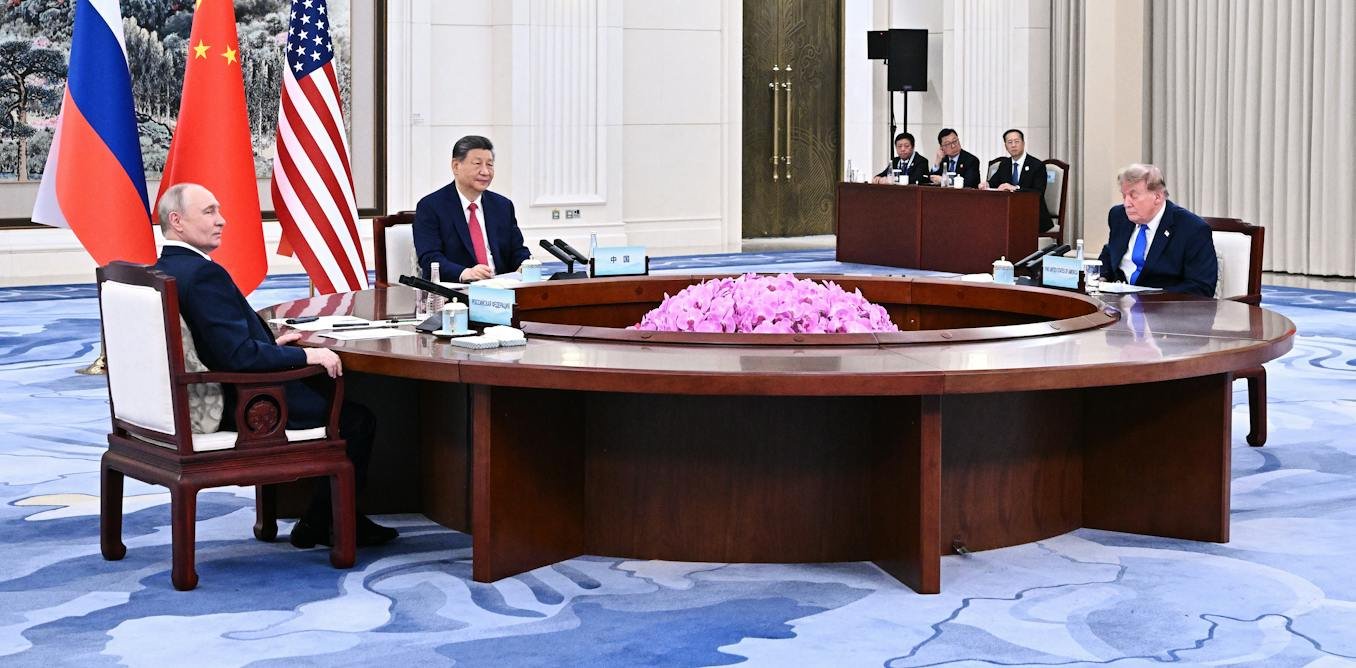
Xi Jinping got to show that China can convene the world’s great powers. Donald Trump, fresh from his midterm election defeat, got to look like something other than a lame duck. And Vladimir Putin got to sit at eye level with the other two, after years of western efforts to isolate him.
Ahead of the summit, concerns about three strongmen carving up the world into spheres of influence made their rounds. There was widespread fear that Shenzhen would resemble the 1945 meeting between the US, UK and Soviet leaders in the Russian resort city of Yalta.
That meeting paved the way for the cold war division of the world into western and Soviet spheres of influence.
Shenzhen produced a different sort of document: a joint peace declaration. Its first substantive point is a pledge to reform the UN, one of the institutions the allies were laying the groundwork for at Yalta.
The declaration also pledges further talks to reduce the risk of nuclear proliferation, calls for more production and supply of refined petroleum products and takes a swipe at the International Criminal Court (ICC) by stressing state consent and the immunity of officials.
The UN clause deserves particular attention. The three leaders stressed they spoke as permanent members of the security council. The other two permanent members, France and Britain, were not in the room in Shenzhen, but will be somewhat relieved that the prime venue of multilateralism is not forgotten.
Less clear, however, is what kind of reform Xi, Trump and Putin have in mind. Their attacks on the ICC, for example, do not give the impression that their vision of a post-reform UN is one of a rules-based order in which international law applies equally to small, medium and great powers.
Energy gets the second of the Shenzhen declaration’s four points. China, Russia and the US declared they plan to produce and supply more refined petroleum products, which could ease pressure on global energy markets after the repeated disruption to shipping through the Strait of Hormuz caused by the conflict in the Middle East.
The recent Nvidia spy scandal and the resignation of the company’s CEO, Jensen Huang, has added a separate source of market stress. At a time when investors are absorbing both shocks, steadier fuel supplies are important also to keep the energy-hungry AI revolution on track.
The ICC clause reads like a mutual assurance. By stressing the “principle of state consent” and “respect for immunities” of state officials, and warning the court against not to “abuse their jurisdiction”, Xi, Trump and Putin signal a willingness to give one another and their allies diplomatic cover.
Here, Putin has the most immediate stake. The ICC issued an arrest warrant for him in 2023 over the alleged unlawful deportation and transfer of children from occupied areas of Ukraine.
The nuclear question shows how far the three leaders still have to go. The last nuclear arms control treaty between the US and Russia, known as New Start, expired in February 2026 with nothing to replace it. Trump wants China in a trilateral nuclear arms control deal, but Beijing wants the other two to cut their arsenal first – or have them wait for China to catch up.
No Yalta 2.0
The Shenzhen summit was not the feared Yalta 2.0, despite Xi mentioning in his opening remarks that the three leaders must not cross each other’s red lines.
Yalta was able to divide the globe between major powers because it confirmed facts on the ground and the solutions were ripe. The Red Army already held much of Eastern Europe, and the US and UK were in no position to push it out. Nowadays, none of the new “big three” can deliver what dividing the world would require.
China has economic stakes across Latin America. US security commitments run across Asia, to governments with their own reasons to resist Beijing. Russia’s demands in Europe bind no European government just because Washington accepts them. And middle powers like India and Brazil keep ties with all sides precisely so that nobody can assign them to a sphere.
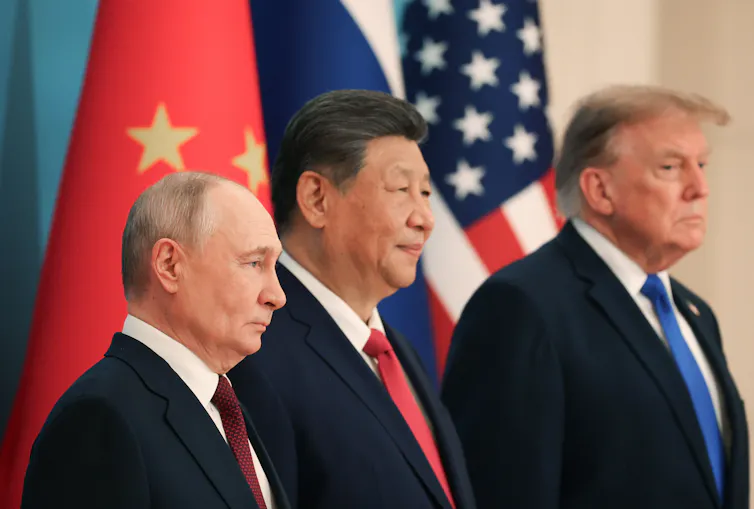
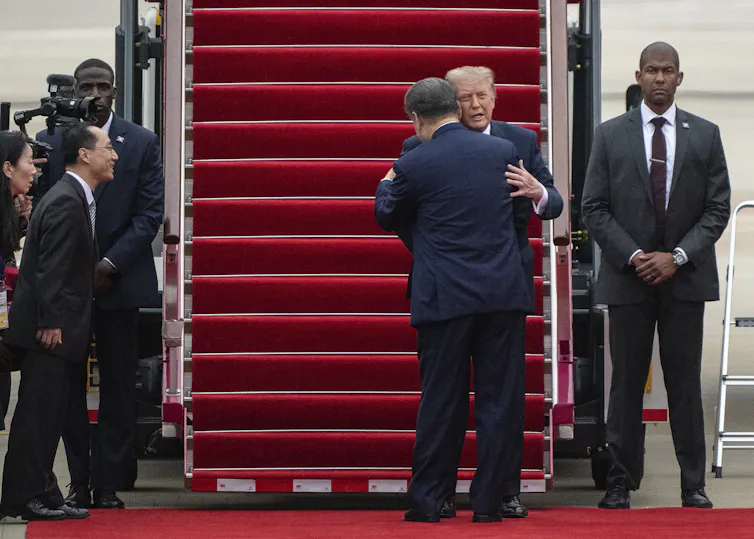
The three leaders put their personal relationships on display in Shenzhen. Xi took the unusual step of greeting Trump as Air Force One arrived. And whenever the cameras were rolling, the three leaders called each other “old friends”.
Ahead of the meeting, Xi had already spent more than two hours in direct talks with Putin, discussing trade and other areas of cooperation. Trump’s separate meeting with Putin lasted about 40 minutes, followed by roughly an hour with Xi before the three sat down together.
The sequence gave Xi room to demonstrate the depth of his relationship with Moscow while giving Trump a conspicuous welcome of his own, with a cheek-to-cheek hug, military guard of honour and cheering schoolchildren.
The Shenzhen declaration gives the three governments a few things to work on together. What is now important is whether they can turn these broad pledges into verifiable commitments. That means agreeing on who does what, in what order and how each side can check that the other parties have followed through.
The G20 summit in Miami in December will show whether anything follows. Washington has invited Putin, but whether he comes, and whether the three meet again, is still open.
By then we will know whether negotiations on details have started behind the scenes, or whether the three leaders still have to make good on the pledges they made in Shenzhen.
Source: Iwpost.com