15.1 C
London
Thursday, May 7, 2026
Home Blog

Trump administration claiming a ‘win’ against Iran – here’s a report card

0
trump-administration-claiming-a-‘win’-against-iran-–-here’s-a-report-card
Trump administration claiming a ‘win’ against Iran – here’s a report card

Two months into the war in Iran, the reasons the US gave for launching this conflict – and Washington’s minimum criteria for claiming success – now appear unintelligible. So much so that US officials are now arguing the war had actually ended in America’s favour almost a month ago, when the ceasefire came into effect.

It is hard to think of a more damning indictment of Donald Trump’s catastrophic war in Iran than the spectacle of his secretary of state, Marco Rubio, telling reporters on May 5 that the main goal now was to get the Strait of Hormuz “back to the way it was: anyone can use it, no mines in the water, nobody paying tolls”.

This, he argued, was an entirely separate defensive and humanitarian operation and would only become a war if US ships came under fire – which they in fact did that same day. Rubio ignored the obvious contradiction that the humanitarian operation had been necessitated by the very war he was simultaneously presenting as already won.

Things took an even more absurd turn later that day. Trump announced he was suspending “Project Freedom”, his plan for the US Navy to escort tankers out of the strait, after just one day. The US president cited “great progress” toward an agreement with Iran. As has happened several times now, global stock markets rallied before falling back again.

Marco Rubio speaks about the Iran war in the White House Press Briefing Room.

Marco Rubio speaks about the Iran war in the White House Press Briefing Room in Washington on May 5. Jim Lo Scalzo / EPA

While few doubt Trump is desperate to put this disastrous war behind him, particularly before heading to Beijing on May 14, he massively oversold the impression of a breakthrough. The Iranians were merely considering a 14-point proposal for 30 days of negotiations aimed at finding a durable end to the war.

The more convincing reason Trump abandoned Project Freedom is that it was already clear it would not solve the crisis. Most owners of the 1,500 ships currently stranded behind the strait were unwilling to risk passage even with a naval escort. Iran’s response, attacking shipping and launching missiles at the United Arab Emirates, also threatened the ceasefire itself.

Washington’s problem is that the Iranians will probably insist talks can only begin, and the Strait of Hormuz reopen, if Trump agrees to end the economic blockade of Iranian maritime trade. The US blockade is inflicting serious damage on the Iranian economy.

Apart from anything else, Iranian officials see ending the blockade as logical reciprocity. But they also understand time is running out before the closure of the strait causes lasting structural damage to the global economy – if it has not already. This gives them enhanced leverage at the moment.

Yet even if negotiations begin, the same problem that prevented a deal before the war remains. Trump lacks the detailed and institutionalised policy apparatus of his predecessor, Barack Obama, whose 2015 nuclear agreement with Iran the current US president so desperately wants to outdo. Obama’s deal took 20 months of intense wrangling to complete. Trump has neither the patience, technical expertise or direct diplomatic connections to achieve the same.

Added to this are new conditions created by the war itself. The fragmentation of Iran’s decision-making process and the empowerment of elites with an even higher tolerance for military and economic pressure have introduced uncertainty into the equation. And Iran has now realised the increased leverage it has through its ability to close a critical artery of the global economy.

Colossal failure

The answer on the nuclear issue may lie in a fudge. Iran could well agree to a moratorium on uranium enrichment while not yet agreeing to ship out or dilute its enriched uranium – though without ruling that out in order to prolong negotiations.

If slightly more moderate heads in Tehran prevail – and that remains a very big if – it would be an obvious concession to make. Iran’s geographic advantages and ballistic missile capabilities have established a credible deterrent against future attack.

The question is whether anything short of total surrender on the nuclear issue is acceptable to Trump, and whether he is willing to resist inevitable Israeli opposition to blurring this red line. If not, he has already threatened to resume bombing at a “much higher intensity” than before.

Yet there are serious doubts about whether he has the stomach for this. And even if he does, it is difficult to see how any amount of US and Israeli bombing can force the Iranian regime to surrender.

Donald Trump speaks during an event at the White House.

Donald Trump is looking for a way out of the war in Iran. Shawn Thew / EPA

Trump’s shifting aims for the war and desperate scramble for an exit underscore that this entire enterprise has been a colossal strategic failure. It will define his legacy, reshape the Middle East and impose further misery on the Iranian people – the very opposite of what he has repeatedly said he wants to do.

The war has has shattered confidence among US regional allies that Washington can protect them. It has also alienated traditional US allies who were blamed and then punished for failing to solve a problem they neither created nor could resolve. The US and Israeli attacks have further entrenched a brutal regime that will now be even harder to negotiate with, while completely marginalising moderate voices inside Iran.

If negotiations can prevail, the successes the US president and his advisers trumpet – the destruction of parts of Iran’s military-industrial capacity and navy – are real. Though in the former case probably only temporary and in the latter, demonstrably not critical for maintaining freedom of navigation.

The only positive is that Trump’s brief experiment with military adventurism, an aberration even within his own muddled political trajectory, may now be ending.


Google unveils screenless Fitbit Air and Google Health app to replace Fitbit

0
google-unveils-screenless-fitbit-air-and-google-health-app-to-replace-fitbit
Google unveils screenless Fitbit Air and Google Health app to replace Fitbit

Wearables have really come full circle. The early Fitbits didn’t have screens, but the move to smartwatches put a screen on everyone’s wrist. Now, devices like Whoop and Hume are designed as data trackers first and foremost without so much as a clock. Google’s newest wearable jumps on that trend: The Fitbit Air doesn’t have a screen, but it does have a suite of health sensors that pipe data into the new Google Health app. And if you want, Google has a new AI-powered health coach in the app ready to tell you what that data means (maybe).

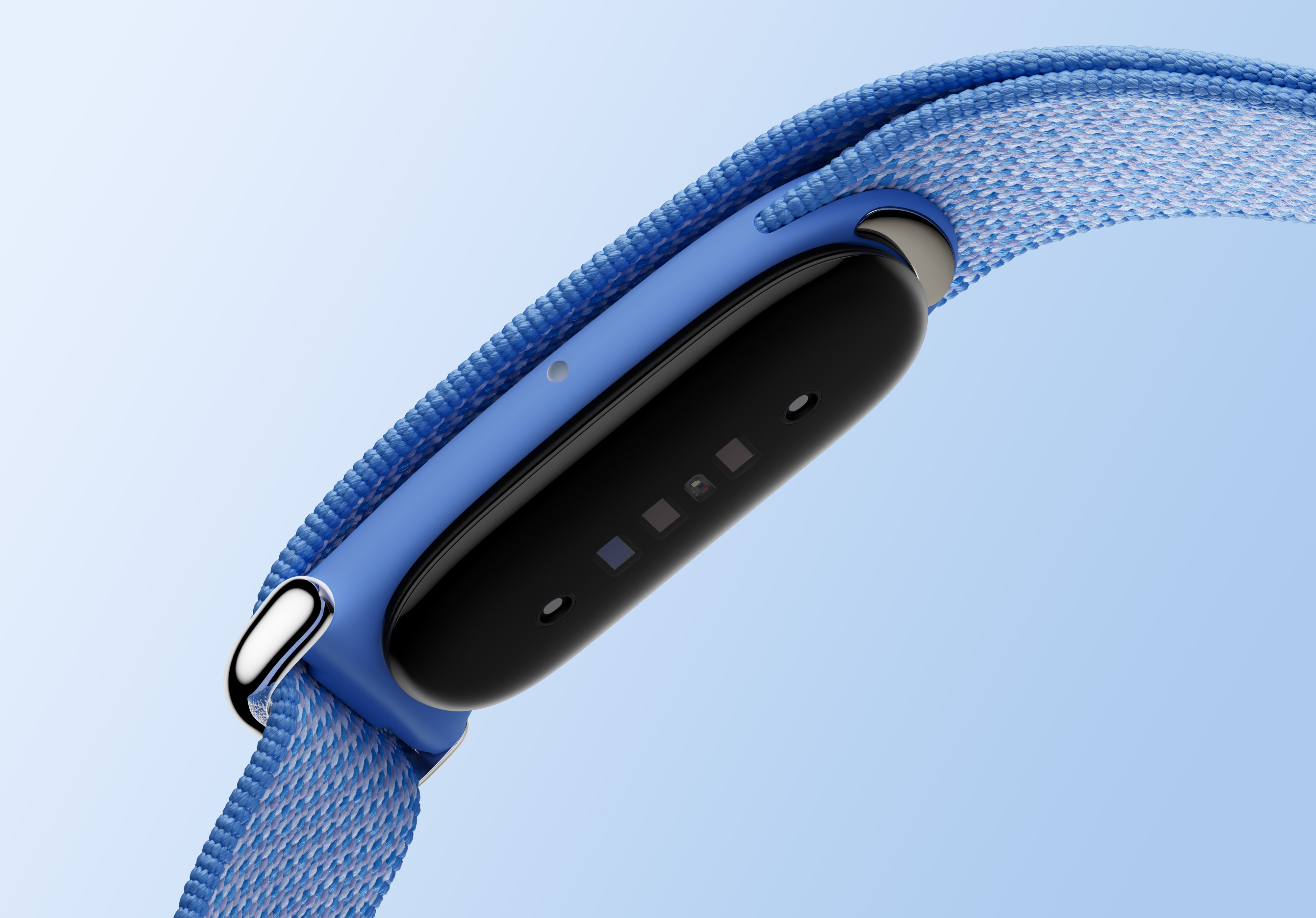
The Fitbit Air itself is a small plastic puck about 1.4 inches long and 0.7 inches wide. It slots into various bands that hold the bottom-mounted sensors against your wrist. There’s no display pointing upward, so the entire device is covered by the fabric or plastic of the band. It’s a streamlined and potentially stylish look—in uncharacteristic fashion, Google has plenty of colors and style options available, including a special-edition Steph Curry version. You may have heard chatter about Curry being seen teasing a new screenless Fitbit, and this is it.

Performance Loop bands.

Elevated Modern bands.

Smartwatches never quite became a must-have device—plenty of people have them, but we don’t all wear them all the time because they need to be charged often and aren’t always very comfortable. The screenless Fitbit Air doesn’t have those issues. Google says it lasts about a week on a charge, and it does that while collecting continuous health data. It can even store a day of data without being connected to your phone.

While the Pixel Watch is very comfortable for a smartwatch, Google still wants to make it easier for people to keep collecting data all day and night. The company says that product testers rated the Air as more comfortable than competing devices, so you may actually be willing to wear it to bed for sleep tracking. You don’t have to choose between these devices, either. You can keep a Pixel Watch and Fitbit Air paired with your phone and wear whichever one you want over time. This capability will come to more wearable devices in the near future, too.

Fitbit Air close up

The Air “pebble” slots into bands from the bottom.

The Air “pebble” slots into bands from the bottom. Credit: Google

The Fitbit Air will have all the standard wearable health sensors: heart rate, accelerometer/gyroscope, infrared SpO2, and skin temperature. Google notes that the heart rate monitor isn’t as advanced as the one in the latest Pixel Watches, so the Air might not be as accurate during vigorous activity. The Air also has a vibration motor that can be used for alarms, but it’s not going to buzz for phone notifications like a smartwatch.

The Fitbit Air launches on May 26 for $99.99 with the included Performance Loop band. There are also silicone Performance Loop and Elevated Modern Band options. Bands start at $34.99 and come in a variety of colors. A Fitbit Air purchase also includes three months of Google Health Premium (replacing Fitbit Premium), which now features Google’s new AI Health Coach.

Goodbye, Fitbit… Hello, Google Health

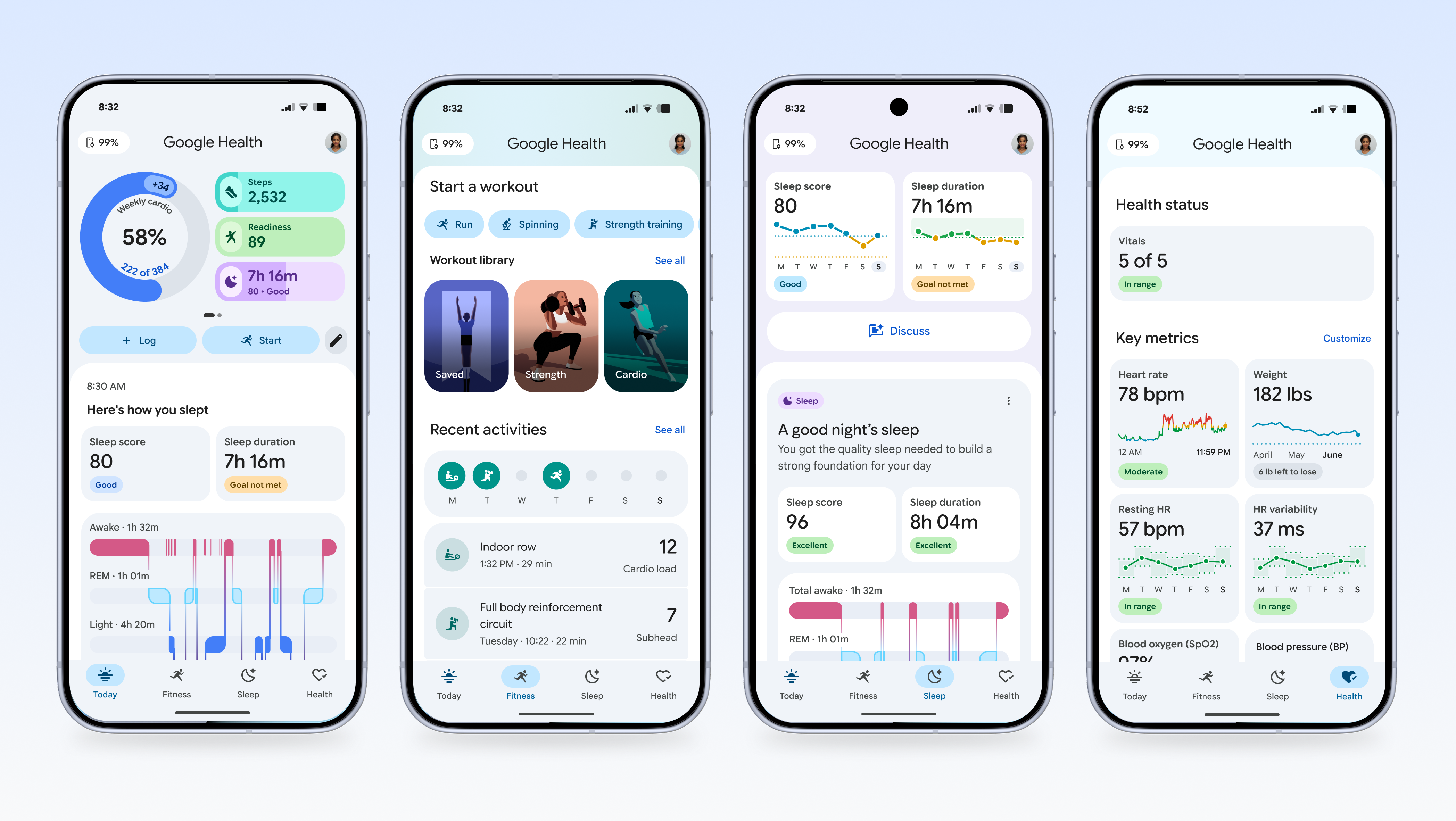
The Fitbit app is getting a major makeover and a new name. An update in the coming weeks will transform that app into Google Health, featuring a new interface with a more extensive Material Expressive aesthetic and redesigned menus and tabs. You also won’t see Fitbit branding in as many places—the Fitbit Premium subscription will become Google Health Premium.

Google Health app UI

Credit: Google

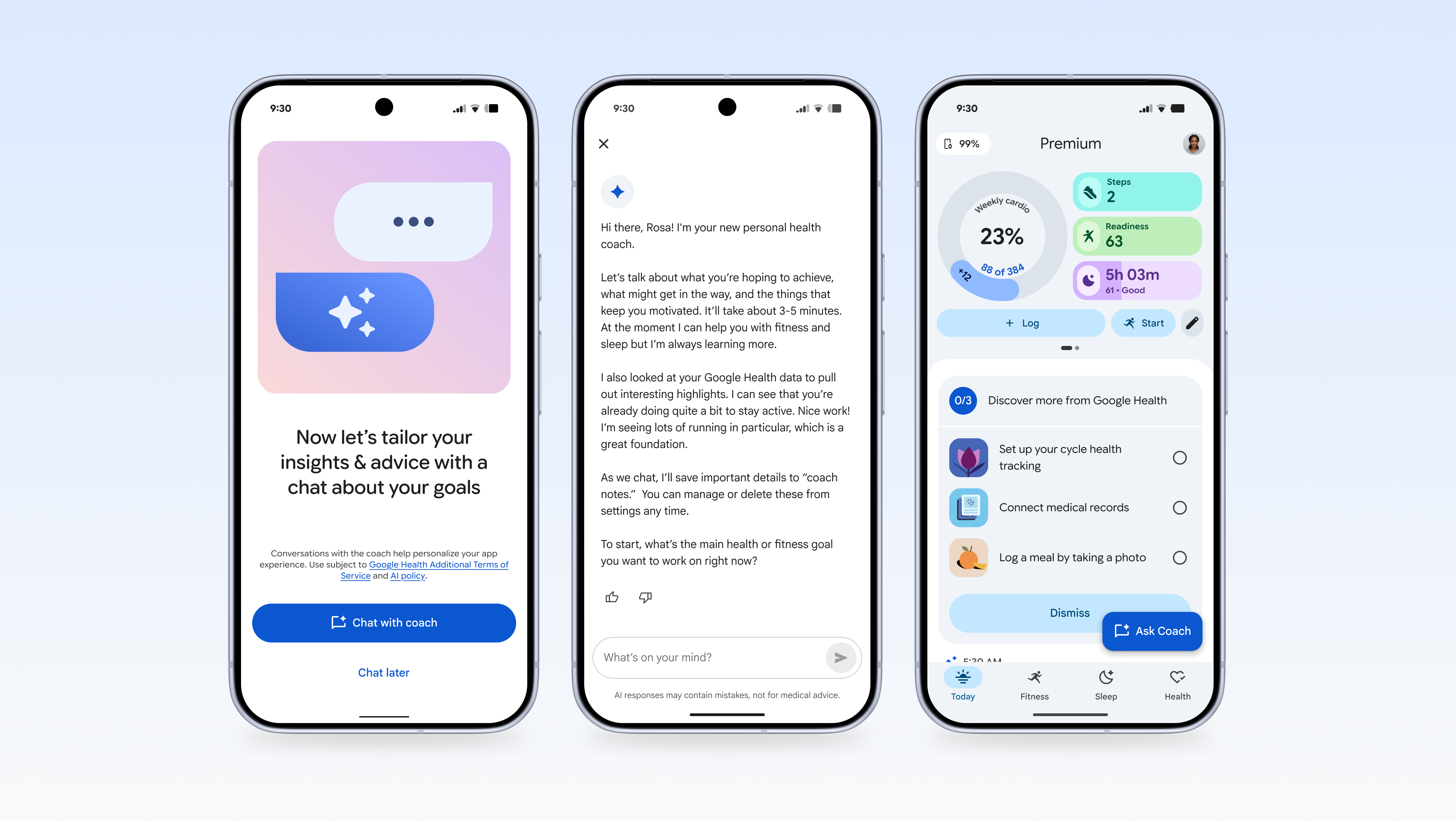
Without a subscription, the app still does all the basic things, like tracking your health stats, automatically logging workouts, and showing it all in a pretty dashboard. With the Premium subscription, you get all the features from Fitbit Premium plus the new AI Health Coach. It’s a chatbot, so you can ask it about any health or wellness topics, and the answers are grounded by your health data.

Google suggests asking the Health Coach for customized workout routines or exploring health concerns. The robot can theoretically use your accumulated health metrics, like workouts, nutrition, and sleep, to provide better suggestions. You can even upload a picture of food to Health Coach and have it automatically logged in the app.

This Health Coach AI was built on Gemini, but it has been tuned differently from the normal frontier model. According to Google, it used a panel of health experts and extensive user studies to validate the Health Coach model. Steph Curry and his “performance team” also had input on how the Health Coach responds.

Health Coach in Google Health

Credit: Google

We won’t know how useful the coach is until it begins rolling out later this month, but the idea is that it will be more useful the more data is piped in from your wearable. Naturally, health data is extremely sensitive, and Google is asking you to dump a lot of it into a cloud-based AI model. Google says it will never use this data for advertising, which has been the case in all its previous health endeavors. In the AI era, it has further stipulated that it won’t use your health data for AI training unless you choose to do that. There will be an opt-in toggle in the settings to contribute data for training, but it’s unclear why anyone would do that.

Like the retired Fitbit Premium, the new Google Health Premium will be available for $10 per month or $100 per year. It’s also included if you’re already paying for AI Pro or AI Ultra. If you choose to skip the subscription, you can continue to use your Fitbit and Google wearables in the new app with the same basic stat tracking features. And what of Fit, that other Google-branded health tracking app? Fit will be shutting down later this year, at which time users will have to migrate their data to Google Health.

Drone threat hangs over Moscow as tensions escalate before May 9 parade

0
drone-threat-hangs-over-moscow-as-tensions-escalate-before-may-9-parade
Drone threat hangs over Moscow as tensions escalate before May 9 parade


Russia said on Thursday that air defences had destroyed 32 drones heading towards Moscow since the start of the day, as the country prepared for its May 9 Victory Day commemorations under heightened security concerns.

Moscow Mayor Sergei Sobyanin said on Telegram that Russian air defences were repelling attacks by Ukrainian drones targeting the capital ahead of the annual celebrations, which commemorate the Soviet Union’s victory in World War II.

The incidents came amid escalating warnings from Moscow over possible Ukrainian attempts to disrupt the commemorations and military parade in Red Square.

Russia warns of retaliation over parade disruption

Russia’s defence ministry had warned earlier this week that it would respond to any Ukrainian attacks during the scaled-back celebrations with what it described as a “massive missile strike” on central Kyiv.

On Wednesday, Russia’s Foreign Ministry said diplomatic missions had been urged to evacuate staff promptly from Kyiv in the event of a large-scale retaliatory strike by Moscow.

Foreign Ministry spokeswoman Maria Zakharova, speaking in a video posted on Telegram, said foreign governments should treat Russia’s warning “with the utmost responsibility” and ensure the “timely evacuation” of diplomatic personnel from Kyiv.

Zakharova said the warning was linked to the “inevitability” of a retaliatory strike by Russia’s armed forces should Ukraine attempt to disrupt Victory Day commemorations.

She also accused Ukrainian President Volodymyr Zelenskyy of making “aggressive and threatening statements” regarding the celebrations during remarks earlier this week at a meeting of the European Political Community in Armenia.

In those remarks, Zelenskyy noted that Russia had scaled back the commemorations and would hold them without military hardware for security reasons.

“It will be the first time in many, many years they cannot afford military equipment and they fear drones may buzz over Red Square. This is telling,” Zelenskyy said.

The exchange underscored growing tensions ahead of the May 9 parade, one of Russia’s most symbolically important state events, as concerns mounted over the threat of further drone attacks on Moscow.

Khalilur Rahman is the master of Bangladesh’s strategic ambiguity

0
khalilur-rahman-is-the-master-of-bangladesh’s-strategic-ambiguity
Khalilur Rahman is the master of Bangladesh’s strategic ambiguity

There are political operators who rise through ideology, and there are bureaucrats who rise through obedience. Then there is Dr Khalilur Rahman, a man who appears to have risen through something far more elusive: usefulness in moments of uncertainty.

In Bangladesh’s increasingly fractured political landscape, Khalilur Rahman has become one of those rare figures who seem to survive every transition while remaining strangely above the noise.

To admirers, he is a strategic mind functioning several moves ahead of everyone else, calibrating every ambiguous statement and diplomatic maneuver toward a larger geopolitical design.

To critics, he is simply a polished improviser, a fluent technocrat capable of dressing up tactical opportunism as grand strategy. And perhaps the most unsettling possibility is that, in the modern age of fractured truths and manufactured narratives, the distinction between the two has ceased to matter.

That ambiguity is precisely where Khalilur Rahman thrives.

His appointment as foreign minister in the new government led by Tarique Rahman stunned many within the ruling establishment itself. Only months earlier, while serving as national security adviser under the interim administration of Muhammad Yunus, he had faced open hostility from sections of the now-ruling Bangladesh Nationalist Party (BNP).

Senior party figures privately questioned why a man with no roots in the country was suddenly handling matters of national security. Some openly described him as an “outsider in charge of the state security.”

Yet here he remains – not merely surviving the transition from interim authority to elected government, but emerging stronger from it. Indeed, the durability of Khalilur Rahman’s influence is perhaps the most fascinating aspect of his story.

Bangladesh has historically been unforgiving toward holdovers from previous administrations. Political transitions are usually accompanied by purges and ideological cleansing coupled with the ritual humiliation of those associated with the outgoing order.

Khalilur Rahman has somehow escaped that fate. More than that, he became indispensable to two successive governments that otherwise shared little political trust between them.

That alone demands explanation. Part of the answer lies in his credentials. Khalilur Rahman is not a conventional party politician parachuted into diplomacy.

He topped Bangladesh’s first regular civil service examination in 1977, graduated first in economics from the University of Dhaka and later studied at both Tufts University’s Fletcher School and Harvard’s Kennedy School, earning advanced degrees in diplomacy and economics.

He spent decades within the United Nations system, occupying senior policy positions in Geneva and New York, and contributing to major UN development frameworks.

Technocrats with international pedigrees are not uncommon. But Bangladesh rarely produces technocrats capable of navigating domestic political paranoia while simultaneously reassuring foreign capitals. Khalilur Rahman appears unusually fluent in both languages.

And so he travels. Since the formation of the new government, he has resumed the now-familiar rhythm of diplomatic shuttlecraft, Beijing one week, Delhi or Istanbul another, Washington always somewhere in the background.

He moves through foreign policy crises with an ease that appears either deeply strategic or recklessly improvised, depending on who is watching or assessing.

Take his recent state visit to China. The joint statements emerging from Dhaka and Beijing read like lyrical declarations of eternal cooperation, packed with ambitious rhetoric and promises of deeper economic partnership.

Yet critics immediately pointed out an uncomfortable contradiction: Bangladesh’s recent agreement with the US reportedly contains clauses that could complicate large-scale future Chinese investments without Washington’s approval or scrutiny.

Whether that interpretation is legally accurate matters less than the perception it creates  — that Bangladesh is simultaneously reassuring Washington while courting Beijing with equal enthusiasm.

And somehow Khalilur Rahman manages to stand in the middle of those contradictions without appearing cornered by them. More remarkably, he revived discussions around China’s involvement in the long-stalled Teesta River management project, an issue historically entangled with India’s regional sensitivities.

For years, even governments of the ousted autocrat Sheik Hasina, who was seen as “exceptionally close to New Delhi,” approached the subject cautiously. Yet Khalilur Rahman reopened the conversation with notable confidence, as though diplomatic landmines were merely procedural inconveniences.

Curiously, his handling of India may be his most impressive balancing act. Relations between Dhaka and New Delhi deteriorated sharply during the Yunus-led interim administration.

Indian media commentary frequently turned hostile, portraying Bangladesh’s political transition as chaotic and unstable. But after the arrival of the Tarique Rahman government, the tone shifted noticeably.

Indian strategic circles began speaking less about instability and more about pragmatism and cooperation. Editorials advocating recalibration and engagement started appearing with surprising frequency.

Inside diplomatic circles, many quietly attribute part of that tonal shift to Khalilur Rahman’s intervention. Whether this reflects genuine strategic brilliance or merely his ability to tell every side what it wishes to hear depends largely on one’s ideological loyalties.

His critics see “contradiction” everywhere in his diplomacy. His supporters see flexibility. His detractors see improvisation. His admirers see sophisticated statecraft. The truth may be that modern diplomacy increasingly rewards exactly this kind of ambiguity.

Bangladesh today occupies an unusually delicate geopolitical position: economically dependent on Western markets, strategically important to India, increasingly tied to Chinese infrastructure financing and perpetually vulnerable to regional instability emanating from Myanmar and the Rohingya crisis.

In such an environment, ideological purity becomes less valuable than adaptive fluency. Khalilur Rahman’s greatest political talent may simply be his ability to inhabit contradictory spaces without collapsing under them. That quality has arguably made him indispensable.

To old BNP loyalists, he remains an outsider. To sections of the bureaucracy, he is still viewed with suspicion. Yet, for successive governments confronting an increasingly unstable regional order, he represents something far more useful than ideological consistency: continuity amid volatility.

And perhaps that is the real explanation behind his unlikely rise. Not that Khalilur Rahman possesses some mystical foreign policy genius. Nor that he is merely a lucky opportunist bluffing his way through power corridors.

But Bangladesh’s political class — fragmented, distrustful, and perpetually reactive — increasingly requires figures capable of operating in ambiguity without being consumed by it. And few in Bangladesh embody that ambiguity better than Khalilur Rahman.

Faisal Mahmud is a Dhaka-based journalist

What has Guterres supported in Gaza?

0
what-has-guterres-supported-in-gaza?
What has Guterres supported in Gaza?

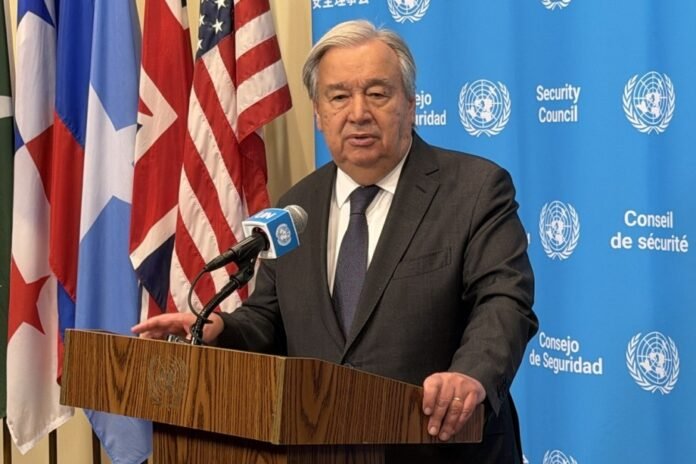
In March this year, UN Secretary General Antonio Guterres had stated that the UN is “cooperating actively with structures created by the Board of Peace.” By the time Guterres made his statement, US Board of Peace High Representative for Gaza Nickolay Mladenov had already warned, in February this year, that Hamas bears the burden of Israel’s full resumption of genocide in Gaza if it fails to disarm.

In a letter that was quoted yesterday in Israeli media, Mladenov and senior US official Aryeh Lightstone warned the Palestinian technocratic government, “Failure by Hamas to accept the framework within a reasonable timeframe, as determined by the Board of Peace and after consultation with the parties, shall render such commitments null and void.”

Two days before Mladenov’s warning was made public, a senior military official said that it was inevitable that Israel would resume “fighting” in Gaza if Hamas refuses to disarm. Israel has in fact not stopped colonising Gaza through violence – what we are seeing now is a slower form of genocide in the aftermath of a very visible genocide which world leaders and diplomats preferred to watch rather than stop.

Mladenov is aware that Israel kept killing Palestinians in Gaza after the ceasefire came into effect, that more buildings were detonated, that the Yellow Line keeps expanding in Gaza besides already occupying more than half of its shrinking territory.

Therefore, the pretence of a before and after the ceasefire does not hold. It is merely a convenient veneer for the Board of Peace’s next rhetorical step that asserts its agreement with genocide.

Israel violated the October 2025 ceasefire multiple times, so in a way the letter is not a warning of novelty. However, the text of the October ceasefire does not stipulate that Hamas should disarm for the ceasefire to hold; that was a clause for the second phase of the ceasefire. The US Board of Peace is therefore saying that Israel is exempt from upholding its obligations stipulated in Phase One if Hamas does not agree to a clause from Phase Two.

In the entire Western narrative of Israel’s genocide in Gaza, Mladenov is not employing a new tactic when blaming Hamas for refusing to disarm. However, exploiting the ceasefire text, which was based on the resumption of humanitarian aid and the return of Israeli hostages, is insightful in terms of how institutions hold the power to manipulate the parameters of international law, accountability and impunity. The October 2025 ceasefire text, which was not dependent on Hamas disarming, can now be discarded simply because the focus is on Phase Two and diplomacy will not check the specific stipulations of Phase One.

Mladenov and Lightstone, therefore, are legitimising institutional complicity with genocide.

This is one clear admission in which a body supposedly tasked with rebuilding Gaza and its governance will not hold Israel accountable for continuing to commit genocide.

By stepping back, the spectator tactic has now been fully employed by Mladenov and the so-called Board of Peace.

When has genocide even been advocated for so smoothly among diplomats? Guterres should take note of what he and the UN have supported.

The views expressed in this article belong to the author and do not necessarily reflect the editorial policy of Middle East Monitor.

Berlin and the Quiet Closing of a Door

0
berlin-and-the-quiet-closing-of-a-door
Berlin and the Quiet Closing of a Door


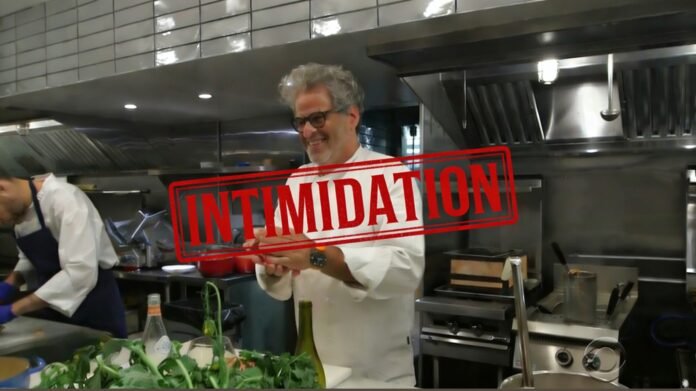
In September 2025, Israeli chef Eyal Shani opened a restaurant in Berlin. By April 2026, it was gone.

The restaurant, Gila & Nancy, did not close because it failed to attract customers or critics. It closed after months of sustained protests, harassment, and threats directed at its staff and patrons. Demonstrators gathered outside. Graffiti invoked violence. Online messages blurred the line between political expression and antisemitic intimidation. Eventually, the pressure achieved its aim.

A restaurant was made to disappear.

It would be tempting to treat this as an isolated incident tied to the broader polarization surrounding the war in Gaza, now months into a ceasefire. But that would deflect from an unsettling truth. What happened to Gila & Nancy shows something more troubling about today’s Germany: A shift in what is tolerated in the public square, and who is no longer defended.

Today, in the capital of Europe’s most powerful economic engine, police are investigating graffiti reading “Kill all Jews,” sprayed onto residential buildings. This is not coded language or debated “river to sea” lingo. It is not shorthand political critique. It is a direct call for violence, splashed on a wall for all to see.

Berlin is not alone. In Cottbus, a swastika was recently displayed in a public setting, a warning signal too few are heeding: Hate symbols once consigned to the dustbin of history are reappearing in everyday life. Germans would be wrong to treat these as disconnected incidents.

They are not disconnected, at least not for Germany’s deeply worried Jews. They did not need the comprehensive 2026 assessment of Jewish communities in Germany describing their “new normal” to understand what is happening. Persistent and growing insecurity has taken hold. A majority of communities report that life has become less safe since October 7, 2023. Only 13% of Jewish communities see a positive future in Germany. Jewish public visibility is declining. Events are being canceled. Solidarity from wider society has clearly eroded.

This is the time for fellow Germans to show solidarity with their Jewish neighbors.

When intimidation shuts down a business, when open calls for violence appear on city streets, and when a minority community begins to withdraw from public life—not by choice, but out of necessity—you have the beginnings of a dangerous road: a future Germany increasingly without Jews.

God forbid: No gas chambers, no Einsatzgruppen, no Nuremberg Laws. Just the slow, steady strangulation of Jewish life caused by burgeoning hatred and dehumanization spread by political extremists infiltrating mainstream politics, antisemitic elements within cultural elites, and Islamist hatred backed by genocidal regimes from Iran to Qatar.

The most powerful blows against German Jews are not slogans chanted, words uttered, or tweets posted. The most powerful weapon is one Jews have little ability to stop: the silence of neighbors, the apathy of the mainstream, the snickering of parts of the media, and a system that too often fails to hold perpetrators of hate accountable.

Across the UK, Scandinavia, France, and Spain, Jews are increasingly targeted with modern blood libels amplified by social media, indifferent courts, and too many silent faith leaders.

Simon Wiesenthal cautioned that the past could return—not necessarily led by a Hitler look-alike.

To defeat the 21st-century scourge of antisemitism, non-Jews must take the lead. And yes, it would make a huge difference across Europe if Germans took the lead.

The challenge facing Germany today is not only ideological. It is whether intimidation will be allowed to shape public life.

The closure of Gila & Nancy was not an accident. It was the result of sustained pressure that ultimately made normal operation impossible for a visibly Israeli business.

That should concern anyone who cares about democratic resilience.

The issue is no longer whether Germany condemns antisemitism in principle. The issue is whether democratic societies can prevent those who practice intimidation from succeeding.

Every time a Jewish or Israeli institution disappears under pressure, a message is sent: Intimidation works.

Such messages spread far beyond one restaurant—to schools, synagogues, universities, and families increasingly questioning how visible they can safely remain.

Berlin, of all places, should understand the danger of such normalization.

No democratic society should accept a situation in which Jews require extraordinary protection simply to participate openly in public life.

The closure of Gila & Nancy is not merely a story about one restaurant.

It is a warning. The real test is whether Germany recognizes it, and whether it is willing to push back.

Teen Girl Falls to Her Death on Waterfall Swing After Warning Her Safety Rope Wasn’t Tight

0
teen-girl-falls-to-her-death-on-waterfall-swing-after-warning-her-safety-rope-wasn’t-tight
Teen Girl Falls to Her Death on Waterfall Swing After Warning Her Safety Rope Wasn’t Tight


A horrifying amusement accident in China has gone viral after a 16-year-old girl reportedly warned workers that her safety rope felt loose just moments before plunging into a gorge below.

The tragic incident happened May 3 at the Maliuyan Waterfall scenic area in Huayin, located in southwestern China.

According to local reports, the teenage tourist — identified only by her surname, Liu — was preparing to ride a massive cliff swing attraction that sends riders soaring out over a deep gorge.

Video from the scene reportedly showed Liu strapped into a harness while staff members moved her toward the edge of the launch platform.

Friends nearby could reportedly be heard laughing and chatting as the teen prepared for the ride, with a cloth draped behind her like a cape.

But moments before she was sent over the edge, Liu repeatedly warned staff that the rope attached to her harness was “not tight enough,” according to reports.

Seconds later, disaster struck.

As workers pushed her out over the drop, Liu suddenly appeared to slip downward several inches, as if part of the harness system had failed.

One person on the platform reportedly reached toward her, but it was too late.

Local reports claim the safety rope snapped almost immediately after she left the platform, sending the teen crashing down onto the cliff face below.

Although Liu initially survived the fall, she later died while being transported to a hospital.

The attraction was reportedly operated by an outdoor adventure company identified as Chongqing Adventure Camp, which had previously promoted the cliff swing attraction online through its WeChat account.

Following the deadly accident, officials shut down the scenic area and launched an investigation into what went wrong.

Authorities have reportedly classified the incident as a “production safety responsibility accident,” suggesting investigators believe safety failures may have played a role.

The park announced it would remain closed through at least May 10 while inspections and maintenance are carried out on the equipment.

The horrifying incident quickly exploded across Chinese social media, where many users accused the operators of ignoring the teenager’s warnings before the fatal plunge.

“They disregarded human life,” one user wrote online. “A small oversight has taken away the future of this young girl.”

The company operating the attraction said it is cooperating with investigators and remains in contact with Liu’s family as the investigation continues.

Is your Porsche Taycan too slow at the Nürburgring? You need this Manthey Kit.

0
is-your-porsche-taycan-too-slow-at-the-nurburgring?-you-need-this-manthey-kit.
Is your Porsche Taycan too slow at the Nürburgring? You need this Manthey Kit.

Porsche is known for building cars that really are extremely good right out of the box. Yes, they tend to be more expensive than the other German luxury car brands, particularly once the option list comes out. But it doesn’t take very long behind the wheel before the driving experience reveals why they’re so good. And that’s just the regular models; the stuff that comes out of the motorsport department in Weissach—like the sublime 911 GT3—is even more focused.

But for some drivers, those who choose to spend their spare time enjoying track days at places like the legendary Nürburgring Nordschleife in Germany’s Eifel Mountains, even cars like the razor-sharp GT3 RS make too many compromises for the road. For those people, there is Manthey Racing.

Based at the industrial estate alongside the ’Ring, Manthey is a highly successful racing team—majority-owned by Porsche since 2013—that applies its years of experience making Porsches go even faster around the 12.9-mile (20.8 km) circuit known as the Green Hell to create upgrade kits that will turn the dials all the way up to 11.

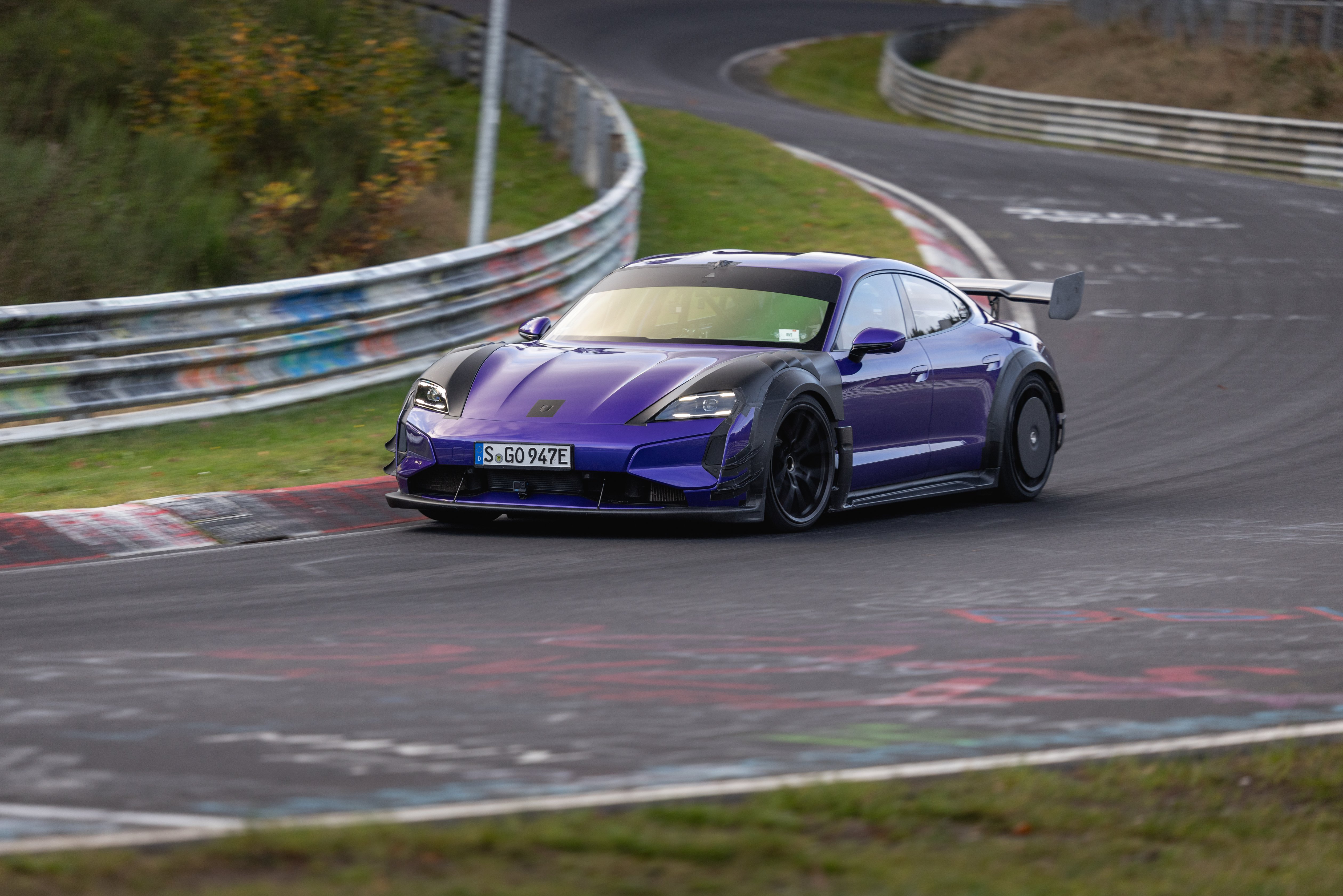
Manthey’s newest upgrade kit is not for the 911 or 718, but the electric Taycan. Specifically, the Manthey Kit is an upgrade to the Taycan Turbo GT variant that Porsche introduced in 2024. More specifically, it actually requires the Taycan Turbo GT to also have the factory-installed Weissach package: this saves weight with carbon-fiber trim, thinner glass, a lighter sound system, and even loses the second charge port and the rear speakers to cut kilos. So equipped, the 0–60 mph (0–97 km/h) time falls from 2.2 seconds to 2.1 seconds.

But a more impressive statistic is how little time it took Porsche factory driver Lars Kern to lap the Nordschleife—in 2024 he completed a lap in 7 minutes, 7.5 seconds.

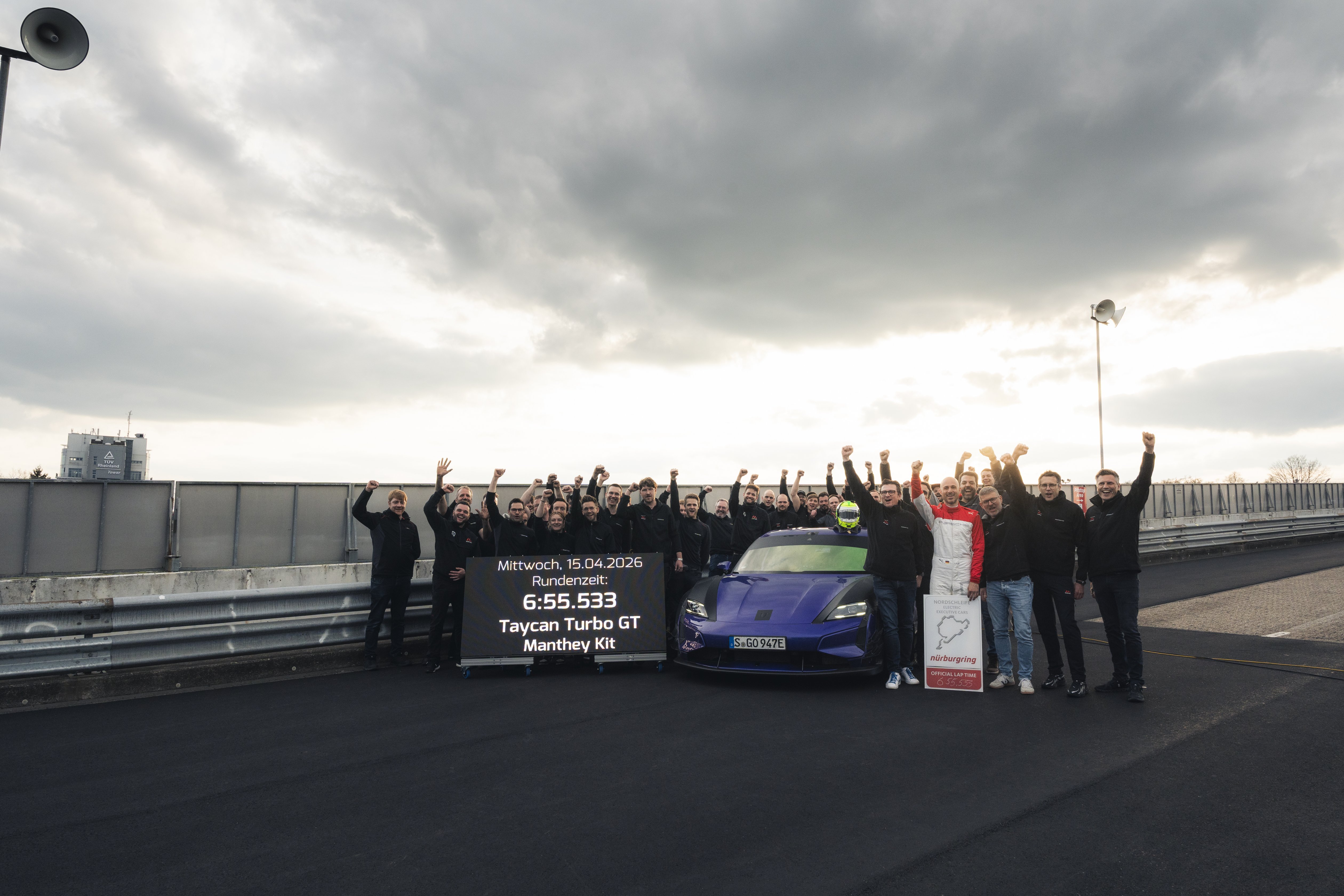
A team of people pose by a car in the pitlane

That’s a very fast lap time.

That’s a very fast lap time. Credit: Porsche

So the 12 seconds he shaved off that time with the Manthey Kit, to set a time of 6:55.553, should underscore just how much faster the car can now go. There’s more aerodynamic downforce courtesy of wild new body extensions, with louvres on the front wheel arches (presumably to let air escape the wheel well), a larger rear wing, new underbody diffusers, and aerodisc rear wheels. And the car’s downforce levels are tunable, so you can optimize it for whichever track you happen to be blistering this week.

At 124 mph (200 km/h), the standard Turbo GT with Weissach package generates 209 lbs (95 kg) of downforce. The Manthey Kit increases this to 638 lbs (290 kg). At top speed—now 192 mph (309 km/h)—the car creates 1,631 lbs (740 kg) of downforce to push it onto the road surface.

It’s fitted with bigger friction brakes with high-performance pads, and the driving dynamics have been honed by a new setup that makes use of the active ride suspension and rear axle steering.

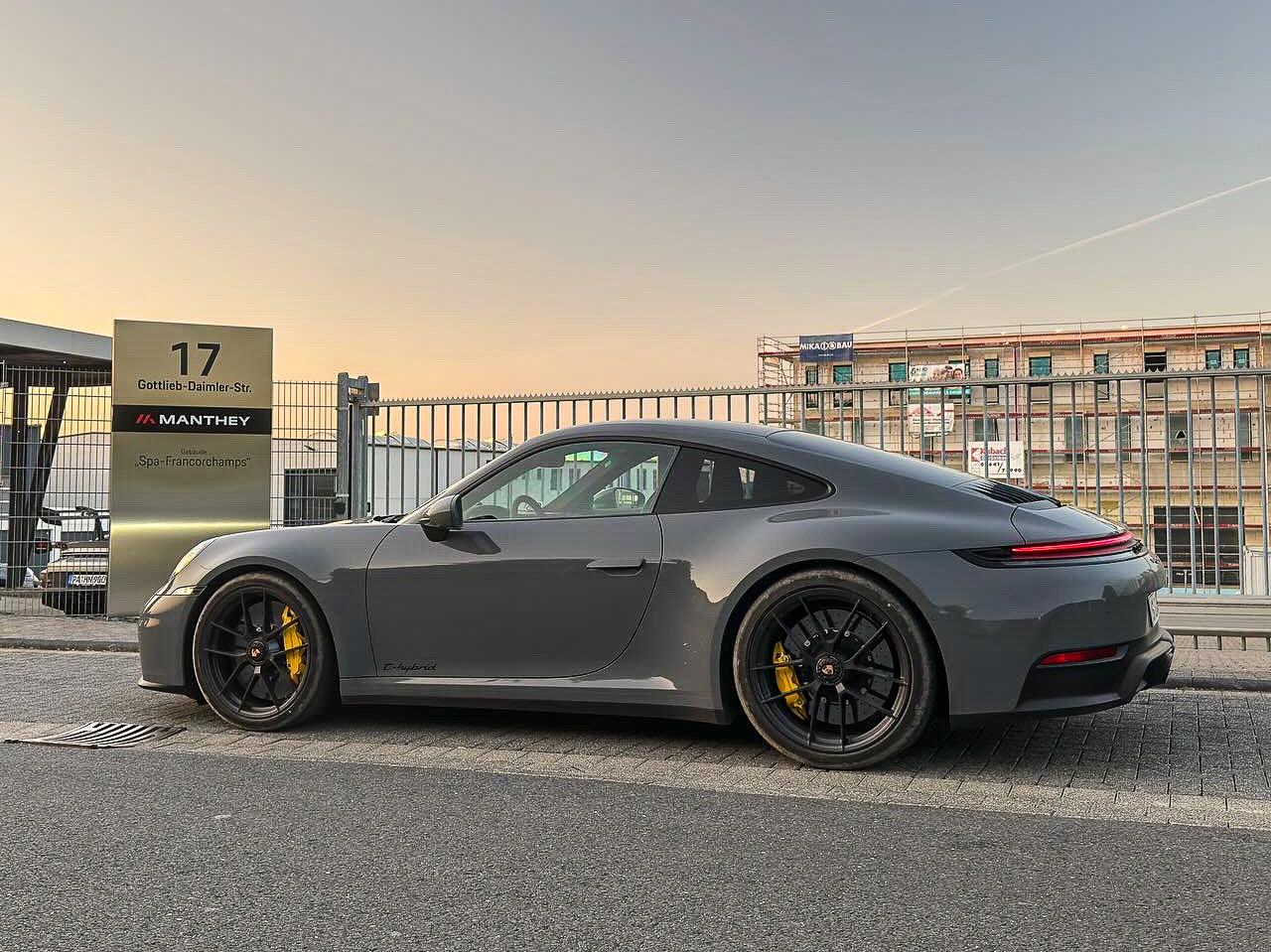
A grey 911 parked outside a gate to Manthey's HQ.

The various gates at Manthey’s Nürburgring HQ are named after different race tracks, which is why that says Spa.

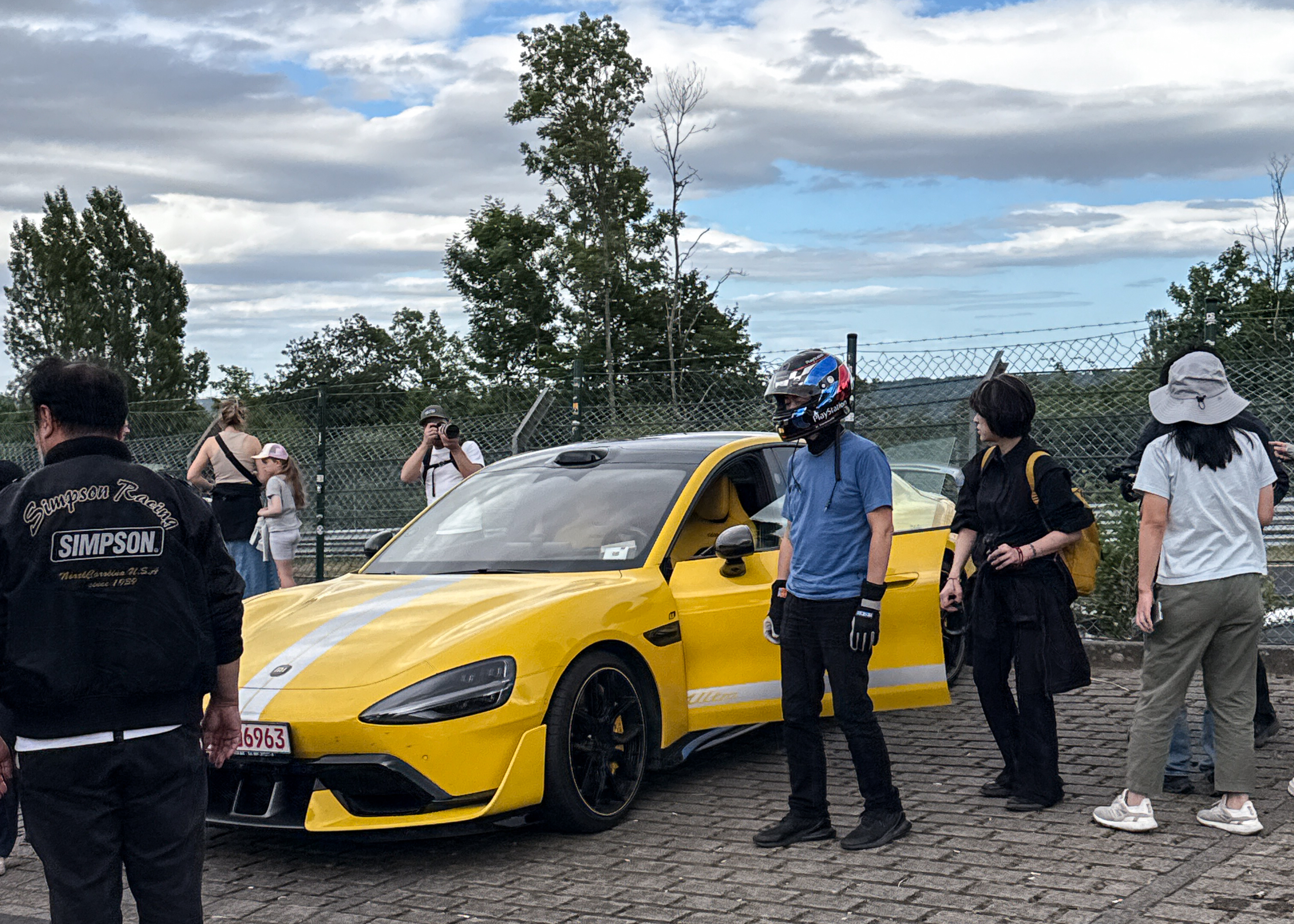
A yellow EV surrounded by people.

The BYD Yangwang U9, seen at the ’Ring last summer. That’s Polyphony Digital’s Kazunori Yamauchi fresh from a passenger lap, a few months before the car appeared in Gran Turismo 7. (I hope the real thing drives better than the car in the game…)

Manthey has also worked some magic on the powertrain. Maximum current has increased by 30 percent to 1,300 A, which increases nominal power by 26 hp (20 kW) to 804 hp (600 kW). Attack mode, imported from Formula E (where Porsche has had quite a lot of success in recent seasons) boosts this to 978 hp (730 kW) for 10 seconds. And while total power output in launch control is still the same 1,019 hp (760 kW) as the Weissach pack, peak torque in this mode increases by 22 lb-ft (30 Nm) to 936 lb-ft (1,270 Nm).

“The Manthey Kit turns the Taycan Turbo GT with Weissach package into the ultimate track tool. On the Nordschleife, you can feel the stability and confidence the car offers in fast sections and when braking,” said Kern. “We were able to improve the previous best times thanks to significantly improved aerodynamics, further improved tires in terms of performance, and higher available overboost power.”

Importantly for Porsche, Kern’s lap time means that once again, the German OEM holds the electric vehicle Nordschleife lap record, wresting it back from BYD, which set a 6:59.157 lap time in late 2025 with the Yangwang U9, a car with more than three times as much power as this Taycan. But none of these road cars are anywhere close to the outright EV lap record, set by Romain Dumas in 2019 in Volkswagen’s ID.R, when he lapped the place in 6:05.336.

Pricing will be announced in time, but the base Taycan Turbo GT with Weissach package starts at $243,700.

Designed to hurt Asia, Trump’s tariffs did the opposite

0
designed-to-hurt-asia,-trump’s-tariffs-did-the-opposite
Designed to hurt Asia, Trump’s tariffs did the opposite

When the Trump administration announced sweeping tariffs on Asian economies on April 2, 2025, the political framing was simple.

The tariffs would punish Asian exporters, shrink the US trade deficit and force capital home. Asia was cast as the vulnerable party in a contest the US expected to dominate. The 2025 trade data, however, tells a very different story.

According to the US Bureau of Economic Analysis, the US goods and services trade deficit with Vietnam reached US$178.2 billion in 2025, an increase of $54.7 billion compared to 2024.

The deficit with Taiwan rose by $73 billion to $146.8 billion. The deficit with Thailand was $71.9 billion, a record high. The deficit with Malaysia was $30.8 billion. With Indonesia, it was $23.7 billion.

These are not the numbers of an Asia bowing to economic pressure. They are the numbers of a region absorbing higher costs while continuing to ship more goods to the US than ever before.

The tariff regime itself has been on a turbulent legal journey. The original “Liberation Day” reciprocal tariffs imposed under the International Economic Emergency Powers Act (IEEPA) were struck down by the US Court of International Trade in May 2025.

The Federal Circuit Court of Appeals affirmed that ruling in August 2025. On February 20, 2026, the Supreme Court issued its decision in Learning Resources, Inc. v. Trump, holding 6 to 3 that IEEPA does not authorize the President to impose tariffs.

The administration’s response was immediate. Within hours, President Trump announced new tariffs under Section 122 of the Trade Act of 1974. A 10% global tariff went into effect on February 24, 2026.

On March 12, 2026, the US Trade Representative began Section 301 investigations on China, the European Union, and several Southeast Asian economies. The legal vehicle changed. The strategic intent did not.

What is striking is what this sustained pressure actually produced.

A region that did not break

Vietnam, the country most exposed to US tariffs, recorded GDP growth of 8.02% in 2025, with total trade volume exceeding $930 billion, an 18.2% year-on-year increase. Vietnam’s exports to the US reached $153.2 billion, generating a trade surplus of $134 billion.

Indonesia’s nickel sector expanded its production by 13.9% in 2025 to reach 2.6 million tonnes. The country now controls more than 60% of global mined nickel supply and processes close to 45% of primary nickel output. Indonesian nickel derivative exports rose from $11.9 billion in 2020 to $38 to $40 billion in 2024, with continued growth into 2025.

Malaysia’s annual export figures tell a more nuanced story. Total exports declined 3.7% over the full year of 2025. But the second half of the year saw a sharp acceleration. December 2025 exports to the United States grew 48.8% year on year.

January 2026 exports to the US grew 33.9%. The country’s electrical and electronic product exports surged 25.3% in December 2025 alone.

The economies that were supposed to be punished by the tariffs have ended up being repositioned by them. Western multinationals seeking to derisk China exposure faced two options.

Bring production home, where capital, labor and energy costs were significantly higher or shift further into ASEAN, where infrastructure had quietly been built up over the previous decade. The vast majority chose the second path.

This was not the outcome that Trump’s tariff policy was designed to produce. But it is the outcome that the underlying economics made inevitable.

Mapping China’s counter-moves

While Western analysts focused on whether the tariffs were working as intended, Chinese companies executed one of the largest cross-border expansion campaigns in modern Asian business history.

BYD began trial production at its first European passenger vehicle plant in Szeged, Hungary, in January 2026, with mass production scheduled for the second quarter. The total investment is up to 4 billion euros, with an initial capacity of 150,000 vehicles per year and a target of 300,000.

CATL, the world’s largest electric vehicle battery manufacturer, is scheduled to begin production at its 7.34 billion euro plant in Debrecen, Hungary, in early 2026. The facility will employ approximately 9,000 people with an annual capacity of 100 GWh. It is the largest greenfield foreign investment in Hungary’s history.

Chinese entities have committed approximately $60 to $65 billion in Indonesian nickel processing infrastructure between 2010 and 2024, transforming Indonesia from a raw material exporter into a vertically integrated processing hub.

The pattern is consistent. Chinese firms are not retreating from the global system. They are repositioning inside it. Where the tariffs created a wall, they bought their way over it. Where capital flows were restricted, they redirected them through ASEAN intermediaries.

The “China plus one” supply chain framework that Western firms were chasing in 2024 has been quietly absorbed by Chinese firms themselves, executing it faster and at greater scale than their US and European competitors.

Where ASEAN governments still risk losing the windfall

The danger for Southeast Asian economies is not the tariffs. Rather, it is the assumption that the tariff windfall will continue without active positioning. Three structural risks deserve attention.

First, Vietnam’s manufacturing rise has so far been concentrated in low to mid-value assembly. Without deeper investment in semiconductor design, packaging and engineering talent, Vietnam risks being repositioned again the moment the next regulatory cycle begins.

Second, Indonesia’s nickel boom has created a single-commodity dependency that mirrors earlier resource curse patterns elsewhere in the region. Without parallel investment in downstream battery and EV manufacturing capacity, the country risks repeating Australia’s iron ore experience. It would become an indispensable supplier with limited pricing power.

Third, much of the manufacturing capital flowing into ASEAN is Chinese, not Western. ASEAN governments now face the question of whether they are partnering with Chinese capital on equal terms or simply hosting an externally managed industrial expansion.

The strategic read

The tariff regime was framed as a contest between the US and Asia. The actual outcome has been a quiet rebalancing inside Asia, with Chinese firms moving fastest, ASEAN economies absorbing capital and Western multinationals navigating an environment they no longer control.

For ASEAN governments, the strategic question is no longer whether to align with one side or the other. It is whether they are positioned to capture the manufacturing, technology and capital flows that are now actively rerouting through their economies.

For Western firms, the strategic question is whether they can move fast enough to compete with Chinese counterparts who are already operating in the region with battle-tested margins and integrated supply chains.

The tariffs did not constrain Asia. They redrew the map of who would benefit from the next decade of regional growth. The countries that read this correctly are already moving and profiting. The ones still waiting for the policy to “work as designed” will find that the windfall has already passed them by.

The most important business decisions of the next five years are being made now. They are being made quietly, by founders, operators and governments who understand that the visible policy and the actual outcome are two very different things.

Chris Chen is an angel investor and founder of Future 500, a Singapore-based operator-led accelerator working with founders to scale beyond their home country.

FDA vaccine studies censored by Trump admin after finding benefits of shots

0
fda-vaccine-studies-censored-by-trump-admin-after-finding-benefits-of-shots
FDA vaccine studies censored by Trump admin after finding benefits of shots

Despite Health Secretary Robert F. Kennedy’s pledge to provide “radical transparency,” the agencies under his control continue to suppress scientific research that conflicts with his anti-vaccine agenda.

On Tuesday, The New York Times reported confirmation from the Department of Health and Human Services that the Food and Drug Administration had blocked the publication of studies showing the safety and efficacy of vaccines against COVID-19 and shingles. The revelation follows a report from The Washington Post last month that the Centers for Disease Control and Prevention scrapped a scientifically vetted study previously scheduled for publication that found COVID-19 vaccines sharply cut the risk of emergency care and hospitalization among healthy adults. The study was ultimately rejected by Kennedy’s acting CDC director, who claimed to have concerns about the study’s methodology.

Similarly at the FDA, two studies on COVID-19 vaccines by agency scientists were accepted for publication at medical journals, according to the Times. But unnamed FDA officials directed the agency scientists to withdraw the studies. While a preliminary abstract of one of the studies presented at a conference last fall remains online, the Times obtained a copy of the full manuscript, the conclusion of which reads, “Given the available evidence, FDA continues to conclude the benefits of vaccination outweigh the risks.”

In addition, the Times learned that FDA officials did not allow agency scientists to submit two abstracts for studies on Shingrix, a shingles vaccine, to a major drug safety conference. The studies reportedly bolstered known efficacy and safety data of the vaccines.

HHS spokesperson Andrew Nixon said in a statement that the axed COVID studies “were withdrawn because the authors drew broad conclusions that were not supported by the underlying data. The FDA acted to protect the integrity of its scientific process and ensure that any work associated with the agency meets its high standards.”

Of the shingles study looking at efficacy, he said, “The design of that study fell outside the agency’s purview.” Nixon did not address why the Shingrix safety study was withheld.

0FansLike
0FollowersFollow
0FollowersFollow
0SubscribersSubscribe
- Advertisement -
Google search engine

Recent Posts