Israeli strikes in Lebanon kill 16, wound 21, damage school despite ceasefire
Israeli drone and air strikes in southern and eastern Lebanon killed 16 people and wounded 21 others, including paramedics, and damaged a school, Lebanese officials said on Wednesday, in the latest apparent violation of a ceasefire, Anadolu reports.
Two people were killed in drone strikes on the town of Mefdoun, while additional airstrikes targeted areas between Zawtar al-Sharqiya and Zawtar al-Gharbiya, Lebanon’s National News Agency reported.
Four more people were killed and three others injured in a separate strike that hit the home of a municipal council head in the town of Zellaya in western Bekaa, with rescue operations ongoing at the site, the agency added.
An Israeli strike also hit a car between the towns of Zawtar al-Sharqiya and Mifdoun in southern Lebanon, leaving two people dead, the same source said.
An Israeli drone targeted paramedics affiliated with the Islamic Health Authority in the town of Deir Kifa, wounding three of them, who were taken to nearby hospitals, the NNA said.
A separate Israeli airstrike on the town of Aadchit in the Nabatieh district killed one person, according to the same source.
The agency also reported that an Israeli strike on the town of Saksakiyeh in the Zahrani area killed five and wounded 15 others.
The Health Ministry said in a statement later that the strike on Saksakiyeh resulted in four deaths and the injury of 33 others, including six children and four women.
In the Tyre district, civil defense teams recovered two bodies following a strike that targeted a vehicle on the al-Haddathiya road near al-Siraj Secondary School between Wadi Jilo and Tayr Debba, the report said.
Israeli warplanes also carried out strikes on the towns of Rishknaniyah, Safad al-Battikh, Baraachit, and Qallawiyeh, causing severe damage to a school building in Burj Qallawiyeh, the agency said.
Israeli warplanes also carried out an airstrike on a residential home in the Bir Zbib neighborhood of the town of Doueir in the Nabatieh district, destroying it completely, NNA said.
On Tuesday, the Israeli army carried out about 60 attacks across Lebanon, killing five people and injuring others as part of ongoing hostilities since March 2.
Despite a ceasefire announced April 17 and extended until May 17, the Israeli army continues daily strikes in Lebanon and widespread demolition of homes in dozens of villages, echoing its years-long devastation of Gaza.
Since March 2, Israeli attacks on Lebanon have killed at least 2,715 people and wounded 8,353 and displaced more than 1.6 million, about one-fifth of the population, according to the latest official figures.
Israel occupies areas in southern Lebanon, including some it has held for decades and others since the 2023-2024 war, and has advanced about 10 kilometers (6.2 miles) inside the southern border during the current conflict.
Nearly $1 billion in oil shorts bet just before Iran peace report
Photo: Gnangarra / Wikimedia Commons
Observers are once again raising concerns about insider trading on Wednesday after a trader took a colossal crude oil short position just over an hour before a US-Iran peace deal was reported to be on the horizon, causing prices to fall.
The Kobeissi Letter, a financial newsletter, reported on X that at 3:40 am on Wednesday, “nearly 10,000 contracts worth of crude oil shorts were taken without any major news.”
This was equivalent to $920 million in notional value, which the letter described as “an unusually large trade” so early in the morning. But it would soon pay off.
At 4:50 am, just 70 minutes later, Axios published an exclusive scoop by Middle East reporter Barak Ravid that the White House believed the US and Iran were on the verge of agreeing to a one-page “memorandum of understanding” to end the war, which included more nuclear negotiations, one of the key sticking points for US President Donald Trump.
By 7:00 am, just over two hours after Axios dropped its report, oil prices had fallen by 12%, allowing the savvy investor to make $125 million in a matter of hours, which led to accusations that it was yet another example of “epic insider trading” by those in the know about Trump’s plans.
Prices have since rebounded by about 8% after Iran announced the creation of the new “Persian Gulf Strait Authority,” to mediate the passage of ships through the Strait of Hormuz on its terms.
The Trump administration has already been deluged with accusations that its members are using insider information to take advantage of financial markets and prediction market apps.
Last month, an active-duty US special forces soldier was indicted by the Department of Justice after he made about $400,000 betting on Polymarket that Venezuelan President Nicolás Maduro would be removed from power, a bet he allegedly placed using classified information about an operation he himself was involved with.
More bettors collected around $1 million in profits from bets on the specific timing of Trump’s war with Iran in late February. The Financial Times also reported a surge of more than $580 million in oil futures trading right before Trump announced a pause in strikes on Iran’s energy facilities in March.
Of course, Wednesday’s bet theoretically could have been made without the aid of insider information.
The new peace framework is the latest in what has seemed to be an endless pattern over the past several weeks in which US officials tell media outlets that a peace agreement is on the horizon, causing oil prices to dip, only for it to collapse later in the week, often with Trump issuing hostile threats or making new demands.
It has become such a familiar story that some have speculated that the announcement of productive ceasefire talks is deliberately choreographed to calm oil markets and bring down prices, which have become a growing problem for Trump among voters.
But as The Economic Times explained, the bet placed Wednesday morning likely “is not a routine hedge” or “a portfolio rebalancing move.”
“At that hour, in that size,” it said, “a crude oil short of that magnitude is a deliberate, high-conviction directional bet.”
Former Rep. Marjorie Taylor Greene (R-Ga.), a one-time Trump cheerleader who’s become one of his leading critics, suggested Trump’s erratic approach to negotiating an end to the war was just a tool used by him and his allies to profit.
“When is everyone going to start realizing that the on-again, off-again war/peace rhetoric is really just insider trading? And sprinkle in some murder,” Greene wrote on social media. “Only a select few in the top tax bracket are benefiting from this, and the majority of you ain’t in it.”
Democrats in Congress have urged the Securities and Exchange Commission (SEC) to investigate what Sen. Chris Murphy (D-Conn.) suggested could be “mind-blowing corruption” by the White House, not only related to Trump’s wars, but also to his tariff regime, which has caused similar market chaos that bettors have been able to capitalize on with fortuitously timed wagers.
But critics have described profiting from the machinations of a war that has killed more than 1,700 civilians as particularly grotesque.
“This has to stop,” said Fox News commentator Jessica Tarlov. “Lives on the line so they can insider trade!”
SpaceX is starting to move on from the world’s most successful rocket
It is far too soon to mention retirement, but astute observers of the space industry have noticed SpaceX’s workhorse Falcon 9 rocket is not launching as often as it used to.
The decline is modest so far, and it does not signal any problem at SpaceX or with the Falcon 9. Rather, it is a manifestation of SpaceX’s eagerness to shift focus to the much larger Starship rocket, an enabler of what the company wants to do in space: missions to land on the Moon and Mars, orbital data centers, and next-gen Starlink.
Elon Musk’s SpaceX conducted 165 launches with the Falcon 9 rocket (no Falcon Heavy missions) last year, up from 134 Falcon 9 and Falcon Heavy launches in 2024 and 96 Falcon flights in 2023. The company plans “maybe 140, 145-ish” Falcon launches in 2026, SpaceX president Gwynne Shotwell told Time earlier this year. “This year we’ll still launch a lot, but not as much,” she said. “And then we’ll tail off our launches as Starship is coming online.”
Letting off the gas
We’re beginning to see what the long, slow tail-off will look like. The changes are most apparent at Cape Canaveral, Florida, where SpaceX has launched the lion’s share of its rockets. Until last December, SpaceX launched Falcon 9s with regularity from two pads on Florida’s Space Coast—one at NASA’s Kennedy Space Center and another a few miles to the south on military property at Cape Canaveral Space Force Station.
SpaceX is transitioning the site at Kennedy, known as Launch Complex-39A, to launch Starships. LC-39A is out of the rotation for Falcon 9 launches, although it remains available for occasional flights of the more powerful triple-core Falcon Heavy. SpaceX launched the first Falcon Heavy in a year and a half last week from LC-39A, and a handful more Falcon Heavy flights are on tap later this year.
Activity at SpaceX’s oldest launch site, Space Launch Complex-40 at Cape Canaveral, is also waning. Last month, SpaceX retired one of its two Florida-based seagoing landing platforms from service for future use as a transporter to ferry Starships and Super Heavy boosters from SpaceX’s factory in South Texas to Florida. SpaceX is constructing a second Starship factory at Kennedy Space Center, but officials want to begin Starship flights from Florida before the factory is operational.
“With 39A becoming a primarily Falcon Heavy and Starship pad, we don’t actually need two operational droneships on the East Coast to maintain our Falcon manifest,” wrote Kiko Dontchev, SpaceX’s vice president of launch, in a post on X last month. The other landing vessel in Florida can support a launch and recovery every four days, according to Dontchev, and some Falcon missions can return their boosters to land onshore.
But those four-day turnarounds are becoming rare at Cape Canaveral. Most SpaceX missions launch satellites for the company’s Starlink broadband constellation. The bulk of SpaceX’s Starlink missions will now depart from Vandenberg Space Force Base, California, where Falcon 9s can launch from the same pad as often as every three or four days. For now, the new norm at Cape Canaveral will average about one Falcon 9 launch per week, approximately the same as SpaceX’s launch cadence at the Florida spaceport in 2023.
The Falcon 9 is not going away anytime soon. The rocket that made SpaceX the world’s most successful space company will remain operational at least as long as the International Space Station. The retirement of the ISS, previously targeted for 2030, is now unlikely to occur before 2032. The Falcon 9 and Dragon capsule are the only US vehicles available to transport crews to and from the station. The Space Force will also rely on the Falcon 9 and Falcon Heavy into the 2030s.
However, SpaceX will put Starship to work as soon as possible by launching upgraded Starlink Internet satellites. Eventually, SpaceX aims to tap Starship to launch nodes for an orbital data center constellation, a project forged by SpaceX’s acquisition of xAI, another Elon Musk company. NASA and SpaceX will also require an untold number of refueling launches each time Starship lands astronauts on the Moon.
File photo of a Falcon 9 launch from Space Launch Complex 4-East at Vandenberg Space Force Base, California.
Credit: SpaceX
File photo of a Falcon 9 launch from Space Launch Complex 4-East at Vandenberg Space Force Base, California. Credit: SpaceX
All in at Vandenberg
SpaceX is launching more often than ever at Vandenberg, some 140 miles northwest of Los Angeles. More than half of all of SpaceX’s launches so far this year have lifted off from the California spaceport. Last year, it was less than 40 percent, and in 2024, it was one-third. Sources tell Ars this trend is expected to continue this year, putting Vandenberg on pace to become SpaceX’s busiest launch site. It’s a remarkable turnaround for the spaceport on the hillsides of California’s Central Coast. In 2020, Vandenberg hosted just a single space launch.
Vandenberg may overtake Florida’s Space Coast—combining NASA- and military-owned launch pads—in launch activity this year, depending on how often other companies like Blue Origin and United Launch Alliance fly their rockets. The last time Vandenberg launched more rockets than Cape Canaveral was in 1987 and 1988, during the grounding of NASA’s Space Shuttle fleet after the Challenger accident.
Nearly 180 rockets took off from the Florida and California spaceports last year, including satellite launches and long-range missile tests. While those numbers may plateau or slightly decline this year, the overall trend points upward. How quickly the launch rates rise will largely hinge on when SpaceX’s Starship becomes operational.
“We see those rates potentially tripling in the near term, the next five years,” said Col. James Horne, commander of Space Launch Delta 30 at Vandenberg, in a roundtable with reporters last month.
Col. Brian Chatman, commander of the military unit overseeing Cape Canaveral’s launch range, said the Space Force is preparing for as many as 500 launches per year from Florida’s Space Coast by 2036. The growth will require new construction, access to utilities, and increased reliance on automation at the military ranges, which are responsible for ensuring public safety during rocket launches.
SpaceX aims to routinely launch Starships from multiple launch pads in Florida and Texas (it has not announced plans for a Starship pad in California), and last month, the Space Force selected Blue Origin to build a brand new launch pad for its New Glenn rocket on an undeveloped site at Vandenberg. Stoke Space and Relativity Space are building launch sites at Cape Canaveral. The only other orbital-class spaceport on federal property is at Wallops Island, Virginia, where Rocket Lab, Northrop Grumman, and Firefly Aerospace plan to base their rockets.
This doesn’t count privately owned spaceports, like SpaceX’s Starbase in South Texas, which operate outside the Space Force’s jurisdiction.
Lawyer on EEOC’s New York Times Lawsuit Has History Battling Discrimination Against Men
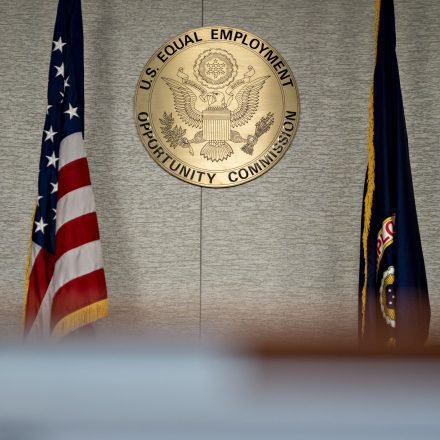
The Equal Employment Opportunity Commission, a key achievement of the Civil Rights Act of 1965 and the federal agency tasked with protecting American workers from employment discrimination, sued the New York Times on behalf of a white man claiming the company discriminated against him based on his race and sex.
North was suspended as a college student over a rape allegation in a case that he claimed violated his civil rights; he has consistently denied the charges. North went on to do work arguing that Title IX, which prohibits gender discrimination at federally funded institutions, has been used to discriminate against the rights of men.
North’s signature on the new lawsuit against the New York Times could mean he wrote it, said Chai Feldblum, a former EEOC chair.
Asked about North’s role, EEOC spokesperson Victor Chen referred The Intercept to the complaint.
The suit comes as part of President Donald Trump’s campaign against diversity, equity, and inclusion policies across the country, including his administration’s efforts to use the EEOC to these ends.
The new EEOC suit, filed Tuesday on behalf of an unnamed man whose identity New York Magazine speculated about, alleges that the employee was passed over for a position because he is a white man.
The claimant applied for a job as a deputy real estate editor in January 2025 but, the lawsuit claims, despite meeting all the requirements for the position, he didn’t get it because he “did not match the race and/or sex characteristics NYT sought to increase in its leadership.” Instead, the job went to a multiracial female candidate who the lawsuit alleges was not qualified.
“There is no actual evidence that he was more qualified than her.”
Feldblum, the former EEOC chair, was skeptical of the agency’s legal argument.
“There is no actual evidence that he was more qualified than her,” Feldblum said. Of the EEOC, she said, “They’re putting out their best facts in this complaint, and the facts are pathetic.”
Particularly for leadership positions, she pointed out, there are many aspects that go into deciding who is the most qualified candidate.
“Their assertion that she was less qualified than him is based on their view of the facts,” she said. “We’ll see what the facts actually say.”
In a statement, the New York Times said it has merit-based employment practices.
“The New York Times categorically rejects the politically motivated allegations brought by the Trump administration’s EEOC,” said Times spokesperson Danielle Rhoades Ha. “Throughout this process, the EEOC deviated from standard practices in highly unusual ways. The allegation centers on a single personnel decision for one of over 100 deputy positions across the newsroom, yet the EEOC’s filing makes sweeping claims that ignore the facts to fit a predetermined narrative.”
Diversity Without Discrimination
The EEOC’s lawsuit claims that the company has “engaged in unlawful employment practices” since at least October 2024 through its diversity, equity, and inclusion policies. It cites the company’s self-published diversity goals, including a 2021 document setting a goal for increasing Black and Latino leadership by 50 percent within four years.
The Times was making “employment decisions on the basis of race and sex to achieve its desired demographic goals,” the lawsuit alleges. “A necessary consequence of NYT’s intent to increase the percentage of non-White leaders would be a decrease in the percentage of White leaders.”
The assertion that the company has engaged in illegal racial and sex discrimination and is making employment decisions solely on those bases “is simply not borne out by the evidence,” Feldblum argued. The EEOC would instead have to have found evidence that hiring decisions were made expressly and intentionally based on such characteristics.
Instead, the actions the New York Times took are “the most basic, acceptable, legal ways to try to increase diversity in a workplace,” Feldblum said. “There is literally nothing illegal in anything that the EEOC has detailed.”
The only place where the Times could have potentially run into legal trouble, she said, was when it was requiring diverse candidate pools for jobs. But if done carefully, she said, that can follow the law as well — for example, by expanding a pool of candidates without removing any qualified white or male ones.
“One can include diversity as an employer without discriminating against white people,” Feldblum said.
Kalpana Kotagal, the sole Democratic commissioner on the EEOC after Trump fired the others contra statute, said she voted against authorizing the lawsuit against the New York Times “because I disagree with the substance of the case and don’t believe it’s a good use of scarce agency resources.”
She added that “a commitment to diversity, equity, inclusion, and accessibility (DEIA), without more, is not evidence of discrimination.”
As a reporter at the Times told New York Magazine, “I’m sorry, there are plenty of white guys at the top of the New York Times. Not really something that’s holding you back.”
The complaint comes after EEOC Chair Andrea Lucas directly solicited complaints from white men alleging that they were discriminated against based on their race and/or sex. She has also instructed agency officials to focus on cases that are in line with her personal priorities, which include “rooting out unlawful DEI-motivated race and sex discrimination,” and cases claiming reverse racism have been “accelerated through the process,” the New York Times recently reported, even though staff are struggling to find complaints with merit.
Feldblum argued that the lawsuit is “quite an inappropriate use of EEOC resources.” The agency’s staffing is currently at its lowest level in decades, so any focus on a particular issue comes at the expense of others.
She said, “It is truly a sad day for anyone who cares about civil rights to see what the EEOC is spending its resources on today.”
Yeshiva University President Says Faith Must Have ‘a Seat at the Table’ as AI Takes Shape
Rabbi Dr. Ari Berman says “the good AI” must beat “the bad AI” as YU expands in technology, draws students and faculty from elite universities where they felt unsupported after October 7, and answers antisemitism with “pro-semitism”
Rabbi Dr. Ari Berman does not talk like a university president under siege. At a time when antisemitism is surging, elite campuses are under scrutiny, artificial intelligence is rewriting the terms of public life, and parents are increasingly unsure what kind of world their children are inheriting, Berman sounds less alarmed than resolved. Kind in demeanor and gentle in speech, Berman nevertheless gives the impression of someone unafraid to say what he thinks—a deep thinker who comes across as authentic, genuine, and real. He speaks about turbulence the way some leaders speak about opportunity—not because he underestimates the danger, but because he believes institutions with deep roots are uniquely equipped to meet it. “We were made for this moment,” he says.
We were made for this moment
That confidence is not naïveté. Berman, now nearly nine years into the presidency of Yeshiva University (YU), says plainly that he could not have predicted what was coming. “There is no way I could have anticipated a whole host of challenges that would come, including COVID,” he says, calling the pandemic “pretty much a curveball.” YU, primarily based in New York City, was “the first university in the Northeast to actually have a student who was diagnosed with COVID.” Then came October 7 and the shock waves that rippled across campus life in America. But if the crises were unanticipated, his response to them was not. “My approach to all of the changes and challenges of these past years,” he says, “is where can you find the opportunity?”
Berman is adamant that YU’s role in this era is not simply to shield Jewish students from hostility, though that matters. It is to offer a model of moral seriousness at a time when too many institutions, in his view, have lost the will to speak plainly. He is direct on the subject of anti-Israel rhetoric. “Anti-Zionism is definitely antisemitism,” he says. He insists the reasoning is straightforward: if Israel alone is denied the right to exist as a Jewish state while Muslim and Christian states are treated as ordinary facts of international life, “that is a double standard. It is discrimination. And by definition, that is antisemitism.” The lesson he wants students to absorb is equally clear: they must learn “to have the courage to call it out and to stand for what is true.”
Anti-Zionism is definitely antisemitism
At the same time, Berman is careful not to reduce campus life to political combat alone. When controversial political figures in New York entered the broader conversation, he says YU itself has not felt a direct institutional impact. “We haven’t felt the effects of Mayor Mamdani and hasn’t had any implications for YU,” he says. But that practical distinction does not soften his larger conviction that students need moral clarity and a firm vocabulary for naming discrimination when they see it.
That phrase—moral clarity—runs through much of Berman’s vision. After October 7, as universities around the country struggled or refused to respond, he moved to organize. “Absolutely. It was very important. And it’s still very important,” he says of the effort to bring presidents and academic leaders together. His position continues to try to hold multiple truths in view at once: “We stand with Israel, with the Palestinian people who suffer under Hamas’s cruel rule in Gaza, and all people of moral conscience.” The line matters because it rejects both terrorism and the flattening habits of campus discourse, where sympathy for civilians can become a pretext for erasing moral distinctions.
Out of that effort came an alliance that Berman describes with pride. “We created a coalition of universities united against terrorism,” he says, and “we had over 100 universities who signed up to join us.” The significance of the coalition is not merely numerical. It is symbolic. “Especially when there were some universities that were silent in the face of these atrocities, it was very important for the country to know that there are good universities too,” he says. “There are presidents who know how to speak with moral clarity.”
The upheaval on campuses has also reshaped where students are choosing to study. Berman says that after October 7, YU saw “a sharp increase in transfer students.” Over time, he adds, there has been “a significant increase in the percentage of students from our feeder schools who would otherwise have gone to these elite universities” but are now choosing YU instead. He is careful to note that the University’s growth did not begin with the current crisis; he says students had already begun recognizing “the excellence of our education.” Still, he offers one figure that captures the shift: early decision applicants are up “over 70% over the past two years.” Those are, he says, “the top students who would otherwise have applied early decision to Ivy League universities.”
What is changing at YU, however, is not simply a matter of student recruitment. Berman describes a broader realignment that includes faculty as well. In fields central to the technological future, he says, professors are increasingly coming to YU after feeling exposed or unsupported elsewhere.
“It’s a story that’s not yet being told,” he says, “which is not just students who want to leave those universities and come to YU, but the faculty.” He ticks through examples: “the former chair of math at Rutgers left Rutgers,” a former chair of electrical engineering at Cooper Union is joining Yeshiva, and “we have a professor from MIT who left MIT in computer science to come to Yeshiva.” The reason, he says, is that after October 7, many discovered that “their peers at best were indifferent to who they are.”
This helps explain why Berman speaks about engineering, robotics, and artificial intelligence with such urgency. YU, he says, “just opened up an engineering track,” backed by a major donation, and is expanding aggressively into the disciplines shaping the next century. “We’re becoming experts in it,” he says of AI. He points to new faculty in math and computer science, and says YU is “at the forefront of research in AI, including in tech health fields.” For Berman, the point is not simply to keep up but to help define the field. “Being at the cutting edge of knowledge is essential,” he says.
Yet Berman does not regard artificial intelligence as merely a technical frontier. For him, it is a moral one. Students must learn to use AI “positively and ethically with values,” he says, and universities cannot afford to treat such questions as peripheral. “AI itself is obviously morally neutral,” he says. “The question is how it’s deployed, and what are the policies, and what are the innovations that we’re going to afford.” That formulation matters because it places responsibility not on the tool itself but on the people who build, regulate, and normalize it.
He is especially concerned with the role AI now plays in misinformation and social distortion. “This is going to be the key issue of the age,” he says, describing the challenge as learning “how to both separate out what’s fake and what’s real, and to be inside the conversation as AI is being formed, so that we do not actually meet a dystopian future, but one that has our values.” YU recently hosted a “hack the hate” event, he notes, that brought together innovators and policy figures, including “the chief policymaker at Meta,” to explore how AI can identify falsehood. “The good AI,” he says, must learn to beat “the bad AI.”
Still, Berman’s questions about AI reach far beyond detection tools and policy frameworks. He speaks of the subject in almost civilizational terms, which is why he has moved to place YU in global conversations about ethics and technology. About a year and a half ago, he traveled to Hiroshima “to sign on to the Rome Call of AI and Ethics.” There, he found himself in a room with faith leaders not only from monotheistic traditions but from Hindu, Sikh, Buddhist, and Shinto communities as well. What stays with him from that gathering is a scene both humorous and revealing. A Shinto priest told him that “there’s a spirit inside of everything,” including AI. Berman turned to a Buddhist monk seated nearby and asked, “Is there a Buddha in AI?” The monk answered, “Rabbi, that’s why I’m here to find out.” When Berman followed up later—had he found the answer?—the monk replied, “I need two more conferences.”
Global faith, political and industry leaders meet at the AI Ethics for Peace Conference, Hiroshima, Japan, July 2024. (IBM)
The anecdote lightens the mood, but Berman’s conclusion is serious. “You have to be in the leadership,” he says. “You have to have a seat at the table in terms of how it’s unfolding right now.” YU is now part of “a consortium of other faith-based universities right now with BYU and Notre Dame” focused on how faith is represented in AI. He sees that work as indispensable. “We don’t know where the world is going,” he says, “but YU has a seat at the table to help bring the Jewish values and the thousands of year tradition that we have in our Talmudic texts and our biblical texts to inform where the future is going to go with AI.”
For Berman, the same principle extends beyond technology into public truth itself. One of the central burdens of our times, he suggests, is not just that lies travel quickly, but that truth is often overshadowed by drama. “The truth will win out at the end,” he says. Then he sharpens the point with a line that feels almost like a creed: “one truth will spread the light that will shatter a thousand lies.”
But if truth is to prevail, it needs people willing to tell it. Berman does not believe truth is collapsing so much as being underreported. “I wouldn’t say it’s failing,” he says. “I think that what I see in the world is actually it’s spreading.” The problem, in his view, is that public attention is skewed toward hatred and conflict. “We are so intrigued by the anti,” he says, because hate and violence “always makes the news.” What is missed is what he calls “the common story,” namely, “the love and appreciation for Jews, for Israel.”
That hidden story, from his perspective, has been one of the most surprising and consequential elements of recent years. When he began organizing support after October 7, some of the first people he reached were leaders at faith-based universities. One Christian leader told him, “Ari, whatever you write, I’m going to sign. You don’t even have to show it to me. I’m with you.” Another, the president of a historically Black faith-based university, offered him a biblical image that Berman clearly treasures. “The Jews win when Moses holds his hands up,” she said, “but who is holding Moses’s hands up? It’s Aaron and Hur. Let us be your Aaron and Hur. You can lean on us.”
What these exchanges have revealed to him is not merely support in a difficult season, but the possibility of a larger coalition grounded in faith and mutual respect. “We have friends and allies in the United States and around the world,” he says. And those allies are not limited to Christians. Reflecting on the coalition, he says, “It’s not just Christians, we have Muslims and Hindus, like we have religions and people of faith all throughout the world who appreciate the Jewish tradition.” This, he argues, is the story too often left untold: “We’re so focused on antisemitism that we’re not doing the pro-semitism.”
That conviction has also shaped YU’s outreach to Christian communities eager to understand Judaism more deeply. Berman says he recognized a real search in the Christian world to understand Judaism from authentic Jewish voices and saw in that search an opening. “We should extend ourselves outward,” he says. The result has been “enormous interest” from students in the United States and abroad, including partnerships with “two Christian universities in South Korea.” YU is not only collaborating with them; “we actually have classes in Korean that we’re teaching Jewish texts in Korean.” Tying together language, technology, and theology, Berman asserts that “especially with AI, [we] have an opportunity to reach everyone in their own language and bring the world back to a time of fellowship.”
Korean delegation meets with faculty from the Revel Graduate School of Jewish Studies in a cross-cultural exchange. (Courtesy Yeshiva University)
He even sees evidence of this growing fascination with Jewish tradition in unexpected places. He notes he had “very strong positive conversations with Charlie Kirk,” whom he describes as one of the possible “harbingers” of a movement among some Christians toward Sabbath observance and a deeper engagement with Jewish ethics. Berman recalls Kirk wanting to visit YU and speaking admiringly of the university. Kirk, known for saying college is a scam, once began talking that way to one of Berman’s sons before realizing whose son he was addressing. He quickly amended his position by saying, “College is a scam except Yeshiva.” Beyond the joke, Berman says, Kirk “believed so deeply in the Jewish tradition as a basis of ethics and morality and as a means to inform the entire conversation, certainly in the United States.”
The through-line in all of this is Berman’s conviction that tradition is not a brake on modernity but a source of strength within it. He says YU’s philosophy, since its founding, has been to be “deeply rooted and forward-focused.” He sees modern instability not as proof that the old foundations have failed, but as proof of how badly those foundations are needed. “The fact that we are built on 3,000 years of tradition gives us a stability,” he says, and allows the university “to be nourished by the past generations, as opposed to being cut off from them.”
He reaches for an old rabbinic image to explain the point: “a tree without roots easily breaks in torrential winds. But a tree with roots can withstand times of great turmoil and instability.” The lesson, as he applies it to YU, is twofold. “The first step is to be deeply rooted,” he says. “But the second step is to be forward-focused.” That means “not to shy away from the technological changes and innovations, but to lean in.” For Berman, this is not a balancing act between two competing loyalties. It is a single philosophy: “rather than seeing tradition as conflicting with innovation, to see it as forming the basis that allows you to lead positive, progressive, and flourishing lives.”
This has implications not just for college students, but for younger children and the parents trying to raise them in a digitally saturated age. “Parents today are worried, and rightfully so,” Berman says. “We’ve never seen children who’ve had such exposure to what these kids have,” and they are being raised “digitally native” in an environment that can intensify “mental health and anxiety.” He says he shares those concerns, and he invokes a conversation with Jonathan Haidt to explain why he believes the answer is not simply technological regulation or educational reform. “The answer actually is rooted in tradition.”
Berman recounts Haidt’s metaphor of a world filled with toxins, in which some cities are protected by a bubble that allows families to flourish. “Those bubbles are tradition and faith,” he says. Communities with a moral center are able “to navigate and sort of filter out the bad toxins to allow the good things to come in.” Without that rootedness, modern life becomes “truly a dangerous world.” With it, students can move confidently into contemporary professions, from computer science to other cutting-edge fields, because “they’re not hiding from progress,” but are “rooted in who they are.”
If Berman’s vision sounds expansive, it is because he is already looking beyond the present moment. He mentions speaking in Dubai on Holocaust Memorial Day, being “the first as an American and Israeli to speak at the [US presidential] inauguration,” and participating in faith events more broadly, each appearance part of a wider effort to place Jewish ideas into global conversations. He is guarded about specifics but clearly energized by what he sees coming next. “We have actually a lot planned,” he says.
Rabbi Dr. Ari Berman (C), president of Yeshiva University, delivers a benediction as US President Donald Trump (L) and former US President Joe Biden (L) listen during President Trump’s inauguration ceremony in the rotunda of the Capitol in Washington, DC, USA, Jan. 20, 2025. (Shawn Thew/Pool via Reuters)
Some of those plans, he suggests, are tied to a changing geopolitical landscape. “After the Abraham Accords, we had a lot of possibilities that were a little held back after October 7, but now we’re able to lean in on,” he says. He expects “a lot of Jewish connection with countries throughout the world that otherwise, in the past, would have been very reluctant to partner with the flagship Jewish university.” He also sees YU moving further into research, not simply consuming existing knowledge but producing it. “As we grow in excellence in research, as we continue to not just study knowledge, but create knowledge, we’re finding incredible partnerships that will help society flourish deeply.”
That word—flourish—comes up often with Berman. It signals the difference between mere survival and something fuller, more ambitious. He is not only trying to protect a university or defend a community, but to argue for a larger model of human development: rooted, ethical, technologically literate, intellectually serious, and open to partnership. In a public culture that often treats faith as either private comfort or political identity, Berman is making a different case—that religious tradition, seriously lived, can be a source of institutional confidence, cultural clarity, and civic repair.
The future of Yeshiva is bright
“The future of Yeshiva is bright,” he says. It is the sort of line many university presidents might offer. But for Berman, it carries a broader aspiration. YU is not simply trying to navigate an age of fracture. It is trying to show that ancient commitments and future-facing ambition need not cancel each other out. If anything, he suggests, each may be impossible without the other. “We’re looking to build a better world for all.”
Operation Epic Fury is over. Or at least, that’s what the US secretary of state, Marco Rubio, announced on May 5, describing any further US action in the Gulf as purely “defensive”.
Rubio’s insistence that the conflict the US and Israel launched on February 28 achieved its objectives is open for debate. But this change of tone and terminology is likely to reflect arguments that raged in the US Congress as the war approached the two-month mark at the end of April, about whether the Trump administration must seek congressional approval for the conflict as required by US law.
The conflict has become the latest episode in a long struggle between the US Congress and the presidency over which branch of government can legitimately start wars. And, in a surprising way, Donald Trump’s actions seem to be pushing power back towards Congress.
The US constitution splits war powers between the presidency and Congress. It gives Congress the power to raise armies and declare war but makes the president the commander-in-chief of the military. That means that, in theory, you need to get Congress to agree to fund and start a war and the president to agree to wage it.
Since the second world war, this system has been changing. The last time the US formally declared war was in 1942 against Bulgaria, Hungary and Romania – having already declared war on Japan and Germany in December 1941. Since then, presidents have often plunged the country into hostilities on their own authority without getting a declaration of war from Congress.
Congress still needs to fund the military – but, with very few exceptions, the legislature has always done so. Individual members of Congress have generally been happy to let presidents take on the blame for starting wars. After conflicts have started, legislators have been unwilling to cut off funds for the troops in the field. As a result, Congress has given up much of its influence over decisions of war and peace.
But not entirely. The high point of Congressional pushback was in 1973, during the tail end of the Vietnam war, which by then had become extremely unpopular. In this context, Congress challenged the executive branch by passing the 1973 War Powers Resolution (also known as the War Powers Act). It’s this law that is shaping the debate over Iran today.
The War Powers Resolution basically repeats what the constitution says: that Congress has to start wars, but it allows for some flexibility. If there is a surprise attack on US forces, the president can act to repel that attack for 60 days before getting a declaration of war from Congress.
As reasonable as this may sound, every administration since the War Powers Resolution was passed has questioned its constitutionality and refused to be bound by it.
To be sure, some presidents have asked Congress for a statement of political support before launching a major war, as they also had done before the War Powers Resolution was passed. For instance, George H.W. Bush did so before the Gulf war of 1990-91. But when doing so, presidents have generally maintained that they did so purely to ensure national unity, and not because the War Powers Resolution required it of them.
Presidents have also launched many interventions in which they ignored the resolution entirely – as Bush himself did in Panama in 1989.
Unpopular war
As a result, the resolution has never acted as a meaningful constraint on presidential war-making power. But things may be changing. The war in Iran is so unpopular that Congress asserting its authority over war powers more strongly than any time since the War Powers Resolution was passed. In the process, it is turning the resolution into something that might meaningfully affect the course of the war.
A significant majority of Americans oppose the war in Iran.EPA/Olga Fedorova
One reason for this is that even Trump’s Republican supporters in Congress are aware of how unpopular this war is. Many are worried about losing their seats in the midterms later this year. As a result, Congress is stirring. Even senior Republican figures are treating the War Powers Resolution and its 60-day clock as an important constraint on the administration and demanding that the war stop or be authorised by Congress after it passes that mark.
In response to this political pressure, the Trump administration seems to be paying more attention to the requirements of the War Powers Resolution than most administrations before it.
The White House is too afraid of Republican opposition to ignore the resolution entirely, particularly when it knows that it may soon have to ask Congress for more funding for the war. Even the argument it made that the 60-day clock has paused during the ceasefire is an indication that it sees the clock as a legitimate thing in the first place.
If the war starts up again, Republicans will clamour for the administration to come to Congress for a declaration. This would probably trigger a major debate over the conditions that Congress wants to attach regarding strategy, goals and funding.
What this shows is that many of the checks and balances of the constitution only work when there is the political will to make them work.
Court strikes down FCC anti-discrimination rule opposed by Internet providers
An appeals court today struck down federal rules that prohibit discrimination in access to broadband services, delivering a victory to telecom and cable lobby groups. The court ruling was welcomed by Federal Communications Commission Chairman Brendan Carr, who voted against the Biden-era rules when they were approved in 2023.
The FCC exceeded its legal authority by imposing liability for actions that result in “disparate impact,” instead of merely policing “disparate treatment,” said a ruling by from the US Court of Appeals for the 8th Circuit. The FCC also exceeded its authority by applying the rules to entities that don’t directly offer Internet service to subscribers, according to the ruling issued unanimously by three judges appointed by Republican presidents.
“Today’s appellate court decision is another common-sense win for nondiscrimination,” Carr said today. Carr claimed the rules “would have required broadband providers and many other businesses to discriminate against people based on their race, gender, or other protected characteristics,” but did not explain how the rules would have required discrimination. Carr also compared the rules to diversity, equity, and inclusion (DEI) policies that he has called discriminatory.
John Bergmayer, legal director of advocacy group Public Knowledge, criticized the court decision. “The practical effect is to eliminate a rule that addresses a documented problem,” he said. “Lower-income neighborhoods and communities of color get slower service, older equipment, and higher prices for the same product their richer neighbors buy. After today, the FCC can act only when it proves a smoking-gun case of conscious bias, which almost never exists in writing.”
Rule enabled discrimination complaints
As we’ve previously written, the FCC rules let consumers file complaints about alleged discrimination and define the elements the FCC would examine when investigating whether an entity should be punished for discrimination. The Biden-era order said that “all penalties and remedies will be available when we determine that our rules have been violated.”
The FCC defined discrimination in broadband access as “policies or practices, not justified by genuine issues of technical or economic feasibility, that differentially impact consumers’ access to broadband Internet access service based on their income level, race, ethnicity, color, religion, or national origin or are intended to have such differential impact.”
The rules applied to broadband providers and other entities, such as landlords that restrict broadband options in a building even when multiple providers are available. “Conduct by entities other than broadband providers might impede equal access to broadband Internet access service on the bases specified in the statute,” the FCC said in its rules.
The FCC discrimination rules were challenged in six federal appeals courts by various telecom and cable industry groups, and the case was assigned randomly to the 8th Circuit. Challengers included cable lobby group NCTA, wireless lobby CTIA, and USTelecom, all of which represent ISPs throughout the US. The rules were also challenged by state-level lobby groups representing ISPs in Minnesota, Missouri, Ohio, Florida, Alabama, Mississippi, and Texas.
Other court challengers include groups representing rental housing providers and contractors that help ISPs build broadband networks. Congressional Republicans separately launched a legislative effort to nullify the rules in 2024, but it was never put to a vote.
Rule covered “unintentional discrimination”
8th Circuit judges said the FCC rule covered “unintentional discrimination,” or disparate impact in which “an entity maintains a facially neutral policy or practice or acts for a non-discriminatory reason, yet still disproportionally affects a protected group,” the court said.
Judges found that “Congress did not authorize disparate impact liability” in the Infrastructure Investment and Jobs Act, the US law that authorized the FCC to impose digital discrimination rules. The law “directs the FCC to adopt final rules ‘preventing digital discrimination of access based on income level, race, ethnicity, color, religion, or national origin,’” the appeals court said, adding that “the Supreme Court has repeatedly stated that the ‘normal definition’ of discrimination is ‘differential treatment.’”
The court also ruled against the FCC’s attempt to regulate entities that aren’t broadband service providers. In addition to ISPs, the FCC tried to apply its rules to “entities that provide services that facilitate and affect consumer access to broadband.”
“A non-exhaustive list of covered entities includes contractors retained by broadband providers, entities ‘facilitating or involved in’ providing broadband, and those ‘maintaining and upgrading network infrastructure,’” the court said. “The definition of covered entity ends with a catchall provision that includes ‘[e]ntities that otherwise affect consumer access to broadband Internet access service.’”
The text of the US law the rules are based on “refers to only two parties involved in the provision of broadband service: broadband providers and service subscribers,” the court said. Judges agreed with industry groups that “there is no textual basis for extending a statute focused on the subscriber-provider relationship to the acts and omissions of entities such as local governments and broadband infrastructure owners.”
Agency powers limited by Supreme Court
The court concluded that the FCC “exceeded its statutory authority in two respects that are the core of the final rule—disparate impact liability and the definition of covered entities. We therefore vacate the final rule in its entirety, leaving the FCC with an unfinished obligation to ‘adopt final rules to facilitate equal access to broadband Internet access service’ in compliance with 47 U.S.C. § 1754.”
Industry groups challenged other aspects of the rules, such as “a burden-shifting framework for adjudicating disparate impact claims,” the court said. Judges did not issue conclusions on these other complaints, but said that any new attempt to impose FCC discrimination rules would be judged against a 2024 Supreme Court ruling that limited federal agencies’ authority to interpret ambiguous laws.
Bergmayer said the 8th Circuit judges “got the statute wrong. Congress told the FCC to prevent digital discrimination. The structure of the statute makes it clear that Congress intended to address the effects of longstanding discriminatory practices—not simply to provide recourse when there is clear evidence of intentional unlawful discrimination.”
MEPs back wider EU vehicle checks, reject shorter inspection intervals
EU lawmakers have backed plans to broaden where and how vehicles are tested for roadworthiness across the bloc, while pushing back against proposals to increase the frequency of mandatory inspections.
Transport and Tourism Committee MEPs adopted their negotiating position on revisions to EU rules governing periodic technical checks and roadside inspections on Tuesday, by 30 votes to 11 with two abstentions.
At the centre of the draft is a push to make life easier for drivers moving across borders, while tightening certain safety and emissions controls.
MEPs agreed that vehicle owners should be able to carry out inspections in any EU country, not just where a car is registered. That would result in a temporary EU-wide roadworthiness certificate valid for six months, with the next full inspection still required in the country of registration. Lawmakers also want this flexibility extended to vans.
However, MEPs rejected the European Commission’s proposal to require annual inspections for cars and vans over ten years old, arguing there was insufficient evidence that shorter intervals would improve road safety. They stressed that member states already retain the option to impose stricter national rules if needed.
On safety standards, lawmakers backed updating inspection requirements to include modern driver assistance systems such as automatic braking and airbags, alongside new checks for electric and hybrid vehicle components.
They also supported voluntary inclusion of emissions testing for pollutants such as nitrogen oxides and particle numbers, leaving implementation decisions to national authorities.
To tackle fraud in the second-hand market, MEPs endorsed stronger rules on odometer recording, including obligations for garages to log mileage during repairs and for manufacturers to store data from connected vehicles in national databases, with exemptions for shorter repair jobs.
The draft also moves to make periodic inspections mandatory for all heavy motorcycles and extend checks to electrically powered models.
On enforcement, MEPs propose shifting roadside inspection targets from EU-level quotas to national responsibility, while expanding checks to vans and introducing broader emissions and noise screening for all vehicle types, including cars and trucks. Vehicles flagged as high emitters could be subject to further mandatory inspections.
The Parliament will now enter negotiations with member states on the final legislation.
Victory in Iran is nothing short of finishing it off
In the part of the world that includes Iran, if you have to explain that you won you have in fact lost.
President Trump’s announcement that he is pausing, after a day, Project Freedom, which had the US Navy escorting cargo ships through the Straits of Hormuz, is puzzling. As are his statements that a deal with the Iranian regime to end the war is within reach.
Keep in mind that focusing too closely on Trump’s zigs-and-zags can be disorienting. Only he knows what he intends to do and how he will get there. And he has access to all the intelligence. We in the commentariat do not.
One hopes the president has a plan for finishing business in Iran in a way that leaves no room for doubt – and that needs no explanation.
However, I’ve got the same feeling as in 1991 when President George HW Bush was ending the first Iraq War 72 hours too soon – and giving Saddam Hussein a new lease on life.
And it was the same feeling in 2001 when President George W. Bush let Osama bin Laden out of Tora Bora instead of killing him.
And there was the time in the mid-1990s when the US government had a chance to finish North Korea’s Kim Family regime along with its quest for nuclear weapons. But President Clinton declined to do so – with an assist from Jimmy Carter, a former president who declared Kim Il Sung “a good man we can do business with.”
And more recently and more Trump-related, recall the time during the first Trump administration when Chinese telecom (AKA spy) companies Huawei and ZTE were on the ropes (actually, they were on the mat) and Trump let them up.
And Tik Tok – the 24/7 Chinese intelligence collection and influence app? The Trump team declined to close it down in the US.
American leaders seem to have forgotten how to defeat our adversaries – rather than just changing the definition of winning.
As for letting Pakistan mediate a deal with the Iranians? The Pakistanis have long been in China’s pocket. They take orders from Beijing.
This resembles team Biden having the Russians mediate between the United States and Iran.
It’s good to have at least some vague idea of who your friends and enemies are.
The Pakistanis are not our friends, as evidenced by their double-dealing during our entire campaign in Afghanistan – and hosting bin Laden himself for a decade after his escape from Afghanistan.
Islamabad has also been conducting a terrorist campaign against India for years that would give Iran’s Revolutionary Guard Quds Force a run for its money.
Are these really the people to trust to negotiate a deal with Iran?
The president, as noted, sees the intelligence. Perhaps there are good reasons for halting Project Freedom.
Maybe we are out of interceptor missiles and we fear Iran launching missiles at the Gulf nations’ (GCC’s) desalination plants?
Maybe the UAE intervened and asked that Trump hold back due to the attacks on their oil installations?
As is the case with all commentators, we don’t know the US military’s inventory situation or the latest intelligence on the Iranians.
But one can’t understand Secretary of War Hegseth and Joint Chiefs of Staff Chairman General Cain talking yesterday about a Red, White and Blue Dome over the Strait of Hormuz – and then, less than 12 hours later, pulling it off the table.
Maybe the President thinks he’s found “moderate” Iranians with whom he can cut a good deal.
Doesn’t nearly a half century of dealing with Iran teach any lessons?
The only moderate Iranians live in Los Angeles. The regime in Tehran is the same one that just murdered 40,000 of its own people.
Windows only stay open for a while and this one might be shutting. Indeed, we might be shutting it.
Even if a deal is reached, it’s likely that the regime will eventually break any promises it makes. It will rebuild and rearm and keep driving for nuclear weapons. It will resuscitate its regional proxies. And it will eliminate all domestic opposition – the same people Trump offered assurances that “help is on the way.”
As for the ripple effects? Xi Jinping had been backfooted by the impressive US military performance – and repeated demonstrations of national will – in Venezuela and the Iran war to date. Now, however, Xi will no longer have much fear of the United States.
He will know he just needs to dig in, maybe absorb some discomfort and wait out the Americans.
And America’s friends who expected Washington to see things through to the end, and take on the local bully, will be more than a little worried.
We should know soon enough if we’ve won or lost in Iran. And if the administration has to explain that it won, –well, you know the answer to that one.
You are here: Home/All RECIPES/ Cheesy Chicken Crescent Bake – Creamy, Cozy & Irresistible
If you’re looking for the ultimate comfort food, this Cheesy Chicken Crescent Bake is exactly what you need. Picture this: tender, juicy chicken wrapped in buttery crescent rolls, baked in a rich, creamy sauce, and topped with melted golden cheese. It’s warm, satisfying, and incredibly easy to make.
Whether it’s a busy weeknight, a cozy weekend dinner, or a potluck with friends, this dish always steals the spotlight—and disappears fast!
Why You’ll Love This Recipe
Quick and easy – minimal prep with simple ingredients
Creamy and cheesy – pure comfort in every bite
Family-friendly – loved by both kids and adults
Perfect for leftovers – great way to use rotisserie chicken
Make-ahead friendly – ideal for busy schedules
Ingredients You’ll Need
2 cups cooked chicken (shredded or chopped)
1 tube refrigerated crescent rolls (8-count)
1 can (10.5 oz) cream of chicken soup
1/2 cup milk
1 cup shredded cheddar cheese (divided)
1/2 teaspoon garlic powder
1/2 teaspoon onion powder
1/4 teaspoon black pepper
Optional: chopped parsley for garnish
How to Make Cheesy Chicken Crescent Bake
Step 1: Preheat & Prepare
Preheat your oven to 375°F (190°C) and lightly grease a 9×13-inch baking dish.
Step 2: Fill the Crescents
Unroll the crescent dough and separate into triangles. Add a spoonful of chicken and a sprinkle of cheese to the wide end of each triangle. Roll them up tightly and place seam-side down in the baking dish.
Step 3: Make the Creamy Sauce
In a bowl, whisk together the cream of chicken soup, milk, garlic powder, onion powder, and black pepper until smooth.
Pour the sauce evenly over the crescents.
Step 4: Add the Cheese
Sprinkle the remaining shredded cheese over the top for that melty, golden finish.
Step 5: Bake
Bake for 25–30 minutes, or until the crescents are golden brown and the sauce is bubbling.
Let rest for about 5 minutes before serving so the sauce thickens slightly.
Serving Suggestions
This dish is hearty on its own, but pairs beautifully with:
A fresh green salad with vinaigrette
Roasted vegetables like broccoli or carrots
A warm bowl of tomato soup
A drizzle of hot sauce or sriracha for extra kick
Easy Variations
Swap the protein: use turkey, ham, or sausage
Add veggies: spinach, mushrooms, or bell peppers
Make it spicy: add chili flakes or diced green chilies
Change the cheese: try mozzarella or pepper jack
Make-Ahead & Storage Tips
Assemble ahead and refrigerate for a few hours before baking
Store leftovers in the fridge for up to 3 days
Reheat in the oven or microwave until warmed through
Freezing is possible, but crescents may soften slightly
FAQs
Can I use homemade chicken? Yes! Any cooked chicken works—just season it well.
What if I don’t have cream of chicken soup? You can substitute cream of mushroom, cream of celery, or make a quick homemade version.
Can I freeze it? Yes, but for best texture, enjoy fresh or within a few days.
Final Thoughts
This Cheesy Chicken Crescent Bake is everything comfort food should be—warm, creamy, cheesy, and incredibly satisfying. It’s the kind of recipe that brings everyone to the table and keeps them coming back for more.