Journalists covering Gaza, Lebanon, Sudan, Iran, and beyond face rising threats, restricted access, and growing uncertainty over whether press credentials still offer protection
For Katrine Dige Houmøller, a Danish freelance journalist based in Lebanon, the crisis facing war reporters can be measured in one piece of equipment: the press vest.
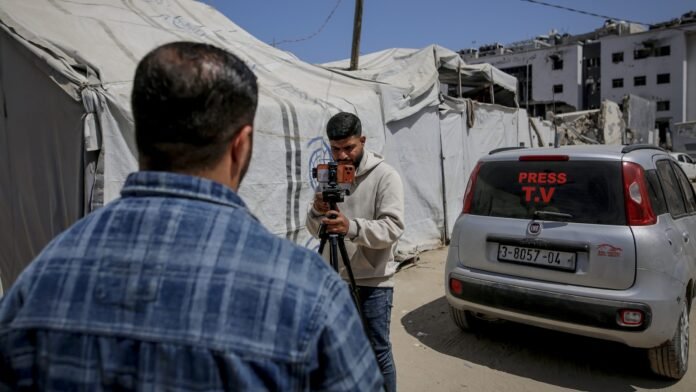
I no longer necessarily feel protected by my press vest or the word ‘press’ painted across the roof of the car. If anything, I sometimes wonder whether it makes me easier to identify, and therefore a clearer target.
“I no longer necessarily feel protected by my press vest or the word ‘press’ painted across the roof of the car. If anything, I sometimes wonder whether it makes me easier to identify, and therefore a clearer target. That concern is grounded in a growing pattern, where more and more journalists have been directly targeted,” she told The Media Line.
Her account came as World Press Freedom Day, marked on May 3, cast renewed attention on the dangers facing journalists in conflict zones and on the shrinking space for independent reporting across the Middle East and beyond.
Houmøller’s experience in southern Lebanon illustrates how access to conflict zones is increasingly negotiated, uncertain, and never fully secure.
“We passed our details [to the Israel Defense Forces (IDF)] through UNIFIL, and the reply came back saying that ‘the IDF cannot deconflict this activity in light of the operational situation.’ The IDF simply could not guarantee our safety while we were working as journalists in the area,” she said.
“Moreover, access depends on coordination always—with the Lebanese army, General Security, Hezbollah, local authorities,” she added.
Receiving permission from the authorities does not necessarily translate into access, since the situation can change from one moment to the next.
The environment itself, she said, is defined by surveillance and unpredictability.
“In the village of Dibbine, an Israeli drone constantly hovered above us. It tracked our movements close enough that it felt almost within reach; it monitored every single step we took,” she said.
But Danny Seaman, a radio host, commentator, and former director of Israel’s Government Press Office, challenged the idea that Israeli restrictions on journalists in conflict zones such as southern Lebanon and Gaza should automatically be understood as attacks on media freedom. He framed them instead as security measures shaped by the conduct of armed groups.
“The problem is that they [journalists] are sometimes placed in those situations deliberately by terrorist organizations like Hezbollah and Hamas, to create further pressure on Israel. That is also why foreign journalists were not allowed into Gaza in the first place, because we knew they could be put in danger, since this has been a common pattern,” Seaman told The Media Line.
Houmøller said that in active conflict zones, journalism often becomes inseparable from risk assessment.
For example, while covering the war in and around the city of Nabatieh, in southern Lebanon, under heavy bombardment, “conversations among journalists shifted from reporting to exit strategies. Some suggested returning to Beirut, but the roads were considered too dangerous. It was a calculated risk—one of many that define the job,” she said.
“The work is not only about what you see, but what you hear, the direction of fighter jets, the distance of incoming strikes, whether explosions are moving closer or further away. Being a journalist inside a designated zone [an area under Israeli evacuation orders] offers no certainty. Your building can still be hit,” she added.
The conditions of freelance work add another layer of vulnerability, Houmøller said, as international outlets increasingly rely on journalists who carry the logistical, financial, and physical risks themselves.
“Working as a freelancer means carrying the entire process alone. Each step comes with a cost, and none of it is guaranteed to pay off. It is not unusual to invest in a driver and a fixer only to find that no outlet is willing to publish the story,” she said.
“Hiring a fixer in Lebanon typically costs between $200 and $350 per day. … In many cases, that is equal to, or more than, the fee paid by a media outlet,” she added.
For Martin Roux, who is in charge of the crisis desk at Reporters Without Borders (Reporters sans frontières or RSF), Houmøller’s experience reflects a broader pattern: Governments and armed actors are increasingly seeking to manage wars by limiting who can witness them.
“There is an attempt … from different parties in wars to prevent journalists from accessing the ground, from reporting in conflict areas. This is something that we saw orchestrated by the Israeli army in a very blatant way in the Gaza Strip, where the Palestinian journalists were targeted. And at the same time, the foreign press was prevented from reporting independently,” Roux told The Media Line.
Seaman disputed the allegation that journalists are being deliberately targeted by Israel, arguing that the danger comes when armed groups exploit journalistic cover.
Journalists are not a target. But when people use journalism as cover, when terrorist groups take advantage of that, and when you start seeing a pattern of individuals who are not upholding professional standards but are using the title of press as protection, then it becomes a different issue.
“Journalists are not a target. But when people use journalism as cover, when terrorist groups take advantage of that, and when you start seeing a pattern of individuals who are not upholding professional standards but are using the title of press as protection, then it becomes a different issue. I am referring to members of Hamas,” he said.
Roux said the trend extends beyond Gaza and has become a defining feature of modern war coverage.
We saw this general trend of trying to organize wars without witnesses, without professional witnesses
“We saw this general trend of trying to organize wars without witnesses, without professional witnesses. … We noticed in the war [between] Iran on one side and Israel and the US on the other, that all the parties in this war were using [the excuse of] national security to prevent reporters from doing their job,” he said.
He pointed to Sudan as another example of access collapsing under the pressure of war.
“What we saw is almost an information blackout in certain areas. For instance, if we take the siege of al-Fasher in north Darfur, very, very few reporters were still reporting from inside the siege. … One of them … was later on arrested. … The targeting of reporters has really increased this trend of information blackout in conflict areas,” Roux said.
Foreign journalists have largely been unable to independently access Gaza since the start of the war, leaving coverage dependent on Palestinian journalists inside the Strip and on secondary verification from outside. For media watchdogs, this has created a sharp imbalance: local journalists face the highest risk, while outside reporters are prevented from witnessing the war directly.
Seaman argued that the reliance on local access networks in Gaza and Lebanon creates its own journalistic problem.
“I do not have much respect for the foreign press, because they are more politically motivated than focused on doing their job. I saw how they collaborate, both politically and physically, with actors on the ground because they cannot work otherwise. They know they are not free in places like Gaza or Lebanon, and they have to work with people connected to those in control, but they do not tell their audiences this, because they would lose access,” he said.
The debate over Israel, Gaza, and Lebanon is part of a larger global deterioration documented by press freedom organizations. The latest findings from RSF place media freedom at its lowest point in 25 years. According to the 2026 World Press Freedom Index, more than half of the 180 countries assessed now fall into the categories of “difficult” or “very serious” for press freedom, while less than 1% of the global population lives in a country considered to have a “good” media environment.
RSF reported that press freedom declined in roughly 100 countries over the past year, reflecting what it described as a systemic global downturn driven by legal pressure, political hostility, and the economic fragility of media systems. The decline is not limited to authoritarian states or war zones. It is also visible in democratic systems, where political polarization, attacks on media credibility, and economic pressure on newsrooms have weakened the conditions needed for independent reporting.
The regional picture is especially severe. The Middle East and North Africa remain the most dangerous region in the world for journalists. In the 2026 index, Qatar is the highest-ranked country in the region, at 75 out of 180 countries worldwide. Still, press freedom is categorized as “problematic” there. Lebanon ranks 115, Israel 116, Syria 141, the Palestinian territories 156, and Sudan 161. Iran is the region’s lowest-ranked country, at 177.
The Committee to Protect Journalists reported that Israel was responsible for the highest number of journalist deaths globally over the past year, marking one of the deadliest periods for media workers in a single country in recent history. The figures reflect the scale and intensity of the war in Gaza, where most of those killed were Palestinian journalists operating inside the Strip, often without the possibility of evacuation or external protection.
The International Federation of Journalists also described the toll as severe.
“The IFJ recorded 128 journalists killed in the line of duty in 2025, and nine have already lost their lives this year—a number of them in war zones,” the organization told The Media Line.
“We are greatly concerned about armed conflicts in which being identified as ‘press’ has become a reason to be targeted, rather than protected. … In Ukraine, Palestine, Lebanon, and Sudan, for example, reporters are being arrested, killed, and sometimes forced into exile because of their work,” it added.
Beyond the battlefield, Anat Saragusti, who is in charge of press freedom at the Union of Journalists in Israel, said pressure on independent journalism inside Israel has taken a more political and institutional form.
“Since this government took office in late 2022, it drafted a master plan to weaken the free press in the country. It’s like a playbook of populist governments in different countries … and it plays out in different dimensions,” she told The Media Line.
“There is a very intensive legislation process targeting the public broadcaster, the commercial television … and giving benefits to the only media channel that completely aligns with the government. … There is also an attempt to create a political takeover and take control of regulatory bodies,” she added.
Seaman rejected the argument that Israeli journalists are meaningfully restricted, saying that criticism of the government remains widespread and that disputes over state funding or regulation should not be conflated with censorship.
“[Reporters] roam around freely and do whatever they want. The fact that the Israeli government does not want to fund certain outlets does not limit press freedom. Nobody is stopping them from working. They can be as critical as they want,” he said.
Saragusti linked the institutional pressure to a broader climate of public delegitimization.
“The prime minister is doing everything he can to break the trust in the media. … He called the TV channels ‘poisoning channels,’ ‘panicking channels,’ and ‘Al Jazeera channels’ to indicate that they are engaged in treason. There is an intensive smear campaign on social media against journalists. … They are threatened, cursed, intimidated … especially those who cover his trial,” she said.
She said the result is not only formal pressure but also self-censorship inside newsrooms.
“The whole package is targeting the mainstream media … and it creates an atmosphere and climate of intimidation and terror. So I guess that the journalists are adopting a mechanism of self-censorship. … The fact that the Israeli media in Hebrew hardly covered the humanitarian crisis in Gaza is because they were intimidated and they didn’t want to be framed as … Hamas supporters,” she said.
Her concerns extended to foreign journalists working in Israel.
“Foreign journalists find it very difficult to work in the country because the officials are really hostile toward them. … They are dependent on them to get accreditation. … It’s intimidating, and it’s a deterrence against international press,” she said.
Seaman said that limitations on sensitive information in a security environment should be understood as operational safeguards, not restrictions on journalism. He also argued that journalists today have more room to operate than they did in the past, even when they face constraints in active war zones.
The debate reflects two sharply different interpretations of the same environment. For press freedom advocates, access restrictions, political hostility, and journalist deaths point to a worsening crisis. For Seaman, many of those claims ignore the ways armed groups exploit media infrastructure, press credentials, and foreign journalists’ dependence on local power brokers.
For RSF, however, the broader conclusion is systemic.
“The situation hasn’t been as difficult as it was for the past 25 years … but because of these challenges, it shows that the work of journalists is needed more than ever … even in a context that has been changing dramatically year after year,” Roux said.
World Press Freedom Day in 2026, therefore, arrived less as a celebration than as a warning: In too many war zones, the word “press” no longer guarantees access, safety, or even recognition as a civilian shield. Across Gaza, Lebanon, Sudan, Ukraine, Israel, and beyond, journalism is increasingly defined by the struggle to report from places where powerful actors would often prefer no witnesses at all.