14.4 C
London
Wednesday, June 10, 2026
Home Blog

Lebanese army death toll rises to 30 after soldier dies from wounds in Israeli strike

0
lebanese-army-death-toll-rises-to-30-after-soldier-dies-from-wounds-in-israeli-strike
Lebanese army death toll rises to 30 after soldier dies from wounds in Israeli strike

Relatives mourn during a funeral ceremony for Eli Nikola al-Huri, a Lebanese army captain who lost his life in an Israeli airstrike and was laid to rest in his hometown of Kafr Cera, east of Sidon, Lebanon, on June 8, 2026. [Mohammad Abushama - Anadolu Agency]

Relatives mourn during a funeral ceremony for Eli Nikola al-Huri, a Lebanese army captain who lost his life in an Israeli airstrike and was laid to rest in his hometown of Kafr Cera, east of Sidon, Lebanon, on June 8, 2026. [Mohammad Abushama – Anadolu Agency]

The death toll for the Lebanese army rose to 30 on Wednesday after a soldier died from wounds sustained in an Israeli airstrike in southern Lebanon nearly three months ago, Anadolu Agency reports.

A military statement said Mohammed Suleiman Al-Ahmad died from injuries he suffered in an Israeli strike that targeted him in the Qaqaait al-Jisr area of the Nabatieh district March 17.

With his death, the number of Lebanese soldiers killed since March has risen to 30, according to official figures.

The announcement came as Lebanon reported an increase in casualties from ongoing Israeli attacks.

Figures released Wednesday said the death toll from Israeli attacks on Lebanon since March 2 has risen to 3,696, with 11,413 injured.

Israeli attacks continue on a near-daily basis despite a fragile ceasefire that took effect April 17 and was later extended by the US until early July.

READ: Israeli strikes in Lebanon kills 10 people, including 3 Lebanese army members

We managed to glean some interesting details about the Artemis III mission

0
we-managed-to-glean-some-interesting-details-about-the-artemis-iii-mission
We managed to glean some interesting details about the Artemis III mission

On Tuesday, NASA announced the crew for the Artemis III mission, which is scheduled to be flown no earlier than summer 2027. As part of the announcement, space agency officials also discussed plans for the crew to dock with both a Blue Origin lander and a SpaceX Starship lander during the spaceflight in low-Earth orbit.

The presentation, although informative, still left open key questions about the landers’ readiness and what exactly they’ll look like. After the crew announcement, Ars sat down with Jeremy Parsons, NASA’s Artemis program manager, to answer some of these questions.

This interview, conducted at NASA’s Johnson Space Center, has been lightly edited for clarity.

Ars: How is the Space Launch System rocket and launch pad looking a couple of months after Artemis II?

Jeremy Parsons: The mobile launcher is honestly in great shape after the launch, so the modifications we did between (Artemis) I and II were highly, highly successful. We rolled back a couple of weeks after launch, and two things are kind of going on in parallel right now.

The boosters have arrived at what we call the rotation processing surge facility, so they’re being prepped and ready for stacking—so rotation, all that kind of stuff. And then on the mobile launcher, there were a couple of areas of damage, and we’ve got like 90-something percent of it done right now. There are a couple of areas in the flame hole that they’re re-welding, and we want to get that work done before we start stacking boosters. As a general rule, we don’t want to weld with the propellant there. So all of that’s looking to finish up [in the] early July time frame. I expect us to be stacking in July.

Ars: What is the plan for testing the SLS rocket? Will you perform a wet dress rehearsal on the rocket before putting Orion on top?

Parsons: As you saw in Artemis I and II, we had issues with the cryogenic seals—those go through what is called the tail service mast umbilicals. We’re in the process of redesigning those and implementing new ones for this mission. Part of what we want to do is… what we call a short-stack tanking or wet dress rehearsal. Basically, you get the boosters and the core stage on, [and] you complete all the thermal protection systems. We then would put a cover on top of the core stage, and we’d roll out in that configuration. Then we tank it up and make sure the seals are tight.

Ars: You’re flying Artemis III without an ICPS upper stage because you don’t need the performance to reach low-Earth orbit. But you do need a second stage simulator. What’s the status of that?

Parsons: That, to me, is really cool. It’s called a spacer, and we already have the design done. Metal is already being bump-formed at United Launch Alliance, and then we’re going to weld it in-house at Marshall Space Flight Center. We expect it to show up at Kennedy Space Center no later than December, and then we’ll stack Orion on top of that. We’re in really good shape with that, and I’m pretty psyched with the progress.

Ars: So it sounds like the rocket and Orion should be good to go by mid-2027. Let’s talk about the other parts, the two lunar landers and their launch vehicles. Starting with Blue Origin, you called the prototype lander they’re flying for Artemis III a “lander test article” during your remarks today. What does that mean, exactly?

Parsons: It’s in between Mk 1 and Mk 2. It’s the same lunar crew module, which is really the most important aspect—same avionics, same flight software, so we’re going to get all of that component testing done. This will be the first production article of the lunar crew module, so we’re also going to have the ECLSS system (environmental control and life support).

The primary differences between this test article and the final lander will be the BE-7 engines, so you’re not going to have cryogenics on this test. What we’re going to use is storable propellants and a reaction control system because they don’t need the big thrust that’s needed to go to and from the Moon. That also gives us some time to really dial in what we call the dual-launch campaign. That’s going to be something to really highly choreograph as we go into the Artemis IV missions and beyond.

Blue Origin’s Blue Moon MK1 lander, seen in the center, is taller than NASA’s Apollo lunar lander, currently the largest spacecraft to have landed on the Moon. Blue Moon MK2 is even larger, but all three landers are dwarfed in size by SpaceX’s Starship.

Blue Origin’s Blue Moon MK1 lander, seen in the center, is taller than NASA’s Apollo lunar lander, currently the largest spacecraft to have landed on the Moon. Blue Moon MK2 is even larger, but all three landers are dwarfed in size by SpaceX’s Starship. Credit: Blue Origin

Ars: Can the Blue Origin lander for Artemis III be launched on the existing 7×2 variant of the New Glenn rocket?

Parsons: Yes.

Ars: You and other NASA officials expressed a lot of confidence in New Glenn being ready to launch this vehicle next year, even after the pad explosion a couple of weeks ago. Is there a decision point at which you have to make a go-or-no-go call on whether to fly the Artemis III test lander on New Glenn or to consider other rockets?

Parsons: So is there a decision point…

Ars: Like if you get to October or November of this year, and Blue Origin’s launch pads for New Glenn are nowhere near ready.

Parsons: I think you’ve heard from Dave Limp, CEO of Blue Origin, and Jeff Bezos, and they are all in. The other thing to take into account is they had already started their second pad, so they’re about a year into that development timeframe. It’s going to be a dual path. They’re really getting in and clearing out SLC-36 right now, and a lot of the key hardware is in really good shape.

That being said, we’re going to be working with them hand in hand every single day, and we are bringing every assessment to bear. Like, if I needed to fly on another vehicle, what would that look like? What are the technical changes? So I would say all of that is in parallel. I want to be careful, though, because the Blue team is confident and is moving forward. We’re looking at this from a broader risk perspective. And how do we ensure both diversity of architecture, diversity of our capabilities, and keeping something flying in 2027?

Ars: Just to be clear, the Blue lander for Artemis III could fly on an alternative launch vehicle such as Vulcan or Falcon Heavy?

Parsons: Yes. The fairing size is part of what can drive that.

Ars: How important for the lunar landing missions is it for Blue Origin to fly the smaller Mk 1 lander to gain confidence in the BE-7 engines and propulsion system?

Parsons: They’ve been putting the BE-7 engine through a ton of test time. And when you look at the broader test campaign, with what we will do with the Earth orbit rendezvous mission of the lander test article and the uncrewed demo [Blue Origin test landing on the Moon], you’re buying down almost all of the reasonable risk you can for a lunar mission.

We actually mapped out every objective—everything that needs to go right, what are your failure scenarios?—and that Earth orbit rendezvous mission buys down a lot of the things we weren’t getting with the uncrewed landing. I think between those two, you can have confidence in saying we can go land. That being said, the more performance, the more data points you get, the more witnesses, if you will, with the Mk 1 landers, will only give you confidence in the systems and help you refine it. But I would not consider it a prerequisite, let’s put it that way.

Ars: As part of the Blue Origin architecture, there are some transfer stages used to push the lander out to the Moon. What are those, and are you going to be able to test them?

Parsons: They’re leveraging a lot of similar designs from Mk 1 all the way to Mk 2. Ultimately, I would suggest talking to John Couluris [leader of Blue Origin’s lunar program] about some of those details. [Editor’s note: Believe me, dear reader, we have tried.]

In this case, you would have three transfer stages and then the mission article for the actual lunar landing. This is what we call the Boots Acceleration 2028 architecture, and really, they’re optimizing it around hardware that’s built, so they have a lot of common hardware between the transfer stages, the Mk 1, and the Mk2 vehicles. That allows us to really ramp up production more than anything.

Ars: It’s clear that New Glenn and Blue Origin have really become essential to NASA and its plans not just for Artemis landings, but also the Moon Base initiative. How much of a gut punch was it for the pad to be destroyed a couple of weeks ago?

Parsons: If you look at the history of new development of launch vehicles, this isn’t uncommon. So was it a gut punch? Absolutely. But we’re moving forward. I know a lot of the Blue Origin team and how hard they’re working. I think it is a good opportunity for them to emerge from this better.

What we’re actually going to end up with is two pads capable of the 9×4 [larger version of the New Glenn rocket] in a shorter period of time. For me, when I step back and talk to the team, it wasn’t so much a gut punch. What we are doing is very much pushing the envelope of anything that’s been done before. We have to be confident in our procedures and our engineering and what we’re doing, and we have to test like you fly.

There was not a payload on that vehicle because this was a static fire test. That’s why they implement some of these things. I was on the phone with Blue Origin leadership that night, all the next day, all through the weekend, and I didn’t at any point see people step back and say, “Let me just lick my wounds.” It was like, what are we doing? How can we help? How do we move forward? I was actually really, really impressed by it.

Ars: And then there’s Starship. Unlike the Blue Moon lander, you’re not sending astronauts inside Starship. There won’t be any life support. I have to admit I was surprised by that. Tell me about the decision-making process that led you to that outcome.

Parsons: Correct, so with Starship, we are going to dock. I will tell you a couple of things I’m most worried about from a testing perspective, things that we’re not going to get with the uncrewed demo [Starship test landing on the Moon].

One is integrated stack control. You have a very large Starship vehicle, and [a] much smaller Orion. Also, your avionics flight software is always tricky to integrate. You can test on the ground, but until you’re up there commanding, those are things that you really want to check out. So those two things are some of the biggest bangs for the buck that we can get with this test.

Blue will launch first. I think we’re going to get even more of the test objectives we’re really looking for there. Because if you look at your major risk for a lunar landing, there’s the long-term ECLSS support—how does it perform in this crew cabin with two crew? And there’s software-integrated stack control. It is much better to do that in low-Earth orbit than it is four plus days away.

So we looked at what each provider could do in the time frame, what they were offering, what it would take in order to accomplish more. And then we said this set of objectives really buys down our risk for a 2028 landing, and it doesn’t perturb their entire development flow as well.

Ars: Can you talk about the orbital parameters of the mission, like altitude and inclination?

Parsons: Artemis III will fly at a -33 degree inclination. We’re flying a circular orbit, and we’re still working through all of the final mission parameters. So right now… we’re targeting below 250 nautical miles (287 miles, or 463 km). We’re doing all the fine-tuning analysis on Orion with thermal, power, what your beta angle cutouts look like, all of those things.

You have a lot more launch opportunities than you do for a lunar mission based off all that. What we are trading against that is MMOD [orbital debris] bands. So you go above 242 nautical miles, and you run into certain constellations, potential MMOD. And then when we looked at other higher orbits, like similar to what we flew for the initial ICPS rendezvous operations with Artemis II, then you start running into different MMOD and radiation concerns. The sweet spot will be probably below 250 nautical miles, probably in the 230s range. Both Blue and Starship can reach that in a single launch.

Ars: Thank you very much for your time. I genuinely want to wish you good luck on all of this. None of it is easy, and we’ll be watching with interest.

China risks dirty hands from Prabowo’s tainted meal deal

0
china-risks-dirty-hands-from-prabowo’s-tainted-meal-deal
China risks dirty hands from Prabowo’s tainted meal deal

For more than a decade, China’s relationship with Indonesia has been defined by railways, industrial parks, nickel processing plants and large-scale infrastructure.

Now, China is beginning to associate itself with something far more politically sensitive: President Prabowo Subianto’s flagship Free Nutritious Meals program, known locally as Makan Bergizi Gratis (MBG).

In April, Counselor Zhen Wangda of the Chinese Embassy attended the inauguration of a nutrition service center (SPPG) project jointly supported by the embassy and the mass Muhammadiyah movement in Southeast Sulawesi.

During the same visit, Zhen met local officials in South Sulawesi and promoted broader opportunities for China-Indonesia cooperation. The embassy presented the initiative as a contribution to social welfare and people-to-people ties.

On the surface, such cooperation appears harmless. Feeding children is difficult to oppose politically. Indonesia faces persistent nutritional challenges, and China has expertise in poverty alleviation, food logistics and public service delivery.

Yet Beijing would be wise to proceed with caution. MBG is no longer merely a social program. It has become one of the most politically controversial and institutionally vulnerable projects in Indonesia.

Last week, Indonesian authorities arrested Dadan Hindayana, the former head of the National Nutrition Agency, along with two former deputies, over allegations of corruption in the management of the MBG program.

Prosecutors allege that officials manipulated the selection of foundations managing meal distribution centers and steered contracts toward organizations linked to agency insiders. Investigators are also examining allegations of procurement markups and conflicts of interest.

Particularly troubling are allegations involving SPPG partners—the very delivery mechanism through which meals reach schools and communities. Prosecutors have stated that foundations connected to agency officials were allegedly allowed to participate despite failing to meet requirements, raising questions about governance throughout the system.

The scandal strikes at the heart of Prabowo’s signature policy at a time of rising economic vulnerability, witnessed in a falling currency and stock market.

For Beijing, the controversy has created a dilemma. China understandably wants to cultivate goodwill among ordinary Indonesians. Supporting school nutrition projects, particularly through respected organizations such as Muhammadiyah, may have appeared to be an effective way to demonstrate that Chinese engagement extends beyond mines and industrial zones.

But there is a difference between supporting Indonesian development and becoming associated with a politically toxic state program. The danger is not that China will be accused of corruption. There is no evidence suggesting any Chinese involvement in the alleged wrongdoing.

Instead, the danger is reputational contagion. Once foreign governments become publicly linked to domestic flagship programs, they inevitably share some of the political risks. If the program succeeds, they may receive credit. If it fails, they may receive blame—even when they had no operational role.

This is a lesson China has learned elsewhere. Infrastructure projects that were initially portrayed as symbols of friendship have occasionally become targets of public frustration when local governance problems emerged. The same dynamic could apply to MBG.

The risks extend beyond corruption allegations. The program has already faced criticism over implementation problems, food quality concerns and cases of food poisoning. Critics argue that the nationwide rollout has moved faster than the government’s administrative capacity. Even supporters acknowledge that governance and oversight mechanisms remain under strain.

That matters because China’s interests in Indonesia are long-term. Beijing gains little from tying its image to the fortunes of a single political initiative or administration. Prabowo’s presidency will eventually end. China-Indonesia relations will carry on.

A wiser approach would be for China to focus on institution-building rather than program-branding.

Instead of associating itself directly with MBG, Beijing could support nutrition research, agricultural productivity, food safety systems, supply-chain modernization and public health capacity. These are areas where Chinese expertise could generate tangible benefits while avoiding entanglement in Indonesia’s domestic political battles.

China should also insist on transparency in any future cooperation. Projects should be structured through credible civil society organizations, local governments and independently audited institutions rather than through politically connected intermediaries.

Indonesia remains one of China’s most important partners in Southeast Asia. The relationship is too valuable to be jeopardized by a program currently engulfed in governance controversies.

The corruption allegations against Dadan Hindayana and other former officials will ultimately be proven or disproven in court. But the broader lesson is already clear. The MBG scandal demonstrates how quickly ambitious social programs can become vehicles for patronage when oversight is weak.

For China, the prudent course is not to retreat from cooperation with Indonesia. It is to distinguish between supporting Indonesia’s development and becoming invested in the political fortunes of Prabowo’s most ambitious—and increasingly controversial—policy experiment.

Muhammad Zulfikar Rakhmat is director of the China-Indonesia Desk at the Jakarta-based Center of Economic and Law Studies (CELIOS) independent research institute. Yeta Purnama is a researcher at CELIOS.

Only 11% of Europeans view US as ally, survey shows

0
only-11%-of-europeans-view-us-as-ally,-survey-shows
Only 11% of Europeans view US as ally, survey shows


Only 11% of Europeans across 15 countries view the United States as an ally, a historic low and down from 16% half a year ​ago and 22% in November 2024, according to a survey published ‌by the European Council on Foreign Relations on Wednesday.

The findings, released ahead of G7 and NATO summits, highlight Europe’s waning confidence in Washington as a reliable security partner. Majorities in ​all surveyed countries expressed doubts that the U.S. would come to their ​defence in the event of an attack.

  • Europeans were four percentage points ⁠more likely than last year to support increased national defence spending. Italy ​is the only country where a clear majority remains opposed.
  • 47% of respondents across the ​region back the idea of collective EU borrowing to fund defence initiatives, with the strongest support recorded in Portugal (59%), Denmark (56%), and the Netherlands (55%).
  • Most respondents advocated reducing reliance on U.S. military hardware ​in favour of European alternatives, with Denmark, the Netherlands and Sweden reporting the ​highest support for “buying European”.
  • Poland was the sole outlier with a majority favouring increased purchases of ‌U.S. ⁠weapons, while Germany, Italy and Hungary showed significant division on the matter.
  • Resistance to cutting domestic public spending for increased defence budgets remains strong in Italy (63%), Austria (59%) and Germany (56%).
  • On energy policy, 44% of Europeans opposed resuming oil and gas imports from Russia ​despite rising costs.
  • Most ​respondents continue to ⁠support Ukraine as an ally or strategic partner, though consensus weakens when it comes to sending peacekeeping troops to Ukraine ​post-war or expanding EU membership eastward.
  • Majorities in every country polled ​except Bulgaria ⁠thought U.S.-European relations would improve when U.S. President Donald Trump left office.
  • The poll was carried out in May 2026 using a mix of methods by pollsters including Mandate ⁠Research ​and YouGov, sampling the views of people aged ​18 and over in Austria, Bulgaria, Denmark, Estonia, France, Germany, Hungary, Italy, Netherlands, Poland, Portugal, Spain, Sweden, ​Switzerland and the UK.

Haiti at the World Cup is more than an underdog tale – it is the story of global migration

0
haiti-at-the-world-cup-is-more-than-an-underdog-tale-–-it-is-the-story-of-global-migration
Haiti at the World Cup is more than an underdog tale – it is the story of global migration

When Haiti’s soccer team lines up against Scotland on June 13, 2026, its players will be representing the Caribbean nation at a World Cup for the first time since 1974. They will also embody the complexities and possibilities of Haiti and its diaspora.

Of the 26 players selected for the squad, only 10 were born in Haiti. And just one, Woodensky Pierre, plays for a Haitian club. Twelve were born in France of Haitian parents, one in Canada, one in Switzerland and two in the United States.

The team is both a symbol of national pride and a condensation of battles Haitians have long fought for dignity and self-determination. Soccer commentator Nico Cantor captured this powerfully when he effused about the deep meaning of Haiti’s qualification for the World Cup on Nov. 18, 2025, exactly 222 years after revolutionary leader Jean‑Jacques Dessalines fought a famous battle against the French on the way to independence. “Their national team has given Haiti something to be proud of,” Cantor said. “It is historic for many reasons.”

Imagined communities and 11 named players

During the World Cup, individual actions can catapult a player to the status of national icon or never-forgotten villain. But we also see teams either connect and pull together or fragment and fall apart. It can become a powerful metaphor for the fate of nations themselves, resonating with a broader human experience.

How does this dynamic shift when a team, like Haiti, consists of players whose personal stories are ones of migration to another country, but who have chosen to represent the nations of their parents in international competition?

Haiti is not alone. Since 2004, FIFA has allowed players who have played for the national team of one country to switch to another if they do so before their 21st birthday. In 2020, the rules were further loosened so that players can change in some contexts after that age.

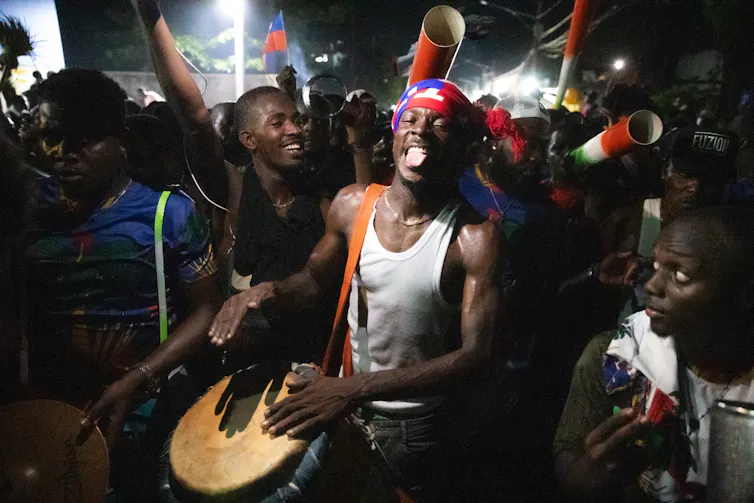
A man beats a drum surrounded by pther people

Haitian fans in Port-au-Prince celebrate the nation’s qualification for the 2026 FIFA World Cup on Nov. 18, 2025. Clarens Siffroy/AFP via Getty Images

Haitians at the World Cup

The broader history of Haitians at the World Cup has long been shaped by diasporic movement. At the 1950 World Cup, when a scrappy U.S. team composed mostly of immigrants famously defeated England 1-0, it was a Haitian man, Joe Gaetjens, who scored the crucial goal.

A black and white photo shows a group of men in soccer jerseys.

The USA team that beat England, including Joe Gaetjens, third from right in front row. EMPICS Sport/EMPICS via Getty Images

Decades later, Jozy Altidore, a child of Haitian immigrants, played in every game for the U.S. during its 2010 World Cup run.

Until now, Haiti’s national teams have appeared in only two World Cups. Most recently, the country’s team qualified for the 2023 Women’s World Cup, overcoming many obstacles in the process. Like the men’s team in this year’s competition, the women could not train or play games at home in Haiti. But playing for Haiti helped their star player, Melchie Durmonay, begin a professional career in France, where she plays for the leading team, Olympique de Lyon, and is considered one of the best players in global women’s soccer.

The men’s team has previously competed only in the 1974 tournament. On that occasion a team made up of players who had all been born in Haiti shocked an Italy team famed for its impregnable defense. Early in the second half, Haiti’s Emmanuel Sanon broke away to catch a masterful pass downfield, dribbled expertly around an Italian defender and powered the ball into the goal.

A group of men in white and orange jerseys stand on a football pitch.

Emmanuel Sanon (20) scores one of his – and Haiti’s – only two World Cup goals, on June 15, 1974. Mirror Syndication International/Mirrorpix via Getty Images

It remains the most celebrated goal in Haitian football. And although Haiti lost that game 3-1, Sanon became a national hero. He went on to a professional career in Florida in the 1980s and later managed the Haitian national team.

When he died in Orlando in 2008, he was buried and received a state funeral in Haiti. A soccer park is named after him in Miami’s Little Haiti in recognition of his place in the country’s history.

A large mural shows people's faces.

A mural depicts Haitian soccer player Emmanuel Sanon alongside revolutionary leaders Fidel Castro, Che Guevara and Jean-Jacques Dessalines in the Bel Air neighborhood of Port-au-Prince. Laura Wagner, CC BY-SA

A diaspora on the pitch

The life histories brought together for the 2026 tournament capture the broader story of Haitian migration, but they also illustrate the different kinds of opportunities young athletes have in different countries.

Some of Haiti’s players, like Hannes Delcroix, have had access to the most elite and well-resourced structures in global soccer. He was born in the Artibonite Valley in Haiti but as a child moved with his parents to Belgium. There, he trained at the youth academy of the Belgium professional team Anderlecht and also played on Belgium’s international youth teams. He now plays professionally in Switzerland.

A man in blue kit controls a football.

Haiti’s Hannes Delcroix on the ball during a friendly match against Tunisia on March 28, 2026. Vaughn Ridley/Getty Images

But it is France’s soccer infrastructure that has in many ways most deeply shaped the trajectories of Haiti’s team. The Haitian diaspora in France is much smaller than in the U.S. – it is estimated at around 100,000 – but its children have had access to one of the most successful systems for soccer training in the world.

Facing many social and economic barriers, children of immigrants, many of whom live in the housing projects in the suburbs of Paris and other French cities, often see an athletic career as their best chance for success. And the country invests heavily in sporting infrastructure with high level of state investment at the local and national level. As a result, immigrant communities in France have become some of the most remarkable generators of soccer talent in the world. Two of the standouts of the French national team – Ousmane Dembele and Kylian Mbappé – are products of the French soccer system. and both are sons of African immigrants. Meanwhile, 75 players born in France will be playing on non-French national teams.

Paths to the World Cup

Haiti’s talisman and top scorer, Duckens Nazon, was born in a Parisian suburb and played with a series of French professional teams before being recruited to the English team Wolverhampton Wanderers in 2017. His stint there was brief, and he has since moved a few times, playing professionally in Iran for Estaghlal this past year and having to make a harrowing escape from the war there in order to be able to play in the World Cup.

The strong representation of Franco-Haitian players, and the relatively small number of those born in the U.S., speaks volumes about the difference in the infrastructure and structure of opportunity around soccer in the two countries.

The U.S. is home to the largest Haitian diaspora in the world, with a population of approximately 1.1 million registered in the 2021 census. Actual numbers – both then and now – are likely larger. Yet only two players born in the U.S. are on Haiti’s World Cup squad: Derrick Etienne Jr., born in Richmond, Virginia, and Duke Lacroix, born in New Jersey.

In both cases, the players were able to find their way to the pathways for professional sport that exist in the U.S. – notably elite universities – that are not available to many other children of Haitian immigrants.

Frantzdy Pierrot, one of the team’s stars, is part of a more recent history of migration from Haiti to the U.S.

He was born in Cap Haïtien in 1995 but migrated to Melrose, Massachusetts, as a child. After high school there, he played at Northeastern University and then Coastal Carolina University before embarking on a professional career that has taken him to England, France, Israel and Turkey. On May 26, 2026, the governor of Massachusetts celebrated his achievements by declaring that day Frantzdy Pierrot Day in the state.

A man sits ion front of a bag of balls.

A shopkeeper sells footballs in Port-au-Prince, Haiti, on April 14, 2026. Clarens Siffroy/AFP via Getty Images

A global Haiti

Whatever happens on the pitch for Haiti this tournament, their games are going to be an occasion for unity and celebration.

Haiti team’s fans are legendary for their passion. One of the most intense victory celebrations I have witnessed took place outside a stadium in Harrison, New Jersey, in June 2019 when Haiti defeated Costa Rica in a Gold Cup group match. The parking lot filled up for many hours afterward, with Rara music and dancing.

Sadly, a visa ban against Haiti means that few Haitians will be able to travel from their country to the U.S. to watch their team play.

But on June 13, Haiti itself will be at a standstill during the games, and across the diaspora – in Boston, New York, Houston, Montreal and Paris, but also in the Bahamas, Brazil, Chile and other parts of Latin America – crowds will gather to be together in pride.

Many others, me included, will join in supporting Haiti out of solidarity, taken by this story of possibility. And if, like Sanon in 1974, one of Haiti’s new generation of players breaks through and scores a goal, the celebration will be truly global.

The 2026 Honda Prelude review: Didn’t expect such a head-turner

0
the-2026-honda-prelude-review:-didn’t-expect-such-a-head-turner
The 2026 Honda Prelude review: Didn’t expect such a head-turner

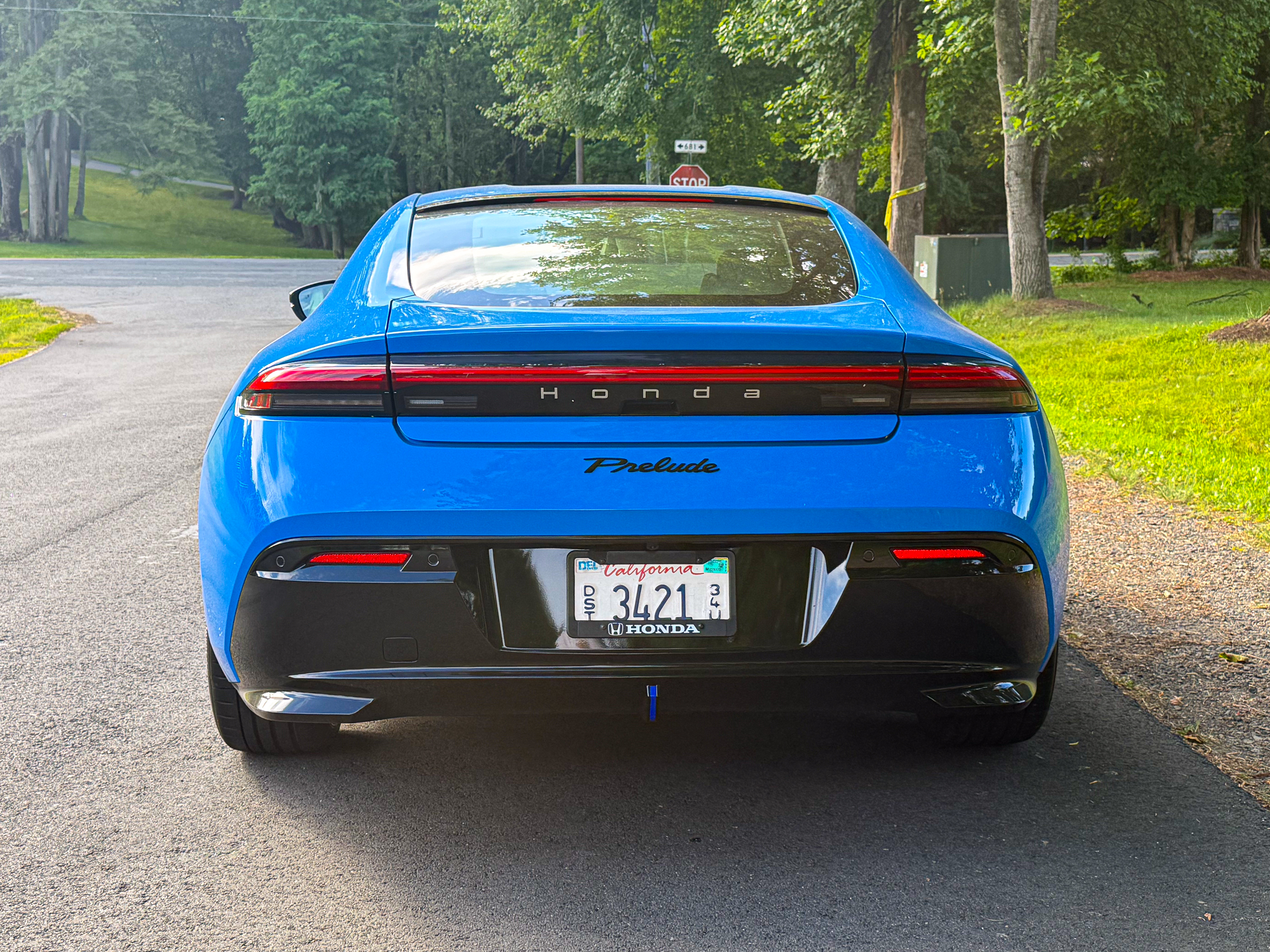
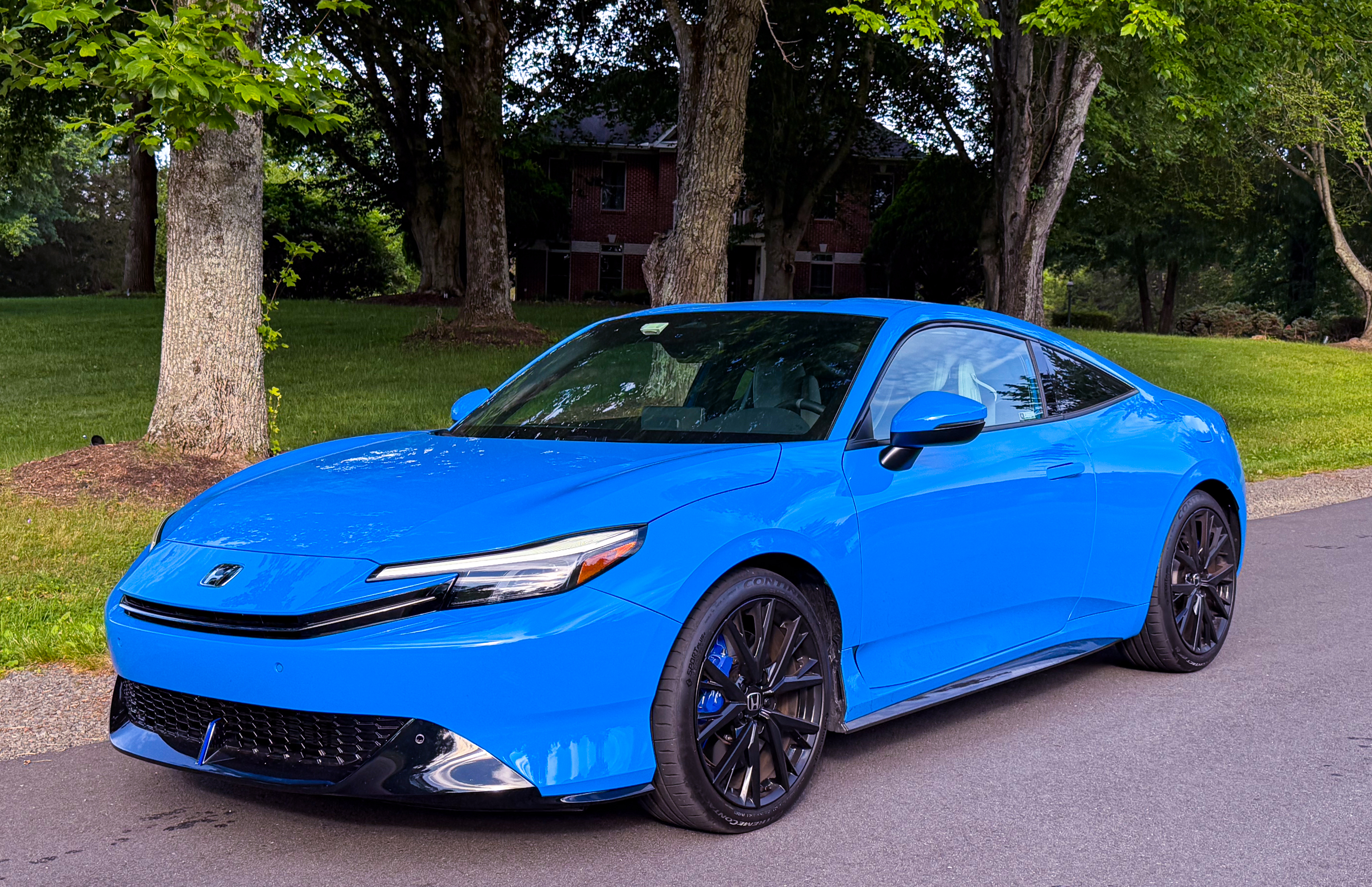
You can tell Honda was trying to manage expectations when it emailed me to stress that “the Prelude is not a sports car.” And I can understand why. On paper, the specs make the sleek coupe—technically a three-door hatch—seem underwhelming. Especially if you start comparing it to alternatives.

A Mazda MX-5 or Subaru BRZ weighs hundreds of pounds less, and the Subaru packs more power than the Prelude’s 200 hp (149 kW). A Volkswagen Golf GTI weighs about the same as the Prelude at 3,261 lbs (1,479 kg), but it delivers 20 percent more power and offers rear seats that actually accommodate adults. But after a week with the bright blue Prelude, it’s hard to care about the specs. This might be one of the best cars we’ll drive all year.

Then again, looking back across the previous five generations, the Prelude was never really a sports car. It has always been a technology showcase for Honda, introducing features like fuel injection, four-wheel steering, variable valve timing, and active torque transfer. For the sixth-generation Prelude, the headline feature is Honda’s S+ shift, which adds some sporty character to the OEM’s four-cylinder hybrid.

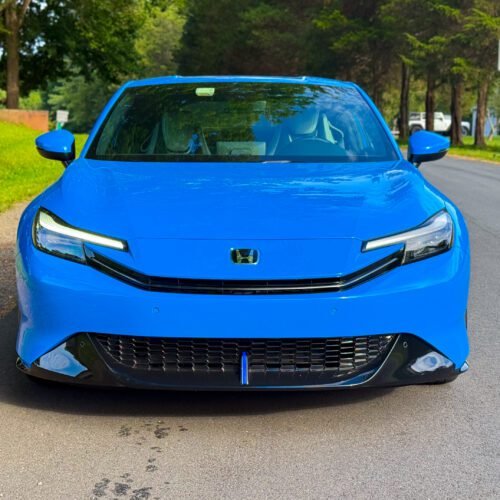
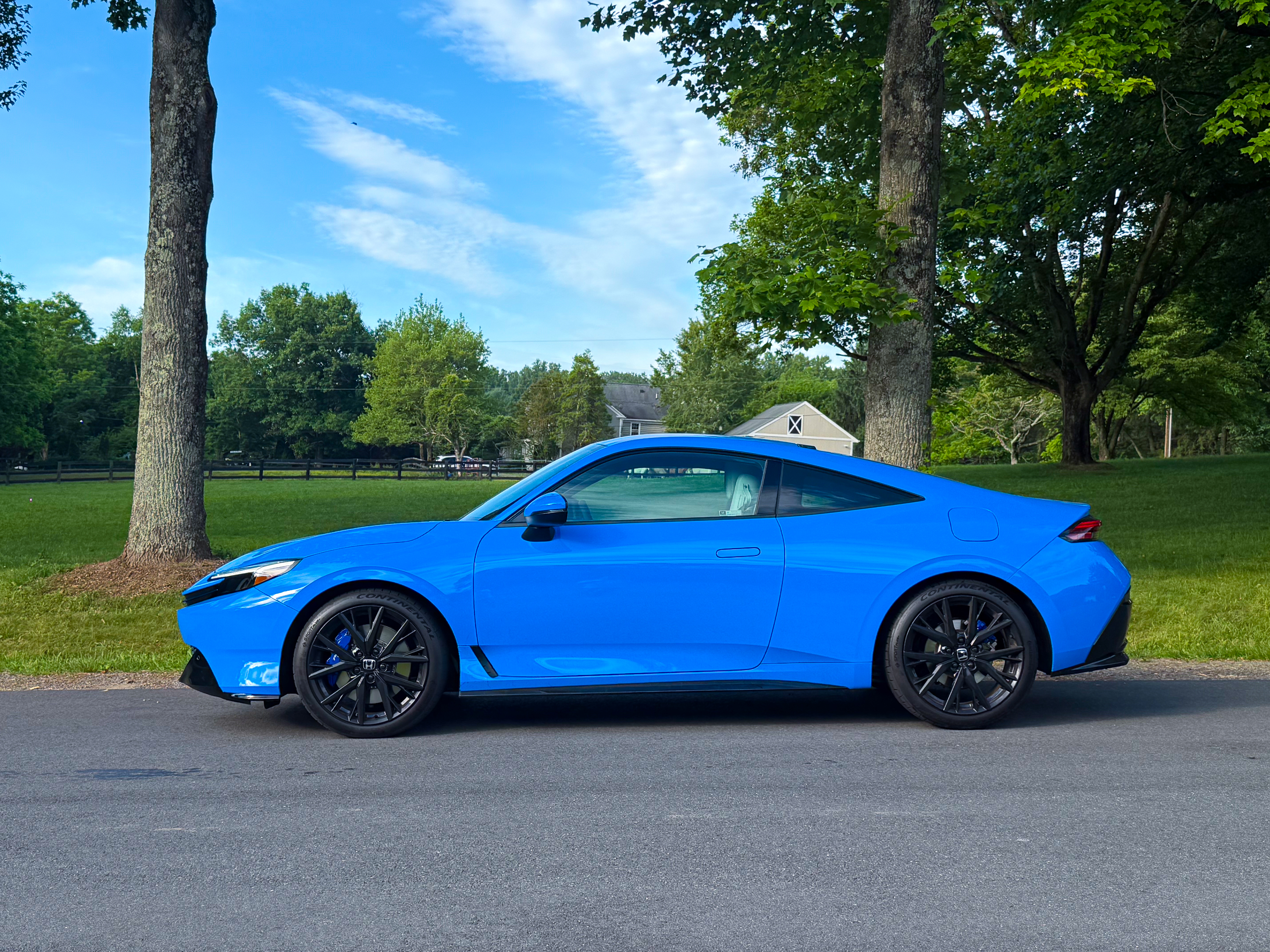
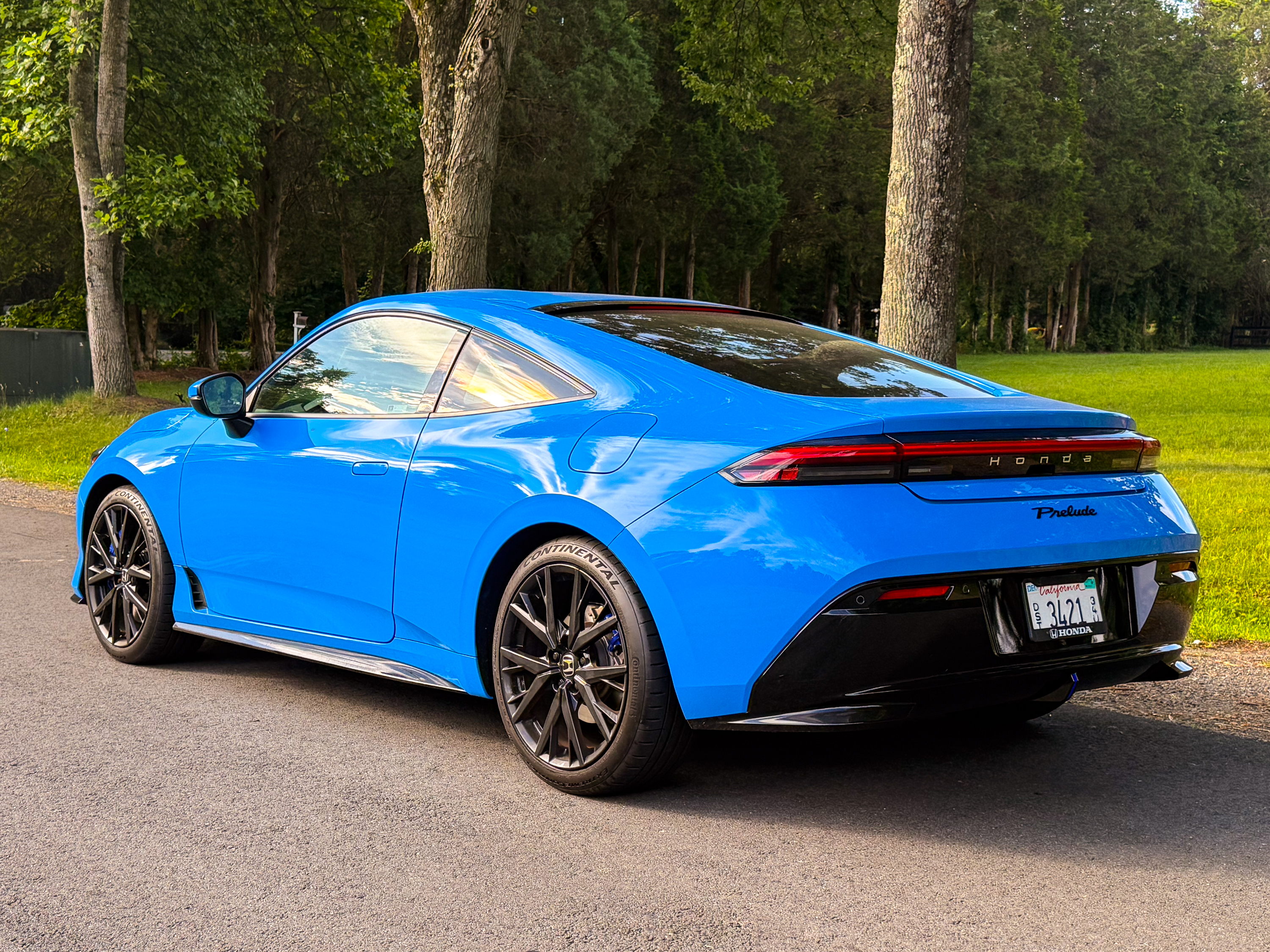
A blue Honda prelude

Note the air vent behind the front wheel well.

There’s something quite Porsche-like about the rear.

Fuel sipper

Most of the time, the front wheels are driven by the Prelude’s 181 hp (135 kW), 232 lb-ft (315 Nm) electric traction motor, which is powered by either the 1 kWh battery for a pure EV drive or the 2.0 L four-cylinder Atkinson cycle engine via a second electric motor/generator unit that converts the engine’s output into electrical energy for use by the traction motor. But like the Chevrolet Volt and some other hybrids, the gasoline engine can directly drive the front wheels at highway speeds, where it’s more efficient.

And efficiency is the name of the game, resulting in a combined 44 mpg (5.3 L/100 km). On a full tank, that means 466 miles (750 km) between fueling stops—talk about a proper grand tourer. And if you leave the drive mode set to Comfort and never touch the paddles behind the steering wheel or the big round S+ button on the center console, the new Prelude might just be a slightly less efficient two-door Toyota Prius lookalike. (At least head-on—I still don’t know how Honda’s designers got away without a cease and desist from their colleagues at Toyota for using a near-identical front.)

In Comfort mode, the ride is soft, the powertrain is quiet, and the engine cuts out whenever possible. Toggle into GT, and the Prelude’s adaptive dampers stiffen up a little, the steering gets weightier, and if you engage S+—which mimics an eight-speed gearbox by changing throttle and regenerative braking maps—the shifts become a little jerkier to provide the driver some feedback.

Sport takes this further; the engine remains running to feed energy into the battery or motors at a moment’s notice, and in S+, the shifts become more deliberately violent (although only a little—we’re not talking sequential crash box or anything), and the powertrain is at its (still not obnoxious) loudest.

A blue Honda Prelude

It might not be an all-out sports car, but it’s still engaging to drive.

It might not be an all-out sports car, but it’s still engaging to drive. Credit: Jonathan Gitlin

I found GT to be the car’s sweet spot. The throttle response is good—better than a turbocharged non-hybrid, perhaps not quite as sharp as the sportiest EVs. The S+ mode’s party trick of replicating a paddle-shift transmission works well on twisty roads, providing an extra layer of driver engagement. Most of the time, though, I left S+ unengaged and simply used the steering wheel paddles to adjust the amount of lift-off regenerative braking, which can be as little as 0.2 g for coasting or as much as 0.2 G, which is less than you’d find in most battery EVs but is still strong enough to replicate the effect of engine braking.

Type-R goodies

There’s more to the drive experience than just an efficient but involving powertrain. The front and rear tracks have been stretched like the Civic Type-R, which donates its front dual-axis and rear multilink suspension to the Prelude, as well as its adaptive dampers, which have been recalibrated for a more comfortable ride. (The stiffest setting in the Prelude is slightly softer than the softest setting in the Type-R.)

Consequently, there’s plenty of grip, especially on the ($1,200) optional summer tires fitted to our test Prelude. The hybrid powertrain encourages a driving style that maintains momentum rather than using a point and squirt approach, and there’s so much front grip that you can corner quicker than you expect, with nary a squeal or noise from the tires as you carry your speed through the apex. And while the curb weight is a good deal more than a Miata or BRZ, compared to the usual diet of crossovers and EVs, the Prelude feels remarkably lithe and nimble.

If you’re an introvert, though, this might not be the car for you, especially in the optional ($455) Boost Blue Pearl you see here. I’m not sure what I last drove that garnered as much attention as the Prelude, but the styling appears to be a hit, generating questions from other drivers in traffic and from bystanders whenever I parked. People like this shape, it seems. Things are pretty good on the inside, too, at least from the front.

Honda Prelude interior

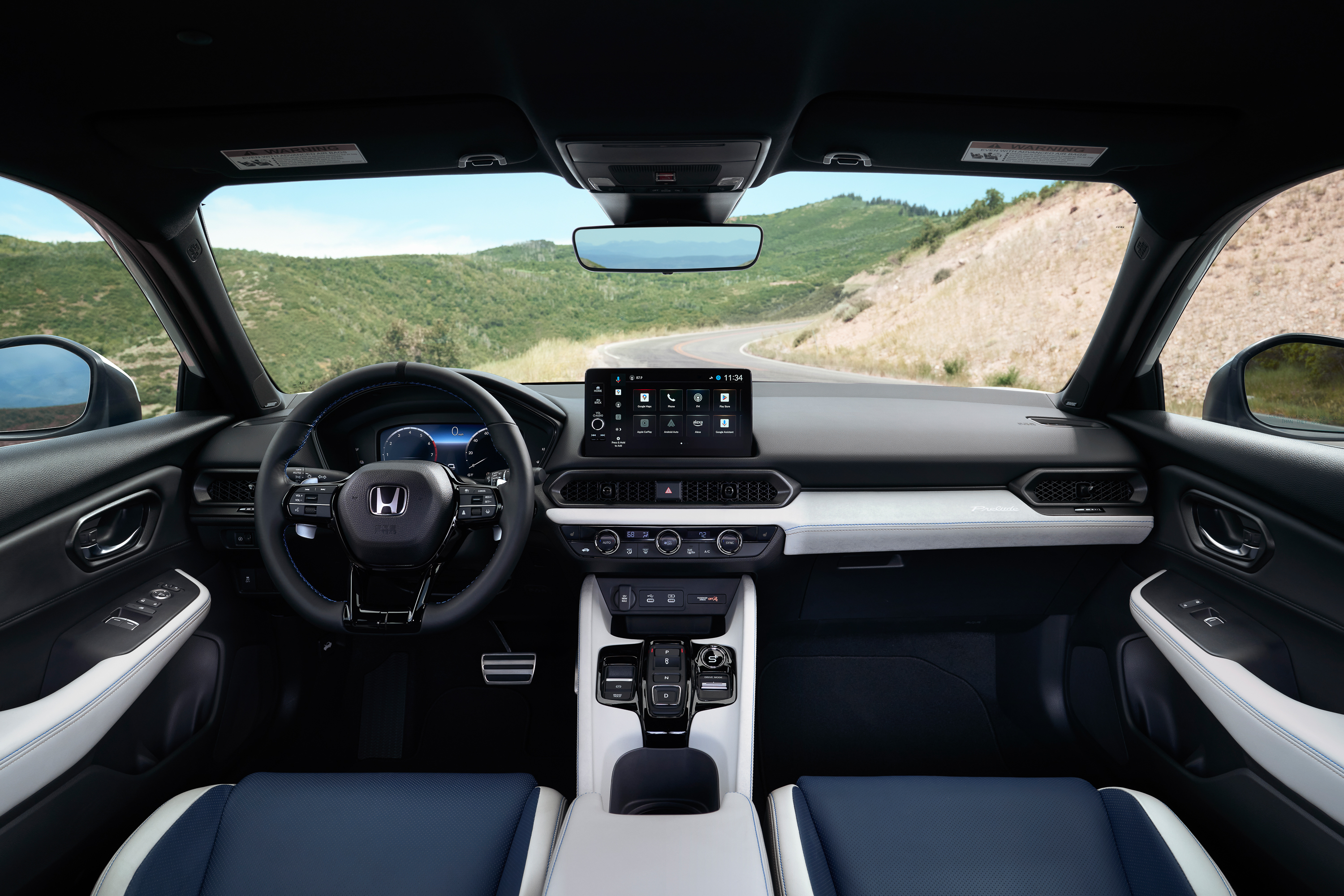
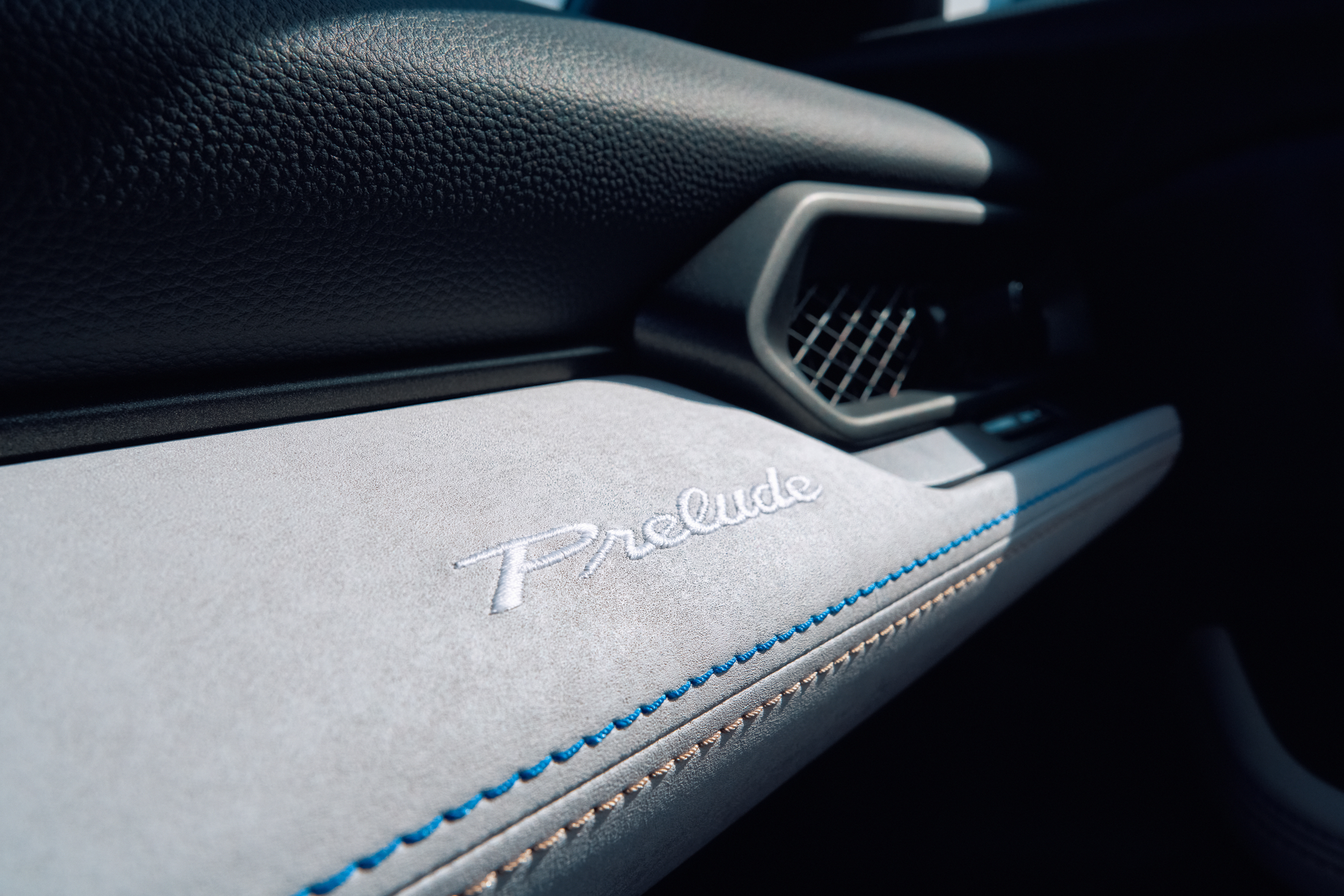
The Prelude interior uses a lot from the Civic, but that’s not a bad thing. And yes, there’s CarPlay and Android Auto.

Honda prelude front seats

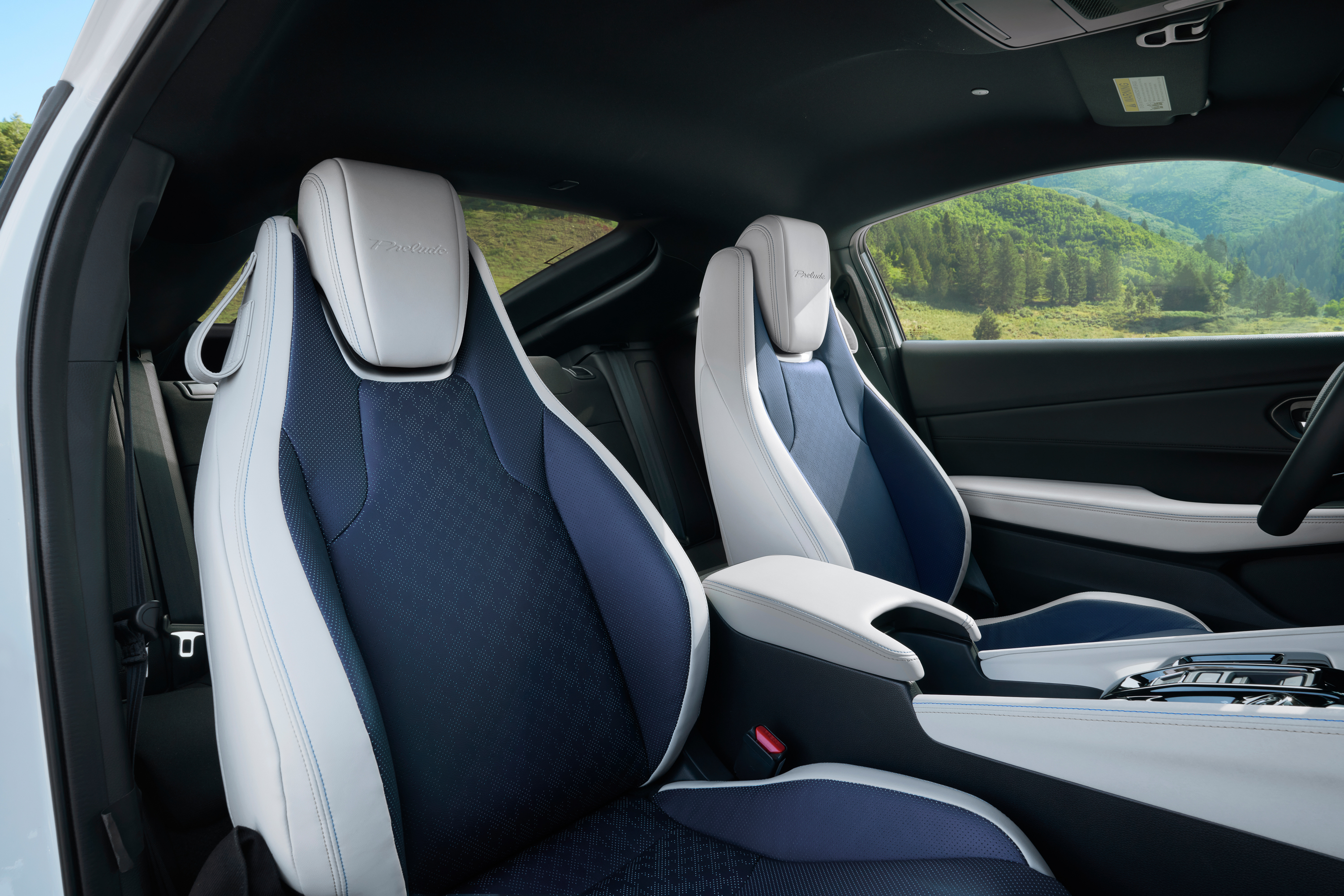
The sporty front seats.

Honda prelude dash

The dash reminds you what you’re sitting in.

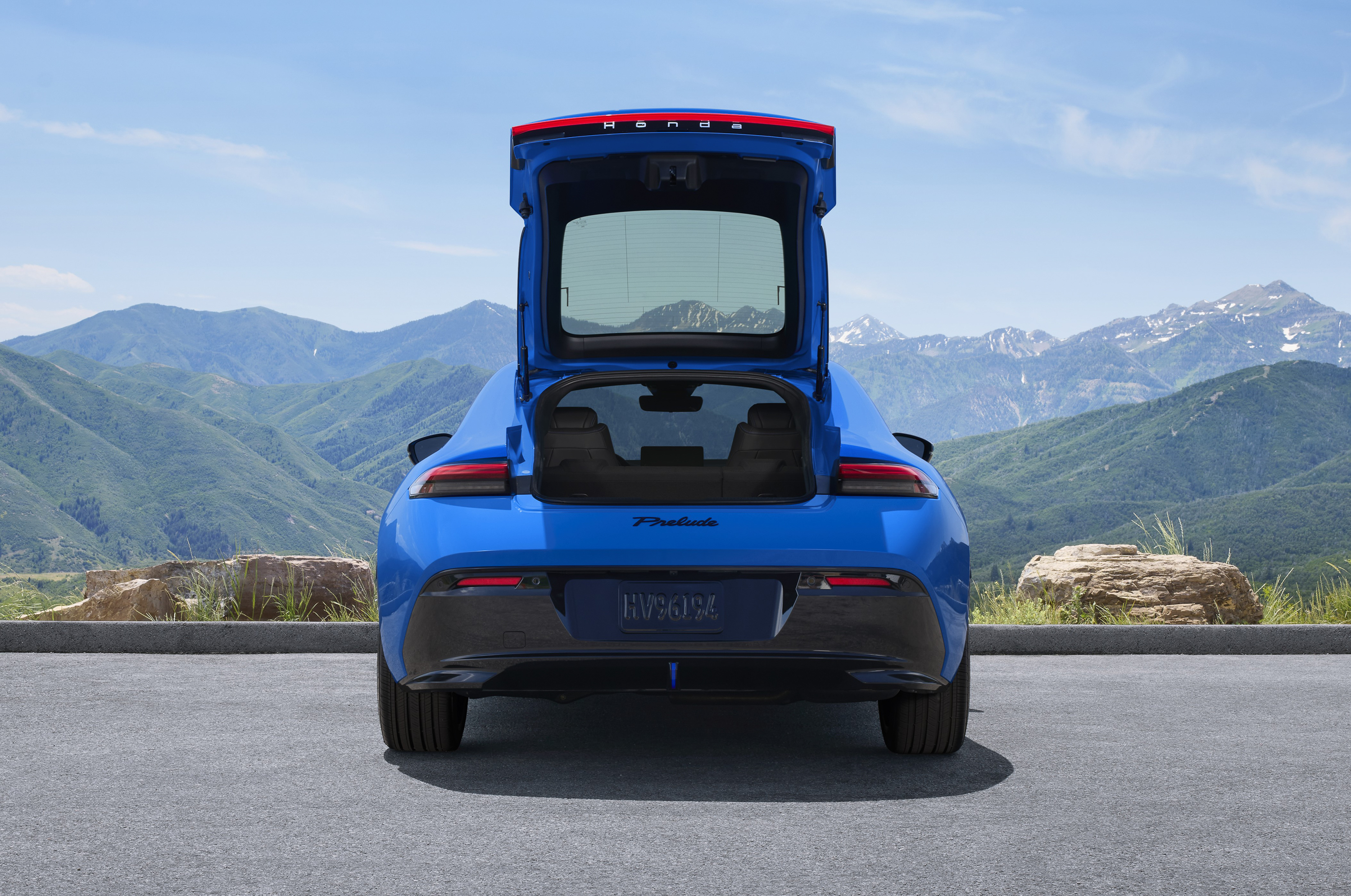
Honda prelude with the hatch open

The back seats fold flat for more storage.

There’s a sportier steering wheel and sporty seats, but the rest of the cockpit borrows from the Civic. That’s no hardship—far from it, as there are discrete buttons and dials for all the controls. The smallish infotainment system is the only touchscreen you’ll find, and you never need to use it to adjust the temperature, change the volume, or handle any of the other functions that some automakers have frustratingly relegated to screens or capacitive panels. I’d prefer the infotainment screen to be slightly angled toward the driver, but that’s a minor quibble at this point.

The back seats are more occasional—think of them like the ones in the back of a Porsche 911, there for small children, small pets, more luggage, or emergencies. But the rear hatch provides plenty of room for the relatively shallow 15.1 cubic feet (427 L).

I’d buy one

I wasn’t expecting to be as smitten with the Prelude as I was. It’s not quite the last word in handling that an MX-5 or BRZ is, and a Golf GTI is both more powerful and more practical. But none of those cars can get anywhere near the Prelude’s efficiency, while the coupe gives up little in terms of driver engagement.

Throw in those looks and a $42,000 MSRP that includes tons of equipment as standard, and it’s quite the proposition. In fact, the new Prelude would be at the top of my list if I were looking for a new car. The car won’t be very common, though—Honda plans to sell only about 4,000 a year.

The road to AI supremacy runs beyond chips

0
the-road-to-ai-supremacy-runs-beyond-chips
The road to AI supremacy runs beyond chips

It’s clear that very soon, maybe even later this year, we’ll be producing more chips than we can turn on — except for China.

Elon Musk, at World economic forum 2026

When Musk made that remark, his core argument was that the biggest bottleneck to AI advancement is not computing hardware but a shortage of electrical power.

For the last few years, the global conversation about artificial intelligence has revolved around one issue: semiconductors. Policymakers across the world have discussed silicon supremacy in their planning documents, as though the future of the AI industry would depend solely on it. NVIDIA became the first chip company to reach $5 trillion valuation. It has now become the gold standard of the industry.

But, nowadays, there seems to be another challenge in front of AI companies. The launch of DeepSeek in 2025 has changed the assumption that was becoming conventional wisdom.

Today, nations, companies and investors are realizing that they have less need to stockpile GPUs, battle for chip supply and chase the next hardware breakthrough. DeepSeek shows that algorithmic efficiency can partially compensate for hardware constraints through optimizations.

Unlike the other AI models that use the entire model for every query, Deep Seek activates only the relevant parts, improving performance per unit of compute.

Whenever an AI model responds to a query, generates a word, answer, image, or video, it performs billions of calculations. But those calculations run on electricity. For example, one ChatGPT query used 10 times as many resources as a Google search query. Generating an AI image requires as much power as charging your smartphone.

Now multiply by hundreds of millions of queries every day, and the math will be terrifying. So, the biggest constraint in the AI industry today is not computing but power. As AI systems grow larger and more capable, electricity supply is emerging as a critical constraint, and the pressure is already showing in the United States.

Washington focused on semiconductors and Beijing on grid

In the US, data centers will account for 38% of the growth in electricity demand between 2024 and 2030, though just 6% in China, according to Bloomberg NEF projections. Data centers will command almost 7% of total US power demand by 2030, compared with 2% in China.  

By 2035, US data center power demand is projected to reach 106 gigawatts. To put that in perspective, the United States operates the largest nuclear fleet on the planet. But its total output is 97 gigawatts, which still wouldn’t be enough to meet the demands. A data centre can be built in as little as 18 months, while bringing a new power supply takes three times longer. In 2024, the US built 888 miles of transmission lines, when it needs about 5000 miles every year.

In  March 2025 CSIS reported that electricity supply had become the biggest bottleneck of US companies. This can be confirmed from the fact that AI data centers are driving up electricity costs in the US. In data center-heavy states like Virginia, power prices have risen by as much as 267% over the past five years. According to IEA predications, the global data-center electricity demand could rise from current estimates of 415 terawatt hours in 2024 to approx. 945 TWh by 2030, with AI being the single largest driver of this growth.

In 2024, China generated over 10,000 TWh of electricity, more than double any other country on the earth. In the next five years, China could add more than 3.4 terawatts of new generating capacity, vastly exceeding expected additions in the United States.  This is equally important because AI deployment ultimately depends on access to reliable and affordable electricity. So, today, the AI race has moved from computational efficiency to energy abundance.

AI race will have a clean energy advantage

Today, in the West, government and energy companies are still focused on protecting traditional industries like oil and natural gas. China meanwhile has invested heavily in new technology such as solar panels, batteries and wind power not to reduce pollution but as industries to create job, drive innovation, and strengthen the economy. In short, Western leaders viewed solar panels, batteries, and wind turbines as climate tools; the Chinese, as industrial tools.

Electricity generation in China vs United States vs Europe

Today, China possesses approximately 430 gigawatts of hydropower, 550-600 GW of Wind Power, and 850-900 GW of Solar Power, apart from 1,150 GW of coal-fired generation. These clean energy assets provide China with a stable energy foundation capable of supporting any industrial expansion, electrification, or AI infrastructure challenge.

The future of AI race will not by determined by the fastest chips or the best algorithms but the one who has better power capacity to run those models. China has recognized this way before the rest of the world. Over the past two decades, the country has invested massively in clean energy and cemented its status as the world’s undisputed clean energy superpower, spending more on renewables than the rest of the world combined.

But the United States has extraordinary strengths: top universities, deep capital markets, an innovation culture, global dominance in the semiconductor industry, entrepreneurial dynamism, and the topmost AI-influential companies in the world. As the landscape evolves, AI is no longer remain a software competition but an infrastructure competition. In infrastructure, expertise and scale matter.

The upcoming decade will reveal whether the decisive factor in the AI race will be silicon or electricity.  In case AI becomes a competition over electrical power, then the most important geopolitical story of the next decade may or may not be happening in Silicon Valley.

Graham Platner Wins in Maine, Turning Anti-Establishment Fight on Susan Collins

0
graham-platner-wins-in-maine,-turning-anti-establishment-fight-on-susan-collins
Graham Platner Wins in Maine, Turning Anti-Establishment Fight on Susan Collins


Political newcomer Graham Platner won a bruising primary fight for the state’s Democratic Senate nomination Tuesday night, when voters easily picked him to take on Republican Susan Collins in November despite damage from stories delving into his past.

Plainspoken populism won the oyster farmer and Marine Corps veteran support among fed-up Mainers, who nominated him in a landslide that The Associated Press called with just 8 percent of the vote in.

“Over the last nine months I have seen Mainers come together behind a vision to take back our power from corporations and billionaires,” Platner said in his acceptance speech Tuesday. “I love every single one of you. Everyone who has shown up at a town hall, who has knocked on a door, who cast their vote — not for me but for a vision of a life in Maine that you can afford; a life of dignity and a government that actually serves its people.”

Platner’s appeal seemed unshaken amid months of

negative press stemming from his inflammatory comments on Reddit and an ill-advised tattoo resembling a Nazi symbol. But a recent series of damaging stories in national media, including revelations in the Wall Street Journal about extramarital sexting and allegations in the New York Times of abusive behavior in past relationships, have given some voters and political observers pause. Others say that in Maine, a fiercely independent state where residents nurse a healthy suspicion of influence “from away,” Platner supporters have dismissed those stories as meddling from an establishment fearful of a political maverick.

“From what I can tell, I don’t think the Times piece moved the needle much,” said Shay Stewart-Bouley, a longtime Maine resident who has written both critically and supportively of Platner on her blog, Black Girl in Maine. “I heard some women say it made them uneasy, but I haven’t heard anyone say it changed how they’re going to vote.”

In other cases, the coverage appears to have cemented Platner’s status as an outsider to an establishment embodied by Collins, who has represented Maine in the Senate since 1997. Like many incumbents nationwide, the Republican senator will have to run amid a shrinking job market and rising costs, points that Platner has seized on throughout his campaign. And Collins’s association with the establishment could prove a major liability, even among onetime supporters of President Donald Trump, according to Charles Pray, a former state senator and veteran figure in Maine Democratic politics.

“Part of Trump’s rise was a total frustration with incumbents and people in power, and a lot of people who were Trump supporters who hoped he was going to address rising grocery prices and stuff now see him saying that affordability is not an issue,” said Pray. “Well, affordability is a big issue in Maine, and I think that hurts Collins.”

Platner faced a nominal challenge in Tuesday’s primary from Maine Gov. Janet Mills, who suspended her campaign in April but remained on the ballot, and from David Costello, a former Democratic nominee in the 2024 Senate race who was little more than an afterthought in the latest contest.

Just days before the primary, the Times reported disturbing allegations about Platner, including that an ex-girlfriend accused him of drunkenly locking her in a room during a fight and physically restraining her at times. (Platner has acknowledged the relationship with the accuser, a longtime Republican operative in Washington, but denies he engaged in violent behavior.)

Pray said that among people he’s spoken with, the allegations, while concerning, are undercut by Collins’s support for the nomination of Supreme Court Justice Brett Kavanaugh despite the sexual assault accusations against him, and by her support of Trump despite the many accusations against him and his consistently hostile behavior toward women interviewers.

“I think people aren’t buying the double standard. She confirmed Kavanaugh, she supports Trump despite his behavior,” Pray said, pointing to the president’s recent outburst on NBC News. “I spoke to three women, including Republicans, who were very upset by that and who said ‘Susan just goes along with that.’”

To Platner’s most ardent supporters, the revelations look like meddling by an establishment that never wanted him to be the candidate, said Andy O’Brien, a former state senator who writes about politics in the state and supports Platner. (O’Brien works for the AFL-CIO of Maine, which has endorsed Platner, but did not speak to The Intercept on behalf of his employer).

“So many people know Graham, and they listen to what he says, they don’t listen to all the crap coming from Washington and New York and California,” said O’Brien. “They like Graham because he speaks to them, and they believe him and trust him. They know he had a messy personal life. I think that there’s a lot of grace that they’re showing him, partly because of his post-traumatic stress from combat and also because there’s this sense that Trump has already lowered the bar so much.”

Mostly, however, Mainers are weary of the national attention the primary brought to their state — with little hope in sight of a let-up, Stewart-Bouley said.

“The general mood is people are really tired of this primary,” she said before Platner’s Tuesday night victory. “But if Platner wins, I suspect we’re not going to be out of the woods.”

In his remarks Tuesday, Platner acknowledged errors in his past and thanked the people of Maine for putting their trust in him despite them.

“Redemption is not just some simple or easy destination. It’s a journey. I’ve made mistakes in my life. Mistakes that I regret, that I live with and that I continue to learn from. And I’m still far from perfect. But every day I wake up and I try to be a little bit better and a little bit kinder than I was before,” Platner said. “And if you give me the chance, I will be a senator for the people who cannot afford to buy a senator.”

Update: June 9, 2026, 9:39 p.m. ET
This story has been updated with news of Platner’s victory in the Maine primary.

Acid Attack on Female Doctor Exposes Workplace Security Lapses in Pakistan

0
acid-attack-on-female-doctor-exposes-workplace-security-lapses-in-pakistan
Acid Attack on Female Doctor Exposes Workplace Security Lapses in Pakistan


Haji Ismat, Dr. Nasir’s uncle, told TML the attack against his niece has sent “a wave of fear through working women across the country who have pursued higher education and professional careers.”  

[ISLAMABAD] Pakistan’s city of Quetta has been shaken by an attack on a female doctor while she was on duty on Saturday, June 5 at Civil Hospital, prompting outrage over workplace safety and violence against women in public institutions. Dr. Mahnoor Nasir, 29, was injured when a hospital employee allegedly threw acid on her in the ward before fleeing the scene, police and hospital sources said.   

After initial treatment in Quetta, she was airlifted to Karachi’s Aga Khan University Hospital for specialized care, where hospital sources said she sustained burns to about 13% of her body, including injuries to her face, abdomen, thighs, and both hands. The hospital reported that her eyesight remains intact, although both her eyes were affected.  

Balochistan Young Doctors Association (YDA) president, Dr. Abdul Hayee Baloch, told The Media Line that the attack caused severe damage to the doctor’s face, while her neck and head were also injured. He strongly criticized the government and the health department, saying that despite official claims, adequate treatment could not be provided at the government hospital, which led to her transfer to a private medical facility.   

A medical technician, Abdul Razzaq Khilji, rushed to Dr. Nasir’s aid during the attack, using his jacket to shield her, and suffered burns in the process. Balochistan Chief Minister Sarfraz Bugti announced that he would be given a prestigious civil award, praised his actions as an example of courage and service, called him a “precious asset to society,” and said that all his medical expenses would be covered.  

The suspect, identified by police as Humayun Shah, a lift operator at the hospital, was later killed in an exchange of fire with police during the ensuing manhunt. Key questions remain unanswered, including how he was able to bring acid into a government medical facility.  

Haji Ismat, Nasir’s uncle, who is accompanying her at the hospital, told The Media Line that doctors are encouraged by her progress. He said that his niece had always dreamed of becoming a doctor and that she had inspired several younger members of her family to pursue higher and professional education.  

Mahnoor turned out to be a trailblazer

“Mahnoor turned out to be a trailblazer,” he said, noting that she was often a source of support for patients from their village and surrounding areas who visited Civil Hospital for treatment.  

 “On the surface, the attack targeted Mahnoor, but in reality, it has sent a wave of fear through working women across the country who have pursued higher education and professional careers,” he noted.  

The attack has prompted strong condemnation from doctors and rights groups. The YDA announced a boycott of government hospital services except for emergencies, and UN Women Pakistan, the resident office of the United Nations agency for gender equality and women’s empowerment, strongly condemned the acid attack, calling it one of the most devastating forms of gender-based violence, saying there could be no justification for such a brutal act.  

In a statement, UN Women Pakistan said the incident serves as a stark reminder that ending violence against women and girls requires collective action, accountability, and unwavering commitment from all sectors of society. The agency also expressed solidarity with Nasir, her family, colleagues, and women healthcare professionals across the country.  

Women’s rights activists and social media users have renewed concerns over the easy and unchecked availability of corrosive acid in local markets, including on the black market.   

Pakistan’s legislative framework has completely failed to deter gender-based chemical violence, women’s rights activist Riffat Ayesha told The Media Line. She emphasized that despite a decade of legal reforms, corrosive acids remain extremely easy to obtain and are widely sold in informal markets under the thin pretext of being domestic drain cleaners or industrial agents.  

Ayesha forcefully condemned the total absence of a state-mandated tracking system, demanding to know who is buying these lethal substances and for what purpose. Until the state implements strict buyer verification, she warned, the unregulated sale of these chemicals will continue to cause profound physical harm and lifelong psychological terror on women across the country.  

Yasir Bashir, a Rawalpindi-based senior law consultant and member of the Lahore High Court Bar Association, told The Media Line that Pakistan’s legal system treats acid attacks as among the most serious violent crimes, combining provisions of the Pakistan Penal Code with a dedicated special law introduced in 2011.  

“Under this special legislation, causing hurt through corrosive substances such as acid carries a minimum sentence of 14 years’ imprisonment, which may extend to life imprisonment, along with a mandatory fine,” he explained.  

He noted that if an acid attack results in death, the case is prosecuted as murder under Section 302, which can lead to either the death penalty or life imprisonment. Courts may order offenders to pay compensation covering victims’ medical treatment and rehabilitation costs.  

Overall, he said, Pakistan’s legal framework classifies acid attacks as aggravated offenses involving intentional disfigurement and severe physical harm, reflecting their long-term physical and psychological impact on victims.  

Quetta-based political analyst Hazar Khan Baloch described the acid attack on a female doctor at a government hospital as highly alarming and possibly the first of its kind. He told The Media Line that the case took a troubling turn when the suspect was later killed in a police encounter.  

Baloch commented that the sequence of events has raised more questions than answers, especially about the motive behind the attack and why the suspect was eliminated so quickly, possibly before a full investigation could determine key facts such as whether there were accomplices or institutional lapses.  

He said the incident reflects a disturbing mix of gender-based violence, workplace insecurity, and concerns over law enforcement practices, adding that while such “swift justice” may offer immediate retribution, it risks undermining due process and deeper accountability.  



Racist comments targeting politicians tripled since Meta relaxed its rules

0
racist-comments-targeting-politicians-tripled-since-meta-relaxed-its-rules
Racist comments targeting politicians tripled since Meta relaxed its rules

Last year, Meta radically overhauled the rules around what content it would allow on its platforms. The company claimed that its own efforts policing speech had gone too far and that it would relax the rules around what speech was allowed. “We have been over-enforcing our rules, limiting legitimate political debate and censoring too much trivial content and subjecting too many people to frustrating enforcement actions,” Joel Kaplan, Meta’s chief global affairs officer, wrote in a blog post at the time.

Over a year later, new research from the Center for Countering Digital Hate (CCDH) shows the immediate impact of these changes.

The researchers analyzed about 8 million Facebook comments and found that abusive and racist comments targeting both Republican and Democrat lawmakers tripled in the six months after the new rules were put in place. Some categories of abusive comments documented by the researchers saw even sharper rises, with violent threats and hate speech quadrupling during the same period.

The report cites specific examples of gendered and racist abuse directed at lawmakers like US representatives Jasmine Crockette of Texas and Byron Daniels of Florida. These comments were not taken down by Meta.

The CCDH researchers also found that threats against President Trump more than doubled in the six months after Meta overhauled its rules. Many of the comments, which included direct threats to his life, could have been classified as felony offenses, the researchers say.

To assess the impact of these rule changes, CCDH’s researchers chose 100 members of the House of Representatives made up of the 50 Republicans and 50 Democrats with the most followers on Facebook. Then the researchers scraped nearly 8 million comments on Facebook posts made by those lawmakers in the six months before and after Meta’s policy changes.

The researchers used an AI system trained to identify comments in the dataset that were likely to violate Meta’s current policies in three areas: violence and incitement, hateful conduct, or bullying and harassment.

Comments that violated Meta’s policies around violent threats quadrupled, from 1,800 in the six months before the changes to 7,600 in the six months after. Hate speech comments also quadrupled, from 6,900 to 30,000. Comments that broke Meta’s rules on bullying and harassment doubled, from 15,700 to 39,900.

“We regularly issue public reports tracking violating content on our platforms, and the prevalence of hateful conduct did not increase throughout 2025,” a Meta spokesperson tells WIRED, adding that the company could not address the report’s claims directly without seeing the research in its entirety. WIRED did provide a list of the abusive comments cited in the report, but Meta did not comment on these. Hours before the report was published, many of the examples were deleted from Facebook.

“When companies reduce oversight in areas like violence, hate, and harassment, it should not be any surprise to see those harms increase,” Senator John Curtis, a Republican from Utah and a member of the Committee on Commerce, Science, and Transportation, said in a statement to CCDH.

The data collected by CCDH researchers is echoed in Meta’s own transparency reports from 2025, which show how the company cut its proactive content moderation enforcement by roughly half in the months following its policy changes. “The surge in abuse and the collapse in enforcement track one another almost exactly,” the report’s authors write.

While Meta claimed its decision to relax rules around abusive content was driven by free speech principles, experts say that extremist content like the comments covered in this report are the type of content that has been shown to be the most engaging on social media platforms.

“Threats and abuse perform well, as do the responses to the threats and abuse,” says Nina Jankowicz, the CEO of the American Sunlight Project who briefly led the Disinformation Governance Board under President Joe Biden. “They keep users scrolling and keep eyeballs on ads. By divesting from content moderation, platforms are amplifying abusive content, saving on the ‘expense’ of keeping their platform safe, and falling into political lockstep with an administration that claims content moderation is censorship.”

The rising threats against lawmakers have real-world implications. The Capitol Police cited increased threats to politicians in March when seeking a budget increase. Former US congresswoman Marjorie Taylor Greene of Georgia, who was the lawmaker in the report who faced the most abusive comments, referenced threats to her life as one of the reasons she stepped away from public life.

“We’ve seen a horrifying trend of political violence, from the latest attack on the president to the murder of Charlie Kirk to the assassination of Melissa Hortman and her husband,” Imran Ahmed, the CEO of Center for Countering Digital Hate, tells WIRED. “Lawmakers are canceling town halls; they’re moving them off online. Election officials are leaving the job. Representatives are saying in public the fear of being targeted shapes how they vote. I don’t see how publishing, amplifying, and failing to enforce your own rules against this kind of harassment, threats, and identity-based hate can in any way be portrayed as a moral act. I think it takes incredible levels of duplicity to claim that.”

This story originally appeared on wired.com.

0FansLike
0FollowersFollow
0FollowersFollow
0SubscribersSubscribe
- Advertisement -
Google search engine

Recent Posts