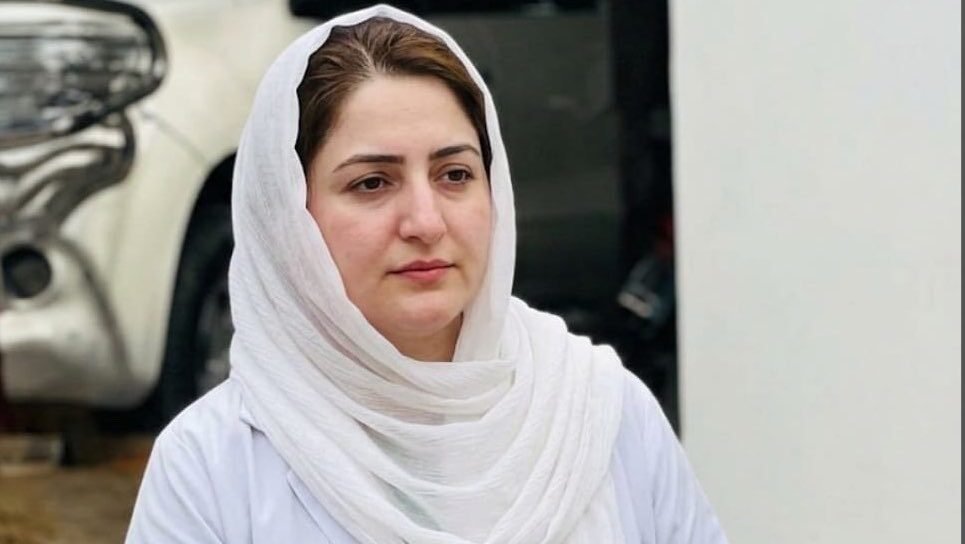
Haji Ismat, Dr. Nasir’s uncle, told TML the attack against his niece has sent “a wave of fear through working women across the country who have pursued higher education and professional careers.”
[ISLAMABAD] Pakistan’s city of Quetta has been shaken by an attack on a female doctor while she was on duty on Saturday, June 5 at Civil Hospital, prompting outrage over workplace safety and violence against women in public institutions. Dr. Mahnoor Nasir, 29, was injured when a hospital employee allegedly threw acid on her in the ward before fleeing the scene, police and hospital sources said.
After initial treatment in Quetta, she was airlifted to Karachi’s Aga Khan University Hospital for specialized care, where hospital sources said she sustained burns to about 13% of her body, including injuries to her face, abdomen, thighs, and both hands. The hospital reported that her eyesight remains intact, although both her eyes were affected.
Balochistan Young Doctors Association (YDA) president, Dr. Abdul Hayee Baloch, told The Media Line that the attack caused severe damage to the doctor’s face, while her neck and head were also injured. He strongly criticized the government and the health department, saying that despite official claims, adequate treatment could not be provided at the government hospital, which led to her transfer to a private medical facility.
A medical technician, Abdul Razzaq Khilji, rushed to Dr. Nasir’s aid during the attack, using his jacket to shield her, and suffered burns in the process. Balochistan Chief Minister Sarfraz Bugti announced that he would be given a prestigious civil award, praised his actions as an example of courage and service, called him a “precious asset to society,” and said that all his medical expenses would be covered.
The suspect, identified by police as Humayun Shah, a lift operator at the hospital, was later killed in an exchange of fire with police during the ensuing manhunt. Key questions remain unanswered, including how he was able to bring acid into a government medical facility.
Haji Ismat, Nasir’s uncle, who is accompanying her at the hospital, told The Media Line that doctors are encouraged by her progress. He said that his niece had always dreamed of becoming a doctor and that she had inspired several younger members of her family to pursue higher and professional education.
Mahnoor turned out to be a trailblazer
“Mahnoor turned out to be a trailblazer,” he said, noting that she was often a source of support for patients from their village and surrounding areas who visited Civil Hospital for treatment.
“On the surface, the attack targeted Mahnoor, but in reality, it has sent a wave of fear through working women across the country who have pursued higher education and professional careers,” he noted.
The attack has prompted strong condemnation from doctors and rights groups. The YDA announced a boycott of government hospital services except for emergencies, and UN Women Pakistan, the resident office of the United Nations agency for gender equality and women’s empowerment, strongly condemned the acid attack, calling it one of the most devastating forms of gender-based violence, saying there could be no justification for such a brutal act.
In a statement, UN Women Pakistan said the incident serves as a stark reminder that ending violence against women and girls requires collective action, accountability, and unwavering commitment from all sectors of society. The agency also expressed solidarity with Nasir, her family, colleagues, and women healthcare professionals across the country.
Women’s rights activists and social media users have renewed concerns over the easy and unchecked availability of corrosive acid in local markets, including on the black market.
Pakistan’s legislative framework has completely failed to deter gender-based chemical violence, women’s rights activist Riffat Ayesha told The Media Line. She emphasized that despite a decade of legal reforms, corrosive acids remain extremely easy to obtain and are widely sold in informal markets under the thin pretext of being domestic drain cleaners or industrial agents.
Ayesha forcefully condemned the total absence of a state-mandated tracking system, demanding to know who is buying these lethal substances and for what purpose. Until the state implements strict buyer verification, she warned, the unregulated sale of these chemicals will continue to cause profound physical harm and lifelong psychological terror on women across the country.
Yasir Bashir, a Rawalpindi-based senior law consultant and member of the Lahore High Court Bar Association, told The Media Line that Pakistan’s legal system treats acid attacks as among the most serious violent crimes, combining provisions of the Pakistan Penal Code with a dedicated special law introduced in 2011.
This feels personal Dr. Mahnoor, my senior known for her passion and dedication, suffered an acid attack while on duty. No doctor deserves this. We need justice and safer hospitals now. #JusticeForDrMahnoor #Balochistan #AcidAttack pic.twitter.com/DHubbaSTAE
— 𝐁𝐚𝐝𝐚𝐤𝐡𝐬𝐡𝐚𝐧 (@badakhshan_k) June 7, 2026
“Under this special legislation, causing hurt through corrosive substances such as acid carries a minimum sentence of 14 years’ imprisonment, which may extend to life imprisonment, along with a mandatory fine,” he explained.
He noted that if an acid attack results in death, the case is prosecuted as murder under Section 302, which can lead to either the death penalty or life imprisonment. Courts may order offenders to pay compensation covering victims’ medical treatment and rehabilitation costs.
Overall, he said, Pakistan’s legal framework classifies acid attacks as aggravated offenses involving intentional disfigurement and severe physical harm, reflecting their long-term physical and psychological impact on victims.
Quetta-based political analyst Hazar Khan Baloch described the acid attack on a female doctor at a government hospital as highly alarming and possibly the first of its kind. He told The Media Line that the case took a troubling turn when the suspect was later killed in a police encounter.
Baloch commented that the sequence of events has raised more questions than answers, especially about the motive behind the attack and why the suspect was eliminated so quickly, possibly before a full investigation could determine key facts such as whether there were accomplices or institutional lapses.
He said the incident reflects a disturbing mix of gender-based violence, workplace insecurity, and concerns over law enforcement practices, adding that while such “swift justice” may offer immediate retribution, it risks undermining due process and deeper accountability.