Pope Leo warns Spain’s parliament the world is in ‘profound’ crisis
Pope Leo told Spain’s parliament that escalating conflict, deepening polarization and widespread disregard for human rights had pushed the world into a profound crisis, in one of his most expansive political addresses yet on Monday.
Leo, who has adopted a more forceful tone recently against the direction of global leadership, also firmly repeated his opposition to increased European military spending, urging politicians instead to end the wars ravaging the globe and help migrants.
“The world is undergoing a profound spiritual and cultural crisis, which is manifested in multiple forms of violence, polarization, and mutual distrust,” the pope said in the address, which came hours after Israel and Iran renewed their attacks on one another in the most serious test of a two-month ceasefire.
“Weapons can impose a temporary silence; but they can never build an authentic and lasting peace,” he said.
Leo’s speech, which was delivered in Spanish and was received with a seven-minute standing ovation by lawmakers, was a rare papal address to a national legislature and the first by a pope to Spain’s parliament. It is part of a week-long visit to the country in which the pontiff has met with migrants and the homeless, and called on national leaders to stop dividing their electorates.
The pope, whose Spain tour will culminate with the pontiff meeting migrants in the Canary Islands who braved dangerous Atlantic waters to enter Europe, said a lack of help for the world’s migrants was challenging “the ethical foundation of the international order”.
He said countries must look for solutions that go beyond “the mere management of flows” and should address the causes that force people to leave their countries of origin, including war, poverty and climate change.
The pope told parliament that “the moral greatness of a nation is manifested above all in its capacity to accompany, protect, and love those lives that pass through the greatest fragility”.
More than 3,000 people died in 2025 trying to reach the Canary Islands, off the western coast of Africa, often in makeshift dinghies, according to NGO Caminando Fronteras.
Prime Minister Pedro Sanchez’s government has opened a mass amnesty programme, allowing an estimated 500,000 immigrants to apply for legal status.
POPE CALLS EUROPEAN REARMAMENT ‘TROUBLING’
Leo, who issued a fervent manifesto last month urging global governments to slow down the development of AI systems, called on Monday for “rigorous ethical vigilance” over how AI was used in warfare.
He said that rising European military spending, which grew last year by the highest amount since the end of the Cold War amid pressure from U.S. President Donald Trump, was “troubling.”
Spanish Prime Minister Pedro Sanchez has refused to meet Trump’s demands for NATO member countries to increase defence spending to 5% of GDP, although the expenditure has tripled since he took office in 2018, rising from around €10 billion ($11.5 billion) to more than €34 billion.
Leo also offered some of his most in-depth remarks yet addressing the balance in the relationship between Church and state. He urged protection of religious freedom, saying that faith “cannot be relegated to silence as though it were irrelevant to public life”.
The pope likewise defended the privacy of the Catholic seal of confession, which obliges a priest not to reveal any information given to him by penitents.
Several countries, including France, have debated whether to compel priests to report sexual abuse disclosed in confessions, following scandals that have shaken the Church internationally.
Protecting the seal, Leo said, preserves “a sacred space of inner freedom, where the believer can open his or her soul before God”.
A 2023 report by Spain’s human rights ombudsman estimated hundreds of thousands of victims of clerical abuse there over decades.
In a meeting with Catholic bishops on Monday after his speech in parliament, Leo said they must listen to survivors of abuse and offer them reparations.
The Vatican has said the pope would meet with a group of victims during the visit, but has yet to offer
They Were Serving the Longest Federal Sentence of Any 2020 BLM Protester. Then They Vanished in Prison.
Incarcerated activist Malik Muhammad’s standing client call in March with their lawyer had been canceled without any real explanation. When Muhammad’s attorney, Lauren Regan, went to check their status on the Oregon Inmate Tracker, she found nothing. They seemed to have vanished without a trace.
Friends and family feared the worst. Muhammad, an army veteran and activist serving the longest federal sentence of any 2020 Black Lives Matter protester, had been a target inside the state prison because of their outspoken political beliefs and organizing efforts while incarcerated, several of their friends and supporters told The Intercept.
“We were calling everyone,” said Christopher Kuttruff, a close friend and supporter. “We were terrified that they were in the hospital or dead …your mind obviously goes to the worst places.”
For weeks, the activist disappeared from all tracking systems. The best Muhammad’s supporters could ascertain by early April was that they had been transferred to a “confidential location.” Late that month, Muhammad was able to get a letter out to their partner from Kirkland Correctional Institute, in South Carolina, an intake facility 3,000 thousand miles from Oregon — or, as Regan puts it, “as far away from me as possible.”
Muhammad described the conditions at Kirkland as deplorable, claiming that incarcerated people are denied access to enough water, food, and recreation, and are forced to sleep on mats on the floor, which sometimes get confiscated as punishment.
The South Carolina Department of Corrections had little to say of Muhammad. In mid-May, the state’s prison system told The Intercept they had no record of someone named Malik Muhammad anywhere in their custody; the prison system did not respond to a follow-up query in June. The activist had become a living ghost within the carceral system.
Even now, friends and family struggle to reach Muhammad, with only the occasional letter or call to the few people approved to contact them serving as proof of life.
Because she is not licensed in South Carolina, Regan said she has “not been able to speak on the phone or in person in an attorney-client privileged manner since their transfer,” seriously impeding her ability to represent her client. She had to hire a local attorney to speak with them in person and collect potential evidence.
Millions of people flow through the U.S. prison system every year. And every year, an untold number of them vanish off the map, lost in a massive system that is legally obligated to watch over them. In New Mexico, Stephen Slevin spent nearly two years in solitary confinement in county jail after county officials appear to have simply forgotten about him after charging him with driving under the influence. Slevin never saw a judge or a lawyer and had to pull his own tooth due to consistent medical neglect.
Wanda Bertram, communications strategist for the Prison Policy Initiative, said that people getting lost in the prison system is “pretty common,” even when they haven’t moved as far away as Muhammad. “There’s never any effort made by prisons to tell incarcerated people’s families, ‘Hey, we’re moving this person,’” said Bertram.
As the Trump administration ramps up its use of incarceration as a method of immigration enforcement, concerns are mounting about the already stretched system’s ability to keep track of the people within its care — and the opportunity such lapses in oversight create for authorities to target activists and dissenters adversarial to the government.
“Not only is [Malik] intelligent,” said Regan, a founder and director of litigation and advocacy at the Civil Liberties Defense Center, “but Malik is Black, Muslim, an anarchist, [and] a political activist, and they have targeted Malik as a result of all of those things.”
Muhammad, who was arrested in October 2020, received the harshest sentence out of the hundreds of protesters hit with federal charges in the wake of the 2020 summer protests for racial justice. After tens of thousands were arrested in some of the largest mass arrests in history, many were released without charges or saw their cases dropped, but some prosecutors pushed for harsh sentences and elevated state or local infractions to the federal level, arguing that rioters were masquerading as protesters.
Muhammad pleaded guilty to both state and federal charges, including two counts of “unlawful possession of a destructive device,”for throwing a Molotov cocktail during a protest in East Portland.In 2022, the then-25-year-old was sentenced to 10 years in state prison.
Their plea agreement specifically stated that they would serve their time in Oregon state prison, near their supporters and community. Regan says that Oregon’s prison system has reneged on the agreement — illegally transferring Muhammad interstate as retaliation for their activism while incarcerated — in another attempt by the criminal legal system to punish Muhammad for their organizing.
“Normally, they would have been sentenced to the federal prison system,” said Regan. However, “because their friends and family and supporters at the time were based in Oregon, they explicitly negotiated an outcome that ensured that they would remain in Oregon.”
Federal prisons tend to be “better,” said Regan, because they often have more funding, allow for more freedom of movement, and have marginally better food. Put it this way, she said, “generally speaking, if you had a choice between Oregon State Prison or Federal Prison, most people would choose [federal].” But instead of relative comfort, Muhammad chose community.
Prisons are essentially a “black box” where people can disappear into solitary confinement or be transferred without their family’s knowledge, according to Bertram of the Prison Policy Initiative.
“There’s so many constant questions that you live with as the loved one of an incarcerated person, and then when that person suddenly disappears, it’s terrifying,” said Bertram.
To make matters worse, she said, “prisons have a kind of nasty habit of not telling the family when someone dies or is transferred to an outside hospital, or needs emergency care,” compounding concerns for people who cannot locate their loved ones on the inside.
In Regan’s view, there are “a number of reasons” to characterize Muhammad’s transfer as retaliatory. For starters, she said this is part of a pattern of behavior from the Oregon prison system. In 2024, The Intercept reported that Muhammad had been effectively held in solitary confinement, which in Oregon is called “special housing,” for more than 250 days — despite the fact that Oregon limits the use of this type of confinement to 90 days.
She said Muhammad had met people in prison, many who’d been through excessive solitary, and suggested that they could become potential plaintiffs in a class-action lawsuit her organization is seeking to file against the state prison system. “The prison is, of course, retaliating against them for basically assisting a nonprofit legal organization in bringing a giant lawsuit about the abuses of solitary confinement in the Oregon prison system,” Regan said.
Oregon flatly denies sending Muhammad to South Carolina as retaliation.
“These decisions are not made lightly and require a thorough review process conducted by all parties. In the case of Mr. Muhammed [sic], there is extensive background for the reasons [they were] a candidate for an Interstate Compact,” Amber Campbell, communications manager at the public affairs division for the Oregon Department of Corrections, wrote in a statement to The Intercept.
Muhammad’s advocacy and community building inside have consistently put a target on their back, said Jeremy, a close friend and pen pal. Friends described Muhammad as “empathetic,” “generous,” and “passionate,” as eager to sing for their cellmates as they are to share a book on political theory.
Now, Muhammad’s friends and family have to sit and wait, and hope the prison system won’t lose them all over again.
A School Bus Killed a 5-Year-Old. The Crash Is Among Dozens Missing From the Bus Company’s Federal Safety Record.
Reporting Highlights
Missing Crashes: The federal system for tracking serious bus crashes fails to identify most of a major company’s fatal collisions.
Fatalities Across the Nation: The buses run by one major transportation company were involved in at least 60 fatal crashes over 10 years; the database notes only 18.
A Schoolboy Killed: The death of a Boston 5-year-old last year was one of the accidents not counted under the name of the bus operator, Transdev, a major transportation company.
These highlights were written by the reporters and editors who worked on this story.
On the day 5-year-old Lens Joseph was killed by a Boston Public Schools bus last year, the driver had already struck a postal truck, ignored a stop sign and missed several stops, prosecutors said. When he got to Lens’ house, he dropped him off on the wrong side of the street and then ran over the kindergartner as he crossed in front of the bus.
Transdev, a multinational company that has been the city’s sole bus contractor since 2013, hired and trained the driver of the bus that killed Lens. Yet a federal safety database shows no sign that the company was involved in the April 2025 crash. WBUR and ProPublica found at least 60 fatal Transdev crashes in the last decade, but the federal database shows only 18 under the company’s name. That means 42 fatal crashes are not identified as Transdev’s.
This missing information is important because the Federal Motor Carrier Safety Administration, which oversees commercial motor vehicles, relies on it to pinpoint unsafe companies.
But the process the agency uses to collect information is faulty: It identifies only a fraction of a company’s fatal crashes.
As a result, the full safety record of Transdev, one of the largest private operators of public transit in the U.S., remains a secret to regulators, the public and the local government agencies that might award it a contract.
“That is a serious, serious gap in safety,” said Peter Kurdock, general counsel with Advocates for Highway and Auto Safety, a nonprofit that promotes transportation safety and has pushed for improvements in crash data for years. “And it’s a serious, serious shortcoming when it comes to the regulation of these carriers by FMCSA.”
Help Further Our Reporting on Bus Crashes
If you are a current or former FMCSA employee, or someone in the industry with information about the agency or the safety of school buses, transit buses or motor coaches, our team wants to hear from you. Willoughby Mariano can be reached by phone at 617-358-0802, Signal at willoughbymariano.55 and email at [email protected].
The deadly crashes associated with Transdev span at least 16 states and involve pedestrians, at least two bicyclists and other vehicles. Lens’ death and at least two others have resulted in criminal charges against the bus drivers. Transdev did not provide comment on any specific crash.
The crash data feeds into FMCSA’s online Safety Measurement System, which makes safety records public for bus companies nationwide. Instead of listing Transdev, that data often lists collisions under the government agency that hired Transdev or the name of a company it acquired. Also, when crashes are listed under other names, companies that oversee the buses involved are not required to claim the collisions. The agency’s instructions for how to determine the motor carrier involved in a crash are interpreted differently by police who respond to the scene, the news organizations found.
Based in France, Transdev has vast U.S. operations. It says it holds contracts in busing, light rail and other forms of public transit in 46 states, plus Washington, D.C., and Puerto Rico. The multibillion-dollar company employs more than 30,000 people nationally. Transdev’s only school bus contract is with Boston Public Schools.
Esaie Joseph wipes away tears as he talks about the April 2025 death of his son, Lens Joseph, 5, who was run over by a Boston school bus operated by Transdev. “The first thing I hope is justice for him,” Joseph said.Jesse Costa/WBUREsaie Joseph wipes away tears as he talks about the April 2025 death of his son, Lens Joseph, 5, who was run over by a Boston school bus operated by Transdev. “The first thing I hope is justice for him,” Joseph said.Jesse Costa/WBUR
Transdev U.S. CEO Laura Hendricks declined an interview. In a written statement, Transdev said it complies with “federally mandated reporting standards.”
“Transparency and continuous improvement are central to our safety approach, and we work closely with oversight agencies and our clients to ensure our practices meet or exceed expectations,” the statement said.
The statement did not respond to questions about why Transdev did not ensure crashes the company was involved in were logged as part of its safety record. It did stress that reporting crashes is the responsibility of law enforcement.
At the publications’ request, Transdev reviewed lists of the crashes that reporters tied to the company. Transdev confirmed that most of them matched with collisions in their records but did not have records for all of them.
The FMCSA did not respond to requests to interview Derek Barrs, the head of the agency, or emails with a list of questions.
Other than the federal database, there are few ways to connect crashes to particular bus companies. A different database, run by the Federal Transit Administration, records transit crashes but doesn’t connect them to contractors. Separately, FMCSA requires all bus companies to keep an internal register of how many serious crashes take place during their operations. However, those records are not open to the public, and companies are not obligated to submit the information to regulators unless they ask for it. Transdev declined the publications’ request for its register.
So while Transdev may know about its own collisions, federal agencies and the public often don’t.
Darin Jones, a former FMCSA Midwest field administrator, spent more than 35 years in federal transportation safety and often oversaw investigations. He said investigators are supposed to consider a company’s serious crashes as part of their assessment. If many are logged inconsistently, they cannot determine whether Transdev or any other company is operating safely.
“ The knowledge of this motor carrier’s operation, any motor carrier’s operation, is critical,” said Jones. “If you don’t have the full picture of an operation, how do you truly know what’s going on?”
At least in Boston, Transdev appears to have had no serious school bus crashes over 10 years. But that’s not true. WBUR and ProPublica uncovered at least 71 serious crashes involving the company that weren’t under its name.
Kurdock says the FMCSA needs to fix its safety data, especially in Boston.
“The agency needs to be much more proactive in ensuring that the data they do have is accurate, even more so when you’re talking about a carrier that is operating a transportation service for schoolchildren,” Kurdock said. “If there is one bipartisan issue left here in Washington, D.C., it’s that schoolchildren should have a safe ride.”
Transdev Crashes Across the Country Were Recorded Under Different Names
Since 2016, about two-thirds of Transdev’s 60 fatal crashes have appeared in federal safety data under the names of a company it acquired or agencies that contracted with them. Click a state to see more details about the Transdev crashes we found there and how they were recorded in the federal database.
State
Fatal Crashes↓
Note: includes crashes from 2016 through 2025. Company and agency names have been standardized. “Not listed” indicates that the crash did not appear in the federal crash database at all.
Nurse, Cyclist Among Those Killed
When a crash happens, local law enforcement fill out accident reports that document the location, identities of the drivers and companies involved. This information becomes part of the federal safety database and helps regulators connect a crash to a particular company.
But the news organizations found multiple examples where that system masked the company running the bus lines. For most of these crashes, the database is also unclear on whether the drivers violated traffic laws.
In Lens’ case, the motor carrier is listed as “CITY OF BOSTON MVMB,” an abbreviation for the city’s Motor Vehicle Management Bureau, which acquires and manages municipal vehicles. There is no mention of the school district or Transdev being involved.
Another crash killed registered nurse Renée Shea in southern Massachusetts in 2017. It appears under the name of the Greater Attleboro Taunton Regional Transit Authority, not Transdev, the agency’s contractor at the time. A bus made a left-hand turn into the path of the Jeep SUV she was driving, according to a police report. The bus company’s driver, Margaret Correia, may have been distracted because she began to take off her jacket before she made her turn, the report found. She could not be reached for comment.
Correia pleaded guilty to misdemeanor negligent operation of a motor vehicle, court records show. A GATRA spokeswoman said Shea’s family received $1 million from the area transit agency’s insurer.
Charlie Shea said his ex-wife was a generous mother who had taken custody of her granddaughter.
A 2006 photo of Charlie Shea and then-wife Renée Shea, who was killed by a transit bus. He wants her death included as part of Transdev’s safety record. “It’d make them more accountable,” he said.Courtesy of Charlie Shea
As a former MBTA bus driver, Charlie Shea said he continues to be shocked by the bus driver’s actions.
Driving and taking your jacket off “ain’t a bright idea for anybody,” he said.
He said his ex-wife’s death, like all crashes, needs to be part of Transdev’s safety record.
“It’d make them more accountable,” Shea said. “They would have to use their safety records to get contracts from the state or the counties or from schools.”
Outside Massachusetts, there are dozens of other fatal Transdev crashes in the database with no mention of the company.
In a November 2023 Las Vegas crash, federal records list the Regional Transportation Commission of Southern Nevada as the motor carrier of a transit bus that killed bicyclist David Ortiz in a crosswalk. Court records state driver Johnelle Johnson, a Transdev employee, pleaded guilty to a misdemeanor vehicular manslaughter charge. A lawsuit by Ortiz’s family against Transdev and the driver was settled for an undisclosed sum.
Transdev has operated the Las Vegas-area bus system since 2023, when it acquired First Transit, which originally held the contract, the commission’s records show.
Although First Transit is now part of Transdev, at least five fatal crashes across the United States are still recorded under First Transit’s name after the acquisition.
Beyond the fatal crashes, WBUR and ProPublica also took a close look at all of Transdev’s serious, but nonfatal, crashes with Boston Public Schools. Those include crashes where any person was transported to a hospital or a vehicle was towed.
In a December 2024 crash, a bus lurched onto a sidewalk outside Curley K-8 School in the Jamaica Plain neighborhood. The bus struck an 8-year-old boy with autism and his school aide before smashing into two fences, a police report states. The crash sent both victims to the hospital with long-term injuries, their civil lawsuits against Transdev allege.
A bus camera showed that Transdev driver Vitony Laguerre’s eyes were closed and his head was back before he pressed the accelerator, police stated. He pleaded not guilty to a misdemeanor charge of negligent operation of a motor vehicle.
In December 2024, an 8-year-old boy and his school aide were struck by a school bus outside Curley K-8 School in the Jamaica Plain neighborhood. Dashcam video shows the driver, Vitony Laguerre, had his eyes closed seconds before he drove up the sidewalk and through fences.Courtesy of Sweeney Merrigan law firmIn December 2024, an 8-year-old boy and his school aide were struck by a school bus outside Curley K-8 School in the Jamaica Plain neighborhood. Dashcam video shows the driver, Vitony Laguerre, had his eyes closed seconds before he drove up the sidewalk and through fences.Courtesy of Sweeney Merrigan law firm
The federal record lists the city of Boston, not Transdev, as the carrier.
Attorneys for Laguerre and both crash victims did not comment for this story. Laguerre and Transdev denied they were negligent in the crash, according to records in an ongoing civil case.
Boston Public Schools Superintendent Mary Skipper declined an interview request. A spokesperson did not answer a list of questions, but in a written statement said that the district follows established safety protocols and has worked with Transdev over several years to improve accountability and performance.
“We will continue to work with our transportation partner to monitor performance, address issues as they arise, and ensure every student gets to and from school safely,” the statement said.
Local Law Enforcement Takes Over
The current system of collecting and publishing bus crash data began as part of a federal push for safer roads. In the early days of this work, in the 1970s and 1980s, rules put the burden on bus and truck companies to self-report serious crashes to the U.S. Department of Transportation. Each operator had to report its fatal bus crashes in person or by telephone “as soon as possible”; crashes that resulted in injuries or serious vehicle damage had to be reported in writing, and in triplicate.
But both companies and federal safety investigators complained the process was burdensome and inadequate. For one thing, investigators could not tell whether companies failed to report their accidents, said Jones, the former FMCSA regional administrator.
Regulators and traffic safety researchers thought they could do better. At the time, many states were already collecting crash information electronically from local police departments.
“Why burden the industry with reporting?” Jones said. “We had a more accurate record from the states.”
So in 1993, the federal Department of Transportation decided to end self-reporting by carriers. Today, local law enforcement agencies send their bus and truck crash information to state agencies, which submit it to FMCSA.
After investigating, a local officer must fill out a form that asks for the name of the bus company, or “carrier,” that is involved in the crash and the company’s U.S. Department of Transportation identifier. FMCSA training material recommends the officer determine which company should be included in the form by figuring out which entity “controls” or “directs” the bus.
For transit and school buses, this decision can be surprisingly complicated. Transdev employees may be behind the wheel, and the company may manage the daily operations of the buses, but the transit agencies or a school district may choose the routes. So who is in charge? In these cases, Transdev’s role often disappears in the data.
Transportation experts and former FMCSA officials said bus companies can voluntarily inform the agency that crashes under other names belong to them.
But Alex Scott, a University of Tennessee, Knoxville transportation expert, said companies rarely update the federal record, according to research he published in 2021. “There’s not really an incentive for them to account for all of their crashes,” Scott said. “If a company could just magically make them go away, of course they would.”
Boston City Councilor Erin Murphy, a former teacher for the district where Lens attended school, has become a vocal critic of how Transdev operates its buses. She was shocked when she learned from a reporter that the company is not required to take steps to ensure all its crashes are part of its federal safety record.
“Horrifying,” she said. “Why would they be able to not report accidents — one that was a fatal accident? There’s nothing worse than a fatal accident.”
“There’s not really an incentive for them to account for all of their crashes. … If a company could just magically make them go away, of course they would.”
Alex Scott, a transportation expert at University of Tennessee, Knoxville
After several passenger bus crashes with multiple fatalities, Congress passed legislation in 2012 that gave FMCSA powers to conduct more comprehensive inspections into the safety operations of bus companies.
When Transdev underwent one of these reviews in 2016, investigators uncovered what they described as “numerous crashes” that were not listed as part of the contractor’s safety record, according to the inspection report. There were enough crashes that the FMCSA planned to give Transdev a “conditional” safety rating, which would mean the company had insufficient safety procedures.
Because local police departments may not “be aware or equipped” to report crashes to the FMCSA, the carrier should report them, the report stated.
“This self reporting is required for accurate evaluation by FMCSA and the accurate safety record of the carrier,” it added.
The company successfully appealed the decision to lower its safety rating by arguing its drivers could not have prevented many of the crashes investigators uncovered.
FMCSA investigators urged Transdev to report to the agency when its role in a crash is not reflected in safety data, yet the company’s name continues to be absent from many of them. Transdev did not comment on this recommendation.
A Father Seeks “Justice”
Lens’ death last year became a local flashpoint, shedding new light on Transdev’s safety procedures and raising questions about its ability to keep the city’s children safe.
The driver of the school bus that killed Lens should not have been behind the wheel that day, and the bus never should have been on the road, according to information from city officials and prosecutors.
Driver Jean Charles became ineligible to operate a school bus in December 2024 after a required driving credential expired, according to a statement from Boston Mayor Michelle Wu’s office last year. But the company did not take him off the road then. In the weeks before Lens died, Charles had two minor collisions and underwent remedial training, it said, and soon returned to work.
On the day of Lens’ death, Charles began his shift without conducting a required pretrip inspection, prosecutors alleged. One of the bus’s four rear tires was flat, and a safety crossing bar was broken. Transdev is also in charge of maintenance, but it’s unclear how long the bus had these problems.
Had Charles followed procedures, the bus would have been sent for repairs, prosecutors said. And yet Charles set off on his route to UP Academy Dorchester, where Lens climbed aboard.
At 2:42 p.m., Charles dropped off Lens and his 11-year-old-cousin on the wrong side of their street. To get home, they would have to cross in front of the bus.
Transdev school bus driver Jean Charles arrives at his arraignment hearing on felony involuntary vehicular homicide in March. Charles drove the bus that ran over and killed kindergartner Lens Joseph.Robin Lubbock/WBUR
Neighbor Carolyn Tomlinson was inside her home cleaning windows when the cries of a child brought her outside. She followed the sound to the corner of Glenwood Avenue and Washington Street, where she saw the cousin screaming. Lens was on the ground.
“I’m looking at Lens, just lying there,” Tomlinson said. “And as a mom it broke my heart.”
Tomlinson said she dialed 911 and held the cousin in her arms to comfort her.
“I was praying with her, saying, ‘It’s going to be OK. God’s got us,’” Tomlinson said.
Lens’ father, Esaie Joseph, had parked his truck in North Carolina after a day on the road as a long-haul trucker when his brother told him about the crash in a phone call. Hours later, he got word that his boy was dead.
Lens was Joseph’s only son, and he was self-assured beyond his years, his father said in an interview with WBUR. His nickname was “smart guy.”
Every time Lens asked Joseph for a new toy, he’d begin with, “Dad, you know I’m a smart guy?” the father recalled.
Joseph has kept his son’s soccer ball and toy cars, and he smiled as he sorted through them on a recent evening: a police car, because Lens wanted to be an officer. A Spider-Man-themed car because he loved the superhero.
Esaie Joseph, Lens’ father, looks through his son’s favorite toys, which he kept after the boy’s death. He said he is suing Transdev because he wants the company to improve safety.Jesse Costa/WBUR
After he lost Lens, Joseph stopped driving trucks and moved with his relatives to a new neighborhood, away from the scene of the crash. He now is a driver for a city of Boston van service for seniors.
He and his family are suing Transdev and Charles, who resigned from Transdev soon after the crash. Joseph said he wants some good to come from Lens’ death, and for Transdev to operate safely.
“The first thing I hope is justice for him,” he said. “They have to care for safety so something like this will not happen again.”
Charles pleaded not guilty to felony involuntary manslaughter and other charges in March. His attorney did not respond to requests for comment.
Transdev did not comment about the crash and said the company had discussed its safety measures publicly during a Boston City Council meeting last August. The company and Charles denied in civil court filings that they were negligent or reckless.
Transdev is in the third year of its five-year, $651 million contract with Boston Public Schools and transports about 19,000 of the district’s students every school day. It is currently looking to expand in Boston, where it is one of three finalists for a multibillion-dollar commuter rail contract.
To this day, the federal record does not show that Transdev was the operator of the bus that killed Lens. Neighbor Tomlinson wants it to be part of Transdev’s safety record so regulators can hold them accountable, and agencies and school systems can understand the companies they are hiring.
“It should be visible to the ones that need it, so we can see it and keep our babies safe,” Tomlinson said.
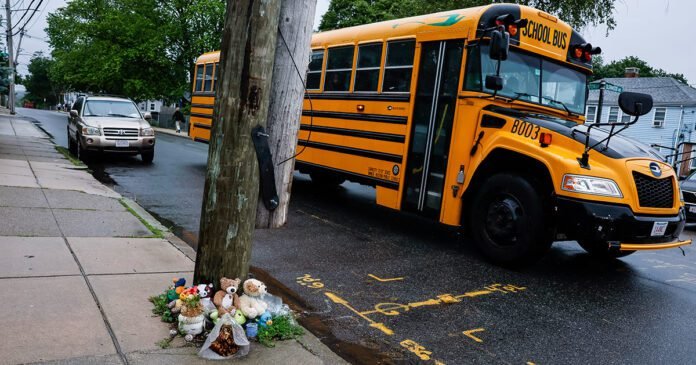
A Boston Public Schools bus drives past a memorial where Lens Joseph was run over in April 2025 by his own school bus.Erin Clark/The Boston Globe via Getty Images
Iran’s attacks on Israel were an attempt to shape the region on its own terms – and it might just do so
Iran fired barrages of missiles at Israel for the first time in two months on June 7. The initial trigger was an Israeli strike against a Hezbollah target in the Lebanese capital of Beirut earlier that day, an attack that Donald Trump had only recently asked the Israeli prime minister, Benjamin Netanyahu, to avoid carrying out.
Israel’s military soon launched retaliatory strikes on targets in western and central Iran, again defying calls by Trump for restraint. Iran subsequently launched fresh strikes of its own, before the Iranian military announced it was bringing its attacks to an end. In a statement, Iran warned it would carry out a “more severe” response if Israel’s attacks on Lebanon continue.
What caught my attention about this round of fighting is the geopolitical context in which it has occurred. Iran is trying to establish a new regional order, based on new rules. And it might just pull it off.
The first notable feature of this order is that Iran dictates to Israel and the US what they may and may not do. Iran started this latest round of fighting not because of an attack on Iranian territory, but as an attempt to dictate Israeli military actions in Lebanon.
Six months ago, Israel could do as it pleased in Lebanon without Iranian intervention. Now, thanks to Trump and Netanyahu’s war, Tehran feels empowered enough to try and place limits on Israeli action on Israel’s own borders.
We have seen, somewhat more obliquely, the same principle apply in the Strait of Hormuz over the past month or so. Iran established a chokehold over the vital waterway shortly after the start of the war in late February. And it has no intention of letting its control go.
This, too, is part of Iran’s new regional order. It is telling its opponents: do as we say or we tighten our stranglehold on the global economy. For now at least, US actions show that Washington would rather accept the continued existence of this reality than fight to change it.
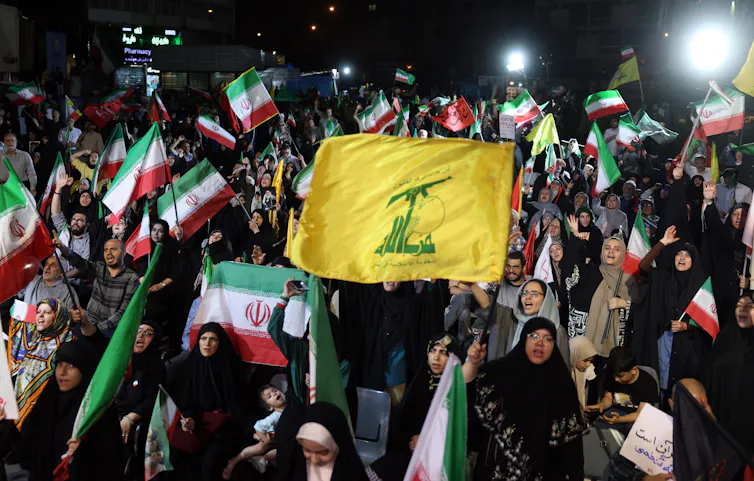
People wave Iranian and Hezbollah flags during a rally in Valiasr square, Tehran, on June 7 following Iran’s attack on Israel.Abedin Taherkenareh / EPA
A second aspect of the new regional order is Iran’s expanding ways of inflicting pain on its enemies in order to force acceptance of this new world. Iran has established that it can rain missiles on Israel, strike infrastructure across the Gulf states, kill American soldiers and choke the global economy of oil, all without facing a realistic attempt at regime change.
Iran also still has many cards in its pocket. These range from expanding the scope of energy and desalination targets it hits across the Gulf to activating the Houthis to block energy traffic in the Red Sea. The Houthis have announced a ban on Israeli shipping in the Red Sea following the latest escalation.
The US has threatened many times now to attack Iranian civilian infrastructure, invade its Kharg island export terminal or to escort ships through Hormuz. However, it has backed down from all of them out of fear of the consequences.
Strained US-Israeli ties
The third feature of the new regional order is that Israel and the US no longer march in lockstep. Trump responded to Iran’s attack on Israel by emphasising that his priority was to stop Israel from retaliating. “I am going to call Bibi right now and tell him not to retaliate,” he said following the initial Iranian strikes.
Netanyahu has managed to manoeuvre Israel into a position in which a Republican president is telling him not to respond to incoming Iranian missile barrages targeting Israeli civilians. This situation would scarcely have been believable six months ago.
Separating Israel from the US is a longstanding dream of Tehran. So far at least, there is no hint that Trump is threatening to withhold missile interceptor defences from Israel over the resumption in hostilities. But even while keeping American defensive aid, it would be very difficult for Israel to sustain further conflict with Iran.
Hunting missiles launchers would alone prove a challenge, because Israeli air power would be stretched much more thinly without American assistance in hitting targets. If the northern front against Hezbollah remains active as well, the Israeli military’s resources will be even more strained.
And for how long is the US going to accept running down its missile interceptor stocks in order to defend Israel from a bout of warfare that its famously mercurial president told the country not to start? In the short term, perhaps for a while. But over the longer term, it is not sustainable for the US to dedicate a substantial portion of its missile defences to protecting Israel.
A missile crosses the night sky over the West Bank city of Nablus on June 7.Alaa Badarneh / EPA
The fourth and final feature of the new regional order is that peace seems impossible to imagine. Netanyahu cannot accept an Iranian veto over Israel’s actions in Lebanon, nor absorb the implications for Israeli deterrence if he lets attacks from Iran go unanswered.
Trump cannot get his peace deal with Iran while Israel is bombing Lebanon. And Iran has the incentive to keep pushing for more, inflicting more costs on its opponents, because in the new regional order it can do so without many consequences.
This is the result of a disastrous war of choice which will go down as one of the most ill-conceived in American history.
Before Castro, the last U.S. indictment of a Latin American leader occurred in January 2026, when a U.S. attorney appointed by President Donald Trump charged Venezuela’s Nicolás Maduro with narco-terrorism. Those charges were promptly followed by U.S. military strikes on Venezuela and the abduction of Maduro.
I believe that what’s missing from most recent analysis of this situation is the history of U.S. aggression against Cuba. This is essential context for understanding the Trump administration’s recent escalations.
‘Striking at Cuba constantly’
In 1823, U.S. Secretary of State John Quincy Adams identified Cuba as “an object of transcendent importance to the political and commercial interests of our Union.” The 1959 Cuban Revolution that overthrew U.S.-backed dictator Fulgencio Batista and replaced him with Fidel Castro, brother of Raúl, directly challenged those interests by asserting political autonomy and expropriating private property.
State Department officials observed that “the majority of Cubans support Castro” because of the government’s redistributive measures and its “real honesty, courtesy, and idealism.” One official warned “that if the Cuban revolution is successful other countries in Latin America and perhaps elsewhere will use it as a model and we should decide whether or not we wish to have the Cuban revolution succeed.”
The CIA-led Bay of Pigs invasion in April 1961 is only the most famous episode. The U.S. trained 1,400 Cuban exiles to invade Cuba, hoping to ignite a nationwide rebellion. Instead, Cubans rallied behind the government.
Longtime CIA official Richard Helms later testified that in the early 1960s, “We had task forces that were striking at Cuba constantly. We were attempting to blow up power plants, we were attempting to ruin sugar mills, we were attempting to do all kinds of things during this period. This was a matter of American Government policy.”
The Bay of Pigs invasion and the airline bombing violate the core principles of international law, including prohibitions on the unprovoked “threat or use of force” and collective punishment. The U.S. government itself defines “international terrorism” as “violent acts” intended “to influence the policy of a government by intimidation or coercion” or to “intimidate or coerce a civilian population.”
By that definition, its Cuba policy qualifies.
By ‘every possible means’
Another U.S. method of striking at Cuba was through economic sanctions, first imposed on the country in 1960. That year, a State Department official wrote that “every possible means should be undertaken promptly to weaken the economic life of Cuba” so as “to bring about hunger, desperation and overthrow of government.” The logic of collective punishment was clear: make Cubans suffer enough that they rebel against Castro.
Images of Cuban President Miguel Díaz-Canel, Raúl Castro and Fidel Castro adorn the state building in Havana, Cuba, on May 20, 2026.AP Photo/Ramon Espinosa
This policy is now more aggressive than ever. The tightening of U.S. sanctions since Trump’s first term has reduced Cuba’s income from tourism, remittances and overseas medical missions. Now, by choking off the supply of fuel, the U.S. has critically weakened the healthcare and sanitation systems that depend on electricity.
‘I was trained as a terrorist by the United States’
The focus of the recent U.S. indictment against Raúl Castro was the incident on Feb. 24, 1996, when the Cuban military, which was headed by Castro, shot down those two planes.
The planes were operated by Brothers to the Rescue, an anti-Castro group of Cuban exiles who said they were aiding Cuban emigres trying to reach Florida. The group’s head, and one of the surviving pilots that day, was José Basulto, a veteran CIA asset and participant in the Bay of Pigs invasion.
In 1962, Basulto fired a cannon and machine gun “16 times” at a Cuban hotel, he later recounted. “I was trained as a terrorist by the United States,” Basulto once told an interviewer.
I believe indicting Cuban officials over the incident is disingenuous, given the provocations by Brothers to the Rescue and U.S. actions against Cuba, which are in direct violation of international and U.S. laws that prohibit threats, nondefensive violence and collective punishment.
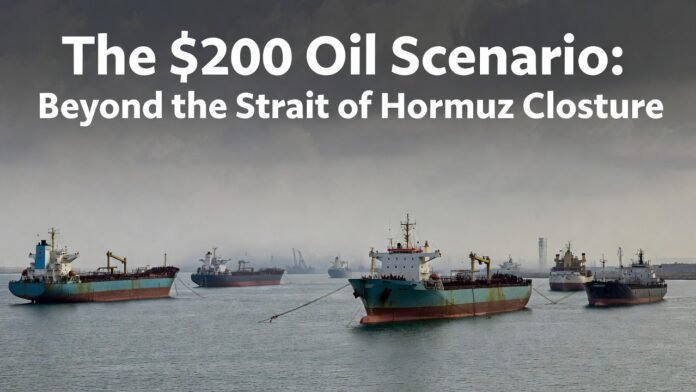
World nears oil operational floor, $200/b without Hormuz deal
The International Energy Agency has made its May report free to download, and the news is not good for the second and third quarters of this year, i.e. April-September.
The IEA hopes things will look up in the fourth quarter, but premises that expectation on an early end to the US conflict with Iran and a reopening of the Strait of Hormuz. At the moment, there does not seem much movement on that front, and in fact the US and Iran are not only skirmishing with one another but Iran is making good on its threat to hurt US allies like Bahrain and Kuwait every time the US hurts Iran.
One was killed and dozens injured in Kuwait last Wednesday by Iranian Shahed drone barrages that also damaged the airport. Kuwait Airlines shut down briefly but is now flying from a different terminal; it is the only carrier flying from Kuwait. Iran also targeted the headquarters of the US Fifth Fleet in Bahrain, but CENTCOM says the missiles were intercepted. Iran says the attacks were in reaction to US strikes on Qeshm Island, which is a base for Iranian missiles and a radar installation.
In the meantime, the IEA says that in Q2, ending June 30, world demand for petroleum will be down by 2.45 million barrels a day. This reduction is what economists call demand destruction and it is a very bad sign. People are just using less petroleum because it is more expensive than it was before the US and Israel attacked Iran on February 28.
In the US, gasoline is up by 35% to 50%. In Europe, diesel, which runs trucks, was the equivalent of $6.78 a gallon in February, and is now $8.02 per gallon (€1.82 per liter). If you are running a fleet of trucks over thousands of miles, that is a huge loss, and you might consolidate and cut out less remunerative routes.
Likewise, airlines have canceled tens of thousands of flights and ticket prices have risen, so some passengers are canceling or postponing trips. It is trucks that eliver goods to retail stores so, with diesel higher, prices of commodities have gone up and some customers have put off buying things they don’t desperately need right now. If the retailer doesn’t sell a product, it doesn’t order more, so the trucks don’t roll as often. And if the goods aren’t selling, the factories scale back production, so they use less petroleum, too.
The IEA statistics suggest that the pain is greater for the poorer countries, which makes sense. The wealthy countries’ consumers are paying more and cutting back a bit. Those in the developing world are just going without, as I pointed out a week ago.
The IEA expected the world to produce 106.1 million barrels a day in 2026. It won’t. That projection has been revised down to 102.2 million barrels a day, a reduction of 3.9 million barrels a day. That is severe. But here is the catch. That is the reduction if “flows through the Strait gradually resume from June.” As Qasim al-Ali points out, that is an iffy bet as things now stand. So the shortfall in production will be bigger. Which will slow the world economy even more.
The agency observes, “With Hormuz tanker traffic still restricted, cumulative supply losses from Gulf producers already exceed 1 billion barrels with more than 14 mb/d of oil now shut in, an unprecedented supply shock.”
The shock hasn’t been as bad as it could have been so far, for several reasons. We just saw that there is enormous demand destruction, with the economic slowdown it implies. Also, there was a glut in the oil market going into the crisis, which takes some of the pressure off. The US, Europe and China are drawing down their Strategic Petroleum Reserves at an alarming rate. That move eases the pain in the short term.
But low reserves imply a limited ability to deal with further supply shocks that may occur next year. Prime Minister Benjamin Netanyahu has signaled that he’d like to attack Iran again. So the big crisis may be next year this time, when there won’t be any SPR cushion.
Also, Strategic Petroleum Reserves are not infinite. China has enough for six months. At some point governments will become reluctant to draw them down any more, and then the interruption in supplies from the Gulf will hit all that much harder. The reserves held at oil hubs can’t go to zero, moreover. The inventory at Cushing, OK, has fallen from 33 to 24.5 million barrels. But it can’t go lower than 20 mn barrels without gumming up the pipelines and refineries.
Last week alone, US petroleum reserves fell by 10.6 million barrels, to the lowest level seen since 2004.
Global reserves of petroleum could fall so low by September that, if the crisis is not resolved, they will reach what analysts call “an operational floor.”
And when that happens, the shortages won’t be able to be finessed anymore, not by demand destruction and not by release of reserves.
And when we cross that threshold, oil shoots suddenly to $200 a barrel, which is an energy crisis apocalypse and spells deep gloom for the global and the US economy.
A Falcon 9 booster turns five years old—and just set a remarkable reuse record
A little more than five years ago, a shiny white Falcon 9 rocket made its debut flight, boosting a Cargo Dragon spacecraft to the International Space Station. Over the next year, it would launch a pair of astronaut missions and a handful of commercial spacecraft.
But since then, this first stage booster, designated B 1067, has mostly flown Starlink missions. It has launched them one after another, always returning safely to a drone ship before undergoing refurbishment and flying again. Sometimes it has flown twice in a single month.
On Monday morning, B 1067 once again took to the skies, launching 29 Starlink Internet satellites into low-Earth orbit from Florida. Upon landing on the A Shortfall of Gravitas drone ship in the Atlantic Ocean, the vehicle completed its 35th mission overall, retaining its title as fleet leader for SpaceX.
Is 40 the goal, or will it be extended again?
The successful launch brings SpaceX closer to its most recently stated goal of qualifying its Falcon 9 first stage vehicles to support 40 missions each. Since that goal was outlined more than two years ago and the company has continued flying its experienced boosters safely across dozens of missions, SpaceX may be intending to push past 40 missions.
We take the Falcon 9 rocket for granted. It now launches so often—a few times a week—that its flights are a complete non-event. Even a milestone like a 35th launch and landing, bringing it closer to space shuttle Discovery‘s record of 39 spaceflights across nearly four decades, seems hardly worth mentioning.
But in reality, the Falcon 9 rocket is the bedrock of SpaceX’s success today. And whatever one might think of the company’s impending IPO—whether it’s a financial boondoggle or a long-awaited opportunity for investors to own a piece of SpaceX—its valuation is largely due to the Falcon 9 vehicle.
The success of Falcon 9 allowed SpaceX to launch cargo and then crew to the space station for NASA, giving it instant credibility as a global spaceflight leader. Experimentation with the Falcon 9 first stages led SpaceX to pioneer first-stage landings and reuse. The record-setting cadence of reused Falcon 9 boosters allowed SpaceX to dominate launch internationally and deploy its Starlink mega-constellation, finally pushing the company to reach profitability.
SpaceX is targeting a valuation of $1.75 billion in its IPO on Friday, which is predicated on Starship flying frequently and deploying massive networks of orbital data centers in space.
But it’s only because of the success of the Falcon 9—with which SpaceX proved it could fly rapid, reusable rockets and use them to deploy thousands of satellites—that anyone gives credence to the company’s future plans. Starship and orbital data centers are the Falcon 9 and Starlink constellations on steroids. Absent the Falcon 9, they seem like the hallucinations of a bad AI model. With the success of the Falcon 9 rocket, a line just might possibly exist from here to there.
More launches than ULA in half a decade
Finally, it’s worth considering just how much work this single Falcon 9 rocket, once so clean and shiny and now so dark and grimy, has accomplished in its short lifetime.
For some context, consider the performance of SpaceX’s top US-based competitor in medium- and heavy-lift launch, United Launch Alliance. Since Booster 1067 made its debut in June 2021, the company has flown its workhorse Atlas V rocket a total of 22 times and the Vulcan rocket four times, and the Delta IV Heavy vehicle made its final three flights.
So in the time that this single Falcon 9 first stage has flown and landed 35 times, its competitor company has made 29 total launches. Put another way, this rocket has put more mass into orbit than more than two dozen expendable rockets over half a decade of effort.
Iran attacking Israel seeks to shape the region on its own terms
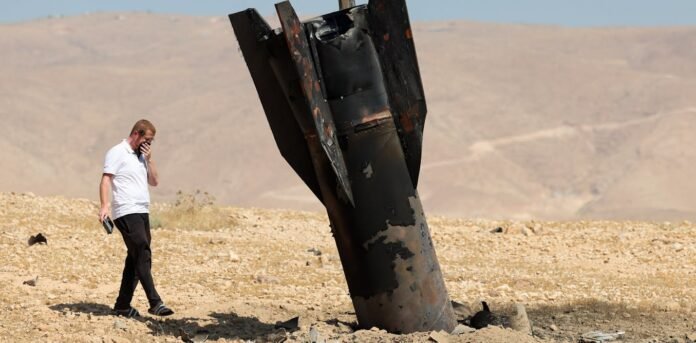
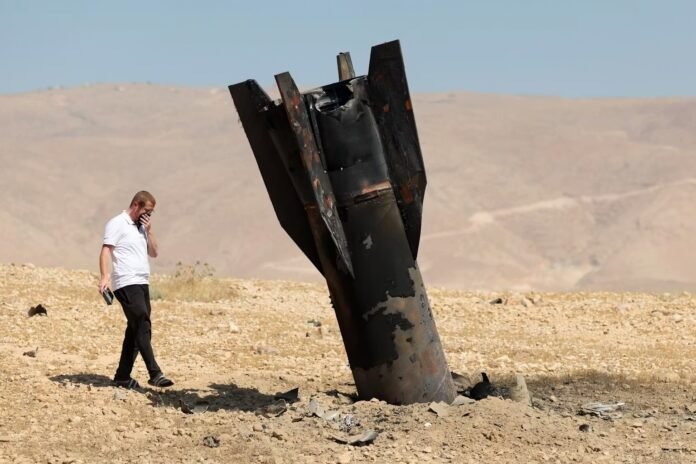
An Israeli man looks at the remains of an Iranian ballistic missile that landed in a field next to the West Bank settlement of Mevo’ot Yericho on June 8. Photo: Abir Sultan / EPA
Iran fired barrages of missiles at Israel for the first time in two months on June 7. The initial trigger was an Israeli strike against a Hezbollah target in the Lebanese capital of Beirut earlier that day, an attack that Donald Trump had only recently asked the Israeli prime minister, Benjamin Netanyahu, to avoid carrying out.
Israel’s military soon launched retaliatory strikes on targets in western and central Iran, again defying calls by Trump for restraint. Iran subsequently launched fresh strikes of its own, before the Iranian military announced it was bringing its attacks to an end. In a statement, Iran warned that it would carry out a “more severe” response if Israel’s attacks on Lebanon continued.
What caught my attention about this round of fighting is the geopolitical context in which it has occurred. Iran is trying to establish a new regional order, based on new rules. And it just might pull it off.
The first notable feature of this order is that Iran dictates to Israel and the US what they may and may not do. Iran started this latest round of fighting not because of an attack on Iranian territory, but as an attempt to dictate Israeli military actions in Lebanon.
Six months ago, Israel could do as it pleased in Lebanon without Iranian intervention. Now, thanks to Trump and Netanyahu’s war, Tehran feels sufficiently empowered to try and place limits on Israeli action on Israel’s own borders.
We have seen, somewhat more obliquely, the same principle apply in the Strait of Hormuz over the past month or so. Iran established a chokehold over the vital waterway shortly after the start of the war in late February. And it has no intention of letting its control go.
This, too, is part of Iran’s new regional order. Tehran is telling its opponents: Do as we say or we tighten our stranglehold on the global economy. For now at least, US actions show that Washington would rather accept the continued existence of this reality than fight to change it.
A second aspect of the new regional order is Iran’s expanding ways of inflicting pain on its enemies in order to force acceptance of this new world. Iran has established that it can rain missiles on Israel, strike infrastructure across the Gulf states, kill American soldiers and choke the global economy of oil, all without facing a realistic attempt at regime change.
Iran also still has many cards in its pocket. These range from expanding the scope of energy and desalination targets it hits across the Gulf to activating the Houthis to block energy traffic in the Red Sea. The Houthis have announced a ban on Israeli shipping in the Red Sea following the latest escalation.
The US has threatened many times now to attack Iranian civilian infrastructure, invade its Kharg island export terminal or to escort ships through Hormuz. However, it has backed down from all of them out of fear of the consequences.
Strained US-Israeli ties
The third feature of the new regional order is that Israel and the US no longer march in lockstep. Trump responded to Iran’s attack on Israel by emphasizing that his priority was to stop Israel from retaliating. “I am going to call Bibi right now and tell him not to retaliate,” he said following the initial Iranian strikes.
Netanyahu has managed to maneuver Israel into a position in which a Republican president is telling him not to respond to incoming Iranian missile barrages targeting Israeli civilians. This situation would have been scarcely believable six months ago.
Separating Israel from the US is a longstanding dream of Tehran. So far at least, there is no hint that Trump is threatening to withhold missile interceptor defenses from Israel over the resumption in hostilities. But even while keeping American defensive aid, it would be very difficult for Israel to sustain further conflict with Iran.
Hunting missile launchers would alone prove a challenge, because Israeli air power would be stretched much more thinly without American assistance in hitting targets. If the northern front against Hezbollah remains active as well, the Israeli military’s resources will be even more strained.
And for how long is the US going to accept running down its missile interceptor stocks in order to defend Israel from a bout of warfare that a famously mercurial US president told Israel not to start? In the short term, perhaps for a while. But over the longer term, it is not sustainable for the US to dedicate a substantial portion of its missile defenses to protecting Israel.
The fourth and final feature of the new regional order is that peace seems impossible to imagine. Netanyahu cannot accept an Iranian veto over Israel’s actions in Lebanon, nor absorb the implications for Israeli deterrence if he lets attacks from Iran go unanswered.
Trump cannot get his peace deal with Iran while Israel is bombing Lebanon. And Iran has the incentive to keep pushing for more, inflicting more costs on its opponents, because in the new regional order it can do so without many consequences.
This is the result of a disastrous war of choice which will go down as one of the most ill-conceived in American history.
Michigan politicians want to ban Chinese-badged cars from even visiting the US
It’s an election year, and that means politicians are putting in extra work to pander to special interest groups they think will help them cross the finish line. If you’re looking to be elected in Michigan, there aren’t many interests more special than the automotive industry, and a good way to get the industry on your side is by going after the thing it fears the most: China.
Now, if a pair of lawmakers get their way, Chinese-badged vehicles wouldn’t just be restricted from sale or import in the US, they’d also be banned from entering the country, even for a simple day trip from Canada or Mexico.
Moves to protect the US auto industry are nothing new, and they’re popular across party lines. Former President Biden added an additional 100 percent import tariff on all Chinese-made cars during his term and then had the Department of Commerce draw up new rules—later implemented by the Trump administration—that banned the import of connected cars manufactured by companies owned by or with links to the Chinese government, starting in 2027.
It’s possible to get authorization under those rules to import connected cars; last month, Volvo Cars got such permission to import its EX60, which would still have fallen foul of the regulations despite being built in Sweden, thanks to Volvo being part-owned by Zhejiang Geely Holding. (Geely also owns Polestar, which is seeking authorization for its own EVs, as well as Zeekr, which will be supplying Waymo with electric minivans to convert into robotaxis.)
But those rules don’t go far enough for Senator Elissa Slotkin (D-Mich.) or Rep. Haley Stevens (D-Mich.), who are introducing the Protecting America from Chinese Cars Act. Should it pass, the bill would ban connected cars built or designed in China (and other adversarial nations like Russia) from entering the country, including any connected cars built elsewhere by a Chinese company or by any firm in which Chinese companies own more than 15 percent.
Like the existing Commerce regulations, the bill would create a mechanism by which OEMs can apply for authorization “to allow otherwise prohibited vehicles to enter the US.”
“Specific authorizations could only be granted under strict conditions, with both transparency and congressional oversight,” the bill says. Customs and Border Protection would have 90 days to implement the rules, “including [generating] a list of prohibited vehicles.”
“We’re gonna be aggressive here because Michigan jobs are on the line, but also so is national security. So close our border to Chinese vehicles and Chinese technology in the vehicles, even for day trips. That’s how aggressive we believe we need to be right now,” Stevens said while speaking at a policy conference.
Her partner in the legislation went much further. “They can certainly come across the border, drive up to Selfridge Air Force base, take some video with the car. The car is a traveling surveillance package. And all of that data that the car is collecting is being sent straight back to Beijing,” Slotkin said.
Sen. Slotkin had previously partnered with Sen. Bernie Moreno (R-Ohio), a former car dealer, on the Connected Vehicle Security Act of 2026, which appears to have the same aims—keeping Chinese-made or Chinese-badged cars out of the US.
“This is an economic security issue and a national security issue, and we must prevent these vehicles from driving over our border and into our communities,” said Senator Slotkin. “They’re surveillance packages on wheels—fully capable of geolocating individual drivers, collecting full-motion video, and mapping sensitive infrastructure sites, including our military. This bill builds on my bipartisan Connected Vehicle Security Act of 2026 and bans fully finished Chinese vehicles from driving over in any capacity, even just for the day.”
In 2021, China barred Teslas from its military bases and other sensitive sites but rescinded the ban recently after Tesla began complying with Chinese data security laws that, among other things, require automakers to hand user data to the Chinese government. More recently, both the UK and Poland have banned Chinese-linked connected cars from parking near sensitive military installations.
The Rolling Stones legend has made it clear he is itching to get back on the road, even as old fears about his safety are coming back into the spotlight.
Jagger, 82, recently said he “can’t wait” to tour again with The Rolling Stones during an appearance on BBC Radio 2’s Tracks of My Years with longtime bandmate Ronnie Wood, 79.
The comments come as the band prepares to release its 25th studio album, Foreign Tongues, on July 10.
But while fans may be thrilled at the idea of seeing the Stones back onstage, insiders say those close to Jagger are worried. The rock icon has survived decades of wild crowds, terrifying threats, riots, violence and the crushing demands of life on the road.
One source close to the band said Jagger’s love of performing has never faded.
“Mick’s passion for performing is as strong as ever, but it inevitably raises concerns among people who care about him,” the insider said. “The extraordinary thing is that after everything he has experienced over the years, including genuine fears for his safety, he still wants to get back out there in front of huge crowds.”
That drive, the source added, is both impressive and worrying.
The renewed concern has brought fresh attention to one of the darkest chapters in Stones history: the band’s infamous 1972 North American tour.
That 53-day run was no ordinary rock tour. It was a chaotic ride through riots, bomb threats, arrests, political unrest and real fears that someone might try to hurt Jagger while he was performing.
The tour came just a few years after the deadly Altamont Speedway Free Festival in 1969, where 18-year-old Meredith Hunter was fatally stabbed during the Stones’ performance. The Hells Angels had been used as security at the event, and the fallout haunted the band for years.
According to tour manager Peter Rudge, members of the biker gang later sought payment for legal expenses tied to the incident and repeatedly harassed the band.
Keith Richards later revealed just how frightened Jagger was during that period.
In his memoir Life, Richards wrote that Jagger became deeply nervous about people trying to get to him. He said there were threats, obsessed fans, people who would walk up and hit him, and fears that the Hells Angels wanted him dead.
Richards said Jagger wanted a doctor nearby who could keep him alive if he was shot onstage.
A source familiar with the Stones’ history said the danger was not exaggerated.
“People sometimes forget just how serious the security situation became during that period,” the source said. “There were credible threats, there was chaos at certain venues, and there was a real fear that someone might try to harm Mick during a performance.”
The 1972 tour was marked by frightening scenes in city after city.
Riots broke out in Vancouver and San Diego. Police used tear gas to control crowds in Tucson. In Montreal, French-Canadian separatists bombed the band’s equipment truck in an attempt to draw attention to their cause.
Jagger himself once admitted he saw disturbing behavior from the stage.
“I see weird things out front some nights,” he said, recalling one fan begging him to whip him during Midnight Rambler.
More than five decades later, Jagger is still brushing off the danger and the physical toll of touring.
When asked if fans could expect another Rolling Stones tour, he left little doubt.
“I’d love to go on tour. Can’t wait,” Jagger said.
He added that it likely would not happen this year, but he hoped it would be “as soon as possible.”
Another insider said performing is simply part of who Jagger is.
“Being on stage is what drives Mick,” the insider said. “Even after decades of touring, controversy, threats and unimaginable pressure, he still sees performing as the thing that keeps him going.”
For now, Jagger appears determined to prove that age, danger and decades of rock ’n’ roll chaos still have not slowed him down.