LONG BEACH, Calif.—2026 is a strange time for electric vehicles in the US. The current administration has no desire to push for their adoption and has rescinded the federal tax credit on which EV sales have depended for years. Tariffs have made vehicles and their constituent components even more expensive, making switching to an EV for the first time an even harder pill to swallow. Manufacturers like Honda, which had three nearly production-ready EVs on deck, just killed them all unceremoniously.
It’s bleak out there.
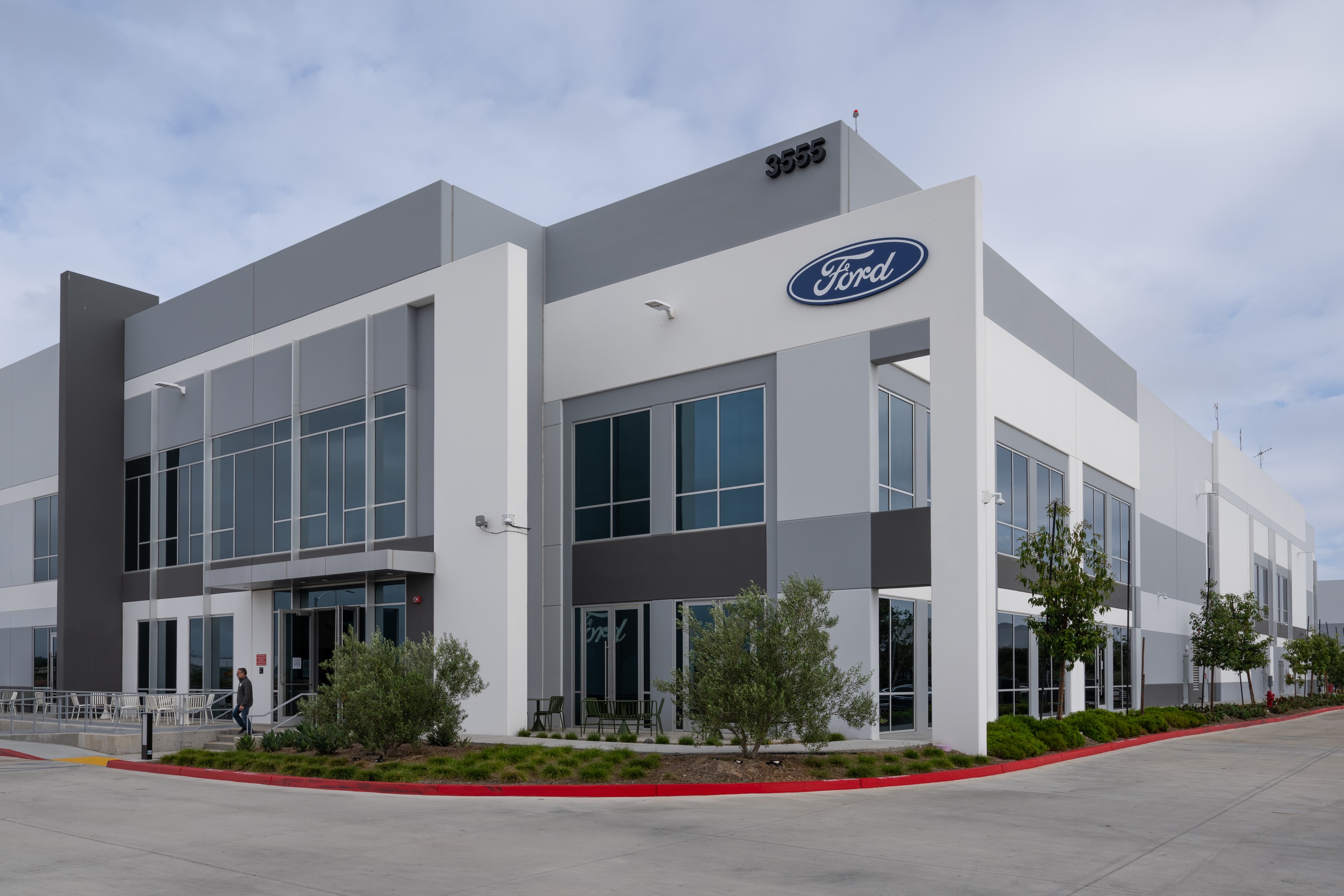
Still, Ford has decided to stay in the game with its “Universal Electric Vehicle,” which it announced in late 2025. This highly modular platform is designed to underpin all of the Blue Oval’s electric vehicles going forward. The work has been largely conducted at Ford’s Electric Vehicle Development Center (EVDC) in sunny Long Beach, California, and Ars Technica was recently invited to tour the facility to see what makes it different from any of Ford’s other operations.
The skunkworks
Inside a bland-looking tilt-up concrete building in a new-ish business park near the Long Beach Airport, Ford is attempting to upend the way it develops new vehicles. The EVDC was conceived of as a “skunkworks,” but what is that, and why is it important for Ford’s future?
The first skunkworks was a highly autonomous, secretive division within Lockheed Martin that began in Burbank, California, in the 1940s. It got its name from its proximity to a plastics plant that made the surrounding area stink; the smell was so bad that one of the engineers assigned to the division started referring to the building as the “Skonk Works,” after a fictional product from the “Lil’ Abner” comic strip. The name stuck, but it was changed from Skonk to Skunk to avoid any lawsuits.

Lockheed’s Skunk Works (an official trademark) was headed by an aeronautical engineer named Clarence Leonard Johnson—better known as Kelly Johnson. Johnson is well known today as the father of the P-38 Lightning, the U2 spy plane, and even the SR-71 Blackbird (aka the coolest plane ever).
He’s probably best known outside plane geek circles for his list of 14 rules for running a skunkworks program. Let’s run through them to understand Ford’s goals with EVDC.
1. The Skunk Works manager must be delegated practically complete control of his program in all aspects. He should report to a division president or higher.
Johnson’s first rule of running a skunkworks is arguably the most critical. The goal of a program like Ford’s EVDC is to reduce the red tape required to advance a project. This is especially important in a company like Ford, which has a deeply entrenched bureaucracy.
In EVDC’s case, this top-level manager is Alan Clarke, vice president of Advanced Development Projects. Before joining Ford in 2022, he worked in development at Tesla. This is a theme at EVDC, with many senior staff coming from Tesla. Clarke works hand in hand with Jolanta Coffey, the vehicle program director for the UEV program, who previously worked on the European Transit and USDM Expedition and Navigator.
2. Strong but small project offices must be provided both by the military and industry.
EVDC’s physical distance from both Dearborn and the EV office in Palo Alto, California, is designed to further ingrain that sense of autonomy from the big blue mothership. While the EVDC program works closely with both of those offices, day-to-day operations take place at the Long Beach location, which serves as a one-stop shop for vehicle development. EVDC spans just two buildings, with the fleet center occupying a large part of the second building.
3. The number of people having any connection with the project must be restricted in an almost vicious manner. Use a small number of good people (10–25 percent compared to the so-called normal systems).
A small team is another of the core principles outlined by Johnson in his 14 rules, and it’s arguably the most quoted today. A small, agile team is an advantage in a skunkworks because, as with the first rule, it cuts through red tape. It allows you to move quickly and adapt to failures or changes without dealing with the organizational inertia inherent in a big team.
To that end, the Ford EVDC currently has around 350 people working at Long Beach at any given time. Employees in outside offices that deal with manufacturing engineering and software, for example, bring the team size to around 480, but in Ford terms, that’s still a very small division.
4. A very simple drawing and drawing release system with great flexibility for making changes must be provided.
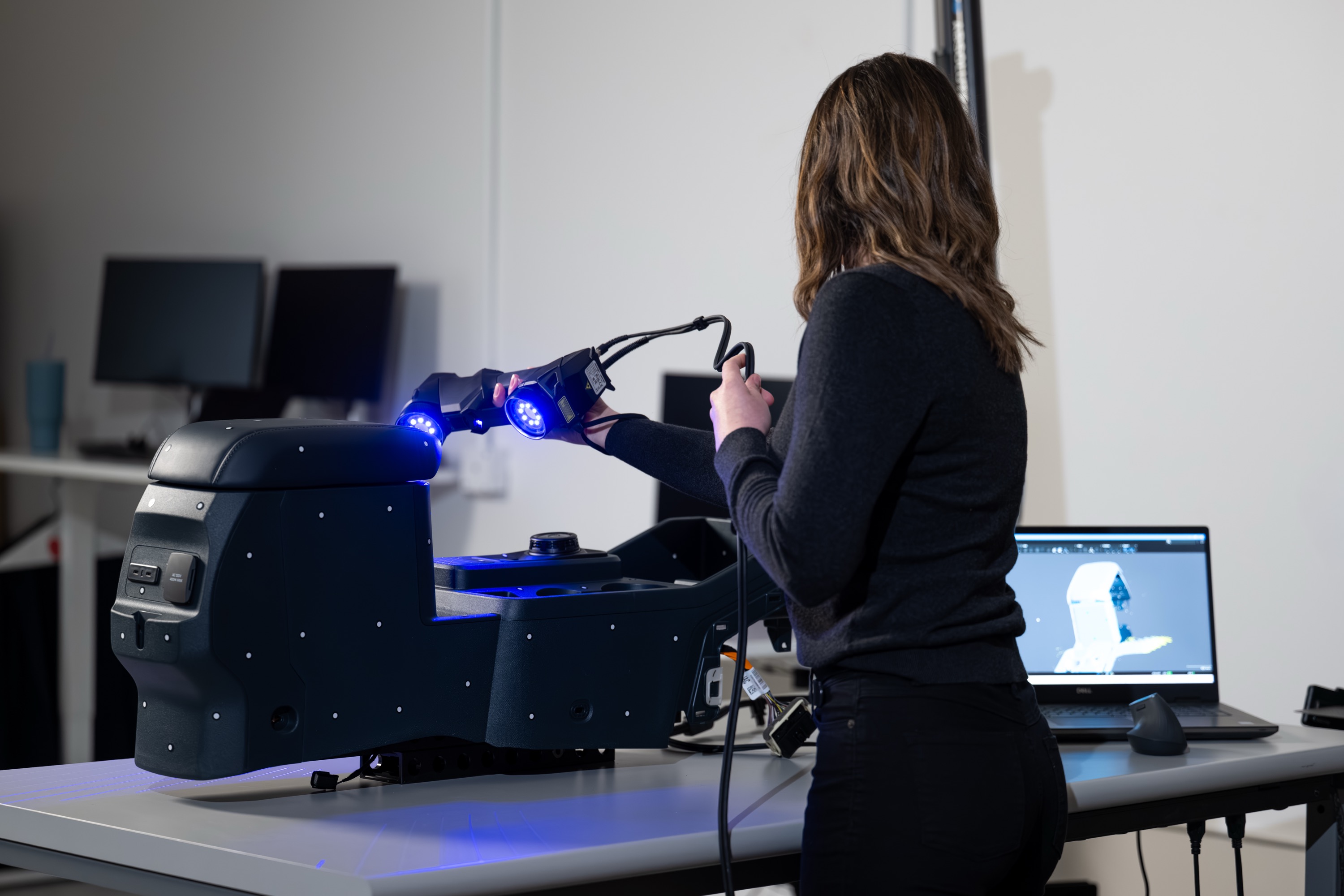
This is an interesting one. EVDC is extremely well-equipped with everything from three types of 3D printers to a CNC mill bigger than my first three apartments (including one just for shaping full-size clay models). This allows for rapid iteration and a simplified approval process without the need to send changed models and drawings off-site for manufacturing. Speed also comes from everyone being under one roof, preventing silos. All of that is in addition to a wood shop, a metals shop, and more. Even elements like seat design and patterning are done in-house.
5. There must be a minimum number of reports required, but important work must be recorded thoroughly.
The less time you spend justifying your decisions to upper management, the more time you have to actually do the work.
6. There must be a monthly cost review covering not only what has been spent and committed but also projected costs to the conclusion of the program.
This may seem like Project Management 101, but it goes beyond just budgeting time and money for the project’s development. Because the Universal Electric Vehicle is being designed to be as affordable as possible, constantly considering the effect of design decisions on cost is critical. This extends from material selection to making the seat mounting bolts face outward, speeding installation and reducing labor costs on the line. Ford is being relentless in this pursuit.
7. The contractor must be delegated and must assume more than normal responsibility to get good vendor bids for subcontract on the project. Commercial bid procedures are very often better than military ones.
Modern manufacturing tech has largely made Johnson’s seventh rule irrelevant. Because EVDC is so vertically integrated, from computer design to clay models, rapid prototyping, assembly, and testing, the need for outside contractors has largely been eliminated.
8. The inspection system as currently used by the Skunk Works, which has been approved by both the Air Force and Navy, meets the intent of existing military requirements and should be used on new projects. Push more basic inspection responsibility back to subcontractors and vendors. Don’t duplicate so much inspection.
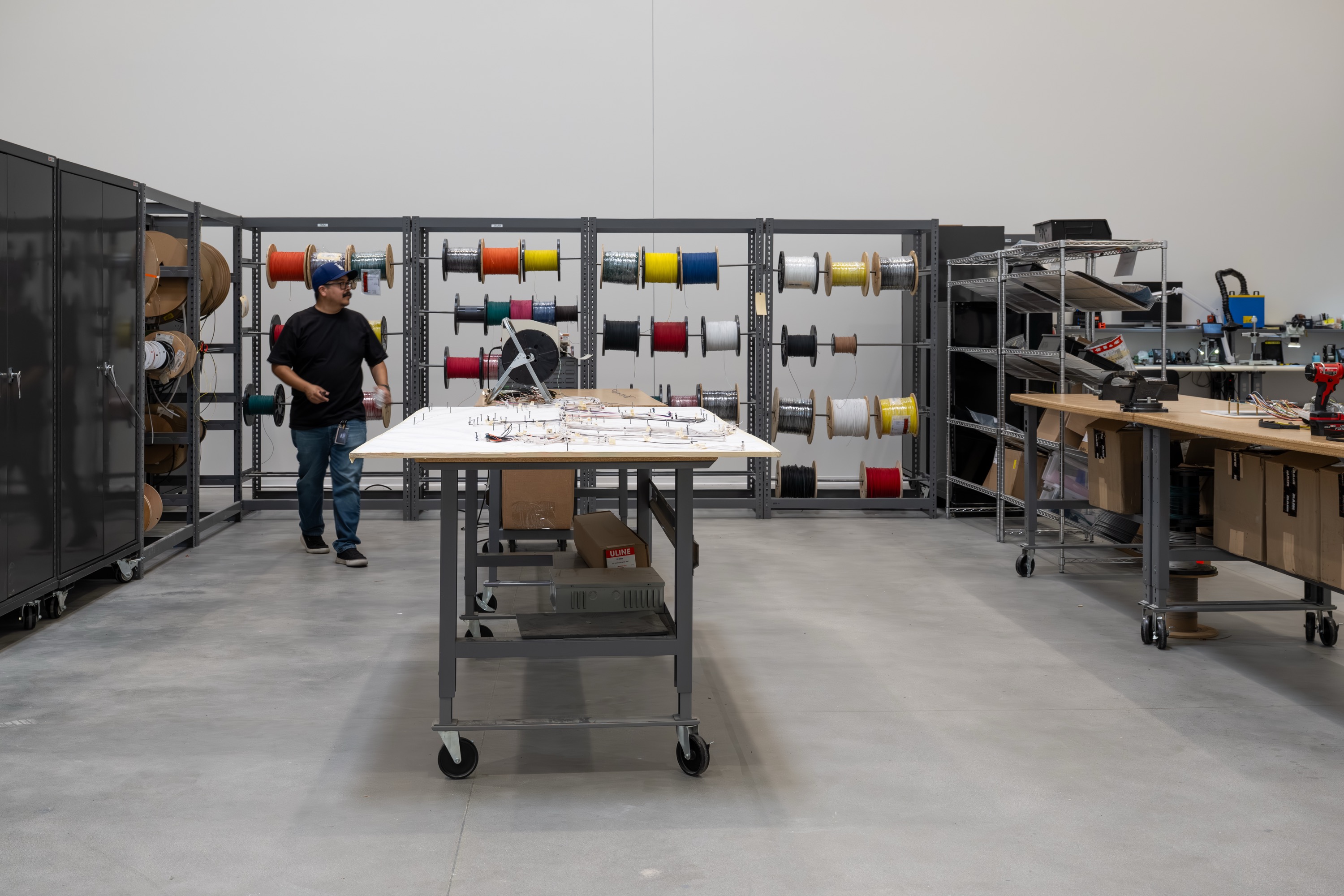
If we swap contractors for engineers, this rule becomes much more relevant to what Ford is trying to do. At EVDC, the teams are fully equipped with high-level test equipment, enabling them to validate designs before they ever leave the office. There is even a mock car made of 80/20 aluminum extrusions, used to lay out an entire wiring harness and everything that attaches to it, short of a battery pack. This allows the engineers to validate not only hardware, such as the in-house modules that make up UEV’s zonal architecture, but also the software.
9. The contractor must be delegated the authority to test his final product in flight. He can and must test it in the initial stages. If he doesn’t, he rapidly loses his competency to design other vehicles.
All teams at EVDC follow their work through all stages of the project. They are in constant contact with other teams to avoid the left hand not knowing what the right hand is doing. Testing is constant, and revisions are as frequent.
10. The specifications applying to the hardware must be agreed to well in advance of contracting. The Skunk Works practice of having a specification section stating clearly which important military specification items will not knowingly be complied with and reasons therefore is highly recommended.
This one isn’t super relevant, but Ford set the specs for the UEV a while ago, giving the design teams a target to hit.
11. Funding a program must be timely so that the contractor doesn’t have to keep running to the bank to support government projects.
There’s probably a joke in here somewhere about Ford not taking the 2009 bailout.
12. There must be mutual trust between the military project organization and the contractor, the very close cooperation and liaison on a day-to-day basis. This cuts down misunderstanding and correspondence to an absolute minimum.
This is related to teams at EVDC working in close proximity. If there’s a hardware problem with the E-Box during climate chamber dyno testing, the team that designed it can simply walk over to see what failed. No travel, no Zoom calls.
13. Access by outsiders to the project and its personnel must be strictly controlled by appropriate security measures.
This is another very important rule. Johnson and the original Skunk Works were working on secret military planes and cutting-edge technology. If other nations got hold of what they were doing, there could have been very real consequences.
The situation is less serious with Ford and EVDC, but the company still takes security very seriously. Our visit to the facility was the first time anyone outside the program had been allowed in. This level of secrecy and access control is a big deal for Ford for obvious reasons, but it speaks to the nature of the work the people at EVDC do.
14. Because only a few people will be used in engineering and most other areas, ways must be provided to reward good performance by pay, not based on the number of personnel supervised.
While I can’t speak to the EVDC staff’s salaries, we can discuss why Ford chose to put this facility in Long Beach. The idea behind EVDC is to attract the best employees possible from a specific pool. Getting some of those people to move to Dearborn might be a challenge—if you’ve been to the Detroit area in January, you understand what I’m talking about. Southern California, despite its high cost of living, is a popular place to live, with great weather and plenty to do. It’s a lower lift to ask people to move from Silicon Valley (like ex-Tesla employees) to the Los Angeles area.
The electric midsize truck
So what has all this secrecy, agility, and good California sunshine gotten Ford? What have the folks behind the Universal Electric Vehicle program managed to create? Will the project bring widespread EV adoption to the US? Or will it be another F-150 Lightning—technically great, liked by critics, but not widely embraced by the truck-buying public?
We don’t know much about the first vehicle based on the UEV platform, and what I saw during the tour was abstract and focused on how the sausage is made. Still, many of the design decisions Ford is making to bring down the UEV platform’s cost seem smart rather than short-sighted, which aligns with what I’ve come to expect from the Big Three.
For example, the UEV uses the battery pack as a stressed member of the chassis, and the vehicle’s seats are even bolted to it. (BMW uses a similar approach with its Neue Klasse EVs.) This reduces the amount of sheet metal required and the time it takes to build a vehicle on the line. The reduction in complexity and parts is at the heart of the UEV program, and it doesn’t stop at the pack.
Ford is using large castings to form the vehicle’s front and rear clips, reducing part count and increasing rigidity. That sounds great, but what happens in a crash? Would the owner be on the hook for an expensive single part rather than cheaper sheet-metal repair pieces? Ford has thought of that, too.
Vlad Bogachuk, Ford’s chief engineer of advanced vehicle structure, explained that the solution is simpler than it seems. “In our collision repair literature, we will outline the process of cutting through the casting at a designated cut line and then replacing the damaged portion with a new repair casting,” he said. “This repair part is bonded to the original casting and shouldn’t affect the integrity of the vehicle’s structure at all.”
If panel bond (essentially expensive car glue) sounds like a strange solution, keep in mind that most supercars and hypercars are held together with it and not much else.
Other methods to keep costs down include “zonal architecture,” which reduces the number of separate computers and control modules, thereby also reducing the wiring harness. That is further thinned down by using 48-volt architecture instead of 12-volt, allowing for thinner wires and less copper overall. EVDC engineers are most focused on increasing efficiency and reducing manufacturing costs.
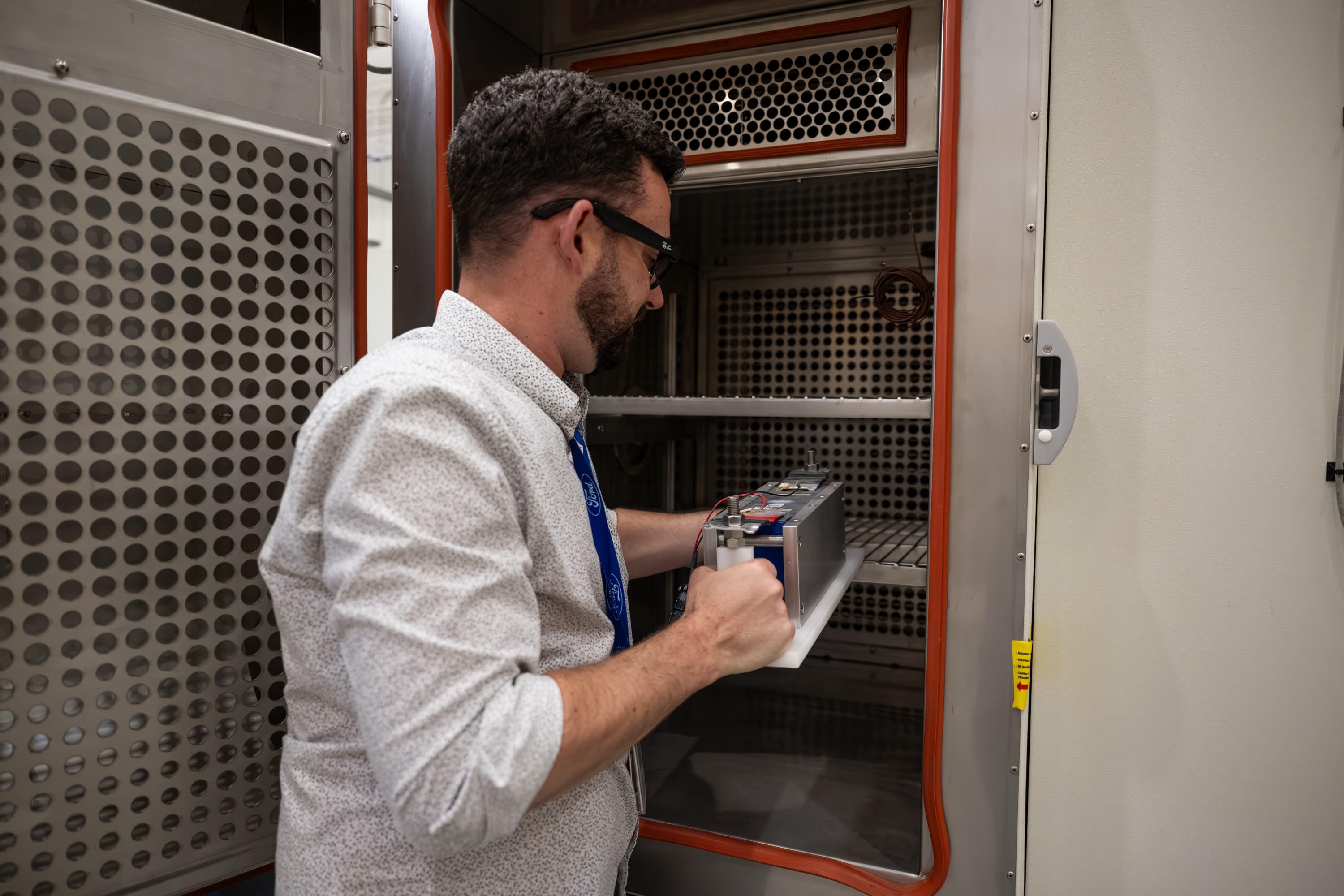
Using lithium iron phosphate battery chemistry, despite its lower energy density when compared to lithium-ion cells, is also a calculated decision. Lithium iron phosphate, or LiFePO4, is much cheaper than lithium-ion because it doesn’t contain rare-earth minerals like cobalt. That also makes it more environmentally friendly.
Ford is hoping that making the UEV midsize truck as light and aerodynamic as possible will offset the lower energy density of LiFePO4 and still produce a vehicle with close to 300 miles (482 km) of range, seemingly the gold standard for convincing people to switch from internal combustion to electric power.
Sounds good—hope it pans out
All of this sounds encouraging, and I was impressed with the culture and facility that Ford has created in Long Beach. But if the recent lessons Honda taught us are anything to go by, the UEV’s future—and indeed that of the Electric Vehicle Development Center—are anything but certain.
Developing electric vehicles that push technology forward is expensive, and Ford is anything but a sentimental company. If the case for the UEV doesn’t make business sense—whether due to customer disinterest or the current administration and its attitudes toward environmentalism—it seems likely that CEO Jim Farley wouldn’t hesitate to cut it loose.