US forces have struck hundreds of Iranian targets – including in the southern port city of Bandar Abbas – over three consecutive nights in a bid by the US president, Donald Trump, to regain some modicum of control over the Strait of Hormuz.
Trump has also inscribed the US as the “guardian” of the vital waterway. He has revived a naval blockade of Iranian ports and briefly demanded a 20% charge on all cargo passing through. His own secretary of state, Marco Rubio, had ruled out such a toll just two weeks ago.
Iran, meanwhile, has escalated by striking two tankers in the strait, killing a crew member. It has also hit US bases across the Gulf. Tehran’s brazen attempt to frustrate the US, and by extension the world economy, by targeting commercial vessels in the strait is indicative of the leverage it holds in this war.
But amid this cycle of tit-for-tat strikes, a key question is why Iran has decided to menace the strait in the current conflict when it has possessed the capacity to do so for decades.
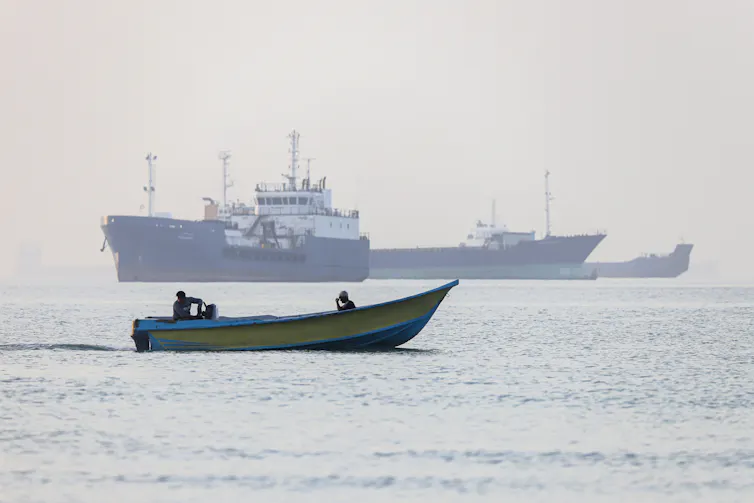
For four decades, the threat to close the Strait of Hormuz represented a match that was never lit. Even at the height of the Iran-Iraq war in the 1980s, where more than 400 vessels were attacked in the Gulf, Tehran demonstrated conspicuous restraint.
It never attempted to seal the strait itself, not even after a US warship – the USS Vincennes – mistakenly shot down an Iranian passenger plane in 1988, killing 290 people.
Back then, Tehran’s logic dictated that closure of the strait would undermine its own oil revenue and invite retaliation. As political scientist Caitlin Talmadge put it in 2008: it would amount to “the military equivalent of cutting off its nose to spite its [enemies] face”.
The Strait of Hormuz served as a key instrument of Iranian coercive diplomacy. Tehran leveraged the prospect of closure as a deterrent and bargaining tool, without resorting to its implementation.
In 2011, Iran’s vice-president at the time, Mohammad Reza Rahimi, threatened that “not a drop of oil will pass through the Strait of Hormuz” if western sanctions on its petroleum exports went ahead. Yet Tehran ultimately acquiesced and allowed the embargo to take effect without closing the strait.
Through every round of escalation prior to 2026, this pattern of bluffing endured. That Tehran has chosen to act upon its threats in the current conflict makes the decision especially telling.
Accepting more risk
This about-turn speaks to a shift in Iran’s psychological risk perception, rather than material capability alone. Here, prospect theory offers a compelling answer. The theory holds that decision makers do not weigh risks consistently or rationally.
People are less likely to accept risk when operating within a frame of gains – preferring the certainty of what they hold over any gamble. But when leaders read a situation as one of loss, the logic reverses and they take greater risks to recover those losses.
The clearest window into this shift is the first statement attributed to the new Iranian supreme leader, Mojtaba Khamenei. In a March 12 statement, two weeks after the assassination of his predecessor Ali Khamenei, he declared:
The revenge we have in mind is not just because of the martyrdom of the illustrious leader of the revolution. Every member of the nation martyred by the enemy is a separate case that demands we seek revenge … the leverage of closing the Strait of Hormuz must definitely continue to be utilised.
The statement presented each death not as a tragic cost of war, but a sacred debt that the US and Israel owe through retributive action. And the Strait of Hormuz was presented as the answer. Khamenei’s insistence that its leverage “must definitely continue to be utilised” transformed the strait into the mechanism through which accumulated losses are regained.
This narrative has been echoed well beyond Tehran. In an address delivered facing the strait itself in mid-April, Iranian cleric Hojjat al-Islam Jafar Rastakhiz stated that “for 47 years the criminal America has sanctioned us” and now “the Strait of Hormuz, because of the atrocities of America, has been closed”.
Ali Khamenei’s funeral, which recently took place across Iran during a week of mass processions, turned the regime’s losses into a public ritual. Mourners were heard chanting: “Our word is one! Revenge! Revenge!”
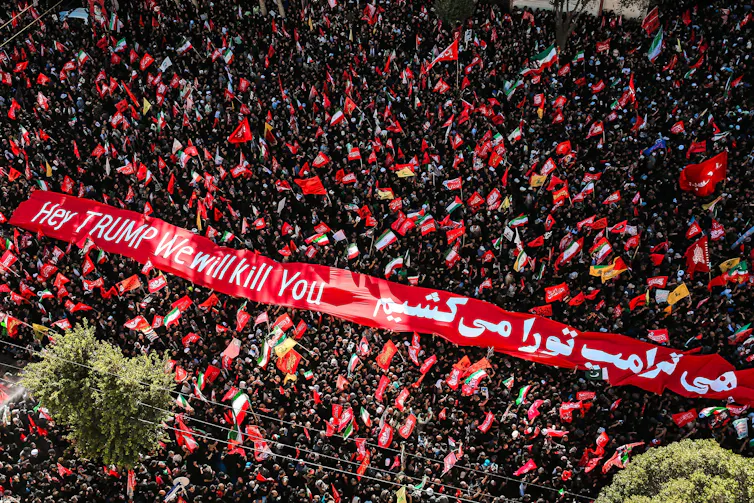
This rhetoric reveals how the regime now narrates its own position. It has portrayed Iran as a state burdened by an accumulation of military, political and symbolic losses that demand recovery. In doing so, it has created the very conditions under which greater risk acceptance becomes conceivable.
In all of this, there is an uncomfortable implication for the US. Trump’s decision to commit to further strikes on Iran, while defending commercial vessels in the strait, may be subsidising the psychological conditions that sustain Tehran’s risky behaviour.
Effective deterrence presumes an adversary weighing what it stands to lose. But against a regime that believes it has already lost, each strike simply deepens the deficit it is gambling to recover. The fight is now being waged on ground that Tehran has defined.