What would George Orwell make of today’s debates over identity, integration, and the Muslim veil in Europe?
It is an impossible question, of course. Orwell has been dead for more than seventy years. Yet one of literature’s great privileges is that it allows us to bring the dead back into contemporary arguments, if only as witnesses against our assumptions.
To imagine Orwell’s answer, it is worth returning to his lesser-known observations from Morocco in 1938. His notes were never intended as a comprehensive study of Moroccan society, nor should they be treated as one today. Yet they remain striking precisely because they were written by an Englishman who arrived with inherited assumptions and left with a more complicated picture than he expected.
Among the things that caught Orwell’s attention was the everyday visibility of women wearing traditional veils in public life. They moved through markets and streets without appearing socially segregated from the communities around them. He also noted that relations between men and women seemed less burdened by the anxieties that many Europeans associated with Muslim societies. Ordinary social encounters, including casual interaction between the sexes, appeared far more unremarkable than prevailing Western stereotypes suggested.
Reading those observations today, another scene comes to mind on the opposite side of the Mediterranean.
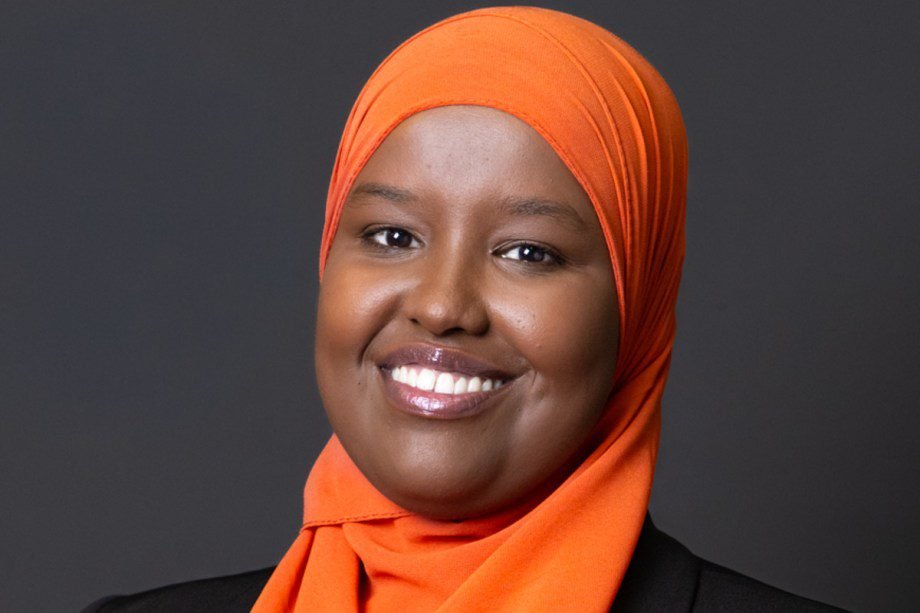
Recently, Sagal Abdi-Wali entered the British Parliament as a Labour MP, wearing a traditional hijab and Somali dress without feeling compelled to downplay her origins or dilute the cultural markers associated with them.
At first glance, there seems little connection between Orwell’s Morocco and contemporary Britain. Yet an invisible thread links the two.
The connection is not the hijab itself. It is the fragility of the assumptions surrounding it.
What Orwell encountered in Morocco challenged the image he carried with him. Likewise, Sagal Abdi-Wali’s presence in the House of Commons challenges assumptions that continue to shape parts of the Western debate about integration and national belonging. In both cases, the problem lies less in reality than in the stories people tell themselves about reality.
Sagal Abdi-Wali did not enter Parliament as a softened version of her identity. She entered as a fully British politician whose Somali heritage remains visible rather than concealed. Her election illustrates a principle that often gets lost in political arguments: integration is not the same as assimilation. Citizenship does not require the erasure of memory, culture, or origin.
The significance of her presence has less to do with what she wears than with what her presence represents. Confident societies do not need their citizens to look identical in order to belong. The strength of democratic institutions is measured not by the uniformity they produce but by the diversity they can accommodate.
At first glance, Orwell’s remarks may seem little more than the observations of a curious traveler. Their deeper value lies elsewhere. They show an outsider confronting the limits of his own assumptions. Orwell arrived with ideas shaped by an imperial era that often imagined the Muslim world as uniquely restrictive, socially rigid, and defined by separations between communities and between men and women. What he found was a reality more nuanced than the caricature.
That history raises an uncomfortable question today: what happened to both sides of the Mediterranean?
READ: UK police take no further action against security adviser’s wife over Palestine Action post
Parts of the Arab world have undoubtedly become more conservative since the 1970s in matters of dress, gender relations, and public morality. Yet parts of Europe have travelled their own ideological distance. In several countries, the hijab is no longer discussed primarily as an issue of personal freedom or religious expression. Increasingly, it is treated as evidence of failed integration or as a symbol of social separation.
The irony is difficult to ignore. The debate is no longer about whether a woman should have the right to wear a hijab or reject it. Instead, it often revolves around who gets to make that decision on her behalf. Some voices in the Muslim world wish to impose the veil in the name of virtue. Some voices in the West seek to restrict it in the name of liberation. Between these competing certainties, the principle of individual freedom becomes the first casualty.
If Orwell were alive today, the garment itself might not be what surprised him most. What might astonish him is the obsession surrounding it.
In the Morocco he visited, he saw veiled women participating in public life and did not regard their presence as a contradiction requiring explanation.
Today, the same piece of cloth has become an ideological battleground. For some, it functions as a measure of religious virtue. For others, it serves as proof of cultural incompatibility. Lost between these opposing interpretations is the individual human being, whose right to define her own life should be the starting point of any liberal society.
None of this means that the past was a golden age of tolerance. Orwell saw only a fragment of Morocco, and he observed it through the lens of a British visitor in a country under French colonial rule. His account cannot stand as a definitive judgment on Arab societies. Its value lies instead in its ability to disturb easy certainties and expose the weakness of stereotypes that often survive long after the realities that produced them have changed.
That is why Sagal Abdi-Wali’s story matters beyond the boundaries of British politics. It demonstrates that national identity and cultural difference are not mutually exclusive. A democratic society does not become weaker when citizens bring multiple histories and traditions into public life. It becomes stronger when it possesses the confidence to accommodate them.
If Orwell were to walk today between Casablanca and London, he might discover that the central struggle is no longer one between East and West, as many in his generation imagined. It is increasingly a struggle between those who believe individuals should be free to define their own identities and those who insist on defining those identities for them.
He might conclude that tolerance belongs to no single civilization and that intolerance is not the monopoly of any culture. The real danger begins when symbols become more important than people, when identity becomes more important than citizenship, and when abstract arguments about belonging eclipse the freedom of the individuals whose lives are being debated.
That may be the enduring lesson connecting Orwell’s Morocco with a hijab-wearing British MP in Westminster. Progress is not measured by the number of laws, skyscrapers, or technologies a society produces. It is measured by its ability to live comfortably with people who are not exactly like itself.
Empires rise and fall. Ideologies come and go. Yet the temptation to tell others how they should live remains one of history’s most persistent habits.
OPINION: Coercive diplomacy: What does the call between Netanyahu and al-Sharaa really mean?
The views expressed in this article belong to the author and do not necessarily reflect the editorial policy of Middle East Monitor.