Originally published by Pacific Forum, this article is republished with permission.
The war on Iran waged by the US and Israel has caused multidimensional and likely irreversible tectonic shifts. At the global level, the negative effects of the war extend far beyond economic aspects such as soaring energy prices and the onset of international stagflation. This war has unnecessarily triggered a transformation in US-Russia relations, a deterioration in US-China relations, and a worsening of transatlantic ties.
Naturally, in the Indo-Pacific region, it is having a complex and ambivalent impact on the trust that US allies and friendly nations place in the United States.
Among these variables, I will examine the changes in “confidence in the US” as seen from the Indo-Pacific, particularly from Japan’s perspective, while consciously distinguishing between Japan’s mass media/researchers, and government officials – and between the US government in general and the Trump administration.
Typical criticism of the US in Japan
Winning a war requires a clear strategy, appropriate tactics, a just cause and trustworthy allies. If a country wages war in this manner, its allies’ trust in that country will remain unshaken. However, the current war with Iran lacks three of these four elements – strategy, a just cause, and allies – leaving only appropriate tactics, namely the powerful American military force. It is only natural that this war would fail to yield results.
Sure enough, confidence in the United States is rapidly declining among Japanese media and researchers.
In public opinion polls conducted by major Japanese media outlets from March to April, the percentage of respondents who “do not support” the attacks by the United States and Israel reached 75% to 86%. Moreover, the criticism is harsher than before. There is strong criticism of Mr. Trump’s “unilateral declaration of war,” and since the attack was forced through without international consensus or clear evidence of nuclear development, many are questioning the United States’ qualifications as a “leader safeguarding the international order.”
Of course, the primary reason for this is that the prolonged war has directly impacted the lives of ordinary people. As Japan’s economic losses materialize – including soaring crude oil and electricity prices due to the blockade of the Strait of Hormuz, as well as the sharp decline in stock prices and the value of the yen – criticism is mounting that American unilateral military actions are harming Japan’s national interests. However, these criticisms are not limited to Japan; they are likely shared across the Indo-Pacific region and around the world.
In fact, among some researchers in Japan, there are those who go beyond a simple “decline in trust” in the US to question the very nature of the alliance with the United States. Some experts have pointed out concerns that the US military’s redeployment of THAAD and Patriot missiles from South Korea and of Marine Corps personnel from Japan to prioritize its response in the Middle East will weaken deterrence against North Korea and China, creating a power vacuum in East Asia.
Furthermore, some voices point to the risk of being “dragged into” conflicts. Given the possibility that the Trump administration might make demands such as “cooperation on missile production” or “dispatching the Self-Defense Forces to the Strait of Hormuz,” there are concerns that Japan may be required to exercise its “right to collective self-defense.” Criticism of the “passive US-Japan alliance”—a recurring theme—is also resurfacing, with concerns that Japan might be forced into a situation where it has no choice but to cooperate.
Trust in ‘the US’ and trust in ‘Trump‘
The Iranian Revolution and the Second Oil Crisis occurred the year after I joined the Ministry of Foreign Affairs in 1978. Over the subsequent 27 years in my capacity as a Japanese diplomat, I personally witnessed the 1991 Gulf War, the War on Terror beginning in 2001 and the 2003 Iraq War. From my perspective, these wars in which the United States fought or was involved in in the Middle East share certain commonalities.
One of these was that, before exercising military force, the US president would carefully explain to the Americans why an attack was necessary. At the very least, during the 1991 Gulf War, the 2001 War in Afghanistan, and the 2003 Iraq War, the US administrations of the time had a minimum sense of “compliance with international law.” For example, the justification for the attack on Iraq was the 1990 UN Security Council resolution authorizing “all means necessary” against Iraq (following its Kuwait invasion). This allowed the US to somehow secure the understanding and support of its allies.
Setting aside media outlets and scholars critical of the government, those currently formulating and implementing policy within the Japanese government likely still share this memory. Given this, the decline in “trust in the US” currently being debated in Japan must, strictly speaking, be analyzed by distinguishing between trust in the “Trump administration” and trust in the “US government in general.” The approaches of the two are vastly different, and the Trump administration, at the very least, lacks a “spirit of lawfulness.”
Even so, why does the Trump administration keep repeating such seemingly crude tactics? I believe the key to understanding this lies not in foreign policy, but in domestic politics. With inflation and the Epstein documents, the Trump administration has been struggling domestically for the past 16 months. Perhaps because the midterm elections are coming up in November, the Trump administration appears to be desperately trying to improve its difficult domestic situation through foreign policy. Compounding this problem is Trump’s personal behavior. Particularly since the start of his second term last January, a distinct pattern has emerged in his conduct. Namely, Trump:
- has a tendency to speak before thinking;
- states his “wishes” that are not necessarily factual;
- doubles down if the other party rejects his “wishes”; and
- if public opinion and the markets reject it, he backs down.
This pattern has been repeated time and again.
There is no way that key figures in the Japanese government are unaware of this. Compared with previous US presidents, there is no doubt that Japanese policymakers have less confidence in the “uncertainty and inconsistency of Trump’s words and actions.” However, I do not believe this decline in trust is as serious as the distrust of the US government felt by European nations.
On the contrary, it seems that Japan’s trust in the “US government in general” remains.
Japan draws a clear line
On April 27, the Nikkei reported as follows, which appears to symbolize this point:
- On April 17, the UK and France—both members of the G7 – hosted a summit aimed at resuming navigation through the Strait of Hormuz. This is a separate framework distinct from that of the United States. The move stems from the view that the Trump administration’s “reverse blockade” may violate international law.
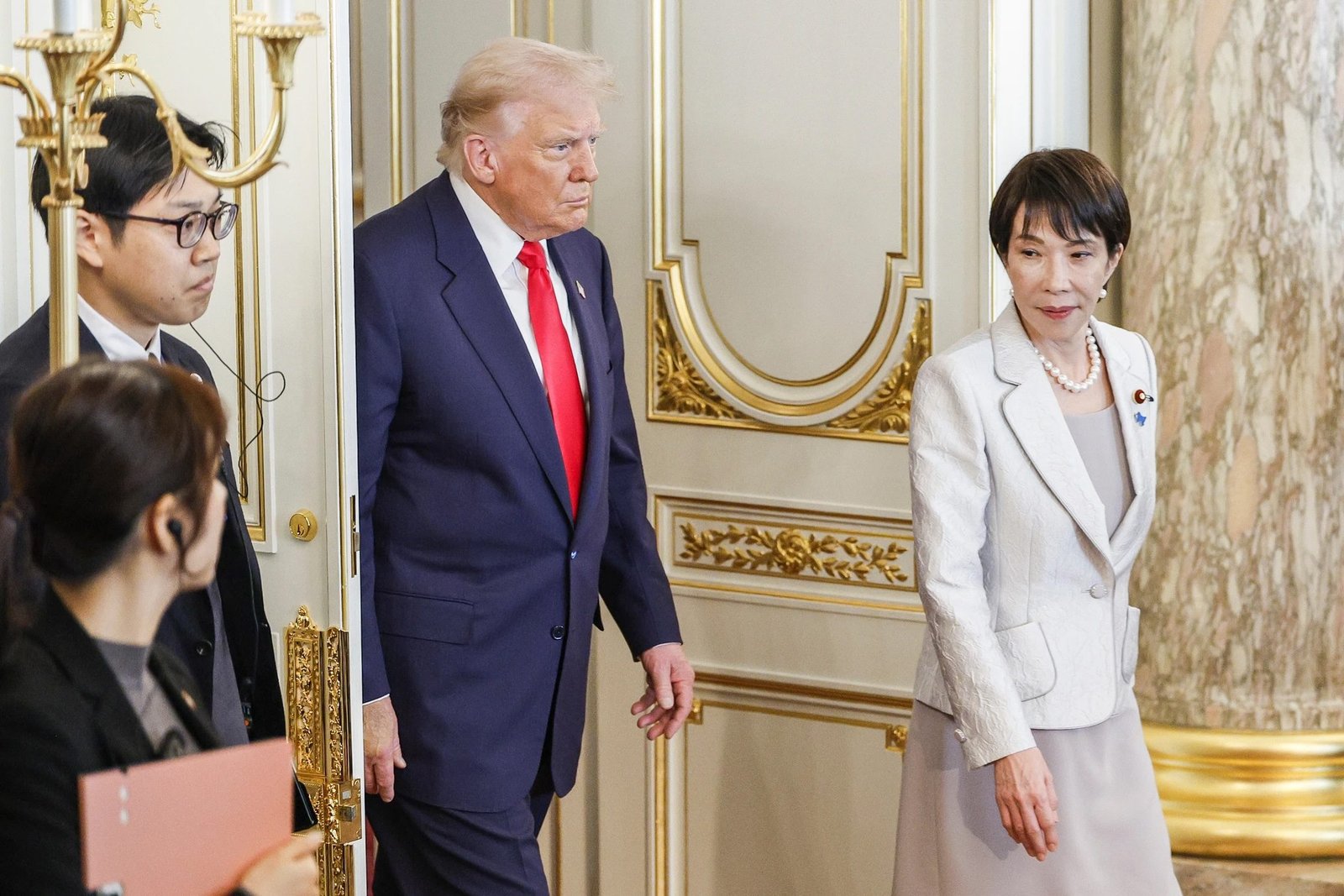
- From Japan, Keiichi Ichikawa, the prime minister’s national security advisor, participated online as an observer. Prime Minister Takaichi Sanae chose not to attend.
- Japan also did not join the statement drafted by the UK and France. The statement called for a diplomatic resolution to the issue of the Strait blockade and emphasized freedom of navigation and the rule of law. G7 members Germany, Italy, and Canada endorsed it.
- A Japanese diplomatic official stated that the phrase “multinational mission” in the statement served as a stumbling block. This is because, to Trump, a “multinational mission” could be perceived as an attempt to establish an international order without the United States.
Why is Japan concerned about the “formation of an international order without the US?” It is self-evident when one considers Japan’s geopolitical environment. By effectively gaining control of the Strait, Iran has inadvertently acquired a “deterrent” comparable to nuclear weapons. Iran’s actions constitute a flagrant violation that fundamentally undermines the legal principle of “freedom of navigation on the high seas” enshrined in the United Nations Convention on the Law of the Sea and could potentially shake the very foundations of Japan’s existence as a maritime nation reliant on international trade.
A situation where international straits, including the Strait of Hormuz, are militarily and politically controlled by a specific country, thereby no longer guaranteeing freedom of navigation, goes beyond mere economic rationality and touches upon Japan’s core interests. In this regard, the “joint mission” by European nations is by no means sufficient to resolve this issue to begin with. Moreover, unlike European nations – which face serious alliance problems with the United States over Ukraine – it is the US Navy’s Seventh Fleet, based in Yokosuka, that is effectively safeguarding the Asian nations’ sea lines of communication all the way to the Middle East.
Given this perspective, setting aside the Japanese media and some researchers, responsible policymakers within the Japanese government should view the situation as follows: despite Trump’s unpredictability, trust in the US to make and implement the minimum policy decisions that a traditional “US government” would naturally take persists. That said, this “sense of trust” could vanish into thin air depending on Mr. Trump’s next move. We can only keep our fingers crossed and hope that this will not happen.
Kuni Miyake (kunimofa@hotmail.com) is a visiting professor of Ritsumeikan University and director and special advisor at Canon Institute for Global Studies.