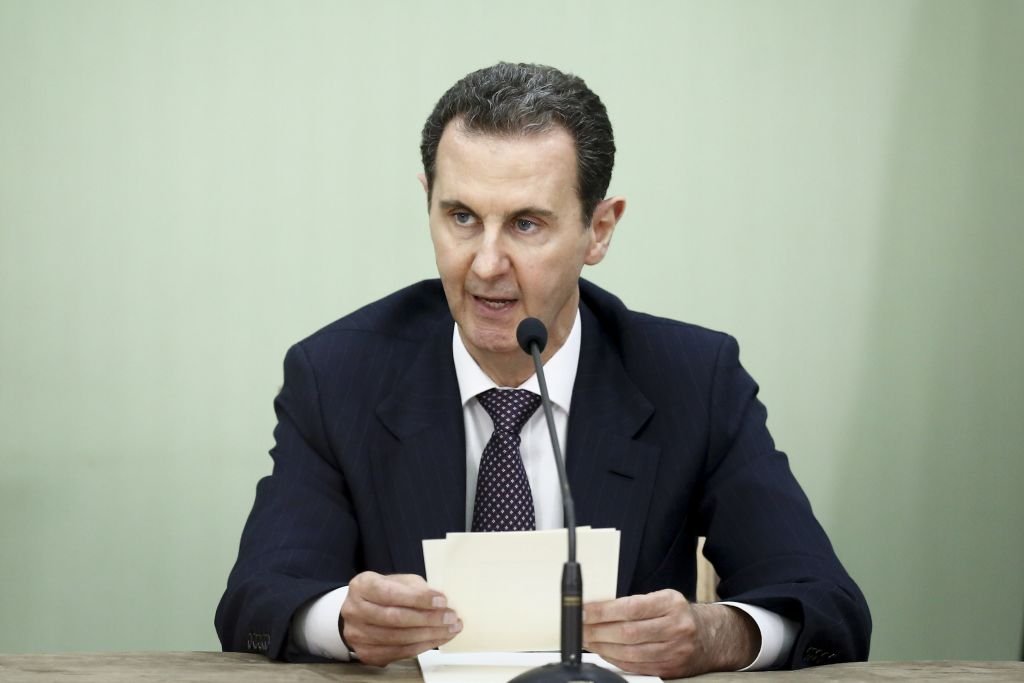
[DAMASCUS] Syria is seeing major new judicial moves as authorities pursue prosecutions against several prominent figures from the former regime, in what observers describe as an early step toward transitional justice and accountability for abuses committed during the country’s yearslong conflict.
The Fourth Criminal Court in Damascus has ruled to strip former Syrian President Bashar Assad, his brother Maher Assad, and several former military and security officials of their civil rights while placing their movable and immovable assets under state administration, according to The Media Line’s correspondent in Damascus.
The ruling was issued during a public hearing connected to the trial of former Brig. Gen. Atef Najib, who faces charges related to widespread abuses committed during the 2011 protests in the southern province of Daraa, the birthplace of the Syrian uprising. The charges include “systematic mass killings,” “arbitrary detention,” and “participation in the al-Omari Mosque massacre,” one of the bloodiest incidents during the early days of anti-government demonstrations.
The legal measures also targeted several prominent military and security figures, including Fahd Jassem al-Freij, Mohammad Ayoush, Louay al-Ali, Qusai Miheoub, Wafiq Nasser, and Talal al-Aseimi. Observers say the move goes beyond procedural legal action and reflects an effort to reopen files tied to violations committed throughout the war.
A correspondent for The Media Line reported that the hearings initially took place in the presence of journalists and representatives of human rights organizations before portions of the proceedings were closed during witness testimony to protect the investigation and ensure witness safety. Atef Najib was also questioned directly as prosecutors presented evidence and accusations related to the events in Daraa.
The trials have brought renewed attention to the Assad family’s 54-year rule over Syria, beginning with Hafez Assad’s rise to power in 1970 through what was known as the “Corrective Movement” and continuing with the transfer of power to his son Bashar Assad in 2000.
Over the decades, the ruling family consolidated control over Syria’s political, military, and security institutions by building an extensive intelligence and security apparatus that played a central role in governing the country, monitoring public life, and suppressing political dissent.
The Syrian regime relied heavily on overlapping security agencies designed to prevent the emergence of rival power centers within the state. Sensitive military and intelligence positions were often assigned to individuals loyal to the ruling family.
Politically, the regime entrenched a one-party system led by the Baath Party, effectively marginalizing political pluralism and independent opposition movements. Although Syria maintained formal constitutional institutions, elections, and a parliament, real decision-making power remained concentrated within the presidency and the inner circle surrounding the security establishment.
Economically, Assad-era Syria saw increasing overlap between political authority and business elites closely tied to the regime. Under Hafez Assad, the state dominated large sectors of the economy through a centralized socialist model. During Bashar Assad’s early years, Syria gradually shifted toward a market economy, but the economic opening failed to create genuine competition and instead enabled a narrow elite to monopolize key sectors such as telecommunications, energy, real estate, and trade.
One of the most prominent figures symbolizing this economic influence was Rami Makhlouf, Assad’s cousin, who controlled vast business networks across strategic sectors and was often described as the regime’s financial backbone.
The Syrian economy also became deeply intertwined with patronage systems and political favoritism, concentrating wealth among elites connected to the ruling establishment while social inequality widened and development levels declined across many parts of the country.
On the security front, the Assad regime faced several domestic challenges over the decades, most notably its confrontation with the Muslim Brotherhood in the late 1970s and early 1980s. The conflict culminated in the 1982 Hama crackdown, when Syrian forces launched a massive military assault on the city, killing thousands in one of the deadliest episodes in modern Syrian history.
When nationwide protests erupted in 2011, Assad’s government faced its most serious threat since the regime’s establishment. Authorities responded with military and security force crackdowns, transforming the protests into a prolonged and devastating armed conflict that killed hundreds of thousands, displaced millions, and caused widespread destruction to Syria’s economy and infrastructure.
Throughout the war, the regime strengthened its dependence on security forces, allied militias, and foreign support to maintain control, relying heavily on military and political backing from Russia and Iran.
Observers say the latest judicial measures represent the first official attempt to prosecute figures who for decades were considered beyond legal accountability. The proceedings have also reignited debate over transitional justice and the possibility of holding officials accountable for abuses committed throughout Syria’s modern history.
At the same time, questions remain about whether these trials can contribute to meaningful national reconciliation in a country still struggling with the consequences of war, political fragmentation, and severe economic and security challenges.