Thomas Barrack cast military force as a dead end and argued that the region’s conflicts will not be solved by trying to destroy enemies one by one
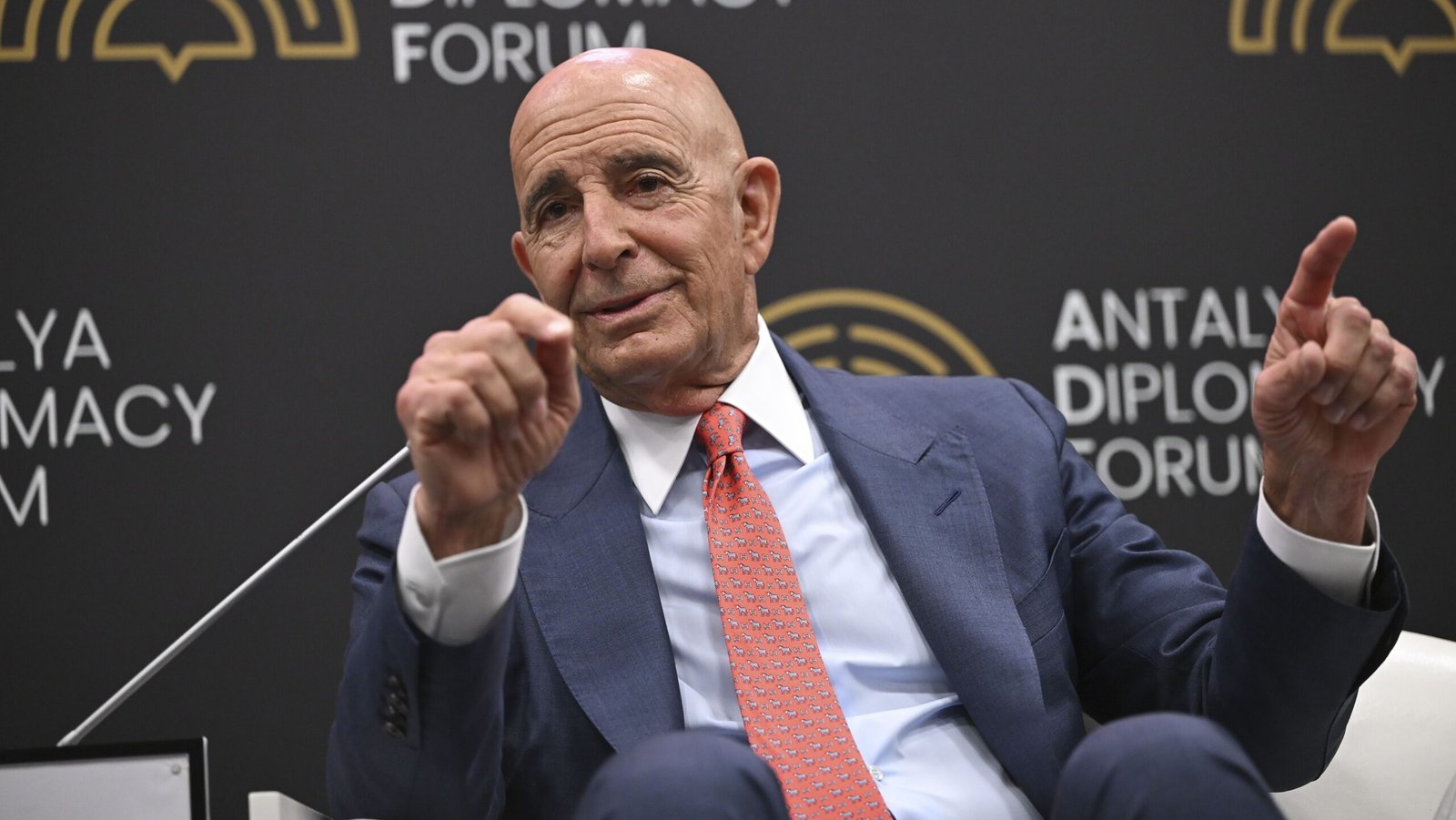
[ANTALYA, Turkey] President Donald Trump has told Israel it was wrong. That was the message delivered Friday by US Ambassador to Turkey and Special Envoy for Syria Thomas Barrack at the fifth Antalya Diplomacy Forum, a day after a 10-day Lebanon ceasefire took effect and hours after Barrack met Syrian President Ahmed al-Sharaa at the Syrian delegation’s Antalya residence.
Foreign Minister Asaad al-Shaibani sat next to Barrack in that Thursday evening meeting. On Friday morning, al-Shaibani returned to the same residence with Turkish Foreign Minister Hakan Fidan. In one weekend came back-to-back bilaterals with Washington and Ankara, with one American envoy at the center of both.
The brilliance of what happened yesterday is it stopped senseless killing, and President Trump and Secretary Rubio stepping in strongly and saying we need a time out
“The brilliance of what happened yesterday is it stopped senseless killing, and President Trump and Secretary Rubio stepping in strongly and saying we need a time out,” Barrack said at the forum. “This is just the beginning of a road, and the ceasefires are so delicate because everybody’s been equally untrustworthy.”
Upstream of everything else moving this weekend sits the Iran war, launched on February 28. The 10-day ceasefire in Lebanon is the first downstream agreement to hold. It is not a permanent cessation. It is a pause scheduled to run parallel to the Iran ceasefire window, which expires next week unless a second round of US-Iran talks in Islamabad produces an extension. Ending Israel’s war with Hezbollah was a key demand from Iranian negotiators in the first round.
On Friday, the Israel Defense Forces (IDF) warned southern Lebanese residents not to move south of the Litani River. Spokesman Avichay Adraee said Israeli troops remain deployed there “in the face of Hezbollah’s ongoing terrorist activities.” The ceasefire stopped the fighting. It did not move the soldiers.
Barrack spelled out the American position on both the mechanism and the war that preceded it. Asked whether the new agreement reproduces the self-defense clause that let Israel resume strikes on Lebanon nine days after the November 2024 ceasefire, Barrack blamed the mechanism. The 2024 agreement failed, he said, because the Biden administration gave Jerusalem a side letter authorizing unilateral strikes whenever Israel determined its sovereignty was threatened. The war restarted on that basis. President Trump, Barrack said, has now told Israel that doing so was wrong.
Nor was this Barrack’s first Lebanon proposal. Earlier this week, he floated a two-month halt to Israeli operations, a pullback from Lebanese territory, and subsequent talks on land and maritime borders. Lebanon’s parliament speaker, Nabih Berri, told Asharq Al-Awsat on Monday that Israel officially rejected that initiative. Barrack then warned Beirut in private messages that hesitation over Hezbollah’s disarmament could trigger Israeli action “without coordination.” What arrived Thursday was the shorter version: a 10-day pause, announced by President Trump, with the Hezbollah weapons question left to the “exclusive state control of weapons” framework that Arab states endorsed Friday.
For three weeks before that, Turkish President Recep Tayyip Erdoğan insisted Lebanon was included in the Iran ceasefire and that Israel was violating it. Washington and Jerusalem rejected that reading. Thursday’s agreement effectively conceded the Turkish framing. On April 8, two weeks after the Iran ceasefire took effect and Hezbollah signaled a pause, the IDF launched what it called Operation Eternal Darkness, striking across Lebanon and killing at least 357 people. Lebanese authorities called it Black Wednesday.
“Everybody is in atrophy over this idiotic war,” Barrack said. “So, will the ceasefire stick? What will we do? It’s baby steps.”
Everybody is in atrophy over this idiotic war
Arab foreign ministries welcomed Thursday’s agreement and endorsed what the Anadolu Agency called “exclusive state control of weapons,” the Levantine euphemism for disarming Hezbollah. If that framework holds, it is the first thing Jerusalem has wanted from a Lebanon agreement in a generation. It is arriving through a channel that Ankara ran and Washington closed. Pakistani Prime Minister Shehbaz Sharif, in Antalya after stops in Riyadh and Doha, wrote on X that the ceasefire was “facilitated through bold and sagacious diplomatic efforts led by President Donald Trump.” Sharif’s country runs the technical mediation of the Iran-US track. Pakistan Army Forces chief Field Marshal Asim Munir arrived in Tehran on Thursday carrying a Washington message. The Turkey-Pakistan-Saudi Arabia-Egypt quadrilateral met on the forum sidelines. Iranian Deputy Foreign Minister Saeed Khatibzadeh was on site.
The Gaza contact group convening at the forum is an eight-party format held at the foreign minister level. The Palestinian Authority holds the Palestinian seat. Hamas, which maintains political relationships with Ankara, is not represented. That composition places Turkey’s hosting on the state-to-state side of the Palestinian question at a moment when Erdoğan’s domestic rhetoric on Israel has reached the threshold of public invasion threats. A week before the forum, Erdoğan told a party audience: “Just as we entered Karabakh, just as we entered Libya, we will do the same to them.” A Turkish court last month indicted Israeli Prime Minister Benjamin Netanyahu and 35 Israeli officials over the October 2025 interception of the Sumud flotilla.
Barrack said he reads the regional press carefully. Turkish outlets have been circulating maps of a Greater Israel stretching across Syrian and Lebanese territory. Israeli outlets have been circulating maps of a revived Ottoman Empire absorbing the Eastern Mediterranean. Nationalist commentators and religious figures on each side have been casting the other’s ambitions in maximalist terms. Political leaders reach for that imagery when they need to flex for domestic audiences. Barrack treated the exchange as both real and rhetorical. The “conquest or conflict” reading of sovereignty it expresses is genuine, he said, and it is also muscle performed in a region that reads muscle as a language.
Next, Barrack offered the American counterframe. The solution runs through the Abraham Accords architecture, extended to a stabilized Syria. He described Israel as a country that “has become comfortable since 1948” and has “taken a point of view which is the antithesis to what the region becomes.” Asked whether US-backed Israeli campaigns across Gaza, the West Bank, Lebanon, and Syria have produced a new generation of enemies, Barrack agreed. He said Saudi Arabia could eventually be “aligned with Israel” for “the prosperity of the Israeli people,” if Jerusalem enters the regional forum rather than remaining outside it. The smartest thing Israel can do, Barrack said, is to “entice” its way in.
Al-Sharaa arrived in Antalya on Thursday afternoon. “Turkey has been a supporter of the Syrian revolution for 14 years,” he told the Syrian state news agency. Within hours, he received Barrack. By Friday morning, he received Fidan. Syrian Democratic Forces (SDF) commander Mazloum Abdi and Syrian Democratic Council co-chair İlham Ahmad joined the Antalya schedule to discuss SDF integration into the new Syrian armed forces. Three Syrian tracks—Damascus-Washington, Damascus-Ankara, and Damascus-SDF—moved through one resort city in 24 hours.
In an interview with Anadolu released Friday, al-Sharaa said talks with Israel were not at a dead end but faced “great difficulty” over the continued Israeli military presence on Syrian territory. The new Syrian government is engaged with Jerusalem on substance. The point of blockage is the footprint that Netanyahu’s forces built after December 2024.
Barrack described the Syrian side in terms that Jerusalem will contest. Syria under the Bashar Assad regime, he said, “never fired a shot” at Israel from Syrian territory. He credited the former Syrian president directly, paraphrasing his position as an insistence that “you don’t want an adversarial issue with Israel” and a willingness to work toward “a nonaggression agreement and a normalization.” Al-Sharaa has continued that posture, Barrack said, and has been “brilliant in not engaging” since October 7, 2023, despite repeated Israeli strikes on Syrian targets. Jerusalem reads Bashar Assad’s record through his hosting of the Islamic Revolutionary Guard Corps command in Syria, his role in the Hezbollah weapons pipeline from Tehran to the Beqaa, and the October 2023 rocket fire from Syrian territory into the Golan. Barrack offered his reading anyway. He also disclosed that a channel between al-Shaibani and an Israeli counterpart got “very close and evaporated” before the present fighting.
Meanwhile, Barrack carries the US bilateral track into this summer’s NATO summit in Ankara, and he spoke Friday as though the track is already open. On the S-400 purchase and the Countering America’s Adversaries Through Sanctions Act sanctions that have blocked Turkey from the F-35 program since 2019, Barrack said President Trump’s acceptance of Turkey back into the F-35 program is “defined as three months.” He described sanctioned countries as becoming so “ingenious” in evading US penalties that they build alliances with other powers. Of Erdoğan, he said the Turkish president is “an amazing leader” and one of four “strong, courageous leaders” in the region. He did not name the other three. A Turkish air force inside the F-35 program changes the Eastern Mediterranean balance Israel has spent a decade building around Turkey’s exclusion.
Earlier, Fidan told Anadolu that the July 7 summit at the Presidential Compound in Ankara “could be one of the most important in the alliance’s history” and an opportunity to further structure NATO-US relations. He used the same interview to warn that Turkey could be next on Israel’s list after Iran and that continued Israeli strikes on Syria constitute “a major problem area” and “a serious risk” to Turkey. President Trump is expected to attend the Ankara summit as Erdoğan’s guest.
Hanging over the forum’s architecture is the question of whether the Iran ceasefire holds. The Lebanon agreement extended it for 10 days. The Palestinian contact group convened because the February 28 war collapsed the old Hamas-centered mediation patterns. The Syria track accelerated because Iran’s reach into Damascus fell away. Three files, one upstream event, 11 weeks until President Trump and Netanyahu are both expected on Turkish soil.
This idea of kinetic elimination of your enemies does not work
Finally, when asked what lessons the United States should draw from its record in the region, Barrack answered in a single construction.
“This idea of kinetic elimination of your enemies,” he said, “does not work.”