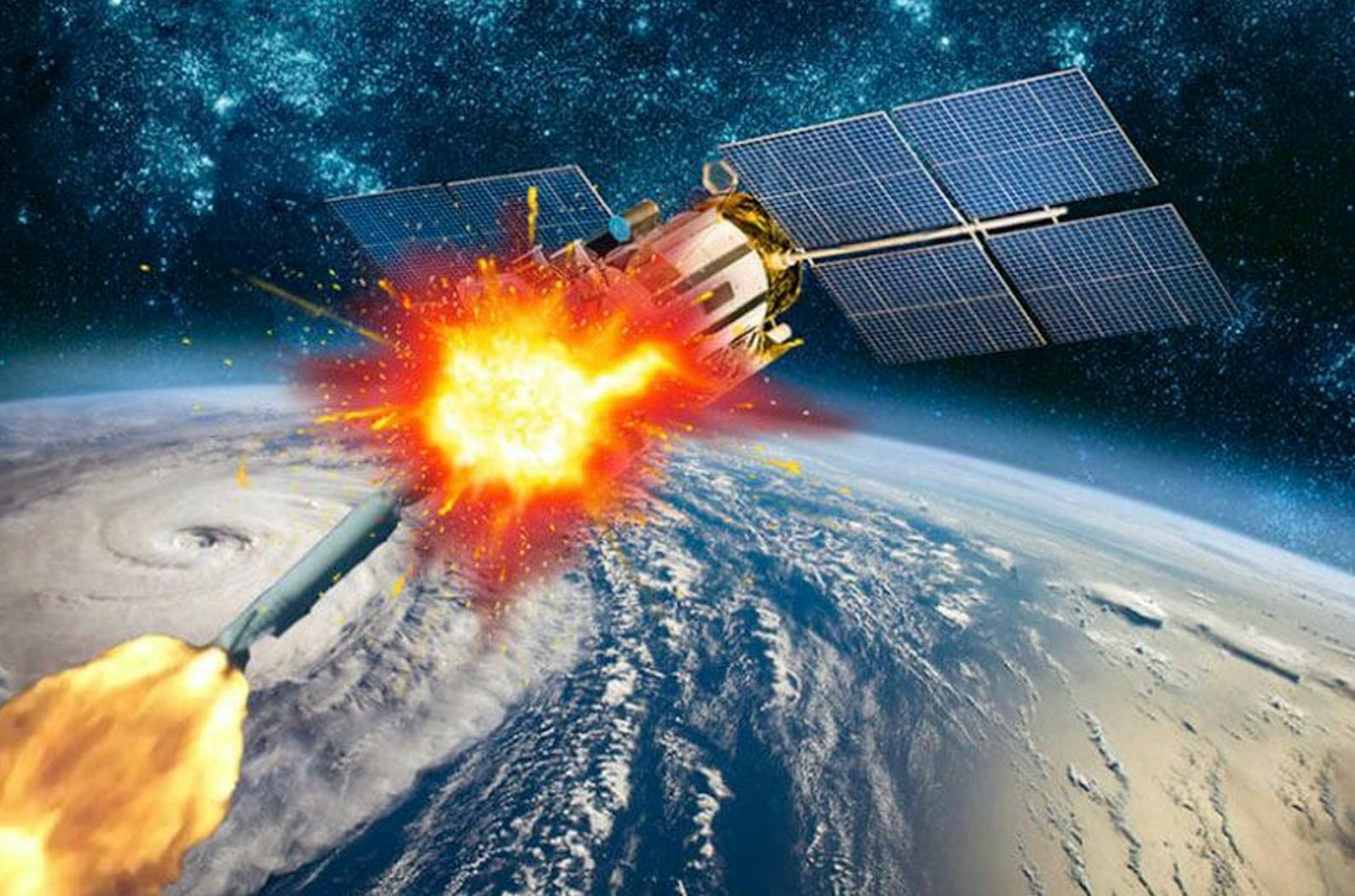
The opening moves of a future US-China war over Taiwan may be made not across the Pacific but hundreds of kilometers above it, as both sides race to seize the orbital advantage that underpins modern military power.
The US and China are accelerating preparations for potential space warfare, increasingly treating orbital spacecraft as active combat platforms rather than passive intelligence tools, Reuters reported.
Both superpowers operate secretive unmanned spaceplanes capable of deploying secondary payloads alongside maneuverable “hunter” satellites engineered for orbital dogfighting, grappling targets and conducting on-orbit refueling.
In September 2025, US and UK space forces conducted their first joint orbital operation, maneuvering close to China’s Shiyan 12-01 satellite, apparently signaling allied deterrence.
US defense chiefs, including outgoing US Space Force Chief General Chance Saltzman and US Space Command head General Stephen Whiting, warn that China is developing advanced ground- and space-based counterspace systems — including jamming, lasers and capture technologies — designed to blind terrestrial armed forces early in a crisis.
In response, the US military is deploying ground-based electromagnetic weapons and advocating for orbital interceptors to defend critical satellite architecture.
While China maintains that its experimental programs serve peaceful civilian surveys and accuses the US of militarizing orbit, Chinese military patents and procurement records reveal aggressive efforts to master autonomous pursuit maneuvers, net captures and multi-satellite fleet coordination.
The emerging US-China contest in orbit therefore centers on whether either side can turn maneuver, disruption and resilience into control over the space-enabled kill chains that would shape a high-intensity conflict.
These developments reflect the embrace of orbital warfare, which, according to Gabriel Elefteri in a July 2026 Council on Geostrategy report, is the use of space-based assets to control the orbital domain through in-orbit kinetic or non-kinetic effects, movement and maneuver.
Elefteri distinguishes this from broader space warfare, which in general encompasses multi-domain counterspace actions, including ground-based missile strikes against satellites or orbital strikes against terrestrial infrastructure. Orbital warfare refers to purely spacecraft-on-spacecraft operations conducted entirely within orbit.
He adds that by excluding Earth-to-space and space-to-ground strikes, the concept focuses military doctrine on dynamic in-orbit maneuvers, rendezvous proximity operations and gray-zone coercive harassment, pressing allied armed forces to treat orbit as an active, standalone warfighting arena.
Maneuverable satellites are key assets in orbital warfare. As Simone Montandon argues in a September 2025 article in the peer-reviewed Journal of Strategic Security, high-thrust and autonomous systems enable hostile spacecraft to execute evasive trajectory shifts, conduct covert rendezvous and proximity operations, and bypass ground-based tracking.
Montandon notes that such maneuverability enables adversarial platforms to shadow high-value assets, conduct non-cooperative dockings, intercept sensitive telemetry or deploy kinetic and directed-energy payloads to neutralize critical navigation, missile defense and reconnaissance networks during the initial combat phases.
That vulnerability extends beyond satellites themselves. Bharath Gopalaswamy argues in an April 2026 Space Review article that modern AI-enabled kill chains are fundamentally space architectures rather than autonomous software feats.
Looking at Operation Epic Fury, Gopalaswamy argues that targeting systems like Project Maven depend entirely on an underlying orbital layer of imaging, communications, signals intelligence and navigation satellites to execute rapid strike packages. He argues that orbit has become both the backbone and primary vulnerability of modern targeting.
Gopalaswamy points out that if orbital infrastructure is blinded, jammed or kinetically denied, algorithmic targeting collapses into processing stale data, rendering sophisticated strike networks blind regardless of their software capabilities.
The stakes are particularly acute in a Taiwan scenario. Zachary Burdette, writing in the May 2025 issue of International Security, notes that China’s orbital presence has surged to more than 1,000 satellites — including nearly 500 reconnaissance platforms — eroding the long-held US space advantage and turning orbit into a shared backbone for Pacific strike networks.
In a Taiwan invasion scenario, Burdette highlights that while the US relies on orbital surveillance, communications and navigation to close long-range kill chains against Chinese amphibious transports from outside China’s anti-access/area denial (A2/AD) zones, China increasingly depends on similar architectures to threaten US power projection by targeting vulnerable forward bases and carrier strike groups.
One possible US approach is to attack that backbone directly. Matthew Smokovitz argues in an August 2025 Modern Warfare Institute (MWI) article that space-based interceptors envisioned for the Golden Dome missile defense system could be adapted into an offensive orbital spear against China’s military battle network.
Smokovitz argues that orbital interceptors, directed-energy weapons and cyber payloads could hit China’s integrated kill chains — its so-called “kill webs” — across the Pacific at once.
Rather than methodically hunting terrestrial launchers, such effectors could blind reconnaissance satellites, corrupt command nodes and disrupt navigation timing, fracturing People’s Liberation Army (PLA) operational coherence before coordinated strikes materialize.
A Chinese concept could mirror that logic. In a January 2026 Wild Blue Yonder scenario, Kenneth Bell argues that the PLA could open a Taiwan campaign with a rapid 24-hour counterspace strike to sever the US space-based intelligence, surveillance and reconnaissance (ISR) backbone before conventional assaults begin.
Bell outlines a synchronized strategy using direct-ascent missiles, cyber intrusions, ground jamming, and orbital warfare assets, including co-orbital grappling platforms, laser dazzling, and signature-mimicking “ghost satellites.”
In Bell’s scenario, attacks on early warning, GPS, reconnaissance and commercial constellations — across orbits, links, and ground stations — aim to leave US forces blind and disoriented, buying a two-week delay in intervention to insulate Chinese amphibious operations.
The broader theory of victory rests on shaping the orbital battlespace before hostilities begin. Paul Szymanski argues in an April 2022 Wild Blue Yonder article that orbital mechanics constrain rapid wartime redeployment, making pre-positioned agile assets, decisive orbital “jumping-off points” and attacks on adversary data-relay satellites critical to gaining the initiative.
For Szymanski, frequent maneuvers and unusual orbits confound enemy tracking, while predictive surveillance and decisive offensive strikes enable forces to exploit the offense-dominant domain, neutralizing threats within 24 to 48 hours before terrestrial command loops can react.
As orbital warfare matures, decisive advantage may belong less to the side with more satellites than to the one that can impose its operational tempo — disrupting, reconstituting and repositioning its orbital kill architecture faster than the enemy can adapt.