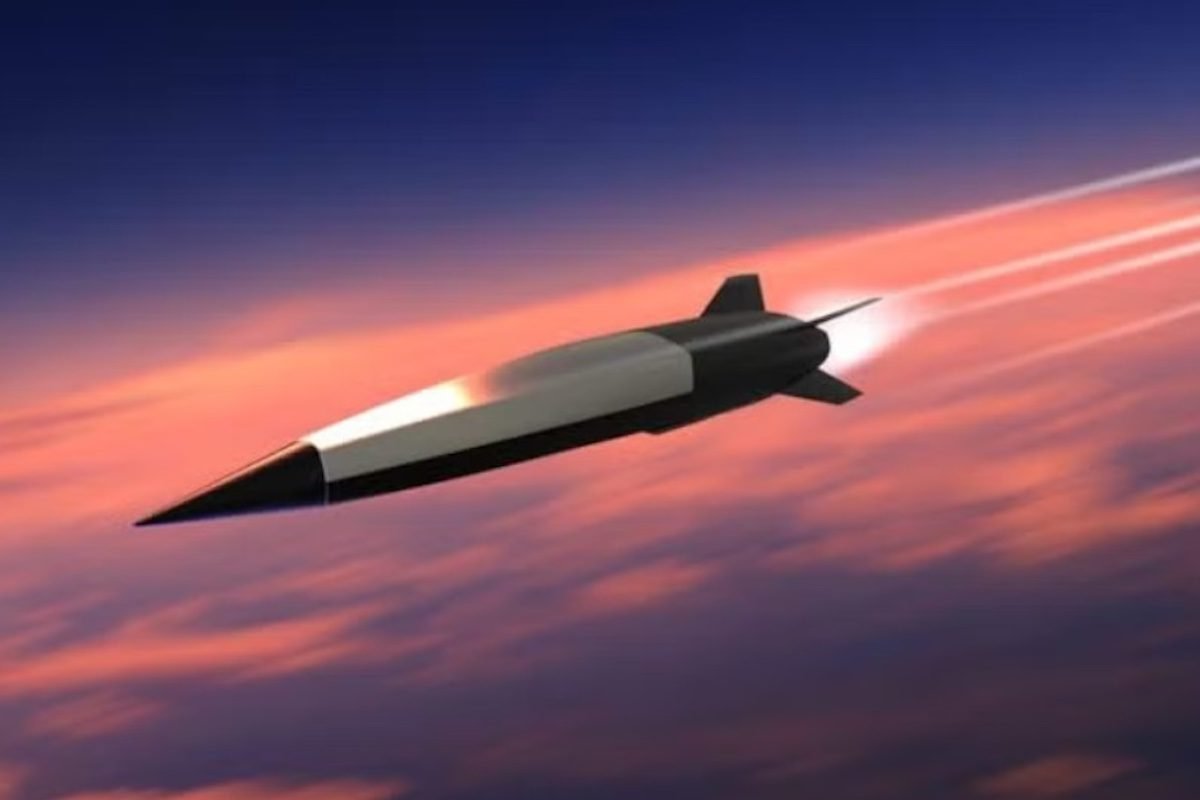
The inaugural flight-test release of a US air-launched hypersonic weapon over an Australian weapons range demonstrates both nations’ push for standoff hypersonic strike, yet the weapon’s true combat value hinges on whether allied airbases and kill chains can survive China’s long-range fires.
This month, multiple media outlets reported that the US Air Force, in partnership with the Royal Australian Air Force, has conducted the first flight-test release of the Hypersonic Attack Cruise Missile (HACM) over an undisclosed Australian test range to evaluate the weapon under realistic flight conditions.
The milestone, confirmed by a service spokesperson, was executed under the bilateral Southern Cross Integrated Flight Research Experiment to gather crucial operational data. Officials declined to reveal the specific launch date, the aircraft platform used, or whether the scramjet-powered munition achieved self-sustained flight after release.
Developed by prime contractor RTX and engine manufacturer Northrop Grumman, the two-stage weapon uses a solid rocket booster before engaging its scramjet cruiser to exceed Mach 5.
Despite design setbacks that caused schedule slips and forced the US Air Force to trim its rapid-prototyping campaign from seven flights to five with zero schedule margin, service leaders are pursuing a rapid fielding decision for fiscal 2027 and full-rate production by 2029, requesting approximately US$1.2 billion in maturation funds and initial operational procurement.
Yet, while this inaugural flight test represents a technical milestone for the program, the critical question remains how the HACM would be operationalized within allied theater strike concepts, and whether forward bases and agile operating postures can survive Chinese anti-access capabilities long enough to employ it effectively in a high-end conflict over Taiwan.
Looking at tactical use-case scenarios for the HACM, Michael White mentions in a February 2026 Atlantic Council report that hypersonic weapons provide the US military with rapid, survivable left-of-launch kinetic capabilities to penetrate heavily defended adversary anti-access perimeters, de-contesting battlefields by destroying high-speed strike systems, integrated air defenses, and command nodes within compressed decision timescales.
White says hypersonic weapons operate as critical force multipliers alongside legacy subsonic arsenals; they defeat time-critical targets early in a conflict to restore battlefield preeminence.
He places the HACM within that strike network, offering distinct operational flexibility: its smaller footprint and lower unit cost let the US deploy it affordably across a wide range of aircraft.
While officials have not shared specific details about the test, an August 2025 US Congressional Research Service (CRS) report mentions that the HACM is designed for launch from both fighter aircraft and bombers, with flight test integration focusing on the F-15E, with potential capacity for a B-52 to carry 20 or more missiles and a B-1 up to 36.
In addition to US aircraft, a July 2024 US Government Accountability Office (GAO) report notes that the HACM could be tested with Australian F/A-18s, with implications for interoperability, strategic depth and resilience, and the development of Australia’s long-range strike capability.
In an operational campaign over Taiwan, allied doctrine envisions heavy bombers operating from sanctuary bases beyond the First and Second Island Chains — such as Australia’s Tindall Air Base — functioning primarily as standoff ‘missile trucks’ to saturate Chinese air defense nodes and neutralize mobile missile launchers before release.
Highlighting the vulnerability of US bases within the First and Second Island Chains, a December 2024 Stimson Center report notes that Chinese missile strikes could deplete theater interceptors within 24 hours, crater runways, ground US fighters in Japan for nearly 12 days, and ground aerial refueling tankers in Japan for more than a month and in Guam for four days.
Compounding these vulnerabilities, a January 2025 Hudson Institute report highlighted that decades of underinvestment have left forward US facilities unhardened compared with China’s network of over 3,000 aircraft shelters, creating a similar asymmetry in which just 10 submunition-armed missiles could neutralize critical installations like Japan’s US Marine Corps Air Station Iwakuni.
As such, Stacie Pettyjohn mentions in a November 2024 Carnegie Endowment report that facilities such as Tindall would function as indispensable staging grounds for US long-range bomber operations during an allied campaign to defeat a Chinese invasion of Taiwan.
Pettyjohn notes that US bombers such as the B-52, B-1, and B-2, operating from northern Australia, allow the US Air Force to generate sustained sorties with stealthy and non-stealthy heavy bombers, delivering massed standoff cruise and hypersonic missiles against Chinese invasion fleets and mainland military targets while preserving strategic operational depth.
However, northern Australia provides no guaranteed sanctuary against the Chinese military’s expanding deep-strike envelope. Intermediate-range ballistic missiles like the DF-26 fired from Hainan Island, paired with South China Sea-deployed H-6N bombers armed with JL-1 aeroballistic missiles, place Tindall within reach of preemptive salvos that could destroy unhardened bombers on the flight line.
In response, the US, under its Agile Combat Employment (ACE) strategy, which entails rapidly moving and dispersing aircraft across multiple sites in the Pacific, has restored former World War II bomber bases, such as Tinian, to serve as alternative staging areas should facilities such as Guam and possibly Tindall be taken out of action.
Yet the dispersed ACE concept faces severe operational friction. Writing in the July 2024 issue of US Naval Institute Proceedings, Michael Blaser argues the posture relies on flawed assumptions regarding Chinese military constraints, emphasizing that the PLARF retains sufficient conventional missile volume to saturate dispersed allied airfields simultaneously across the Pacific theater.
Blaser adds that China’s expanding constellation of space-based sensors, paired with AI, can shrink its targeting kill chain to under 24 hours, effectively out-cycling dispersed US fighter units restricted to a planning factor of just one sortie per day.
Beyond airfield survivability, the precision-strike kill chains required to guide the HACM to its targets may face severe systemic vulnerabilities. In a May 2023 Mitchell Institute policy paper, Heather Penney emphasizes that the People’s Liberation Army’s (PLA) doctrine of “system destruction warfare” specifically aims to paralyze allied targeting architectures rather than simply attriting individual launch platforms.
Penney notes that this operational concept seeks to neutralize airborne early-warning aircraft and satellites, sever Link-16 tactical datalinks, degrade command-and-control networks, and introduce severe mission friction through pervasive jamming, camouflage, and missile salvos. These lines of effort, she says, push US forces outside effective ranges, ultimately paralyzing mission execution before weapons reach their targets.
Ultimately, the HACM’s strategic value will not be decided by Mach 5 speed alone, but by whether the US and Australia can harden forward infrastructure and preserve resilient, cyber-redundant kill chains under massed missile fire long enough to translate standoff hypersonic speed into credible theater deterrence.