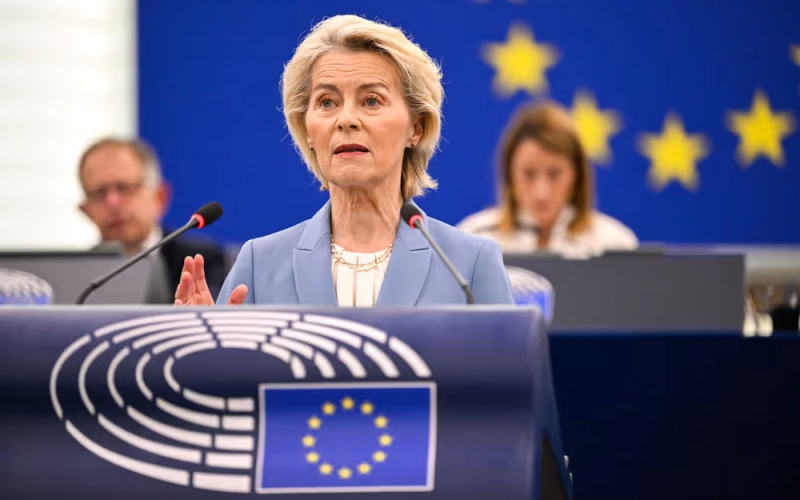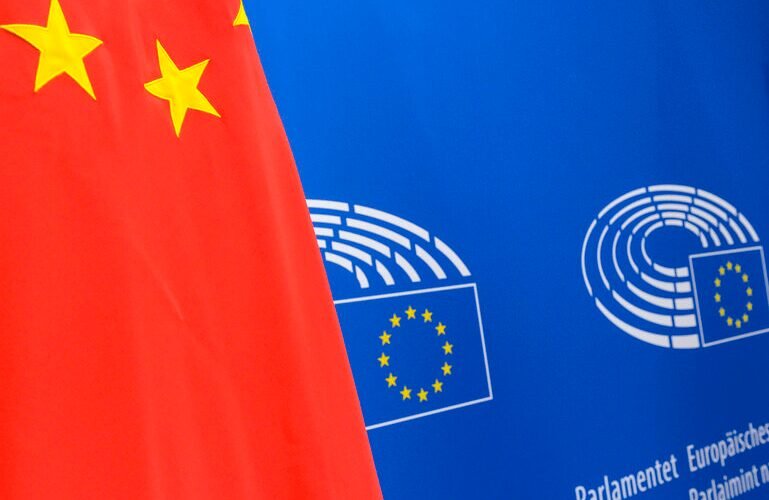
The European Parliament on Wednesday called for the European Union to keep up dialogue with China while taking a firmer line on trade, security and human rights, saying relations have reached a critical point.
Lawmakers adopted the recommendation, addressed to the other EU institutions, by a vote of 454-86, with 110 abstentions. It says the EU’s interest lies in reinforcing a multilateral world and stresses the importance of talks with China on global challenges, peace and security, climate and human rights.
The lawmakers blamed the strain in relations on China’s unfair economic practices and its position on Russia’s war against Ukraine. They said they were deeply concerned by verified reports that the Chinese military has trained Russian military personnel to fight in Ukraine. The EU should coordinate with the United States, G7 members and other like-minded partners, they said, and encourage China to use its influence on Russia to help end the war.
Trade and dependencies
Lawmakers said urgent action is needed against the weaponization of the EU’s overreliance on China. They called for a rigorous de-risking strategy focused on critical raw materials, medicines, batteries, electric vehicles, information and communication technology, semiconductors and other strategic sectors. They also urged stronger investment screening and better protection of critical technologies, infrastructure and supply chains.
Parliament identified China’s industrial overcapacity, state subsidies and restrictions on European firms’ access to the Chinese market as growing challenges to the EU economy. Lawmakers demanded reciprocity and a level playing field in trade and investment, and they backed proportionate EU action if China fails to open its internal markets.
The recommendation also calls for stronger Global Gateway partnerships to offer a credible alternative to China’s Belt and Road Initiative, particularly in Africa and Latin America.
Taiwan, security and human rights
The recommendation reaffirms the EU’s One China policy while opposing any unilateral change to the status quo in Taiwan by force or coercion.
Lawmakers called for stronger resilience against cyberattacks, foreign interference, espionage and hybrid threats. They also demanded a reinforced human rights dialogue and more pressure on China over repression, forced labor and policies in Tibet and Xinjiang.
Parliament expressed deep concern over China’s adoption of the Law on Promoting Ethnic Unity and Progress, saying it could further institutionalize assimilationist policies. Lawmakers also called for the unconditional release of political prisoners.
“Today’s majority marks a turning point in Europe’s China policy,” said Hilde Vautmans, a Belgian lawmaker with the Renew group who wrote the report. She cited a Franco-German initiative this week as a sign that “a broad EU consensus is emerging on the need for a more balanced economic relationship with China.”
Vautmans said she hopes Commissioner Maroš Šefčovič will take that message to Beijing on Thursday. “We want cooperation with China where possible, while standing firm on our security and values,” she said. “As long as fundamental differences persist, systemic rivalry will also be part of our relationship.”
Background
Three parliamentary delegations visited China between March and June 2026, and a fourth is expected later in October. Direct contacts between the European Parliament and Chinese authorities resumed last year after being effectively frozen since 2021. That year, the Chinese government imposed sanctions on several lawmakers in response to EU human rights sanctions against Chinese officials and organizations.