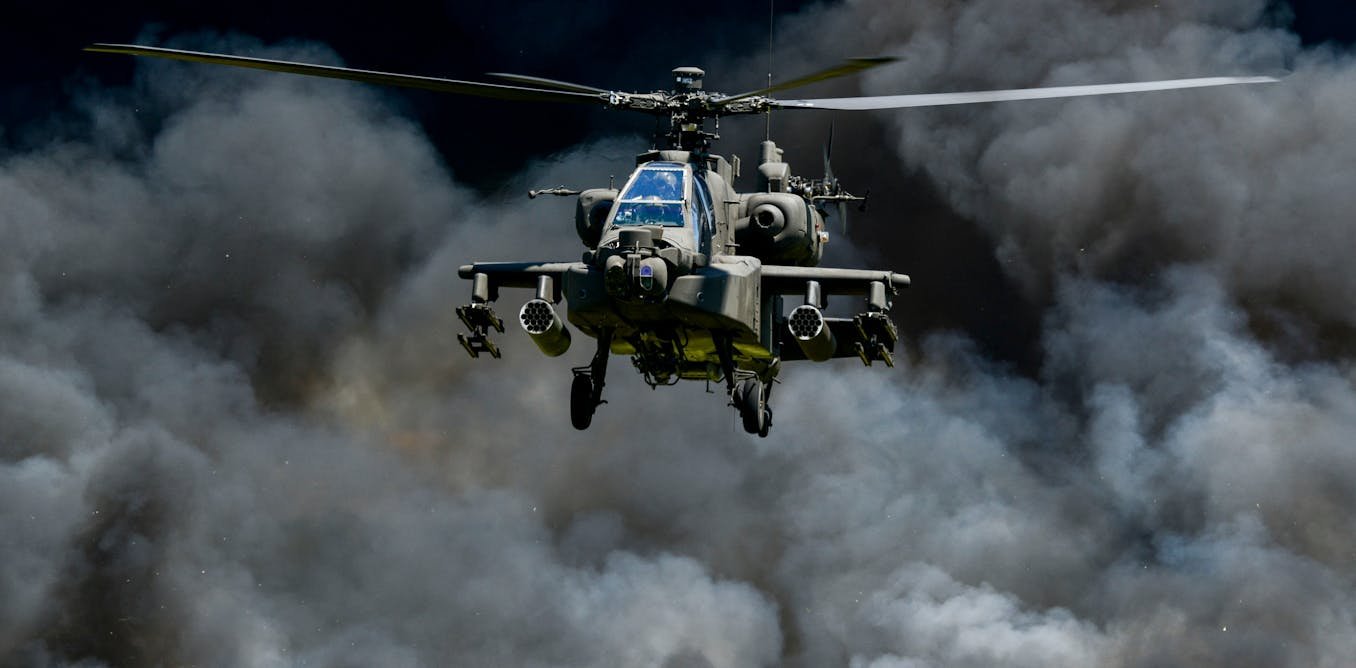
The US military launched strikes against Iran on June 9 in response to the downing of a US Army helicopter near the Strait of Hormuz a day earlier. These strikes, which the US military called “a proportional response to unjustified Iranian aggression”, came after Donald Trump claimed he was in the “final throes of what will be a very, very good deal” to end the war.
Iran swiftly carried out retaliatory attacks of its own. The powerful Islamic Revolutionary Guard Corps branch of Iran’s armed forces says it has struck US bases in Bahrain and Jordan. And it has warned of “even more severe attacks” if the US repeats its strikes.
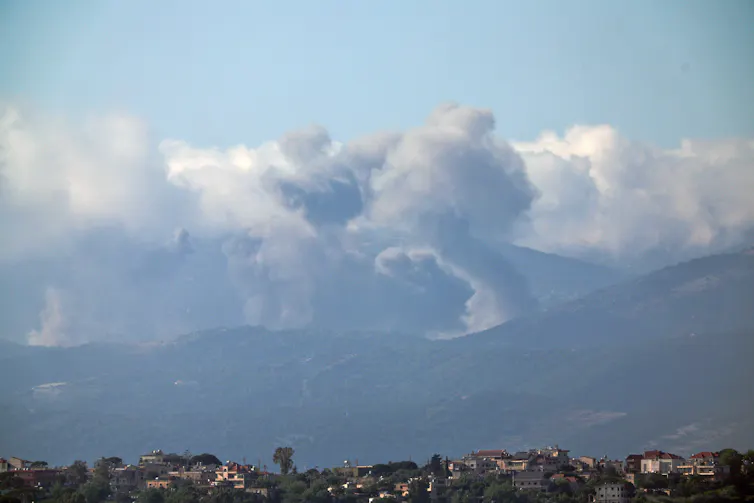
This episode took place days after Israel and Iran had briefly returned to direct conflict. Triggered by Israeli operations against Hezbollah in Lebanon, where a ceasefire was supposedly in effect, both sides launched various rounds of tit-for-tat strikes before announcing they would halt hostilities.
At first glance, these incidents appear contradictory. Diplomacy is supposed to be the alternative to war and ceasefires are supposed to reduce violence. Yet with the US, Israel and Iran once again exchanging attacks, and as military operations continue in Lebanon despite ceasefire arrangements, diplomacy and conflict increasingly seem to be unfolding simultaneously.
For decades, policymakers assumed that war and diplomacy were distinct phases of international politics. States negotiated until talks broke down, and fighting followed. Eventually, battlefield realities or international pressure pushed adversaries back to the negotiating table. Diplomacy then functioned as an exit ramp from conflict.
The aftermath of the 1973 Arab-Israeli war exemplified this model. Sustained diplomatic efforts following the conflict culminated in the 1978 Camp David accords, which laid the groundwork for a definitive peace treaty between Egypt and Israel. This treaty was signed the following year and remains in effect to this day.
However, this model is becoming difficult to recognise, with the Middle East nowadays characterised by a different dynamic. Negotiations between warring parties continue during military confrontations, ceasefires coexist with airstrikes and mediators shuttle between capitals even as threats escalate.
The problem is not that diplomacy is failing. Instead, it is that diplomacy is no longer serving its traditional purpose. Rather than ending conflicts, diplomacy is helping to manage them – a distinction that matters because a conflict that is managed is not necessarily a conflict that is resolved.
Managing conflict
The latest escalations between Israel and Iran, and now Iran and the US, illustrate this dilemma. None of these parties appear to want a full-scale regional war, as the costs would be enormous and the consequences unpredictable. Yet each of them is unwilling to abandon what they see as vital security interests.
Israel views Hezbollah’s military capabilities as a major threat and therefore has a strong incentive to weaken the group. Iran, on the other hand, sees defending Hezbollah as critical to its security because the group serves as a key deterrent against Israel and extends Tehran’s regional influence. And the US struck Iran in an attempt to uphold deterrence and signal that attacks on US personnel and assets would carry consequences.
The result of this is a cycle of calibrated escalation. Military force is used not to secure decisive victory but to signal resolve to adversaries, reassure allies and domestic audiences, and persuade opposing leaders that the costs of further escalation outweigh the potential benefits. Diplomacy, meanwhile, works not to eliminate the underlying dispute but to prevent escalation from spiralling beyond control.
This creates a dangerous equilibrium. When diplomacy functions primarily as a mechanism for crisis management, leaders face less pressure to make the difficult compromises that lasting peace requires. Negotiations can continue indefinitely while violence persists, ceasefires become pauses rather than settlements and conflict becomes chronic.
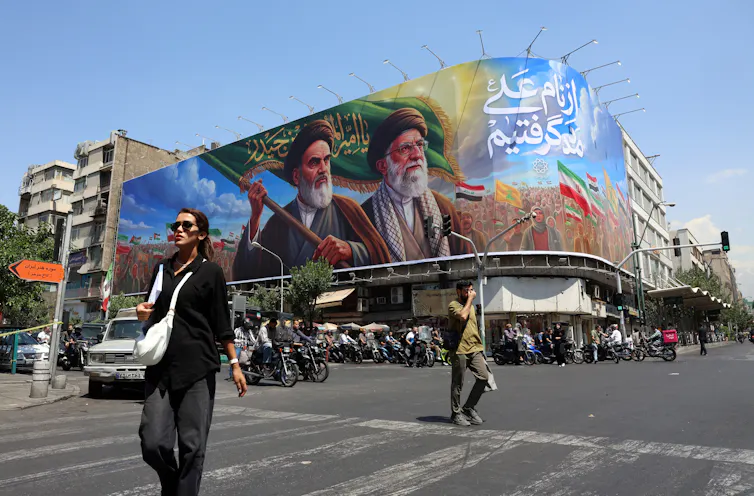
The old distinction between war and peace is becoming blurred in the Middle East. Rival powers do not move neatly from diplomacy to conflict and back again. Instead, they are operating permanently in the space between the two. This should concern policymakers.
Much of contemporary diplomacy remains based on assumptions that no longer fully apply. Negotiations are often treated as evidence of deescalation, while ceasefires are assumed to signal progress towards peace. Yet neither necessarily tells us much about whether a conflict is actually moving closer to resolution.
The latest exchanges between the US and Iran, as well as Iran and Israel, therefore raise a troubling possibility. The greatest danger may not be that the Middle East slides back into a wider war. It may be that it settles into a condition of permanent confrontation in which violence periodically erupts, diplomacy periodically intervenes and neither fundamentally changes the underlying reality.
For decades, the central challenge of international politics has been how to move from war to peace. The challenge emerging today is different, with negotiators grappling with the much more difficult task of ending a conflict when war and peace are happening at the same time.