China has extended a series of olive branches to Washington this month, including a jump in soybean purchases, the release of a detained Chinese pastor and approval to import Nvidia’s H200 chips, ahead of President Xi Jinping’s expected visit to the United States.
Nvidia’s H200 processors, used in AI platforms, will become available to major Chinese technology companies, including Alibaba and ByteDance, once Beijing approves purchases of up to 200,000 units, according to The Information.
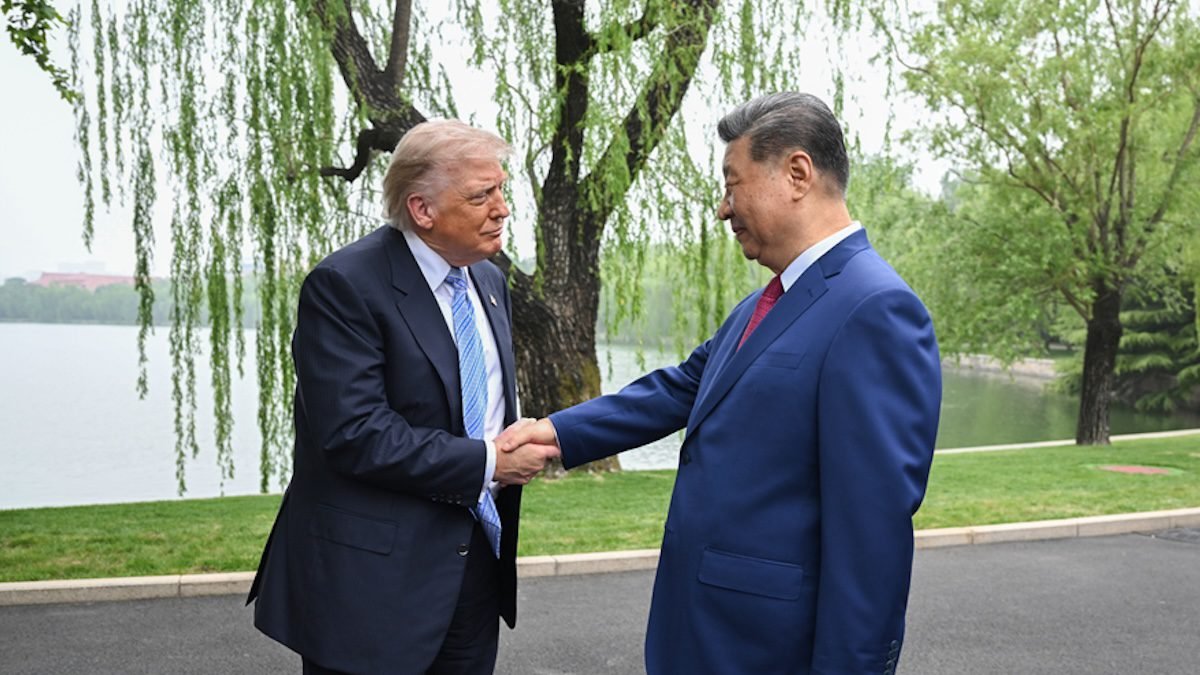
US President Donald Trump said Monday that a meeting with Xi could take place around September 24, a timeframe that would coincide with the United Nations General Assembly session in New York. He floated the date while discussing plans for a new White House ballroom, describing an anticipated visit from the Chinese leader as one justification for building it.
Trump is scheduled to address the UN General Assembly on September 22 and typically remains in New York for several nights to meet other world leaders. Xi has attended the assembly only once since taking office in 2012.
To win approval to import the H200 chips, Chinese companies must specify how many chips they require and justify the request, The Information reported. Beijing has yet to settle on an overall quota for the purchases, and the eventual total could fall short of the 200,000 units floated earlier.
Chinese officials have stressed that any imported H200 chips would be reserved for training advanced AI models rather than for routine daily inference work, which is expected to rely on domestically produced processors instead.
“The total number of approved chips is still being finalized, but the overall quota is expected to fall short of 200,000 units, less than half of what domestic firms applied for earlier this year,” says a columnist with PCPop.com, a Chinese technology news site.
“Even a limited allocation cannot fully close the industry’s shortfall, but it will still ease pressure on China’s high-end computing needs and speed up development of homegrown large language models.”
He adds that although the H200 lags two generations behind Nvidia’s latest flagship chips, it is still more advanced than Chinese AI chips. Trump approved the export of H200 chips to China last December, opening the door for Chinese buyers to place orders for the advanced processors.
Reuters reported on January 28 that ByteDance, Alibaba and Tencent had already been cleared to purchase more than 400,000 H200 chips combined. Yet Nvidia shipped none of the chips to China in the first half of this year, as Beijing urged domestic firms to prioritize homegrown chips instead.
The uncertainty prompted Nvidia cheif Jensen Huang to join Trump aboard Air Force One for a visit to China in mid-May.
Some observers viewed Beijing’s latest decision to allow Chinese firms to import 200,000 H200 chips as a concession to the Trump administration’s tightening of chip export controls.
On May 31, the US Commerce Department moved to close a loophole that had allowed Nvidia’s advanced AI chips to reach China through overseas units of Chinese companies, mainly in Singapore and Malaysia.
The department’s Bureau of Industry and Security (BIS) said a license would now be required to export advanced processors to entities ultimately headquartered in China, a measure that also applies to chipmaker AMD.
Xi has, in general, acted quickly to the requests Trump made during their summit in Beijing in May, when the two leaders agreed on stepped-up fentanyl enforcement, an increase in American agricultural purchases, greater access to rare earth minerals, and Beijing’s pledge to purchase 200 Boeing aircraft.
Two other recent developments also suggest Beijing is working to smooth the atmosphere in Sino-US relations. At Trump’s request, China released Pastor Kim Myeongil, who led China’s largest evangelical underground church before his arrest last October, and sent him to the US, according to a US official.
Bloomberg reported Tuesday that China’s state-owned trader Cofco has booked at least six cargoes of American soybeans for shipment between September and October. The US Department of Agriculture disclosed on Wednesday that Beijing had purchased 472,000 metric tons of soybeans in a single sale, the largest daily volume shipped to China since November 2025.
Trump also raised the case of Jimmy Lai, the jailed Hong Kong media tycoon, but Beijing has yet to free him.
Arms sale to Taiwan
Beijing’s gestures followed a call on June 30 between Chinese Foreign Minister Wang Yi and US Secretary of State Marco Rubio, in which Wang warned that the Taiwan issue affects the broader relationship and urged Washington to handle related matters with great caution.
“Both sides should always uphold the spirit of equality, respect and mutual benefit, and translate the consensus reached by the two heads of state into concrete policies,” Wang said. “To do so, both sides need to expand the cooperation list and create a more positive agenda, while narrowing the list of problems and managing various risks. A slight move on the Taiwan issue could affect the whole situation.”
Wang was believed to be referring to a proposed US$14 billion US arms sale to Taiwan, which includes HIMARS (High Mobility Artillery Rocket System) rocket systems, howitzers, Javelin anti-tank missiles, Altius loitering munitions and ATACMS (Army Tactical Missile System).
In late May, acting US Navy Secretary Hung Cao said the US was pausing its planned arms sale to Taiwan to ensure it had enough weapons for the Iran war. In early June, Rubio clarified at a House Foreign Affairs Committee hearing that the arms sale to Taiwan had not been halted but remained under review, and that US policy toward Taiwan had not changed.
Beijing is also discussing with the US a proposed trade mechanism for non-sensitive goods, under which each side would identify about $30 billion in goods eligible for reduced tariffs and mutual sales without crossing national security red lines.
On June 25, the US and China agreed to set up a trade council to discuss cooperation on agricultural trade, including reciprocal tariff cuts. Under the mechanism, China will import more American beef, fruit and grain, while the US will ease restrictions on imports of Chinese dairy products, potted ornamental plants, aquaculture products and poultry.
“Compared with the overall scale of Sino-US trade, $30 billion is not a huge sum, but its value should not be measured only by its size,” a columnist with the International Business Daily, a Chinese newspaper run by the Commerce Ministry, said in an article published on July 2. “Starting with the agricultural sector offers a realistic path toward expanding the scope of tariff cuts later on.”
Washington announced a one-year tariff war truce last November that has kept US tariffs on Chinese goods at about 30% through November 10, 2026.
Read: China’s H200 hunger drives Nvidia chip smugglers to Japan route
Follow Jeff Pao on X at @jeffpao3