During World War II, physicists on the Manhattan Project worried that the Nazi German nuclear program might achieve the first nuclear bomb before the US and its allies. That’s not what transpired, but historians have debated just how close the Germans came to achieving criticality in their last attempt at building a reactor: the B8 pile. Werner Heisenberg, who led that effort, claimed that they were close and had only needed a little more uranium. But according to a paper published in the Proceedings of the National Academy of Sciences Nexus, that was not the case: the project simply didn’t have sufficient uranium and heavy water to build a working bomb, given the design they were using.
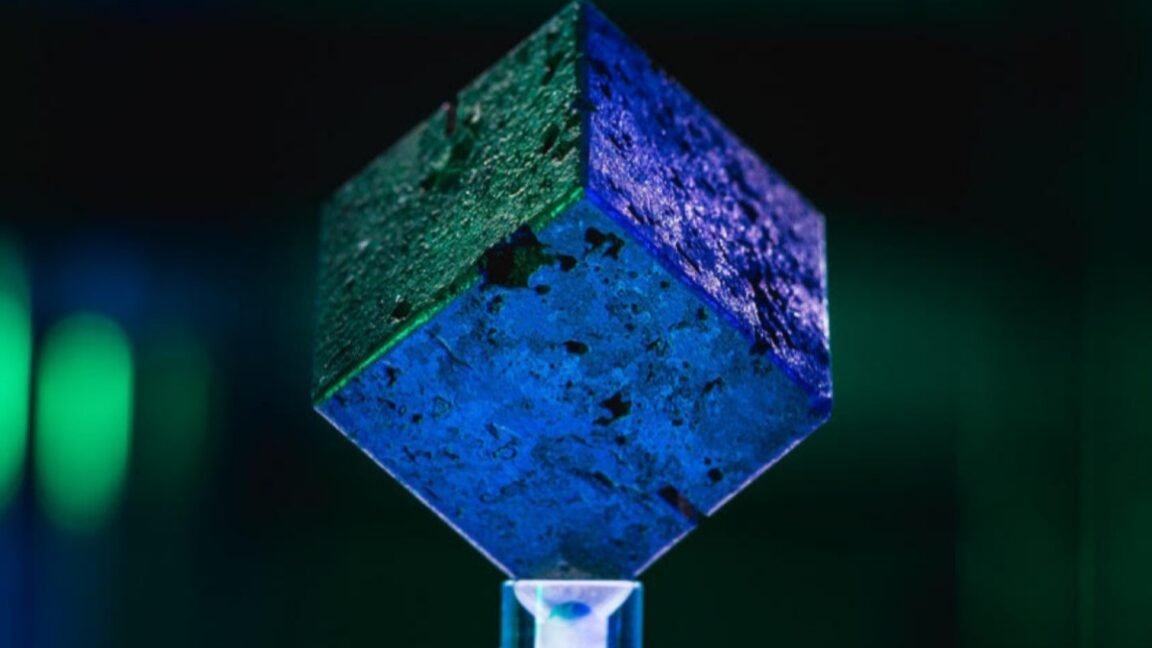
This particular research started in 2013, when University of Maryland physicist Timothy Koeth—a co-author on the new paper—received the gift of a mysterious heavy metal cube from a friend. He instantly recognized it as one of the uranium cubes used by German scientists in their unsuccessful attempt to build a working nuclear reactor. Only 14 such cubes are known to exist today.
In 2019, we reported on Koeth’s quest to track down the cube’s origins, as well as several other similar cubes that had somehow found their way across the Atlantic. At the time, Koeth and his partner in the quest, then-graduate student Miriam “Mimi” Hiebert, had tracked down ten such cubes around the US. For instance, the Smithsonian Institute had a German uranium cube in storage. They tracked a third cube to Harvard University, where it was regularly passed around to students in introductory physics classes as a curiosity.
Underpinning the Manhattan Project in the US was the fear that German scientists under Adolf Hitler’s Nazi regime would beat the Allies to a nuclear bomb. The Germans had a two-year head start, but according to Koeth, “fierce competition over finite resources, bitter interpersonal rivalries, and ineffectual scientific management” resulted in significant delays in their progress toward achieving a sustained nuclear reaction. German nuclear scientists were separated into three isolated groups based in Berlin (B), Gottow (G), and Leipzig (L).
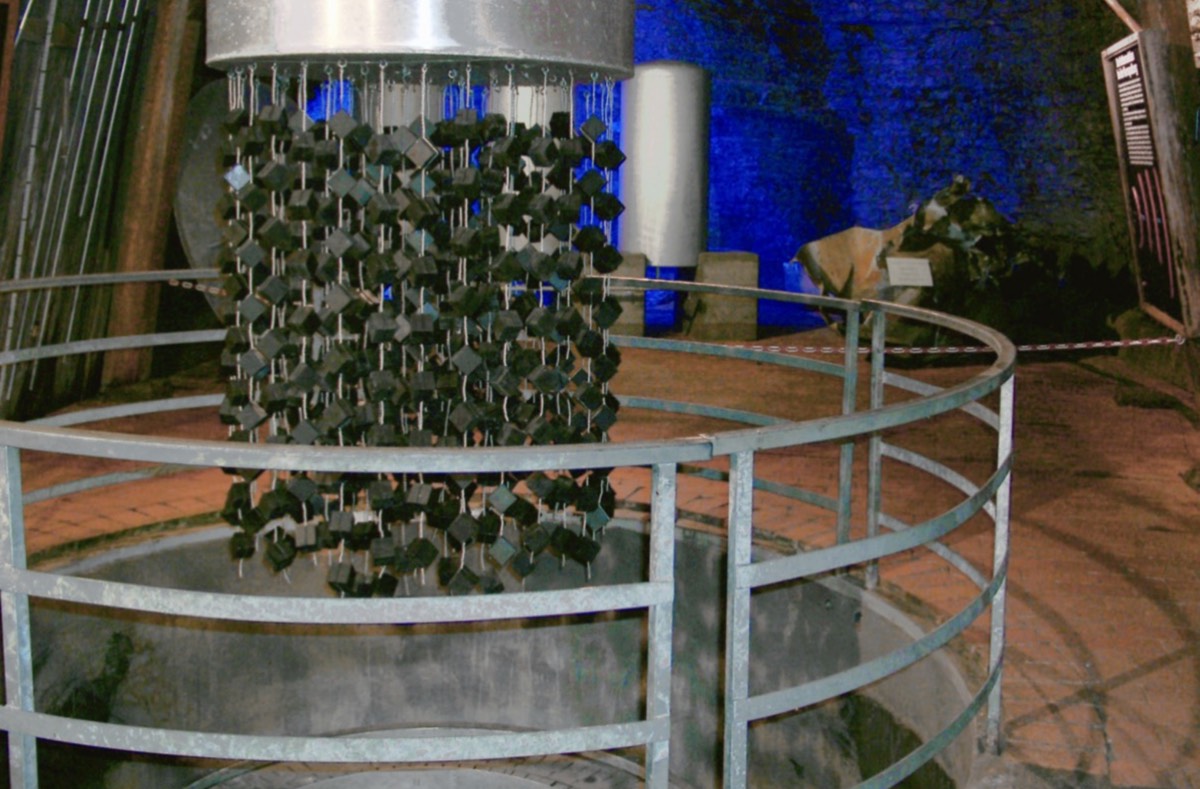
Heisenberg headed the Berlin group, and as the Allied forces advanced in the winter of 1944, Heisenberg moved his team to a cave under a castle in a small town called Haigerloch—now the site of the Atomkeller Museum. That’s where the group built the B8 reactor. It resembled an “ominous chandelier,” per Koeth, because it was composed of 664 uranium cubes strung together with aircraft cable and then submerged in a tank of heavy water shielded by graphite to prevent radiation exposure.
As the German scientists were racing against time, Manhattan Project lead Lieutenant General Leslie Groves kicked off a covert mission dubbed “Alsos,” with the express purpose of gathering information and materials related to Germany’s scientific research. When Allied forces closed in, Heisenberg took apart the B8 experiment and buried the uranium cubes in a field, ferreting away key documentation in a latrine. (Pity Samuel Goudsmit, the poor physicist who had to dig those out.) Heisenberg escaped by bicycle, carrying a few cubes in a backpack.
A critical reassessment
As Heisenberg reported, the German scientists’ final experiment failed because the amount of uranium in the cubes was insufficient to trigger a sustained nuclear reaction. But Heisenberg was confident that “a slight increase in its size would have been sufficient to start off the process of energy production.” A model described in a 2009 paper supported that, showing the group would have needed only 50 percent more uranium cubes to make the design work.
Koeth and Hiebert uncovered a box of declassified documents about German uranium in the National Archives and found about 400 other uranium cubes from a separate reactor experiment by the Gottow group. They concluded that the combined inventory would have been more than enough to achieve criticality in the B8 reactor, suggesting that Germany’s secretive, isolationist approach hampered their nuclear program because the two groups weren’t sharing information or resources.
This latest paper builds on that earlier work but reaches a different conclusion. Koeth, Hiebert, and their co-authors analyzed two of the surviving uranium cubes, along with combing through historical records, technical reports, correspondence, and similar archival sources to learn more about the uranium, heavy water, and graphite blocks used for the B8 reactor experiment.
Among their findings: The B8 reactor would have needed between 1,292 and 1,775 uranium cubes to achieve criticality, and twice the heavy water produced by the Norsk Hydro plant in Vemork, Norway—the only source at the time—over the course of the entire war. In short, “Our calculations suggest Heisenberg significantly underestimated the materials required,” the authors wrote.
The authors also cited prior work noting key differences in American and German graphite production. The former used petroleum coke. While some of this supply reached Germany, the British naval blockade in January 1940 deprived the Germans of that vital resource. The German nuclear physicists had to use metallurgical coke from the Ruhr, which had twice as many impurities as American coke. (The US scientists had similar issues until they located an unusually low-boron coke in Pennsylvania.) Thus, “no natural uranium, graphite-moderated pile could have gone critical” with the materials available to the German scientists at the time.
PNAS Nexus, 2026. DOI: 10.1093/pnasnexus/pgag282 (About DOIs).