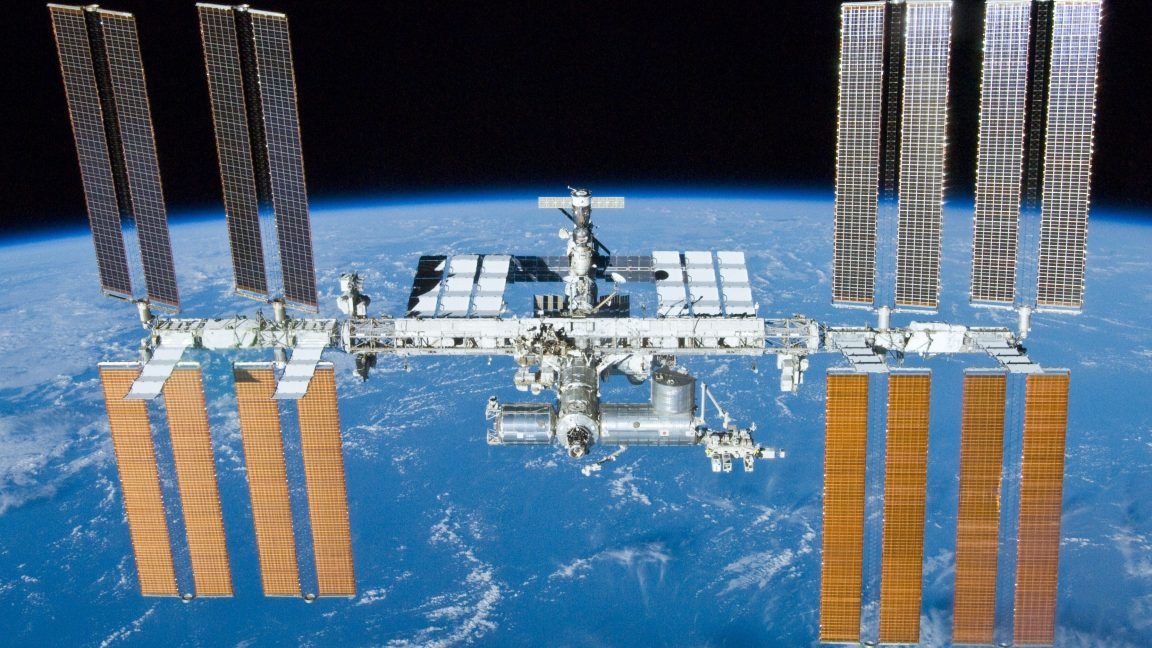
NASA confirmed Thursday that the Russian segment of the International Space Station has begun leaking atmosphere into space again. It’s an old problem that NASA recently hoped was resolved.
For more than half a decade, engineers from Roscosmos and NASA have been tracking the leak rate from a small Russian module attached to the space station that leads to a docking port. The source of these leaks, microscopic structural cracks, have been difficult to find and address.
In January, NASA said that after multiple inspections and sealant applications, the pressure inside this segment, known as the PrK module, had reached a “stable configuration.” The PrK module is essentially a transfer tunnel attached to the Zvezda Service Module on the Russian segment of the space station.
This announcement by NASA was greeted by a sigh of relief in the space community, as atmospheric leaks on a pressure vessel like the International Space Station are never a good thing.
Leaks begin again
Unfortunately, the leak returned three weeks ago. After a couple of sources reported this to Ars, NASA confirmed the issue on Thursday. On May 1, after Russian cosmonauts unloaded cargo from the Progress 95 cargo spacecraft, Roscosmos noted a “slow pressure drop” in the PrK module.
“Teams performed data analysis, which indicated a loss of about one pound per day,” NASA spokesperson Josh Finch told Ars. “Roscosmos allowed the pressure in the transfer tunnel to gradually decrease while monitoring the rate. The area now is being maintained at a lower pressure, with small repressurizations as needed. There are no impacts to station operations, and NASA and Roscosmos are coordinating on next steps.”
Although there is no impact on astronauts aboard the station, nor any immediate concerns about the station’s health, the returning leak issue raises new questions about the long-term viability of the ISS.
High risk, high consequence
In the past, NASA officials have downplayed the severity of the leak risks publicly and in meetings with external stakeholders of the ISS. Internally, however, there appears to be greater concern. The space agency uses a 5×5 “risk matrix” to classify the likelihood and consequences of risks to spaceflight activities, and the Russian leaks have been classified as a “5” on both high likelihood and high consequence. Their potential for “catastrophic failure” is discussed in meetings.
Despite its dwindling budget, Roscosmos has managed the problem over the last several years largely by keeping the hatch to the PrK module closed to the rest of the station. It was thought that the issue could be similarly managed through 2030, when the space station was due to be retired.
However, NASA and the US Congress are now considering extending the space station’s lifespan to at least 2032, if not longer. The reemergence of cracking on the space station—some of its modules have now been in space for nearly three decades—calls into question whether continually extending its operation is a viable long-term strategy.
Can NASA keep extending ISS into perpetuity?
NASA must win international partner support for these extensions, including from Russia. The agency’s decision-making is further complicated by the desire to continue flying the station until private replacements are ready.
The US space agency has struggled to find a viable path forward with “commercial” space stations, a plan in which NASA would help fund development of one or more private space stations while also agreeing to be one of several customers with its astronauts. In March, NASA proposed a revised plan for these commercial space stations at its Ignition event, which included private firms docking initial modules to the International Space Station, but it has not been particularly well-received.
The commercial companies are wary about NASA’s discussions to extend the station’s lifespan because they say they will be ready by 2030. Phil McAlister, NASA’s former director of commercial spaceflight, said the agency would be best served by fully supporting the development of commercial space stations and working with the private companies to ensure they are ready by 2030.
“This further confirms the wisdom of the current policy of retiring the ISS in 2030 and replacing it with more modern, more cost-effective, and safer commercial platforms,” McAlister told Ars.