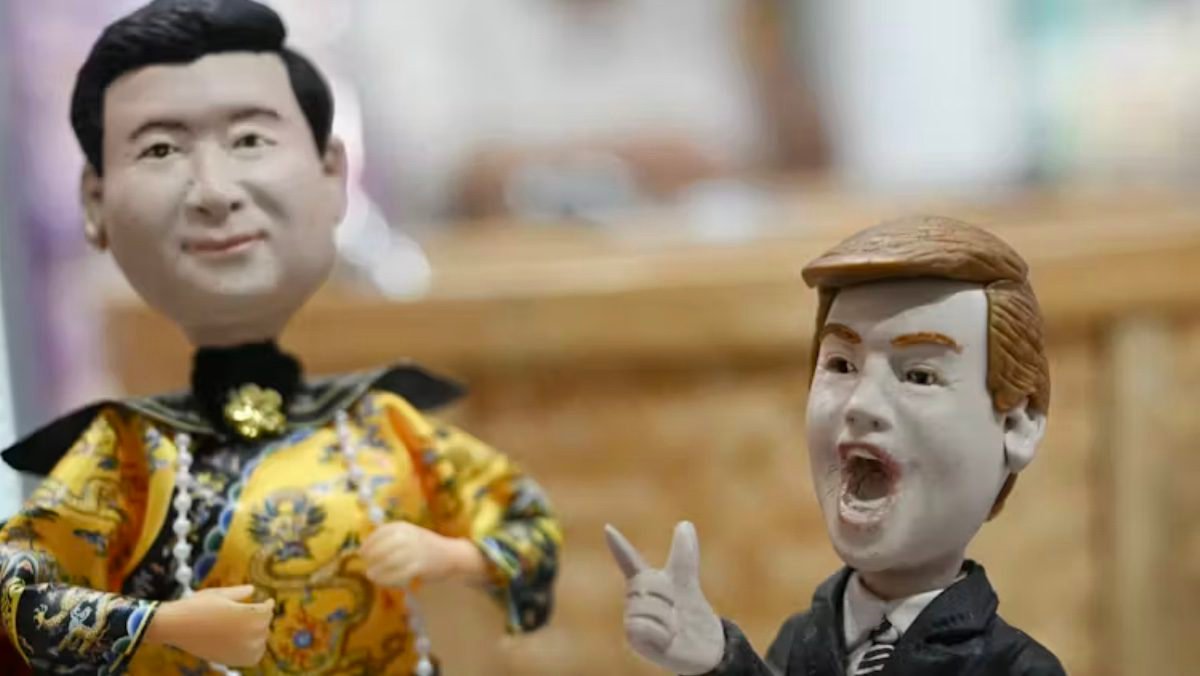
Meetings between Chinese and American leaders are not exactly routine, but few are historically groundbreaking.
The exceptions include the very first visit by a sitting US president to China, when Richard Nixon met with Chairman Mao Zedong in Beijing in February 1972 – at a time when America did not even formally recognize the People’s Republic of China.
Deng Xiaoping’s visit to the US in 1979 generated a similarly iconic moment when the reformist Chinese leader donned a Stetson at a Texas rodeo, a sign that he would be willing to engage with America in a way that Mao contemplated only near the end of his life.
Donald Trump may harbor hopes that his upcoming visit, slated for May 14-15, 2026, could have similar historical significance to those moments half a century ago. It will, after all, be the first face-to-face meeting of US and Chinese leaders in Beijing since Trump’s own visit nearly a decade ago in 2017.

Yet the outcomes of this Trump summit with Xi Jinping are likely to be vague because the goals for both leaders are also only partially evident. The visit is being driven by trade imperatives, but there are other issues that threaten US-China relations in the longer term.
It will be extremely hard for the two sides to address these more deep-rooted divides. Indeed, as an analyst of US-China relations, I believe the world’s two largest economies will have an essentially competitive relationship for years to come, and areas of plausible cooperation – whether on climate change or AI regulation – are increasingly hard to find.
Taiwan: a change in US position?
One area that has been a source of contention for quite some time is Taiwan. Xi has made it clear that the unification of the island with the mainland cannot be left to “another generation” but has left it vague – up to now – as to how that goal will be achieved.
The summit has been preceded by lots of chatter about US preparedness to honor its somewhat ambiguous promise to defend Taiwan in the event of an invasion – with Chinese analysts concluding that the war in Iran has severely weakened Washington’s capabilities on this front.
However, there are plenty of signs that Xi would rather find peaceful means to unite with Taiwan that avoid all-out war, particularly as the examples of Russia in Ukraine and the US in Iran show that the outcomes of wars are not predictable.
Instead, China has seemingly concentrated its efforts on influencing the upcoming January 2028 Taiwan presidential election. The leader of the island’s major opposition Kuomintang party, Cheng Li-wun, recently visited the mainland and had a photo op with Xi – a sign that she thinks dealmaking with China might just be acceptable to the Taiwan electorate despite its deep distrust of Beijing.
To further fuel the narrative of a seemingly inevitable path toward unification, it would be helpful for Xi to have signals that the US is no longer committed to defending Taiwan.
China will push for a change from the official position that the US “does not support Taiwan independence” to “the US opposes Taiwan independence.” The latter change sounds minor but would have great significance, as it would essentially be an acknowledgment that the US recognizes unification, by some means, as a legitimate goal in its own right.
Trump has kept his own position ambiguous: He has noted more than once that Taiwan is very close to China and very far from the US, but he has also authorized major arms sales to the island that have infuriated Beijing.

Taiwan’s ruling Democratic Progressive Party does not specifically endorse independence, as it knows that’s a red line for Beijing, but it would regard this change in American language as a serious blow to its position.
It’s unlikely that the US would make such a major concession during Trump’s visit – but that won’t stop Beijing from asking for it.
AI: The battle for global leadership
A more tentative but increasingly important area for discussion during the Xi-Trump summit is technology in general and AI in particular.
Just three years ago, the attitude of the US government was summed up in the phrase of then national security adviser Jake Sullivan: “small yard, high fence.”
In other words, there would be only a few restricted areas of technology, but they would be fiercely guarded.
In 2026, things have changed. In some areas, tech restrictions have just become looser; the US government now permits the sale to China of some high-specification, American-manufactured chips that were previously restricted.
That policy was probably driven by the sense that China was developing its own domestic alternatives anyway and that the US was losing market share.
Yet there is growing concern both in the US and China that AI developments are moving too fast for governments – or companies – to know fully what the technology is capable of doing, let alone being able to regulate it.
China and the US both desire to dominate AI and set the global norms and standards surrounding it. But they are also aware that AI has the potential to cause immense damage.
There has been loose discussion of whether any joint form of supervision or regulation of AI between the US and China might be possible. And that could well form part of the discussions during the leaders’ summit.
But realistically, both sides see themselves in fierce competition, and the likelihood that either American or Chinese companies would restrain themselves may be fanciful.
The trade elephant in the room
The most substantial achievements of the summit, however, are likely to be in the least glamorous area: remedying the trade deficit.
Trump’s tariffs aim to make the US’s global trade partners pay a higher price for entry to the American market, and China’s persistent and massive trade surplus has been a prime target for the US president.

While there are many American products that China would like to buy, most of them are not products that the US government is willing to let them have, including high-tech equipment that could be used for military purposes.
Instead, the key products are likely to be agricultural, including US soybeans and beef. Look out for concessions from China that would benefit farmers in key Republican states, such as Iowa.
The current tariff dispute between the US and China has frozen into a standoff: The US has agreed to allow China’s goods into its immense market at manageable tariff rates, and China has – mostly – agreed to allow critical minerals and rare earths to flow to US manufacturers.
That truce lasts until October, but the summit may see it extended.
Neither side is keen to restart the trade war that marked the summer of 2025, when Trump announced tariffs of over 100% on China and the US was in danger of having key mineral supplies cut off as a result.
Summit to talk about? Perhaps not
So how consequential will the Trump-Xi summit be? Well, don’t expect another “Nixon meets Mao” moment.
The circumstances more than a half-century on are also remarkably different. Today’s China, unlike in 1972, has an economy and military second only to the US and a central position in global organizations, from the United Nations to the World Trade Organization, particularly as the US retreats from such institutions.
Both the US and Chinese sides know that they can expect limited cooperation at best from their opponent.
But after a period, particularly during the Covid-19 pandemic, when communication between the countries atrophied, it’s still important that they are talking at all.
Rana Mitter is professor of US-Asia relations, Harvard Kennedy School
This article is republished from The Conversation under a Creative Commons license. Read the original article.