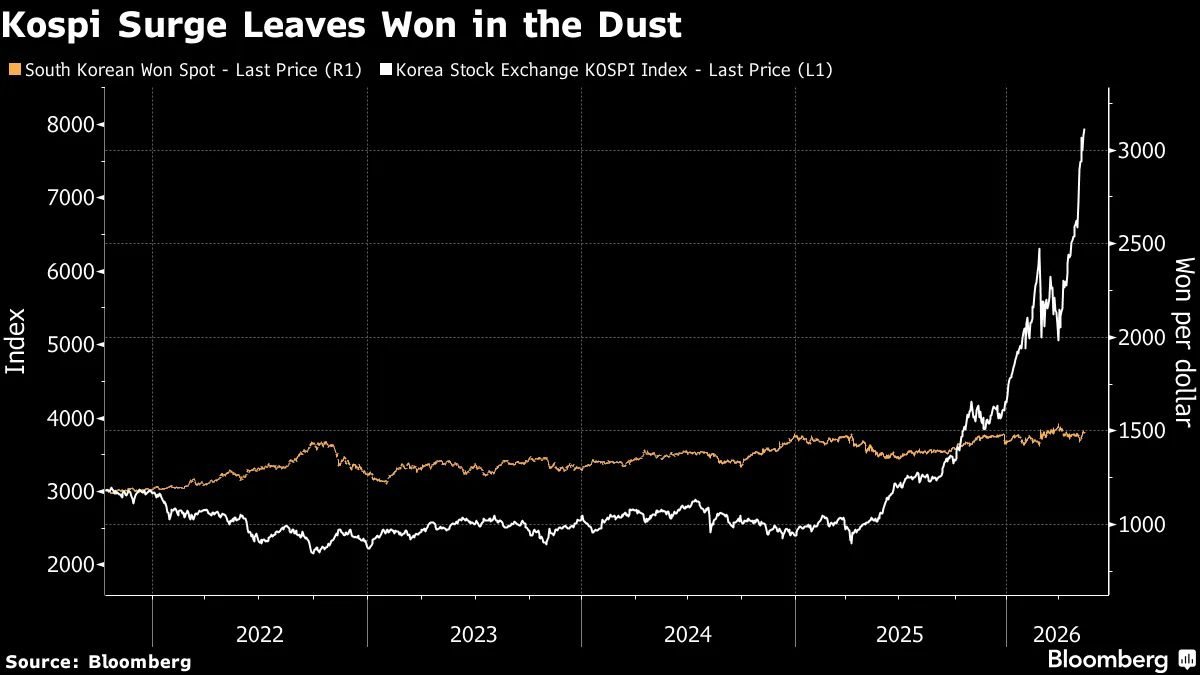
TOKYO — Few market visuals are more striking than the South Korean won and the Kospi index suddenly tearing off in opposite directions.
The won has slumped 4.5% this year, putting it among Asia’s weakest currencies. The Kospi, meanwhile, has exploded — up 85% since Jan. 1 and 200% over the past year. The frenzy propelling Seoul stocks to record after record is rooted in artificial‑intelligence mania. Tech giants SK Hynix, up 873% in twelve months, and Samsung Electronics, up 447%, are doing most of the heavy lifting.
The stock surge has given President Lee Jae‑Myung an almost sorcerous market aura. On the campaign trail before taking office in June 2025, he vowed to lift the Kospi to 5,000 – a target that implied doubling the index over his five‑year term. Instead, it blew past 8,000 in under a year (it’s currently at 7,815).
Yet the won’s slide is marring Lee’s market triumph. Since mid‑2025, the currency has drifted steadily lower even as stocks soared. Its drop is far milder than the Kospi’s surge, but the won is now hovering near levels last seen during the 2009 global financial crisis as the Iran war fallout ripples across Asia.
“The weakness in the won is an important data point as Korea doesn’t have any fiscal problems,” says Brad Setser, an economist at the Council on Foreign Relations. “It also doesn’t suffer from any shortage of foreign exchange – so creative policy makers should be able to engineer a stronger won.”
That’s easier said than done, of course. Setser says Korea’s giant National Pension System should pause its accumulation of foreign assets. Effectively, this means selling dollars for won. The US, meanwhile, should be willing to join the BOK in directly supporting the won. Bottom line, Setser says, it’s “time to be creative.”
The problem, notes economist Paul Cavey, founder of advisory East Asia Econ, is that “foreigners became huge sellers of domestic assets” in recent weeks. Net sales of Kospi shares by overseas investors so far this year topped US$62 billion. Part of the worry is that AI made it too easy for President Lee’s team – and that the market is too frothy for comfort.
Earlier this month, Citigroup analysts raised the specter of “irrational exuberance” dominating the Kospi. The reference here is to a phrase made famous by then-Federal Reserve Chairman Alan Greenspan in 1996.
“Although we believe it’s too early for a severe market correction or the end of the bull market due to tightening financial conditions caused by interest rate factors, the Kospi appears significantly more overbought compared to the US market,” Citi writes. “A prudent approach would be to take profits on half of the positions.”
A major worry is that Lee still hasn’t tackled the long‑standing “Korea discount,” which keeps local equities priced below global peers. It’s also why MSCI continues to withhold developed‑market status — an upgrade that would unleash a flood of foreign capital into won‑denominated assets.
MSCI has pressed Korea to scrap outdated rules, ease ownership limits, deepen capital markets, extend currency‑trading hours and boost transparency. Seoul has made some progress. Lawmakers reinstated short‑selling in March 2025 after a 17‑month ban. Authorities have expanded foreign‑exchange trading to 17 hours.
Yet MSCI holds that Korea still isn’t ready for global prime time. In June 2025, when it rejected Korea’s upgrade request again, MSCI said: “Despite these reforms, investors believe it remains critical to assess whether the implemented measures are sufficient, given that developed markets typically feature fully convertible currencies with active, unconstrained offshore and onshore forex markets.”
To be sure, Korea recently saw its weighting in MSCI Emerging Markets Index increase to 21.7% from 15.4%. This puts Korea in league with China’s 22% weighting.
Yet the Korean market is being challenged from both ends amid domestic rigidities and global headwinds.
Internationally, the surging US dollar is adding pressure, siphoning capital out of emerging markets and raising the risk of accelerated outflows from Korea. It also magnifies the country’s exposure to soaring energy costs. With Middle East turmoil keeping oil in the $100 a barrel range, the shock poses a direct threat to Asia’s fourth‑largest economy.
In March, Korea imposed nationwide fuel‑price caps for the first time in nearly three decades. Inflation accelerated anyway. Consumer prices rose 2.6% in April from a year earlier, the fastest pace in about two years and up from 2.2% in March. That leaves the Bank of Korea in a bind – and raises the odds that new governor Shin Hyun‑song will soon opt for a rate hike.
The BOK has held rates steady since May 2025, after delivering four 25-basis-point cuts in the previous seven months. The last time the BOK tightened was in January 2023. At the time, the central bank hiked rates to 3.5%, the highest since 2008. Though the BOK meets on May 28, it’s not expected to start hiking its 2.5% benchmark until the second half of 2026.
The longer the Strait of Hormuz stays closed, the more Korea’s 2026 outlook unravels — and the more vulnerable the AI‑driven economy becomes. As inflation pushes bond markets into turmoil, the risk grows that capital will retreat from AI, data centers, and cloud infrastructure.
Korea may become ground zero for a new clash between the “old economy” — surging commodity prices and other traditional pressures — and the “new economy” that AI is building in real time.
Earlier this month, BOK Deputy Governor Ryoo Sang-dai warned it may be “time to consider stopping rate cuts, and thinking about increases” as inflation heats up. Economist Kong Dong‑rak of Daishin Securities notes that, compared with the last policy meeting — when officials adopted a wait‑and‑see stance amid uncertainty over the war’s impact — recent BOK comments mark “a step forward” toward prioritizing inflation.
This isn’t to dismiss Korea’s potential. Betting against it hasn’t been a winning strategy in recent decades. Korea is, after all, an economy that knows how to take a punch.
After the 1997-98 Asian financial crisis, Korea was the first shattered economy to claw its way back. A decade later, it sidestepped the “Lehman shock” in ways hedge funds never anticipated. And in 2009, despite market speculation, Korea didn’t become the “next Iceland” at all.
Korea sailed through the Federal Reserve’s 2013 “taper tantrum,” which rattled emerging markets worldwide. Ditto for the 2017-2021 Trump‑era trade war. In 2020, Korea became a Covid‑19 exemplar with remarkably low infection rates. And by 2021, the BOK was the first top‑12 central bank to tighten policy.
More recently, President Lee steered Korea through the turbulence of the 2025 Trump 2.0 trade war with surprising resilience. And today, the Kospi is hitting all‑time highs despite US tariffs and the ongoing US-Israeli conflict in Iran.
The challenge is that Korea excels at economic defense but struggles to play offense. In the second half of 2026, it will need both skills.
Lee also must convince the world that Korea hasn’t lost its innovative edge. It once sat at the center of the tech universe when success meant flashy smartphones. Today, the bar is far higher. It’s about not just producing top‑tier AI chips but also inventing the next wave of game‑changing technologies that put Korea at the heart of global disruption.
And in an Asia‑wide start‑up arms race, strengthening Korea’s competitiveness may matter more than ever. Korea’s biggest structural problem is its sprawling family-owned conglomerates, or chaebols, which dominate the economy and crowd out the resources new startups need to thrive. In such top-down systems, real disruption usually only happens once a company reaches a significant size.
Last month, Lee urged Korea Inc. to move upmarket quickly. “With free trade weakening and geopolitical risks rising, the global trade order is at a turning point,” he said. “A manufacturing-dependent country like ours must pursue bold, transformative innovation – our future depends on it.”
Easier said than done. To stay ahead of the global pack Team Lee must incentivize Korea to raise its game in R&D, building ecosystems, and fostering a risk-taking culture that puts Korea at the center of shaping — not just riding — the AI wave.
Lee’s 351-day-old administration is clearly on a roll. On his watch, the Kospi has soared beyond virtually everyone’s wildest expectations. Fueled by AI, Korea’s market cap has since surpassed France, Germany and the UK. Yet, the weak won suggests Korea might not be as ready for global prime time as the bulls believe.