
The Trump administration is putting in place a military blockade of all of Iran’s ports and coastal areas. The blockade came into effect at 10 am US Eastern time on Monday. As it is currently defined, the blockade will allow ships to transit the Strait of Hormuz if traveling between non-Iranian ports.
A lot depends, of course, on the ability to prevent efforts by Iran to disrupt Hormuz traffic, which up until now they seem to have been doing successfully (although mostly it is the fear factor that is keeping tankers from moving).
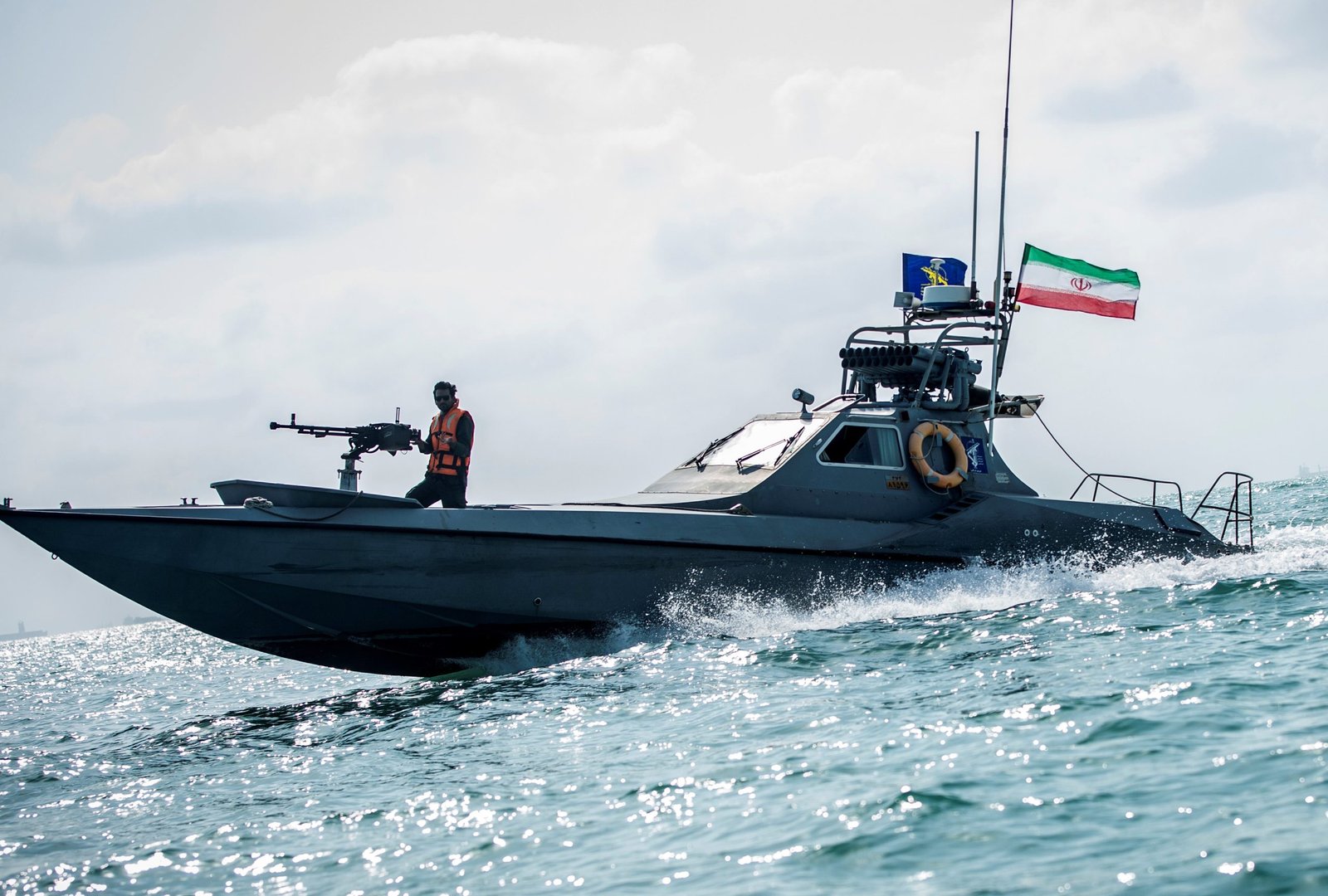
Iran still has a fleet of small attack craft loaded with missiles. If they show up to try and stop shipping, the US Air Force and Navy will have to sink them.
President Trump explained that US forces mostly did not go after them during the heavy military operations targeting Iran, as the American interest was sinking Iran’s main naval ships and submarines (although there is some concern about the whereabouts of Iran’s Russian-supplied Kilo class submarines). Now, however, the US will have to locate and destroy them.
This will take time. At the start of the recent conflict Iran had a large number of heavily armed speedboats, some belonging to the regular Iranian Navy and the others to the Islamic Revolutionary Guard Corps Navy. At minimum the count was somewhere between 3,000 and 4,000 speedboats and another 133 patrol and combatant vessels. Even if the US Navy and Air Force goes all out on knocking them out, locating and destroying them will take time and a lot of weapons.
The best and most cost effective tool in the US arsenal, with the least risk, is the A-10, because it can fire low-cost laser guided rockets and has a powerful 30mm Gatling gun that can easily shred any small ship. Unfortunately, there are only around 30 A-10s in the Middle East. These came from 107th Fighter Squadron (Selfridge ANGB, Michigan) and the 190th Fighter Squadron (Gowen Field, Idaho). Each of these squadrons has between 6 and 9 A-10s still remaining in the US.

Obviously more A-10s are needed. As of April 2026, the Air Force had retired approximately 56 to 59 A-10s to the “boneyard” (AMARG) at Davis-Monthan AFB in Arizona during the preceding fiscal year. These aircraft are operational, have all their equipment and can be activated. Obviously, pilots who know how to fly them have to be transitioned back to the A-10, but this can happen quickly if the Air Force and the Trump administration want to do it.
The impact would be substantial. Practically overnight, the A-10 fleet in theater could be tripled ( 30 A-10’s to over 90 A-10s). While not all of them may have laser guided rockets, all of them have the firepower of the 30mm Gatling gun that fires ammunition enhanced with depleted uranium shells.
Air Force will put up every kind of argument
Unfortunately the Air Force, which has been working to get rid of the A-10s, will put up every kind of argument to prevent the use of these aircraft. It will be a challenge to the Pentagon, which needs to quickly win the Iran war, and to the Trump administration, which has typically deferred to the military. Deferring to the Air Force when it comes to the A-10 would harm America’s effort in the Gulf.
If the Iranians lose the fight in the straits, they are in a stranglehold with nowhere to go. Without being able to ship oil, their entire economy will stop functioning.
Blockade goal: collapse of the rial
Miad Maleki has written: “The US naval blockade of the Strait of Hormuz would cost Iran approximately $276M/day in lost exports and disrupt $159M/day in imports, a combined economic damage of ~$435M/day, or $13B/month. Over 90% of Iran’s $109.7B in annual trade transits the Persian Gulf. Oil/gas accounts for 80% of government export earnings and 23.7% of GDP. Kharg Island alone generates ~$53B/year, or as I noted to @TIME, “$78 billion a year in energy revenue.”
Miad Maleki is a prominent national security analyst and sanctions strategist currently serving as a Senior Fellow at the Foundation for Defense of Democracies (FDD). He is widely recognized for his expertise in economic warfare, specifically regarding the Iranian regime and its proxy networks. Maleki tells us that Iran’s currency will collapse quickly from the blockade. “The rial has already cratered from 42,000 to 1.5M per dollar. Banks are limiting withdrawals to $18-30/day. Overall inflation: 47.5%. A blockade eliminating all forex earnings pushes the rial into terminal hyperinflation.”
It is fairly obvious that the Trump strategy either will force the current regime to agree to the US terms on a deal, or social revolution will result that the regime won’t be able to stop.
A key factor is the rapid return of the A-10 to the fight in the Straits of Hormuz.
Stephen Bryen is a former US deputy under secretary of defense. Read this article and many others on his Substack newsletter, Weapons and Strategy.