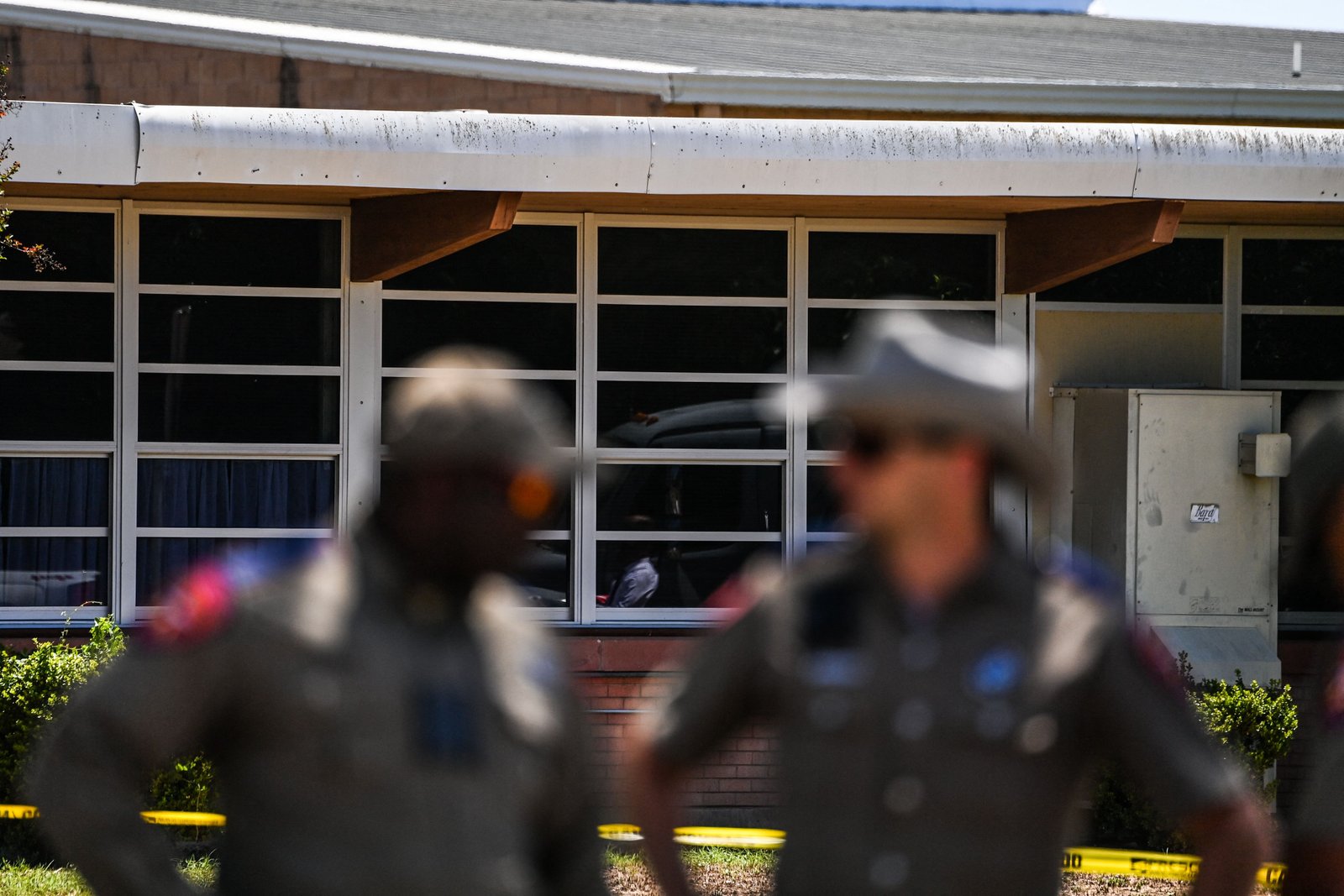
If there’s one thing we know about the 2022 school shooting in Uvalde, Texas, which left 19 children and two teachers dead, it is this: The police failed to stop it. This was not for an absence of well-funded, trained officers on the scene. They were there.
Rather than placing themselves potentially in harm’s way, however, the cops waited outside for over an hour and aggressively confronted desperate parents who begged for them to enter, including handcuffing one mother.
This failure to save lives was not, as I wrote at the time, a failure of police work. It in fact exemplified what police critics and abolitionists have stressed for decades, with reams of evidence. Police do not save lives or prevent crime. Policing is not the “thin blue line” between social peace and chaotic violence. And the work of policing is a far cry from the heroic myth so stubbornly lodged in the American imagination.
This was not, of course, the lesson learned by Texas authorities after the shooting. Instead, the state’s response was as predictable as it was doomed to produce only more violence in Texas schools: They added more cops.
There were no well-researched, pragmatic policy changes around limiting assault rifles, regulating the hyper-destructive expanding bullets that ripped children’s bodies apart, and increasing mental health support — things that could actually stop shootings like in Uvalde, which was carried out by a troubled 18-year-old.
Texas school districts instead poured billions of dollars into stationing police at every public school campus in the state. The results, as a New York Times report published this week found, has been an horrific spate of violent police abuse against children in schools across the state.
Texas stationed police officers at every school. The result has been a horrific spate of police abuse against children.
There is no official use-of-force data on the over 11,000 cops stationed across Texas’s 400-plus school district police departments, the Times reported, and scant oversight. Despite the limited access to information, journalists were able to pinpoint “more than 2,600 use-of-force incidents” in a nearly four-year period using only the “small share of records” available.
There are horrific details. Kids are routinely slammed to the ground for minor misbehavior. Police punch children in the face. They shock students with Tasers for being in the wrong place. Or point guns at unarmed teens. Cops put handcuffs on a 6-year-old who later cried to his father, “The police wants me to die!” In some cases, low-level disciplinary infractions that should lead to no more than a trip to the principal’s office left children facing criminal charges; the well-documented school-to-prison pipeline in all its ignominy.
According to policing experts who spoke with the paper, Texas lawmakers “embraced school policing without establishing safeguards required for meaningful accountability.” A cop was mildly disciplined for having hogtied a 10-year-old boy with a behavioral disorder; apparently hogtying kids was a pattern for the officer. In response to the incident, the school district had to ban the practice of binding children by their hands and feet. The risks of bodily harm coming to kids across the state, however, remain tremendous: As in 16 other states, corporal punishment is legal in Texas schools.
And there is no mention in the Times investigation of the demographic profiles of the children abused by cops, but the videos in the report overwhelmingly show what appear to be nonwhite children enduring violent police abuse.
Filling school campuses with cops, meanwhile has not even worked to achieve the policy’s stated aim of stopping school shootings in Texas. In late March, a 15-year-old student in Bulverde, Texas, shot and injured a teacher and then took his own life.
Policing: A Twisted Civic Religion
After Uvalde, it was obvious to many of us that, despite widespread and high-profile criticisms of the police officers’ actions that day, we were unlikely to see a radical shift in mythic perceptions around the value of policing as a source of public safety.
The conflation of police presence and public safety maintains a powerful ideological hold, resistant to revision, regardless of recalcitrant evidence. Even the Supreme Court affirmed in 2005 that police departments are not in fact obligated to provide protection to the public.
In a gun-drenched, law-and-order conservative state like Texas, police lionization is a twisted civic religion. Republican Gov. Greg Abbott signed a law in 2016 to designate police officers a protected class, “making it a hate crime for anyone to commit a crime against a law enforcement officer out of bias against the police.”
As I wrote in 2022, just after the Uvalde shooting, it would be too generous to those in power to grant that they have simply been misled by pro-police propaganda. By insisting that we double down on policing, leaders like Abbott make clear that they too uphold what the institution of policing defends: property, power, and racial hierarchy.
When it comes to the teachers and students whose lives are infused with greater violence and risk because of increased police presence, support for ever-present cops is more surprising. Even with ample evidence of police escalating confrontations and instigating violence against kids of all ages, sources who spoke to the Times reaffirmed the necessity of cops in schools.
“In interviews, dozens of parents, teachers, principals and students said that they believed police officers were needed to keep schools safe,” the Times reported.
It is well established what flooding schools with police does and does not do. It does not promote safety.
Writer Patrick Blanchfield noted in 2020 that the police “are in our minds as a solution rather than as a problem.” There is a powerful false consciousness at play, violently reinforced when every social problem is met solely with a carceral, policing-based solution.
“We don’t know what our nation without police would look like,” the abolitionist scholar Mariame Kaba wrote. “But we know that our society with police is violent, racist, precarious, unequal, and unfree.”
As the response to Uvalde makes clear, this is not a knowledge problem. It is well established what flooding schools with police does and does not do. It does not promote safety; it does increase life-altering incidents of violence against children.
Texas is not alone in choosing violence.