As the United States of America celebrated its 250th birthday on terra firma with fireworks displays this weekend, two Asian countries made some splashes of their own farther from Earth.
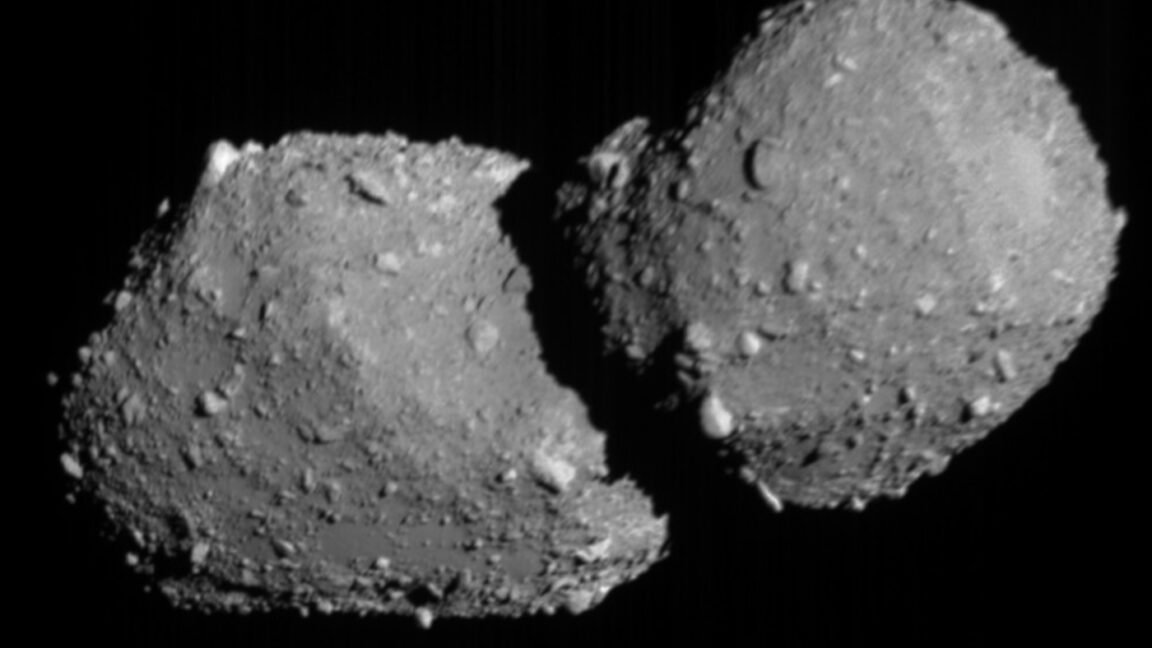
On Sunday, an aging Japanese spacecraft named Hayabusa2, which completed its initial sample-return objective more than half a decade ago, found success with an extended mission that saw the vehicle fly by a peanut-shaped asteroid named Torifune.
Hours later, the Chinese space agency released images from a spacecraft, Tianwen-2, arriving at its target asteroid following a journey of 1 billion km. At this small asteroid, the Chinese spacecraft will attempt to retrieve samples and return them to Earth late next year.
Torifune flyby
The Japanese space agency’s Hayabusa2 mission launched back in December 2014 and made a rendezvous with a near-Earth asteroid named 162173 Ryugu in June 2018. After gathering samples, the spacecraft burned its ion propulsion engines to return to Earth, and during a flyby in late 2020 it released a small return capsule. Scientists recovered 5.4 grams of asteroid material from the capsule.
By this point, however, Hayabusa2’s efficient propulsion system still had nearly half of its xenon propellant remaining—approximately 30 kg of the 66 kg it began its mission with.
So Japanese engineers and scientists plotted out an operations plan that would extend over the next decade and visit two more asteroids. It flew by the first of these on Sunday, a 450-meter-long asteroid designated as 98943 Torifune. Observations began about two weeks ago and culminated in a flyby during which the spacecraft passed within about 10 km of the asteroid.
“These observations continued until immediately before the closest approach to Torifune but could not be conducted after the spacecraft had passed the asteroid,” JAXA, the Japanese space agency, said in a news release early Monday. “At present, only part of the data acquired by the scientific instruments has been transmitted to Earth. The remaining data will be transmitted to the ground during future operations.”
The successful operations set the stage for the final encounter planned by Hayabusa2, a tiny near-Earth object believed to be just 11 meters across. This flyby of 1998 KY26 would occur sometime in July 2031 if the spacecraft proceeds nominally.
Aloha Kamoʻoalewa
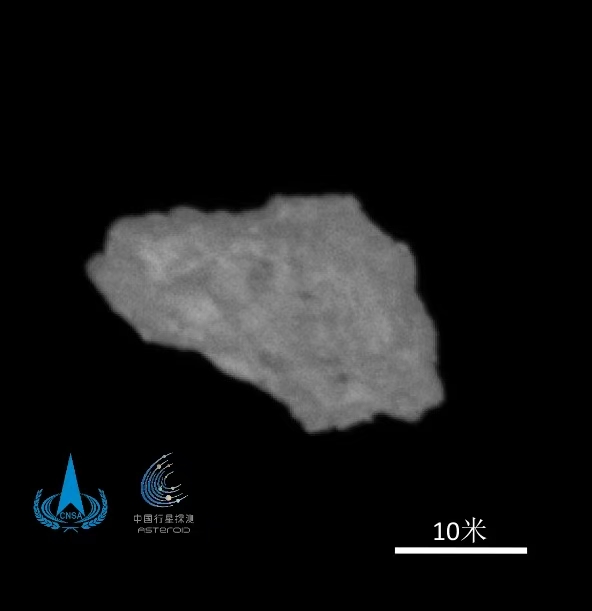
Also this weekend, the China National Space Administration announced that its Tianwen-2 spacecraft had reached within 20 km of another near-Earth asteroid designated 469219 Kamoʻoalewa. This is another relatively small asteroid, with a diameter of only about 20 meters. The spacecraft made its arrival on July 2.
As part of its announcement, China released a somewhat fuzzy image of the asteroid, which loosely resembles the shape of an arrowhead. The probe’s arrival marks the beginning of more detailed scientific operations, the Chinese space agency said, to better characterize the asteroid’s shape, material composition, rotational properties, and more.
The asteroid is also known as a “quasi moon” because it rotates ahead of Earth in a similar orbital period of 365 days. It is leading Earth, and at its closest approach comes within about 4.6 million km (more than 10 times the Earth-Moon distance). It is not gravitationally bound to Earth, however.
After characterizing the nature of the asteroid, Tianwen-2 will attempt to gather samples. A return to Earth is tentatively scheduled for November 2027.
If all goes well, after the release of a sample capsule, Tianwen-2’s mission will also be extended. China has announced preliminary plans for the spacecraft to then travel to and orbit an intriguing asteroid named 311P/PanSTARRS. This asteroid has “tails,” and so it may be a comet.